kottke.org posts about TV
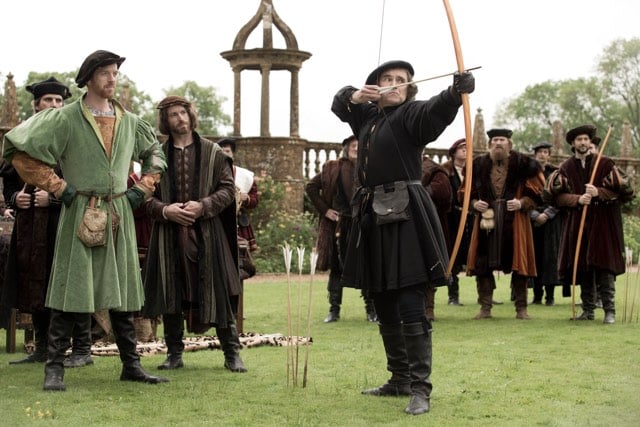
Wait, how did I miss this…Hilary Mantel’s excellent pair of novels about Thomas Cromwell & Henry VIII, Wolf Hall and Bring Up the Bodies, are being turned into a six-part BBC miniseries. Outstanding! Noted Shakespearian actor Mark Rylance will play Cromwell with Homeland’s Damian Lewis as Henry VIII.
BBC One will be airing the show in Britain in January while American audiences without access to BitTorrent will have to wait until PBS airs it in April.
Jordan Hoffman is a huge huge huge Star Trek fan. So great is his fandom that he is able to rank every single episode from every single Star Trek series from #695 to #1. Several TNG episodes make it into the top 10, including Yesterday’s Enterprise, Darmok, and The Best of Both Worlds.
kottke.org favorite Matt Zoller Seitz weighs in on his top 10 best TV shows for 2014. For someone who doesn’t watch a ton of TV, I have seen a surprising number of these.
My friend David has been trying to tell me about Hannibal, but I haven’t been listening. Maybe I should start? Olive Kitteridge was great; Frances McDormand was incredible. True Detective was pretty good and I was lukewarm on Cosmos (I have NDT issues). Mad Men continues to be great…I keep waiting for it to fall off in quality, but it hasn’t happened. The Roosevelts was really interesting and like Seitz, I find myself thinking about it often. I’ve seen bits and pieces of John Oliver but I get enough of the “humans are awful ha ha” news on Twitter to become a regular viewer.
Other shows I’ve watched that aren’t on the list: Downton Abbey (my favorite soap), Game of Thrones (tied w/ Mad Men for my fave current show, although MM is better), Boardwalk Empire (strong finish), Sherlock (still fun, tho got a bit too self referential there), and Girls (gave up after s03e04 when it was airing but recently powered through rest of the 3rd season and is back in my good graces).
Back in September, I posted that HBO was remastering The Wire in HD. The company announced they’ve completed the process; it’ll be on HBO Go this month at full-frame 16x9 HD.
HBO announced today that they had completed the high-definition re-mastering of all five seasons of “The Wire,” which will debut in December on HBO Signature and HBO Go, be sold in digital HD (through iTunes, Google Play, etc.) starting January 5, and on Blu-ray starting next summer. As the press release notes, “The entire series has been beautifully re-mastered in 16x9 Full-Frame HD from more than 8,000 reels of original 35mm camera negative, allowing for a tighter fit on widescreen TVs and computer/tablet screens. The original negatives were scanned, edited, dust-busted and color-corrected with great care and attention taken to stay true to the look and feel of the original Standard-Definition 4x3 version.”
Well, well. That’s a welcome change from what I heard about how the show was shot and how they were going to remaster it (chop the top and bottom off the 4x3 frame). David Simon wrote extensively on how he became involved in the remastering process and came up with something to everyone’s satisfaction.
To their great credit, once we alerted HBO production executives to our absolute interest in the matter, they halted the fall HD release and allowed us to engage in detail. And over the past several months, looking at some of what the widescreen format offered, three things became entirely clear: First, there were many scenes in which the shot composition is not impaired by the transfer to 16:9, and there are a notable number of scenes that acquire real benefit from playing wide. An example of a scene that benefits would be, say, from the final episode of season two, when an apostolic semicircle of longshoremen forms around the body of Frank Sobotka. Fine as far as it goes, but the dockworkers are all that much more vulnerable, and that much more isolated by the death of their leader when we have the ability to go wider in that rare crane shot.
But there are other scenes, composed for 4:3, that lose some of their purpose and power, to be sure. An early example that caught my eye is a scene from the pilot episode, carefully composed by Bob, in which Wee Bey delivers to D’Angelo a homily on established Barksdale crew tactics. “Don’t talk in the car,” D’Angelo reluctantly offers to Wee Bey, who stands below a neon sign that declares, “burgers” while D’Angelo, less certain in his standing and performance within the gang, stands beneath a neon label of “chicken.”
That shot composition was purposed, and clever, and it works better in the 4:3 version than when the screen is suddenly widened to pick up additional neon to the left of Bey. In such a case, the new aspect ratio’s ability to acquire more of the world actually detracts from the intention of the scene and the composition of the shot. For that reason, we elected in the new version to go tighter on the shot in order to maintain some of the previous composition, albeit while coming closer to our backlit characters than the scene requires. It is, indeed, an arguable trade-off, but one that reveals the cost of taking something made in one construct and recasting it for another format. And this scene isn’t unique; there are a good number of similar losses in the transfer, as could be expected.
(thx jeff & @jasonsantamaria/)
Update: HBO Signature is currently running a marathon of all the HD episodes. They’re also available on HBO Go.
David Simon added some before-and-after video clips to his piece about the HD remastering process showing instances where the wider aspect was beneficial and not-so-beneficial.
Scenes from Seinfeld can help illustrate economic concepts like incentives, thinking at the margin, and common resources. For instance, in The Strike from season nine (the episode that popularized Festivus), Elaine angles for a free sandwich:
Elaine has eaten 23 bad sub sandwiches, and if she eats a 24th, she’ll get one free. She is determined to do it, even though Jerry advises her to ignore sunk costs and walk away.
See also the economics of The Simpsons.
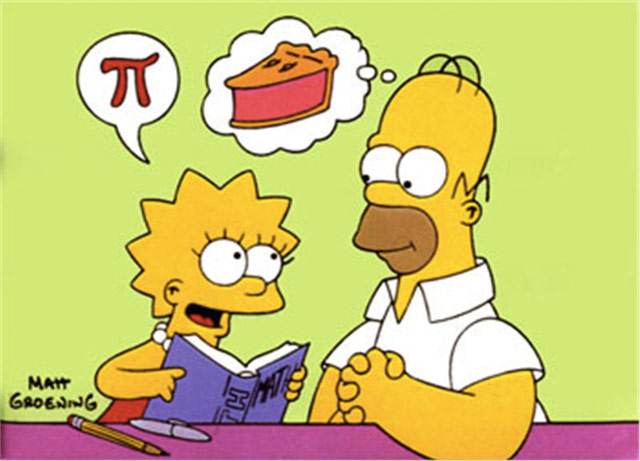
Acclaimed science and math writer Simon Singh has written a book on the mathematics of The Simpsons, The Simpsons and Their Mathematical Secrets. Boing Boing has an excerpt.
The principles of rubber sheet geometry can be extended into three dimensions, which explains the quip that a topologist is someone who cannot tell the difference between a doughnut and a coffee cup. In other words, a coffee cup has just one hole, created by the handle, and a doughnut has just one hole, in its middle. Hence, a coffee cup made of a rubbery clay could be stretched and twisted into the shape of a doughnut. This makes them homeomorphic.
By contrast, a doughnut cannot be transformed into a sphere, because a sphere lacks any holes, and no amount of stretching, squeezing, and twisting can remove the hole that is integral to a doughnut. Indeed, it is a proven mathematical theorem that a doughnut is topologically distinct from a sphere. Nevertheless, Homer’s blackboard scribbling seems to achieve the impossible, because the diagrams show the successful transformation of a doughnut into a sphere. How?
Although cutting is forbidden in topology, Homer has decided that nibbling and biting are acceptable. After all, the initial object is a doughnut, so who could resist nibbling? Taking enough nibbles out of the doughnut turns it into a banana shape, which can then be reshaped into a sphere by standard stretching, squeezing, and twisting. Mainstream topologists might not be thrilled to see one of their cherished theorems going up in smoke, but a doughnut and a sphere are identical according to Homer’s personal rules of topology. Perhaps the correct term is not homeomorphic, but rather Homermorphic.
Adult Swim did something magical with this 11-minute 80s sitcom intro:
I didn’t have high hopes for this when I started watching, but it’s like the Terminator of 80s sitcoms: it just will not stop introducing people. Better quality here. (via waxy)
Update: The inevitable oral history of Too Many Cooks.
I had this idea but didn’t know if I could keep it going for 11 minutes.
(via @everydayscott)
Prince played Saturday Night Live last night at the request of host Chris Rock, doing one 8-minute medley of songs instead of two separate short performances during the show. Here’s the whole performance:
If Hulu isn’t working for you, try the video embed on Deadspin. A set list is available on Rdio and Spotify. (via @anildash)
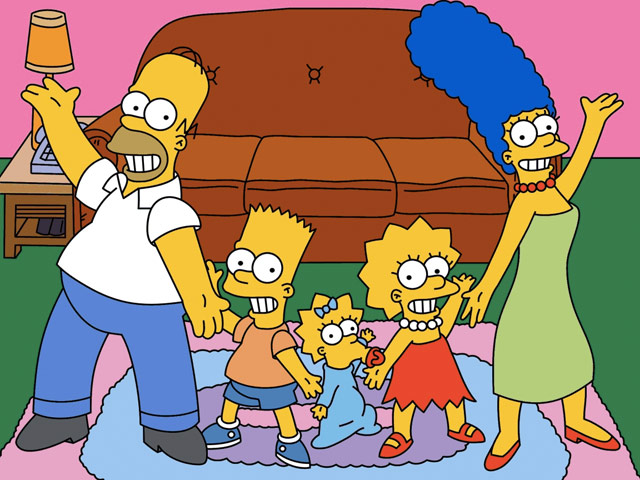
This happened a few days ago, but I just got a chance to check it out: FXX launched Simpsons World, a site where you can stream every Simpsons episode ever aired. You just need a cable login, as with HBO GO. There are apps too: iOS and Android. To get you started, here are the top 10 episodes of all time, from a 2003 Entertainment Weekly list.
1. Last Exit to Springfield
2. Rosebud
3. Cape Feare
4. Marge vs. the Monorail
5. Homer’s Phobia
6. Mr. Plow
7. Itchy & Scratchy Land
8. A Fish Called Selma
9. Treehouse of Horror V
10. The Last Temptation of Homer
Update: Got a bunch of complaints that the “free” in the title is misleading because a cable subscription is required, even though I explicitly called that out in the second sentence. Fair enough. But then again, if you’re going to nitpick, nothing is free. Even if you didn’t need a cable login, Simpsons World would hardly be free. You need access to an expensive computer or mobile device, high-speed internet access, and enough free (there’s that word again!) time to watch. And even if you’re viewing using a computer at the public library, you’re paying with your attention by watching advertising.
But all that is red herring nonsense. I was using “free” in the sense that for cable subscribers, they’re getting something they did not have for the same price they were previously paying. You know, free.
Speaking of PBS shows, Steven Johnson’s How We Got to Now starts on PBS tonight with two back-to-back episodes. The NY Times has a positive review.
The opening episode, for instance, is called “Clean,” and it sets the pattern for the five that follow. We tend not to acknowledge just how recent some of the trends and comforts of modern life are, including the luxury of not walking through horse manure and human waste on the way to the post office.
The episode turns back the clock just a century and a half, to a time before our liquid waste stream was largely contained in underground pipes. Mr. Johnson then traces the emergence of the idea that with a little effort, cities and towns could have a cleaner existence, and the concurrent idea that cleanliness would have public health benefits.
But his examination of “the ultraclean revolution,” as he calls it, doesn’t stop at the construction of sewage and water-purification systems. He extends the thread all the way to the computer revolution, visiting a laboratory where microchips are made.
The show is based on Johnson’s book of the same name, which enters the NY Times bestseller list at #4 this week. Also, I keep wanting to call the book/show How We Got to Know, which strikes me as a perfectly appropriate title as well.
Update: The first two episodes are available online until 10/30.
Update: How We Got to Now is now available on Netflix and Amazon Prime Video.
Atul Gawande’s best selling Being Mortal is getting the Frontline treatment on PBS this January. Here’s the trailer:
Jack Handey, who wrote for SNL for seventeen years, remembers Phil Hartman.
Phil Hartman was perhaps the best cast member, ever, of Saturday Night Live. I loved writing for him. So did the other writers. Phil was rarely “light in the show,” as the saying went.
Roles I gave him, from an unfrozen caveman lawyer to a giant businessman to a frustrated robot, Phil made shine. He was especially good at being the patient, authoritative voice of reason, gently explaining to an idiot why he was an idiot, and why he had to stop being an idiot.
(via digg)
When Anthony Bourdain’s hour-long food and travel show first launched on CNN, it marked the network’s step away from 24 hours news and towards more entertainment programming. But maybe Bourdain is just the reporter we need these days when most of what we see of other cultures is satellite images or shots of rubble. “I’m not a foreign policy wonk, but I see aspects of these countries that regular journalists don’t.” From FastCo: Anthony Bourdain has become the future of cable news, and he couldn’t care less.
I hid in the clouded wrath of the crowd,
but when they said, “Sit down,” I stood up.
— Bruce Springsteen, Growing Up
In the NYT Magazine, A.O. Scott reflects on the death of adulthood in American culture:
What all of these shows grasp at, in one way or another, is that nobody knows how to be a grown-up anymore. Adulthood as we have known it has become conceptually untenable. It isn’t only that patriarchy in the strict, old-school Don Draper sense has fallen apart. It’s that it may never really have existed in the first place, at least in the way its avatars imagined. Which raises the question: Should we mourn the departed or dance on its grave?

This Lego version of the Simpsons house looks amazing. Not sure if it’s $200 amazing, but still. These minimalist Lego Simpsons characters are much cheaper.
Newer posts
Older posts





Socials & More