kottke.org posts about Randall Munroe
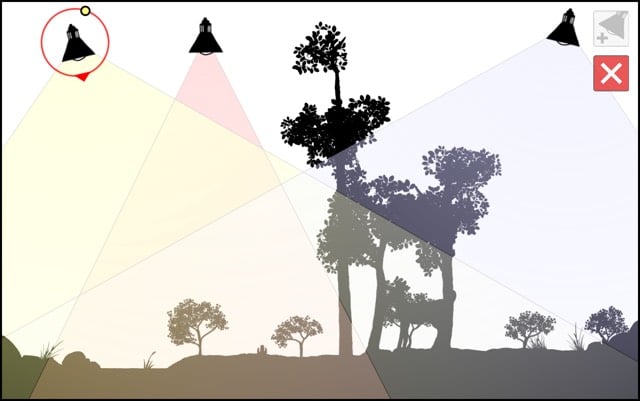
For April Fools’ Day, Randall Munroe made an interactive widget where you can grow your own garden. Here’s mine so far. Others’ gardens are further along, with people and octopuses showing up. As with real gardens, the keyword is “patience”.
Update: In experimenting with his garden, @dennis_e_a found:
One color of light on a spot of ground changes what grows. Red: Desert, Blue: Ocean, Yellow: Park-ish
I have modified my lighting accordingly, but my flora and fauna have yet to follow suit. Perhaps I need to prune a bit?

Inspired by Randall Munroe’s Thing Explainer, Morten Just built a simple text editor for OS X that restricts your writing to the 1000 most common English words. You can also use Munroe’s Simple Writer on the web.
Randall Munroe’s best-selling Thing Explainer, in which he explains scientific concepts using only the 1000 most common words, will be incorporated into the upcoming editions of some of Houghton Mifflin Harcourt’s high school science textbooks.
Mr. Munroe, 31, said the project appealed to him. He recalled as a child a foldout diagram showing different animals at the starting line of a race and then sprinting/flying/crawling to show the different speeds of different species. “For some reason, I fixated on that illustration,” he said. “It stuck with me my entire life.”
Mr. Munroe said he hoped his drawings would break up the monotony and pace of a typical textbook. “I’m hoping it will be, ‘Oh, here’s a kind of fun and unexpected component,’” he said.
I think Bill Gates would approve.

Randall Munroe has made a map of the United States with all of the states in different places but still retaining the same general shape. Particularly clever is the Michigan/Maryland combo to recreate the Bay Area.
Randall Munroe has a new book coming out called Thing Explainer: Complicated Stuff in Simple Words in which he uses the 1000 most common English words to explain interesting mostly scientific stuff. In a preview of the book, Munroe has a piece in the New Yorker explaining Einstein’s theory of relativity using the same constraint.
The problem was light. A few dozen years before the space doctor’s time, someone explained with numbers how waves of light and radio move through space. Everyone checked those numbers every way they could, and they seemed to be right. But there was trouble. The numbers said that the wave moved through space a certain distance every second. (The distance is about seven times around Earth.) They didn’t say what was sitting still. They just said a certain distance every second.
It took people a while to realize what a huge problem this was. The numbers said that everyone will see light going that same distance every second, but what happens if you go really fast in the same direction as the light? If someone drove next to a light wave in a really fast car, wouldn’t they see the light going past them slowly? The numbers said no-they would see the light going past them just as fast as if they were standing still.
It’s a fun read, but as Bill Gates observed in his review of Thing Explainer, sometimes the limited vocabulary gets in the way of true understanding:1
If I have a criticism of Thing Explainer, it’s that the clever concept sometimes gets in the way of clarity. Occasionally I found myself wishing that Munroe had allowed himself a few more terms — “Mars” instead of “red world,” or “helium” instead of “funny voice air.”
See also Albert Einstein’s Theory of Relativity In Words of Four Letters or Less. You might prefer this explanation instead, in the form of a video by high school senior Ryan Chester:
This video recently won Chester a $250,000 Breakthrough Prize college scholarship.2 Nice work!
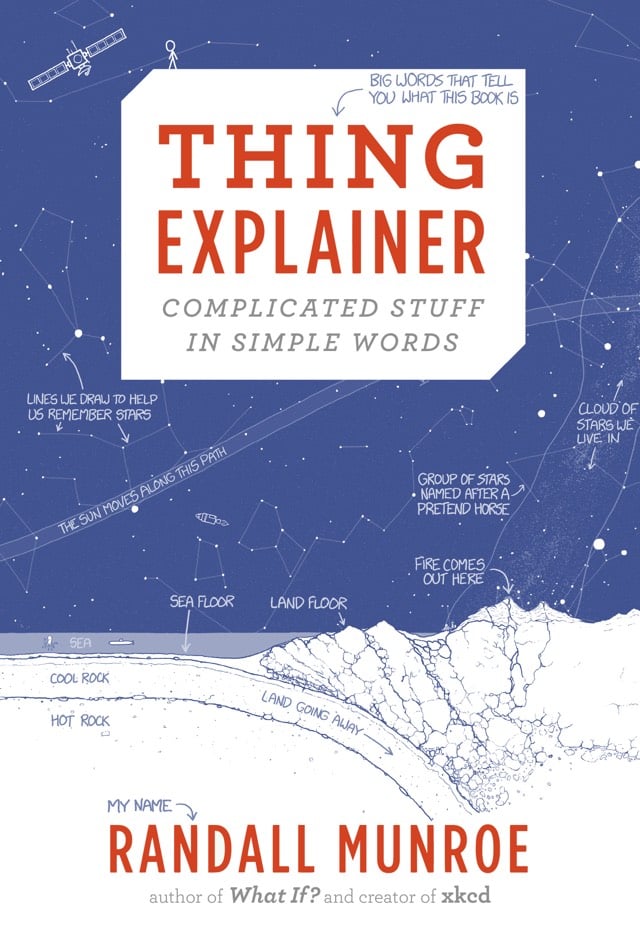
Randall Munroe of xkcd is coming out with a new book called Thing Explainer.
Inspired by his popular comic, “Up Goer Five,” THING EXPLAINER is a series of brilliantly — and simply — annotated blueprints that explain everything from ballpoint pens to the solar system using line drawings and only the thousand most common English words.
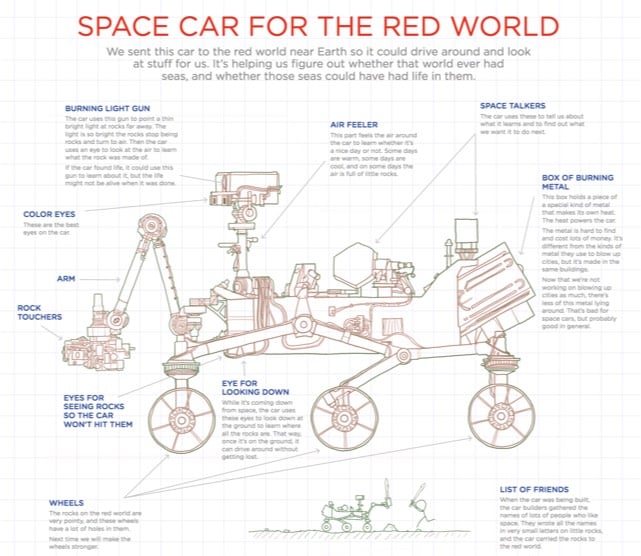
So awesome. I love everything about this. Here’s a look at part of one of the blueprints, the Curiosity rover, aka Space Car for the Red World:
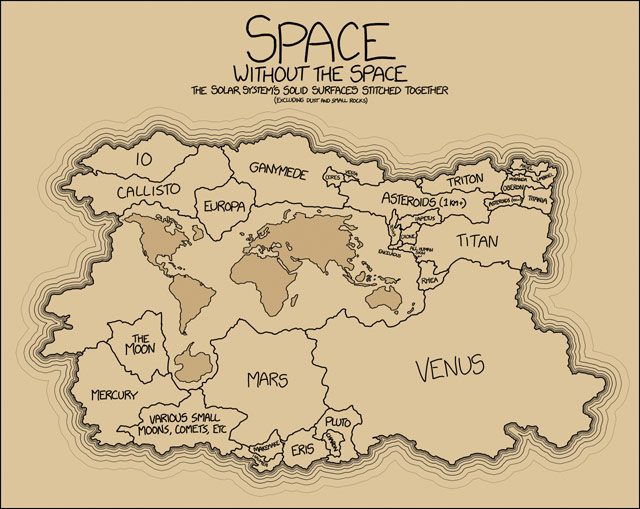
From XKCD, an illustration of the solar system’s solid surfaces stitched together. Best viewed large (if only to find the “all human skin” label). Randall Munroe is just the best, isn’t he?
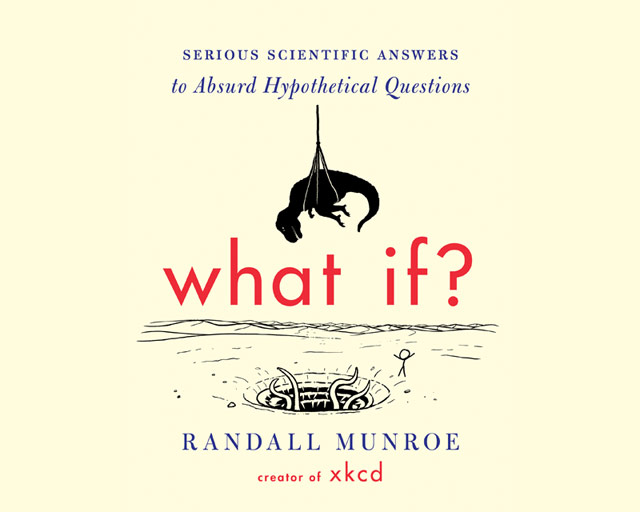
Fantastic…Randall Munroe is turning his What If? web series into a book. Munroe explains:
As I’ve sifted through the letters submitted to What If every week, I’ve occasionally set aside particularly neat questions that I wanted to spend a little more time on. This book features my answers to those questions, along with revised and updated versions of some of my favorite articles from the site. (I’m also including my personal list of the weirdest questions people have submitted.)
Update: What If? the book is now out. Phil Plait has a rave review.
Look, I answer questions for a living, too, and Randall is really, really good at this. He finds weird little scientific ways to answer the questions, but it’s his extrapolations that kill me. I laughed a lot reading this book. Even better: I learned stuff reading this book. And you will too.
Related to my post on the frequency of humanity is this post on XKCD on the various frequencies of events, from human births to dog bites to stolen bicycles.
For his latest What If? column, Randall Munroe tackles the question “When, if ever, will Facebook contain more profiles of dead people than of living ones?”
Based on the site’s growth rate, and the age breakdown of their users over time, there are probably 10 to 20 million people who created Facebook profiles who have since died.
That’s an incredible number; most tech startups would kill (well, not really but maybe…) for that many alive users.
Randall Munroe of XKCD drew the Saturn V rocket (aka Up Goer Five) annotated using only the 1000 most common English words.
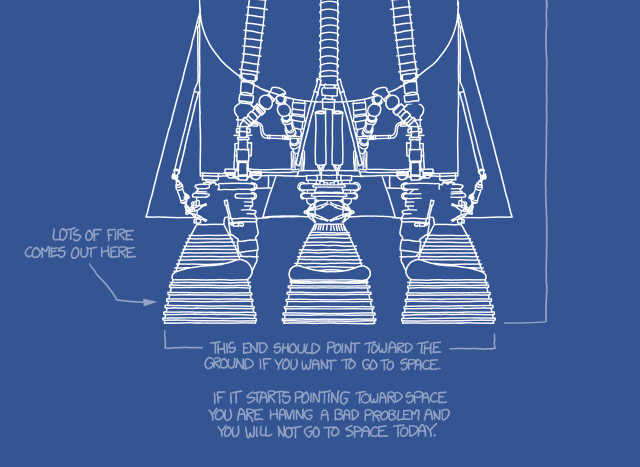
See also Albert Einstein’s Theory of Relativity In Words of Four Letters or Less.
Hey, if Randall keeps writing them, I’m gonna keep posting links to them…today’s XKCD What If is “If every person on Earth aimed a laser pointer at the Moon at the same time, would it change color?”
Unfortunately, the laser energy flow would turn the atmosphere to plasma, instantly igniting the Earth’s surface and killing us all.
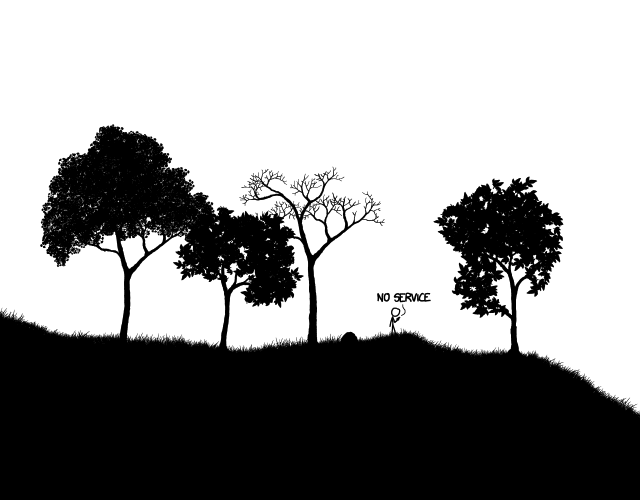
Today’s XKCD must have taken Randall several years to draw…if you click and drag, it goes on forever. Or not quite forever, but Dan Catt did some figuring and:
Ok, so the XKCD map printed at 300dpi is around 46 foot / 14 meters wide, half that at magazine 600dpi quality.
Here’s a better Google Maps-like way to explore the entire world.
With the assistance of a nuclear reactor operator, Randall Munroe came up with this handy radiation dose infographic. Doses recorded near the Fukushima plant compare to those from a single mammogram or dental x-ray. A note on how to use this chart:
If you’re basing radiation safety procedures on an internet PNG image and things go wrong, you have no one to blame but yourself.
(via df)
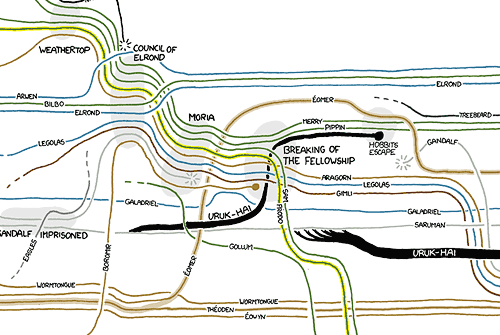
A wonderful character interaction map of the Lord of the Rings trilogy drawn by Randall Munroe. Here’s just a little part of it:
Newer posts





Socials & More