



Recipe for making McDonald’s Egg McMuffins at home
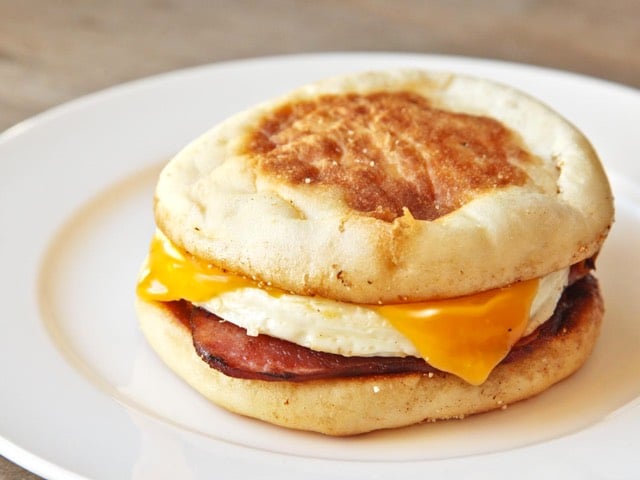
At Serious Eats, the Food Lab’s Kenji Lopez-Alt reverse engineers (and improves) the Egg McMuffin for the home cook. Clever use of a Mason jar lid for cooking the egg.

This site is made possible by member support. 💞
Big thanks to Arcustech for hosting the site and offering amazing tech support.
When you buy through links on kottke.org, I may earn an affiliate commission. Thanks for supporting the site!
kottke.org. home of fine hypertext products since 1998.
Beloved by 86.47% of the web.
At Serious Eats, the Food Lab’s Kenji Lopez-Alt reverse engineers (and improves) the Egg McMuffin for the home cook. Clever use of a Mason jar lid for cooking the egg.
McDonald’s Canada continues their series on how their business works with a video on how Chicken McNuggets are made.
Best part of the video: the casual reveal that McNuggets come in four standard shapes: the ball, the bell, the boot, and the bow tie:

I had a McNugget over the weekend, the first one in probably more than 10 years, and it tasted and felt like chicken. Not bad for fast food. See also how McDonald’s fries are made and how McDonald’s photographs their food for advertising.
People waiting in line for food in the Soviet Union in the late 1980s:

The opening day line for the newest outpost of the Shake Shack in Moscow:

That’s nothing, though, compared to the line to get into the first McDonald’s in the Soviet Union, which opened in Moscow in 1990.
A year later in Moscow, an estimated 1.6 million people turned out to see Metallica in concert. Look at all those people:
McDonald’s recently held an event where chefs took the ingredients used to make McDonald’s menu items and used them to make dishes that one might find at a nice restaurant. Thrillist has the report.

The slow-cooked beef with blueberry pomegranate sauce and Mac Fry gnocchi comes from McD’s chef Jessica Foust, and was, without a doubt, the best of the night. It’s their burger beef before it gets ground, plus blueberries and pomegranates from the smoothies, thinly ribboned carrots, and French fries magically turned into gnocchi.
See also a previous discussion of fast food and fine dining. Dammit, now I’m hungry for a Quarter Pounder… (via @jeb)
McDonald’s started out as McDonald’s Bar-B-Q in San Bernardino, CA in 1940. Here’s a copy of the menu from that time:
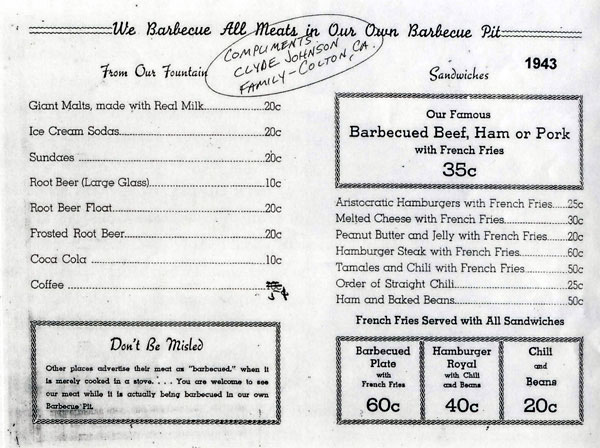
The drive-in BBQ restaurant was a great success:
The restaurant had carhops serving guests and would often see 125 cars crowding the lot on weekends. They quickly saw their annual sales topping $200,000 on a regular basis.
But competitors opened similar restaurants and they were selling more hamburgers than barbequed ham so the McDonald brothers closed their place for three months to retool. They reopened as plain old McDonald’s, serving cheap fare (like hamburgers) quickly. This is what an early version of the menu looked like:
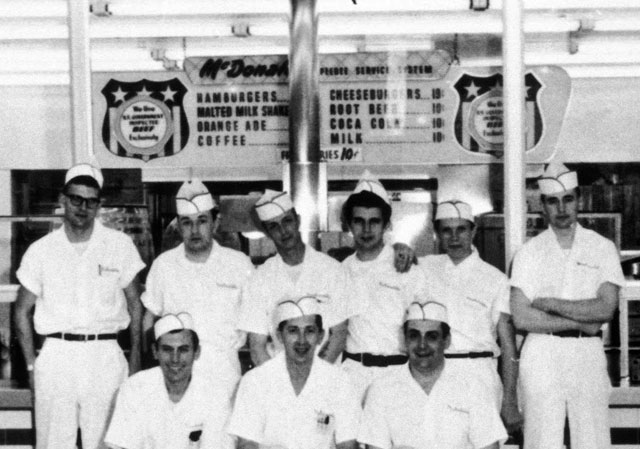
The original McDonald’s served potato chips and pie, which were swapped out for french fries and milkshakes after the first year; that photo must have been taken sometime after the switch. Ray Kroc got involved in 1955 and opened the first McDonald’s franchise east of the Mississippi in Des Plaines, Illinois:
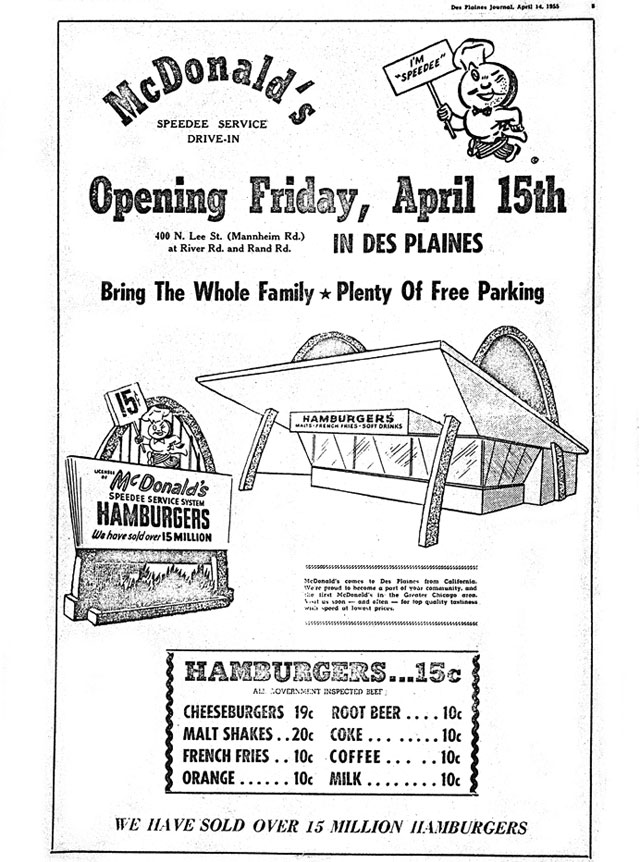
The version of the menu currently going around (on Reddit; I found it here) looks like it’s from the Kroc era, the arches having been introduced in 1953, shortly before he got involved:
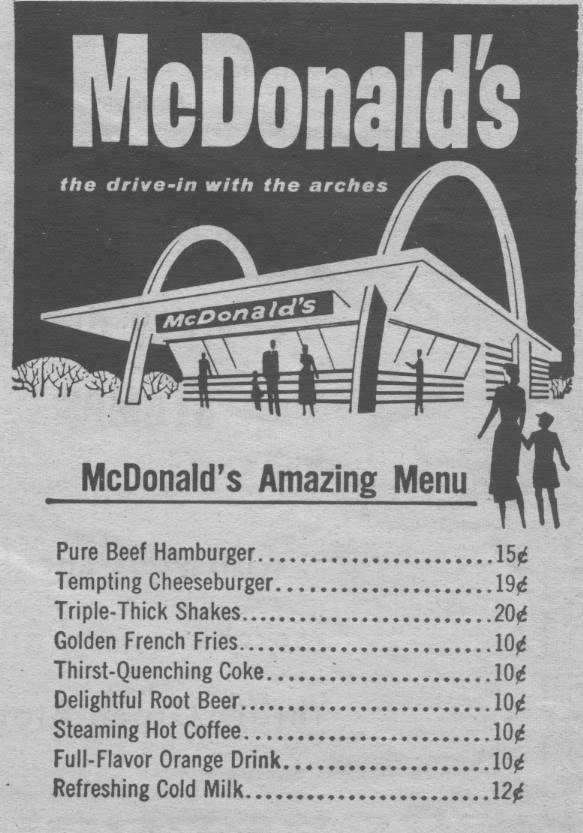
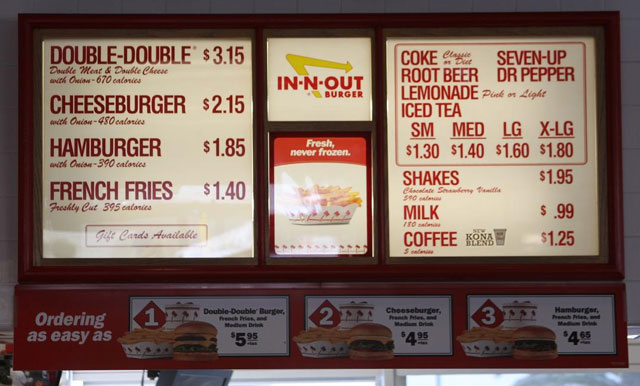
It’s interesting to compare these early McDonald’s menus to the current menus of places like In-N-Out Burger and Five Guys, especially in comparison with the sprawling McDonald’s menu of today:
After reading all these menus, you’re probably getting hungry. So here’s how to make a hamburger that tastes like an original McDonald’s hamburger from 1948 (as well as recipes for a bunch of other McDonald’s menu items, from McNuggets to the McRib to the dipping sauces). Enjoy!
For their Big Mac index (a way to look at currency exchange using global Big Mac pricing) this year, the Economist has released an interactive tool for exploring the data.
The Big Mac index was invented by The Economist in 1986 as a lighthearted guide to whether currencies are at their “correct” level. It is based on the theory of purchasing-power parity (PPP), the notion that in the long run exchange rates should move towards the rate that would equalise the prices of an identical basket of goods and services (in this case, a burger) in any two countries. For example, the average price of a Big Mac in America at the start of 2013 was $4.37; in China it was only $2.57 at market exchange rates. So the “raw” Big Mac index says that the yuan was undervalued by 41% at that time.
They’re also made the data set available in .xls format for at-home analysis.
Writing for The Awl, Jeb Boniakowski shares his vision for a massive McDonald’s complex in Times Square that serves food from McDonald’s restaurants from around the world, offers discontinued food items (McLean Deluxe anyone?), and contains a food lab not unlike David Chang’s Momofuku test kitchen.
The central attraction of the ground floor level is a huge mega-menu that lists every item from every McDonald’s in the world, because this McDonald’s serves ALL of them. There would probably have to be touch screen gadgets to help you navigate the menu. There would have to be whole screens just dedicated to the soda possibilities. A concierge would offer suggestions. Celebrities on the iPad menus would have their own “meals” combining favorites from home (“Manu Ginobili says ‘Try the medialunas!’”) with different stuff for a unique combination ONLY available at McWorld. You could get the India-specific Chicken Mexican Wrap (“A traditional Mexican soft flat bread that envelops crispy golden brown chicken encrusted with a Mexican Cajun coating, and a salad mix of iceberg lettuce, carrot, red cabbage and celery, served with eggless mayonnaise, tangy Mexican Salsa sauce and cheddar cheese.” Wherever possible, the menu items’ descriptions should reflect local English style). Maybe a bowl of Malaysian McDonald’s Chicken Porridge or The McArabia Grilled Kofta, available in Pakistan and parts of the Middle East. You should watch this McArabia ad for the Middle Eastern-flavored remix of the “I’m Lovin’ It” song if for nothing else.
And I loved his take on fast food as molecular gastronomy:
How much difference really is there between McDonald’s super-processed food and molecular gastronomy? I used to know this guy who was a great chef, like his restaurant was in the Relais & Châteaux association and everything, and he’d always talk about how there were intense flavors in McDonald’s food that he didn’t know how to make. I’ve often thought that a lot of what makes crazy restaurant food taste crazy is the solemn appreciation you lend to it. If you put a Cheeto on a big white plate in a formal restaurant and serve it with chopsticks and say something like “It is a cornmeal quenelle, extruded at a high speed, and so the extrusion heats the cornmeal ‘polenta’ and flash-cooks it, trapping air and giving it a crispy texture with a striking lightness. It is then dusted with an ‘umami powder’ glutamate and evaporated-dairy-solids blend.” People would go just nuts for that. I mean even a Coca-Cola is a pretty crazy taste.
I love both mass-produced processed foods and the cooking of chefs like Grant Achatz & Ferran Adrià. Why is the former so maligned while the latter gets accolades when they’re the same thing? (And simultaneously not the same thing at all, but you get my gist.) Cheetos are amazing. Oscar Meyer bologna is amazing. Hot Potato Cold Potato is amazing. Quarter Pounders with Cheese are amazing. Adrià’s olives are amazing. Coca-Cola is amazing. (Warhol: ” A Coke is a Coke and no amount of money can get you a better Coke than the one the bum on the corner is drinking.”) WD50’s Everything Bagel is amazing. Cheerios are amazing. All have unique flavors that don’t exist in nature — you’ve got to take food apart and put it back together in a different way to find those new tastes.
Some of these fancy chefs even have an appreciation of mass produced processed foods. Eric Ripert of the 4-star Le Berdardin visited McDonald’s and Burger King to research a new burger for one of his restaurants. (Ripert also uses processed Swiss cheese as a baseline flavor at Le Bernardin.) David Chang loves instant ramen and named his restaurants after its inventor. Ferran Adrià had his own flavor of Lay’s potato chips in Spain. Thomas Keller loves In-N-Out burgers. Grant Achatz eats Little Caesars pizza.
When Ronald McDonald bought a run-down house that dated back to 1795 with the intention of tearing it down to put up a hamburger restaurant, the citizens of New Hyde Park successfully got the house landmarked. Instead of cutting their losses, McDonald’s renovated the house into the nation’s classiest fast food joint.

Why does McDonald’s food look so much better in the ads than at the restaurant? Watch as the director of marketing for McDonald’s Canada buys a Quarter Pounder at McDonald’s and compares that to a burger prepared by a food stylist and retouched in post by an image editor.
Short answer: the burger at the restaurant is optimized for eating and the photo burger is optimized for looking delicious. (via ★interesting)
This is likely the best piece you’ll read about the economics of the McRib and McDonald’s motivation in its periodic reintroduction.
At this volume, and with the impermanence of the sandwich, it only makes sense for McDonald’s to treat the sandwich as a sort of arbitrage strategy: at both ends of the product pipeline, you have a good being traded at such large volume that we might as well forget that one end of the pipeline is hogs and corn and the other end is a sandwich. McDonald’s likely doesn’t think in these terms, and neither should you.
Oh and speaking of pipelines:
And for its part, the McRib makes a mockery of this whole terribly labor-intensive system of barbecue, turning it into a capital-intensive one. The patty is assembled by machinery probably babysat by some lone sadsack, and it is shipped to distribution centers by black-beauty-addicted truckers, to be shipped again to franchises by different truckers, to be assembled at the point of sale by someone who McDonald’s corporate hopes can soon be replaced by a robot, and paid for using some form of electronic payment that will eventually render the cashier obsolete.
There is no skilled labor involved anywhere along the McRib’s Dickensian journey from hog to tray, and certainly no regional variety, except for the binary sort — Yes, the McRib is available/No, it is not — that McDonald’s uses to promote the product. And while it hasn’t replaced barbecue, it does make a mockery of it.
(via @joeljohnson)
The Economist has updated their Big Mac Index, a “fun” measure of how purchasing power varies from country to country.
It is based on the theory of purchasing-power parity (PPP), the notion that in the long run exchange rates should move towards the rate that would equalise the prices of a basket of goods and services around the world. At market exchange rates, a burger is 44% cheaper in China than in America. In other words, the raw Big Mac index suggests that the yuan is 44% undervalued against the dollar. But we have long warned that cheap burgers in China do not prove that the yuan is massively undervalued. Average prices should be lower in poor countries than in rich ones because labour costs are lower. The chart above shows a strong positive relationship between the dollar price of a Big Mac and GDP per person.
McDonald’s in the Czech Republic has introduced a line of NYC-themed hamburgers, including the Wall Street Beef and SoHo Grande:
Grilled beef, spicy salami pepperoni, cheese, crisp, with cheese sauce and salsa mexico-tion in the bun, cheese.
Mmmm?
Smoothie shop Jamba Juice is responding to McDonald’s jump into the smoothie market with a mock campaign selling a smooth and creamy cheeseburger smoothies. The video is a nice touch.
Somewhat related to this story, the large McDonald’s smoothies have more calories than a cheeseburger. But it’s the good kind of calories. Now all I want to know is if the smoothie cheeseburger has more calories than either the regular cheeseburger or the fruit smoothie.
It involves finagling some uncooked frozen fries from a local McDonald’s under the ruse of a scavenger hunt. Kenji Lopez-Alt explains.
I’ve been literally giddy with the quality of the fries that have been coming out of my kitchen for the last two days. My wife won’t hear the end of it. Even my puppy is wondering why his owner keeps exclaiming “Holy s**t that’s good!” every half hour from the kitchen. I’ve cooked over 43 batches of fries in the last three days, and I’m happy to report that I’ve finally found a way to consistently reach crisp, golden Nirvana.
Here’s the full recipe/instructions. BTW, Kenji’s series of posts on Serious Eats is one of the best things going on the web right now (you might remember his sous-vide in a beer cooler hack). Passionate down-to-earth writing about cooking and food backed by some serious skills and scientific knowledge…it’s really fun to read.
Adding sushi to the ever-growing list of everyday consumables as economic indicators: steak, Big Macs, Starbucks coffee, Coca-Cola, and cigarettes.
Socials & More