kottke.org posts about Jason Kottke
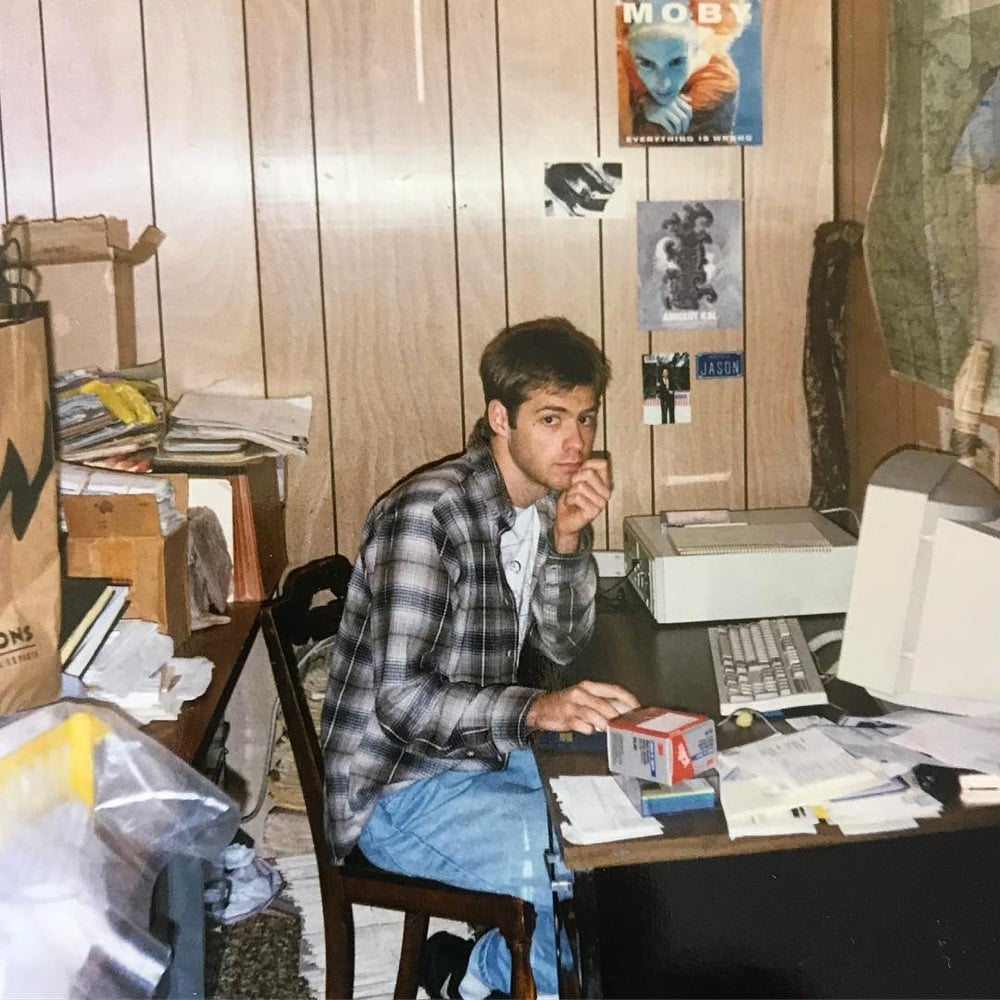
Fifteen years ago this week, on Feb 22, 2005, I announced that I was going to turn kottke.org, my personal website, into my full-time job.
I recently quit my web design gig and — as of today — will be working on kottke.org as my full-time job. And I need your help.
I’m asking the regular readers of kottke.org (that’s you!) to become micropatrons of kottke.org by contributing a moderate sum of money to help enable me to edit/write/design/code the site for one year on a full-time basis.
It seemed like madness at the time — I’d quit my web design job a few months earlier in preparation, pro blogs existed (Gawker was on its 3rd editor) but very few were personal, general, and non-topical like mine, and I was attempting to fund it via a then-largely-unproven method: crowdfunding. As I wrote on Twitter the other day, attempting this is “still the most bonkers I-don’t-know-if-this-is-going-to-work thing I’ve ever done”.
These days, people are used to paying directly for online media through services like Kickstarter, Patreon, and Substack and kids want to run their own personality-driven businesses online when they grow up. But back then, aside from the likes of the WSJ, websites were either a) free to read or b) free to read & supported by advertising and being an online personality was not a lucrative thing. But I figured that enough of you would pitch in to support the site directly while keeping it free to read for everyone with no advertising.
In order to make it feel somewhat familiar, I patterned it after a PBS/NPR fund drive. During a three-week kick-off period, I asked people to support the site by becoming micropatrons. The suggested donation was $30 (but people could give any amount) and there were thank you gifts — like signed books, software, signed photo prints, a free SXSW ticket — for people who contributed. Several hundred people ended up contributing during those three weeks, enough for me to do the site for a year. I still remember that first day, responding to well-wishes from friends on AIM and watching my PayPal account fill up, and it hitting me that this bonkers scheme was actually going to work and pretty much bursting into tears.
Fast forward to the present day and this little website is still chugging along. In its almost 22 years of existence, kottke.org has never gotten big, but it’s also never gone away, predating & outlasting many excellent and dearly missed sites like Grantland, Rookie, The Toast, The Awl, Gawker, and hundreds of others. I have other people write for the site on occasion, but it’s still very much a one-person production by a reluctant influencer (*barf*) who, as an introvert, still (naively?) thinks about posts on the site as personal emails to individual readers rather than as some sort of broadcast. I’d like to thank those early supporters for having faith in me and in this site — you’re the reason we’re all still here, gathered around this little online campfire, swapping stories about the human condition.
About 3 years ago, I returned to the crowdfunding model with kottke.org’s membership program. Since then, I’m very happy to report, readers like you who have purchased memberships have become the main source of financial support for the site. As I’ve written before, I have come to love the directness of this approach — I write, you pay, no middlemen, and, crucially, the site remains part of the Open Web, unpaywalled & free for everyone to read. If you’ll indulge me in a request on this anniversary, if you’re not currently a member of the site (or if your membership has lapsed) and can afford to do so, please consider supporting the site with a membership today. I really appreciate everyone who has become a member over the past few years — thank you!! — and I hope you will consider joining them.
Note: I have no photos of myself taken around this time in 2005, so the photo at the top of the post is me circa spring 1996. I’d dropped out of grad school & was back living at my dad’s house, spending 10-12 hours a day online (via a 28.8K modem) trying to figure out how to build websites. I applied for jobs & internships at places like Wired/Hotwired, Razorfish, Studio Archetype, and MTV but no one wanted to hire a physics major w/ no art or design education or experience to design websites. kottke.org was still a couple of years off at this point…
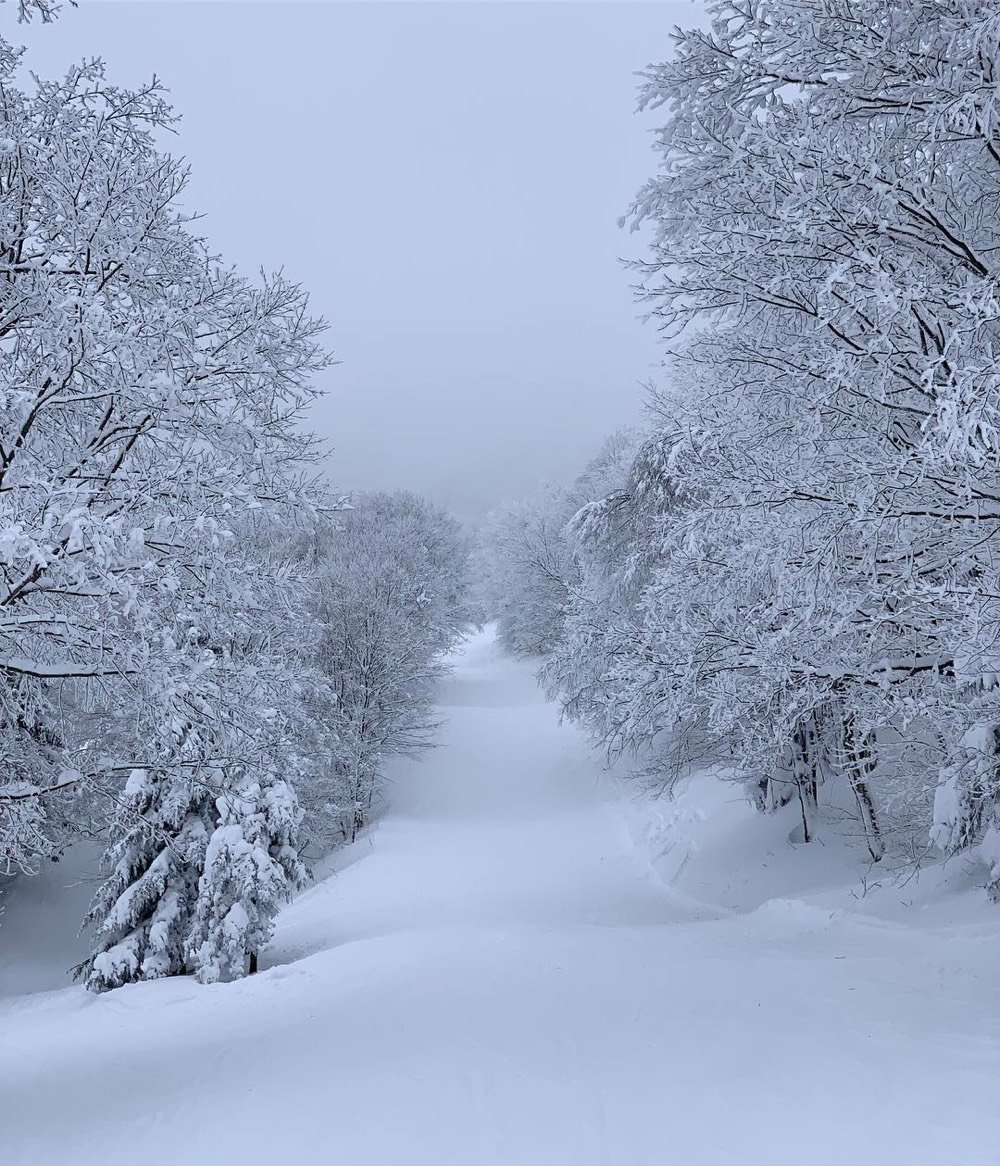
I grew up in Wisconsin, and have lived in Iowa, Minnesota, and New York. Except for a two-year stint in the Bay Area, I’ve experienced winter — real winter, with lots of snow, below-freezing temperatures, and little daylight — every year of my life and never had a problem with it. So I was surprised when my last two Vermont winters put me on my ass. In winter 2017-18, I was depressed, anxious, wasn’t getting out of bed in the morning, spent endless time on my phone doing nothing, and had trouble focusing on my work. And I didn’t realize what it was until the first nice spring day came, 70 and sunny, and it hit me: “holy shit, I’ve been depressed because of winter” and felt wonderful for the next 5 months, like a completely different person. Then last year I was so anxious that it would happen again that all that stuff was worse and started basically a week into fall.
Nothing helped: I tried getting outside more, spent more time with friends, got out to meet new people, travelled to warm places, took photos of VT’s beautiful winter landscapes, spent time in cities, cut back on alcohol, and prioritized sleep. Last year I skied more than ever before and enjoyed it more than I’d ever had. Didn’t matter. This stuff worked during the spring and summer but my winter malaise was seemingly impenetrable. The plan for this fall was to try a SAD lamp, therapy, maybe drugs, and lots more warm travel. But then something interesting happened.
Sometime this fall — using a combination of Stoicism, stubbornness, and a sort of magical thinking that Jason-in-his-30s would have dismissed as woo-woo bullshit — I decided that because I live in Vermont, there is nothing I can do about it being winter, so it was unhelpful for me to be upset about it. I stopped complaining about it getting cold and dark, I stopped dreading the arrival of snow. I told myself that I just wasn’t going to feel like I felt in the summer and that’s ok — winter is a time for different feelings. As Matt Thomas wrote, I stopped fighting the winter vibe and tried to go with it:
Fall is a time to write for me as well, but it also means welcoming — rather than fighting against — the shorter days, the football games, the decorative gourds. Productivity writer Nicholas Bate’s seven fall basics are more sleep, more reading, more hiking, more reflection, more soup, more movies, and more night sky. I like those too. The winter will bring with it new things, new adjustments. Hygge not hay rides. Ditto the spring. Come summer, I’ll feel less stress about stopping work early to go to a barbecue or movie because I know, come autumn, I’ll be hunkering down. More and more, I try to live in harmony with the seasons, not the clock.
Last night, I read this Fast Company piece on some research done by Kari Leibowitz about how people in near-polar climates avoid seasonal depression and it really resonated with this approach that I’d stumbled upon.
At first, she was asking “Why aren’t people here more depressed?” and if there were lessons that could be taken elsewhere. But once she was there, “I sort of realized that that was the wrong question to be asking,” she says. When she asked people “Why don’t you have seasonal depression?” the answer was “Why would we?”
It turns out that in northern Norway, “people view winter as something to be enjoyed, not something to be endured,” says Leibowitz, and that makes all the difference.
The people in the Norwegian communities Leibowitz studied, they got outside as much as they could — “there’s no such thing as bad weather, only bad clothing” — spent their time indoors being cozy, came together in groups, and marveled at winter’s beauty. I’d tried all that stuff my previous two winters but what seems to have moved the needle for me this year is a shift in mindset.
As I experienced firsthand Tromsø residents’ unique relationship to winter, a serendipitous conversation with Alia Crum, assistant professor of psychology at Stanford University, inspired me to consider mindset as a factor that might influence Tromsø residents’ sunny perspective of the sunless winter. Crum defines mindsets as the “lenses through which information is perceived, organized and interpreted.” Mindsets serve as an overarching framework for our everyday experiences — and they can profoundly influence how we react in a variety of situations.
Crum’s work has shown that mindsets significantly influence both our physical and mental health in areas as diverse as exercise, stress and diet. For example, according to Crum’s research, individuals can hold the mindset that stress is either debilitating (bad for your health and performance) or enhancing (motivating and performance-boosting). The truth is that stress is both; it can cause athletes to crumble under pressure and lead CEOs to have heart attacks, but it can also sharpen focus and critical thinking, giving athletes, CEOs and the rest of us the attention and adrenaline to succeed in high-pressure situations. According to Crum’s work, instead of the mere presence of stress, it is our mindset about stress — whether or not we perceive it as a help or a hindrance — that contributes most to health, performance and psychological outcomes.
This is the woo-woo bullshit I referred to earlier, the sort of thing that always brings to my mind the advice of self-help gurus embodied by The Simpsons’ Troy McClure urging his viewers to “get confident, stupid!” Is the secret to feeling happy really just to feel happy? It sounds ridiculous, right? This is the bit of the Fast Company piece that resonated with me like a massive gong:
But overall, mindset research is increasingly finding that it doesn’t take much to shift one’s thinking. “It doesn’t have to be this huge complicated thing,” says Leibowitz. “You can just consciously try to have a positive wintertime mindset and that might be enough to induce it.”
So how has this tiny shift in mindset been working for me so far? It’s only mid-November — albeit a mid-November where it’s already been 5°F, has been mostly below freezing for the past week, and with a good 6 inches of snow on the ground — but I have been feeling not only not bad, but actually good. My early fall had some seasonally-unrelated tough moments, but I’ve experienced none of last year’s pre-winter despondency. I’m looking forward to the start of skiing, especially since my kids are so jazzed up about it. I don’t currently have any trips planned (just got back from warm & sunny Mexico and am glad to be home even though the trip was great), but I’m definitely eager to start prepping for something in January. I’ve had more time for reading, watching some interesting TV, eating rich foods, making apple pie, and working. I went for a 6-mile walk in the freezing cold with a friend and it was delightful. And I’m already looking forward to spring and summer as well. It’s comforting to know that warmer weather and longer days are waiting for me in the distance, when I can do more of what I want to do and feel more like my true self. But in the meantime, pass the cocoa and I’ll see you on the slopes.
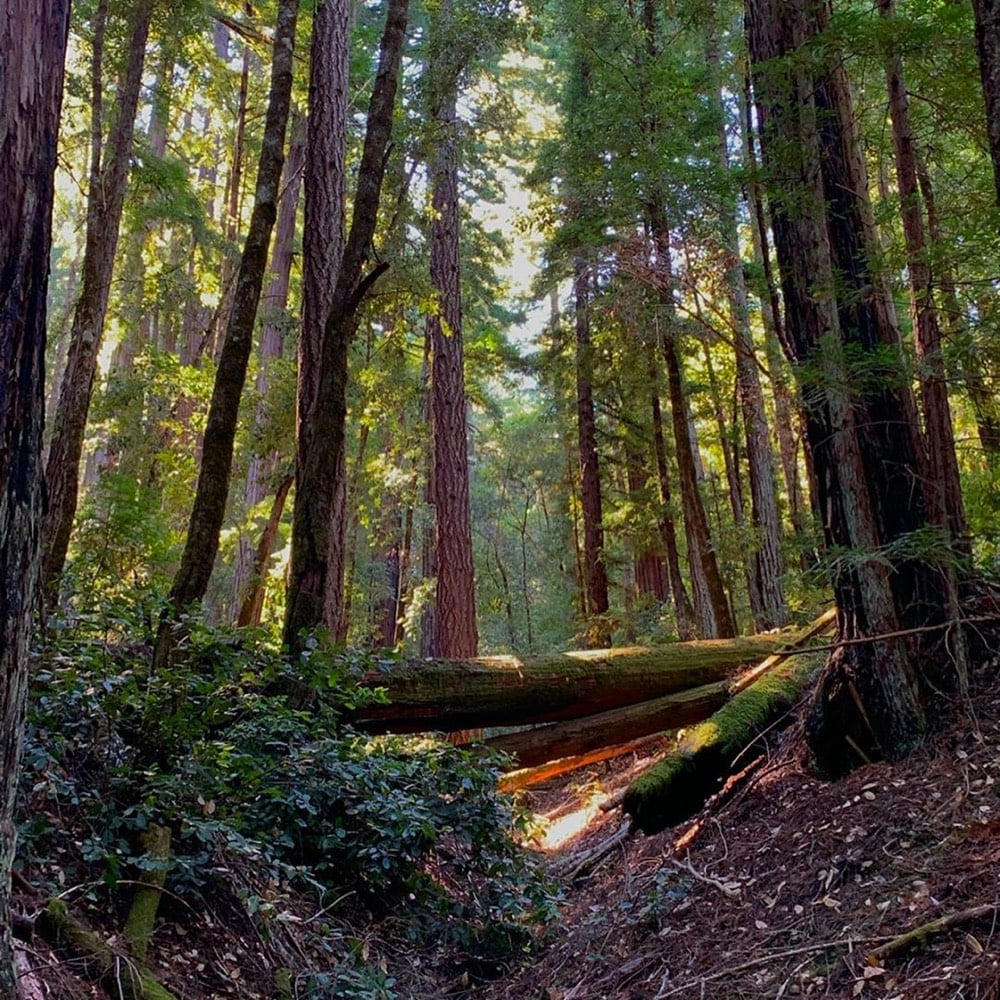
In late July after visiting my kids at camp, I flew into LA, rented a car, and spent two weeks driving up the coast from there to Portland, OR. Along the way, I visited old friends and made some new ones, got to see how some of my favorite movie magic is performed, ate very well, spent some time in an old neighborhood, drove 1700 miles, communed with the tallest trees on Earth, and watched the ocean churn and swell and crash and froth for a very very long time. Here are some reflections and observations from the trip, from my vantage point a month later.
To start off the trip I spent a little less than three days in LA, essentially my first trip to the second largest city in the US (aside from 24 hours spent there in 2005). It was…fine? The food was good, beach was good, museums were good, but I guess I didn’t feel a whole lot of natural affinity for the place. Then again, three days isn’t a lot of time and I will go back to explore more for sure. I somehow didn’t even get tacos, an oversight I rectified once I got to Santa Barbara. But I was able to see a few friends, which trumped any possible attractions or sights I could have seen instead.
Aside from visiting friends, like 75% of the reason I wanted to go to LA was to see Chris Burden’s Metropolis II at LACMA. I timed my visit for the weekend so it’d actually be running, and it did not disappoint. Could have watched it for hours:
Electric scooters (I used the ones from Lime and Lyft) made getting around LA a breeze. Cities need to figure out how to work these into their transportation infrastructure without clogging their sidewalks, keeping riders & pedestrians safe, theft/breakage, and not undermining other more accessible forms of public transportation.
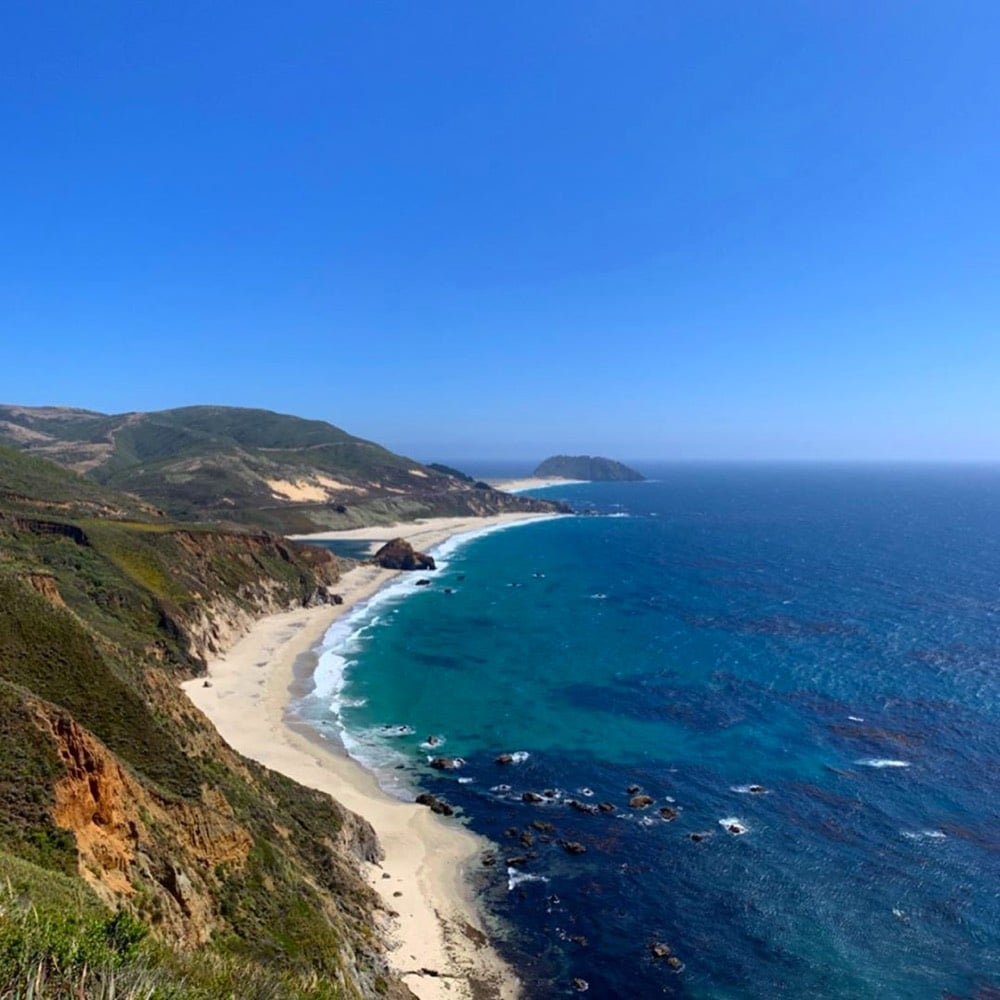
Not much to say about Big Sur other than it’s gorgeous but crowded. Around each curve was a seemingly better view than the last.
The redwoods. Where do I even start? They were my absolute favorite part of the trip. I spent the better part of three days exploring Big Basin Redwoods State Park, Humboldt Redwoods State Park, and Redwood National and State Parks and even at the end of the third day, I was looking up at these 300-foot monsters and saying “wow!” It was like going to church. I can’t wait for my kids to spend some time exploring the redwood forests.
When I lived in SF from 2000-2002, my favorite place to visit was Muir Woods and I was really looking forward to seeing it again. When I swung by to visit on this trip, I was frustrated to learn from the friendly park ranger at the entrance that parking now requires advance reservations. So no Muir Woods for me this trip. Luckily there were many more redwoods to be had elsewhere…
Along almost the entire route of my trip (I stuck mostly to Highway 1 and the 101), I passed people working in fields. They were everywhere, toiling away to earn a hard living so their families could eat, so that they could pay their taxes, so that they could make a good life for their children. The news of ICE raids and the continued separation of children from their parents by the most inhumane administration in recent American history were never far from my mind.
Every summer when I was a kid, my dad, my sister, and I would take a roadtrip to a different part of the country: Florida, Virginia, Texas. Sometimes we took a car and camped along the way (with occasional motel stays) and other times we drove in a used motorhome my dad bought one year (approximately one of these). But the ocean was always a constant as a destination. My sister and I had grown up in Wisconsin but had never seen the ocean before, and after our first trip to the Gulf Coast of Texas, we were hooked. One year we drove out to California and up the coast to Oregon. I remember vividly the freezing cold ocean and the winding coastal roads — we almost got our camper stuck in a particularly tight hairpin curve. I loved those roadtrips…they are my absolute happiest memories from childhood. Driving some of those same curves in northern California this time around, I waved to pretty much any RV I saw, as if I were saying hello to my past teenaged self, who was getting a taste of what awaited him in this whole wide world.
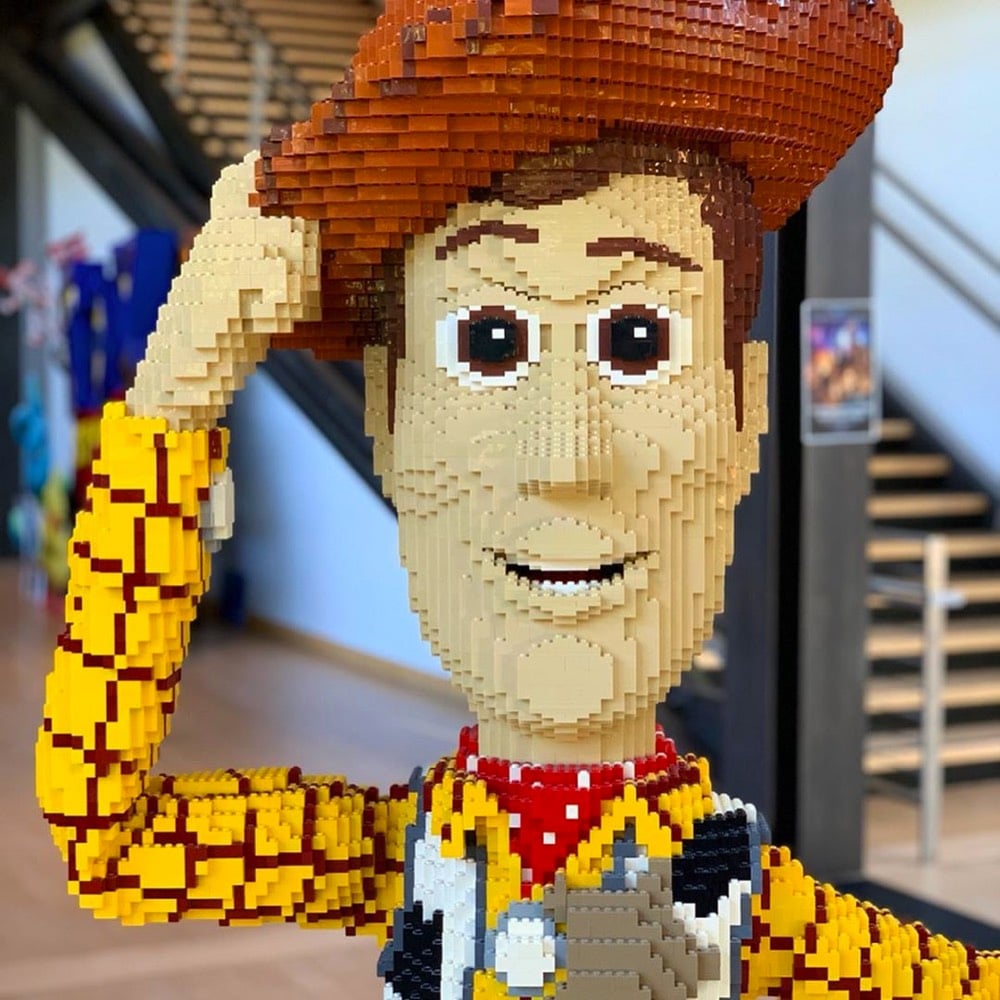
When I was in the Bay Area, I got to fulfill a long-time dream of mine: visiting the Pixar campus in Emeryville. I gotta say, stepping into the main building, designed by Steve Jobs to foster collaboration among the company’s employees, gave me goosebumps. I could have spent hours looking at all of the sketches, storyboards, and ephemera from Incredibles II that they had hanging on the walls. I visited the recording studios, the screening rooms, the secret speakeasy, and saw a few of the animators’ wildly decorated cubicles. They told me how the process of making a movie at Pixar has changed from “laying down the track in front of a moving train” to “laying down the track in front of a moving train while also building the train”…it sounds like they’ve really worked hard on making their development process as asynchronous as possible. I was told that Pixar has an entire team just for making crowds now.
My tour guides showed me some of the company’s favorite misrendered scenes culled from an internal mailing list, including an amazing rain tornado around a car in Toy Story 4. I saw in action the AI spiders that were designed to weave the cobwebs in TS4.
Typically, cobwebs must be made by hand, but, because of the number of cobwebs which the crew wanted to include, Hosuk Chang (Sets Extensions Technical Director) wrote a program to create a group of artificial intelligence spiders to weave the cobwebs just like a real spider would.
We actually saw the AI spiders in action and it was jaw-dropping to see something so simple, yet so technically amazing to create realistic backgrounds elements like cobwebs. The spiders appeared as red dots that would weave their way between two wood elements just like a real spider would.
They showed me a scene from TS4 and how it was made — the different layers of shading and lighting, storyboards, effects, the different cameras and lenses that were available for the director’s use. One cool tidbit: the virtual cameras used in the Toy Story movies are human-scale and shot from human height so that the toys actually look like toys. Ok, another cool tidbit: the virtual cameras & lenses are based on actual cameras and actual lenses so the directors know what sort of depth of field, angle, and views they’re going to get with a given setup. The software is incredible — they showed me a screen with like 30 different camera/angle/lens/focus combinations so that a director can simultaneously watch a single scene “filmed” all those different ways and choose which shot they want to go with. I mean…
To get the motion just right for the baby carriage scene in the antique store for TS4, they took an actual baby carriage, strapped a camera to it, plopped a Woody doll in it, and took it for a spin around campus. They took the video from that, motion-captured the bounce and sway of the carriage, and made it available as a setting in the software that they could apply to the virtual camera. I MEAN…
I also heard a few Steve Jobs stories that I’m going to keep to myself for now…they are not mine to tell. Thanks to Tom, Ralph, and Bob for showing me around and being so generous with their time. Ok,
I had forgotten that driving though the groves of eucalyptus just north of San Francisco was so wonderfully fragrant. Way better than one of those Muji aroma diffusers. But I’ll tell you: I do not miss living in SF. I spent a lovely afternoon walking around my old neighborhood, wandering in Golden Gate Park, and stopping in to check out the Dahlia Garden (my favorite place in SF), but that was enough for another few years.
While driving, I listened to To Kill a Mockingbird on audiobook; I’d never read or listened to it before. A favorite line: “Delete the adjectives and you’ll find the facts.” I’m not sure I’ve been successful in curbing my adjective use in this post.
At dinner one night, I asked an LA pal about work and she said she’d quit her bartending job to deliver weed — better schedule and pay. There were cannabis dispensaries everywhere in California and Oregon. The one I visited in central CA had a security guard outside checking for IDs and weapons, a double door system in the reception area, and once you got into the retail space, you could find out more about a product by placing it on a sensor and the info would appear on a nearby touchscreen. But at other dispensaries, like the one I walked past in Arcata, the door was wide open and you could just mosey on in. Let’s just say I slept pretty well on this trip.
After seeing the 45-minute-long line for lunch at the Tillamook Creamery (and a 20-minute-long line just for cheese samples), I decamped to a local Burger King to try the Impossible Whopper for the first time. All the people saying that the Impossible patty tastes just like a real burger have either never tasted meat before or don’t pay a whole lot of attention when they eat. It’s the best veggie burger patty I’ve ever had, but it sure ain’t beef.
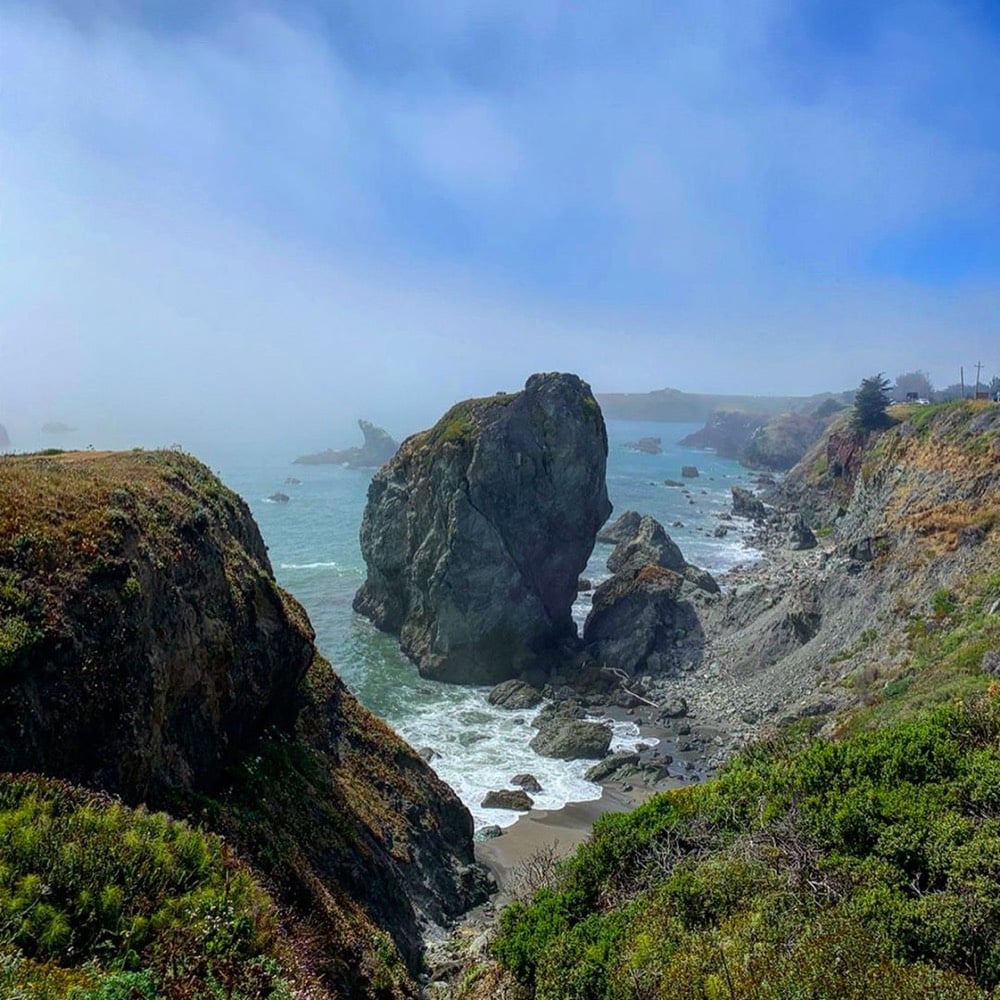
A few small towns caught my attention. Cambria, CA was a cool little place I would gladly spend more time in — Moonstone Beach was beautiful. Los Alamos, CA is possibly the quaintest town I have ever seen — ate a great breakfast at Bob’s Well Bread Bakery. I breezed through Arcata, CA and explored the downtown a bit, but it had such a cool vibe that I’d definitely go back for another look.
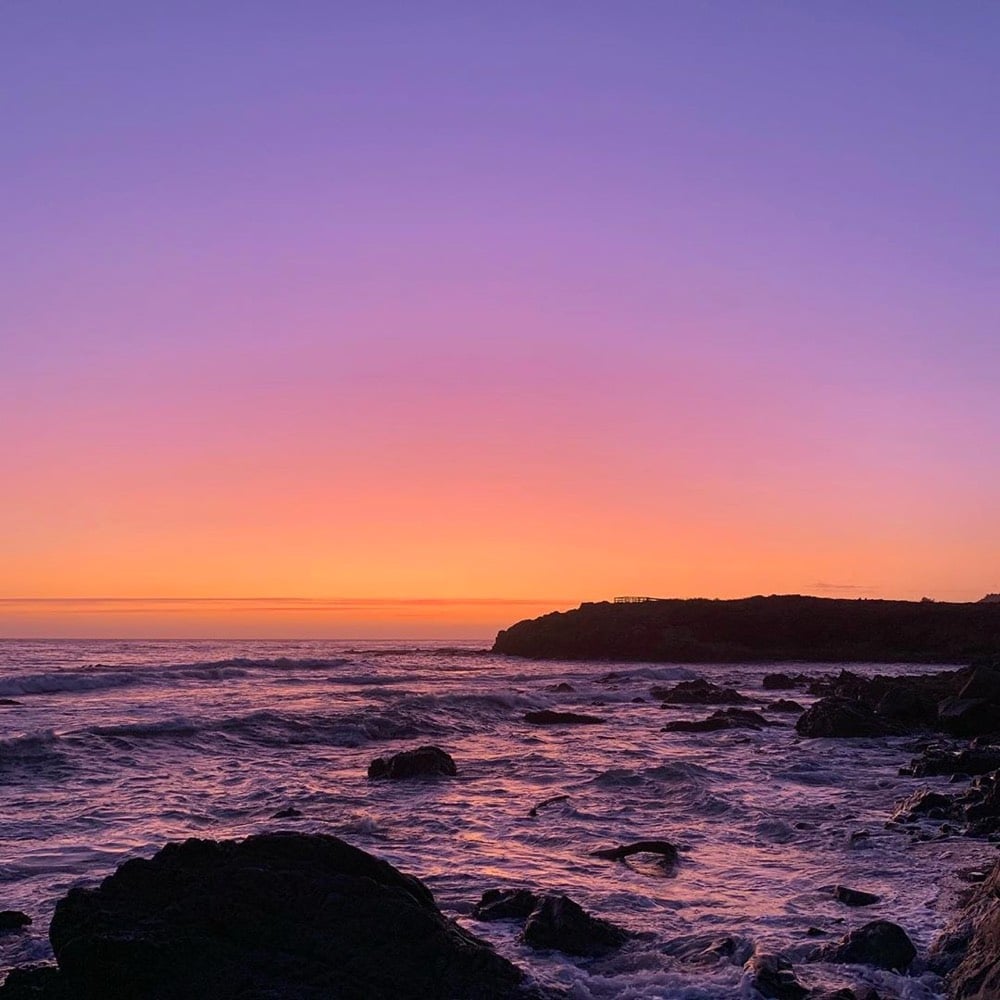
Sometimes the problem with going on vacation is that you have to take yourself along with you. No matter how astounding the sights, how engaging the catchups with friends, how relaxing it is, and how far away the rest of the world seems, your thoughts and anxieties and hang-ups come with you everywhere you go. Near the end of my trip, I splurged on a nice hotel room for two nights in Yachats, OR and mainly sat on the rocks and watched the waves crash. It was perfect. The ocean remains my ultimate happy place and I need to find a way to spend more (or perhaps all) of my time closer to it.

And then it was time to head home. You can check out a bunch of my photos from the trip on Instagram and in this Instagram Story. Thanks to my friends Alex, Michael, and Matt for the accommodations & fellowship along the way. This trip was not the once-in-a-lifetime experience that last year’s western roadtrip was, but I did feel similarly at its conclusion:
Doing this roadtrip reminded me of many great things about this country & the people who live in it and gave me the time & space to ponder how I fit into the puzzle, without the din of the news and social media. If you can manage it, I encourage you all to do the same, even if it’s just visiting someplace close that you’ve never been to: get out there and see the world and visit with its people. This world is all we have, and the more we see of it, the better we can make it.
Thanks for following along with my journey.

My kids are lucky enough to be at sleep-away summer camp this year. It’s their fourth year, and I was a little skeptical about this at first. Sleep-away camps weren’t really a thing in Wisconsin when I was a kid and schlepping out to the East Coast was not going to happen, financially speaking. But their mom went to camp and it had a big impact on her life and the kids wanted to go, so I went along.
I’m really glad I did. I miss them while they’re gone, but they have such an amazing time there, away from their parents, figuring out what kind of humans they are going to be. The staff at Ollie’s camp (an all-boys camp for grades 3-8 — Minna goes to an affiliated camp for girls) sent the parents a letter about some of the principles they use in supporting their campers by building “a feeling of profound belonging”. They are super thoughtful in their approach and none of it is mere lip-service. I thought a few of their principles were worth sharing with you. From a section that starts “We shape our program and culture to build belonging by…”:
…embodying our belief that there are many ways to be a man. We give boys a diverse array of role models — men and women in whom campers can see aspects of the selves they seek to develop. When the people around us model the same humility, humor, talent, and compassion that we seek to develop in ourselves, they help us to recognize the sturdy roots of those same virtues within us. In such moments, we know that we are in a place where we belong.
…focusing on what is personal, real, and lasting. Too often children learn to gauge belonging through external signals: the music they listen to, the brands they wear, the devices they own. The result can be toxic, especially for boys, who learn to measure themselves against dangerously narrow standards of masculinity. By embracing simplicity — in the uniforms we wear, the music we make, the technology we leave at home — we foster deeper connections with each other and even with ourselves.
…emphasizing honesty as the most direct path towards a life of substance and meaning. Ultimately, belonging is not an external validation, but an authentic way of being. Honesty — and its companion, vulnerability — are signs of strength and signals of openness. Honesty elevates relationships beyond the superficial, and invites us towards friendships in which we have the courage to be imperfect and the compassion to accept ourselves anyway. At camp, as in life, there is no more powerful belonging than to each other.
I don’t mind telling you that I teared up reading through these. That there are many ways to be a man, that masculinity can be toxic, that vulnerability is strength…hearing these ideas more often would have benefited an adolescent Jason, a shy and sometimes bullied small-town kid who didn’t feel like he belonged, truly belonged, anywhere until he went off to college and discovered that the world was full of weirdos just like, and also very unlike, himself. I still feel that little kid’s pain, and it makes me very happy that my kids are lucky enough to spend significant time in a place where those ideas take center stage.
Excerpts above are from Building Belonging from the staff at Camp Lanakila.
Gothamist recently posted some vintage photos of NYC’s High Line taken by Jake Dobkin back when it was still an abandoned rail line and not an immaculately designed space surrounded by luxury condos. Meg & I snuck up there in Feb 2004 and walked all the way down from 33rd St to the Meatpacking and back again. Here are a few photos I snapped that day:


A couple of these were kindly included in Phaidon’s book about the making-of the High Line park.
It’s snowing right now in Vermont, but fall was extra lovely this year, so I’m sharing some foliage shots I’ve taken over the past month or so.


All photos taken with the iPhone XS. I’ve previously shared some of these on my Instagram account, where you can see, for instance, that my 11-year-old goes the extra mile to get the good photo by polishing the apples on the orchard tree.
Update: For some other views of fall, try this photo series from In Focus: part 1, part 2.
Hello everyone. Today is my birthday, and I’m taking the day off. My pal Tim will be here tomorrow to share some knowledge and perspective with you.
Since it’s my birthday, I think the rule is that I get to ask you a favor. If you’re an eligible US citizen, please take just two minutes to register to vote in the November elections. If you believe you’re already registered, please check your status because some areas of the country are aggressively removing people from electoral rolls. If you’re all set, please reach out to a friend, family member, or coworker to make sure they’re registered. In conclusion:

Thank you.
Last week, I stood in the middle of the caldera of a supervolcano, walked on rocks billions of years old, and traveled back in time simply by driving down a mountain. I looked a bison in the eye at five yards. I witnessed the final resting place of a 12 million-year-old fossilized horse buried in volcanic ash. I saw a rainbow emerging from a mighty thundercloud — powerful with a little bit of tender. I talked civilly with red hatters in red states and found some common ground at least. I drove across the western United States, from Iowa to Oregon, over the course of 10 days. Here is some of what I saw and learned.
Biggest surprise of the trip, part 1: The Bighorn Mountains and The Bighorn National Forest. I had planned to just drive though, up and over, on my way to Yellowstone, but I ended up stopping here for quite a while. The Bighorns aren’t as spectacular as Yellowstone or some of the other parks, but it’s a hell of a lot less crowded. I’d go back and spend a few days here easy.
Surprisingly, despite spending 57 hours in the car, I was not bored a single minute of my trip. I marveled at the landscape, played music, and thought. I thought a lot. I expected to listen to a bunch of audiobooks but only managed to finish one I was most of the way through and the first third of another…the landscape was just too distracting most of the time. My experience leads me to believe I might be a good candidate for a solo Mars mission (aside from the one-way thing).
Animals seen on my trip, a partial list: rabbits, prairie dogs, antelope, ducks, geese, pelicans, pheasants, a moose, a wolf, elk, bison, deer, and a bunch of birds I couldn’t identify. The prairie dogs sat near their holes peeping at each other…it was really cute. The moose was a juvenile male in Yellowstone who looked lost & confused; he trotted alongside the road for a bit, then swam across the river and took off into the woods. I was apprehensive about not seeing a bison on my trip, but I shouldn’t have worried…Yellowstone was lousy with ‘em. Pro tip: bring a good pair of binoculars, possibly left over from eclipse-watching.
Yellowstone was one of the highlights (with a caveat that I’ll get to in a second). A single park containing all these different landscapes, from volcanic wastelands to mountain peaks to verdant river valleys to evergreen forests to grasslands…it’s a geographic marvel. But here’s the but: it’s also really crowded in the summer. At times, it felt like a nature mall, with herds of consumers moving from the bison shop to the geyser store. Reminded me a bit of my experience at the Louvre, itself a wonderful place too crowded to enjoy.
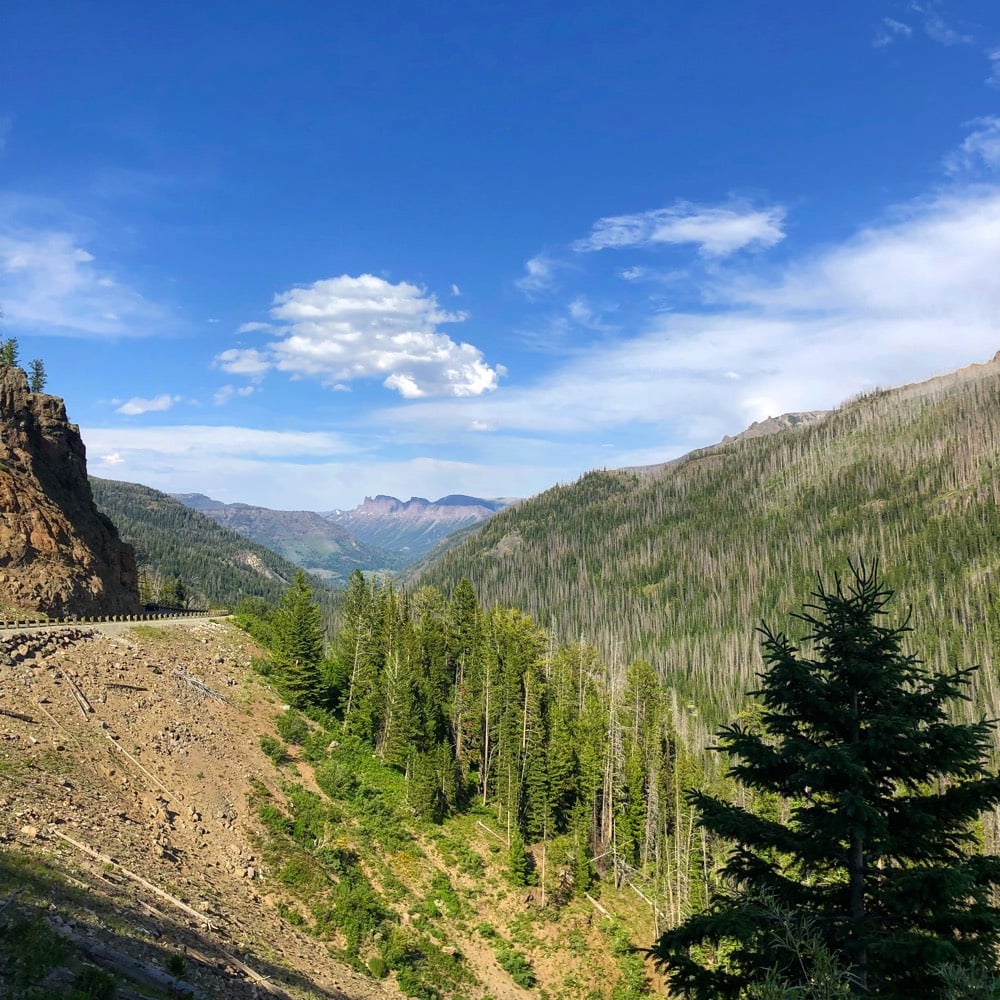
Final roadtrip stats: 2748 miles driven in 10 days and a total of 57 hours in the car. 718 photos and videos taken. I visited seven states — Iowa, Nebraska, South Dakota, Wyoming, Montana, Idaho, and Oregon — and spent at least one night in each save Idaho. Lowest point: 810’. Highest point: 11,070’.
Somewhere west of the Missouri River, which separates Iowa & Missouri from Nebraska & Kansas, the dominance in the eastern US of human activity & organization gives way to geology and geography. Even in the sparser areas of the Midwest, you look down from an airplane and see the Jefferson grid: square parcels of land, each with a group of buildings contained somewhere within it. Further west, hills and mountains and volcanoes and rivers and streams and forests and plains dominate the landscape and how people move within it. The West is not yet tamed, not by a long shot, and acknowledging this goes a long way toward understanding the people who live here.
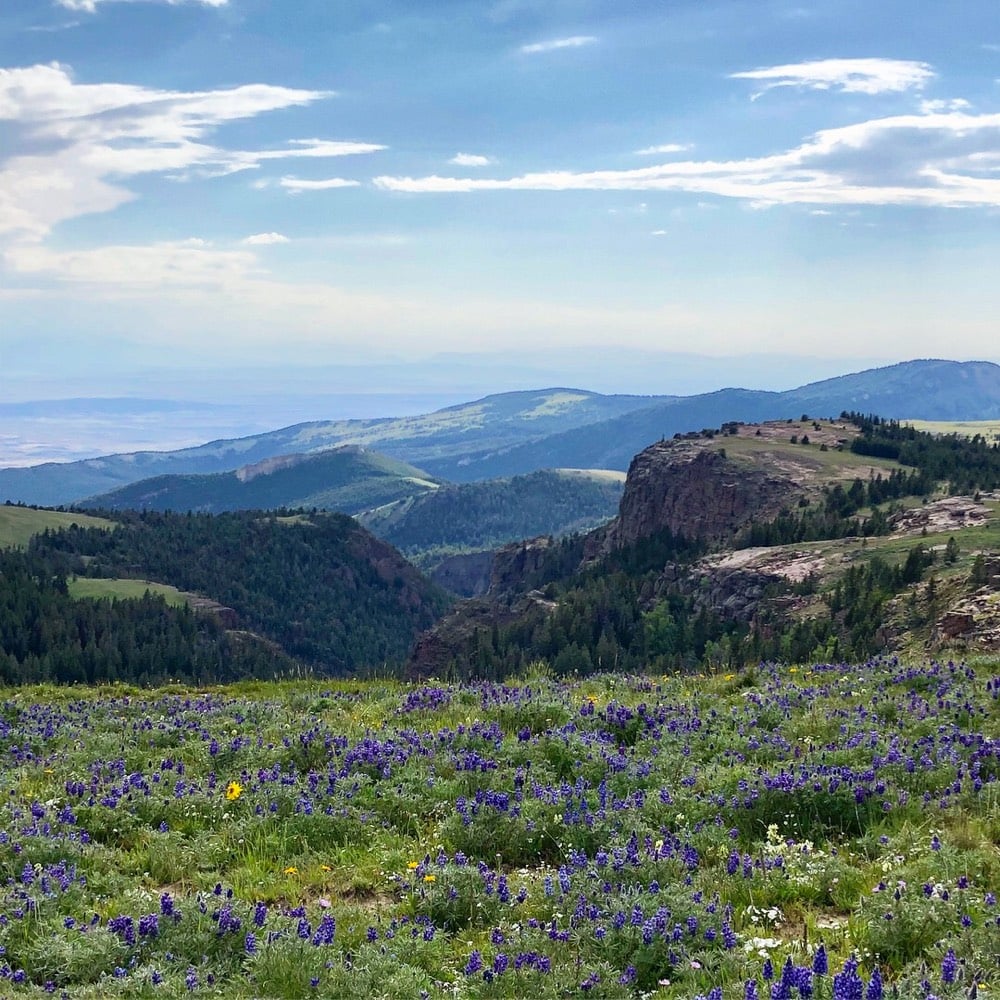
Biggest surprise of the trip, part 2: High altitude wildflower meadows. When I stopped my car at a scenic overlook at 9400’ in the Bighorn Mountains and saw a path down a gentle slope through a meadow of wildflowers growing very close to the ground, I didn’t think a whole lot about it. Pretty scene, right? I grabbed my daypack from the car and as soon as I stepped down onto the path and into the meadow, this amazing smell sent me reeling. For 20 minutes, I walked in an olfactory daze to the crest of the next hill and back. OMG, what an amazing sensation…a definite high-water mark.
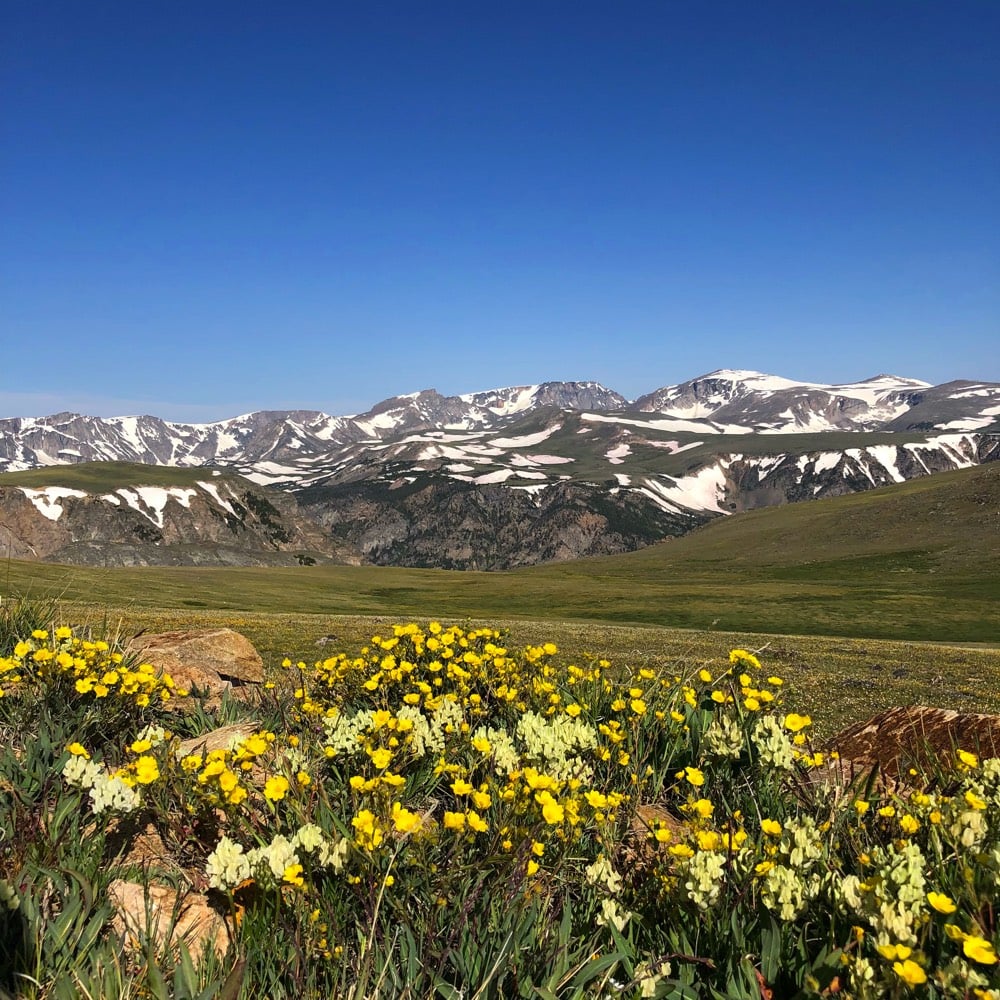
The speed limit on the freeways in South Dakota, Wyoming, Montana, and Idaho was 80 mph. On some rural undivided two-lane highways, the limit was still 70 mph, which I found astounding. But the lanes and the shoulders were way wider than in Vermont, the roads flatter and straighter, and traffic was few and far between most of the time. Still, even just that little extra speed really cuts down on drivers’ potential reaction times.
I had high hopes for the Badlands, and it lived up to the hype. Magnificent desolation, accessible, and not super crowded. I could (and probably should) have spent a couple of days there easy.
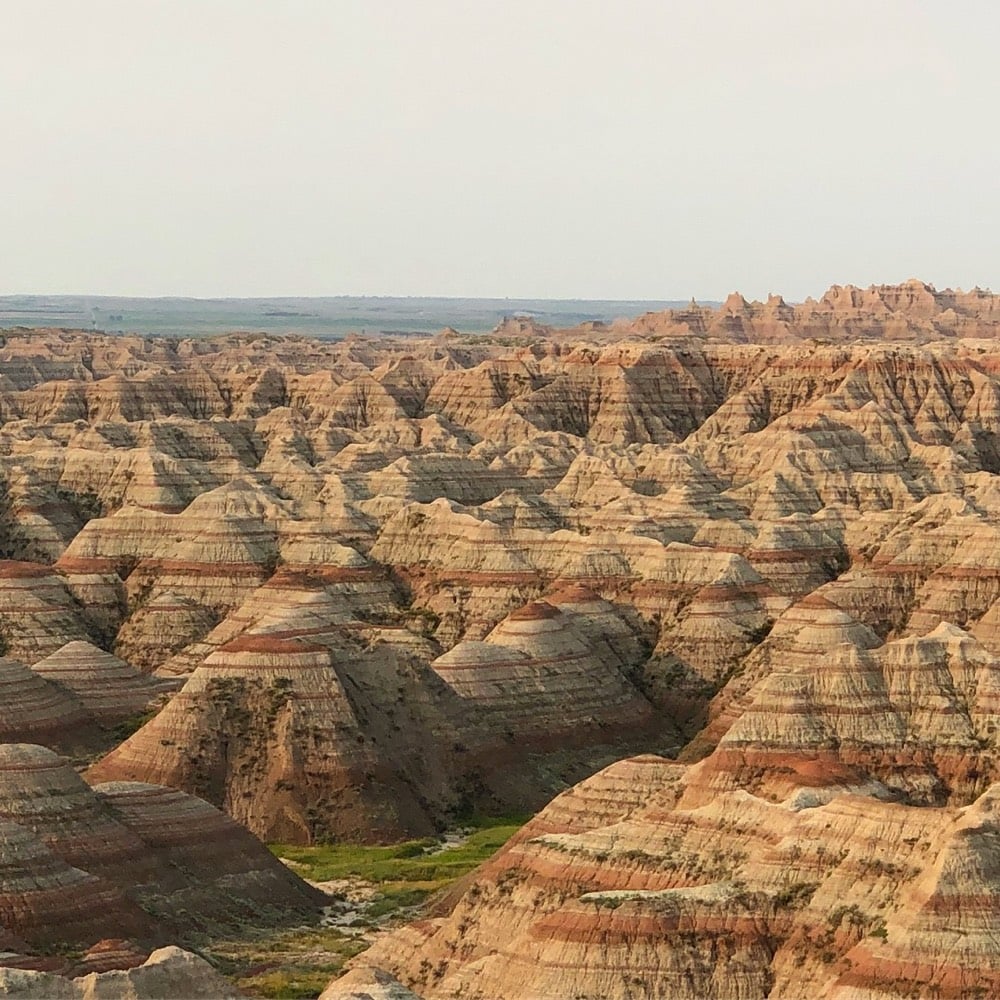
Food was not a highlight or a focus of this trip, mostly because I didn’t spend a tremendous amount of time seeking out good places to eat. I had some Thai lettuce wraps w/ bison in SD that were pretty good, some just-fine sushi in Missoula, and a delicious tostada scramble in Rhododendron, OR. Maybe the best thing I ate was a homemade breakfast burrito I bought at a gas station in Red Lodge, Montana. It was a struggle to find non-meat things to eat — I’m not a vegetarian, but man cannot subsist on burgers & hot dogs & steaks & BBQ for a week and a half w/o GI discomfort. With some notable exceptions, food in the US is more homogenous than ever…you can get anything almost anywhere.
Biggest surprise of the trip, part 3: The hosts at the B&B I stayed at in Wyoming advised me to enter Yellowstone via the Beartooth Highway and I am so glad I took their advice. The 68-mile drive was called “the most beautiful drive in America” by former CBS correspondant Charles Kuralt and he might be right. At the top of the pass, you drive just short of 11,000’ above sea level; I climbed above the 11K mark for a stunning 360° view of the entire area. Reader, I may have done the arms-wide-on-the-bow-of-the-Titanic gesture on top of a rock at the top of the world…no apologies.
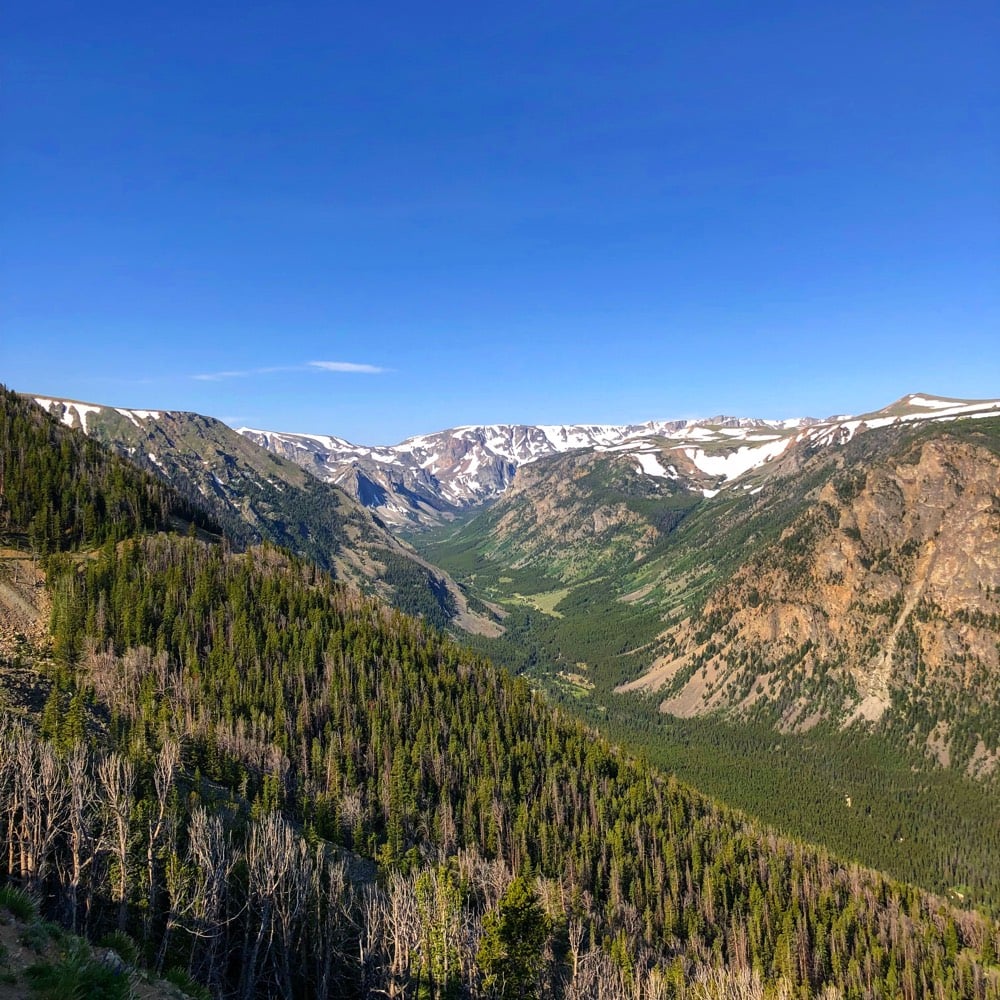
About 5 minutes after I checked into my B&B near Cody, WY, I looked out my window to see a rain cloud off in the distance with a rainbow coming out of it. Chuckling, I asked my host if that was a common occurence around here. “Pretty much,” he replied, “especially with climate change.” A life-long resident of the area, he went on to explain that it rains a lot more there now than “20-30 years ago”. “See all that grass out there? It’s supposed to be brown this time of year.”
Several people told me before my trip that Devils Tower was worth the effort, but as I spotted it off in the distance on my approach, I had my doubts. But as it got closer, I realized they’d all been right. Totally crazy geological thing worth seeing in the flesh.

At a gas station in southern South Dakota, a man noticed the Texas plates on my rental car and asked, “What’s the price of gas in Texas these days?” I explained my situation, and he said, “I’m from Texas originally and I can tell by your accent that you ain’t. What’re ya doing in this godforsaken country?”
In Wyoming, I stayed less than a mile from the Heart Mountain Relocation Center, a WWII Japanese American confinement site. From 1942 to 1945, this concentration camp held almost 14,000 people, making it the third-largest town in Wyoming at the time. The majority were American citizens and had done nothing wrong and committed no crimes…they were put there for being of Japanese heritage. I regret that my plans didn’t allow for a visit; if I’d had known beforehand that it was going to be so close, I would have made the time, given our present administration’s treatment of its Muslim citizens and asylum seekers from Central and South America. As Faulkner said, “The past is never dead. It’s not even past.”
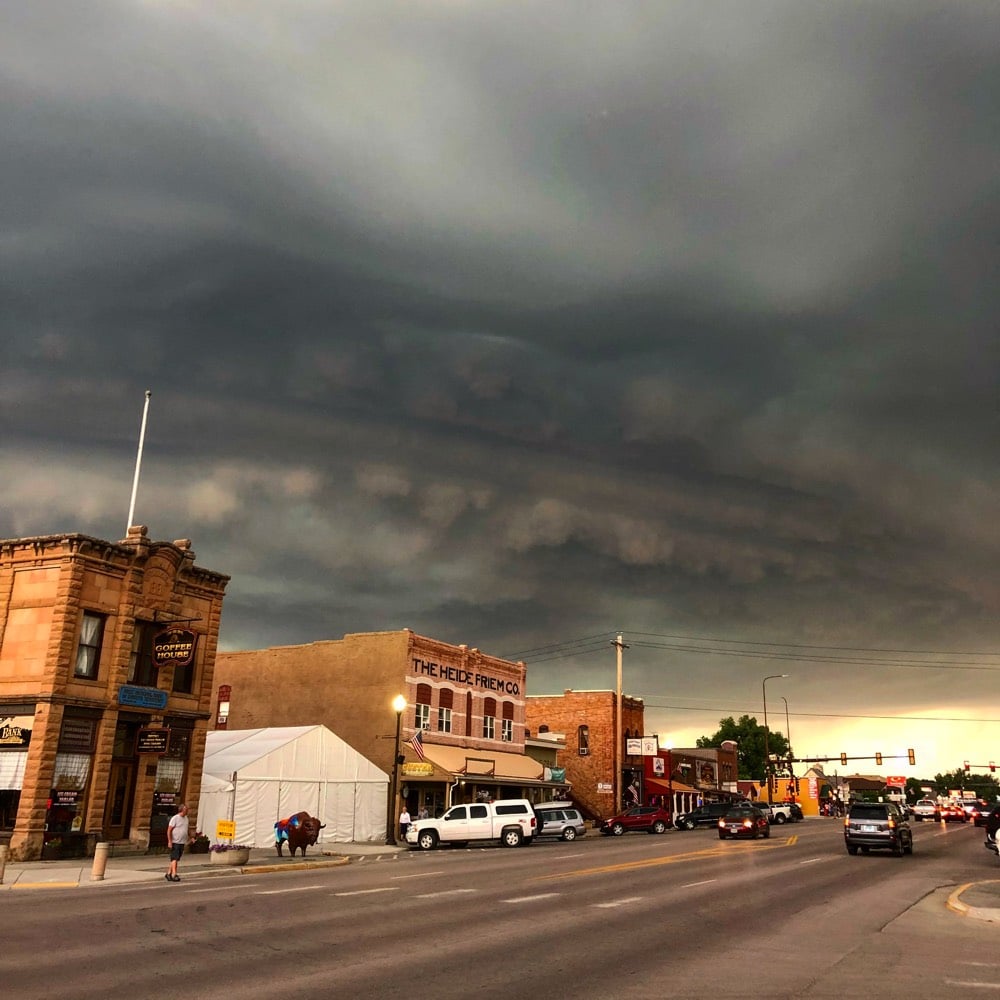
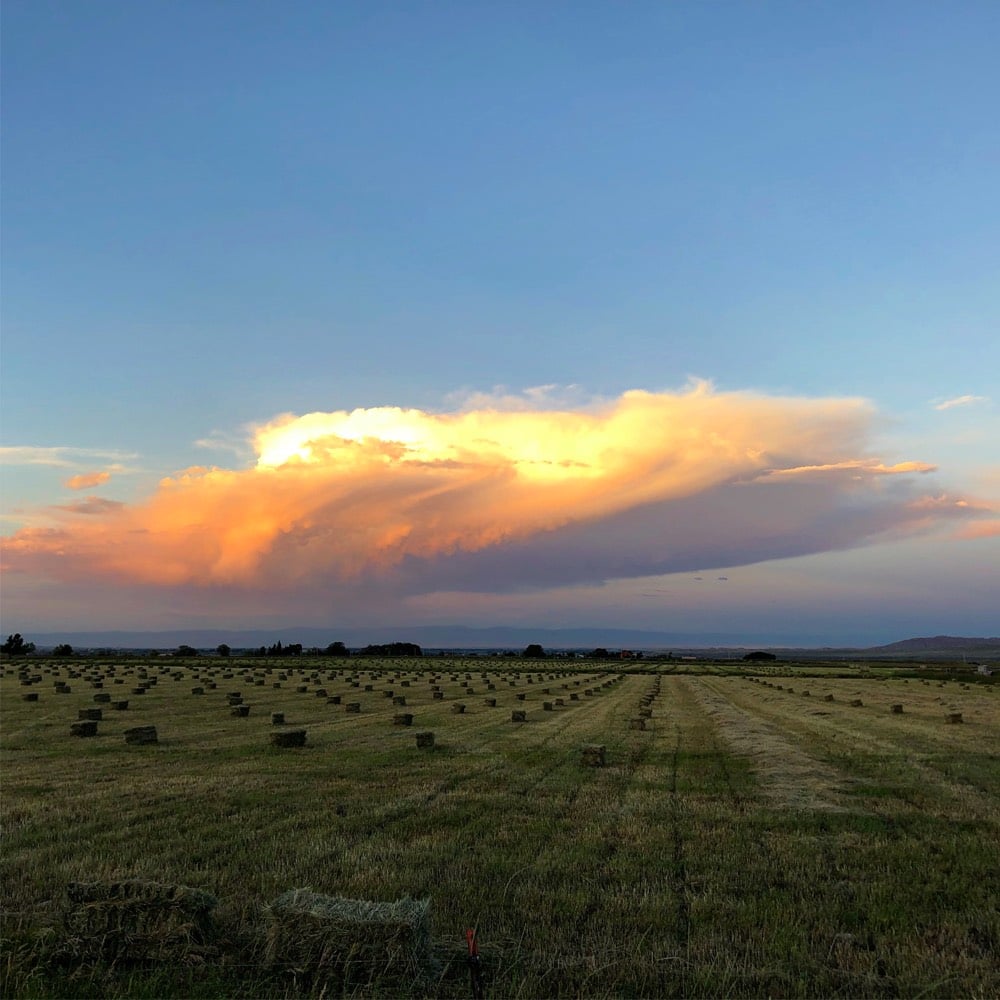
I saw some cool thunderstorms:
If I had a time machine, I would tell myself from two weeks ago to skip Mt Rushmore, Wind Cave, and the volcanic stuff in Yellowstone. And perhaps Wall Drug. I also would have opted to fly out of Salt Lake City instead of Portland, OR to give me more time to explore Montana and Wyoming…the trip ended up having too much driving and not enough being out in nature.
You can see more photos from my trip on Instagram and in this saved Instagram Story. I feel very lucky to have had the time and resources to take this trip. It definitely took me out of my comfort zone in both good ways and bad — the journey definitely wasn’t all sunshine and lollipops, despite what my photos might indicate. To many of us, it seems like a perilous time in our nation’s history, with many debts, old and new, coming due in rapid-fire succession. Doing this roadtrip reminded me of many great things about this country & the people who live in it and gave me the time & space to ponder how I fit into the puzzle, without the din of the news and social media. If you can manage it, I encourage you all to do the same, even if it’s just visiting someplace close that you’ve never been to: get out there and see the world and visit with its people. This world is all we have, and the more we see of it, the better we can make it.
I was on the road for an unexpectedly long time last week, so the post I wrote about kottke.org’s 20th anniversary was a little rushed and incomplete. I often call kottke.org my “one-man band” but it has been anything but. Today, I want to swing back around and thank all of the people and organizations who have supported me and the site with their encouragement, advice, criticism, well-wishes, hard work, and services.
I’ve thanked ‘em before and I’ll thank ‘em again: the support of kottke.org members has given this here webmaster new life. If you’d like to see kottke.org run another 20 years, the best way to do that is to sign up for a membership (it’ll only take you a minute).
I’ve been lucky to work with a bunch of talented guest editors over the years, including Sarah Pavis, Greg Allen, Adam Lisagor, Choire Sicha (now the editor of the NY Times Style section — fancy!), Deron Bauman of the dearly missed Clusterflock, Susannah Breslin, Cliff Kuang, Ainsley Drew, Jenni Leder, Joel Turnipseed, Lance Arthur, Andy Baio, and Chrysanthe Tenentes. Chris Piascik has provided the occasional high quality illustration. Aaron Cohen guest edited for a couple of weeks and then, unbidden & for reasons unknown, posted 3-5 posts each week for several months. (Aaron still bugs me bi-monthly about doing a Kottke Konference and someday he might actually persuade me to do it.)
And a special mention goes to Tim Carmody, who has guest edited several times and is now writing the Noticing newsletter and posting on Fridays. He’s like my smarter and more verbose brother, and I love what he contributes to the site.
Back in 2005, when I quit my job to work on kottke.org full-time, I asked my readers to support me in a precursor to the membership program. Hundreds of them did just that, and I’m forever grateful.
To Greg Knauss, Anil Dash, Heather Armstrong, Michael Sippey, Mark Wilkie, David Jacobs, Meg Hourihan, Jake Dobkin, and Jonah Peretti: your advice and counsel over the years has been invaluable to me. Best informal board of advisors ever.
I need to thank Greg Knauss & Mark Wilkie again, along with Finn Smith, for helping me out with the heavy lifting server admin stuff. Mark in particular hosted kottke.org on his own personal server for many years in the early days.
Along with his counsel, I’d like to thank Jonah Peretti for providing me with a space at Eyebeam Labs in 2005 as a senior fellow and again at Buzzfeed as a design advisor and a desk-squatter for almost 10 years.
kottke.org is proudly hosted by Arcustech, which keeps the site running at top speed with no downtime. I dunno, maybe the site’s been down once, for like 2 seconds in the middle of the night, but I was sleeping and didn’t notice.
The fonts for the site are courtesy of Hoefler & Co. I’m proud to have been one of the first sites on the web to use their web fonts.
I’d like to thank my advertising partners throughout the years: Carbon Ads, We Work Remotely (which started out as the job board for 37signals), and especially The Deck.
And last but not least, I’d like to thank all of you for reading all these years, despite the repeated use of cliches like “last but not least”. I ♥ you all!

kottke.org is 20 years old today. Holy shit! On March 14, 1998, I launched a new episode of 0sil8 called “Notes”. 0sil8 was a previous website of mine, started in 1995 or 1996. The site’s format was episodic: every month or two the design and content was completely different. With Notes, I wanted to have somewhere to write regularly for my friends, modeled after the online diaries that were growing in popularity at the time. Weblogs were a thing, one of the many types of regularly updated personal sites that were in existence then; they wouldn’t take off and begin to consume all media for another year or two. In December 1998, I registered kottke.org (kottke.com was taken and I wasn’t a network so .org it was) and sometime later moved Notes over, where it’s been ever since. And now it’s one of the oldest regularly updated sites on the web.
I’ve been reading back through the early archives (which I wouldn’t recommend), and it feels like excavating down through layers of sediment, tracing the growth & evolution of the web, a media format, and most of all, a person. On March 14, 1998, I was 24 years old and dumb as a brick. Oh sure, I’d had lots of book learning and was quick with ideas, but I knew shockingly little about actual real life.1 I was a cynical and cocky know-it-all. Some of my older posts are genuinely cringeworthy to read now: poorly written, cluelessly privileged, and even mean spirited. I’m ashamed to have written some of them.
But had I not written all those posts, good and bad, I wouldn’t be who I am today, which, hopefully, is a somewhat wiser person vectoring towards a better version of himself. What the site has become in its best moments — a slightly highfalutin description from the about page: “[kottke.org] covers the essential people, inventions, performances, and ideas that increase the collective adjacent possible of humanity” — has given me a chance to “try on” hundreds of thousands of ideas, put myself into the shoes of all kinds of different thinkers & creators, meet some wonderful people (some of whom I’m lucky enough to call my friends), and engage with some of the best readers on the web (that’s you!), who regularly challenge me on and improve my understanding of countless topics and viewpoints.
I had a personal realization recently: kottke.org isn’t so much a thing I’m making but a process I’m going through. A journey. A journey towards knowledge, discovery, empathy, connection, and a better way of seeing the world. Along the way, I’ve found myself and all of you. I feel so so so lucky to have had this opportunity. When kottke.org turned 10, my post marking the anniversary ended with “I’ll see you in 2018”. In my recollection, that line was somewhat serious but also partially somewhere between a joke and a dare. Like, “how has this thing lasted 10 years, why not go for 20?” So…why not go for 30? 40? I’ll see you for sure in 2028 and perhaps even in 2038. Thank you so very much for being here with me, I surely don’t deserve such fine company.
P.S. And if you’ll indulge me for a moment in a brief shameless sale pitch, if you have found something valuable here over the past 20 years, please consider supporting the site with a membership. Member support has put the site on a stable financial path into the future and has personally re-energized my involvement and commitment to the site. Thanks!
The latest issue of Noticing (kottke.org’s weekly newsletter) went out today. This issue includes a link to my interview with Laura Hazard Owen at NiemanLab about kottke.org turning 20 years old next month, the state of blogging, and the melancholy of the conversation around the decline of the open web.
I think that it’s been really hard, the last couple of years, to cover anything — I don’t know how to say this in a way that isn’t going to get all weirdly interpreted — it’s been hard to cover anything but things that are serious. Because, you know, a lot of people - I think very rightly - feel that if you’re someone who thinks the world is coming down around all of us, that you should be on a mission to try to fix that. And I think that there are plenty of sites and plenty of media outlets and plenty of people who are oriented in that direction and moving in that direction.
But I don’t think kottke.org is one of those things. I think that the site is much more about things that are a little bit more — I don’t want to say hopeful, but a lot of it is, like, look at this cool thing. Look at what humans can do when they have enough time and energy and whatnot to do them! When you called, I was had just been watching the SpaceX thing. Seeing those two booster rockets land at the same time blew my mind. I was just sitting here, yelling, like, oh my god!
There has to be room in our culture for that type of stuff — that stuff that is inspirational and aspirational — because it provides some sort of hope that we can actually have more of that in our lives, rather than less.
To which Tim added (italics mine):
I freely admit that this is something Jason does as a blogger way better than I do (along with writing fewer words more often). I think I look at the world and mostly think less “oh my god!” and more “how in the hell does that work?” But I think the two of them have to be complimentary. Learning begins in wonder (the Greeks would call it thauma) as much or more than in criticism (skepsis).
That last line sums up my approach here (and honestly, to life) as well as you can in one sentence. Noticing could very well have been called Wonder instead.
You can read the rest of this week’s newsletter here or subscribe here.

*record scratch*
*freeze frame*
Yep, that’s me. You’re probably wondering how I ended up back in the 1970s with such a sweet jacket and bitchin’ mustac— Ok all jokey tropes aside, I got to appear on AMC’s Halt and Catch Fire last night as a background extra. (Mild spoilers follow.) This season of the show is set in the 90s, but this episode flashes back to the 70s soon after Gordon and Donna get together. My scene takes place during this flashback and is pretty short. Gordon is at a gas station, waiting to use the pay phone. A man (that’s me!) exits the station with a 6-pack of beer, gets into his car, and drives off after Gordon crosses the pavement to the phone. And that was it! But as a big fan of the show — and I refuse to have any chill about this — it was one of the coolest experiences I’ve had in forever.
I’ve been watching the show since the first season, when the action focused on a small company trying to build one of the first IBM-compatible PCs on the market. (You may have read about this show on kottke.org once or twice. Or a dozen times. I have an unauthorized Cardiff Electric t-shirt I bought from some sketchy site online. Did I mention I was a big fan?) At some point during the next two seasons of the show, when the action moved from PCs in Texas to online services & anti-virus software in Silicon Valley, I followed the two creators of the show, Christopher Cantwell and Christopher Rodgers on Twitter. And at some later point, they followed me back and we tweeted at each other a handful of times.
Meanwhile, the show got renewed for a fourth and final season. At the end of season three, the characters started talking about this new thing called the World Wide Web and it was clear that season four was going to focus on early 90s web startups. Now, I don’t know if you know this about me or not, but I love the web. (Oh, you could tell? I let that slip at some point?) And I am so very nostalgic for the early days of the web in the 90s — the Mosaic days, the Altavista days, the Bobaweb days, the Entropy8 days, the Suck days, the CSotD days, the alt.culture.days, the 0sil8 days, the Yahoo on the akebono server at Stanford days. The days when I was young and dumb and decided to quit grad school in a promising field without talking to a single other person about it because I just knew I needed to do whatever I could to get a job working on the web, a job that didn’t even exist at the beginning of my junior year in college. Season four was going to be about those days?! Holy shit.
In June, Chris Cantwell, who was down in Atlanta to direct an episode of the fourth season, tweeted that he was in the hospital, on dilaudid waiting for a kidney stone to pass and was available to answer any questions his followers had about the show. After a crap-can month of May, I’d been focusing on being more direct with what I want, so fuck it, yolo, totally trying to take advantage of this poor guy being hopped up on goofballs, I tweeted back:
Do you need extras for s04? Will do retro web design on screen for zero pay. I still can code circa-1994/5 HTML by hand.
Which was like 30% joking and 70% serious. A few minutes later, he replied:
Dude if you can fly out here I’ll put you in a long wig and put you at a gas station.
I had no idea what the hell he was talking about — remember, he was super fucking high — but we followed up via DM and I bought a plane ticket for Atlanta and booked a hotel the next morning. Sometimes, just sometimes, you get what you want, even if it’s not exactly what you asked for.


Less than a week later, I’m in Atlanta. They put me through wardrobe, where I tried on two sets of 70s clothes (they ended up using a mix of clothes from the two looks). I got a tour of the storeroom where they keep all of the clothes for the series; it was massive…I kept thinking I was going to uncover the Ark of the Covenant in there. I went from there to hair & makeup, where they fit me with a wig and mustache for Cantwell to approve. My scene wouldn’t shoot until the next evening, so they had to take it off that afternoon and put it all back on the next day:

I got to meet the actors that played Gordon, Donna, and Joe…they were super nice. Hell, everyone was super nice and professional and seemed to be having fun…a good crew. I was there to be an extra, but since I knew Cantwell, I was also “a friend of the show”. (Everyone kept saying, “oh, you’re the blogger!”) So they took me out to a couple of the sets, and I got to see Mackenzie Davis do her thing (❤️!). They showed me how everything on-set worked and gave me a headset so I could listen in on what was happening. I met the show’s producers, one of whom told me that with my hair and mustache, I looked just like his friend Bill Paxton from 20 years ago, in Tombstone…to the point where it freaked him out a little to see his recently deceased friend standing before him. I saw a stuntman jump off a cliff into a quarry. They gave me a chair to sit in so I could watch the action on the monitors in real-time. I ate so much food at the end-of-day meal. I got to drive a big-ass Chevy from the 70s. I read a call-sheet for the next day’s shoot that totally spoiled the season’s biggest reveal and I didn’t even care that much.
On the day of the shoot, the scene took place at night, so my call time was 6pm. Did the hair and makeup thing again, ate, sat around, got dressed, and then was shuttled out to the set at around 10pm. I watched them set up and then it was go time. I did my scene probably 8 or 10 times. They shot it with two different camera setups and had me change little things here and there…like the first time I walked out of the store, I didn’t have the beer in my hand:

And then, right around midnight, it was done. I filled out my sheet to get paid ($51.64 after taxes) and somehow stayed awake on the 90 minute drive back to Atlanta.
That last-minute, three-day trip totally blew my travel budget for the summer. Was it worth it? When I was a kid, there was nothing I was more interested in than computers. My dad bought one of the first available IBM PC-compatibles on the market. I’ve read and watched a ton about the PC revolution. I used online services like Prodigy. And the web, well, I’ve gotten to experience that up close and personal. One of the reasons I love Halt and Catch Fire so much is that it so lovingly and accurately depicts this world that I’ve been keenly interested in for the past 35 years of my life. Someone made a TV show about my thing and it was great, a successor to Mad Men great. Getting to be a microscopically tiny part of that? Hell yeah, it was worth it.
Update: Will Fitzgerald pointed out that I now have a Bacon Number of 2.
Six Degrees of Kevin Bacon is a parlour game based on the “six degrees of separation” concept, which posits that any two people on Earth are six or fewer acquaintance links apart. Movie buffs challenge each other to find the shortest path between an arbitrary actor and prolific character actor Kevin Bacon. It rests on the assumption that anyone involved in the Hollywood film industry can be linked through their film roles to Bacon within six steps.
While not strictly within the rules (HaCF is TV, not film), I was in an episode of Halt and Catch Fire with Toby Huss and Huss was in R.I.P.D. Because of a few physics papers I co-authored in college, I also probably have an Erdös Number (I’d estimate 5 or 6?). I’ve got a ways to go on an EGOT, but I’m doing pretty well on the Bacon-Erdös scale!
Update: Here’s a clip of my scene:
Last week (approx. May 7-14), I stopped using social media for an entire week. I logged out of all the sites and deleted the apps from my phone. I didn’t so much as peek at Instagram, which is, with Twitter and old-school Flickr, probably my favorite online service of all time. I used Twitter as minimally as I could, for work only.1 I didn’t check in anywhere on Swarm. No Facebook. As much as I could, I didn’t use my phone. I left it at home when I went to the grocery store. I didn’t play any games on it. I left it across the room when I went to bed and when I worked.
Many people have given up social media and written about it — the digital equivalent of the “Why I’m Leaving New York” essay — but since I didn’t write about leaving New York, I’m going to do this instead.
I used to be very good about using my phone and social media appropriately. More than a decade of working on kottke.org taught me how to not be online when I wasn’t working (for the most part). I tried super hard not to use my phone at all around my kids and if I was out with friends, my phone stayed in my pocket.2
Almost a year ago, after 13+ years in the city, I moved from lower Manhattan3 to rural Vermont. It’s beautiful here. I live in a house in the country surrounded by horse pasture and there’s great skiing in the winter. The nearest town is only five minutes away by car; it has a two-screen movie theater, a handful of restaurants (none of which are typically open after 10pm), two grocery stores, but nowhere to get a proper donut, sushi, or bowl of ramen. (The nearest ramen is an hour’s drive away.) While I was writing this post yesterday afternoon, the power in my house went out and didn’t come back on for three hours, forcing a delay in publication. It’s been difficult to meet people. Folks here are nice, but they mostly remind me of the people in the small town I grew up in (aka why I moved to the city in the first place). I work from home at a desk in my bedroom and some days, the only beings I’ll talk to are Siri, my landlord’s horses, and some days, my kids and their mom.
Social media, mostly through my phone, has been an important way for me to stay connected with friends and goings on in the wider world. But lately I’d noticed an obsessiveness, an addiction really, that I didn’t like once I became fully aware of it. When I wasn’t working, I was on my phone, refreshing Instagram, Twitter, and Facebook repeatedly in an endless series, like a little old lady at Caesar’s Palace working several slot machines at the same time. And I couldn’t stop it — my phone was in my hand even when I was trying to concentrate on my kids, watching a movie, or reading a book. So, I quit for a week to see what would happen. It’s not a super-long time period, but here’s what I noticed:
- Once I’d set my mind to it, it was pretty easy to go cold turkey. Perhaps my Twitter usage and keeping up with the news for kottke.org acted as a nicotine patch, but I don’t think so. Instagram was the toughest to stay away from, but I didn’t crack once.
- As the week went on, it was more and more evident that it wasn’t so much social media as the phone that was the problem. Even now, a few days after the conclusion of my experiment, I’m leaving my phone at home when I go out or across the room when I’m doing something. I’m going to try hard to keep this up.
- Buuuut, when you have kids, there is no such thing as giving up your phone. There’s always the potential call from their school or their mom or their doctor or another parent regarding a playdate or or or. I spend enough time online at my computer for work that I could mostly do without my phone, but with kids, that’s not really an option.
- Not a single person noticed that I had stopped using social media. (Not enough to tell me anyway.) Perhaps if it had been two weeks? For me, this reinforced that social media is actually not a good way to “stay connected with friends”. Social media aggregates interactions between loved ones so that you get industrialized communication rather than personal connection. No one really notices if a particular person goes missing because they’re just one interchangeable node in a network.
- My no-social week, for a variety of reasons, was probably the shittiest week I’d had in more than a year. Total emotional mess. Being off social media didn’t make it any better, but I doubt it made it worse. Overall, it was probably a good thing I wasn’t subjecting my friends and followers to self-subtweets and emo Instagram Stories…I was already scoring enough own goals without social media’s help.
- So, what did I do instead? I wish I could say that I had loads of extra free time that I used to learn Spanish, clean my house, catch up with old friends, cook delicious meals, and finish a couple work projects. Perhaps if shittiest week ever hadn’t been happening, I would have done some of that. Still, I did end up going to bed early every night, read a couple books, and had more time for work and dealing with kid drama.
After the week was up, I greedily checked in on Instagram and Facebook to see what I had missed. Nothing much, of course. Since then, I’ve been checking them a bit less. When I am on, I’ve been faving and commenting more in an attempt to be a little more active in connecting. I unfollowed some accounts I realized I didn’t care that much about and followed others I’ve been curious to check out. Swarm I check a lot less, about once a day — there was a lot of FOMO going on when I saw friends checked in at cool places in NYC or on vacations in Europe. And I’m only checking in when I go someplace novel, just to keep a log of where I’ve been…that’s always fun to look back on.
Mostly, I’ve resolved to use my phone less. Being on my phone was my fidget spinner…this thing that I would do when there was nothing else to do or that I would use to delay going to bed or delay getting out of bed in the morning. Going forward, I’m going to be more mindful about its use. If nothing else, my hands and thumbs might start feeling better.
Finding out about your family history through a DNA test can be a thrilling or disturbing experience, particularly when it comes to race and identity. In the NY Times, researcher Anita Foeman writes about asking people how they identify and then DNA testing them. A man named Bernard identifies as black and predicted his test would show 50% European and 50% African ancestry (his father was black and his mother was white):
His comments before the test: My mother said, “I know you are me, but no cop is going to take the time to find out your mother is white.” She was very specific about raising me as a black man.
His DNA test showed he is “91% European, 5% Middle Eastern, 2% Hispanic; less than 1% African and Asian”:
Thoughts about his ancestry results: What are you trying to do to me? You have caused a lot of problems in my family. I know my nose is sharp and my skin is light, but my politics are as black as night. Today, I don’t identify as mixed. I reject my white privilege in a racist America. There is no way that I or my kids will identify as anything other than black.
In a follow-up newsletter, Times reader Carl Johnson writes:
I am a 55-year-old American male of African descent. I have a dark complexion and grew up in rural East Tennessee with my mother’s relatives. I wanted to have DNA testing done to confirm rumors of my Native American heritage. To my surprise, my results were 84 percent West African, 14 percent European, and 2 percent East Asian.
My bigger dilemma is: How do I embrace my European origins? It’s assumed that the European DNA was obtained by force during slavery. I think that is most likely. But what if my European ancestors were indentured servants who worked closely with African slaves and a real romance evolved, despite the cultural norms of that time, and now here I am?
If I am true to myself and the scientific evidence that provides richness to the DNA I’ve inherited, I now need to figure out a way to honor all of me and those who survived to make me possible. The journey and adventure continues.
I got DNA tested many years ago and I just went back to look at the results. My parents’ grandparents (or great grandparents, don’t really know) settled in Minnesota and Wisconsin in the mid-to-late 1800s as part of a wave of upper Midwestern immigration from Germany and Scandinavia.1 Unsurprisingly, my results came back as 100% European — mostly Northern European with some Eastern European2 — but with more British and Irish than I suspected (12%):
You most likely had a grandparent, great-grandparent, or second great-grandparent who was 100% British & Irish. This person was likely born between 1850 and 1910.
Huh.

Isabella Rotman drew a comic for The Nib about her life as a hemophobe (someone who faints at the sight of blood).
Once at a former deli job, I passed out onto a pizza oven in response to a coworker’s particularly graphic description of a lawn mower injury. Had the oven been on, I would have suffered some pretty drastic burns.
I’m a fainter, though not at the sight of blood. After fainting a couple of times in high school, a doctor chalked it up to low blood pressure — I am the chillest mofo you know, blood pressure-wise — and urged me not to stand up too quickly after lying down. Just this morning, I did not heed that advice and almost toppled over after getting out of bed and stretching my arms above my head.
But my bigger problem, and what made Rotman’s comic resonate with me, is that medical procedures and doctor’s offices also cause me to faint. This wasn’t always the case. When I was younger, I received allergy shots up to three times a week and had no problem going into the clinic to get my shot…I even looked at the thin needle going into my arm every time. Flu shots, dentist visits, doctor’s appointments? No problem. Then when I was 17, I went to the local clinic for a mandatory physical for college. They did a blood draw, which went smoothly, but right afterwards, as I was sitting in a chair in the hallway, I fainted — probably because of my low blood pressure. Weird, but not a big deal.
Fast forward 12-15 years, during which time (because I was young and healthy and dumb and medical care is expensive) I did not visit a doctor’s office1 and somehow I had developed a phobia of needles going into my skin. I found this out when I went to get a flu shot, watched the needle sink into my arm, and promptly passed the fuck out.2 Since then, any time I’ve had to get a shot or blood drawn, I have fainted (or at least felt like I was going to).
That’s bad enough, but the problem became psychosomatic. Any trip to a doctor’s office will now trigger a faint feeling, even if I’m not the patient. Every time I take my kids to the pediatrician, there’s a possibility I’ll end up on the floor. When my wife was pregnant with our first kid, I nearly fainted at one of her ultrasound appointments and the ultrasound tech plopped me down in a nearby chair and handed me a glucose drink, telling me that becoming a father is a lot to handle for some men. (I think I nodded weakly, not even able to muster a “yeah, it’s not that”.) It’s gotten to the point where even *thinking* about it makes me feel weird. My palms have been sweaty and I’ve felt lightheaded the entire time I’ve been writing this post. The same thing happens when I tell people about it in person. It’s ridiculous and I feel stupid about it, even though it’s a stark reminder how much your subconscious thoughts can affect your body (and how little control we have over ourselves sometimes).
As Rotman did, I have been attempting exposure therapy with some success. When I went in for a physical a few months ago, I told the nurse that I might faint during the blood draw. She had me lay down on the table and just before she came over with the kit, I popped my headphones in and put on some relaxing music (Tycho I think). I broke out in a sweat and the procedure took much longer than it should have — she had to stick me *twice* because she didn’t get enough the first time — but I got through it without passing out. Progress to build on, I hope!
Newer posts
Older posts



Socials & More