


Japan’s Dark Spring
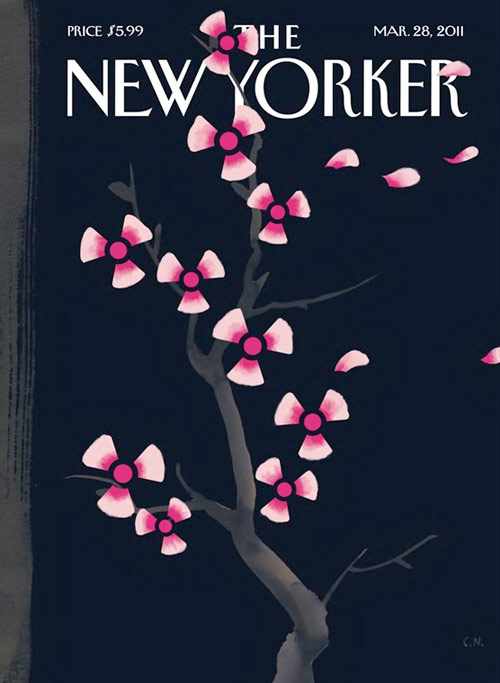
Lovely Japan-themed New Yorker cover this week by Christoph Niemann.
(via stellar)

This site is made possible by member support. 💞
Big thanks to Arcustech for hosting the site and offering amazing tech support.
When you buy through links on kottke.org, I may earn an affiliate commission. Thanks for supporting the site!
kottke.org. home of fine hypertext products since 1998.
Beloved by 86.47% of the web.
Lovely Japan-themed New Yorker cover this week by Christoph Niemann.
(via stellar)
That’s the title of an article written by Michael Lewis in 1989.
A big quake has hit Tokyo roughly every 70 years for four centuries: 1923, 1853, 1782, 1703, 1633.
(via @daveg)
I haven’t been keeping up with the Japan nuclear power plant situation as much as I want, but I wanted to pass along a few interesting articles. Over at Boing Boing, Maggie Koerth-Baker wrote a widely linked piece about how nuclear power plants work:
For the vast majority of people, nuclear power is a black box technology. Radioactive stuff goes in. Electricity (and nuclear waste) comes out. Somewhere in there, we’re aware that explosions and meltdowns can happen. Ninety-nine percent of the time, that set of information is enough to get by on. But, then, an emergency like this happens and, suddenly, keeping up-to-date on the news feels like you’ve walked in on the middle of a movie. Nobody pauses to catch you up on all the stuff you missed.
As I write this, it’s still not clear how bad, or how big, the problems at the Fukushima Daiichi power plant will be. I don’t know enough to speculate on that. I’m not sure anyone does. But I can give you a clearer picture of what’s inside the black box. That way, whatever happens at Fukushima, you’ll understand why it’s happening, and what it means.
MrReid, a physics teacher, writes about the situation at Fukushima:
Even with the release of steam, the pressure and temperature inside Unit 1 continued to increase. The high temperatures inside the reactor caused the protective zirconium cladding on the uranium fuel rods to react with steam inside the reactor to form zirconium oxide and hydrogen. This hydrogen leaked into the building that surrounded the reactor and ignited, damaging the surrounding building but without damaging the reactor vessel itself. Because the reactor vessel has not been compromised, the release of radiation should be minimal. It appears that a very similar situation has occurred at Unit 3 and that hydrogen is again responsible for the explosion seen there.
And this piece is a more meta take on the situation, What the Media Doesn’t Get About Meltdowns.
Of immediate concern is the prospect of a so-called “meltdown” at one or more of the Japanese reactors. But part of the problem in understanding the potential dangers is continued indiscriminate use, by experts and the media, of this inherently frightening term without explanation or perspective. There are varying degrees of melting or meltdown of the nuclear fuel rods in a given reactor; but there are also multiple safety systems, or containment barriers, in a given plant’s design that are intended to keep radioactive materials from escaping into the general environment in the event of a partial or complete meltdown of the reactor core. Finally, there are the steps taken by a plant’s operators to try to bring the nuclear emergency under control before these containment barriers are breached.
From the NY Times, Japan’s Strict Building Codes Saved Lives:
Had any other populous country suffered the 8.9 magnitude earthquake that shook Japan on Friday, tens of thousands of people might already be counted among the dead. So far, Japan’s death toll is in the hundreds, although it is certain to rise somewhat.
Over the years, Japan has spent billions of dollars developing the most advanced technology against earthquakes and tsunamis. The Japanese, who regularly experience smaller earthquakes and have lived through major ones, know how to react to quakes and tsunamis because of regular drills — unlike Southeast Asians, many of whom died in the 2004 Indian Ocean tsunami because they lingered near the coast despite clear warnings to flee.
Note: the title of the post is a reference to a tweet by Dave Ewing:
The headline you won’t see: “Millions saved in Japan by good engineering and government building codes”. But it’s the truth.
Google has built a quick little app for people trying to locate friends and family in Japan. There are two options: 1) “I’m looking for someone” and 2) “I have information about someone”.
Over at The Atlantic’s In Focus blog, Alan Taylor is compiling a selection of photos of the earthquake and tsunami in Japan. You’ve seen many of these on other sites, but not at these sizes (1280 pixels wide).
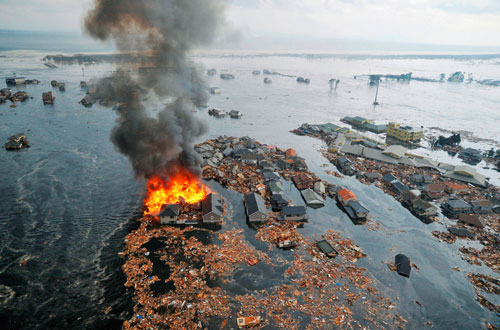
If you haven’t already heard, Al-Jazeera had (and continues to have) some of the best coverage of earthquake and tsunami in Japan. Here’s a clip from earlier showing the tsunami rushing through a populated area.
Contrast with CNN, which was apparently home to giggles and Godzilla jokes as the quake was being reported. In the last three or four big events in the world, Al-Jazeera has had the best coverage…is this a changing of the guard?
Update: Mediaite investigates and finds no evidence that a Godzilla reference or giggling occurred on CNN last night.
We did find an example of an American in Japan that made a reference that it was like a “monster movie” (which is included below) but Church handles herself completely appropriately.
Update: Mediaite found a video of the CNN broadcast in question where the anchor chuckles at something her interviewee says. And her whole tone sounds a bit more chipper than it ought to. The sing-song anchor voice might suffice when reporting non-news filler but fails when watching video of dozens of homes (possibly with people in them!) being swept along by a massive wave of water. (via @somebadideas)
Two videos of the tsunami triggered by the 8.9 magnitude eathquake that struck Japan. Both are from Sendai:
The quake is one of the most powerful ever to hit Japan.
The United States Geological Survey said the earthquake had a magnitude of 8.9, and occurred at about 230 miles northeast of Tokyo and at a revised depth of about 17 miles. The Japanese Meteorological Agency said the quake had a magnitude of 8.8, which would make it among the biggest in a century.
The quake occurred at 2:46 p.m. Tokyo time and hit off Honshu, Japan’s most populous island. The quake was so powerful that buildings in central Tokyo, designed to withstand major earthquakes, swayed.
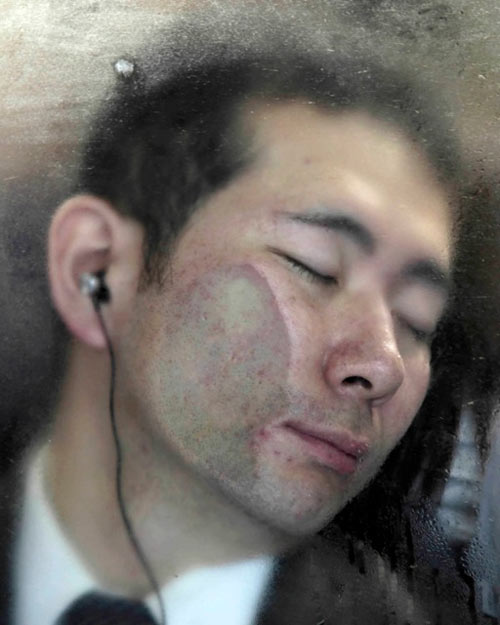
From photographer Michael Wolf — you might remember his Architecture of Density or 100x100 projects — a collection of photos of people pressed against fogged-up Tokyo subway windows.
(via coudal)
The Cove has been getting great reviews: four stars from Ebert (who calls it “a certain Oscar nominee”) and a score of 82 on Metacritic. A quick synopsis from Wikipedia followed by the trailer:
The Cove is a 2009 documentary film documenting the annual killing of more than 2,500 dolphins in a cove at Taiji, Wakayama in Japan. The film was directed by former National Geographic photographer Louis Psihoyos, and was filmed secretly during 2007 using underwater microphones and high-definition cameras disguised as rocks.
In remembrance of the mass destruction of life and property due to the dropping of the first atomic bomb on Hiroshima 64 years ago today, The Big Picture presents a typically excellent selection of photos.
Update: From Design Observer about a year ago, Hiroshima, The Lost Photographs.
Nisan is a balding 37-year-old man with gray hair and Nemutan is his girlfriend, a video game character printed on a pillow.
When I joined the couple for lunch at their favorite all-you-can-eat salad bar in the Tokyo suburb of Hachioji, he insisted on being called only by this new nickname, addressing his body-pillow girlfriend using the suffix “tan” to show how much he adored her. Nemutan is 10, maybe 12 years old and wears a little blue bikini and gold ribbons in her hair. Nisan knows she’s not real, but that hasn’t stopped him from loving her just the same. “Of course she’s my girlfriend,” he said, widening his eyes as if shocked by the question. “I have real feelings for her.”
2-D love has similarities to objectophilia. (via waxy)
A cyber cafe outside of Tokyo has been coverted into an apartment complex of sorts. “Cyber drifters” pay $500/month to live in the cafe’s computer cubicles.
Sure, it looks like Astro Boy with heartburn, but Kenji Yanobe’s Giant Torayan is not the kind of toy you leave with just any kid.
This GIANT TORATAN doll is the ultimate child’s weapon, as it sings, dances, breathes fire, and follows only those orders given by children.
Masterminded at Nagoya Institute of Technology, its Command Device uses voice-recognition technology to differentiate between instructions given by adults versus those given by younger evil geniuses.
Half-dragon, half-Mary Poppins, all awesome.
Photo essay of how Japanese knives get made by hand.
Japanese kitchen knives cost more than a camera, they can’t be washed in a machine, are subject to rusting and boy, they are so sharp that if you slip you’ll lose a finger or two before you can say banzai. There is no doubt that these are the best knives in the world. Nothing comes close to them in terms of sharpness. With one of these knives, you could slice fish so thin you could read a whole chapter of La Physiologie du Gout through the slices. Earlier this month, I had the chance to see how knives are made in Japan like they have been for the last 200 years.
(via serious eats)
At the Shibuya Pink Girl’s Club in Tokyo, men pay upwards of $130 to grope the girl of their choice on a simulated subway train.
The connoisseur picks out from the menu the girl of his choice, dressed either as a schoolgirl or office receptionist. This girl then beckons him through the window of a mock-up train carriage, which not only broadcasts station announcements, but even shakes and rattles.
Real-life incidents of subway train groping are on the decline, in part because more women are reporting them and the subway offering women-only cars during peak times.
A month after the bombing of Hiroshima in 1945, the US government imposed a code of censorship in Japan, which means that photos of the effects of the nuclear device are somewhat difficult to come by. Enter diner owner Don Levy of Watertown, MA.
One rainy night eight years ago, in Watertown, Massachusetts, a man was taking his dog for a walk. On the curb, in front of a neighbor’s house, he spotted a pile of trash: old mattresses, cardboard boxes, a few broken lamps. Amidst the garbage he caught sight of a battered suitcase. He bent down, turned the case on its side and popped the clasps.
He was surprised to discover that the suitcase was full of black-and-white photographs. He was even more astonished by their subject matter: devastated buildings, twisted girders, broken bridges — snapshots from an annihilated city. He quickly closed the case and made his way back home.
The photographs were taken by the US Strategic Bombing Survey immediately after the war and are now in the possession of the International Center of Photography. A copy of a report made by the US Strategic Bombing Survey is available online at the Truman Library.
As part of the Japanese census, people were asked to keep a record of what they were doing in 15 minute intervals. The data was publicly released and Jonathan Soma took it and graphed the results so that you can see what many Japanese are up to during the course of a normal day.
Sports: Women like swimming, but men eschew the water for productive sports, which is the most important Japanese invention.
Early to bed and early to rise… and early to bed: People start waking up at 5 AM, but are taking naps by 7:30 AM.
Fascinating.
Japanese face-scanning vending machines designed to distribute cigarettes only to those of legal age can be fooled by holding a photo of an of-age person in front of the scanner.
In an effort to curtail healthcare spending, the Japanese government is requiring companies to cut the number of overweight workers (and their dependents!) by 25% as of 2015. Companies which fail to do so will have to pay into a fund for elderly care.
Reduced exercise, the adoption of western foods and an aging population have made Japanese men about 10 percent heavier than they were 30 years ago, ministry statistics show. Women are 6.4 percent fatter.
The ministry estimates that half of men over age 40 and 20 percent of women will be diagnosed with metabolic syndrome. For men, a key yardstick is whether they have a waistline wider than 85 centimeters (33.5 inches). Body mass, cholesterol, blood pressure, blood sugar and smoking will also be taken into account.
Here’s a video of a car driving on Japan’s aforementioned melody roads. (thx, kyle)
The top 60 Japanese buzzwords and buzzphrases of 2007.
The term “monster parents” refers to Japan’s growing ranks of annoying parents who make extravagant and unreasonable demands of their children’s schools.
(via bb)
Japanese researchers have developed “melody roads” that play tunes when you drive on them. You could use this technique for traffic calming…i.e. the road plays music only when you’re driving the speed limit and hope that there’s no second-order melody that plays at two times the speed limit to entice highway hackers to speed for forbidden tunes.
Video of a Japanese game show where contestants have to clear hurdles while running on treadmills. There’s something Sisyphean about their task. No word on whether any of the contestants were able to take off.
A Japanese temple building company goes out of business after 1428 years. Kongo Gumi was founded in 578 and was the “world’s oldest continuously operating family business”.
Very much on the travel to-do list: head to Japan to see the cherry blossoms.
There are some goldfish in Japan that live in a functioning deep fat fryer. The frying oil floats above the water where the fish live and as long as they don’t try jumping out of their layer, they’re fine. A nice side effect of this arrangement is that the fish keep the fryer clean, eating whatever food scraps fall from the fryer above. (via cyn-c)
Socials & More