kottke.org posts about Donald Trump
The central point of Dr. Brooke Harrington’s essay about the destabilization of “basic systems we count on to make our society function” over the past month is bang on:
This promises to be a tough way for Americans to learn a critical fact too often overlooked: that one of our country’s greatest and least-appreciated assets has been public faith and trust in a variety of highly complex systems staffed by experts whose names we’ll never know. In fact, high levels of trust used to be one of our superpowers in the United States: specifically, that meant trust in our government to operate with reasonable competence and stability and without the kind of corruption that has hobbled other societies.
In this video, David Lynch talks about the effect of depression on creativity:
It stands to reason: the more you suffer, the less you want to create. If you’re truly depressed, they say you can’t even get out of bed, let alone create. It occupies the whole brain, poisons the artist, poisons the environment; little room for creativity.
But his assertion can be easily extended to how instability in one’s life leads to an inability to live fully. Stability and lack of corruption allows people to live their lives, make art, engage in commerce with each other, build families, and strive to be their best, authentic selves. The US has never been completely stable or uncorrupt, but we’re at real risk of losing something incredibly valuable here…and it’ll be difficult to get it back when it’s too far gone.
From David Wallace-Wells, a reminder that those who were considered alarmists at the beginning of the pandemic were ultimately proved right — it actually was an alarming situation.
Today, the official Covid death toll in the United States stands at 1.22 million. Excess mortality counts, which compare the total number of all-cause deaths to a projection of what they would have been without the pandemic, run a little higher — about 1.5 million.
In other words, the alarmists were closer to the truth than anyone else. That includes Anthony Fauci, who in March 2020 predicted 100,000 to 200,000 American deaths and was called hysterical for it. The same was true of the British scientist Neil Ferguson, whose Imperial College model suggested that the disease might ultimately infect more than 80 percent of Americans and kill 2.2 million of us. Thankfully, the country was vaccinated en masse long before 80 percent were infected…
I’m also going to point out that those who were labeled alarmists about the impact of Donald Trump’s presidencies were also “closer to the truth than anyone else”, certainly closer than all those centrist “pundits”. I’m particularly thinking of those who knew when they woke up on November 9th to a Trump victory that Roe v Wade was toast and that Americans’ civil rights would be taken away and were called “hysterical” (there’s that word again) for saying so.
For the Atlantic, Adam Serwer writes about the Great Resegregation, the attempt by the Trump administration to reverse the civil rights movement.
If the Great Resegregation proves successful, it will restore an America past where racial and ethnic minorities were the occasional token presence in an otherwise white-dominated landscape. It would repeal the gains of the civil-rights era in their entirety. What its advocates want is not a restoration of explicit Jim Crow segregation—that would shatter the illusion that their own achievements are based in a color-blind meritocracy. They want an arrangement that perpetuates racial inequality indefinitely while retaining some plausible deniability, a rigged system that maintains a mirage of equal opportunity while maintaining an unofficial racial hierarchy. Like elections in authoritarian countries where the autocrat is always reelected in a landslide, they want a system in which they never risk losing but can still pretend they won fairly.
Like CRT before it, DEI has become conservatives’ go-to cover for their discriminatory actions:
The term DEI, frequently invoked by the Trump administration, functions as a smoke screen. It allows people to think that the Trump administration’s anti-DEI purge is about removing pointless corporate symbolism or sensitivity trainings. Although it is easy to find examples of DEI efforts that are ill-conceived or ill-applied, some conservatives have leveraged those criticisms to pursue a much broader agenda that is really about tearing anti-discrimination laws out at the roots, so that businesses and governments are free to extend or deny opportunities based on race, gender, and sexual orientation if they so choose.
Karen Attiah recently wrote about resegregation as well: The assault on DEI? It’s aimed at resegregation.
Across the United States, in government agencies and private corporations, leaders are scrambling to eliminate DEI programs. President Donald Trump is not only destroying any trace of diversity work within the government: He has ordered a review of federal contracts to identify any companies, nonprofits and foundations that do business with the government and keep their diversity, equity and inclusion programs, and he has warned that they could be the target of investigations.
Let’s call this what it really is: resegregation.

The Guardian profiled a number of people fired from the agencies that manage federal lands - the US Forest Service, Bureau of Land Management, etc. — purged from their jobs by the Trump/Musk administration.
Victoria Winch, US Forest Service wilderness forestry technician, Flathead national forest, Spotted Bear ranger district, adjacent to Glacier national park, Montana:
People come on to these lands to hunt, to feed their families. People are allowed to get firewood. Outfitters, who are a big part of the local economy, use these trails.
But every single field person at Spotted Bear was terminated. Those trails won’t get cleared this year. And it takes less than one season for them to be totally impassable.
Nick Massey, USFS wilderness Ranger, Pisgah national forest, North Carolina:
We were very, very busy with public interaction, conversations, giving directions, educating. I would come up on folks quite often who were either lost or having some sort of emergency, and I’m also a member of two mountain rescue teams in the area.
I really loved seeing so many different people from different walks of life. Being able to be a part of that wilderness experience that people are having was really, truly magical.
Other fired federal land and National Park employees have been sharing their stories with media and on social media, highlighting how little these purges are about saving money and much more about all the services and benefits that Americans will be losing that we paid for. (Their stories also highlight the lies about employees not being fit for their jobs being used as the pretext to fire them. And the lack of due process. And, and, and…) Here are a few of those stories.
Brian Gibbs, Educational Park Ranger at Effigy Mounds National Monument:
I am a father, a loving husband, & dedicated civil servant.
I am an oath of office to defend and protect the constitution from all enemies foreign and domestic.
I am a work evaluation that reads “exceeds expectations.”
I am the “fat on the bone.”
I am being trimmed as the consequence of the popular vote
I am the United States flag raiser & folder
I am my son’s “Junior Ranger” idol
I am a college kid’s dream job
Alex Wild, park ranger:
Today I lost my dream job as a permanent park ranger in the NPS. I’m still in shock, and completely devastated. I have dedicated my life to being a public servant, teacher, and advocate for places that we ALL cherish. I have saved lives and put my own life at risk to serve my community.
I honestly can’t imagine how the parks will operate without my position. I mean, they just can’t. I am the only EMT at my park and the first responder for any emergency. This is flat-out reckless.
The NY Times published an overview of the firings and their effect on federal land management, including interviews with purged employees:
Arianna Knight, 29, of Bozeman, Mont., the wilderness trails supervisor for the Yellowstone District of the Custer Gallatin National Forest, was let go on Feb. 14 along with more than 30 other Custer Gallatin employees. Ms. Knight said she and two workers under her supervision typically cleared 4,000 downed trees and logs from hundreds of miles of trails each year, often hiking and using hand tools for a week at a time in wilderness areas, where federal law prohibits motorized vehicles and mechanized tools like chain saws.
Now those trails won’t be cleared, Ms. Knight said, adding, “People are going to suffer.”
And:
While it may seem as if the cuts will mean fewer people trampling through the parks, allowing ecosystems to regenerate, some fear the opposite: that less oversight and control over huge crowds may damage the parks for seasons to come.
Adam Auerbach, 32, a former park ranger at Rocky Mountain National Park, said visitor numbers at the park has been climbing consistently for decades, to more than four million in 2023 from 2.6 million in 1990. The park has had to institute a timed-entry permit system to control the numbers.
With the new cuts, he said, “There will be fewer rangers on the ground to enforce regulations and fewer public educators to help the public even understand the regulations and the reasons for them in the first place.”
From a news release by the Association of National Park Rangers:
Rick Mossman, president of the Association of National Park Rangers (ANPR) said, “These actions will hurt visitors and the parks they travelled to see across the United States. If a visitor is involved in an automobile accident in Badlands National Park in South Dakota, or has their car broken into at a trailhead in Rocky Mountain National Park in Colorado, there will be a delay in the response by a ranger to investigate — or perhaps no response at all. If a visitor suffers a medical emergency while hiking in Grand Canyon National Park in Arizona, ranger response could be delayed.”
Mossman went on to say that visitors are likely to experience reduced hours or days — and even closures — of visitor centers and other public-use facilities. Ranger-led educational programs will be reduced or eliminated. Trash and litter may accumulate, and restrooms will be dirtier because of reduced maintenance and fewer custodial workers. There could even be complete closures of some parts of parks to protect visitors and those park resources.
From the National Parks Conservation Association:
In a phone interview, Moxley said she had to walk away from a year’s worth of research and work on wetland restoration, invasive plant documentation and funding efforts to save Harper Ferry’s remaining hemlock trees from a devastating invasive insect called a woolly adelgid.
Adding that she speaks on behalf of herself and not Harpers Ferry or the National Park Service, Moxley said parks — large and small — have behind-the-scenes staff who work to protect natural habitats, historic structures and museum objects and exhibits.
“Visitors don’t usually encounter us, but without us, there would not be sites to enjoy,” Moxley said. “Without staff, the National Park Service will be unable to carry out its 100+ year mission to leave the parks unimpaired for the enjoyment of future generations. This is a mission my colleagues and I take seriously.”
Russell Vought is a Christian nationalist, a significant contributor to Project 2025, the policy director of the RNC’s platform committee for the 2024 election, and is currently the director of the Office of Management and Budget and the Consumer Financial Protection Bureau.
In 2023, he gave a private speech at a meeting of his Center for Renewing America think tank in which he describes the goal of the purge of governmental employees that’s happening right now. A short clip of the speech obtained by ProPublica:
A transcript:
We want the bureaucrats to be traumatically affected. When they wake up in the morning, we want them to not want to go to work because they are increasingly viewed as the villains. We want their funding to be shut down so that the EPA can’t do all of the rules against our energy industry because they have no bandwidth financially to do so. We want to put them in trauma.
From the accompanying article:
In his 2024 speech, Vought said he was spending the majority of his time helping lead Project 2025 and drafting an agenda for a future Trump presidency. “We have detailed agency plans,” he said. “We are writing the actual executive orders. We are writing the actual regulations now, and we are sorting out the legal authorities for all of what President Trump is running on.”
Vought laid out how his think tank is crafting the legal rationale for invoking the Insurrection Act, a law that gives the president broad power to use the military for domestic law enforcement. The Washington Post previously reported the issue was at the top of the Center for Renewing America’s priorities.
“We want to be able to shut down the riots and not have the legal community or the defense community come in and say, ‘That’s an inappropriate use of what you’re trying to do,’” he said. Vought held up the summer 2020 unrest following George Floyd’s murder as an example of when Trump ought to have had the ability to deploy the armed forces but was stymied.
In another video, Vought stated that the “entire apparatus” of the US government was vulnerable and “exposed to our strategy”. And in this one, he talks about the president’s need to be able to ignore laws.
Over at Vox, Zack Beauchamp wrote about Vought today too: The obscure manifesto that explains the Trump-Musk power grab.
In 2022, Vought published an essay in the American Mind, a publication of the arch-Trumpist Claremont Institution, that provides an answer to some of these questions. Read properly, it serves as kind of a Rosetta stone for the early days of the Trump administration — explaining the logic behind the contemptuous lawbreaking that has become its trademark.
Beauchamp continues:
Vought believes that executive agencies have, with Congress and the courts’ blessing, usurped so much power that the Constitution is no longer in effect. He believes that presidents have a duty to try and enforce the true constitution, using whatever novel arguments they can dream up, even if the rest of the government might reject them. And he believes that threatening to ignore the Supreme Court isn’t a lawless abuse of power, but rather the very means by which the separation of powers is defended.
Russell Vought can call this whatever he wants, but it’s fairly clear what it amounts to: a recipe for a constitutional crisis. And it’s one the president currently appears to be following to a tee.
You should read both articles in their entirety.
Part of what this underscores for me is that this is not just Elon Musk’s coup. Musk seems to be following his own playbook but it’s clear that there are multiple, intersecting, mutually beneficial things going on there with Trump, Musk, Vought, and many Republican members of Congress. As Osita Nwanevu wrote recently in the Guardian:
Democratic republican governance will never be secured in America without turning our attention to the structure of our economic system as well. Dismantling the federal government to prevent that from happening was a key object of the conservative project before Trump. It has remained so with him at the head of the Republican party and will remain so whenever his time is up.
Not sure what else to say about this…their plan is all laid out in Vought’s remarks and in Project 2025. They’ve crossed some of this stuff off of the checklist already, so I guess we should be on the lookout for the rest of it, e.g. when/if protesting ramps up as the weather warms, we should expect Trump to invoke the Insurrection Act and attempt to use the US military to quell dissent.
This afternoon on Twitter, the official White House account posted an ASMR video of an immigrant deportation flight. Elon Musk quoted-tweeted the video with “Haha wow 🧌🏅”. Here’s a screen recording I made of the video & tweet:
A popular genre on YouTube, ASMR videos are designed to trigger feelings of relaxation and low-grade euphoria through sounds and imagery. In this video, the Trump White House invites us to relax to the clinking of handcuffs, the rattling of chains, and other sounds of immigrants being shackled like criminals and placed on flights out of the country. Some of those being deported are not criminals, are being imprisoned in countries other than their own, could be sent to a detention center in Guantanamo Bay, or might be sent back to countries with autocratic regimes to face persecution or death.
This is unfathomably cruel and monstrous. Vile. Evil. The stuff of sadistic dictators and terrorists. Nazis. People who killed cats for fun when they were kids. From the top down, the people serving in the Trump administration are sick, inhuman, heartless. This video absolutely gutted me. I am so very ashamed to be an American today. (via @rebeccasolnit.bsky.social)
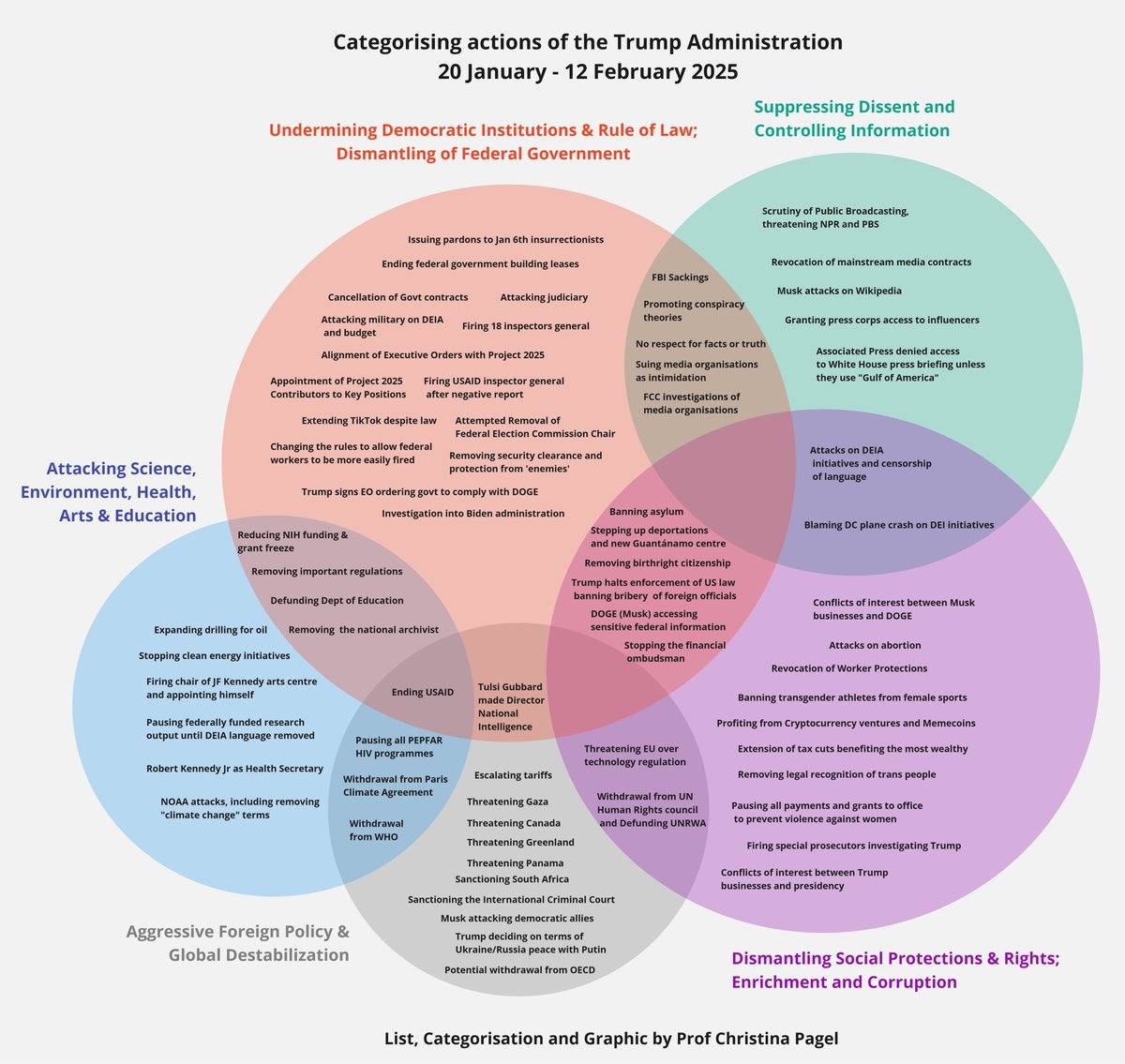
Professor Christina Pagel of University College London has mapped the actions of the Trump administration’s first few weeks into a Venn diagram (above) with “five broad domains that correspond to features of proto-authoritarian states”:
- Undermining Democratic Institutions & Rule of Law; Dismantling federal government
- Dismantling Social Protections & Rights; Enrichment & Corruption
- Suppressing Dissent & Controlling Information
- Attacking Science, Environment, Health, Arts & Education
- Aggressive Foreign Policy & Global Destabilization
This diagram is available as a PDF and the information is also contained in this categorized table. Links and commentary from Pagel can be found on Bluesky as well.
Also very helpful is this list of authoritarian actions that the Trump administration has taken, each with a link to the relevant news story. I will be referring back to this list often in the coming weeks.
Jamelle Bouie has started posting video essays on his YouTube channel about the current US political crisis. His latest one is an adaptation of his NY Times piece, There Is No Going Back.
Now, even if Musk had been elected to office, this would still be one of the worst abuses of power in American history. That is unquestionable. No one in the executive branch has the legal authority to unilaterally cancel congressional appropriations. No one has the legal authority to turn the Treasury payment system into a means of political retribution. No one has the authority to summarily dismiss civil servants without cause. No one has the authority to take down and scrub Americans’ data unilaterally. And no private citizen has the authority to access some of the most sensitive data the government collects on private citizens for their own unknown and probably nefarious purposes.
Bouie has also regularly been posting videos to his Instagram (bio: “National program director of the CHUM Group”) and TikTok.
This piece at The Verge from Elizabeth Lopatto is a great recap of Elon Musk’s coordinated attack on the infrastructure of the US federal government. I particularly appreciate the dozens of links throughout the piece that provide context for the text, a demonstration of the powerful utility of hypertext.
But I do have a criticism and I think it’s an important one: this is not solely Elon Musk’s coup. Here’s the lede:
Almost 250 years after the Declaration of Independence, America has gotten herself a new king. His name is Elon Musk.
“Wait a minute,” you may be saying. “What about President Donald Trump?” Trump ran, much like Silvio Berlusconi before him, primarily to avoid prosecutions. He has never liked being president and he has already gotten what he wants. He’s not the power center. Musk is.
Consequently I will not be bothering with whatever statements Katie Miller of DOGE and White House Press Secretary Karoline Leavitt are putting out. We all have eyes; we can see what is going on. Musk has taken over the civilian government. This is a billionaire pulling a heist on the entire nation.
The Verge is not alone in asserting this — Carole Cadwalladr’s latest piece is almost entirely about Musk’s actions. While I agree that Musk is the sharp end of the spear and what he’s doing (and has already done) is of unprecedentedly massive concern, this single villain view of the coup is incomplete, for two main reasons:
- The executive branch is fully participating in the coup. Musk is acting on behalf of Trump and with his public approval. This cover matters, even if Trump isn’t actively directing what Musk is doing (he surely isn’t), even if Trump doesn’t actually know what exactly Musk is up to and why (he probably doesn’t), and whether Musk’s and Trump’s agendas overlap (only partially).
Additionally, through his executive orders, Trump is also attempting to seize governmental power that doesn’t reside in the office of the president. The data & systems that Musk now has access to will be useful to Trump in executing these power seizures. The chaos Musk is creating will also be useful in distracting from Trump’s own authoritarian objectives.
- In standing by and allowing Trump & Musk to seize power that is not constitutionally theirs, the Republican-controlled Congress is fully participating in the coup. Most of the power being grabbed here is that of Congress…and they are just letting it happen.
Let me put it this way: let’s say this afternoon Elon Musk is somehow stopped, fired, thrown out of the country, divested of all his companies. The coup would continue. Perhaps not as vigorously as before, but it would continue because the executive branch and Congress are fully on board. It’s important that we don’t lose sight of this larger picture.
This fantastic two-minute video, from a guy named Rich, neatly explains why the anger and frustration of Trump’s supporters has been growing over time — why the pushback on things like diversity, equity, inclusion, trans rights, and LGBTQ+ issues seems to be increasing and the hate grows more overt. It has to do with an idea called an extinction burst.
Here’s a transcript of the video:
The Trump spike in racism, sexism, and hate — it’s the emotional foundation for the entire Make America Great Again movement, that nostalgia for when life in America was simpler and paler. But as soon as we began addressing it — boom! extinction burst.
This term is why I love science so much. You can take an idea from one field, like psychology for example, and apply it to another field, like political science, and the principles still apply.
Extinction burst is actually really simple. It’s when you have a behavior and a reward, and you withdraw the reward in order to change the behavior. When you do that, usually to change an undesirable behavior, the behavior itself increases in frequency and intensity for a short period of time until ultimately the subject changes the behavior and then that behavior goes extinct.
This is like you’re at the store and you’re swiping your credit card, and it doesn’t work, and so then you swipe your credit card like 15 more times until you’re so angry you’re freaking out, and you’re about to scream an F-bomb in the middle of Toys R Us. And then you say, “I’ll just pay with cash”. Swiping is the behavior and the payment is the reward. So when the swiping doesn’t work and you don’t get the reward you need, you get madder and madder and you try it more and more until you change the behavior, which then results in the extinction of the original behavior.
Now, extinction burst at the national level is much slower, but in this case we actually know very clearly what triggered it: it was Obama’s election in 2008. Sarah Palin, the Tea Party Movement, the birther movement, and ultimately MAGA. It is a 10-year tsunami of rage in the face of inevitable extinction.
This is why Republicans are still so angry. They know they know Trump winning can’t stop it, and they know Trump in office can’t stop it — they can feel the inevitable extinction of their own terrible beliefs.
At this point, the only thing that’ll stop it is if we let up. If you stop interfering with that undesirable behavior, it will go back to normal. So no, you’re not crazy; yes, you are doing the right thing; and yes, if you persevere, the extinction burst will end.
Note that this isn’t an explanation of where the Tea Party & MAGA movements came from; many people have written about how MAGA can be understood as a reaction to Obama’s election — subsequent events like Black Lives Matter, the Me Too movement, the election of a Black woman as vice-president, the legalization of gay marriage, etc. have kept the indignities coming.
Rather, the extinction burst concept explains why the reaction seems to be getting more extreme, from QAnon to an increased number of book bans to anti-trans laws to anti-abortion laws to Elon Musk doing Nazi salutes in public to openly expressed racism by many Republican politicians to January 6th to the 2025 Coup. We are seeing behavior that 15-20 years ago would have been almost unthinkable — now it’s daily. They are swiping the card and getting madder and madder.
You can read more about extinction bursts, including some examples of extinction bursts in children:
Tantrums: A child who has learned that tantrums result in attention from their parents may initially escalate their tantrum behavior when their tantrums are no longer reinforced. This escalation is an extinction burst, as the child is attempting to regain the attention they once received.
Protesting: When a person has been reinforced by being excused from a task or activity, they may initially increase their protest behaviors, such as whining or arguing, when the reinforcement is no longer provided. This increase in protest behavior is an extinction burst.
Persistence: In some cases, individuals may persistently engage in a behavior that previously led to reinforcement, even if the reinforcement is no longer present. For example, a child who used to receive a treat for asking repeatedly may continue to ask repeatedly, hoping for the treat, even when the treat is no longer given. This persistence is an extinction burst.
And in adults:
Cell Phone Addiction: If an individual is accustomed to receiving instant gratification through social media notifications on their cell phone, they may experience an extinction burst when they attempt to reduce their screen time. They may initially intensify their checking behavior, hoping to regain the previous level of reinforcement.
Gambling: In the context of gambling, an individual who has previously experienced wins and rewards may exhibit an extinction burst if they suddenly stop winning. They may increase their gambling behavior, hoping to recreate the past reinforcement.
Smoking Cessation: When someone tries to quit smoking, they may experience an extinction burst in the form of increased cravings and even heightened smoking behavior. This burst occurs because the expected reinforcement (nicotine) is no longer being received, leading to an initial escalation in smoking behavior.
(via @karenattiah.bsky.social)
Charlie Warzel and Ian Bogost from The Atlantic talked to four experienced federal-government IT professionals who have all “built, modified, or maintained the kind of technological infrastructure” that Elon Musk’s team of young hackers are attacking. They are beyond concerned about the potential consequences.
Based on what has been reported, DOGE representatives have obtained or requested access to certain systems at the U.S. Treasury, the Department of Health and Human Services, the Office of Personnel Management, and the National Oceanic and Atmospheric Administration, with eyes toward others, including the Federal Aviation Administration. “This is the largest data breach and the largest IT security breach in our country’s history—at least that’s publicly known,” one contractor who has worked on classified information-security systems at numerous government agencies told us this week. “You can’t un-ring this bell. Once these DOGE guys have access to these data systems, they can ostensibly do with it what they want.”
What exactly they want is unclear. And much remains unknown about what, exactly, is happening here. The contractor emphasized that nobody yet knows which information DOGE has access to, or what it plans to do with it. Spokespeople for the White House, and Musk himself, did not respond to emailed requests for comment. Some reports have revealed the scope of DOGE’s incursions at individual agencies; still, it has been difficult to see the broader context of DOGE’s ambition.
The four experts laid out the implications of giving untrained individuals access to the technological infrastructure that controls the country. Their message is unambiguous: These are not systems you tamper with lightly. Musk and his crew could act deliberately to extract sensitive data, alter fundamental aspects of how these systems operate, or provide further access to unvetted actors. Or they may act with carelessness or incompetence, breaking the systems altogether. Given the scope of what these systems do, key government services might stop working properly, citizens could be harmed, and the damage might be difficult or impossible to undo. As one administrator for a federal agency with deep knowledge about the government’s IT operations told us, “I don’t think the public quite understands the level of danger.”
For example:
Many systems and databases in a given agency feed into others, but access to them is restricted. Employees, contractors, civil-service government workers, and political appointees have strict controls on what they can access and limited visibility into the system as a whole. This is by design, as even the most mundane government databases can contain highly sensitive personal information. A security-clearance database such as those used by the Department of Justice or the Bureau of Alcohol, Tobacco, Firearms and Explosives, one contractor told us, could include information about a person’s mental-health or sexual history, as well as disclosures about any information that a foreign government could use to blackmail them.
Karen Attiah wrote a short opinion piece about how the nationwide assault on diversity, equity and inclusion led by conservatives is actually aimed at resegregation and how being precise in our language about what’s happening is crucial.
These facts, taken together, point to the removal of Black people from academic, corporate and government spaces: resegregation.
People are vowing to push back with their wallets — to shop at Costco and boycott Target, for example. But I believe the fight starts with language. Journalists have a role and an obligation to be precise in naming what we are facing.
Frankly, I wish the media would stop using “DEI” and “diversity hiring” altogether. Any official, including the president, who chooses to blame everything from plane crashes to wildfires on non-White, non-male people should be asked whether they believe that desegregation is to blame. Whether they believe resegregation is the answer. We need to bring back the language that describes what is actually happening.
When I write about difficult or contentious topics where I want to take great care to not be misunderstood and to be as accurate as I can be, I always think about this piece by history professor Michael Todd Landis on the language we use to talk about the Civil War & slavery.
Specifically, let us drop the word “Union” when describing the United States side of the conflagration, as in “Union troops” versus “Confederate troops.” Instead of “Union,” we should say “United States.” By employing “Union” instead of “United States,” we are indirectly supporting the Confederate view of secession wherein the nation of the United States collapsed, having been built on a “sandy foundation” (according to rebel Vice President Alexander Stephens). In reality, however, the United States never ceased to exist. The Constitution continued to operate normally; elections were held; Congress, the presidency, and the courts functioned; diplomacy was conducted; taxes were collected; crimes were punished; etc. Yes, there was a massive, murderous rebellion in at least a dozen states, but that did not mean that the United States disappeared.
Landis notes that scholar Edward Baptist also uses different language:
In his 2014 book The Half Has Never Been Told: Slavery and the Making of American Capitalism (Basic Books), he rejects “plantations” (a term pregnant with false memory and romantic myths) in favor of “labor camps”; instead of “slave-owners” (which seems to legitimate and rationalize the ownership of human beings), he uses “enslavers.” Small changes with big implications. These far more accurate and appropriate terms serve his argument well, as he re-examines the role of unfree labor in the rise of the United States as an economic powerhouse and its place in the global economy. In order to tear down old myths, he eschews the old language.
German museums and public remembrances of the Holocaust use similarly precise language:
Just as important, the language they used on the displays in these places was clear and direct, at least in the English translations. It was almost never mealy-mouthed language like “this person died at Treblinka”…like they’d succumbed to natural causes or something. Instead it was “this person was murdered at Treblinka”, which is much stronger and explicitly places blame on the Nazis for these deaths.
This is why I’ve been so insistent on describing the events of January 6, 2021 as an attack on Congress and as a coup attempt:
This was not an attack on the Capitol Building. This was an attack on Congress, the United States Government, and elected members of our government. It was a coup attempt. Can you imagine what the mob in those videos would have done had they found Nancy Pelosi? Kidnapping or a hostage situation at the very least, assassination in the worst case. Saying that this was an “attack on the Capitol” is such an anodyne way of describing what happened on January 6th that it’s misleading. Words matter and we should use the correct ones when describing this consequential event.
In writing about the 2025 Coup, I’ve been careful to call it a coup because it is. I’ve been repeating words like “illegal” and “unconstitutional” because these actions attacks by Trump and Musk are just that. Our government’s computing systems have been “seized” or “broken into to” or “hacked” (illegal!) rather than “accessed” (sounds routine). In his piece yesterday, Jamelle Bouie argued for more precision in how we describe the coup:
To describe the current situation in the executive branch as merely a constitutional crisis is to understate the significance of what we’re experiencing. “Constitutional crisis” does not even begin to capture the radicalism of what is unfolding in the federal bureaucracy and of what Congress’s decision not to act may liquidate in terms of constitutional meaning.
One of the reason people get so upset at media like the NY Times and Washington Post is because the language they often use is so watered down that it’s actually not truthful. Take the initial opening paragraph to this NYT piece about Trump’s statement about wanting to ethnically cleanse Gaza:
President Trump declared on Tuesday that he would seek to permanently displace the entire Palestinian population of Gaza and take over the devastated seaside enclave as a U.S. territory, one of the most audacious ideas that any American leader has advanced in years.
(They later changed “audacious” to “brazen”.) Audacious? Brazen? Advanced? Ideas? These words all have meanings! And when you put them together, it makes Trump sound like some genius superhero statesman. And “seaside enclave”? That is technically correct but it sounds like they’re talking about fucking Montauk. This is terrible writing that fails to communicate the truth of the situation.
Here’s why this matters: imprecise and euphemistic language is the language of fascists, authoritarians, and oppressors — power-craving leaders who either don’t want people to know what they are doing or don’t want them to think too hard about the illegality or immorality of their actions. The Nazis had all kinds of euphemisms — the “Final Solution to the Jewish Question”, “protective custody”, “work-shy”, “enhanced interrogation” — to mask their mass imprisonment activities and mass murder.
In 1946, Nineteen Eighty-Four author George Orwell published an essay called Politics and the English Language in which he decried the “lack of precision” of political writing:
Each of these passages has faults of its own, but, quite apart from avoidable ugliness, two qualities are common to all of them. The first is staleness of imagery; the other is lack of precision. The writer either has a meaning and cannot express it, or he inadvertently says something else, or he is almost indifferent as to whether his words mean anything or not. This mixture of vagueness and sheer incompetence is the most marked characteristic of modern English prose, and especially of any kind of political writing. As soon as certain topics are raised, the concrete melts into the abstract and no one seems able to think of turns of speech that are not hackneyed: prose consists less and less of words chosen for the sake of their meaning, and more and more of phrases tacked together like the sections of a prefabricated hen-house.
And from his concluding paragraph:
…one ought to recognize that the present political chaos is connected with the decay of language, and that one can probably bring about some improvement by starting at the verbal end. If you simplify your English, you are freed from the worst follies of orthodoxy. You cannot speak any of the necessary dialects, and when you make a stupid remark its stupidity will be obvious, even to yourself. Political language — and with variations this is true of all political parties, from Conservatives to Anarchists — is designed to make lies sound truthful and murder respectable, and to give an appearance of solidity to pure wind. One cannot change this all in a moment, but one can at least change one’s own habits…
You can read Orwell’s whole essay here.
I don’t always succeed, but I try really hard to use precise, concrete language in my writing. As Attiah urges, we should want and expect our media to do the same — anything less is an abdication of their duty to their readers to tell them the truth.
Historian Timothy Snyder, author of On Tyranny, is urging people and the media to understand and acknowledge that what’s happening right now is definitely a coup.
Imagine if it had gone like this.
Ten Tesla cybertrucks, painted in camouflage colors with a giant X on each roof, drive noisily through Washington DC. Tires screech. Out jump a couple of dozen young men, dressed in red and black Devil’s Champion armored costumes. After giving Nazi salutes, they grab guns and run to one government departmental after another, calling out slogans like “all power to Supreme Leader Skibidi Hitler.”
Historically, that is what coups looked like. The center of power was a physical place. Occupying it, and driving out the people who held office, was to claim control. So if a cohort of armed men with odd symbols had stormed government buildings, Americans would have recognized that as a coup attempt.
And that sort of coup attempt would have failed.
Now imagine that, instead, the scene goes like this.
A couple dozen young men go from government office to government office, dressed in civilian clothes and armed only with zip drives. Using technical jargon and vague references to orders from on high, they gain access to the basic computer systems of the federal government. Having done so, they proceed to grant their Supreme Leader access to information and the power to start and stop all government payments.
That coup is, in fact, happening. And if we do not recognize it for what it is, it could succeed.
This long post by Mike Brock at Techdirt does a great job in laying out the many reasons why we should be concerned about Elon Musk’s power grab. Here’s just part of the section about all of the federal laws he is breaking:
When Congress passed 18 U.S.C. § 208, they were imagining scenarios where federal officials might have access to some information that could affect their private interests. But Musk’s situation goes far beyond anything the drafters likely contemplated—he has gained access to the actual machinery of government while simultaneously running multiple companies directly affected by that machinery.
Consider what this means in practice: Through DOGE, he has access to sensitive Treasury data while running public companies whose stock prices could be affected by that information. He can see classified materials while controlling SpaceX, which competes for national security contracts. He has visibility into federal agency operations while owning a social media platform that shapes public discourse about those agencies.
The Ethics in Government Act and STOCK Act were designed to prevent federal officials from using nonpublic information for private gain. But Musk isn’t just getting occasional access to sensitive information — he’s gained unprecedented access to core government systems while maintaining control of companies worth hundreds of billions of dollars. The potential for using this access to benefit his private interests isn’t incidental — it’s systematic and structural.
I really appreciate Heather Cox Richardson’s daily newsletter for providing historical context to what’s happening right now. In this morning’s letter, after summarizing the Musk/Trump attacks on our government (most of which I linked to yesterday), Richardson talks about the history of the liberal consensus, the post-WWII agreement about how government should be deployed and how that consensus is coming to an end (gradually, then suddenly).
Musk’s takeover of the U.S. government to override Congress and dictate what programs he considers worthwhile is a logical outcome of forty years of Republican rhetoric. After World War II, members of both political parties agreed that the government should regulate business, provide a basic social safety net, promote infrastructure, and protect civil rights. The idea was to use tax dollars to create national wealth. The government would hold the economic playing field level by protecting every American’s access to education, healthcare, transportation and communication, employment, and resources so that anyone could work hard and rise to prosperity.
Businessmen who opposed regulation and taxes tried to convince voters to abandon this system but had no luck. The liberal consensus—”liberal” because it used the government to protect individual freedom, and “consensus” because it enjoyed wide support—won the votes of members of both major political parties.
But those opposed to the liberal consensus gained traction after the Supreme Court’s 1954 Brown v. Board of Education of Topeka, Kansas, decision declared segregation in the public schools unconstitutional. Three years later, in 1957, President Dwight D. Eisenhower, a Republican, sent troops to help desegregate Central High School in Little Rock, Arkansas. Those trying to tear apart the liberal consensus used the crisis to warn voters that the programs in place to help all Americans build the nation as they rose to prosperity were really an attempt to redistribute cash from white taxpayers to undeserving racial minorities, especially Black Americans. Such programs were, opponents insisted, a form of socialism, or even communism.
That argument worked to undermine white support for the liberal consensus. Over the years, Republican voters increasingly abandoned the idea of using tax money to help Americans build wealth.
Newer posts
Older posts





Socials & More