



A list of sports teams named after technology, including the Detroit Pistons, the Houston Rockets, the San Antonio Spurs, and the Brooklyn Nets. Additions welcome.

Advertise here with Carbon Ads
This site is made possible by member support. 💞
Big thanks to Arcustech for hosting the site and offering amazing tech support.
When you buy through links on kottke.org, I may earn an affiliate commission. Thanks for supporting the site!
kottke.org. home of fine hypertext products since 1998.
Beloved by 86.47% of the web.
Entries for April 2024
The NY Times’ coverage of trans people and issues has been awful. Two-thirds of stories about anti-trans legislation failed to quote trans people and “another 18% of such articles included anti-trans misinformation with no fact-checking”.

A Graph of Solar Eclipse Coolness: Totality or GTFO
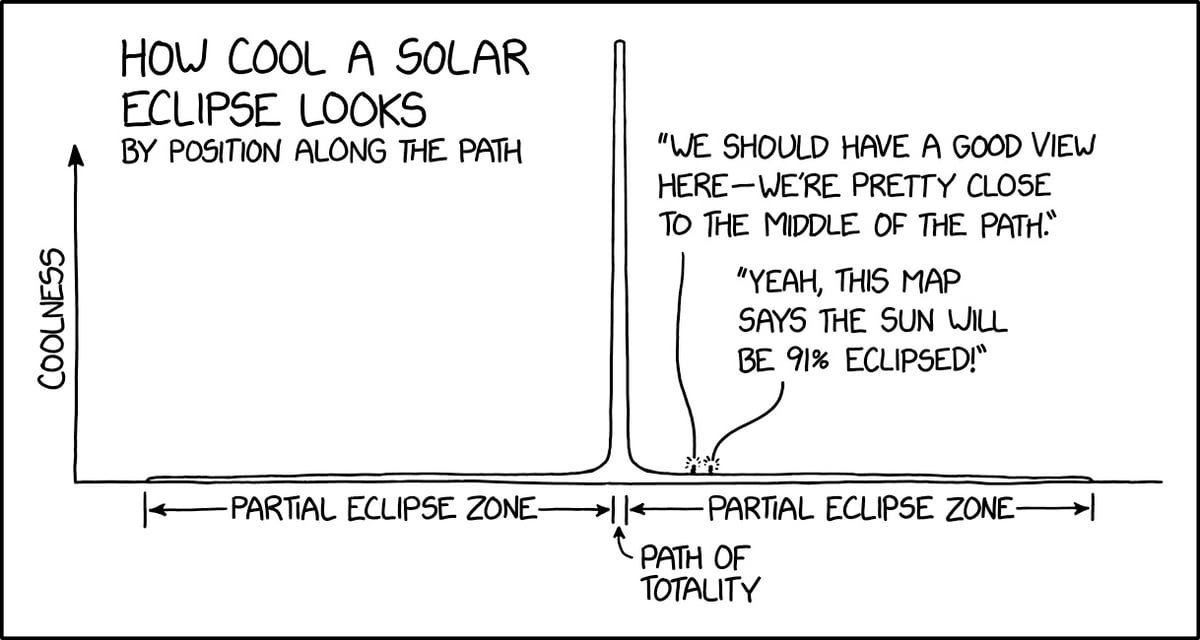
As usual, XKCD is spot on with this graph of solar eclipse coolness as a function of distance from the path of totality. The image’s alt text reads:
A partial eclipse is like a cool sunset. A total eclipse is like someone broke the sky.
See also the 2017 version. After witnessing the 2017 total solar eclipse, I wrote:
We saw the Baily’s beads and the diamond ring effect. And then…sorry, words are insufficient here. When the Moon finally slipped completely in front of the Sun and the sky went dark, I don’t even know how to describe it. The world stopped and time with it. During totality, Mouser took the photo at the top of the page. I’d seen photos like that before but had assumed that the beautifully wispy corona had been enhanced with filters in Photoshop. But no…that is actually what it looks like in the sky when viewing it with the naked eye (albeit smaller). Hands down, it was the most incredible natural event I’ve ever seen.
I’m not sure exactly what I expected, but this wasn’t it. I’d seen photos of coronas around suns, but this wasn’t that. And I’d expected that those photos, like many astronomical pictures, are long exposure, other wavelengths, and otherwise capturing things the naked eye can’t see. I thought there might be a glow of light in a circle, or nothing, or, I don’t know. What I did not expect was an unholy horror sucking the life and light and warmth out of the universe with long reaching arms, that what I’d seen in pictures was not an exaggeration but a failure to capture the extent of this thing that human eyes, and not cameras, are uniquely suited to absorb the horror of.
I had seen a partial eclipse in 1970. A partial eclipse is very interesting. It bears almost no relation to a total eclipse. Seeing a partial eclipse bears the same relation to seeing a total eclipse as kissing a man does to marrying him, or as flying in an airplane does to falling out of an airplane. Although the one experience precedes the other, it in no way prepares you for it.
I am so looking forward to Monday and crossing my fingers for clear skies — the path of totality goes right over my house.
The final interview of Brigitte Höss, the daughter of Rudolf Höss, the commandant of Auschwitz (and subject of The Zone of Interest). And here’s a previous interview from 2013.

🎵 There’s only wi-fi when it rains… 🎵 “The rain held up for about an hour, and so did the internet connection.” Love a good tech debugging story — they always remind me of The Case of the 500-Mile Email.

The Evolution of Mozart’s Music (From 5 to 35 Years Old)
Wolfgang Amadeus Mozart’s first surviving musical composition was created at age five and in this video visualization, you can hear and see how his music evolved from that early piece to those created in his 20s and 30s. Not knowing a whole lot about music or of Mozart in particular, I was shocked at how incredible his compositions were at ages five, six, and seven. Sheesh.
See also Hear the Pieces Mozart Composed When He Was Only Five Years Old. (via open culture)
Swirling Magnetic Fields Visible in New Black Hole Images
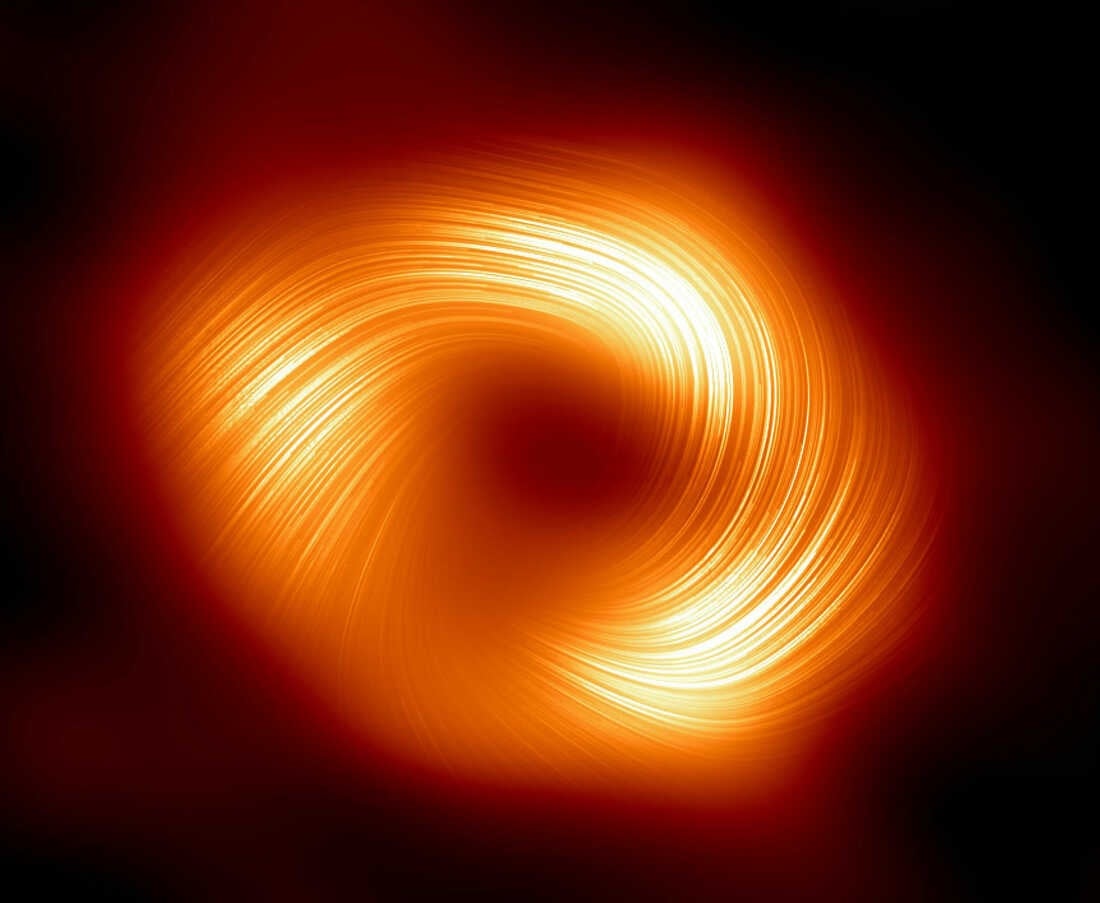
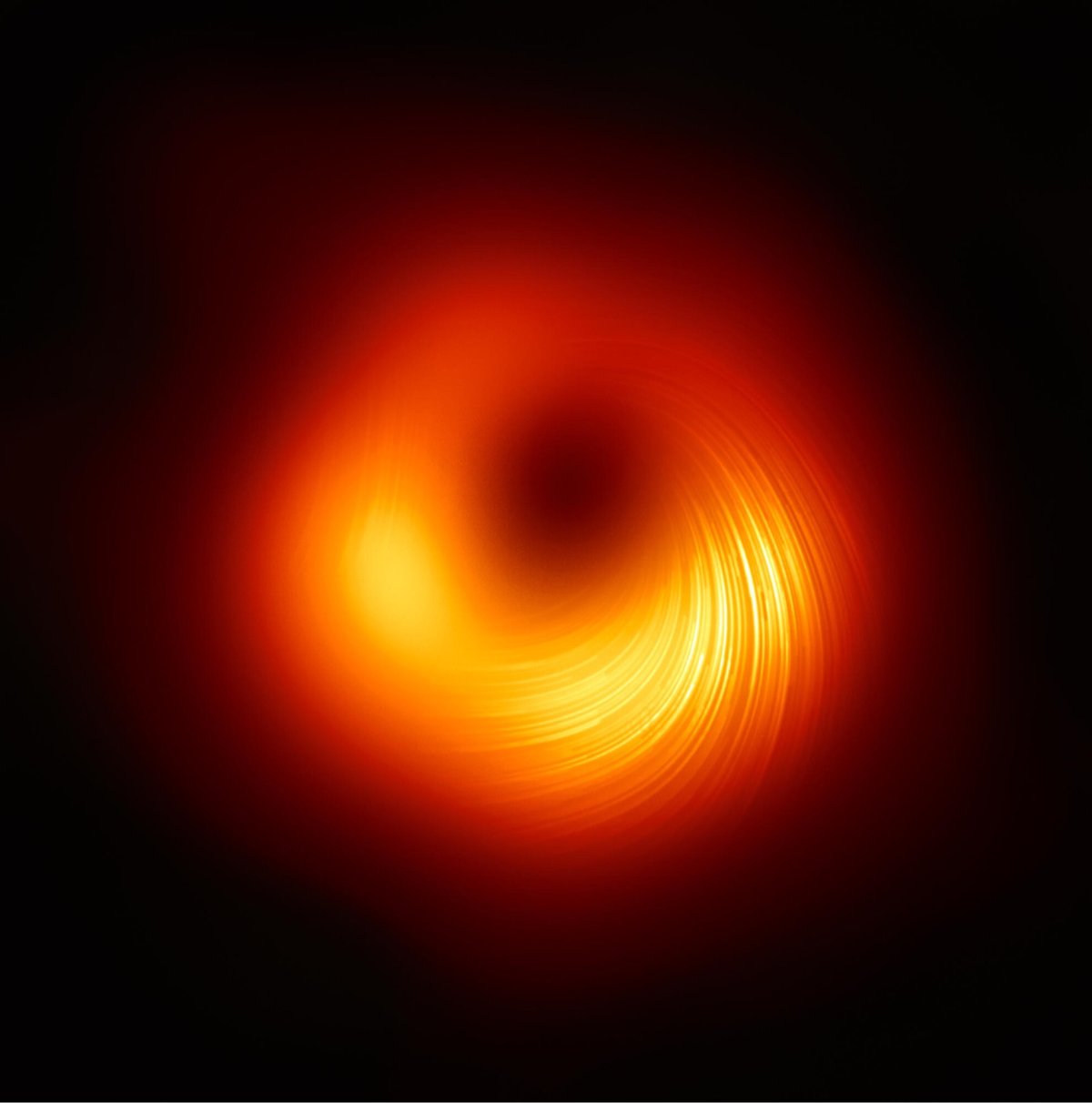
It’s been about five years since scientists captured the first blurry image of a black hole. Using what they learned from that experience, they’ve teased out some more detailed images of the black holes at the centers of the Milky Way galaxy (top) and the M87 galaxy (bottom). The process of collecting the data for these images is interesting:
The only way to “see” a black hole is to image the shadow created by light as it bends in response to the object’s powerful gravitational field. As Ars Science Editor John Timmer reported in 2019, the EHT isn’t a telescope in the traditional sense. Instead, it’s a collection of telescopes scattered around the globe. The EHT is created by interferometry, which uses light in the microwave regime of the electromagnetic spectrum captured at different locations. These recorded images are combined and processed to build an image with a resolution similar to that of a telescope the size of the most distant locations. Interferometry has been used at facilities like ALMA (the Atacama Large Millimeter/submillimeter Array) in northern Chile, where telescopes can be spread across 16 km of desert.
In theory, there’s no upper limit on the size of the array, but to determine which photons originated simultaneously at the source, you need very precise location and timing information on each of the sites. And you still have to gather sufficient photons to see anything at all. So atomic clocks were installed at many of the locations, and exact GPS measurements were built up over time. For the EHT, the large collecting area of ALMA-combined with choosing a wavelength in which supermassive black holes are very bright-ensured sufficient photons.
The images of the two black holes look similar, which was somewhat unexpected:
While this idea may initially sound somewhat mundane, it is anything but. The result is surprising because Sgr A*’s mass is about 4.3 million times that of the Sun, while M87*’s is about 6.5 billion times that of the Sun. Despite the significant difference in mass between the two supermassive black holes, the fact that their magnetic fields behave similarly and are both well-organized is an incredible discovery.
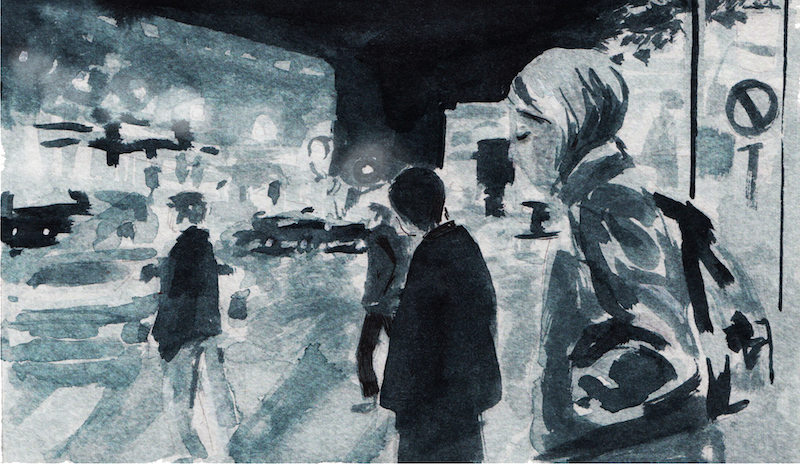
An ode to women who walk through cities in films. “She will be ordinary, immersed in the practical aspects of her own life and my heart will skip a beat at the sight of her, in possession of her own life, in the city, alone.”
Crash Course Lecture: The Deadliest Infectious Disease of All Time
In this Crash Course video, author and “TB-hater” John Green takes a deep dive into tuberculosis.
This is the story of the deadliest infectious disease of all time. It’s been with us for 3 million years, since before humans were homo sapiens. We have evidence of it in the mummies of ancient Egypt, and it’s mentioned in the Hebrew Bible.
We’ve made extraordinary medical advances. Vaccines, antibiotics, and clean water have saved millions of lives. And yet despite that, in 2022, this disease killed more people than malaria, typhoid, cholera, homicide, and war…combined.
It has gone by many names. In ancient China, it was known as huaifu, meaning “destroyed palace.” In ancient Hebrew, “schachepheth,” meaning wasting away. The 19th-century term: “consumption,” for the way it seemed to consume the body. Today, we call it tuberculosis.
I actually love this idea: host a PowerPoint Night “where all your friends present on their jobs so you can finally understand what the heck everyone does all day”.
Substack is speedrunning the enshittification curve. “This latest intervention is indicative of their efforts to transition to a social media hub where they can sell ad space.” We can all see where this is going…now is a great time to get off.
Tyler Cowen Interviewing Marilynne Robinson
COWEN: What is your most unusual successful work habit?
ROBINSON: I think it’s becoming used to the fact that it takes me a long time to get to the place where I can work on something — that all this frustration [laughs] and depression that precedes my writing anything is part of the process of writing.
As someone who’s interested in finding God, I liked letting this religion-themed conversation wash over me. I also liked the idea that creative projects just have to take as long as they take and be as hard as they are. Robinson’s new book is about Genesis — she calls the Bible “the most complex document on the planet” — but in the interview they touch on several non-religious topics, too (like the above). Meanwhile I’m enjoying reading the negative reviews of her book on Amazon, which is probably bad (of me).
I missed that Benjamin Labatut (When We Cease to Understand the World, 👍👍) came out with a new novel last fall, The Maniac. The book centers on John von Neumann and the fuzzy, unstable, tech-centric world (atomics, AI) he and his colleagues created.

Dog Poo Golf. A Wii Sports Golf-style browser game (with the music!) where you fling dog poop bags into a garbage can.

Milky Way Embroidery



I love Yuliya Krishchik’s space-themed embroidery pieces, especially the ones featuring Milky Way-like star fields — she calls them “surreal space landscapes”. If you watch one of Krishchik’s videos, you can see that her pieces are just a bit 3D…a cool effect.
You can find more of her work on Instagram and her blog or buy original pieces in her store (they go quickly though).
I’ve been reading about this xz Utils exploit and it sounds absolutely nuts. “It came from a main maintainer and was introduced slowly over years. Everything is gpg signed.”

People Hate the Idea of Car-Free Cities — Until They Live in One. The car-free schemes end up being so popular and work so well that “once cities make the decision to reduce or remove cars, they rarely go back”.

Socials & More