Entries for November 2020
The green screen is a staple of visual effects for movies and TV. You film actors in front of a green or blue screen and then use digital editing technology to replace the solid color with any background you’d like. But as Phil Edwards explains in this video, the effects teams for some movies and shows (like Disney’s The Mandalorian) have swapped green screens for virtual sets. In lieu of block colored backgrounds, the actors are surrounded by massive LED panels that display the background and background action so everything can be filmed in one go.
It’s a pretty cool technique. Among the benefits of such a system: you get the “natural” light from the LEDs falling on the actors and other objects in the scene, so you don’t need to add it in later digitally or use extra on-set lighting.


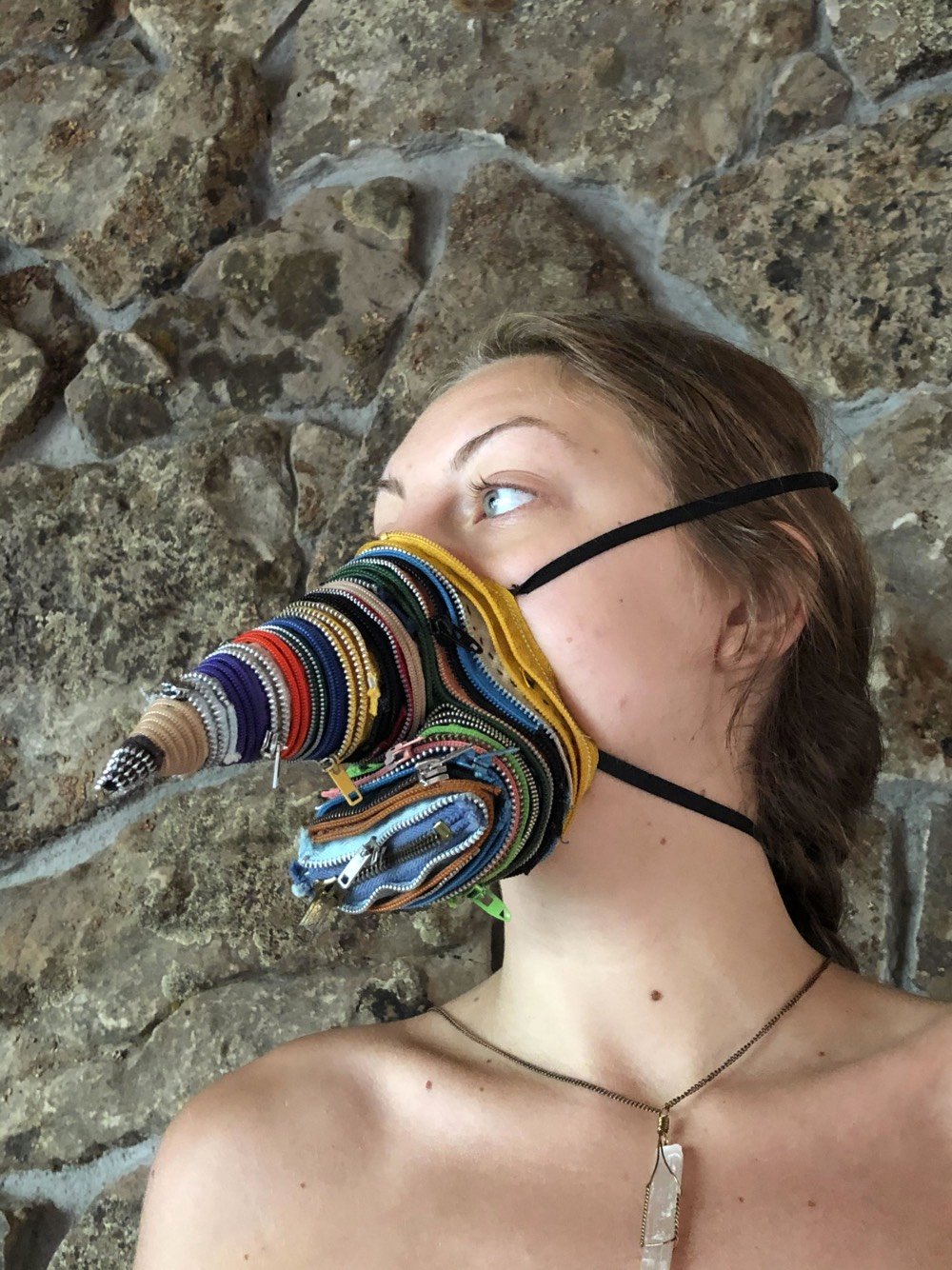
Denver’s Vicki Myhren Gallery is hosting a virtual exhibition called MASK that showcases participating artists’ takes on the now-ubiquitous Covid-19 face masks.
Through this project, we hope to call attention to the significance and signification of masking as an issue of public health and a demonstration of civic responsibility. Equally, MASK calls attention to this newly important medium’s function as an outward mode of self-expression and opportunity for creativity.
(via colossal)
I didn’t know I needed the Wobble Dog 9003i hot dog wobbling machine in my life before watching this video but now I can’t imagine living without it. Q: Can something be both hilarious and kinda-but-not-really erotic at the same time? A: Yes? (via @machinepix)
In August, 55 people attended a wedding reception in Maine. A single guest had Covid-19 and it eventually spread to 176 other people, 7 of whom died. “None of the victims who lost their lives had attended the party.”
Since 1789, Fueki Syoyu Brewing has been making soy sauce using simple ingredients, big wooden barrels for aging, and traditional methods handed down through the generations to ensure the signature richness and taste of their product. This video from Eater takes us inside the brewery to see how the magic happens.


The winners of the second annual Close-Up Photographer of the Year competition have been announced. You can check out the winners and the finalists on the competition website. The photos above were taken by (from top to bottom) Don Komarechka, Bernhard Schubert, and Gerd A. Günther. (via in focus)
We’re Past the ‘Point of No Return’ on Global Warming, Scientists Warn. “It simply will not stop from cutting manmade greenhouse gasses. We need to do something more in order to stop it.”
This clip of Leta Powell Drake interviewing 80s TV & movie stars like Tom Hanks, Telly Savalas, and Gene Hackman is incredible. She was obviously not intimidated by celebrity — leaning in closely to Hackman, she says: “You’ve done some brilliant pictures and you’ve done some stinkers.” And that’s not even her worst burn.
The clips were compiled from interviews that she did for the TV station KOLN/KGIN in Lincoln, NE when celebs would come through town to promote their latest thing. History Nebraska has a full archive of these interviews available on YouTube.
Here’s a video profile of Drake from 2014 and a recent profile. She’s in the Nebraska Broadcasters Association Hall of Fame (alongside Johnny Carson, Tom Brokaw, and Dick Cavett), played a character called Kalamity Kate on TV for several years, and also won city championships in horseshoes, golf, and bowling. Wow. (via @jfrankensteiner)
Fifty years ago today, on the beach outside a small town in Oregon, local officials used way too much dynamite (a half ton!) to dispose of a beached whale with a result that seems predictable in hindsight: chunks of whale absolutely everywhere. The explosion was captured on film by local TV station KATU and in the 90s, it went viral on the internet.
As it turns out, that was overkill. Mammalian marine guts spewed everywhere, raining down on townsfolk. A quarter-mile away, cars were smashed with chunks of cetacean carcass.
This story remained a local legend for two decades, until the early ’90s , when the newspaper columnist Dave Barry mentioned seeing footage of the exploding beast. Soon after, this video clip — originally reported by Portland news channel KATU — went viral on the internet, long before “going viral on the internet” was even a thing.
You should watch it if you’ve never seen it, and if you have, you should definitely watch it again today in all of its digitally remastered 4K glory above. I clearly remember the day at work in the mid-90s when someone discovered this video and the entire office came to a halt as we all watched it over and over again in a tiny QuickTime player window on a small computer screen — it’s just as hilarious today as it was back then.


Last year, I shared the concept designs for Norway’s new passports by creative agency Neue. Last month, the first documents using the new design were released. You can see them here.
Aside from a design that makes the passport safer, the passport also has details from Norwegian nature used both as a background illustration and a security element.
When the pages of the passports are placed under UV light, the reproduction of the Norwegian landscape will change from day to night, with, among other things, beautiful northern lights and clouds.
You can see the appearance of the northern lights under UV in the third image above — what a great detail! And I liked this explanation regarding the shared ownership of the passport:
The documents need to ensure identification for its holder and for controlling authorities — domestically as well as abroad. This implies that the ID documents are both a private and a public matter. The document’s holder should feel proud ownership, thus treating the documents carefully and with respect.
When we can all travel again, I will be on the lookout for these sharp-looking documents. And how does one get Norwegian citizenship…? (thx, bård)
A look at the beef between the owner and employees of NYC’s iconic Strand Bookstore. “Why, they wonder, are their fellow employees still out of jobs while the owner gets a government payroll loan and has the money to invest elsewhere?”
How has Uruguay done so well during the pandemic? “Only 3,620 cases and 62 deaths despite sharing borders with Brazil & Argentina, two of the world’s top-10 in overall cases.”
When I think back to my middle and high school experience, I always felt weird and out of sync with everyone else. I was comparing my insides to my classmates’ outsides and — surprise! — I didn’t measure up. It was only later in life that I realized that this was a universal experience that continues for, as far as I can tell, most of your life? This short promo video for UK youth support hotline Childline (with a Radiohead soundtrack) shows that feeling different is a common experience and urges kids to reach out for help if they’re feeling isolated.
There is nothing wrong with being different from other people. But if feeling different is making you feel isolated or upset, then there are things you can do to feel better.
(via colossal)
The winners of the 2020 AAAS Kavli Science Journalism Awards. Lots of meaty reading here about the pandemic, climate change, and other topics.
Trump is attempting a coup in plain sight. “That this coup probably will not work — that it is being carried out farcically, erratically, ineffectively — does not mean it is not happening, or that it will not have consequences.”
How many holes does a donut have? That’s pretty easy: one. What about a straw? Two (one at each end) or just one? (Isn’t a straw just an elongated donut?) Does a coffee mug have one hole or two? Does a bowl have a hole? If no, then what about a hole in the ground or a hole in a wall that doesn’t pass all the way through? Does a basketball have a hole? A Reddit user asked 1600 people how many holes were in various objects and the results are fantastically all over the place.

This is a trivial question, but it reveals something interesting about people’s perceptions. The dictionary definition of “hole” includes two main meanings for the purposes of this question: “an opening through something” and “a hollowed-out place”. Mathematics offers another possible meaning:
A hole in a mathematical object is a topological structure which prevents the object from being continuously shrunk to a point. When dealing with topological spaces, a disconnectivity is interpreted as a hole in the space. Examples of holes are things like the “donut hole” in the center of the torus, a domain removed from a plane, and the portion missing from Euclidean space after cutting a knot out from it.
But a hole isn’t clearly defined in math or topology. From What We Talk about When We Talk about Holes in Scientific American:
Here’s my short answer that is also the reason I’m not an algebraic topologist. If you can put it on a necklace, it has a one-dimensional hole. If you can fill it with toothpaste, it has a two-dimensional hole. For holes of higher dimensions, you’re on your own.
That answer isn’t very satisfying. Is there a better way to describe holes? I talked with some of my topologist friends and discovered two things: topologists don’t all agree on what a hole is, and it’s fun and interesting to think about different interpretations of a word whose mathematical definition isn’t completely settled. I think my larger conclusion, in the spirit of the season, is that holes are like Santa Claus: the true meaning is in your heart.
No wonder those poll results are all over the place. But at the same time, it’s interesting that many more people say that donuts have a hole than washers or rubber bands. I guess donut holes have better marketing? As for straws — reason tells me they only have one hole but I know in my heart they have two. (via the whippet)
Could a Peasant Defeat a Knight in Battle? “If a knight came face-to-face with a peasant in battle, then the latter had the odds very much against them.”
The headline and first few paragraphs of today’s front-page story in the NY Times say it all: The Times Called Officials in Every State: No Evidence of Voter Fraud.
Election officials in dozens of states representing both political parties said that there was no evidence that fraud or other irregularities played a role in the outcome of the presidential race, amounting to a forceful rebuke of President Trump’s portrait of a fraudulent election.
Over the last several days, the president, members of his administration, congressional Republicans and right wing allies have put forth the false claim that the election was stolen from Mr. Trump and have refused to accept results that showed Joseph R. Biden Jr. as the winner.
But top election officials across the country said in interviews and statements that the process had been a remarkable success despite record turnout and the complications of a dangerous pandemic.
Of course, the Republicans have made no fraud claims about states where they did well. Every Republican who the media projected to be the winner has claimed victory on that basis. And if the Democrats were somehow cheating, wouldn’t they have done far better on down-ballot races — presumably hundreds of thousands of fake ballots for Biden would also have gone for Democratic Senate and House candidates as well? The whole thing is obviously absurd.
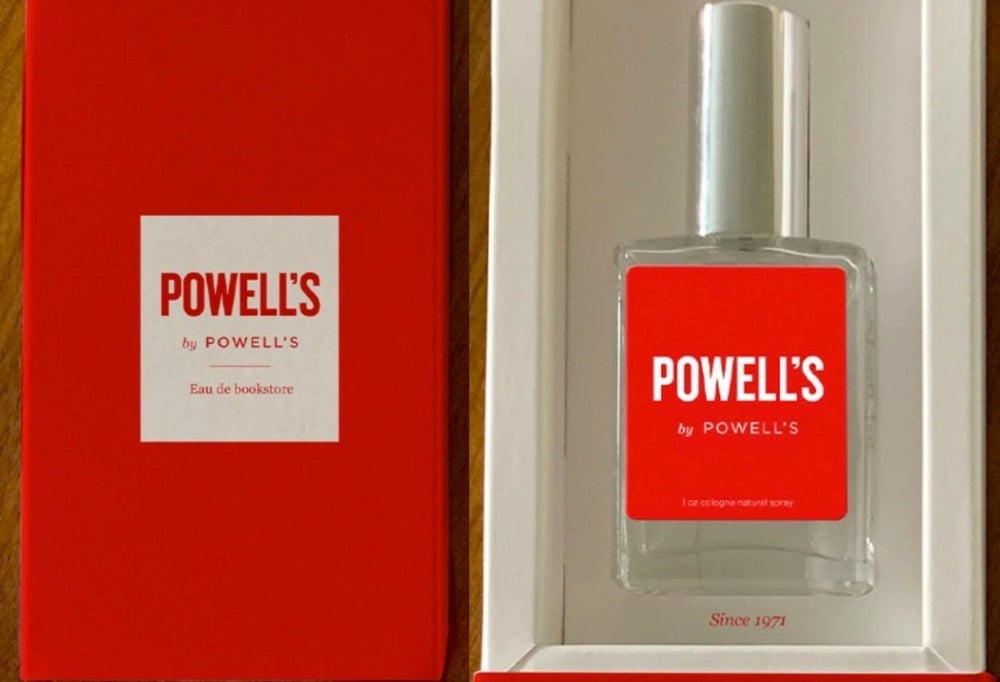
Beloved Portland indie bookseller Powell’s Books is selling a unisex fragrance that smells like a bookstore.
This scent contains the lives of countless heroes and heroines. Apply to the pulse points when seeking sensory succor or a brush with immortality.
According to KOIN, the company noticed that customers missed the smell when they were closed during the pandemic lockdown in the spring.
Powell’s Books is releasing a limited edition unisex fragrance that captures what they said is what customers missed most about Powell’s — the aroma.
Store officials said they surveyed customers about what they missed while the store was temporarily closed by the pandemic. It’s not the books. It’s the smell.
The perfume comes packaged in something that looks like a book, like a hidden bottle of hooch or a gun.
If you can’t get your hands on Powell’s scent, you have other options. Demeter makes a fragrance called Paperback that’s available in a variety of formats (cologne, shower gel, diffuser oil) and Christopher Brosius offers a scent called In The Library in his shop. (via moss & fog)
I missed this back in March (I think there was a lot going on back then?) but the feature-length documentary AlphaGo is now available to stream for free on YouTube. The movie documents the development by DeepMind/Google of the AlphaGo computer program designed to play Go and the competition between AlphaGo and Lee Sedol, a Go master.
With more board configurations than there are atoms in the universe, the ancient Chinese game of Go has long been considered a grand challenge for artificial intelligence. On March 9, 2016, the worlds of Go and artificial intelligence collided in South Korea for an extraordinary best-of-five-game competition, coined The DeepMind Challenge Match. Hundreds of millions of people around the world watched as a legendary Go master took on an unproven AI challenger for the first time in history.
During the competition back in 2016, I wrote a post that rounded up some of the commentary about the matches.
Move after move was exchanged and it became apparent that Lee wasn’t gaining enough profit from his attack.
By move 32, it was unclear who was attacking whom, and by 48 Lee was desperately fending off White’s powerful counter-attack.
I can only speak for myself here, but as I watched the game unfold and the realization of what was happening dawned on me, I felt physically unwell.

In 1960, six-year-old Ruby Bridges became the first Black student at the newly desegregated William Frantz Elementary School in New Orleans. Escorted to her first day of school by federal marshals, she was immortalized by Normal Rockwell in a 1964 painting called The Problem We All Live With. Bridges has a new book out today called This Is Your Time.
Written as a letter from civil rights activist and icon Ruby Bridges to the reader, This Is Your Time is both a recounting of Ruby’s experience as a child who had no choice but to be escorted to class by federal marshals when she was chosen as one of the first black students to integrate New Orleans’ all-white public school system and an appeal to generations to come to effect change.
In a segment on NPR’s Weekend Edition, Bridges shared some of her story from the book.
The first day that I arrived with federal marshals, they rushed me inside of the building. And 500 kids walked out of school that first day and they never returned.
[Making friends] did not come easy because I heard kids, there were days when I would go into this coat closet to hang up my coat and I could hear kids laughing and talking, but I never saw them. Later on, I came to realize that they were being hidden from me in another classroom.
And that was because there were some white parents who actually crossed that picket line and brought their kids to school. But the principal who was part of the opposition, she would hide them. And even though I was complaining — or at least mentioning it to Mrs. Henry, she would never say anything to me, but she was actually going to the principal and saying, if you don’t allow those kids to come together, because the law has now changed, then I’m going to report you to the superintendent. And so I think after months of that, we were allowed to come together.
Bridges is only 66 years old today — this was all not so long ago.
Update: Sad news: Ruby’s mother, Lucille Bridges, died yesterday at the age of 86.
Her daughter went on to become an icon of the Civil Rights Movement, memorialized in Norman Rockwell’s famous painting “The Problem We All Live With” which depicts a tiny Ruby in a white dress carrying her notebooks and a ruler surrounded by much taller U.S. Marshals. But Ruby Bridges once credited her parents as the forces behind her history-making achievement.
“My parents are the real heroes,” the U.S. Marshals Service once quoted her as saying during a ceremony at an art gallery showing the painting. “They (sent me to that public school) because they felt it was the right thing to do.”
Holy crap, watch this video of someone exhaling in a N95 mask with a value vs. an unvalved mask. If you’re still somehow wearing a valved mask thinking it will protect others from your possible infection, please find a better option.
For the New Yorker, Keeanga-Yamahtta Taylor writes that as much noise and pain that Donald Trump generated while he was in office, it can’t hold a candle to America’s systemic problems, which remain unaddressed by both major parties.
Like tens of millions of Americans, I voted to end the miserable reign of Donald J. Trump, but we cannot perpetuate the election-year fiction that the deep and bewildering problems facing millions of people in this country will simply end with the Trump Administration. They are embedded in “the system,” in systemic racism, and the other social inequities that are the focus of continued activism and budding social movements. Viewing the solution to these problems as simply electing Joe Biden and Kamala Harris both underestimates the depth of the problems and trivializes the remedies necessary to undo the damage. That view may also confuse popular support for fundamental change, as evidenced by Trump’s one-term Presidency, with what the Democratic Party is willing or even able to deliver.
What if we treated the American Presidency as the civil service job that it is? “We don’t think of the Presidency as a civil service position like working at the DMV or delivering the mail. But that’s what it is. It’s another government service job.”
This is a video of world champion Grant Holloway doing the 110-meter hurdles that’s been modified to keep his head right in the middle of the video. While champion hurdlers don’t keep their heads as still as birds do when hunting, Holloway’s relative lack of motion is incredible.
In this view, you can clearly see how expert hurdlers don’t jump their whole bodies over the hurdle (like Super Mario or something) — it’s more that they just bring their lower bodies up over the hurdles while their heads & shoulders remain more or less the same height from the ground. There’s hardly any lateral motion either — very little wasted energy here.
This is a fascinating post by historian Bret Devereaux, who specializes in ancient history (esp. Rome), that looks at ancient self-governing democracies and republics in the Greek and Roman world and describes how they fell into crisis and, crucially, how they were able to recover to avoid losing that self-governance.
But in that large sample size, we also get a sense of what solutions succeed and what solutions fail to hold together a self-governing community in these sorts of pressures. Beset by repeated political crises from 494 to 287 (known as the Struggle of the Orders), the Roman Republic repeatedly survived and grew stronger through compromise and by constructive, inclusive redefinition of the republic to include a broader range of people (not merely the patrician elite, but also the plebeian elite). In no small part, that success seems to have been motivated by the avowed need of elite patricians for the support of the plebeian commons in order to campaign, since the plebeians made up most of the army.
In stark contrast, the effort by conservative (in the general sense, not in the American sense) elements of the Roman senate to ‘hold the line’ and permit no compromise on questions of land reform and citizenship in the Late Republic led quite directly to the outbreak of civil war in 91 (with the Italian allies) and in 88 (between Romans) and consequently to the collapse of the Republic. Initially, the influence and raw power of the elite was sufficient to squash efforts at reform (including the murder of some prominent reformers), but in the long run the discontent those crackdowns created laid the fertile ground for the rise of demagogic military leaders to supplant the Republic entirely, culminating in first Caesar and then Octavian doing just that. In an effort to compromise on nothing, the Roman elite lost everything.
Devereaux then draws a parallel to the 2020 election:
In short, Joe Biden is running on a platform of compromise and a constructive, inclusive redefinition of the polity which explicitly welcomes past opponents to join him at the table. To me, reasoning from historical example, that seems like the correct answer to the current moment.
On the other hand, we have a different candidate (and current President) who is running on a promise to ‘win’ the stasis by main force, to dominate and to win, indeed, until he (or we) get tired of winning, to escalate the tensions to the final victory of the faction. This is exactly the approach that I think a sober reading of historical examples warns us is likely doomed to failure, regardless of what one thinks of the underlying policy aims (which might well have been achieved without the rhetoric and practice of escalation). I cannot help but think that, as happened in the last decades of the Roman Republic, rewarding this sort of rhetoric and behavior will produce more of it from both parties and put our republic on a dangerous path.
As a ballerina in NYC during the 60s, Marta C. González undoubtably performed Tchaikovsky’s Swan Lake hundreds or even thousands of times. González passed away recently — perhaps from complications due to her Alzheimer’s, which can affect a person’s memory and movements in profound ways — but she had one last chance to revisit her ballet days before she died. In the video above, you can see how, as she starts to listen to Swan Lake in a pair of headphones, she reanimates and begins performing the dance choreography in her wheelchair. Clips from what I’m assuming is her past Swan Lake performance are interspersed throughout the video. What a lovely moment.
Citing international precedent and America’s anti-majoritarian systems, Zeynep Tufekci argues that the next authoritarian who runs for President will be much more competent and dangerous.
The Electoral College and especially the Senate are anti-majoritarian institutions, and they can be combined with other efforts to subvert majority rule. Leaders and parties can engage in voter suppression and break norms with some degree of bipartisan cooperation across the government. In combination, these features allow for players to engage in a hardball kind of minority rule: Remember that no Republican president has won the popular vote since 2004, and that the Senate is structurally prone to domination by a minority. Yet Republicans have tremendous power. This dynamic occurs at the local level, too, where gerrymandering allows Republicans to inflate their representation in state legislatures.
The situation is a perfect setup, in other words, for a talented politician to run on Trumpism in 2024. A person without the eager Twitter fingers and greedy hotel chains, someone with a penchant for governing rather than golf. An individual who does not irritate everyone who doesn’t already like him, and someone whose wife looks at him adoringly instead of slapping his hand away too many times in public. Someone who isn’t on tape boasting about assaulting women, and who says the right things about military veterans. Someone who can send appropriate condolences about senators who die, instead of angering their state’s voters, as Trump did, perhaps to his detriment, in Arizona. A norm-subverting strongman who can create a durable majority and keep his coalition together to win more elections.
You should also read Tufekci’s related thread, where she responds to some comments and criticism of the piece.
This isn’t some rare thing that just happened because of weird circumstances. This is a playbook that works. This is a global playbook on the rise. This is a playbook found in America’s past, too. Realism is the true basis for hope.
We have to keep pushing to make sure no populist authoritarians ever get their hands on the Presidency again.
An interview with former chess champion Linda Diaz about what The Queen’s Gambit got right & wrong. “She’s really aggressive. And I was also an aggressive player. And so it comes off as ‘you’re impatient,’ and really it’s that you’re creative…”
This is pitch perfect: I Guess I Just Expected a Little More From This Country. “How could a people that had to be explicitly told not to eat Tide Pods be so short-sighted?”
This morning, the transition team for President-elect Joe Biden announced the members of his Covid-19 task force.
The list includes Rick Bright, the former head of the vaccine-development agency BARDA ousted by the Trump administration in April; Atul Gawande, the surgeon, writer, and recently departed CEO of Haven, the joint JP Morgan Chase-Berkshire Hathaway-Amazon health care venture; and Luciana Borio, a former Food and Drug Administration official and biodefense specialist.
Biden has cast the escalating Covid-19 crisis as a priority for his incoming administration. The task force, he said, would quickly consult with state and local health officials on how to best prevent coronavirus spread, reopen schools and businesses, and address the racial disparities that have left communities of color harder hit than others by the pandemic.
From Biden’s transition website, here’s the Biden-Harris administration’s seven-point plan to beat COVID-19 (which is the first item in the site’s “Priorities” menu). The seven points are:
- Ensure all Americans have access to regular, reliable, and free testing.
- Fix personal protective equipment (PPE) problems for good.
- Provide clear, consistent, evidence-based guidance for how communities should navigate the pandemic — and the resources for schools, small businesses, and families to make it through.
- Plan for the effective, equitable distribution of treatments and vaccines - because development isn’t enough if they aren’t effectively distributed.
- Protect older Americans and others at high risk.
- Rebuild and expand defenses to predict, prevent, and mitigate pandemic threats, including those coming from China.
- Implement mask mandates nationwide by working with governors and mayors and by asking the American people to do what they do best: step up in a time of crisis.
This looks like what the plan should have been from the beginning. Of particular note, under the point about testing:
Stand up a Pandemic Testing Board like Roosevelt’s War Production Board. It’s how we produced tanks, planes, uniforms, and supplies in record time, and it’s how we will produce and distribute tens of millions of tests.
Establish a U.S. Public Health Jobs Corps to mobilize at least 100,000 Americans across the country with support from trusted local organizations in communities most at risk to perform culturally competent approaches to contact tracing and protecting at-risk populations.
Over the past week, as Americans voted and then held their breath for the results of the election, over 750,000 Americans tested positive for Covid-19. Based on the current case fatality rate of 2.4%, over 18,000 of those people will die in the days and weeks ahead. Many more will suffer long-term health effects because of the disease and struggle emotionally, financially, and spiritually in the months ahead. I really really hope there’s enough of a spirit of togetherness and cooperation left in America for a science-based plan like this to work in controlling a disease that’s killed almost 230,000 people. We — all Americans — need this so so much.
Newer posts
Older posts





Socials & More