



Advertise here with Carbon Ads
This site is made possible by member support. 💞
Big thanks to Arcustech for hosting the site and offering amazing tech support.
When you buy through links on kottke.org, I may earn an affiliate commission. Thanks for supporting the site!
kottke.org. home of fine hypertext products since 1998.
Beloved by 86.47% of the web.
Entries for November 2020
Oxford-AstraZeneca’s Covid-19 Vaccine Up to 90% Effective
Preliminary results from the trials of the Covid-19 vaccine jointly developed by the University of Oxford and AstraZeneca indicate that the vaccine’s overall efficacy is 70% but that a regimen that calls for a lower first dose is 90% effective.
The preliminary results on the AstraZeneca vaccine were based on a total of 131 Covid-19 cases in a study involving 11,363 participants. The findings were perplexing. Two full doses of the vaccine appeared to be only 62% effective at preventing disease, while a half dose, followed by a full dose, was about 90% effective. That latter analysis was conducted on a small subset of the study participants, only 2,741.
Hopefully more study will be done on that dosage question. From the AP:
“The report that an initial half-dose is better than a full dose seems counterintuitive for those of us thinking of vaccines as normal drugs: With drugs, we expect that higher doses have bigger effects, and more side-effects,” he said. “But the immune system does not work like that.”
The seemingly lower efficacy comes with some perhaps significant benefits: this vaccine is cheaper to produce and doesn’t require any special refrigeration.
The vaccine can be transported under “normal refrigerated conditions” of 2 to 8 degrees Celsius (36 to 46 degrees Fahrenheit), AstraZeneca said. By comparison, Pfizer plans to distribute its vaccine using specially designed “thermal shippers” that use dry ice to maintain temperatures of minus-70 degrees Celsius (minus-94 degrees Fahrenheit).
The Pfizer and Moderna vaccines were pretty similar in many respects and this one seems quite different. These results were just released a few hours ago, so it will be interesting to follow the debate and expert commentary on this. Stay tuned…
Update: This is amazing: the seemingly more effective 1/2 dose + full dose regimen was a mistake.
Around the time when Astra was initiating its partnership with Oxford at the end of April, university researchers were administering doses to trial participants in Britain.
They soon noticed expected side effects such as fatigue, headaches or arm aches were milder than expected, he said.
“So we went back and checked … and we found out that they had underpredicted the dose of the vaccine by half,” said Pangalos.
A far smaller number of participants was given the initial half-dose, so more research will need to be done to determine if this mistake will be added to the long list of scientific discoveries made because of errors. There’s a good piece in Nature that talks about what we know and don’t know about the vaccine results so far along with some informed speculation.
But, if the differences are bona fide, researchers are eager to understand why. “I don’t think it’s an anomaly,” says Katie Ewer, an immunologist at Oxford’s Jenner Institute who is working on the vaccine. “I’m keen to get into the lab and start thinking about how we address that question.” She has two leading theories for why a lower first dose might have led to better protection against COVID. It’s possible that lower doses of vaccine do a better job at stimulating the subset of immune cells called T cells that support the production of antibodies, she says.
Another potential explanation is the immune system’s response against the chimpanzee virus. The vaccine triggers an immune response not only to the SARS-CoV-2 spike protein, but also to components of the viral vector. It’s possible that the full first dose blunted this reaction, says Ewer. She plans to look at antibody responses against the chimpanzee virus to help address this question.
Update: A short thread by Dr. Natalie Dean, which leads with “AstraZeneca/Oxford get a poor grade for transparency and rigor when it comes to the vaccine trial results they have reported”.
On the sanctity of American marriage. “I believe that marriage is a lasting partnership between one person without health insurance and one person who gets pretty good coverage through work.”
Tom Stoppard and the Last Crusade

Hermione Lee has written an authorized biography of playwright, screenwriter, translator, and man of letters Tom Stoppard, called Tom Stoppard: A Life. It was released in the United Kingdom on October 1st and should appear in the United States on February 23, 2021.
Here’s an excerpt from the core of Kate Kellaway’s glowing review in The Guardian:
“He put on Englishness like a coat,” Lee writes - and one imagines a particularly dashing coat because Stoppard compensated for his reserve by being an unretiring dresser (a recent photograph shows him, in his 80s, still modishly draped). But the English coat was possibly over-buttoned. Stoppard had an exile’s gratitude to England. He found his boarding school in 18th-century Okeover Hall “paradise”. Yet Lee qualifies the received idea - an oversimplified, dismissive slur - of Stoppard as unswervingly conservative. For a start, he is too entertaining to be stuffy…
His championing of political causes is shown to have stemmed more from empathy with individuals than from abstract ideals. His support for Belarus Free Theatre makes particularly fascinating reading, as does the account of his friendship with Václav Havel, Czech playwright and president. Havel is presented as the person Stoppard might have been had he not become an Englishman.
Lee’s studies of the plays are masterly - especially of Rosencrantz and Guildenstern Are Dead (1966) and Arcadia (1993) - and her book will be a formidable resource for Stoppard enthusiasts. She makes a persuasive case for the importance of emotion, challenging - even in the early work - the old complaint that Stoppard is all head and no heart. Jumpers is “a sensational exercise in mental acrobatics” but also “a play of grief and love. It carries the sadness and the guilt of living in a malfunctioning marriage with a wife who is having a breakdown and it opened two days after his divorce.”
The British edition from Faber & Faber is 992 pages long and weighs 1.33 kilograms (about three pounds). It also retails for £30 in the UK, about 40 USD (used to be more, but the exchange rate has been low—point is, it’s an expensive book). Mercifully, Knopf’s US hardcover will be only 897 pages and cost $37.50, with weight unchanged.
It’s a big book by a biographer known for big books about major literary figures, sadly mostly dead. Stoppard is very much alive, and although quite private, agreed to sit for hours of interviews over a course of years. Lee was also able to interview Stoppard’s friends and colleagues, including actress Felicity Kendal (who starred in multiple Stoppard plays, including in roles written for her), director Trevor Nunn (in charge of three of Stoppard’s world premieres), and filmmaker Steven Spielberg.
This last might seem like an odd choice, but Spielberg and Stoppard have multiple points of contact. Stoppard wrote the screenplay for Spielberg’s Empire of the Sun, and served as an uncredited ghostwriter on Indiana Jones and the Last Crusade. In fact, not only was Stoppard not credited, the lack of credit was actually given to a pseudonym, “Barry Watson.”
Everything suggests that Stoppard’s contributions to the film were substantial. In a brief oral history of The Last Crusade, now lost to linkrot but still preserved by the Wayback Machine, Spielberg says, “Tom is pretty much responsible for every line of dialogue.”
Last year, narrative analyst Mike Fitzgerald broke down in detail differences between a draft version of the screenplay by credited writer Jeffrey Boam and the published draft, including revisions by Spielberg and a heavy rewrite by Stoppard. (You can actually download both versions of the screenplay on Fitzgerald’s site.) Again, Stoppard contributed not just lines of dialogue, but new scenes, a new structure, and changes in characterization.
Vast enhancements were made to every element of the story - character, plot, pace, humor, action, tone, clarity, dialogue. The result is a markedly more coherent, charming, and enduring script that truly belongs in a museum. I suspect that, absent the final revisions, this film would have been regarded by audiences as inferior to its antecedent sequel THE TEMPLE OF DOOM in tone, wit, and entertainment value…
TIGHTENING: The revised draft is 15 pages shorter, though material was not arbitrarily removed just to cut pages. I found 19 instances of scenes or beats being cut, 6 superfluous characters removed, several jokes deleted, and dialogue often pared down. Each of these extractions had a clear purpose to it, whether streamlining the plot, quickening the pace, avoiding redundancies, or simply that the material in question was superfluous and distracting. Note that the revised draft has also ADDED a substantial amount of new scenes, beats, jokes, and dialogue, so in order to counterbalance the new material and cut 15 pages, an ample sum of script was removed…
DIALOGUE: One of Stoppard’s most obvious revisions is to vastly refine the dialogue, and only by reading both drafts side by side is it possible to study those differences. I would ballpark that 80% of the lines have been substantially changed.
HUMOR: This manifests largely in the dialogue, but also in sight gags, character actions, edit points, and streamlining moments to make the jokes land with more precision. The quality of humor is also refined, by removing coarse innuendo and making the jokes smarter and less predictable.
Stoppard was responsible for reshaping one of my favorite scenes in the film. At one point, Henry (Sean Connery’s character) was going to use Indy’s gun (down to just one bullet) to shoot at the seagulls, who would in turn fly into the engines of the plane pursuing them and make it crash. Stoppard had Henry chase them with his umbrella instead.
(The Charlemagne quote is totally made up. Unclear whether Henry Jones is supposed to believe that it’s real.)
Stoppard emphasized elements of faith and history in the story. For example, he rewrote the character of Kazim, changing him from a Nazi stooge to a protector of the grail, and invented the Brotherhood of the Cruciform Sword.
Stoppard also rewrote Henry’s dialogue during the cavern collapse to have him finally call his son by his chosen name, Indiana.
One last thing: if you watch The Last Crusade now, as opposed to thirty years ago, certain things stand out. They used a lot of projected backgrounds. Those don’t look great. More substantively, the Nazis, while generally faithful to their portrayal in Raiders of the Lost Ark, plus some updates, feel pretty… thin. They’re bad guys, evil and a little scary, but you’d be forgiven if you came away from the movie thinking the problem with the Nazis was that they liked to burn books and despoil antiquities, while good people love libraries and museums. That ain’t it.
Stoppard was born Tomás Straüssler, in 1937, in Zlín, Czechoslovakia. In 1939, his parents, nonpracticing Jews, fled the Nazi invasion to Singapore. His father was killed in 1942 when the Japanese Air Force bombed Singapore, and Stoppard has no memory of him; Tom, his mother Marta, and his brother succeeded in reaching India, where he lived until 1946. His new stepfather, Major Kenneth Stoppard, was an antisemite; his mother hid her and her children’s Jewishness to be accepted by him and his circle, now in England.
Three of Stoppard’s aunts, all four of his grandparents, and his great-grandmother all died in the Holocaust. And Stoppard did not know this about his extended family until 1993, four years after the release of Indiana Jones and the Last Crusade.
It is tempting to ask, if Stoppard had been fully aware of and fully embraced his central European and Jewish roots, as he was when he wrote his new play Leopoldstadt, whether his approach to the Nazis, or the very Christian, very English themes of the Grail legend, or even the son striving to be reconciled to his father, might have been substantively different.
In many ways, the Grail legend was perfect for Stoppard: more English than the English, but still a little resistant, a little outside the nation’s own history. A crusade, a quest, a reclamation, a reconciliation.
This saga of the Craigslist Pig Couch—which has been circulating in various listings since at least 2016—is intriguing in its own right. But what really nails the story are the dry, perfectly shaped sentences, one after another
The volunteers, coders, designers, coordinators, and journalists behind The @COVID19Tracking Project are some of the genuine heroes of this year. Here’s how they came together to do a job the US federal government can’t or won’t do:
The Moral Calculus of COVID-19
COVID-19 has required all of us to scrutinize our actions and sacrifice our desires and even our obligations in order to keep ourselves and those around us safe. I want to examine two cases where reasonable, well-informed, and influential people make entirely different choices based on largely similar evidence.
You may have heard that MSNBC host Rachel Maddow has been quarantining at home following close contact with a person who had tested positive for COVID-19. You may have also heard that last night, Maddow returned to her show (still filming from home) to reveal that this person was her partner of 20+ years, artist/photographer Susan Mikula. Mikula is recovering, but at at least one point, the couple genuinely feared for her life. Maddow herself is still testing negative; with Mikula in much less danger and Maddow nearing the end of quarantine, they felt it was time to open the curtain on their experience.
If you haven’t seen it already, I’d like you to watch the video of Maddow describing her experience of living with a loved one who is suffering from COVID-19, whom you have to care for but cannot touch without grave risk to yourself, and then to others. (It is about Mikula’s own experience, but it’s really much more about Maddow’s experience, for good reason.)
Here’s a quick excerpt, if you want a textual preview (via Vulture):
“Just believe me: Whatever you have calculated into your life as acceptable risk, as inevitable risk, something that you’re willing to go through in terms of this virus because statistically, hey probably, it will be fine for you and your loved ones, I’m just here to tell you to recalibrate that,” [Maddow] warned. “Frankly, the country needs you to recalibrate that because broadly speaking, there’s no room for you in the hospital right now.”
She cites hospitals being overwhelmed with a “50 percent” increase in patients “in two weeks.” While it may be easy to risk your own life, the virus doesn’t let you make the choice. “What you need to know is whoever’s the most important person in your life, whoever you most love and most care for and most cherish in the world, that’s the person who you may lose and who you may spend weeks up all night freaking out about and calling doctors all over the place and over and over again all night long, trying to figure out how to keep that person breathing and out of the hospital,” she said. “Whatever you’re doing, however you’ve calibrated risk in your life, don’t get this thing.”
Another moment worth noting in the video is shortly after she begins. Maddow is interrupted by a recurring beeping noise in a room off-camera. She has to attend to it herself, in the middle of a live television show, because there’s no one else at home who can do it. She takes off her microphone and earpiece, then has to put it back on. After already revealing at the beginning of the show that she’s not wearing makeup—she doesn’t know how to apply it herself, and no one can help her—it’s a nice peek behind the scenes.
I don’t know if everyone always understands how much work it takes it is to perform for live television: how many accessories you need, how much support is required. People don’t see what you have to look like, sound like, or act like; they don’t see the almost cyborg contraption you have to become in order to make a successful television appearance. Being good at television is a specific skill. It’s as different from writing, reporting, or public speaking as football, baseball, and basketball are from playing polo. It doesn’t matter if you have your words on a teleprompter (although that does help): you still have to deliver them, in time, no backsies, and look and sound good while you’re doing it.
The disruption of the show also happens in the middle of a charming metaphor Maddow uses to describe her relationship:
The way that I think about it is not that she is the sun and I’m a planet that orbits her—that would give too much credit to the other planets. I think of it more as a pitiful thing: that she is the planet and I am a satellite, and I’m up there sort of beep-beep-beeping at her and blinking my lights and just trying to make her happy.
Compare this to Farhad Manjoo’s essay in The New York Times today, “I Traced My COVID-19 Bubble and It’s Enormous.” Manjoo starts with a classic dilemma: he knows it’s unsafe in general to travel for Thanksgiving, but he wonders if it might be safer for his family, given the size of their social circle and the precautions they’ve taken. He’d like to find out more, to replace his general intuitions, which pull him in both directions, with something more concrete. This is a time-honored journalistic premise (a rhetorical trope, really) for answering a question many people might have.
In researching his close contacts, and their own exposure to other people, Manjoo quickly has cold water thrown on the notion that his bubble is in any way contained to the degree he’d imagined it to be. (This part of the story is well-illustrated: I’ll give you the text excerpts, but it’s worth clicking through and scrolling through yourself.)
I thought my bubble was pretty small, but it turned out to be far larger than I’d guessed.
My only close contacts each week are my wife and kids.
My kids, on the other hand, are in a learning pod with seven other children and my daughter attends a weekly gymnastics class.
I emailed the parents of my kids’ friends and classmates, as well as their teachers, and asked how large each family’s bubble was.
Already, my network was up to almost 40 people.
Turns out a few of the families in our learning pod have children in day care or preschool.
And one’s classmate’s mother is a doctor who comes into contact with about 10 patients each week.
Once I had counted everyone, I realized that visiting my parents for Thanksgiving would be like asking them to sit down to dinner with more than 100 people.
He isn’t actually done counting yet: from himself, he’s only gone to three degrees of separation. But presumably, the point in the headline is made. The author’s bubble is enormous, and presumably the reader’s is, too.
Then a curious thing happens. Manjoo decides that what he’s learned doesn’t matter. He thinks his family and his contacts are special after all. “All of my indirect contacts are taking the virus seriously—none of them spun conspiracy theories about the pandemic, or suggested it was no big deal or told me to bug off and mind my own business.” (This is a very low threshold for “taking the virus seriously.”) And he would really like to take his wife and children to see his parents. An epidemiologist gives him some cover, saying his desire to see their parents is understandable, and it’s all a matter of assessing and evaluating risk.
So, he changes his mind again. He makes a few concessions (drive, not fly; an outdoor meal rather than an indoor one; staying off-site rather than sleeping over). And he’s going to travel five hours each way with his wife and children and their 100+ direct and indirect contacts to celebrate Thanksgiving with his parents.
This is contrarianism on a scale not usually seen in a newspaper article. (They’re usually too short to take this many turns.) It is one thing to counter received wisdom by posing a counterfactual. It is another to spend hours of reporting, gathering facts, calling in experts, putting everything on the record, and then deciding that none of that matters.
On Twitter, I called it “the full Gladwell”; only Malcolm Gladwell at The New Yorker can consistently pull this hairpin twist off and stick the landing, even if he frequently violates good sense and plain facts to do it.
It’s important, though, that this is not just a rhetorical trick. These are the real lives of real people, both in the story itself, and radiating out to its readers and their contacts in a global newspaper, the United States’ paper of record. And the reasoning and evidence that are considered but discarded gives the illusion that this is a choice motivated not by setting reason aside, but considering all options and maximizing one’s expected utility.
Not to “both sides” this, but I’m gonna “both sides” this: in some sense, both Maddow and Manjoo are putting their thumb on the scales, in opposite directions. For Maddow, the experience of almost losing the love of her life makes it so that she would take no willing risk that might endanger her or anyone else. (She acknowledges that a certain amount of unavoidable, unwilling risk remains.)
Manjoo is different. He acknowledges that he has no such experience. He is less concerned with the possible loss of his parents’ lives than the loss of their presence in his life and in their childrens’ lives. He sees the willing assumption of risk as an open moral question, and something that can be calculated and appropriately mitigated.
Maddow has constructed a universe where she is a tiny satellite orbiting a much larger planet, whose continued health and existence is the central focus of her concern. Manjoo has drawn a map with himself at its center, where anyone beyond the reach of his telephone falls off the edges.
Maddow is also explicitly pleading with her viewers to learn what they can from her experience, and adjust their behavior accordingly. Manjoo is performing his calculus only for himself; he implicitly presents himself as a representative example (while also claiming he and his circle are extraordinarily conscientious and effective), but each reader can draw their own conclusions and make their own decision.
At this point the balancing dominoes tip over. Maddow’s position, her argument, and her example are clearly more moral and more persuasive than Manjoo’s. Manjoo’s essay is worth reading, but the conclusion is untenable. It doesn’t do the work needed to arrive there or persuade anyone else to do the same. And at a time when many people are spinning conspiracies about the pandemic, or claiming that it’s no big deal, and in turn influencing others—when we haven’t even yet considered the virus’s impact on the uncounted number of people, from medical staff and many other essential workers to prisoners and the impoverished, who do not simply get to choose how to spend their holiday—it’s irresponsible.
The larger moral tragedy is that because our leaders have failed, and too often actually worked to damage the infrastructure, expertise, and goodwill accumulated over generations, we have no consistent, authoritative guidance on what we should and should not do. We do not know who to trust. We have no money, no help, and no plan but to wait. We have no sense of what rules our friends and neighbors, colleagues and workers, are following when they’re not in our sight; we don’t even know what practices they would even admit to embracing. We have no money; we have no help. We are left on our own, adrift in deep space, scribbling maps and adding sums on the back of a napkin. We are all in this together, yet we are completely alone.
Election Days I Have Known

My birthday is November 3, 1979. This means that Election Day 2020 in the United States was also my 41st birthday. It was a very strange birthday. But I believe that anyone born in the first week of November who lives and/or votes in this country often finds themselves celebrating strange birthdays. Their memories and experiences of those days are different, more vivid, and more hopelessly entwine the political, civic, and personal.
I was very nearly born on November 2nd. That was my mother’s 28th birthday. She went into labor at lunch with my aunt and my grandmother. She was enjoying time away from my older brother and sister (then two and five) and didn’t want to change her plans. When she got home, she was well into labor but didn’t tell my father. My godmother, whom my whole family calls my Aunt Joette but who is not, strictly speaking, my aunt, and her husband, my Uncle Mike (same deal) came over to visit.
Uncle Mike somehow picked up that my mother was having contractions, timed them in his head, and told her when it was time to go to the hospital. He also offered to watch my siblings while my father drove her there. He even cleaned and vacuumed the house, with my brother clinging to his leg. Aunt Joette, who was 26 but already had three children of her own, hopped in the back seat of my parents’ Thunderbird. My mom, now seriously uncomfortable, told my dad to punch it. He drove through Detroit at over 100 mph to Hutzel Hospital, where I would be born. My godmother, always terrified of expressways and fast driving, has never ridden in a car with my father since. My dad still says he has never made such good time downtown.
But once they got to the hospital, everything stopped. My parents say it was the first sign of how stubborn I could be. (Frankly, this trait is overdetermined in my family.) My mother was in labor for more than 24 hours. Her doctors prepared for an emergency C-section before I arrived, about an hour and a half before the end of November 3. Since 1979 is an odd-numbered year, there wasn’t a federal election that week. But it would have been a good Election Day story if there had been one.
My mother’s father’s birthday was October 29th. In Detroit, October 30th is Devil’s Night. October 31st is Halloween. November 1st is All Saints’ Day and Dia de los Muertos; this holiday is a pretty big deal in southwest Detroit’s Mexicantown, where Uncle Mike, Aunt Joette, and my cousins Rachel, Nikki, and Miguel went to church at Holy Redeemer.
November 1st is also my mother’s brother’s birthday. My Uncle Chris is exactly fourteen years younger than my mother and fourteen years older than me. He turned 30 two days before I turned 16, and called my mother the day in between, and since my mom wasn’t home, he and I talked for about half an hour. With leap days included, he is just one day closer in age to my mother than he is to me. My mother’s birthday (and All Souls’ Day) is November 2nd, and mine is November 3rd. It’s a lot of birthdays and holidays in just a few days. My parents’ wedding anniversary is February 5th, which explains why I was born nine months later; the others in my family can plausibly be blamed on cold Michigan nights. This has always made the week of Election Day a pretty big deal in our family.

The first President elected in my lifetime was Ronald Reagan, on November 4, 1980. I don’t remember this very well, but I have seen pictures of my first birthday party the day before. My parents, like a surprisingly large number of Americans, both voted for independent candidate John Anderson, supposedly moved that he might be driven to bankruptcy by his campaign debts if he didn’t receive enough of the vote. Either they’re misremembering or are suckers, because in September, Anderson had already qualified for matching funds. Anyways, they both worked multiple jobs and had three small children, and ready access to reliable political information was not very good 40 years ago either.
I remember Reagan as President, but do not especially remember his reelection on November 6, 1984. I do remember my 5th birthday party extremely well. It was at McDonald’s, and my friends from kindergarten Andrew and Norman were invited. Ronald McDonald was there, I ate at least six Chicken McNuggets (which I still love), and Andrew gave me the He-Man action figure Jitsu, a bad guy with a golden hand that did a karate chop. He was kind of an evil knockoff of Fisto. Another of my uncles also gave me a copy of Jitsu, and I was excited about returning it and picking out a different He-Man character, but my younger brother took the second Jitsu out of its box, so we had two Jitsus, which is at least one too many. My brother was only three, but I was very upset with him.

In 1988, my mom and I were pulling for Jesse Jackson, and both of us were pissed off when he didn’t win the nomination. (I’m still mad about this, actually.) This is when I start to remember Phil Hartman’s Ronald Reagan, Dana Carvey’s George H.W. Bush, and Jon Lovitz’s undersung Michael Dukakis (“I can’t believe I’m losing to this guy”).
My parents were not around very much—my sister is really the one who raised me while the two of them worked, and I’ve always thought of her as an equal parent as well as a beloved sibling—but they indulged my watching late night television and asking questions about the conventions at a young age. George H.W. Bush was elected on November 8th. (See, it’s not really always the first Tuesday in November, because for whatever reason, November 1st doesn’t count.)
[Note, in lieu of art: I do not currently possess any photos of myself from age 12 or 13, which is right and just.]
Bill Clinton was elected President on November 3, 1992, my thirteenth birthday. In my junior high’s mock election, held the day before, Ross Perot won in a landslide. (We’d moved to the suburbs by this point.) Why were mostly-white suburban tweens entranced by Perot, who had simply nothing in his history or character to appeal to them, besides perhaps a funny voice? Some of it felt like a collective prank, a joke on the fact that the school was pretending to let us decide something we actually had no choice about: “Let’s all vote for Perot, and see what happens.”
I think some people were moved by the idea that something, anything unexpected might happen. It’s like why little kids are fascinated by dinosaurs: here are these creatures, older and bigger than your parents, older and bigger than anything, who once ruled the world. They all died, and anything, no matter how powerful or seemingly inevitable, can die again and be replaced by something new. I don’t know; maybe that was why my parents, still in their late twenties, wanted to vote for Anderson. Maybe that was part of why so many of my friends in college voted for Ralph Nader. Longing for change becomes something more than rational when so many external things determine your life.
Anyways, Bill Clinton was a deeply flawed President and remains a deeply flawed human being. Still, given the choices, I’m happy with how it actually turned out.
November 3rd was also the day of my last junior high football game. I was a starting defensive tackle, and our team was undefeated. So were our cross-town rivals at Wilkinson. They ran all over us that day: our defense, which had shut out all but one team we played and gone games without giving up any yards, could not stop Jason Byrd, a big, fast, 14-year-old athlete most of us knew from little league baseball. He died in 1997.

In 2000, I turned 21. Four days later, I voted for the first time. I did not vote in the 1998 midterms, even though Michigan’s governor was on the ballot, because my college town made it difficult for students to register to vote, and because, having just turned 19, I briefly did not believe electoral politics could create genuine change. I was also lazy, and foolish, and preoccupied with many other things.
But by 2000, I’d had a change of heart, and voted for Al Gore. I now think Gore would have been a better President than I believed then, partly because of the incredibly guarded, talking-out-both-sides-of-his-mouth campaign that he ran, but also because I did not foresee the disaster of the Bush years. I thought things would carry on mostly like they had, and that Bush, while dim and disengaged, would be a relatively benign conservative like I thought his father had been. I also thought he wouldn’t win anyways. I was a real putz. I had studied so much history but had no idea of what history had in store for us.
That year, my senior year in college, I lived in a big co-op house with fourteen other people. The house was right around the corner from my favorite bar, where I’d rung in my 21st birthday at midnight. We all watched the election results on CBS—I don’t know who chose that network, but Dan Rather had a lot of homespun idioms he used to introduce all the tosses and turns.
After the news came in that Florida had been called for Gore, then moved to toss-up, then called for Bush, then nobody was sure, my worst roommate, the one who let her dog shit all over the living room carpet, who installed her own private air conditioner even though we all split the utility bills, who everyone hated and nobody could figure out how she’d moved into the house or how to get her to leave, was openly celebrating a Bush win and taunting the rest of us (pretty even split Gore/Nader). I had one thought: I need a drink.

Bush won again, defeating John Kerry after Election Day on November 2, 2004. For me, this was the biggest gut-punch election of my life. I followed it closely, I watched all the debates, I participated in antiwar, anti-Bush, and anti-Cheney demonstrations, and met up with other young people involved in politics in Philadelphia, where I’d moved in 2002. I had thought Gore would win, but was convinced Kerry would—even after the midterm losses in 2002, even after the bombs fell on Iraq the day after my first son was born.
The next day, my 25th birthday, I walked around the city in a haze. I had to get groceries. The new Trader Joe’s on Market St had opened, right across the street from Center City’s small but lively porno district. I talked to my parents and each of my siblings on the phone, but I don’t remember what any of us said. Ohio was close, and there would be recounts, but it was over. Maybe Kerry would have been a good President, maybe he wouldn’t have, but at that moment, every possibility felt foreclosed upon. This is what they want, I thought. It wasn’t for the first time and certainly would not be the last.

For years, I thought Barack Obama was elected on my birthday in 2008. I even told people in the run-up to the 2020 election, just weeks ago, no, it’s OK, it’s actually good luck: Barack Obama won on my birthday. It’s not true. He was elected on Tuesday, November 4th, the day after.
But those few days all feel like one day, in the best sense. Now, my younger son had just turned one year old in September, had been walking (for some value of “walking”) since August, and his mother and I hadn’t properly slept yet. On November 3rd, my friends Matt Thompson and Robin Sloan celebrated the fifth anniversary of their blog Snarkmarket by asking me to join them as the site’s third author. I was scrambling to finish my doctoral dissertation in comparative literature, and to send out applications for Assistant Professor and Visiting Fellow jobs that were rapidly disappearing thanks to the economic collapse. (More jobs I applied to cancelled their searches than gave me outright Nos.)
It was total disaster. And yet somehow, the best thing had happened. Obama was the only Presidential candidate I’d supported in the primary who’d ever made it to the general election (that’s still true, by the way). He was the first Presidential candidate I’d voted for who’d won, and I had a young, multiracial family living in the birthplace of the Declaration of Independence who were counting on him. Health care for everyone, an end to the war in Iraq, real progress for Black and Latinx (we didn’t use the X then, but I will now) and Middle Eastern and South and Central Asian people seemed imminent. I was now 29, and even though I professed to know better, to have made myself properly jaded, properly paranoid, properly realistic about the limits of elected officials, the military, corporations, and the American people… I found myself quite carried away, like so many others. Meanwhile, the slaughterhouse continued its work.

By November 2012, I was separated. I was living in Manhattan’s Hell’s Kitchen, but still registered to vote in Philadelphia. I had completely bounced out of academia, but somehow wound up with a series of very good jobs writing for technology magazines and websites. My son and his mom had just moved from Philadelphia to Atlanta after Philly’s public schools fell apart, making it much harder for me to take the train to see them.
My 33rd birthday was nevertheless my favorite ever. I was visiting Washington, DC for a few days, and all my friends in the area gathered to have brunch. Some of them knew each other, and some of them didn’t. We swapped stories about our “formative nerd texts,” the book that shaped our obsessions at an early age. (My answer: Calvin and Hobbes.) I had a crush on someone again, one of the first since my wife, and I didn’t know what to do with it. On the way back to New York, I stopped in Philadelphia to vote for Barack Obama again. (He won.) The city I’d lived in for a decade began to feel less and less like home. When I finally got from Penn Station to my apartment, I felt twin waves of longing and relief.
I turned 37 on November 3, 2016. My mother had just turned 65. My uncle, whom I remember as eternally 30, turned 51. By then, all of my grandparents had died. I had moved back in with my parents in metro Detroit the year before, partly to help my parents after my father’s heart attack, and partly because I had no place else to go.
I did not want to celebrate my birthday. I did not want to see or be seen by anyone. I closed off my wall on Facebook well before November. I stopped posting on Twitter a month before Election Day. Even though all the polls and polling averages, which had been so successful in 2008 and 2012 by controlling for known problems, had predicted until shortly before the end that Hillary Clinton would likely sail to an easy victory, I could feel what was coming.
I felt it in the part of my brain that can recognize a rattlesnake in the grass. There was nothing statistical about it at all, nothing deductive, just pure anticipation. Certain other primates have a word that means “snake,” and everyone in their band knows what it means. When they hear that word, the monkeys run for the trees. My brain was screaming that word, and it was running for the trees.
I thought, I will vote. And if she wins and he loses, then I will have helped stop this. And then I can kill myself.
Of course, it didn’t work out that way.

This Election Day and my 41st birthday have been even more unusual. It was my first birthday without my sister, Kelly. She had also been living with my parents after many years in New York, and died suddenly in April from a pulmonary embolism caused by COVID-19. My sister Kelly was 45 years old.
She would have been so good at figuring out how to celebrate my birthday and my mom’s, to keep us all safe and still have fun. She would have been so happy to vote to turn Michigan blue again. She would have had my nieces and nephews rolling with laughter at the funeral she didn’t have. She was my parent, and she was my sister. And she had a whole life to live that had nothing to do with me, but still shared with me, that she would tell me about on long telephone calls and late-night talks. And if she loved you, family or friend, she loved every part of you: she loved your parents and partners and children. She was the only person in my family who could befriend every generation, who could tell the third cousins apart, who knew what your second cousins’ kids wanted for Christmas without having to ask.
I feel like I lost all three people she was: sister, parent, protagonist. I still have so much I want to ask her about. I think I know, but I will never know.
We couldn’t celebrate my or my mother’s birthday with my brothers and their families, so my mother, my father, and I tried to make an even bigger celebration ourselves. Her birthday bled into mine, as it always does. We bought a Grand Traverse Baking Company cherry crumb pie, which was delicious. We had all already dropped off our ballots in October, so on Election Day (my birthday), we ordered carry-out from my favorite Lebanese restaurant. I bought a bottle of Jameson Irish whiskey, but didn’t drink any of it. I was in a good mood all night (the pie definitely helped), even as Michigan and Pennsylvania remained uncounted, as Georgia remained uncertain, as the blue mirage turned into a red mirage and back again.
Even now, although nearly all the votes have been counted (and Georgia’s, my son’s adopted home state, have been counted twice), Election Day is somehow not yet over. We knew it would be Election Week; few of us knew it would be Election Month.
Yet that means somehow my birthday is not yet over; it has metastasized to become all of Scorpio season, perhaps to Thanksgiving and after. And that means I am still only on the verge of turning 41, still 40, still waiting for the clock to turn over to start this next part of my life, a second half if I am lucky, a final third if everything goes chalk. I wasn’t born until late in the night on November 3, 1979, and I proved even before I was here that I can wait a very long time.
Still, I would like this to end, and end properly, even if I have to march on the state house in Michigan’s capitol building with the family I have left to see it out. Everyone is dying again; they have never stopped dying, and I would like to end that too.
I have no fantasies about Joe Biden or Kamala Harris. I don’t see them as avatars of hope like I saw Barack Obama, or as neoliberal schemers determined to betray their base. But I cannot survive (too many of us cannot survive) the petty fascist death cult of the Republican party under Trump. It has been building to this for generations, but now achieved its worst form yet. I will use every tool at my disposal, including the Democratic party, to crush them and drive them from power, like St. Patrick did Ireland’s snakes in legend.
They let New Orleans drown; they poisoned Flint; they let the police and bigots fashioning themselves as police murder Black people throughout the country, and then said it was the victims’ fault. They let my sister die and called it a rounding error. They have always been my enemies, ever since I was a little boy watching Ronald Reagan on television and realized what he was, even though I didn’t know the words for it. This was a man who would let us all die and (if he said anything at all) call our deaths noble and brave and necessary, if it would suit his vision of his own power, and perhaps enrich people I would never know.
Snake. The word I was looking for, that I already knew at four years old, was snake.
My father is terrified of snakes: he says that this is because in Ireland, where his parents were born, they have none. Snake is also what my mother’s people, the Ojibwe or Lake Superior Chippewa, called the Dakota and Lakota peoples when they fought them in what’s now Wisconsin: Sioux is a Chippewa word. (Literally, nadouessioux, or more properly natowessiwak, means “little snakes.”)
I know that if we want elections worth the name in 2022 or 2024 or any year afterwards, we have to win. The GOP, despite their hold on state legislatures, the courts, and at worst a 50/50 split in the US Senate, are fighting like they will never win a fairly counted, fairly administered, unsuppressed election again. And they might be right. But Democrats have to fight too. For once, Democrats have to forget that they’ve won and continue to fight.
I would like back everything that I have lost. But until the end of time and the return of the Messiah (and yes, I do mean Gritty), none of us can ever have that. All we can look forward to are more birthdays, more yahrzeits, and—I hope—more Election Days.
Maybe they will even become a holiday. Wouldn’t that be beautiful?
Tomorrow’s Special Guest…
Hey all. I’m taking the day off tomorrow (Friday) to take care of a few things I’ve been neglecting in my life recently (laundry, tidying, showering, maybe even email). But I am pleased to tell you that Mr. Tim Carmody will be covering for me in his typically fine fashion. Tim has been a part of this website for many years now and I’m so glad to welcome him back. He’ll be helming the @kottke Twitter account tomorrow as well, so pop over there if you want to say hello, offer feedback, etc. I’ll be back next week, hopefully with clean clothes.
This Village’s Adorable Christmas Lights Are Designed by Kids
In the Scottish village of Newburgh, the Christmas lights hung up around town were designed from drawings done by local schoolchildren. Poppy McKenzie Smith shared some of the displays on Twitter.


This is the best, way better than any professional display. The kids must feel so great seeing their handiwork lit up around town like this.
The Winners of the 2020 Weather Photographer of the Year Competition


The Royal Meteorological Society has announced the winners and runners-up in the 2020 Weather Photographer of the Year competition. I shared some of my favorites above, but somehow none of the cloud pics made the cut? Am I feeling alright? *feels forehead* Ok, just one — I can’t resist cumulonimbus mammatus:

Photos by (top to bottom) Vu Trung Huan, Alexey Trofimov, Andrew McCaren, and Boris Jordan. (via moss & fog)
A Secret to Vermont’s Pandemic Success
For Vox, Julia Belluz takes a look at the approach that’s made Vermont more successful than most other US states in combatting Covid-19. The big thing? State officials recognized that those most at risk needed more support.
There’s a fatal flaw embedded in the basic Covid-19 test, trace, and isolate trifecta used around the world: It doesn’t account for the fact that the coronavirus is not an equal-opportunity pathogen. The people who are most likely to be tested, and to have the easiest time quarantining or isolating, are also the least likely to get sick and die from the virus.
From the United Kingdom to Sweden to Canada, we have evidence that the virus preys on people employed in “essential service” jobs (bus drivers, nurses, factory workers), which don’t allow for telecommuting or paid sick leave; people in low-income neighborhoods; and people in “congregate housing” like shelters, prisons, and retirement homes.
People of color tend to be overrepresented in these groups — but there’s no biological reason they’re more likely to get sick and die from the virus. Simply put: They tend to work jobs that bring them outside the home and into close contact with other people, live in crowded environments ideal for coronavirus contagion, or both.
The state then directed efforts, resources, and money to nursing homes, the unhoused, prisons, and essential workers to make it easier for those folks to stay safe.
I also thought this bit was really interesting:
There’s a simple adage in public health: “Never do a test without offering something in exchange,” said Johns Hopkins’s Stefan Baral. So when a patient gets tested for HIV, for example, they’re offered treatment, support, or contact tracing. “We’re not just doing the testing to get information but also providing a clear service,” Baral added, and potentially preventing that person from spreading the virus any further. “This is basic public health.”
With Covid-19, the US has failed at basic public health. Across the country, people have been asked to get tested without anything offered in exchange.
“If we are asking people to stay home and not work, we have to make sure society is supporting them,” Baral said. “An equitable program would support people to do the right thing.”
“Never do a test without offering something in exchange.” To the extent that federal and state governments have been asking to people to stay home, get tested, and wear a mask, many of those same governments have been unwilling or unable to provide people with much in return for doing so. And so, here we are months into this, paying for that inaction with 250,000 lives.
Update: How NYC does “never do a test without offering something in exchange”:
You can access a free hotel room to safely isolate from your family, which include meals, Rx delivery, free wi-fi, medical staff on site, and transportation to and from hotel and medical appointments.
(via @agoX)
Blade Runner Soundtrack Remastered into a Feature-Length Soundscape
I don’t think it’s much of a stretch to argue that much of the enduring success of Blade Runner comes down to how well the potent combination of the film’s score, created by electronic composer Vangelis, and the visuals instantly evoke, even in 2020, the future. Ok, a dystopian neo-noir future, but the future nonetheless. A YouTuber has reworked that score, along with ambient sounds and dialogue from the film, into a feature-length soundscape that, as Colin Marshall put it at Open Culture, “feels a great deal like watching Blade Runner without actually watching Blade Runner”. I think I’ll be listening to this as I work today. (via open culture)
Winning Shots from the 2020 International Landscape Photographer of the Year Awards


The International Landscape Photographer of the Year Awards have announced their results for this year and you can see some of the winning photographs at In Focus. Photos by (top to bottom) Shashank Khanna, Vikki Macleod, and Nikhil Nagane.
“T-shirt? Towel? Some experts say it’s time to get beyond states’ anything-goes approach to masks.” Yes. Enough of the bandanas and single-ply gaiters.
Was This Famous War Photo Staged?
In 2007, Errol Morris wrote a three-part series for the NY Times about a pair of photos taken by Roger Fenton of the Crimean War in 1855. Taken from the same position on the same day, one of the photographs shows cannonballs scattered on a road while in the other photo, the road is clear of cannonballs. Which one, Morris wondered, was taken first and why?
I spent a considerable amount of time looking at the two photographs and thinking about the two sentences. Sontag, of course, does not claim that Fenton altered either photograph after taking them — only that he altered or “staged” the second photograph by altering the landscape that was photographed. This much seems clear. But how did Sontag know that Fenton altered the landscape or, for that matter, “oversaw the scattering of the cannonballs on the road itself?”
His three posts about these photographs are a fascinating exposition on truth and evidence — I posted about them back when he wrote them, saying of part one that “this might be the best blog post I’ve ever read” — and I recommend you read them, but the next best thing is watching the video above in which Vox Darkroom’s Coleman Lowndes talks with Morris about the mystery of the photos and how he arrived at a conclusion.
What Happens When You Spend Weeks, Months, or Even Years in Solitary Confinement
This video interview with two former inmates (Five Mualimm-Ak and Terrence Slater) about their experiences in solitary confinement is, well, I was going to says “sobering” but it’s not sobering. It’s fucking infuriating and upsetting. Just to pick one moment, here’s Mualimm-Ak’s answer to “How do you maintain a sense of who you are?”:
You don’t. You live off of your memories because you have nothing else to accumulate to move forward. And then you end up having this short-term memory disorder which is a part of you the consequences of being in solitary where you can’t keep one train of thought for too long. And then you’re dropped off in 42nd Street-Times Square, the biggest tourist spot in the world, with 20 million commuters. It’s a sensory overload.
As Atul Gawande wrote in the New Yorker in 2003, solitary confinement is legalized torture by the state. Here’s more from a Psychology Today article on how long-term solitary can change your perception of the world:
Being confined in a 6x9-foot cell for almost 30 years, with very limited contact with other humans or physical exercise, surely has consequences on one’s overall health, including the brain. King knew that solitary confinement was changing the way his brain worked. When he finally left his cell, he realized he had trouble recognizing faces and had to retrain his eyes to learn what a face was like. His sense of direction was also messed up, and he was unable to follow a simple route in the city by himself. It is as if his brain had erased all those capabilities that were no longer necessary for survival in a cell no bigger than the back of a pick-up truck.
A couple of things from the video that merit your attention. The first is Hell Is a Very Small Place, a book of stories by people who are now or have been in solitary confinement. And second, Mualimm-Ak started an organization called Incarcerated Nation Network “an abolition alliance network dedicated to transforming the prison industrial complex & ending torture” — join me in sending a donation to them? (via open culture)
The Best Maps & Charts from the 2020 Election
From Stamen’s lead cartographer Alan McConchie, an excellent review of the charts and maps that best communicated vital information about the 2020 election.
After the first night of election results was over, and most of the state races had been called, we settled in for several more days of vote counting in a few key states. Dynamic “choose your own adventure” maps and scenario modeling tools became much less useful, and the landscape of the remaining Electoral College outcomes could be explained better without a map or a chart at all. Simple infographics like this one from the BBC did an excellent job of telling the reader all they needed to know.
You should dig into the article for the commentary and analysis, but I did want to share a couple of my favorite maps/charts:
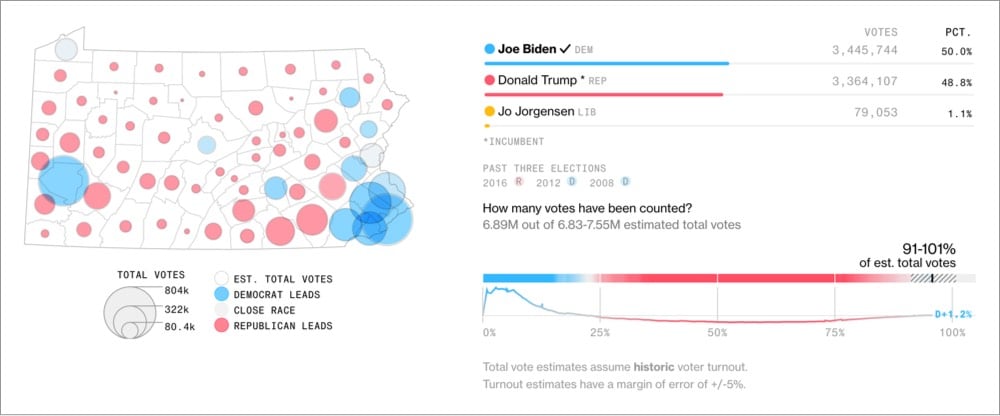
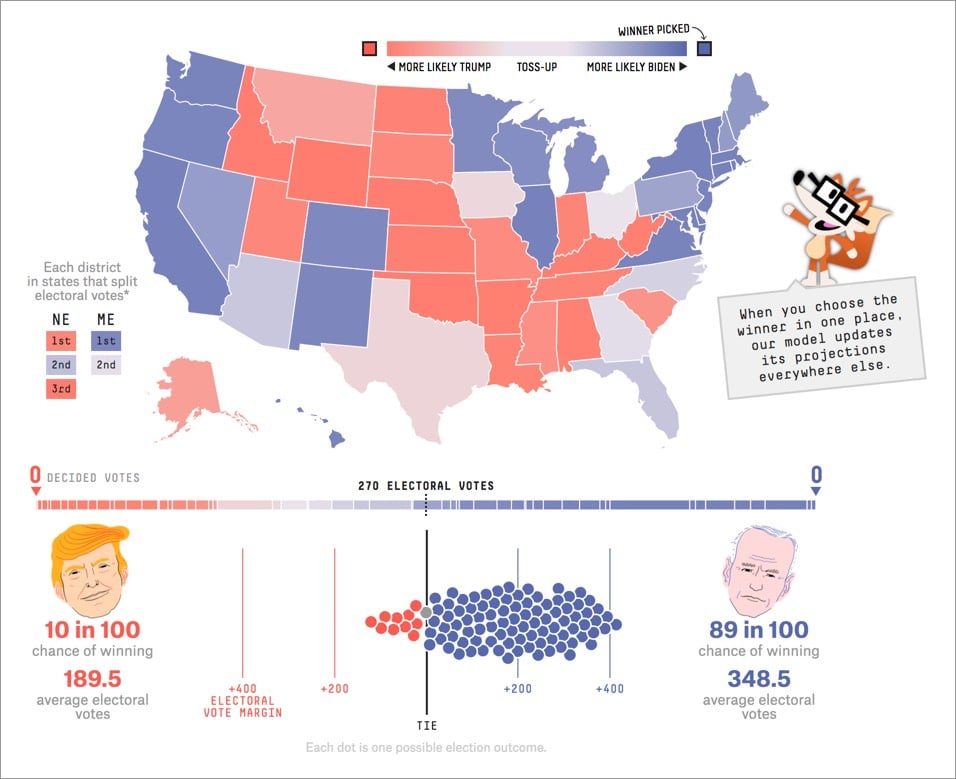
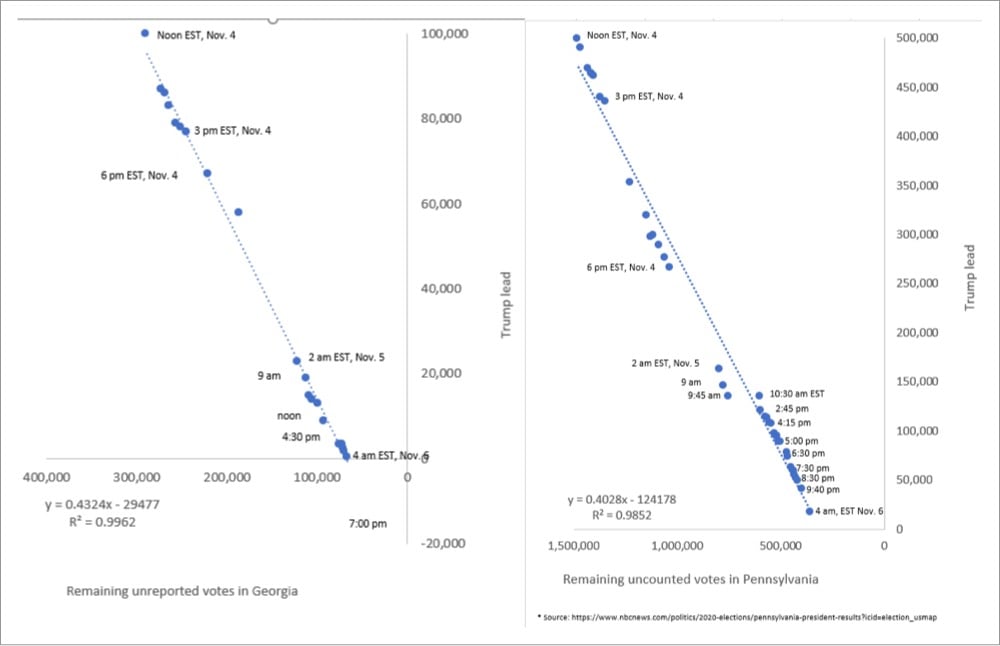
The graphs by John Harurum in that last image were especially useful for me in seeing how the counting trends were going.
Video of an anti-vaxxer gathering in Iowa last weekend shows huge indoor gathering, chanting Freedom!, no mask wearing, no distancing. Currently 51.7% of tested Iowans have Covid. Pure lunacy.
Pandemic Safety Rules
As I write this, it’s snowing outside here in Vermont and Covid-19 has finally gained a foothold in our little state. At the governor’s press conference yesterday, he and his pandemic response team announced that contact tracing done by the state showed that the rise in cases started as an outbreak in some hockey leagues. That initial outbreak wasn’t contained and subsequent non-essential, indoor, mask-less, multi-household gatherings and Halloween parties resulted in the very sharp rise we started to see here in the first week of November.
Scott explained that 71% of outbreaks reported from Oct. 1 to Nov. 13 were linked to “social events, parties and people hanging out at home or bars and clubs.” He added Vermont has not seen the virus spread widely at schools, restaurants or other businesses.
Dr. Mark Levine, the state health commissioner, said those parties came in a variety of sizes of parties — Halloween gatherings large and small, dinner parties, baby showers, “people in the high single numbers at a deer camp.”
In states with many infections, particularly in the Midwest, contact tracing is all but impossible, so it’s instructive to pay attention to Vermont’s example here: we’re doing the tracing and the tracers say the infections are coming from people gathering indoors across multiple households. Which is exactly what public health and medical experts have been urging people not to do for months now.
And that brings us to Thanksgiving. For The Atlantic, Rachel Gutman asked her colleagues who have been writing extensively about the pandemic for some of their top safety rules and guidelines and their number one was, say it with me:
My colleagues’ guidance boils down to this winter’s golden rule for interacting with anyone outside your immediate household: Don’t spend time indoors with other people.
Here it is again in a fun font, just to make sure you got it: 𝓓𝓸𝓷’𝓽 𝓼𝓹𝓮𝓷𝓭 𝓽𝓲𝓶𝓮 𝓲𝓷𝓭𝓸𝓸𝓻𝓼 𝔀𝓲𝓽𝓱 𝓸𝓽𝓱𝓮𝓻 𝓹𝓮𝓸𝓹𝓵𝓮.
Look, for some people spending time indoors with others is essential — jobs, education, etc. — but those who don’t have to, shouldn’t. And this goes for everywhere in the US because no states (aside from maybe Hawaii) are doing well right now — cases are either high, rising sharply, or both. Please please don’t gather in indoor, multi-household groups for Thanksgiving if you haven’t quarantined beforehand. In the US right now, about 1-in-55 people who get Covid-19 die from it. With rates already high around the country, if many people do Thanksgiving as usual, an already horrific and deadly situation could become much much worse.
Modelling the risk of aerosol transmission of Covid-19 during Thanksgiving dinner. Room size matters, outdoors is very low risk, “if superspreader present, everyone will be infected”, risk rises faster than group size, HEPA filters useful.
Apple reduces their App Store cut to 15% for businesses making less than $1 million/yr. Why not make this automatic and more progressive though?
More preliminary results from Pfizer’s Covid-19 vaccine: 95% effective after 170 accumulated infections. Moderna reported 94.5%. This is good news.
On the Authenticity of the Chess in The Queen’s Gambit
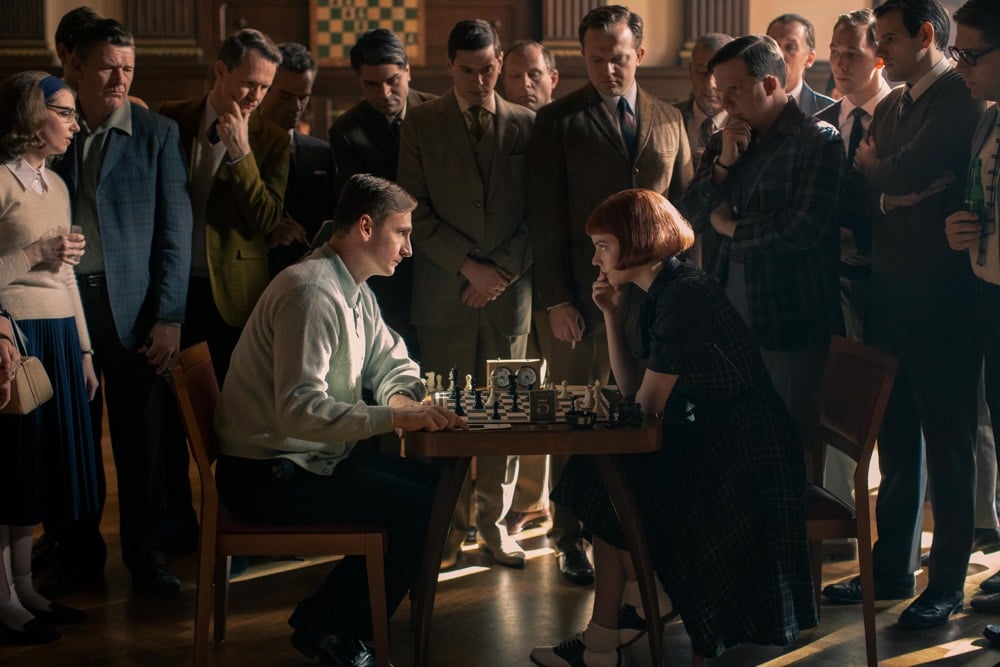
Like many of you, I watched and loved The Queen’s Gambit on Netflix (trailer). Part of the reason it’s so compelling is the care the show’s creators took in accurately portraying the chess players, games, and tournaments. Over the past few weeks, I’ve been reading articles by and interviews with chess experts on what the show got right and wrong. I’ll link to some of them below, but this interview with Garry Kasparov, one of the best chess players ever and an advisor to the show, is particularly worth reading. Here he talks about choosing a real game to be played as the final match in the series (spoilers):
Most of the games, it was not difficult, but the biggest challenge was the last game, because the last game is just, it’s a full game. And the problem is that the last game had to be played by the Queen’s Gambit. Of course I could pick up games from other openings, but it would be very much against the spirit of the book. How did I find a good game that will be played for 40 or so moves adjourned in a complicated situation? And then you have this very important element of Benny and his team calling from New York. It means the position had to be complicated. I found a few games and picked up one: Patrick Wolff against Vassily Ivanchuk, Biel Interzonal, 1993. Wolff sent me a note a couple of days after the show was released: “I recognize the game.” It was quite an obscure game. He said, “Garry, how on earth did you find it?” I said, “I had certain parameters, with the gambit, the number of pieces left, so basically, I ended up with 700 games.” It’s not perfect, because it’s not exactly as complicated as I want it, but it fit the book description: game adjourned, complicated position. And even with all the ruckus, he’s pushing the rook. The rook is trapped in the center. I preserved most of the game description and I think it helped, because that’s a climax, and the climax is something that people always recall.
The interview is interesting throughout. Here are some of the other articles I’ve read: former pro Linda Diaz, former top 10 player Judit Polgar (and others), former NY Times chess columnist Dylan Loeb McClain, chess pros Alexandra and Andrea Boetz, 2-time US champ Jennifer Shahade, and ChessBase editor Albert Silver.
Today Marks a Year of Covid-19
According to an unpublicized report by the Chinese government, the first documented case of Covid-19 was a 55-year-old person living in Hubei province on November 17, 2019. That makes today the first anniversary of the start of the Covid-19 pandemic. From that person (and possibly earlier or concurrent cases), the disease slowly and silently spread until it was determined to be due to a novel coronavirus.
They found that following the Nov. 17 case, about one to five new cases were reported every day and by Dec. 15, the total infections reached 27. Daily cases seem to have increased after that, with the case count reaching 60 by Dec. 20, the SCMP reported.
On Dec. 27, Dr. Zhang Jixian, head of the respiratory department at Hubei Provincial Hospital, reported to health officials in China that a novel coronavirus was causing the disease; by that day, it had infected more than 180 individuals. (Doctors may not have been aware of all of those cases at the time, but only identified those cases after going back over the records, the Morning Post reported.)
No one had any idea how much the world was going to change that day. What an awful, humbling, terrifying, ghoulish year.
Anonymous Obama Gets Some Ice Cream
Barack Obama’s A Promised Land comes out today and The Root’s Michael Harriot has a brief interview with Obama. The rest of the interview is meatier, but I like Harriott’s last question:
Q: You are a former president and you are unquestionably the predominant role model for a generation of Black people, both of which come with a certain amount of public scrutiny. But for one day, you get to be an anonymous, everyday American who can go anywhere you want and do anything. Describe that day.
A: You know, honestly, I’d just take a walk. Go to the grocery store. Go out to dinner with Michelle. Maybe get some ice cream. Around my second or third year in office, I’d have this recurring dream, maybe once every six months, where I’m walking down the street and head into a coffee shop or a bar or something and nobody recognizes me. It was great!
You can read the rest of his answer, including his thoughts on “the tyranny of selfie”. I watched the Pete Souza documentary The Way I See It the other day1 and the wildest scenes were the ones showing a young Obama on the Senate campaign trail just walking around with no one noticing or bothering him. He must miss those days for sure. But I bet it’s also fun to be able to get literally anyone you want on the phone in 30 seconds.
P.S. I haven’t read it myself yet, but I’ve heard from many folks that Jeffrey Goldberg’s lengthy conversation with Obama is worth checking out.
P.P.S. In their excellent 5-part series on Princess Diana, You’re Wrong About’s Michael Hobbes shared his theory that “fame is abuse” and I’ve been thinking about that in relation to every celebrity story I’ve read since.
Pro tip: in the US it’s streaming for free on Peacock, NBC’s new streaming service.↩
The COVID-19 Event Risk Assessment Planning Tool estimates how likely it is for a Covid-positive person to be at a gathering of X people. At a gathering of 15 people where I grew up in WI, there’s currently an 81% chance that someone there will have it.
Beyond parody…this is real Cosmo front page copy (about The Black Death!): “Dating Lessons from Pandemics Past – The 14th Century Called and It Wants Its Sex Spree Back”
The Swiss Cheese Covid-19 Defense
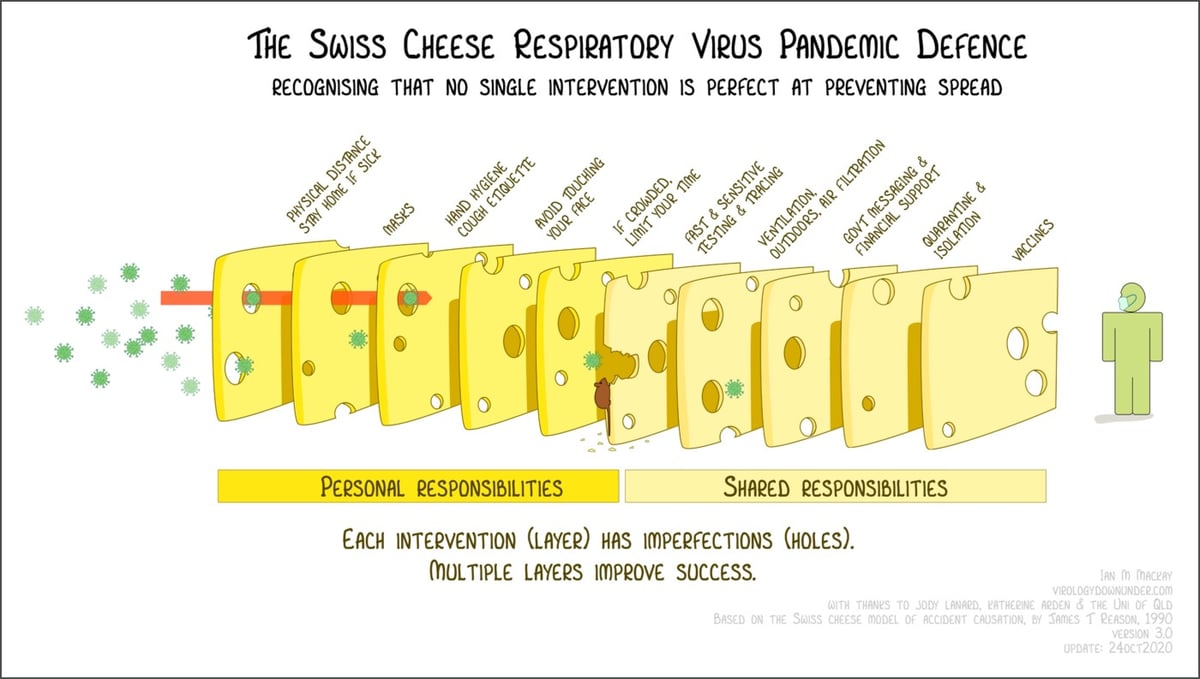
The Swiss cheese model of accident causation is a framework for thinking about how to layer security measures to minimize risk and prevent failure. The idea is that when several layers of interventions, despite their weaknesses, are properly stacked up between a hazard and a potentially bad outcome, they are able to cumulatively prevent that outcome because there’s no single point of failure. During the pandemic, health care workers and public health officials have been using the Swiss cheese model to visualize how various measures can work together to help keep people safe.
Virologist Dr. Ian Mackay has visualized the Swiss cheese Covid-19 defense in a wonderful way (pictured above). Each layer of cheese represents a personal or shared intervention — like mask wearing, limiting your time indoors w/ crowds, proper ventilation, quarantine, vaccines — and the holes are imperfections. Applied together, these imperfect measures work like a filter and can vastly improve chances of success.1 He even added a “misinformation mouse” chewing through one of the cheese slices to represent how deceptive information can weaken these defenses.
Mackay has released this graphic under a Creative Commons license (free to share and adapt w/ attribution) and is available in English, German, French, Spanish, Korean, and several other languages. (via @EricTopol)
It’s interesting that the Swiss cheese model is physically how masks work to stop aerosols and droplets — like layered filters and not sieves.↩
America’s healthcare workers, already strained and exhausted from months of continuous effort, are facing a “bigger and broader” third surge. “More people than ever are hospitalized with COVID-19. Health-care workers can’t go on like this.”
53 Whiskey Cocktails to Get You Through Winter. Only 53?! I don’t know if that’s going to be enough… (Pairs well with The 4000 Best Movies You Must Watch on Netflix Tonight!!!)
“It’s Time to Hunker Down”
Zeynep Tufekci says that a devastating third pandemic surge is upon us and that It’s Time to Hunker Down. She leads with the good news (vaccines, treatments, knowledge, testing capacity & quickness) but notes that with winter coming and a high baseline of cases from a summer not spent in preparation, now is the time to really knuckle down so that we can get to the finish line.
Whatever the causes, public-health experts knew a fall and winter wave was a high likelihood, and urged us to get ready.
But we did not.
The best way to prepare would have been to enter this phase with as few cases as possible. In exponential processes like epidemics, the baseline matters a great deal. Once the numbers are this large, it’s very easy for them to get much larger, very quickly — and they will. When we start with half a million confirmed cases a week, as we had in mid-October, it’s like a runaway train. Only a few weeks later, we are already at about 1 million cases a week, with no sign of slowing down.
Americans are reporting higher numbers of contacts compared with the spring, probably because of quarantine fatigue and confusing guidance. It’s hard to keep up a restricted life. But what we’re facing now isn’t forever.
It’s time to buckle up and lock ourselves down again, and to do so with fresh vigilance. Remember: We are barely nine or 10 months into this pandemic, and we have not experienced a full-blown fall or winter season. Everything that we may have done somewhat cautiously — and gotten away with — in summer may carry a higher risk now, because the conditions are different and the case baseline is much higher.
The Covid-19 Crystal Ball: Estimating Future Deaths from Today’s Reported Cases
On Friday, November 13, 170,792 new cases of Covid-19 were reported in the United States. About 3000 of those people will die from their disease on Dec 6 — one day of Covid deaths equal to the number of people who died on 9/11. It’s already baked in, it’s already happened. Here’s how we know.
The case fatality rate (or ratio) for a disease is the number of confirmed deaths divided by the number of confirmed cases. For Covid-19 in the United States, the overall case fatality rate (CFR) is 2.3%. That is, since the beginning of the pandemic, 2.3% of those who have tested positive for Covid-19 in the US have died. In India, it’s 1.5%, Germany is at 1.6%, Iran 5.5%, and in Mexico it’s a terrifying 9.8%.
A recent analysis by infectious disease researcher Trevor Bedford tells us two things related to the CFR.
1. Reported deaths from Covid-19 lag behind reported cases by 22 days. Some deaths are reported sooner and some later, but in general it’s a 22-day lag.1
2. The overall CFR in the US is 2.3% but if you use the 22-day lag to calculate what Bedford calls “a lag-adjusted case fatality rate”, it’s a pretty steady average of 1.8% since August. Here’s a graph:
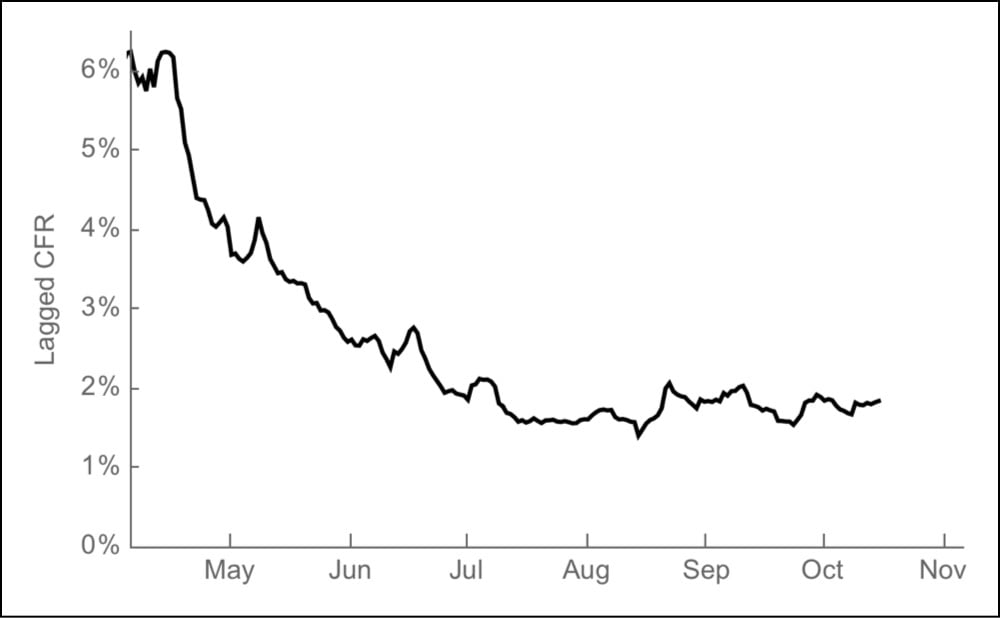
As you can see, in the early days of the pandemic, 4-6% of the cases ended in death and now that’s down to ~1.8%. That’s good news! The less good news is that the current case rate is high and rising quickly. Because of the lag in reported deaths, the rise in cases might not seem that alarming to some, even though those deaths will eventually happen. What Bedford’s analysis provides is a quick way to estimate the number of deaths that will occur in the future based on the number of cases today: just multiply the number of a day’s cases by 1.8% and you get an estimated number of people who will die 22 days later.2
For instance, as I said above, 170,792 cases were reported on Nov 13 — 1.8% is 3074 deaths to be reported on December 6. Cases have been over 100,000 per day for 11 days now: here are the estimated deaths from that time period:
| Date | Cases | Est. deaths (on date) |
|---|---|---|
| 2020-11-15 | 145,670 | 2622 (2020-12-08) |
| 2020-11-14 | 163,473 | 2943 (2020-12-07) |
| 2020-11-13 | 170,792 | 3074 (2020-12-06) |
| 2020-11-12 | 150,526 | 2709 (2020-12-05) |
| 2020-11-11 | 144,499 | 2601 (2020-12-04) |
| 2020-11-10 | 130,989 | 2358 (2020-12-03) |
| 2020-11-09 | 118,708 | 2137 (2020-12-02) |
| 2020-11-08 | 110,838 | 1995 (2020-12-01) |
| 2020-11-07 | 129,191 | 2325 (2020-11-30) |
| 2020-11-06 | 125,252 | 2255 (2020-11-29) |
| 2020-11-05 | 116,153 | 2091 (2020-11-28) |
| 2020-11-04 | 103,067 | 1855 (2020-11-27) |
| Totals | 1,609,158 | 28,965 |
Starting the day after Thanksgiving, a day traditionally called Black Friday, the 1.6 million positive cases reported in the past 12 days will result in 2-3000 deaths per day from then into the first week of December. Statistically speaking, these deaths have already occurred — as Bedford says, they are “baked in”. Assuming the lagged CFR stays at ~1.8% (it could increase due to an overtaxed medical system) and if the number of cases keeps rising, the daily death toll would get even worse. As daily case totals are reported, you can just do the math yourself:
number of cases × 0.018
200,000 cases in a day would be ~3600 deaths. 300,000 daily cases, a number that would have been inconceivable to imagine in May but is now within the realm of possibility, would result in 5400 deaths in a single day. Vaccines are coming, there is hope on the horizon. But make no mistake: this is an absolute unmitigated catastrophe for the United States.
Update: Over at The Atlantic, Alexis Madrigal and Whet Moser took a closer look at Bedford’s model, aided by Ryan Tibshirani’s analysis.
Tibshirani’s first finding was that the lag time between states was quite variable-and that the median lag time was 16 days, a lot shorter than the mean. Looking state by state, Tibshirani concluded, it seemed difficult to land on an exact number of days as the “right” lag “with any amount of confidence,” he told us. Because cases are rising quickly, a shorter lag time would mean a larger denominator of cases for recent days — and a lower current case-fatality rate, something like 1.4 percent. This could mean fewer overall people are dying.
But this approach does not change the most important prediction. The country will still cross the threshold of 2,000 deaths a day, and even more quickly than Bedford originally predicted. Cases were significantly higher 16 days ago than 22 days ago, so a shorter lag time means that those higher case numbers show up in the deaths data sooner. Even with a lower case-fatality rate, deaths climb quickly. Estimating this way, the country would hit an average of 2,000 deaths a day on November 30.
The other major finding in Tibshirani’s analysis is that the individual assumptions and parameters in a Bedford-style model don’t matter too much. You can swap in different CFRs and lag-time parameters, and the outputs are more consistent than you might expect. They are all bad news. And, looking retrospectively, Tibshirani found that a reasonable, Bedford-style lagged-CFR model would have generated more accurate national-death-count predictions than the CDC’s ensemble model since July.
Courtesy of Ed Yong, the lag between cases and hospitalizations is about 11 days. So the full ICUs and packed ERs were hearing about now are going to get so much worse in the next two weeks. And just think about the potential situation a month from now if cases keep rising at the rate they are now for two more weeks…↩
Just to stress again: this is only an estimate. The real reported deaths from a single day’s reported cases will be spread out over several days or weeks. And case reporting is much lower on Sundays and Mondays than on other days (fewer reports on weekends). Bedford accounted for this in his analysis by using 7-day averages.↩
Using techniques borrowed from sex-ed (to e.g. encourage condom use) to talk to people about mask wearing. “It feels strange to do this even if you don’t feel sick. That’s actually why it matters: if we do this, we get to keep…spending time together.”
Preliminary Results: Moderna Covid-19 Vaccine Is 94.5% Effective
Last Monday the world got some good news: an early review of the data showed that Pfizer’s Covid-19 vaccine was “more than 90% effective” in preventing the disease. The results pointed to other vaccines also being highly effective against the virus and this morning comes this news: Early Data Show Moderna’s Coronavirus Vaccine Is 94.5% Effective.
The drugmaker Moderna announced on Monday that its coronavirus vaccine was 94.5 percent effective, based on an early look at the results from its large, continuing study.
Researchers said the results were better than they had dared to imagine. But the vaccine will not be widely available for months, probably not until spring.
Despite the delivery timeline, this is such good news.
The companies’ products open the door to an entirely new way of creating vaccines — and creating them fast. Both use a synthetic version of coronavirus genetic material, called messenger RNA or mRNA, to program a person’s cells to churn out many copies of a fragment of the virus. That fragment sets off alarms in the immune system and stimulates it to attack, should the real virus try to invade. Although a number of vaccines using this technology are in development for other infections and cancers, none have yet been approved or marketed.
“The fact that two different vaccines made by two different companies with two different kinds of structures, in a new messenger RNA concept, both worked so effectively confirms the concept once and for all that this is a viable strategy not only for Covid but for future infectious disease threats,” said Dr. Barry R. Bloom, a professor of public health at Harvard.
Natalie E. Dean, a biostatistician at the University of Florida, said an important finding was that the vaccine appeared to prevent severe disease. Pfizer did not release information about disease severity when reporting its results.
Researchers say the positive results from Pfizer and Moderna bode well for other vaccines, because all of the candidates being tested aim at the same target - the so-called spike protein on the coronavirus that it uses to invade human cells.
It’s only a few more months — please please do what you can to stay safe and keep others safe (especially medical workers) until these vaccines can be rolled out.
A South Dakota ER nurse on her Covid-19 patients who refuse to believe Covid is real. “They call you names and ask why you have to wear all that ‘stuff’ because they don’t have COViD because it’s not real. Yes. This really happens.”
Socials & More