



JK Rowling’s plot spreadsheet
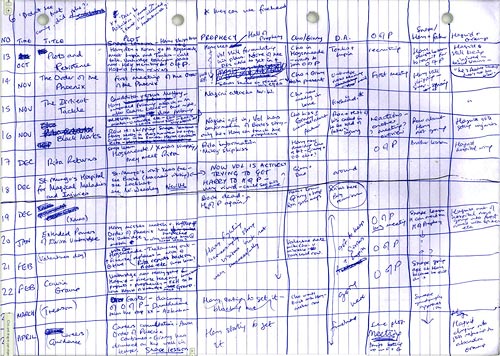
Rowling’s writing process visualized. Looks like this page is from The Order of the Phoenix. (via famulan)

This site is made possible by member support. 💞
Big thanks to Arcustech for hosting the site and offering amazing tech support.
When you buy through links on kottke.org, I may earn an affiliate commission. Thanks for supporting the site!
kottke.org. home of fine hypertext products since 1998.
Beloved by 86.47% of the web.
Rowling’s writing process visualized. Looks like this page is from The Order of the Phoenix. (via famulan)
Author Janet Fitch wrote a list of 10 Writing Tips That Can Help Almost Anyone.
Long ago I got a rejection from the editor of the Santa Monica Review, Jim Krusoe. It said: “Good enough story, but what’s unique about your sentences?” That was the best advice I ever got. Learn to look at your sentences, play with them, make sure there’s music, lots of edges and corners to the sounds. Read your work aloud. Read poetry aloud and try to heighten in every way your sensitivity to the sound and rhythm and shape of sentences. The music of words.
There are seven main features of a Malcolm Gladwell book.
5. Give things names and remember Douglas Adams’ rule of capital letters. Capital letters make things important. For example, in The Tipping Point, Gladwell conjures up the following important concepts: The Law of the Few, The Stickiness Factor, and The Power of Context. In Outliers, there’s The Matthew Effect and The 10,000-Hour Rule.
And totally unrelated but related, here’s an awesome photo of a 14-year-old Gladwell running the 1500 meters. (thx, nick)
A book about Agatha Christie’s working notebooks reveals that the writer known for her intricate plots worked in a highly nonlinear fashion. Sometimes she didn’t even know whodunnit until late in the writing process.
The contents of the notebooks are as multi-dimensional as their Escher-like structure. They include fully worked-out scenes, historical background, lists of character names, rough maps of imaginary places, stage settings, an idle rebus (the numeral three, a crossed-out eye, and a mouse), and plot ideas that will be recognizable to any Christie fan: “Poirot asks to go down to country-finds a house and various fantastic details,” “Saves her life several times,” “Inquire enquire-both in same letter.” What’s more, in between ominous scraps like “Stabbed through eye with hatpin” and “influenza depression virus-Stolen? Cabinet Minister?” are grocery lists: “Newspapers, toilet paper, salt, pepper …” There was no clean line between Christie’s work life and her family life. She created household ledgers, and scribbled notes to self. (“All away weekend-can we go Thursday Nan.”) Even Christie’s second husband, the archeologist Sir Max Mallowan, used her notebooks. He jotted down calculations. Christie’s daughter Rosalind practiced penmanship, and the whole family kept track of their bridge scores alongside notes like, “Possibilities of poison … cyanide in strawberry … coniine-in capsule?”
I don’t know why this approach seems so surprising. From all that I’ve read about how book authors work, writing a book is like sanding wood…you can’t just start with the extra-fine sandpaper and expect a smooth surface.
In a memo to the writers of The Unit, David Mamet (the show’s executive producer) provides a short but master class in writing for television.
THINK LIKE A FILMMAKER RATHER THAN A FUNCTIONARY, BECAUSE, IN TRUTH, YOU ARE MAKING THE FILM. WHAT YOU WRITE, THEY WILL SHOOT.
HERE ARE THE DANGER SIGNALS. ANY TIME TWO CHARACTERS ARE TALKING ABOUT A THIRD, THE SCENE IS A CROCK OF SHIT.
ANY TIME ANY CHARACTER IS SAYING TO ANOTHER “AS YOU KNOW”, THAT IS, TELLING ANOTHER CHARACTER WHAT YOU, THE WRITER, NEED THE AUDIENCE TO KNOW, THE SCENE IS A CROCK OF SHIT.
(thx, mark)
The Guardian asked a bunch of writers to share their tips for writing fiction. The responses appear in two parts. Elmore Leonard:
Never use an adverb to modify the verb “said”… he admonished gravely. To use an adverb this way (or almost any way) is a mortal sin. The writer is now exposing himself in earnest, using a word that distracts and can interrupt the rhythm of the exchange. I have a character in one of my books tell how she used to write historical romances “full of rape and adverbs”.
Here’s Philip Pullman’s response in full:
My main rule is to say no to things like this, which tempt me away from my proper work.
(via mr)
Who knew that a long article about F Scott Fitzgerald’s tax returns could be so interesting?
The five months of furious short-story writing in 1923-24 had left him with a stake of $7,000. In Great Neck, that would only cover two and a half months of expenses. How could he stretch the $7,000 to gain the time to finish Gatsby? Earlier, as he was struggling to save, a friend wrote from France to suggest that Fitz-gerald join the many Americans living well in Europe on the strong American dollar. The friend wrote that it cost one-tenth as much to live in Europe: he had just finished “a meal fit for a king, washed down with champagne, for the absurd sum of sixty-one cents.” Fitzgerald thought, based on the friend’s recommendation, living expenses on the off-season Riviera would be low enough to let him finish Gatsby without any short-story interruptions.
Writer Joel Stickley keeps a blog about how best to write badly. Here’s a snippet from a recent entry titled “Describe every character in minute detail, taking no account of narrative pacing”:
Terrence Handley shifted his weight, the weight that had been steadily increasing for the last ten years and showed no sign of diminishing, at least while his wife Marie continued to excel as she did at the design and production of delectable gourmet meat pies, and shuffled his feet restively as he waited.
At 70, writer Charles Bukowski started using a computer — a Macintosh IIsi that his wife gave him for Christmas — and was so taken with it that he never went back to the typewriter.
There is something about seeing your words on a screen before you that makes you send the word with a better bite, sighted in closer to the target. I know a computer can’t make a writer but I think it makes a writer better. Simplicity in writing and simplicity in getting it down, hot and real. When this computer is in the shop and I go back to the electric, it’s like trying to break rock with a hammer. Of course, the essence of writing is there but you have to wait on it, it doesn’t leap from the gut as quickly, you begin to trail your thoughts — your thoughts are ahead of your fingers which are trying to catch up. It causes a block of sorts indeed.
One of Kurt Vonnegut’s eight rules for writing short stories:
7. Write to please just one person. If you open a window and make love to the world, so to speak, your story will get pneumonia.
Ayup. See also How to Write With Style.
The Paris Review has posted an extensive excerpt of an interview with writer Gay Talese from their summer issue. Wonderful stuff, ranging from his unusual writing process to how he got his start to a brief behind-the-scenes about writing Frank Sinatra Has a Cold.
All the other reporters of my generation would come back from an assignment and be done with their piece in a half hour. For the rest of the afternoon they’d be reading books or playing cards or drinking coffee in the cafeteria, and I was always very much alone. I didn’t carry on conversations during those hours. I just wanted to make my article perfect, or as good as I could get it. So I rewrote and rewrote, feeling that I needed every minute of the working day to improve my work. I did this because I didn’t believe that it was just journalism, thrown away the next day with the trash. I always had a sense of tomorrow. I never turned in anything more than two minutes before deadline. It was never easy, I felt I had only one chance. I was working for the paper of record, and I believed that what I was doing was going to be part of a permanent history.
It had better be good too, because my name was on it. I’ve always thought that. I think this came from watching my father work on suits. I was impressed by how carefully he would sew, and he never made much money, but I thought he was the real thing. His name was on those suits-the buttons couldn’t fall off tomorrow. They had to look great, had to fit well, and had to last. His business wasn’t profitable, but from him I learned that I wanted to be a craftsman.
Don’t miss the piece of shirt board that Talese used to outline the Sinatra story. (via submitted for your perusal)
Update: Who else used shirt boards? Robert Rauschenberg.
The deadline for entering the Winterhouse Awards for Design Writing & Criticism is nearing. Get your entries in by June 1.
The Writing Award of $10,000 is open to writers, critics, scholars, historians, journalists and designers and given for a body of work. The Education Award of $1,000 is open to students (high school, undergraduate or graduate) whose use of writing in a single essay demonstrates originality and promise.
Cathy Curtis, a former staff writer for The LA Times, shares how the web made her a better writer.
Another impetus for scanning, I believe, is the web’s seemingly limitless content. It’s like being unable to enjoy yourself at a party because you might be having a better time at someone else’s house. Add the growing mania for speed (“This #%&* site is taking 20 seconds to load!”), and it’s clear that web writing has to pick up the pace.
(via subtraction)
A Primer for Kicking Ass
Being the Result of One Man’s Fed-upped-ness With ‘How to Write’ Books Not Actually Showing You How to Write
By James Tanner. Reprinted with permission.
0. Begin with an idea, a string of ideas.
Ex: Mario had help with his movie. He did a lot of the work himself.
1. Use them in a compound sentence:
It’s obvious someone helped with the script, But…Mario did the puppet work, And…It was his shoes on the pedal.
2. Add rhythm with a dependent clause:
It’s obvious someone helped with the script, but Mario did the puppet work, and it was, without question, his shoes on the pedal.
3. Elaborate using a complete sentence as interrupting modifier:
It’s obvious someone helped with the script, but Mario did the puppet work — his arms are perfect for the puppets — and it was, without question, his shoes on the pedal.
4. Append an absolute construction or two:
It’s obvious someone helped with the script, but Mario did the puppet work — his arms are perfect for the puppets — and it was, without question, his shoes on the pedal, the camera mounted on a tripod, mops moved out of frame.
5. Paralell-o-rize your structure (turn one noun into two):
It’s obvious someone helped with the script, but Mario did the choreography and the puppet work — his arms and fingers are perfect for the puppets — and it was, without question, his shoes on the pedal, the camera mounted on a tripod, mops and buckets moved out of frame.
-
STOP HERE IF YOU ARE A MINIMALIST, WRITING COACH, OR JAMES WOOD
-
6. Adjectival phrases: lots of them. (Note: apprx. 50% will include the word ‘little’):
It’s obvious someone helped with the script, but Mario did the choreography and most of the puppet work — his little S-shaped arms and curved fingers are perfect for the standard big-headed political puppets — and it was, without question, his little square shoes on the pedal, the camera mounted on a tripod, mops and dull-gray janitorial buckets moved out of frame.
7. Throw in an adverb or two (never more than one third the number of adjectives):
It’s obvious someone helped with the script, but Mario did the choreography and most of the puppet work personally — his little S-shaped arms and curved fingers are perfect for the standard big-headed political puppets — and it was, without question, his little square shoes on the pedal, the camera mounted on a tripod, mops and dull-gray janitorial buckets carefully moved out of frame.
8. Elaboration — mostly unnecessary. Here you’ll turn nouns phrases into longer noun phrases; verbs phrases into longer verb phrases. This is largely a matter of synonyms and prepositions. Don’t be afraid to be vague! Ideally, these elaborations will contribute to voice — for example, ‘had a hand in’ is longer than ‘helped’, but still kinda voice-y — but that’s just gravy. The goal here is word count.
It’s obvious someone else had a hand in the screenplay, but Mario did the choreography and most of the puppet-work personally — his little S-shaped arms and curved fingers are perfect for the forward curve from body to snout of a standard big-headed political puppet — and it was, without question, Mario’s little square shoes on the pedal, the camera mounted on a tripod across the over lit closet, mops and dull-gray janitorial buckets carefully moved out past the frame’s borders on either side of the little velvet stage.
-
STOP HERE IF YOU ARE NOT WRITING PARODY
-
9. Give it that Wallace shine. Replace common words with their oddly specific, scientific-y counterparts. (Ex: ‘curved fingers’ into ‘falcate digits’). If you can turn a noun into a brand name, do it. (Ex: ‘shoes’ into ‘Hush Puppies,’ ‘camera’ into ‘Bolex’). Finally, go crazy with the possessives. Who wants a tripod when they could have a ‘tunnel’s locked lab’s tripod’? Ahem:
It’s obvious someone else had a hand in the screenplay, but Mario did the choreography and most of the puppet-work personally — his little S-shaped arms and falcate digits are perfect for the forward curve from body to snout of a standard big-headed political puppet — and it was, without question, Mario’s little square Hush Puppies on the H^4’s operant foot-treadle, the Bolex itself mounted on one of the tunnel’s locked lab’s Husky-VI TL tripods across the over lit closet, mops and dull-gray janitorial buckets carefully moved out past the frame’s borders on either side of the little velvet stage.
10. Practice. Take one sentence — any sentence — and Wallacize it. Turn ten boring words into a hundred good ones.
Ex: “John wanted to play ball, but he sat on the couch.”
Or did John _________________________________ ?
[Ed note: I saw this on a mailing list a few weeks ago, really liked it, and asked permission to reprint it here. Thanks for sharing, James.]
Several authors share what they like and dislike about writing for a living.
I wouldn’t be the first writer to point out that doing something so deeply personal does become less jolly when you have to keep on at it, day after cash-generating day. To use a not ridiculous analogy: Sex = nice thing. Sex For Cash = probably less fun, perhaps morally uncomfy and psychologically unwise. Sitting alone in a room for hours while essentially talking in your head about people you made up earlier and then writing it down for no one you know does have many aspects which are not inherently fulfilling.
Socials & More