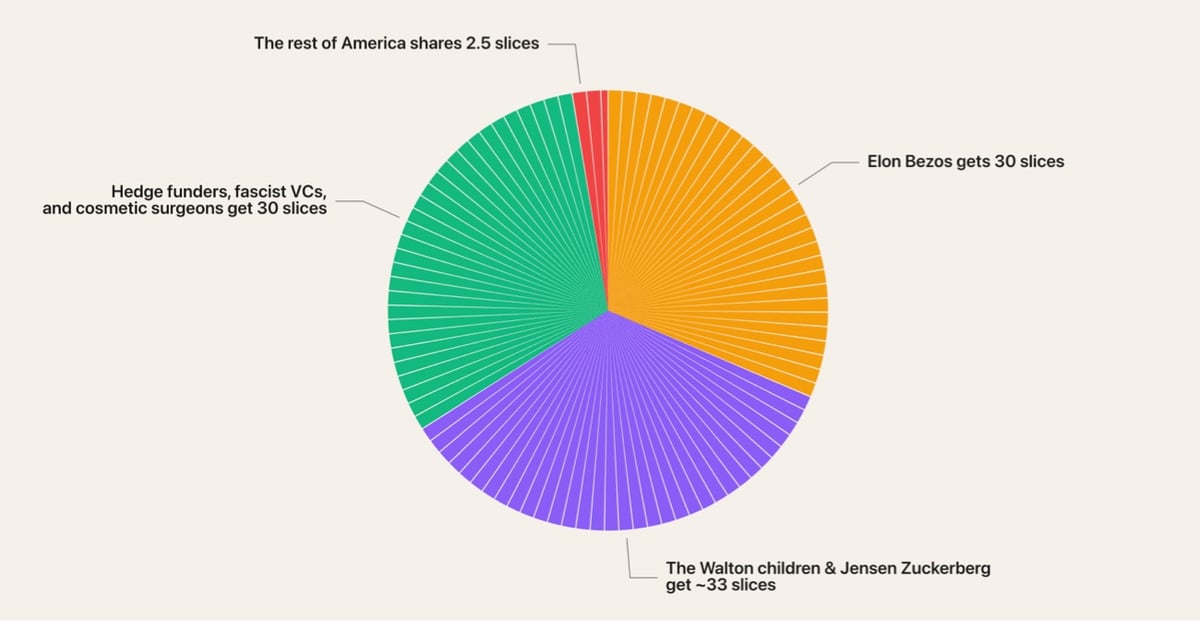
Using the Federal Reserve’s Distribution of Household Wealth in the U.S. since 1989 data, Ryan Thorpe imagines a pizza party with 100 guests and 100 slices of pizza as a stand-in for the United States:
We’re having a pizza party with 100 guests! Let’s divvy up the slices the way wealth is divided among American households:
• 1 person gets 30 slices
• 9 people get 3.7 slices each
• 40 people get 0.75 slices each
• 50 people get 0.05 slices each
Dig in! But watch out for “those people” trying to steal your 0.05.
I checked the math and it’s not quite 100 slices…it’s ~96.1 I whipped up a pizza pie chart (embedded above) so you can visualize how much each person gets. Is this the kind of party we Americans want to attend on a daily basis?
Filmmaker Noah Hawley was invited to Amazon founder Jeff Bezos’s Campfire retreat in 2018. Reflecting on the experience recently for The Atlantic, Hawley writes that today’s super-rich have stopped “pretending that the rules of human society apply” to them.
The Jeff Bezos of 2018 acted as if he still believed that people’s impression of him mattered, that his financial and social value could be affected by negative publicity. He still believed that his actions had consequences. He had not yet freed himself—the way Daniel Plainview freed himself—from the rules of men.
Eight years later, Bezos and two of the world’s other richest men—Mark Zuckerberg and Elon Musk—have clearly left the world of consequences behind. They float in a sensory-deprivation tank the size of the planet, in which their actions are only ever judged by themselves.
The closer I’ve gotten to the world of wealth, the more I understand that being truly rich doesn’t mean amassing enough money to afford superyachts, private jets, or a million acres of land. It means that everything becomes effectively free. Any asset can be acquired but nothing can ever be lost, because for soon-to-be trillionaires, no level of loss could significantly change their global standing or personal power. For them, the word failure has ceased to mean anything.
Daisy Grewal in 2012 for Scientific American: How Wealth Reduces Compassion.
Who is more likely to lie, cheat, and steal—the poor person or the rich one? It’s temping to think that the wealthier you are, the more likely you are to act fairly. After all, if you already have enough for yourself, it’s easier to think about what others may need. But research suggests the opposite is true: as people climb the social ladder, their compassionate feelings towards other people decline.
Billionaire Wilderness: The Ultra-Wealthy and the Remaking of the American West by Justin Farrell sounds like an interesting read along these same lines.
Presentation: how to make a million dollars. “In America, starting a successful business is the surest, most controllable path available to you for making a million dollars”.
Class “conflict” on Nantucket: the old rich meet the new super-rich. And then there’s the rest of the island’s population that can’t afford to live there anymore.
Google’s famous chef is leaving the company. It must be hard to cook free lunches when you’re so filthy, stinking rich.
The Neiman Marcus Paradox: How dumb rich people end up in debt. “14 percent of people with more than $5 million in assets have credit-card balances [which is] mystifying since credit-card cash is perhaps the most expensive form of money legally available.”




Socials & More