kottke.org posts about sports
Morgan Spurlock ate McDonald’s for 30 days, gained 25 pounds, and had health problems. US swimmer Ryan Lochte has eaten McDonald’s for “almost every meal” since he arrived in Beijing and has won four Olympic medals. His fellow swimmer Michael Phelps doesn’t eat so healthy either. In a sport where you can win or lose by tenths or hundredths of seconds, I wonder what impact a proper diet would have on their times. (And to not eat any Chinese food — one of the world’s great cuisines — while in Beijing? A travesty.)
Update: The Guardian’s Jon Henley tries Michael Phelps’ diet for a day. Unsuccessfully, I don’t need to add. (thx, laura)
Update: Fear of illness may also have something to do with Lochte’s standing reservation at McDonald’s.
Popular Woodworking magazine weighs in: why are major league bats breaking at an increasing rate?
So is the broken bat mystery merely a question of maple vs. ash? As a woodworker, I doubt it. I will concede that the safety question is best answered with the choice of ash over maple because I’d bet the ash will be far less likely to break in two and send a hurtling projectile. More likely, ash will just crack or splinter.
(thx, brent)
Update: Cal Ripken and Harold Reynolds agree with the woodworkers: bats break because they’re lighter with thinner handles. (thx, gerard)
In terms of population, the Bahamas won more medals at the 2004 Summer Olympics than any other country, by more than double. For a country of ~21 million, the super-fit Australians make a good showing on the list.
Update: And here’s a listing of medals rated by wealth. (thx, noah)
Elite archers are sometimes afflicted with something called target panic.
Target panic, as the condition is known, causes crack shots to suddenly lose control of their bows and their composure. Mysteriously, sufferers start releasing the bow the instant they see the target, sabotaging any chance of a gold-medal shot. Others freeze up and cannot release at all. Target panic is akin to the yips in baseball and golf, when accomplished athletes can no longer make a simple throw to first base or stroke an easy putt.
Some researchers have asserted that there are two types of yips, neurological (when groups of neurons become worn from overuse) and psychological.
For the past few years, Mark Bottrell has been tracking how many players who have appeared in RBI Baseball (from 1988) and Tecmo Super Bowl (from 1991) are still active in MLB and the NFL. Sad news this year…only one player is still active.
The last man to finish the Tour de France gets the unofficial title of winner of the Lanterne Rouge. Finishing last is not as easy as you might suppose.
The designation falls somewhere between insult and accolade. Mr. Vansevenant, who after Stage 18 sits in 150th place, some 3 hours and 45 minutes behind Mr. Sastre, is indeed the worst-placed rider in the Tour de France. But, in turn, he has outlasted those who abandoned the Tour through illness, injury or simple exhaustion; those who were eliminated for failing to finish within each day’s time limit and are forced to withdraw; and those who were banned or withdrew for doping-related causes. From year to year, about 20% of the riders drop out. In other words, you can’t simply coast to last place; you have to work for it.
Wim Vansevenant did hang on to become the first three-time winner of the Lanterne Rouge.
I am powerless against YouTube videos with names like Federer Madness. The video’s so crappy that I can’t even see the ball most of the time and yet I cannot stop watching. From there, it’s federer legendary 10 top shots, Rafael Nadal neat ball trick, and Michael Chang’s underhand serve at the 1989 French Open. Send help and Gatorade!
At Piedmont High School in California, two coaches have devised an offense in which all 11 men are responsible for carrying the ball down the field Plays start with two quarterbacks and go from there.
Yes, per the rules of the game, only five players are eligible to catch a pass during a particular play and seven players have to set up on the line of scrimmage. But in the minds of Bryan and Humphries, you can develop an infinite number of plays with an infinite number of formations.
Talk about confusing a defense.
“It presents a different set of challenges for defenses because they have to account for which guys go out or might go out,” Bryan said. “Those guys who are ineligible to go down the field and catch a pass, they can take a reverse pitch or a negative screen or a hitch behind the line of scrimmage.
This 4-minute video provides a good look at how the offense functions and there’s lots more at a11offense.com. (via clusterflock)
Ben Fry analyzes the data from an intelligence test administered to all incoming NFL players and displays the results by position. Offensive players do better than defensive players on the test, although running backs score the lowest (wide receivers and cornerbacks also don’t do well). As Michael Lewis suggested in The Blind Side, offensive tackles are the smartest players on the field, followed by the centers and then the quarterbacks.
Malcolm Gladwell talked about the Wonderlic test at the New Yorker Conference and judged it a poor indicator of future performance.
In his latest podcast, Bill Simmons apologizes (sort of) for his stupid article on why tennis is sucky and boring, calling it “maybe the dumbest column I’ve ever written”. But then he goes on to say that what Wimbledon needs is a retractable roof on Centre Court and lights so that matches can proceed without fear of rain or night. Both of which are totally happening next year, unbeknowst to Simmons.
If you’re a sports columnist, it helps if you’re, you know, interested in sports. Many columnists are only interested in the big three sports — football, basketball, baseball — and treat other sports with a not-so-veiled disinterest or even distain. Competition, both against others and with the self, is at the base of all sports and if, as a so-called “sports fan”, you can’t find something of that to love about tennis or badminton or NASCAR, maybe you need to look elsewhere for work. Simmons needs to bring himself up to speed on tennis; he’s missed a lot.
And if you’re writing about a sport you don’t know much about and argue that it needs to be changed in such a way that makes it more exciting for the short attention span generation, you should also be prepared to advocate for the 35-game NBA season, the 60-game MLB season, moving the pitcher’s mound back to 65 feet, eliminating charging in the NBA, and 11-on-10 in NFL games.
In what was probably the weirdest soccer match finish ever, Barbados tied their match against Grenada with an own goal to send the match into overtime where they won by the 2 goals needed to qualify for the finals in the 1994 Shell Caribbean Cup.
Needing to beat Grenada by two clear goals to qualify for the finals in Trinidad and Tobago, Barbados had established a 2-0 lead midway through the second half and were seemingly well in control of the game. However, an own goal by a Bajan defender made the score 2-1 and brought a new ruling into play, which led to farce. Under the new rule, devised by the competition committee to ensure a result, a match decided by sudden death in extra time was deemed to be the equivalent of a 2-0 victory. With three minutes remaining, the score still 2-1 and Grenada about to qualify for the finals, Barbados realised that their only chance lay in taking the match to sudden death. They stopped attacking their opponents’ goal and turned on their own. In the 87th minute, two Barbadian defenders, Sealy and Stoute, exchanged passes before Sealy hammered the ball past his own goalkeeper for the equaliser.
The Grenada players, momentarily stunned by the goal, realised too late what was happening and immediately started to attack their own goal as well to stop sudden death. Sealy, though, had anticipated the response and stood beside the Grenada goalkeeper as the Bajans defended their opponents’ goal. Grenada were unable to score at either end, the match ended 2-2 after 90 minutes and, after four minutes of extra time, Thorne scored the winner for Barbados amid scenes of celebration and laughter in the National Stadium in Bridgetown.
Here’s a video with highlights of the end of the game. (via gulfstream)
1. The Federer/Nadal final at Wimbledon was epic. I was tense for the entire duration of the final three sets, which lasted about 2.5 to 3 hours. After years of sportswriters declaring that Roger Federer is the best player of all time, we might be faced with the possibility that he’s not even the best player of his generation. Two data points: 1) Nadal has shown that he can win on any surface, including Federer’s specialty, and 2) Nadal’s head-to-head record against Federer is 10-5 (although many of those wins came on clay). The match also clearly reveals the idiocy of this lame Bill Simmons article about how tennis needs to change.
2. Joey Chestnut successfully defended his title this weekend at the Nathan’s Famous Hot Dog Eating Contest, eating 59 hot dogs and buns in 10 minutes. He needed a 5-dog overtime to hold off long-time champ Takeru Kobayashi, who has lost to Chestnut the last two years. Chestnut weighs 230 pounds while Kobayashi is only 160 pounds.
3. The US Olympic swimming trials are over and Michael Phelps qualified in 5 individual events and will likely participate in three relays as well, giving him a chance to break Mark Spitz’s record of seven gold medals won in a single Olympics. Overshadowing Phelps’ achievements was “41-year-old mom” (that’s how they kept describing her on TV) Dara Torres, who qualified in both the 100-meter freestyle and the 50-meter freestyle.
Update: Ok, Nadal can’t consistently win on hardcourt. But he’s 22…give him time. (thx, everyone)
Tim Lincecum is a 5’ 10” 172-pound Major League pitcher with a 98-mph fastball. Such velocity out of such a small frame is attributed to his unique (but mechanically sound) pitching technique.
One key to Lincecum’s delivery is to keep his left side, especially his left shoulder, aimed toward his target for as long as possible. “Don’t open up too soon because then you lose leverage,” Tim says. “If you twist a rubber band against itself, the recoil is bigger. The more torque I can come up with, the better.”
Where Lincecum truly separates himself from most pitchers is the length of his stride. It is ridiculously long as it relates to his height. And just as his left foot, the landing foot, appears to be nearing the ground at the end of his stride, he lifts it as if stepping over a banana peel — extending his stride even more. The normal stride length for a pitcher is 77% to 87% of his height. Lincecum’s stride is 129%, or roughly 7 1/2 feet.
As a casual fan, it’s difficult to see what’s so different and violent about Lincecum’s pitching technique.
This is Olympic swimmer Dara Torres.
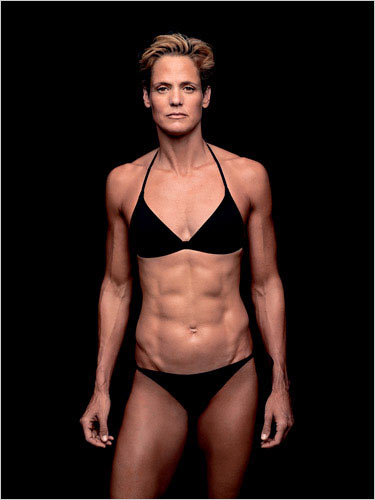
She’s 41 years old, has a two-year-old daughter, and won her first Olympic medal, a relay gold, in 1984. Torres is training to make the 2008 US Olympic team, but it’s not some casual attempt to relive the good old days: Torres set the American record in the 50-meter freestyle just a few months ago. As the photo above attests, part of Torres’ continuing success is due to her training regimen.
Torres calls resistance stretching her “secret weapon.” Bob Cooley, who invented the discipline, describes it in less-modest terms. According to Cooley, over a two-week period in 1999, his flexibility system turned Torres “from being an alternate on the relay team to the fastest swimmer in America.” The secret to Torres’s speed, Cooley says, is that his technique not only makes her muscles more flexible but also increases their ability to shorten more completely, and when muscles shorten more completely, they produce greater power and speed. “What do race-car drivers do when they want to go faster?” Cooley asks. “They don’t spend more hours driving around the track. They increase the biomechanics of the car. And that’s what resistance flexibility is doing for Dara - increasing her biomechanics.”
The Olympic Trials are going on right now in Omaha, NE. The women’s 50-meter freestyle preliminaries take place on July 5 with the final on July 6, broadcast live on NBC.
Newer posts
Older posts





Socials & More