kottke.org posts about religion
In the latest issue of Nextdraft, Dave Pell points to an episode of the Reveal podcast that goes behind the scenes of the investigation into the Catholic Church sex abuse scandal depicted in Spotlight.
Spotlight (one of the key contenders in the Oscar race) is an excellent movie that tells the story of an endangered species in American life: a well-funded, local, investigative reporting team. My friends at Reveal go behind the scenes to provide the backstory on how Boston Globe reporters broke the story of the Catholic Church sex abuse scandal, and provide a look into the latest developments in what is, sadly, an ongoing story.
Spotlight was one of my favorite 2015 movies.

Pastrami on Rye is a full-length history of the NYC Jewish deli, written by Judaism scholar Ted Merwin. From a review in The Economist:
Jewish delicatessens may now be known for knishes, latkes and pastrami sandwiches, but back in their heyday, during the 1920s and 1930s in the theatre district in New York, they also served beluga caviar, pâté de foie gras and Chateaubriand steak. Jewish classics were gussied up and defiled: chopped chicken liver was served with truffles. Treyf, like oysters and pork chops, was eaten with abandon alongside kosher delicacies.
That reminds me…a trip to Katz’s is looooooong overdue.
Jonathan Merritt writes about Fred Rogers, ordained Presbyterian minister and beloved children’s TV show host who used his faith and TV to help millions of children.
Fred Rogers was an ordained minister, but he was no televangelist, and he never tried to impose his beliefs on anyone. Behind the cardigans, though, was a man of deep faith. Using puppets rather than a pulpit, he preached a message of inherent worth and unconditional lovability to young viewers, encouraging them to express their emotions with honesty. The effects were darn near supernatural.
I watched Mr. Rogers religiously growing up, pun intended. Actual church, with its focus on rites, belief in the supernatural, and my pastor’s insistence that the Earth was only 6000 years old, was never appealing to me, but Mr. Rogers’ unconditional, graceful, and humanistic brand of religion was just perfect. I heard him say this line at the end of his show hundreds of times:
You’ve made this day a special day by just your being you. There is no person in the whole world like you, and I like you just the way you are.
It’s easy to roll your eyes, but when you’re six or eight years old, such a simple message from someone who obviously loves you can mean everything.
Tyler Cowen on Republican presidential candidate Ben Carson and our selective preference for some religious beliefs over others.
Loyal MR readers will know that I am myself a non-believer. But what I find strangest of all is not Ben Carson’s pyramids beliefs, but rather the notion that we should selectively pick on some religious claims rather than others. The notion that it is fine to believe something about a deity or deities, or a divine book, as long as you do not take that said belief very seriously and treat it only as a social affiliation or an ornamental badge of honor.
To the non-believer, the Scientologist’s belief in thetans and the vengeful sky god of Christianity are both equally implausible.
From Zain Khalid at McSweeney’s, The Four Horsemen of Gentrification: Brine, Snark, Brunch, and Whole Foods. From the book of Millennials of the New Standard Greenpoint Bible, chapter 6, verse 1:
Then I saw when the Landlord broke one of the rent-controlled seals. I heard one of the four living creatures saying as with a voice of thunder, “Gentrify.” I looked, and behold, a green horse, and he who sat on it had a mason jar; and a fedora was his crown, and he went out pickling and to pickle.
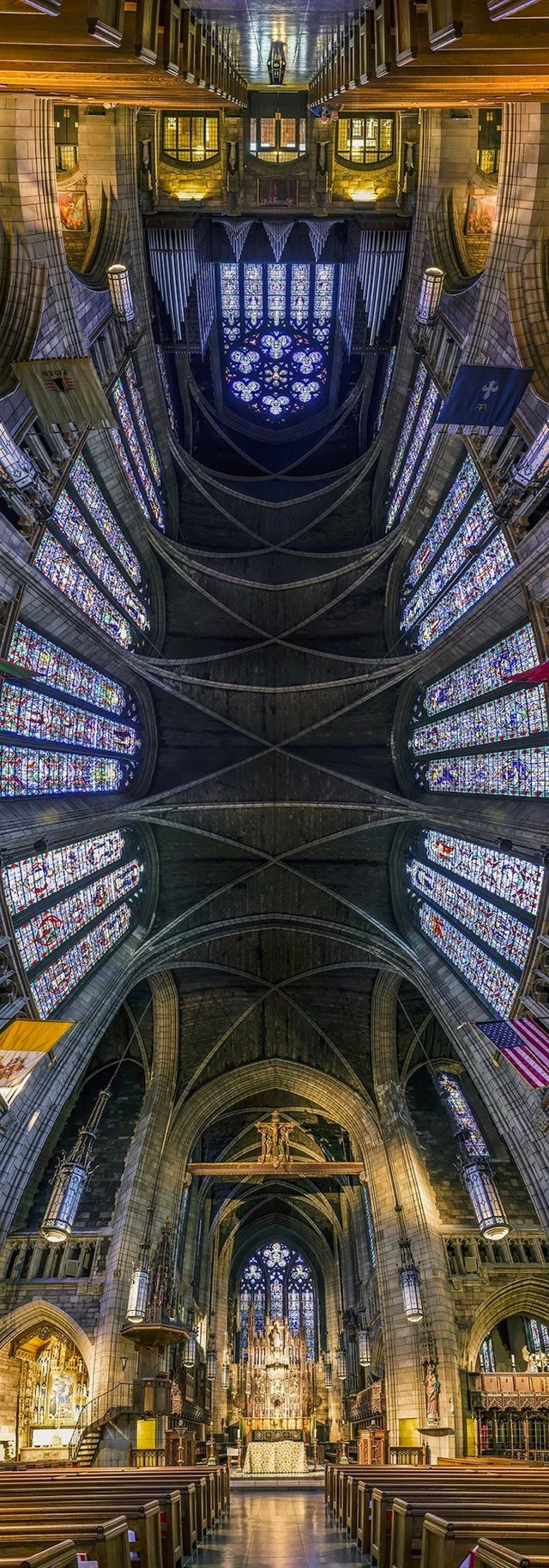
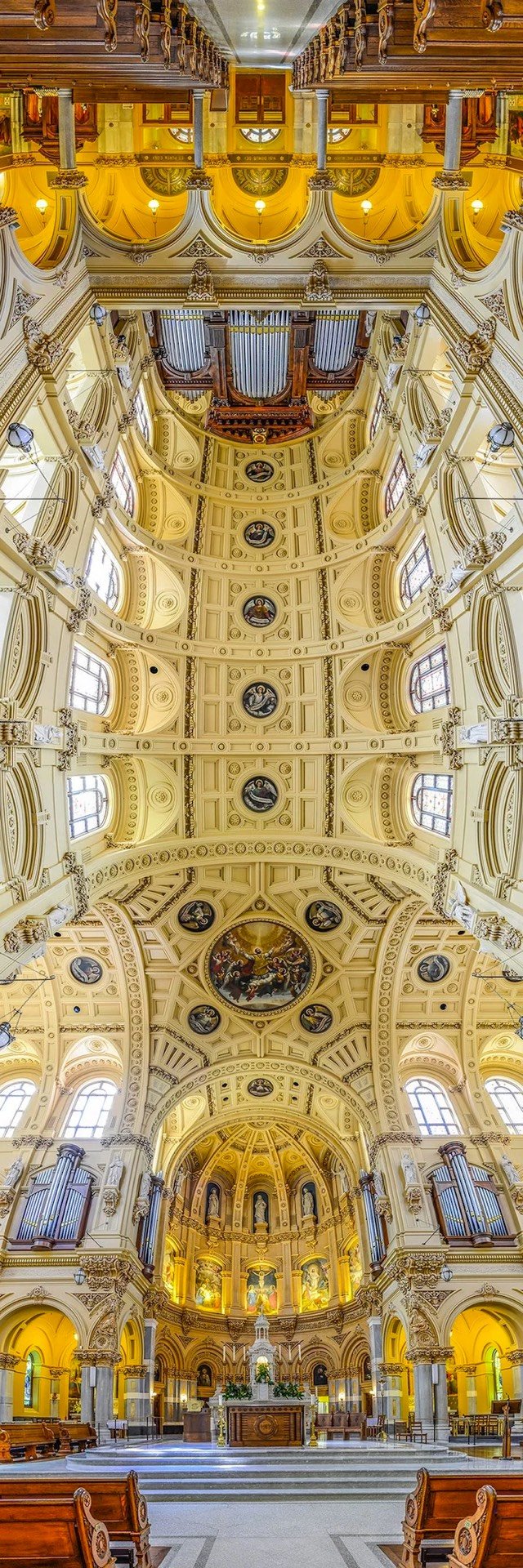
From photographer Richard Silver, vertical panoramic photos of churches that emphasize their often incredible ceilings. (via ignant)
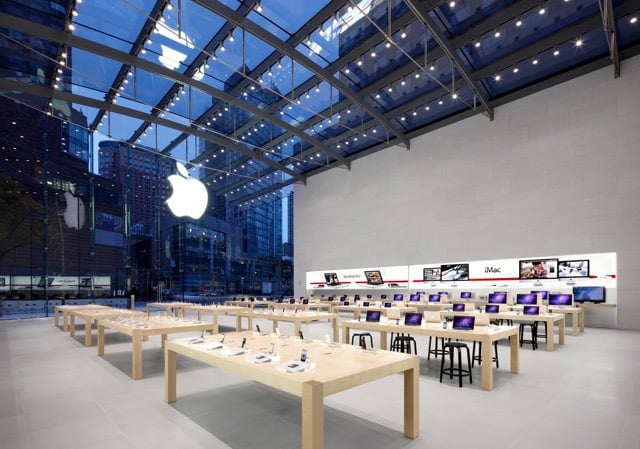
Sarah Laskow of Atlas Obscura took cultural historian Erica Robles-Anderson to the Soho Apple store. Robles-Anderson recently studied the use of technology in churches and Laskow wanted to know: are Apple stores the new temples?
“People have used technology for a long time to speak to the gods,” she says — to create collective experiences of the sublime.
These days, technology is more often talked about as a way to create personalized, individual experiences, but Robles-Anderson thinks that’s only part of the story. Communal ritual is always a part of technology: Early computers came into group spaces, like families and offices. (Mad Men understood this dynamic: the computer as an event weathered together.) Powerpoint presentations gather people to look at giant screens. Even using an iPhone to tune out the human beings around you requires being part of a larger group.
And Apple, more than any other technology company, has been able to access both these experiences, the individual and the collective. “They feel iconic, like an emblem of the personal,” says Robles-Anderson. “And yet it’s a cult. Right? It’s so obviously a cult.”
The architecture of the stores contributes to the sacred feeling of cult membership.
“The oversized doors are fantastic,” says Robles-Anderson. “There’s no reason for them.” They’re there only to communicate that this place is important. Also, they’re heavy, like church doors, to give purpose and portent to the entry into the space.
We walk inside. It’s light and bright, and immediately in front of us, a wide staircase of opaque glass sweeps up to the second floor.
This is an old, old trick. “It’s used in ziggurats, even,” Robles-Anderson says. “It creates a space that emphasizes your smallness when you walk in. You look at something far away, and that makes your body feel like you’re entering somewhere sacred or holy.”
It’s the Pope’s first time in America and we sent him straight to Congress. That doesn’t exactly seem like we’re putting our best foot forward. In his historic speech to a joint session of Congress, Pope Francis addressed climate change, capitalism, the death penalty and immigration. MoJo pulled out the ten most important lines from the speech.
“This Pope often operates through symbolism and gestures that convey his intentions in ways that words never could.” The New Yorker on Pope Francis and his little Fiat.

Oliver Sacks was a champion of one of humankind’s most admirable qualities: Curiosity. The neurologist and writer died on Monday. He wrote beautifully about his impending death in a piece published a couple weeks ago:
And now, weak, short of breath, my once-firm muscles melted away by cancer, I find my thoughts, increasingly, not on the supernatural or spiritual, but on what is meant by living a good and worthwhile life…
Longform has a collection of links to some of Sacks’ most popular essays.
BuzzFeed’s Tom Chivers asked several atheists How They Find Meaning In A Purposeless Universe.
The way I find meaning is the way that most people find meaning, even religious ones, which is to get pleasure and significance from your job, from your loved ones, from your avocation, art, literature, music. People like me don’t worry about what it’s all about in a cosmic sense, because we know it isn’t about anything. It’s what we make of this transitory existence that matters.
These kinds of questions always make me think of Richard Feynman on beauty, science, and belief.
From the NY Times, Nine Are Killed in Charleston Church Shooting; Gunman Is Sought.
An intense manhunt was underway Thursday for a white gunman who opened fire on Wednesday night at a historic black church in this city’s downtown, killing nine people before fleeing.
The police chief, Greg Mullen, called the shooting a hate crime.
Chief Mullen said that law enforcement officials, including the F.B.I. and other federal agencies, were assisting in the investigation of a shooting that left six women and three men dead.
Chief Mullen said the gunman walked into the historic Emanuel African Methodist Episcopal Church and attended the meeting for about an hour before open firing. Among the dead, according to reports, was the Rev. Clementa Pinckney, who was also a state senator.
From the David Rumsey Map Collection, a remarkable timeline/history of the world from 4004 BC to 1881 called Adams’ Synchronological Chart. This is just a small bit of it:
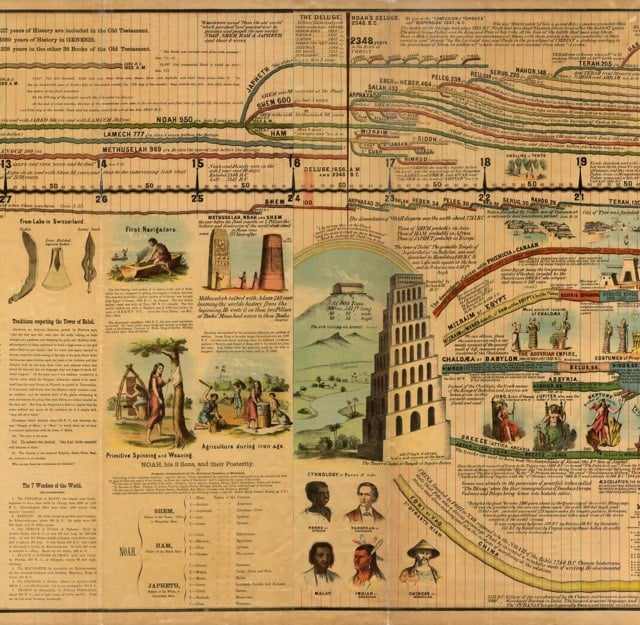
According to Rumsey’s site, the full timeline is more than 22 feet long. (via @john_overholt)
Update: A replica of this chart is available on Amazon in a few different iterations…I’m going to give this one a try. Apparently the charts are popular in Sunday schools and such because the timeline uses the Ussher chronology where the Earth is only 6000 years old.
“You see this goblet?” asks Achaan Chaa, the Thai meditation master. “For me this glass is already broken. I enjoy it; I drink out of it. It holds my water admirably, sometimes even reflecting the sun in beautiful patterns. If I should tap it, it has a lovely ring to it. But when I put this glass on the shelf and the wind knocks it over or my elbow brushes it off the table and it falls to the ground and shatters, I say, ‘Of course.’ When I understand that the glass is already broken, every moment with it is precious.”
From Thoughts Without a Thinker: Psychotherapy from a Buddhist Perspective by Mark Epstein.
James Krupa teaches a mandatory biology class at the University of Kentucky and some students have a difficult time because Krupa refuses to shy away from evolution.
Rarely do I have a Kentucky student who learned about human evolution in high school biology. Those who did usually attended high schools in large urban centers like Louisville or Lexington. Given how easily it can provoke parents, the teaching of human evolution is a rarity in high school, so much so in Kentucky that it startled me when I first arrived.
The story of our evolutionary history captivates many of my students, while infuriating some. During one lecture, a student stood up in the back row and shouted the length of the auditorium that Darwin denounced evolution on his deathbed — a myth intentionally spread by creationists. The student then made it known that everything I was teaching was a lie and stomped out of the auditorium, slamming the door behind him. A few years later during the same lecture, another student also shouted out from the back row that I was lying. She said that no transitional fossil forms had ever been found — despite my having shared images of many transitional forms during the semester. Many of her fellow students were shocked by her combativeness, particularly when she stormed out, also slamming the door behind her. Most semesters, a significant number of students abruptly leave as soon as they realize the topic is human evolution.
I personally don’t understand the compatibility of evolutionary biology and Christianity Krupa emphasizes in his class, but I guess it helps to meet people halfway?

I, for one, welcome our new ROBOPRIEST overlords. I found ROBOPRIEST on artist Josh Ellingson’s website. The robot costume-for-two was intended to perform wedding ceremonies and is the brainchild of Ellingson and Selene Luna, a 3’10” performance artist. It speaks in a robot voice, has flashing eyes, and the interior of its hatch is decorated with dirty pictures.
The idea of ROBOPRIEST started as a joke on Twitter between me and Selene Luna, an actress friend of mine in Los Angeles. We were trying to come up with funny ideas to collaborate on wedding services.The joke then turned into reality when Selene asked me to build ROBOPRIEST for her one woman show, “Sweating the Small Stuff” in San Francisco. The costume consisted mostly of cardboard and foam rubber with a skeleton of plastic hula hoops. The “eyes” are speakers equipped with voice-activated electro-luminescent wire. The audio for ROBOTPRIEST’s voice and various sound-effects were created by sound designer, Jim Coursey.
Its components include children’s toy claws, silver lame, ductwork, an iPod, and a harness that enables Luna to operate the costume from inside while riding piggyback on Ellingson.
Selene pilots ROBOPRIEST from a harness attached to my back. The harness is called The Piggyback Rider and is really just a backpack strap with a bar that runs along the bottom. This allowed Selene to comfortably stand on my back and easily hop off if needed. The top of ROBOPRIEST is equipped with a hatch from which Selene can address her minions. The inside of the hatch is decorated with a collage of nudie magazine clippings (NSFW), something that I thought appropriate for the insides of a repressed robot’s head at the time, although it may just have been all the hot-glue fumes getting to me.
Ellingson’s site has sound clips and a video of ROBOPRIEST announcing himself, and there are lots of photos on Flickr showing the build process.
Newer posts
Older posts




Socials & More