In a waterpark parable about contemporary American politics, Tom Junod asks: “Are we a nation of line-cutters, or are we the line?”
But here’s the thing about waiting in line at Whitewater, here’s the lesson that you learn from the spectacle of America in the raw: It works. When my daughter gapes and marvels, I tell her that human beings come in all shapes and sizes, and it’s an explanation that seems to satisfy her because it’s inescapable. When I hear the censorious voice in my head saying that the woman in front of me shouldn’t be wearing that bikini, I go on to draw the only conclusion that the evidence all around me permits: that no one should, and that therefore everyone can. Going to Whitewater is like bathing in the Ganges, with chlorine and funnel cakes — and also with the elemental difference that not everyone is poor, lowly, untouchable, an outcast. Rather, everyone is quite simply American, and so the line slouches and stumbles forward, the very definition of a mixed blessing — a blessing mixed black and white, rich and poor, slovenly and buff, and so on down the line. It can be slow going, it can be frustrating, but people have no choice to make the best of it, so they talk to one another, they gripe amusingly, they laugh, they compromise, they endure, and they scream when they finally go down a water slide whose initial pitch approaches 90 degrees. No one cuts, or tries to; the line works because for all its inherent and exhibitionistic imperfections it keeps its promise of equal access, and, by God, it moves.
See also paying to get through airport security faster (TSA Pre, etc.).
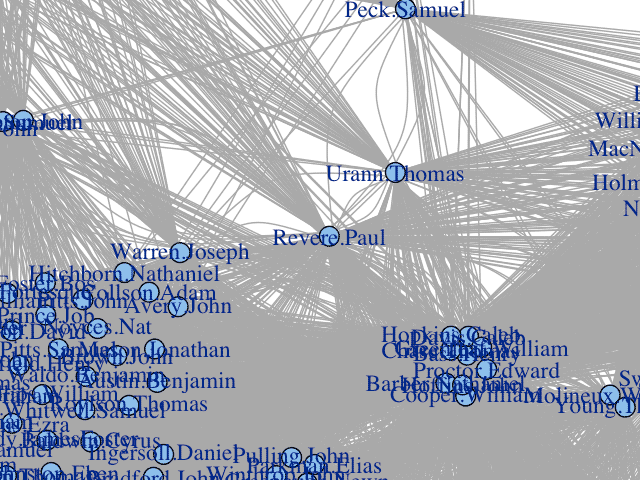
There’s been a lot of discussion recently about government programs like PRISM and how, according to defenders of such surveillance, they “only” collect metadata related to communications and not the content of the communication. In a clever article, Kieran Healy uses only the membership lists of various Boston-area organizations in the late 1770s to find out quite a lot about who might be the leaders of the nascent revolutionary cell. Even with this simple analysis, Paul Revere’s name pops out of the data.
The analytical engine has arranged everyone neatly, picking out clusters of individuals and also showing both peripheral individuals and-more intriguingly-people who seem to bridge various groups in ways that might perhaps be relevant to national security. Look at that person right in the middle there. Zoom in if you wish. He seems to bridge several groups in an unusual (though perhaps not unique) way. His name is Paul Revere.
Once again, I remind you that I know nothing of Mr Revere, or his conversations, or his habits or beliefs, his writings (if he has any) or his personal life. All I know is this bit of metadata, based on membership in some organizations. And yet my analytical engine, on the basis of absolutely the most elementary of operations in Social Networke Analysis, seems to have picked him out of our 254 names as being of unusual interest.
Now, the Crown may have suspected Revere of anti-Royalist leanings without this analysis. But with the analysis, they all but know. Get Revere and a few other highly connected nodes into jail on some trumped-up charges and, voila, maybe the American Revolution never happens or is quickly quashed. Revere and the American Revolution is an extreme example of what Moxie Marlinspike is getting at in We Should All Have Something To Hide: that breaking the law is sometimes how society moves forward.
Over the past year, there have been a number of headline-grabbing legal changes in the US, such as the legalization of marijuana in CO and WA, as well as the legalization of same-sex marriage in a growing number of US states.
As a majority of people in these states apparently favor these changes, advocates for the US democratic process cite these legal victories as examples of how the system can provide real freedoms to those who engage with it through lawful means. And it’s true, the bills did pass.
What’s often overlooked, however, is that these legal victories would probably not have been possible without the ability to break the law.
The state of Minnesota, for instance, legalized same-sex marriage this year, but sodomy laws had effectively made homosexuality itself completely illegal in that state until 2001. Likewise, before the recent changes making marijuana legal for personal use in WA and CO, it was obviously not legal for personal use.
Imagine if there were an alternate dystopian reality where law enforcement was 100% effective, such that any potential law offenders knew they would be immediately identified, apprehended, and jailed. If perfect law enforcement had been a reality in MN, CO, and WA since their founding in the 1850s, it seems quite unlikely that these recent changes would have ever come to pass. How could people have decided that marijuana should be legal, if nobody had ever used it? How could states decide that same sex marriage should be permitted, if nobody had ever seen or participated in a same sex relationship?
In a unanimous decision, the US Supreme Court ruled today that human genes cannot be patented.
The case involved Myriad Genetics Inc., which holds patents related to two genes, known as BRCA1 and BRCA2, that can indicate whether a woman has a heightened risk of developing breast cancer or ovarian cancer.
Justice Clarence Thomas, writing for the court, said the genes Myriad isolated are products of nature, which aren’t eligible for patents.
The high court’s ruling was a win for a coalition of cancer patients, medical groups and geneticists who filed a lawsuit in 2009 challenging Myriad’s patents. Thanks to those patents, the Salt Lake City company has been the exclusive U.S. commercial provider of genetic tests for breast cancer and ovarian cancer.
The challengers argued the patents have allowed Myriad to dictate the type and terms of genetic screening available for the diseases, while also dissuading research by other laboratories.
Fuck yes. A defect in her BRCA1 gene is what caused Angelina Jolie to recently have a preventive double mastectomy. (via @tylercowen)
In a book called Three Felonies A Day, Boston civil rights lawyer Harvey Silverglate says that everyone in the US commits felonies everyday and if the government takes a dislike to you for any reason, they’ll dig in and find a felony you’re guilty of.
The average professional in this country wakes up in the morning, goes to work, comes home, eats dinner, and then goes to sleep, unaware that he or she has likely committed several federal crimes that day. Why? The answer lies in the very nature of modern federal criminal laws, which have exploded in number but also become impossibly broad and vague. In Three Felonies a Day, Harvey A. Silverglate reveals how federal criminal laws have become dangerously disconnected from the English common law tradition and how prosecutors can pin arguable federal crimes on any one of us, for even the most seemingly innocuous behavior. The volume of federal crimes in recent decades has increased well beyond the statute books and into the morass of the Code of Federal Regulations, handing federal prosecutors an additional trove of vague and exceedingly complex and technical prohibitions to stick on their hapless targets. The dangers spelled out in Three Felonies a Day do not apply solely to “white collar criminals,” state and local politicians, and professionals. No social class or profession is safe from this troubling form of social control by the executive branch, and nothing less than the integrity of our constitutional democracy hangs in the balance.
In response to a question about what happens to big company CEOs who refuse to go along with government surveillance requests, John Gilmore offers a case study in what Silverglate is talking about.
We know what happened in the case of QWest before 9/11. They contacted the CEO/Chairman asking to wiretap all the customers. After he consulted with Legal, he refused. As a result, NSA canceled a bunch of unrelated billion dollar contracts that QWest was the top bidder for. And then the DoJ targeted him and prosecuted him and put him in prison for insider trading — on the theory that he knew of anticipated income from secret programs that QWest was planning for the government, while the public didn’t because it was classified and he couldn’t legally tell them, and then he bought or sold QWest stock knowing those things.
This CEO’s name is Joseph P. Nacchio and TODAY he’s still serving a trumped-up 6-year federal prison sentence today for quietly refusing an NSA demand to massively wiretap his customers.
You combine this with the uber-surveillance allegedly being undertaken by the NSA and other governmental agencies and you’ve got a system for more or less automatically accusing any US citizen of a felony. Free society, LOL ROFLcopter.
Update: For the past two years, the Wall Street Journal has been “examining the vastly expanding federal criminal law book and its consequences”. (thx, jesse)
By now, you’ve likely heard of Edward Snowden, the former NSA contractor who leaked secret documents to the press regarding that agency’s electronic surveillance activities. From Glenn Greenwald’s excellent coverage for The Guardian, here are a few of the most interesting passages from interviews with Snowden.
From the moment he decided to disclose numerous top-secret documents to the public, he was determined not to opt for the protection of anonymity. “I have no intention of hiding who I am because I know I have done nothing wrong,” he said.
—
Despite these fears, he remained hopeful his outing will not divert attention from the substance of his disclosures. “I really want the focus to be on these documents and the debate which I hope this will trigger among citizens around the globe about what kind of world we want to live in.” He added: “My sole motive is to inform the public as to that which is done in their name and that which is done against them.”
He has had “a very comfortable life” that included a salary of roughly $200,000, a girlfriend with whom he shared a home in Hawaii, a stable career, and a family he loves. “I’m willing to sacrifice all of that because I can’t in good conscience allow the US government to destroy privacy, internet freedom and basic liberties for people around the world with this massive surveillance machine they’re secretly building.”
—
“All my options are bad,” he said. The US could begin extradition proceedings against him, a potentially problematic, lengthy and unpredictable course for Washington. Or the Chinese government might whisk him away for questioning, viewing him as a useful source of information. Or he might end up being grabbed and bundled into a plane bound for US territory.
“Yes, I could be rendered by the CIA. I could have people come after me. Or any of the third-party partners. They work closely with a number of other nations. Or they could pay off the Triads. Any of their agents or assets,” he said.
“We have got a CIA station just up the road — the consulate here in Hong Kong — and I am sure they are going to be busy for the next week. And that is a concern I will live with for the rest of my life, however long that happens to be.”
—
He left the CIA in 2009 in order to take his first job working for a private contractor that assigned him to a functioning NSA facility, stationed on a military base in Japan. It was then, he said, that he “watched as Obama advanced the very policies that I thought would be reined in”, and as a result, “I got hardened.”
The primary lesson from this experience was that “you can’t wait around for someone else to act. I had been looking for leaders, but I realised that leadership is about being the first to act.”
—
“I carefully evaluated every single document I disclosed to ensure that each was legitimately in the public interest,” he said. “There are all sorts of documents that would have made a big impact that I didn’t turn over, because harming people isn’t my goal. Transparency is.”
And from a second piece with a straight-up interview:
Q: Why did you decide to become a whistleblower?
A: “The NSA has built an infrastructure that allows it to intercept almost everything. With this capability, the vast majority of human communications are automatically ingested without targeting. If I wanted to see your emails or your wife’s phone, all I have to do is use intercepts. I can get your emails, passwords, phone records, credit cards.
“I don’t want to live in a society that does these sort of things … I do not want to live in a world where everything I do and say is recorded. That is not something I am willing to support or live under.”
—
Q: What do the leaked documents reveal?
A: “That the NSA routinely lies in response to congressional inquiries about the scope of surveillance in America. I believe that when [senator Ron] Wyden and [senator Mark] Udall asked about the scale of this, they [the NSA] said it did not have the tools to provide an answer. We do have the tools and I have maps showing where people have been scrutinised most. We collect more digital communications from America than we do from the Russians.”
—
Q: What is your reaction to Obama denouncing the leaks on Friday while welcoming a debate on the balance between security and openness?
A: “My immediate reaction was he was having difficulty in defending it himself. He was trying to defend the unjustifiable and he knew it.”
—
Q: Washington-based foreign affairs analyst Steve Clemons said he overheard at the capital’s Dulles airport four men discussing an intelligence conference they had just attended. Speaking about the leaks, one of them said, according to Clemons, that both the reporter and leaker should be “disappeared”. How do you feel about that?
A: “Someone responding to the story said ‘real spies do not speak like that’. Well, I am a spy and that is how they talk. Whenever we had a debate in the office on how to handle crimes, they do not defend due process - they defend decisive action. They say it is better to kick someone out of a plane than let these people have a day in court. It is an authoritarian mindset in general.”
Both of these pieces are very much worth reading in entirety. Also worth a read is Timothy Lee’s piece for The Washington Post, Has the US become the type of nation from which you have to seek asylum?
Four decades ago, Daniel Ellsberg surrendered to federal authorities to face charges of violating the Espionage Act. During his trial, he was allowed to go free on bail, giving him a chance to explain his actions to the media. His case was eventually thrown out after it was revealed that the government had wiretapped him illegally.
Bradley Manning, a soldier who released classified documents to WikiLeaks in 2010, has had a very different experience. Manning was held for three years without trial, including 11 months when he was held in de facto solitary confinement. During some of this period, he was forced to sleep naked at night, allegedly as a way to prevent him from committing suicide. The United Nations’ special rapporteur on torture has condemned this as “cruel, inhuman and degrading treatment in violation of Article 16 of the convention against torture.”
Small protests in Istanbul over the past few days have erupted into what’s becoming a typical scene across the world: authoritarian governments attempting to crack down on a citizenry agitating for increased freedom.
No newspaper, no television channel was there to report the protest. It was a complete media black out.
But the police arrived with water cannon vehicles and pepper spray. They chased the crowds out of the park.
In the evening the number of protesters multiplied. So did the number of police forces around the park. Meanwhile local government of Istanbul shut down all the ways leading up to Taksim square where the Gezi Park is located. The metro was shut down, ferries were cancelled, roads were blocked.
Yet more and more people made their way up to the center of the city by walking.
They came from all around Istanbul. They came from all different backgrounds, different ideologies, different religions. They all gathered to prevent the demolition of something bigger than the park:
The right to live as honorable citizens of this country.
They gathered and marched. Police chased them with pepper spray and tear gas and drove their tanks over people who offered the police food in return. Two young people were run over by the panzers and were killed.
To keep up with events in Turkey, try Occupy Gezi’s Tumblr and Facebook page.
Taking a page from Orwell, officials in Chengdu, China endeavored to prevent recent protests by moving the weekend and scheduling security exercises at the same time and place as the scheduled protest.
As text messages circulated calling for another protest, authorities decided to fiddle with the calendar: For many, Saturday became a workday, and the day of rest was moved to Monday, May 6. So as Saturday dawned, schoolchildren straggled reluctantly back to class, and employees at government-run work units discovered the day was taken up by urgent meetings.
See also how Georgia ended the country’s drug problem:
But the more radical steps involved brutalizing the addicts themselves. Saakashvili mandated as aggressive a drug policy as any country has attempted since Mao Zedong threatened to execute all Chinese opium fiends and “cured” about five million of them overnight. If you think New York’s stop-and-frisk rule is invasive, try Georgia’s: Cops can stop anyone at any time for no reason and force him to urinate into a cup. Fifty-three thousand people were stopped on the street in 2007, or about one in 20 of the young men in Georgia. About a third of those passed dirty urine; first-offenders were levied a fine of several hundred dollars. One more dirty test amounted to a criminal offense.
“There was such an unprecedented drug war,” Otiashvili says. “What was going on-and still goes on-in Georgia doesn’t happen anywhere. No country puts people in the prison for a positive urine test.”
(via @tylercowen)
Former Supreme Court Justice Sandra Day O’Connor now admits that taking on the Bush vs Gore case in 2000 was probably a mistake.
“It took the case and decided it at a time when it was still a big election issue,” O’Connor said during a talk with the Chicago Tribune’s Editorial Board on Friday. “Maybe the court should have said, ‘We’re not going to take it, goodbye.’”
The case, she said, “stirred up the public” and “gave the court a less than perfect reputation.”
“Obviously the court did reach a decision and thought it had to reach a decision,” she said. “It turned out the election authorities in Florida hadn’t done a real good job there and kind of messed it up. And probably the Supreme Court added to the problem at the end of the day.”
[Hair tearing-out noise]
From a 1995 article in The Independent, an account of how the CIA promoted and funded US and other Western artists during the Cold War, including abstract expressionists like Rothko and Pollock.
The decision to include culture and art in the US Cold War arsenal was taken as soon as the CIA was founded in 1947. Dismayed at the appeal communism still had for many intellectuals and artists in the West, the new agency set up a division, the Propaganda Assets Inventory, which at its peak could influence more than 800 newspapers, magazines and public information organisations. They joked that it was like a Wurlitzer jukebox: when the CIA pushed a button it could hear whatever tune it wanted playing across the world.
The next key step came in 1950, when the International Organisations Division (IOD) was set up under Tom Braden. It was this office which subsidised the animated version of George Orwell’s Animal Farm, which sponsored American jazz artists, opera recitals, the Boston Symphony Orchestra’s international touring programme. Its agents were placed in the film industry, in publishing houses, even as travel writers for the celebrated Fodor guides. And, we now know, it promoted America’s anarchic avant-garde movement, Abstract Expressionism.
(via @sippey)
I was offline yesterday evening and this morning, so this is a little tardy but what the Senate did in not passing the already woefully wimpy gun control legislation yesterday was embarrassing and shameful. Fuck them.
For 45 senators, the carnage at Sandy Hook Elementary School is a forgotten tragedy. The toll of 270 Americans who are shot every day is not a problem requiring action. The easy access to guns on the Internet, and the inevitability of the next massacre, is not worth preventing.
In a NY Times editorial, former Congresswoman Gabrielle Giffords has some sharp words for our elected officials.
Speaking is physically difficult for me. But my feelings are clear: I’m furious. I will not rest until we have righted the wrong these senators have done, and until we have changed our laws so we can look parents in the face and say: We are trying to keep your children safe. We cannot allow the status quo — desperately protected by the gun lobby so that they can make more money by spreading fear and misinformation — to go on.
I am asking every reasonable American to help me tell the truth about the cowardice these senators demonstrated. I am asking for mothers to stop these lawmakers at the grocery store and tell them: You’ve lost my vote. I am asking activists to unsubscribe from these senators’ e-mail lists and to stop giving them money. I’m asking citizens to go to their offices and say: You’ve disappointed me, and there will be consequences.
And The Onion once again hits simultaneously below the belt and precisely on target: Next Week’s School Shooting Victims Thank Senate For Failing To Pass Gun Bill.
Great job, guys,” said 14-year-old Jacob Miller, one of nine junior high school students who will be shot next week by a mentally ill gunman wielding a legally acquired assault rifle that was purchased at a gun show. “My classmates and I are really proud of you for cowering to the NRA and caring more about politics than my friends and I getting shot and killed. It totally makes sense. You’re the best.”
Quora is full of questions college students ask each other while high, except that sometimes they get answered seriously. Case in point: What is the political situation in the Mario universe? The top answer starts out:
Without going into too much detail, Mario generally lives and works in the Mushroom Kingdom, one of the largest geo-political structures on Mushroom World, in the Grand Finale Galaxy in, yes, the Mushroom Universe.
For the purposes of this answer I will deliberately restrict the terms to discussing Mushroom World, as a comprehensive answer on the entire Mushroom Universe would require covering 20-22 (depending on how you count) Galaxies and frankly, I doubt it would be any more fun to read than it would be to write.
Also, Bowser is probably a fascist.
Feeling totally depressed and sad and useless about this: the NRA wins again.
After Sandy Hook, after twenty children were shot and killed at a place where they should have been safe from all harm, there was some optimism among supporters of gun control: perhaps now, finally, both Democrats and Republicans could see the light — and the suffering-and revive the assault — weapons ban. It was a futile hope.
Less than a week after Adam Lanza shot up an elementary school, it was already basically clear that an assault-weapons ban could not pass Congress-that it probably couldn’t even get through the Democratic-controlled Senate, never mind the House. So it was hardly a surprise when, three months later, Senate Majority Leader Harry Reid announced that the ban would be removed from a larger gun-control package that is making its way through the upper chamber and given a separate vote that it will not survive. The scale of the defeat suffered by the ban’s supporters, though, is shocking. This wasn’t a close call; it was a body blow.
I haven’t forgotten Sandy Hook. We drive by there every time we go to Vermont. I think about those kids almost every day. Sometimes when I think about them, I close my eyes and see my 5-year-old son cowering in the corner of his classroom as a black-clad figure toting a machine gun bears down on him. And then the tears come. I can’t stand that this is what America is; that we trade our children’s lives for the opportunity to purchase items specifically invented for killing. I can’t stand it. It’s pathetic and embarrassing and barbaric.
In 1968, Richard Nixon, then a candidate for President, used backchannel negotiations to scuttle peace talks that may have ended the Vietnam War. Nixon was afraid an end to the war meant an end to his campaign.
By the time of the election in November 1968, LBJ had evidence Nixon had sabotaged the Vietnam war peace talks — or, as he put it, that Nixon was guilty of treason and had “blood on his hands”.
The war went on for seven more bloody years, most of them under Nixon’s watch. Shameful.
Ask anyone with young children what they think of daylight saving time and you’ll probably get a stabbing in the eye. It just totally fucks your world for two+ weeks a year with zero benefit. This petition needs 100,000 digital signatures for the White House to issue an official response to it. Sign it or I might get stabby.
Update: I honestly don’t care which time we keep (DST or standard time), as long as the biannual time switching nonsense stops.





Socials & More