There is a strong possibility that Barack will pursue a political career, although it’s unclear. There is a little tension with that. I’m very wary of politics. I think he’s too much of a good guy for the kind of brutality, the skepticism.
And Favreau is right, Gerson’s speech for Bush that September 20 was one of the great speeches in American history. But it must be noted here that with that speech the discord between speech and speaker has never been more pronounced, for we have come to know that Gerson’s boss never fully grasped the power of words. With an exalting script, Gerson could make George W. Bush sound like Winston Churchill for an hour. But it is Jon Favreau’s task and his gift that he is able to make his boss — a fellow who has been known to write a sentence or two on his own — sound like Barack Obama.
What I don’t understand is how Favreau finds the time to write Obama’s speeches *and* direct Robert Downey Jr. in Iron Man. Time machine?
The mother of five, who enjoys attending church potluck dinners with husband Todd, an unemployed commercial fisherman, reportedly “jumped at the chance” to become the second most powerful person in the country.
Sometimes the funniest fake news is disturbingly real.
Aired a few weeks before the 2008 election, The President’s Guide to Science is a 50-minute video featuring several prominent scientists — Richard Dawkins, Michio Kaku, etc. — offering their advice for the incoming US President, basically what they would teach the President about science. (via smashing telly)
Tom Armitage imagines If Gamers Ran The World. For instance, what happens if the President of the United States in 2018 is the same age as Barack Obama is now.
They’re 45 in 2018 when they stand for office - that means they were born in 1973. They would have been four when Taito released Space Invaders came out; seven when Pac Man came out. In 1985, when they were 12, Nintendo would launch the NES in the west. At 18, just as they would have been heading to University, the first NHL game came out for the Genesis/Megadrive and might consumed many a night in the dorm. At 22, the Playstation was launched. At 26, they could have bought a PS2 at launch; at 31, they might have taken up World of Warcraft with their friends.
I wanted to create something to look at a couple years from now to remember the election and hopefully present a good representation of what both sides of America were feeling on that day as evidenced by the response in the press and on the blogs. I didn’t capture everything, though I’ve certainly tried
Included are lots of videos, links to articles, reactions from the author’s friends, and even Facebook status messages as the election results rolled in, covering a nice cross-section of citizens from top politicians to the big media, to blogs, to normal people celebrating on the streets. However, I have a feeling that due to linkrot, much of this may not even be available online.
Well, the “O” was the identity for the Obama ‘08 campaign and the campaign is over. That doesn’t mean that the mark will be forgotten; I think the memorabilia from this campaign will have a long shelf life and will stand as a visible symbol of pride for people who supported the candidate and for those who see it as a representation of a watershed moment for our country. As far as having another life, I can’t say. Perhaps the 2012 campaign will hark back to it in some way.
Sender’s web site has a bit more info on the development of the Obama brand.
This is not a political blog. However, this is a story I couldn’t pass up: the story of how voting patterns in the 2008 election were essentially determined 85 million years ago, in the Cretaceous Period. It’s also a story about how soil science relates to political science, by way of historical chance.
Headline I’d like to see in 96 pt. type in the NY Times: Obama Elected By Rich Loamy Soils of Cretaceous Seas.
The ballots are being recounted in the Senate race in Minnesota between Norm Coleman and Al Franken because the initial tally was almost too close to call. MPR has a look at some of the ballots that are being challenged…it’s amazing how many weird ways people can mark a ballot that uses a simple fill-in-the-circle design.
Online political observers say President-elect Obama’s innovative, online-fueled campaign will likely evolve into a new level of online communication between the public and the White House — the Internet-era version of President Franklin Roosevelt’s famous “fireside chats” between 1933 and 1944.
For more than three decades Eugene Allen worked in the White House, a black man unknown to the headlines. During some of those years, harsh segregation laws lay upon the land. He trekked home every night, his wife, Helene, keeping him out of her kitchen. At the White House, he worked closer to the dirty dishes than to the large desk in the Oval Office. Helene didn’t care; she just beamed with pride. President Truman called him Gene. President Ford liked to talk golf with him. He saw eight presidential administrations come and go, often working six days a week. “I never missed a day of work,” Allen says. His is a story from the back pages of history. A figure in the tiniest of print. The man in the kitchen.
When it looked as though Obama was going to win the election, former photojournalist Matt Mendelsohn went to the Lincoln Memorial in Washington DC expecting to find a huge crowd of celebrants.
I’d spent most of election night in front of the TV in Arlington, Va. But around 11 p.m. I couldn’t sit idle any longer, which is why I sped to the memorial. When I arrived, I found a TV crew sitting on the plaza above the Reflecting Pool, waiting, I assumed, for a mob to arrive. I approached with cameras in hand. One of them looked up and said with a slight roll of his eyes, “Nothing to see here.”
Instead he found a small group of people listening to Obama’s acceptance speech on a transistor radio and shot this wonderful picture of the scene. I can’t think of an image that better characterizes the grass-roots, get-out-the-vote, small-donations-by-millions-of-people aspect of Obama’s campaign. (via 3qd)
Hopefully I’ll have some time this afternoon to update the 2008 Election Maps page; I’ve got lots of good submissions waiting in my inbox. Thanks to everyone who sent in links and screenshots.
Idea for the Obama administration: fireside chats. On the radio, on satellite radio, as a podcast, transcripts available online soon after airing. Done live if possible, a genuine lightly scripted chat. Maybe Obama could have special guests on to talk about different aspects of policy and government. Bush does weekly radio addresses but they’re short, boring, and scripted.
And I gotta tell you, if change.gov is indicative of how the Obama administration is going to use the web to engage with Americans, this is going to be an interesting four years.
Ok, that’s probably the last Obama post for a bit. Back to your irregularly unscheduled programming.
“Teaching keeps you sharp,” Obama said. “The great thing about teaching constitutional law” — his subject — “is that all the tough questions land in your lap: abortion, gay rights, affirmative action. And you need to be able to argue both sides. I have to be able to argue the other side as well as Scalia does. I think that’s good for one’s politics.”
In writing the article, Finnegan ran across some people who thought Obama could be President someday but chose not to include those quotes because it felt “not only absurdly premature but like bad juju”.
If you followed or were at all interested in the 2008 presidential election, this seven-part series by a group of Newsweek reporters is a must read. The reporters were granted exclusive access to the campaigns of Barack Obama, John McCain, and Hillary Clinton for a year on the condition that they wouldn’t print anything until after the election was over. The series, of which the first three parts are currently up on the Newsweek site, is a fascinating look at how the political process works and contains all manner of salacious political gossip.
Part One: How Obama was persuaded to run and found his campaigning rhythm and his first scuffles with the Clinton campaign.
In some ways, running for president was a preposterous idea for someone who had served as a two-term state legislator and had spent only two years in the United States Senate. But Obama, a careful student of his own unique journey, could see the stars coming into alignment-the country was exhausted by the Iraq War (which he, alone among leading candidates, had opposed as “dumb” from the outset). As Obama saw it, the conservative tide in America was ebbing, and voters were turning away from the Republican Party. People were sick of politicians of the standard variety and yearned for someone new-truly new and different. Another politician with a superb sense of timing, Bill Clinton, perfectly understood why Obama saw a golden, possibly once-in-a-lifetime, opportunity. The former president believed that the mainstream press, whose liberal guilt Clinton understood and had exploited from time to time, would act as Obama’s personal chauffeur on the long journey ahead. “If somebody pulled up a Rolls-Royce to me and said, ‘Get in’,” Clinton liked to say, with admiration and maybe a little envy, “I’d get in it, too.”
Part Two: John McCain’s campaign gets off to a terrible start and then suddenly recovers.
Along about Thanksgiving, reporters began to notice a change. The size of the crowds was increasing, and McCain began to creep up in the polls, especially in New Hampshire. He was blessed by the quality of his opponents. In the grim days of summer, when a NEWSWEEK reporter had asked why he shouldn’t join the rest of the press corps in reading the last rites for McCain’s presidential aspirations, Rick Davis had responded with an incongruously cheerful smile. Nothing personal, he said; our opponents are all good men, some of them are my friends-but politically speaking? “Look, at the end of the day,” he said, “the rest of these guys suck.” However crude, his judgment was not off base. Ex-businessman Mitt Romney seemed to treat the campaign as a management-consulting project, as if he were selling a product and trying to increase market share. He had no fingertips as a politician and came off as a phony, even when he was perfectly sincere. Rudy Giuliani seemed to be building a cult of Rudy, constantly talking about his performance on 9/11 to a nation that wanted to forget about the terrorist attacks, and he badly miscalculated by believing that he could wait until the Florida primary in late January to make his move. Former senator Fred Thompson seemed old and half asleep. Former governor Mike Huckabee of Arkansas was emerging as an engaging showman and a lively dark horse-but as an evangelical minister with no foreign-policy experience, he almost certainly could not win.
Part Three: The role of the candidates’ spouses, the continuing clashes between the Obama and Clinton campaigns, and Obama’s Star Trek joke.
Obama carefully conserved his energy. He was not a man of appetites, like Bill Clinton, who would grab whatever goodie passed by on the tray. Obama was abstemious. Indeed, to the reporters following him, he appeared very nearly anorexic. Most candidates gain the Campaign 10 (or 15). Hillary was struggling with her waistline, as she gamely knocked back shots and beers in working-class bars and gobbled the obligatory sausage sandwiches thrust at her in greasy spoons along the Trail of the White Working-Class Voter. Obama, by contrast, lost weight. He regularly ate the same dinner of salmon, rice and broccoli. At Schoop’s Hamburgers, a diner in Portage, Ind., he munched a single french fry and ordered four hamburgers-to go. At the Copper Dome Restaurant, a pancake house in St. Paul, Minn., he ordered pancakes-to go. (An AP reporter wondered: who gets pancakes for the road?) A waiter reeled off a long list of richly topped flapjacks, but Obama went for the plain buttermilk, saying, “I’m kind of traditionalist.” Reporters joked that if he ate a single bite of burger or pancake once the doors of his dark-tinted SUV closed, they’d eat their BlackBerrys. Frustrated by reporters fishing for trivial “gaffes,” Obama did not like coming back to the plane to talk to the press. As he trudged back from time to time to deal with the reporters’ incessant questions, he looked like a suburban dad, slump-shouldered after a long day at the office, taking out the trash.
I got another sense, however: a sense that he was conserving focus. Fed went through all his subsidiary responsibilities as the President of Tennis (as Steve Tignor calls him) without concentrating on anything, or at least on as few things as possible.
Concentration takes mental energy, as anyone who has fought off five break points before shanking a ball on the sixth knows. And whenever I saw Federer on the grounds, he seemed to be using as little of it as possible. Practicing with Nicolas Kiefer on Ashe a few days before the tournament, he mostly just messed around. He would hit a few familiar Federer shots, the heavy forehand, the penetrating slice, then shank a ball and grin, or yell. Either way, he wasn’t really concentrating all that hard.
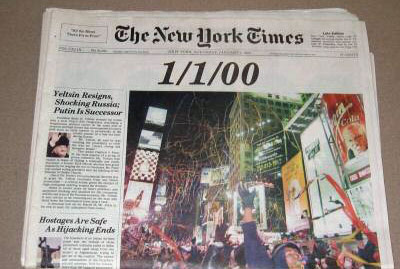
Update: The Times used 96 pt. type for the front page headline on at least one other occasion: January 1, 2000. I wonder if there are others. (thx, jeff)
Update: Fuck you too, Arizona and Florida. Also, several people objected to the strong language I used here, saying that I can’t curse an entire state where many voted against the ban, it was all the Mormon Church’s fault, and in one case, that it was hypocritical of me as a New York resident to complain. You know what? I’m *upset* about this and a little profanity, a little lashing out, is totally fucking warranted.
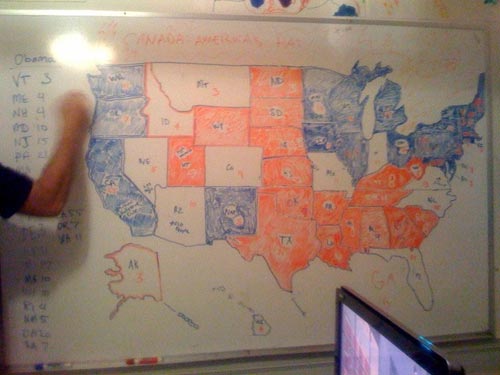
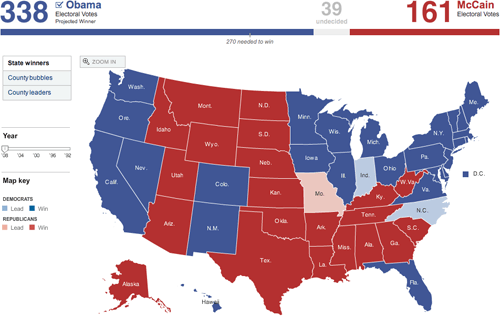
Last night as the election results were coming in online, I took screenshots of a bunch of the now-familiar red/blue electoral maps being used by the larger media sites to show election results and posted them all on this page. (There are currently 25 maps…I’m adding more in a few minutes.)
1. No one strayed from the red and blue. The red/blue combo is overwhelmingly symbolic but there are plenty of other colors in the crayon box; I would like to have seen someone try something different.
2. In the 2000 and 2004 elections, the red/blue map was the focal point of the media coverage. People were fixated by it. This time around, it didn’t matter so much. The maps were interesting for 3-4 hours until the overwhelming nature of Obama’s victory became apparent and then, not so much. By this morning, the maps are already shrinking or disappearing from the home pages of the Times, CNN, and the like.
3. Nate Silver and the rest of the 538 guys nailed it. They got Indiana wrong and there are a couple more states that are still too close to call, but they got the rest of the map right. Their final projection had Obama getting 348.6 electoral votes and they currently have him at 349.
Note: If you are a member and tried to log in, it didn't work, and now you're stuck in a neverending login loop of death, try disabling any ad blockers or extensions. Or try logging out and then back in. Still having trouble? Email me!






Socials & More