


Video segment of photographer Garry Winogrand talking
Video segment of photographer Garry Winogrand talking about how he works from a Bill Moyers show in 1982. Here’s a transcript of the video. “Photographing something changes it.”

This site is made possible by member support. 💞
Big thanks to Arcustech for hosting the site and offering amazing tech support.
When you buy through links on kottke.org, I may earn an affiliate commission. Thanks for supporting the site!
kottke.org. home of fine hypertext products since 1998.
Beloved by 86.47% of the web.
Video segment of photographer Garry Winogrand talking about how he works from a Bill Moyers show in 1982. Here’s a transcript of the video. “Photographing something changes it.”
Curious story of what’s up with JPG Magazine, a photography mag founded by Heather Champ and Derek Powazek. Derek formed a new company (8020 Publishing) with a friend (Paul Cloutier) and that company bought JPG. Then, says Derek, “Paul informed me that we were inventing a new story about how JPG came to be that was all about 8020. He told me not to speak of that walk in Buena Vista, my wife, or anything that came before 8020.” The founding and the first 6 issues of JPG were removed from the site and Derek left his company. More from Heather and on MetaFilter, including this nice sentiment: “The great thing about a labour of love is the love, not the labour.”
Photo of Deadwood, South Dakota from 1888. Doesn’t look so rambunctious from that angle.
Photo gallery of heavy metal bands from the early 80s. These aren’t glossy magazine photos…they’re snapshots from the crowd, backstage, and at the afterparties.
No matter how many times I see the photos, the proximity of the runway to the beach at the St. Maarten airport amazes me. (via gulfstream)
The first photo of Earth from space was taken by a V-2 missile in 1946. Large panoramic shot of a 1948 photo is here.
Clever technique for pinching the colors from famous paintings using the Match Color tool in Photoshop. “The Old Masters of painting spent years of their lives learning about color. Why let all their effort go to waste on the walls of some museum when it could be used to give you a hand with color correction?”
Noah Kalina is selling signed and numbered prints of individual frames of his seminal everyday movie.
Photographs of novelist Will Self’s writing room, seemingly wallpapered by Post-Its. (via moon river)
I’ve had this photo up in my browser for a few hours now and every so often, I’ll sneak away from what I’m doing and take a peek at it. I love the feeling of motion and its capture: the boy and the pigeon captured by the camera, the pigeon’s shadow captured by the sidewalk, the momentum of an unseen car captured by the now-bent steel of the firebox.
A pair of NYC photographs from Shorpy today: Penn Station in 1910 and a scene from outside Grand Central Terminal in 1908.
Jake’s featuring a photo today of some NYC street art by Bloke, who does paper-plane pieces. I’m a sucker for dashed lines.
Update: More stuff by Bloke here. (thx, daniel)
It’s been awhile since I’ve done one of these. Here are some updates on some of the topics, links, ideas, posts, people, etc. that have appeared on kottke.org recently:
Two counterexamples to the assertion that cities != organisms or ecosystems: cancer and coral reefs. (thx, neville and david)
In pointing to the story about Ken Thompson’s C compiler back door, I forgot to note that the backdoor was theoretical, not real. But it could have easily been implemented, which was Thompson’s whole point. A transcript of his original talk is available on the ACM web site. (thx, eric)
ChangeThis has a “manifesto” by Nassim Taleb about his black swan idea. But reader Jean-Paul says that Taleb’s idea is not that new or unique. In particular, he mentions Alain Badiou’s Being and Event, Jacques Derrida, and Gilles Deleuze. (thx, paul & jean-paul)
When I linked The Onion’s ‘Most E-Mailed’ List Tearing New York Times’ Newsroom Apart, I said “I’d rather read a real article on the effect the most popular lists have on the decisions made by the editorial staff at the Times, the New Yorker, and other such publications”. American Journalism Review published one such story last summer, as did the Chicago Tribune’s Hypertext blog and the LA Times (abstract only). (thx, gene & adam)
Related to Kate Spicer’s attempt to slim down to a size zero in 6 weeks: Female Body Shape in the 20th Century. (thx, energy fiend)
Got the following query from a reader:
are those twitter updates on your blog updated automatically when you update your twitter? if so, how did you do it?
A couple of weeks ago, I added my Twitter updates and recent music (via last.fm) into the front page flow (they’re not in the RSS feed, for now). Check out the front page and scroll down a bit if you want to check them out. The Twitter post is updated three times a week (MWF) and includes my previous four Twitter posts. I use cron to grab the RSS file from Twitter, some PHP to get the recent posts, and some more PHP to stick it into the flow. The last.fm post works much the same way, although it’s only updated once a week and needs a splash of something to liven it up a bit.
The guy who played Spaulding in Caddyshack is a real estate broker in the Boston area. (thx, ivan)
Two reading recommendations regarding the Jonestown documentary: a story by Tim Cahill in A Wolverine Is Eating My Leg and Seductive Poison by former People’s Temple member Deborah Layton. (thx, garret and andrea)
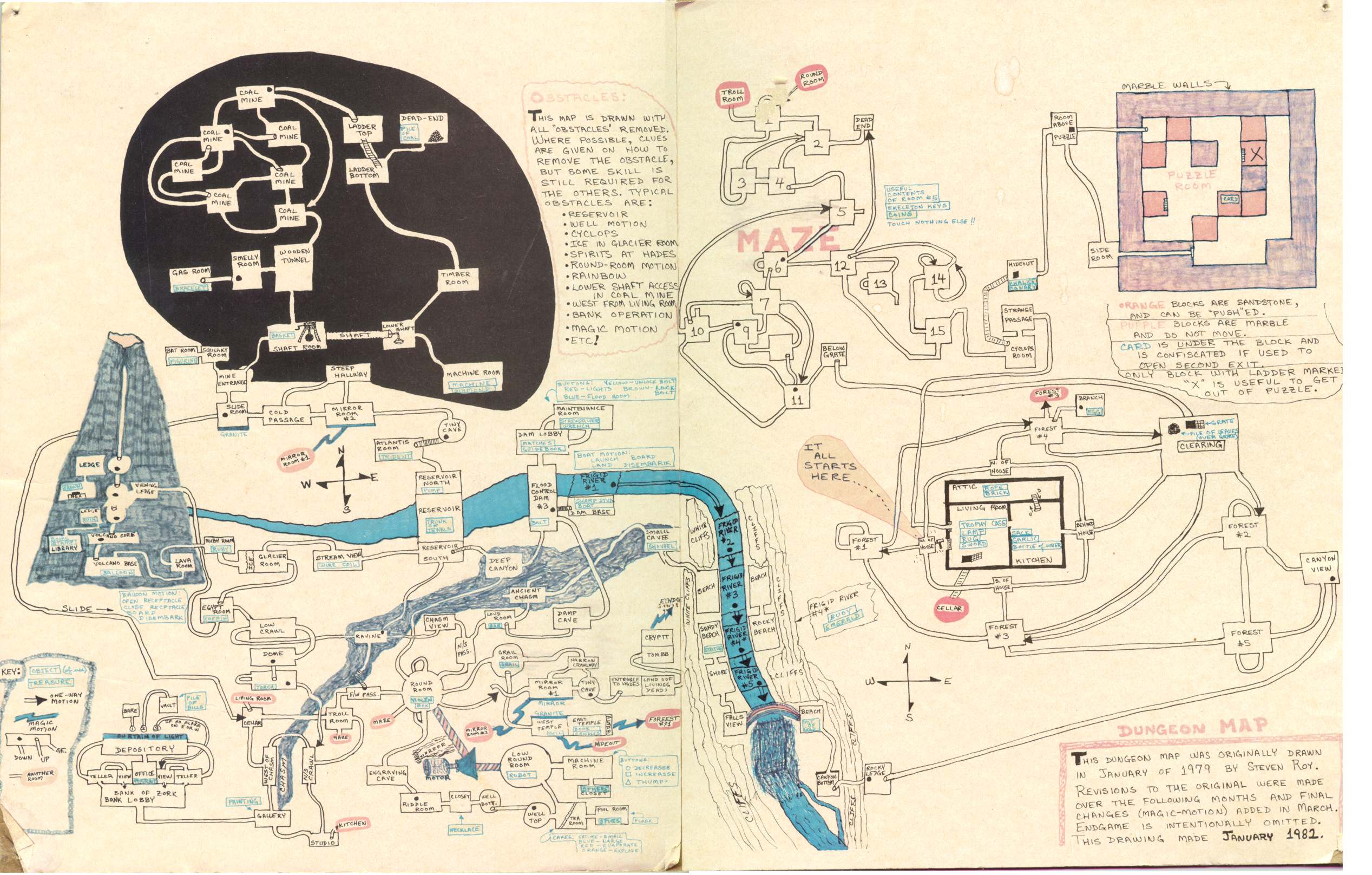
In case someone in the back didn’t hear it, this map is not from Dungeons and Dragons but from Zork/Dungeon. (via a surprising amount of people in a short period of time)
When reading about how low NYC’s greenhouse gas emissions are relative to the rest of the US, keep in mind the area surrounding NYC (kottke.org link). “Think of Manhattan as a place which outsources its pollution, simply because land there is so valuable.” (thx, bob)
NPR did a report on the Nickelback potential self-plagiarism. (thx, roman)
After posting about the web site for Miranda July’s new book, several people reminded me that Jeff Bridges’ site has a similar lo-fi, hand-drawn, narrative-driven feel.
In the wake of linking to the IMDB page for Back to the Future trivia, several people reminded me of the Back to the Future timeline, which I linked to back in December. A true Wikipedia gem.
I’m ashamed to say I’m still hooked on DesktopTD. The problem is that the creator of the game keeps updating the damn thing, adding new challenges just as you’ve finally convinced yourself that you’ve wrung all of the stimulation out of the game. As Robin notes, it’s a brilliant strategy, the continual incremental sequel. Version 1.21 introduced a 10K gold fun mode…you get 10,000 gold pieces at the beginning to build a maze. Try building one where you can send all 50 levels at the same time and not lose any lives. Fun, indeed.
Regarding the low wattage color palette, reader Jonathan notes that you should use that palette in conjunction with a print stylesheet that optimizes the colors for printing so that you’re not wasting a lot of ink on those dark background colors. He also sent along an OS X trick I’d never seen before: to invert the colors on your monitor, press ctrl-option-cmd-8. (thx, jonathan)
Dorothea Lange’s iconic Migrant Mother photograph was modified for publication…a thumb was removed from the lower right hand corner of the photo. Joerg Colberg wonders if that case could inform our opinions about more recent cases of photo alteration.
In reviewing all of this, the following seem related in an interesting way: Nickelback’s self-plagiarism, continual incremental sequels, digital photo alteration, Tarantino and Rodriquez’s Grindhouse, and the recent appropriation of SimpleBits’ logo by LogoMaid.
Digital filmmaking may be responsible for a new type of acting where actors and directors don’t need to worry so much about getting the shot *right this instant* while expensive film is rolling through the camera but can instead find the right performance out of many. “Digital removes those constraints. There’s no such thing as rehearsal. You can shoot anything you want. You don’t have to say ‘cut.’ You don’t have to say ‘action.’” Definitely a parallel here to how digital camera changed photography.
Armed America: Portraits of Americans and their Guns. “I got a gun here because we live in kind of a rough neighborhood and I take the subway home from work. I figured that since the bad-guys had guns, I should have one too.”
I love this photo of a chick pulling a little wagon with flowers in it. The 1908 version of Cute Overload.
Photographer Cara Barer creates twisty, rumpled sculptures out of damp books…the results are beautifully fractal in nature. (via your daily awesome)
While working for the FDR administration in 1936, photographer Dorothea Lange took the following photograph:
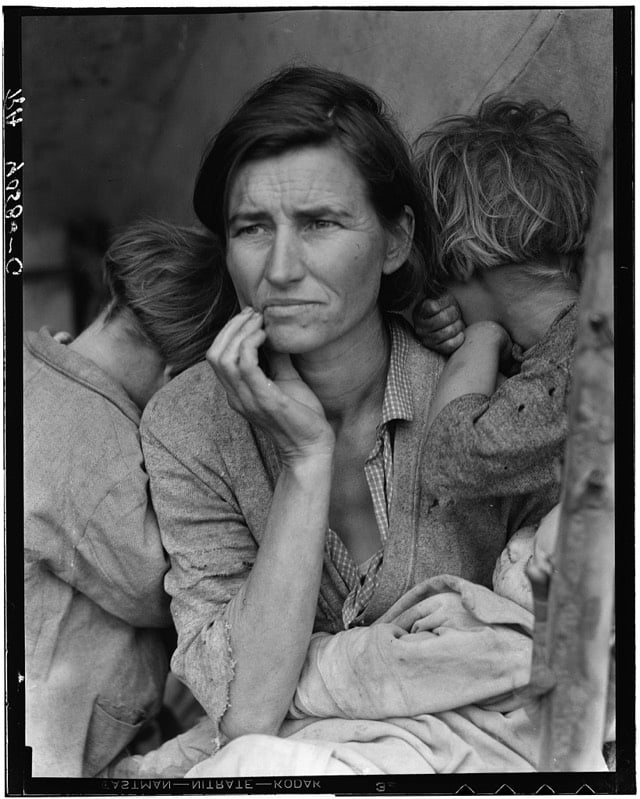
You’ve likely seen it before…it’s called Migrant Mother and it’s one of the more famous American photos. When she took the photo, Lange neglected to note the woman’s name (or other details) so her identity remained anonymous while the photo went on to become a symbol of the Great Depression. In the late 1970s, Florence Owens Thompson revealed herself to be the woman in the photo after she wrote a letter to her local paper saying that she didn’t like the image. In an AP story about the ensuing flap, Thompson stated:
I wish she hadn’t taken my picture. I can’t get a penny out of it. [Lange] didn’t ask my name. She said she wouldn’t sell the pictures. She said she’d send me a copy. She never did.”
In addition to not taking her subject’s name, Lange got something else wrong. Thompson and her family weren’t typical Depression migrants at all; they’d been living in California for almost 10 years. Like all photographs, Migrant Mother is neither truth nor fiction but somewhere in-between.
Photographs from the Arkansas State Prison 1915-1937. (via your daily awesome)
If you’re at a loss for something to wear tomorrow, check out the Wardrobe Remix photo pool on Flickr…12,000+ photos of normal people showing off what they’re wearing. “i believe the best stylists walk the streets, not the photo sets, nor the backstage of the runways. the real innovators are you and me: real, fashionable people, men and women alike.”
Finalists in Smithsonian magazine’s 2007 photo contest. Some good stuff in here, but some of it is a little cheesy.
Photojojo celebrates its first birthday with a tutorial on how to make video panoramas. The end result is pretty cool.
Photos of the offices of prominent New Yorkers. You can tell which of these people actually use their offices to get work done…Martha Stewart’s computer monitor is stashed neatly away in a drawer. For a less rarefied look at people’s workspaces, try the Desk Space, My Desk, and My Cluttered Desk photo pools on Flickr.
Update: I read Martha’s item incorrectly…her keyboard is in a drawer, not her monitor. Still, I contend that she doesn’t do any real work in that office. (thx, haran and eric)
A man named Dusan Stulik is working to document and preserve all the different ways in which photographs have been made. “Surprisingly, the large photography companies — Kodak, Ilford, Fuji, Polaroid and Agfa — did not save samples of the hundreds of different films and papers they developed over the last century. We’re hoping that you did.”
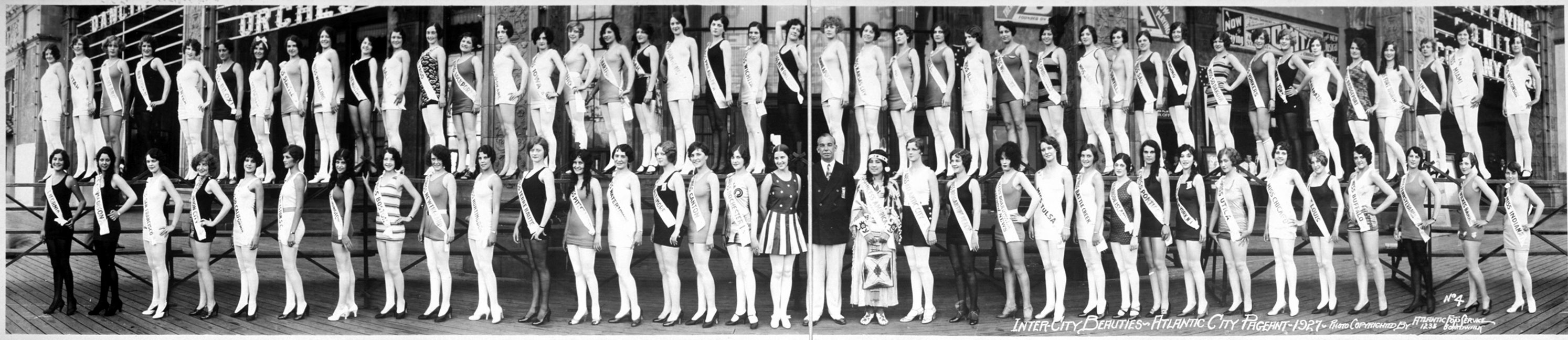
Photo of the contestants in the 1927 Atlantic City Pageant, the forerunner of the Miss America Pageant. (Larger photo here.) Compare with a photo of the contestants in the 2007 competition. What strikes me most about the 1927 photo is all the short hair.
Very much on the travel to-do list: head to Japan to see the cherry blossoms.

Socials & More