


Frances Bean Cobain

From fashion designer Hedi Slimane’s photoshoot with Cobain. She’s 18 now. The time, where did it go?

This site is made possible by member support. 💞
Big thanks to Arcustech for hosting the site and offering amazing tech support.
When you buy through links on kottke.org, I may earn an affiliate commission. Thanks for supporting the site!
kottke.org. home of fine hypertext products since 1998.
Beloved by 86.47% of the web.
From fashion designer Hedi Slimane’s photoshoot with Cobain. She’s 18 now. The time, where did it go?
AP photographer David Guttenfelder was recently granted “unprecedented access” to locations in North Korea…In Focus has a selection of the photos he took.
A short and charming documentary about fashionable seniors who are very much young-at-heart.
I’m not ready for a convent or anything, so I can wear leopard glasses.
If you like that, check out the portraits on Advanced Style, which is like a Sartorialist for the AARP set.
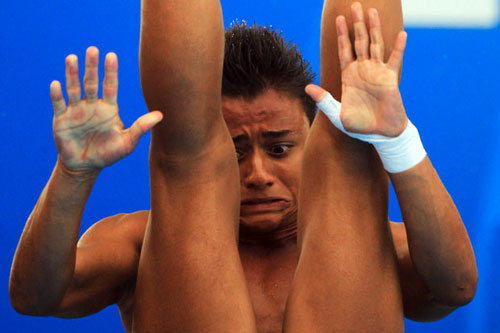
The Telegraph has a great photo gallery of divers’ faces as they compete in diving world championships in Shanghai.
(via ★antimega)
Photographer Joao Silva lost his legs last October when a land mine exploded under him in Afghanistan. Today, he’s back at work with a photo on the front page of the NY Times.
Although Mr. Silva can walk, he still needs a cane, which he holds in his right hand. When he wants to shoot, he must transfer the cane to his left arm so he can pick up the camera. He also conceded that he was frustrated about not yet being able to move as nimbly as he once could. But all in all, he said he was happy with his first day’s work.
“It was a matter of making the best of what I had,” he said. “There will come a time when I can run, but now I can walk.”
These color photos taken of London during WWII’s Battle of Britain are great.
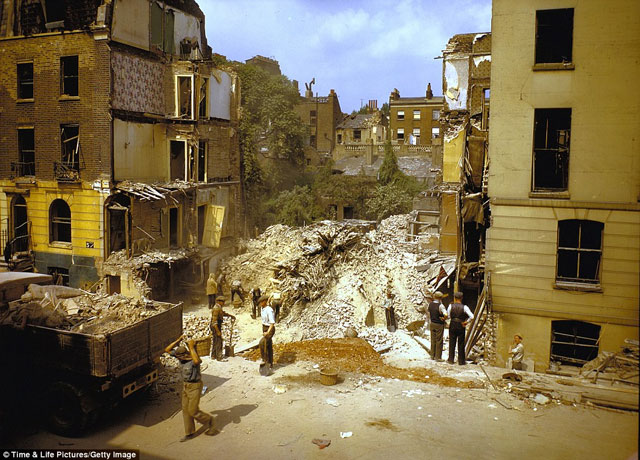
Alan Taylor recently covered the Battle of Britain over at In Focus as well…I love this “business as usual” photo.
This is a macro photo of…what do you think this is?

Click through to find out and see more macro photos from Caren Alpert.
Wow. So remember the photo taken by the monkey and Techdirt’s subsequent musings about who owns the copyright a photo taken by a monkey? Today Techdirt is reporting that Caters News Agency sent a takedown notice to Techdirt asking them to remove the monkey’s photos. Totally not making this up.
We were a bit surprised to receive a notice on Monday from Caters News, telling us they represented David Slater with respect to the syndication of those photos, and asking us to take down the photos. The notice was not a DMCA takedown notice. It doesn’t even mention copyright, though that seems like the only basis upon which they would make such a takedown request. And, to be clear, it was not in the least bit threatening. There is no legal language and no threat at all in the note.
When asked for clarification by Techdirt, a representative from Caters replied:
Michael, regardless of the issue of who does and doesn’t own the copyright — it is 100% clear that the copyright owner is not yourself. You have blatantly ‘lifted’ these photographs from somewhere — I presume the Daily Mail online. On the presumption that you do not like to encourage copyright theft (regardless of who owns it) then please remove the photographs.
Onionesque. Please someone interview the monkey about his/her views on this.
Alan Light got himself invited to the Academy Awards in 1989 with full access privileges…he took along a camera and shot dozens of candid photos of celebrities on the red carpet, at rehersals, and at after-parties. Here are Drew Barrymore and Corey Feldman arriving:
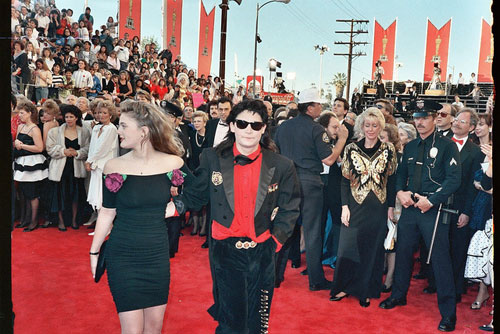
Barrymore, 14, and Feldman, 17, were dating at the time. At this point, Barrymore had been in rehab twice for drugs/alcohol and is two months away from a failed suicide attempt. Light also got photos of Lucille Ball a month before she died, Tom Cruise and Mimi Rogers, Mayim Bialik, Jodie Foster (who won the Best Actress Oscar that year for The Accused) and, my favorite for some reason, River Phoenix.
From earlier this month at In Focus, a photographic look at the “dizzying inspiration and crushing disappointment” of NASA’s Space Shuttle program. (via @robinsloan)
I almost made a joke on this post about getting a takedown notice from the monkey who took the inlined image, but this story on Techdirt explores the copyright issues involved in a more serious way.
Technically, in most cases, whoever makes the actual work gets the copyright. That is, if you hand your camera to a stranger to take your photo, technically that stranger holds the copyright on the photo, though no one ever enforces this.
(via ★tcarmody)
Even though several photographers have done similar projects (e.g. Denis Darzacq), these levitating self-portraits by Natsumi Hayashi charmed the pants right off of me.

Forget the million monkeys at a million typewriters eventually pounding out Shakespeare. Watch out Cartier Bresson (or perhaps Jill Greenberg), they’ve moved on to photography. A crested black macaque grabbed a photographer’s camera and shot dozens of shots, including this fine self-portrait:

I think that is my new favorite photo by my new favorite photographer.
Anna Skladmann takes photographs of the children of rich Russian families.
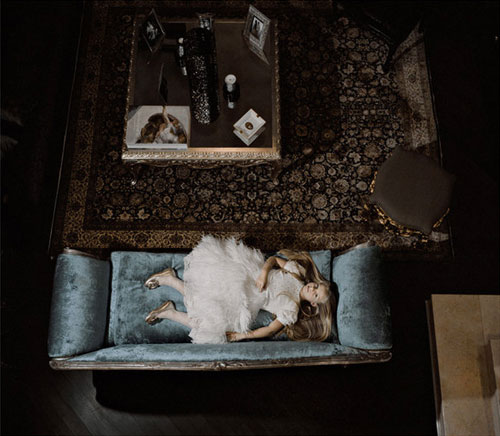
When I came to photograph Eva, she was at home with her two nannies, one British and one Russian. She had planned everything in advance: the dress she had chosen hung already perfectly ironed and pressed with matching tights and shoes carefully next to it. I felt that I had been hired by Eva to do this shoot rather than the other way around. She was experienced and knowledgeable as she showed me the rooms we were allowed to photograph. She placed herself carefully on the edge of a couch, stood in front of her favorite painting, and posed in her parents’ library. At the end of this photo session she was exhausted and lay down on the sofa. Finally I was able to take the only photograph that I had composed myself.
A photo restorer walks through the process of restoring a tintype photograph from the 1870s.
My standard operating procedure is to use an ultra-high resolution camera combined with a top-of-the-line macro lens to photograph tintypes. I use strobe lights to illuminate the artwork. Strobes produce “hard” light, much like the sun on a clear day. In addition to the strobes, I place a polarizer over the camera lens and polarizer gels over the strobe lights. This eliminates all reflections and enables the camera to pick up a greater tonal range along with more detail.
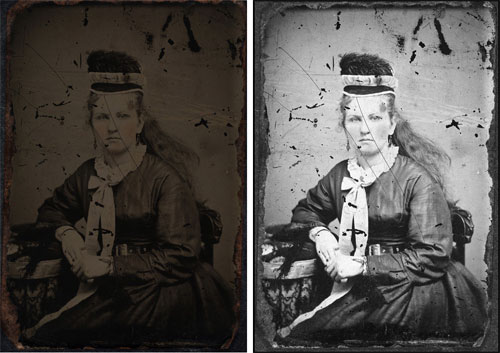
The original photo is on the left and an intermediate step on the right; you’ll need to click through to see the finished product.
Update: This is a better restoration…the one above is too airbrushed, like the photo on the cover of a fashion magazine.
A lovely collection of self portraits by Vivian Maier.
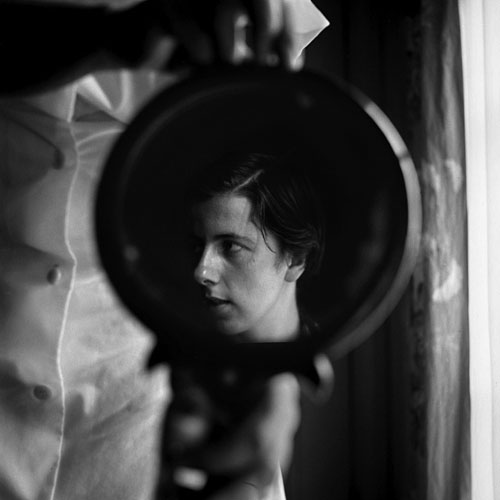
Maier, you’ll recall, is the street photographer whose photos were discovered at a Chicago thrift store in 2007.
A bunch of street level panoramas of midtown Manhattan from 1982. 1982 has never seemed so long ago. This link has been up and down for the past two weeks so it may not be available, so bookmark it for later checking-out.
As part of his new-ish gig as editor of In Focus at The Atlantic, Alan Taylor is running a 20-week series of photo essays on World War II. The first essay, Before the War, has been posted and is excellent.
The years leading up to the declaration of war between the Axis and Allied powers in 1939 were tumultuous times for people across the globe. The Great Depression had started a decade before, leaving much of the world unemployed and desperate. Nationalism was sweeping through Germany, and it chafed against the punitive measures of the Versailles Treaty that had ended World War I. China and the Empire of Japan had been at war since Japanese troops invaded Manchuria in 1931. Germany, Italy, and Japan were testing the newly founded League of Nations with multiple invasions and occupations of nearby countries, and felt emboldened when they encountered no meaningful consequences. The Spanish Civil War broke out in 1936, becoming a rehearsal of sorts for the upcoming World War — Germany and Italy supported the nationalist rebels led by General Francisco Franco, and some 40,000 foreign nationals traveled to Spain to fight in what they saw as the larger war against fascism.
(thx, david)
Peter Langenhahn will take hundreds of photos at a sporting event and stitch them together to make a single time-compressed panorama of the event’s action, like this image of every foul committed during a soccer match. Here’s a short video showing how he does it.
See also Peter Funch’s composite NYC street scenes. (via petapixel)
There’s a great thread over at Quora with photos of famous people in unexpected places, situations, or company. For example, there’s a photo of a young Bill Clinton meeting John F. Kennedy and one of Mark Twain and Nikola Tesla hanging out. My two favorites are a photo of Tank Man captured from an unusual angle and a chilling photo of John Wilkes Booth at Lincoln’s second inauguration, taken a little over a month before he killed Lincoln.

See also awesome people hanging out together. (thx, david)
No idea what these have to do with business or being inside business or whatever, but Business Insider has a nice selection of photos by Danny Lyon of Brooklyn in 1974.
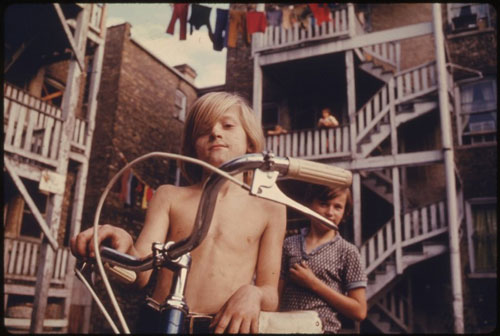
Textify.it is a web app that uses text to make alphabetic pointillist representations of images. I turned a photo of the Most Photographed Barn in America into this:
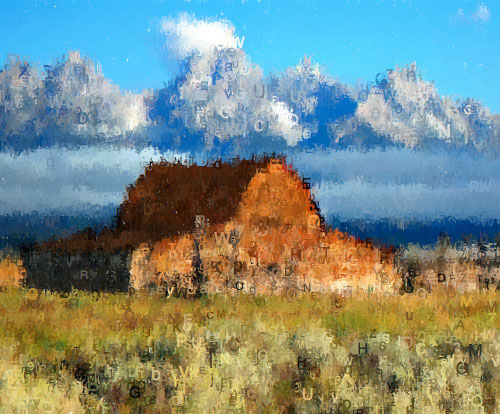
It’s also available as an iOS app. (via prosthetic knowledge)
A great collection of behind-the-scenes shots from famous movies. Here’s Kubrick and Sellers on the set of Dr. Strangelove:

(via df)
Paragliding photographer George Steinmetz takes beautiful aerial photos of Africa and other places from what is basically a chair attached to a motor and parachute.
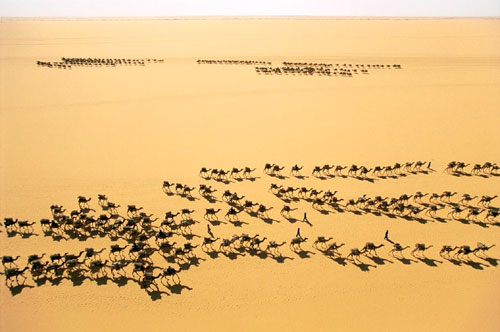
Steinmetz was the subject of a New Yorker profile last year.
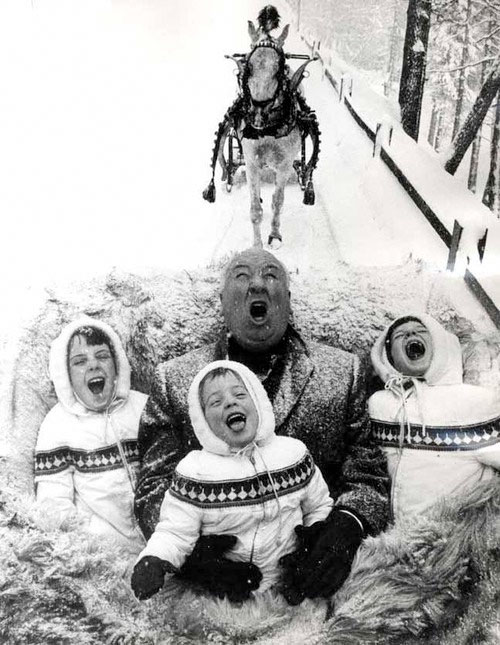
I found this photo of Alfred Hitchcock with three children here labeled “Alfred Hitchcock and his kids” but since he only had one child and looks older in the photo, I assume those are actually his three granddaughters, Mary, Tere, and Katie.
Anyway, lots of other rarely seen celebrity photos here, including a few fakes — notably the JFK/Monroe one done by Alison Jackson — an unheartthrobby George Clooney as a teen, and Hitler’s baby picture. (via ★genmon)
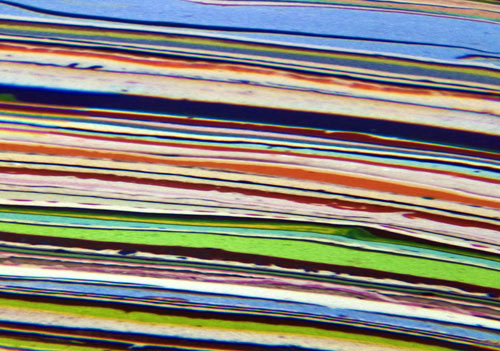
There’s a rock at the main intersection of White Rock, New Mexico that’s often repainted, sometimes two or three times a day. My pal Mouser and a couple friends of his took a core sample of the rock to determine the paint thickness…turns out there was five and a half inches of paint on that rock. Here’s a composite photomicrograph of the paint layers.
LeafSnap is a new iPhone app that uses facial recognition techniques to identify trees based on photos of their leaves.
Leafsnap contains beautiful high-resolution images of leaves, flowers, fruit, petiole, seeds, and bark. Leafsnap currently includes the trees of New York City and Washington, D.C., and will soon grow to include the trees of the entire continental United States.
Wow. Garden Design has more info. (thx, claire)
The recent uploads by your contacts is the most important page on Flickr and it’s broken. Timoni West is a designer at Flickr and she wrote a brief post on that page’s problems.
The page fails on a fundamental level — it’s supposed to be where you find out what’s happened on Flickr while you were away. The current design, unfortunately, encourages random clicking, not informed exploration.
The page isn’t just outdated, it’s actively hurting Flickr, as members’ social graphs on the site become increasingly out of sync with real life. Old users forget to visit the site, new sign ups are never roped in, and Flickr, who increased member sign-ups substantially in 2010, will forego months of solid work when new members don’t come back.
Many of my friends have switched their photo activities to Instagram and, more recently, Mlkshk. And Flickr’s broken “what’s new from your friends” page is to blame. Both of those sites use a plain old one-page reverse-chronological view of your friends’ photos…just scroll back through to see what’s going on. The primary advantage of that view is that it tells a story. Ok, it’s a backwards story like Memento, but that kind of backwards story is one we’re increasingly adept at understanding. The Flickr recent uploads page doesn’t tell any stories.
As long as we’re talking about what’s wrong with Flickr — and the stories thing comes in here too — the site is attempting to occupy this weird middle ground in terms of how people use it. When Flickr first started, it was a social game around publishing photos. You uploaded photos to Flickr specifically to share them with friends and get a reaction out of them. As the service grew, Flickr became less of a place to do that and more of a place to put every single one of your photos, not just the ones you wanted friends to see. Flickr has become a shoebox under the bed instead of the door of the refrigerator or workplace bulletin board. And shoeboxes under beds aren’t so good for telling stories. A straight-up reverse-chron view of your friends’ recent photos probably wouldn’t even work on Flickr at this point…you don’t want all 150 photos from your aunt’s trip to Kansas City clogging up the works. Instagram and Mlkshk don’t have this problem as much, if at all. (via @buzz)
The caption says that this is a photo. My brain is having a difficult time agreeing.

(via stellar)


Socials & More