kottke.org posts about museums
As you might have heard, MoMA recently acquired 23 typefaces for its Architecture and Design collection. I was curious about how such an acquisition works, so I sent a quick email to Jonathan Hoefler, one of the principals at Hoefler & Frere-Jones, a New York City type foundry that contributed four typefaces to the MoMA.
Kottke: Three of the four H&FJ typefaces acquired by MoMA are available for purchase on your web site. Did they just put in their credit card info and voila? Or was there a little more to it?
Hoefler: MoMA’s adopting the fonts for their collection was much more complex than buying a copy online (and not only because Retina, one of our four, isn’t available online.) I should start by stating that you can never actually “buy fonts” online: what one can buy are licenses, and the End-User License that surrounds a typeface does not extend the kinds of rights that are necessary to enshrine a typeface in a museum’s permanent collection. The good news is that H&FJ has become as good at crafting licenses as we have at creating typefaces, an unavoidable reality in a world where fonts can be deployed in unimaginable ways. This was a fun project for our legal department.
It was actually a fascinating conversation with MoMA, as we each worked to imagine how this bequest could be useful to the museum for eternity. What might it mean when the last computer capable of recognizing OpenType is gone? What will it mean when computers as we know them are gone? How does one establish the insurance value of a typeface: not its price, but the cost of maintaining it in working order? Digital artworks are prone to different kinds of damage than physical ones, but obsolescence is no less damaging to a typeface than earthquakes and floods to a painting. On the business side there are presumably insurance underwriters who can bring complex actuarial tables to bear on the issue, but I think it’s an even more provocative issue for conservators. 472 years after its completion, the frescoes of the Sistine Chapel underwent a restoration that scholars still find controversial. What might it mean for someone to freshen up our typefaces in AD 2483?
—
Thanks, Jonathan.
The photographs taken of everyone who sat with Marina Abramovic at her The Artist is Present show at MoMA are being compiled into a book called Portraits in the Presence of Marina Abramovic.
Just as Abramovic’s piece concerned duration, the photographs give the viewer a chance to experience the performance from Abramovic’s perspective. They reveal both dramatic and mundane moments, and speak to the humanity of such interactions, just as the performance itself did. The resultant photographs are mesmerizing and intense, putting a face to the world of art lovers while capturing what they shared during their contact with the artist.
The Museum of the City of New York has put a sizable chunk of their photography collection up on their web site. The interface is a little hinky, but it’s worth wading through. This is 220 Spring St from 1932, from right near Sixth Avenue:
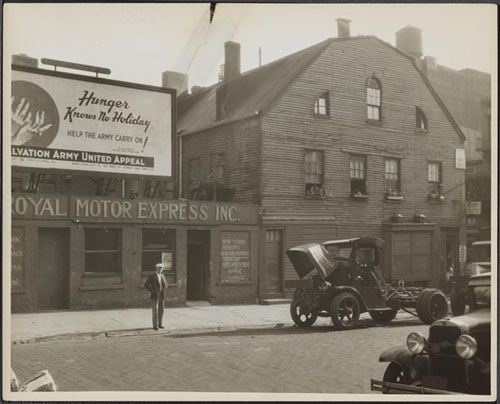
Photo credit: 220 Spring Street by Charles Von Urban. From the Collections of the Museum of the City of New York. (thx, @bamstutz)
The newest exhibition in The Tate Modern’s cavernous Turbine Room is Ai Weiwei’s Sunflower Seeds:

The room is filled with millions of handcrafted ceramic sunflower seeds:
Each seed has been individually sculpted and painted by specialists working in small-scale workshops in the Chinese city of Jingdezhen. Far from being industrially produced, they are the effort of hundreds of skilled hands. Poured into the interior of the Turbine Hall’s vast industrial space, the 100 million seeds form a seemingly infinite landscape.
Porcelain is almost synonymous with China and, to make this work, Ai Weiwei has manipulated traditional methods of crafting what has historically been one of China’s most prized exports. Sunflower Seeds invites us to look more closely at the ‘Made in China’ phenomenon and the geo-politics of cultural and economic exchange today.
For the first couple of days, people could walk around on the tiny sculptures (as you can see on Flickr), but health concerns prompted the museum to put a stop to that. Still pretty cool, but this remains my favorite Turbine Hall exhibition. (via hilobrow)
The only reason I ever go to MoMA anymore is so that my son can see the helicopter and whatever motor vehicles are on display in the design collection, but if I get a chance to sneak away soon, I’m definitely making use of the MoMA’s new iPhone app: tours, a catalog of thousands of works, events calendar, etc.

That’s from behind the scenes at the National Museum of Natural History in DC.
MoMA intern Julia Kaganskiy did an interview with Paco Blancas, who you might recognize as the man who has sat with Marina Abramović at MoMA more than a dozen times.

Maybe it’s just an image that pops while I’m connected with Marina. Let’s say it’s an image of someone I love deeply, and then this creates the emotion, the tears just come out. Most of the time it’s tears of joy. You’re just being and thinking about somebody or something that’s important in your life. And then just acknowledging this person or situation and moving on into being present because yeah, the tears come, but I don’t want to cry for the entire sitting. I want to move on and continue to be with Marina, to be present.
At the behest of MoMA, photographer Marco Anelli has been taking photographs of all the people participating in Marina Abramović’s performance in the main atrium of the museum and posting them to Flickr. To review:
Abramović is seated in [the atrium] for the duration of the exhibition, performing her new work The Artist Is Present for seven hours, five days a week, and ten hours on Fridays. Visitors are invited to sit silently with the artist for a duration of their choosing.
The photographs are mesmerizing…face after face of intense concentration. A few of the participants even appear to be crying (this person and this one too) and several show up multiple times (the fellow pictured above sat across from Abramović at least half-a-dozen times). The photos are annotated with the duration of each seating. Most stay only a few minutes but this woman sat there for six and a half hours. This woman sat almost as long as was also dressed as the artist. (It would be neat to see graphs of the durations, both per day and as a distribution.)
Has anyone out there sat across from Abramović? Care to share your experience? (via year in pictures)
Update: On the night of the opening exhibition, the third person to sit across from Abramović was her ex-boyfriend and collaborator of many years, Ulay (pictured here on Flickr). James Wescott reports on the scene:
When she looked up again, sitting opposite her was none other than Ulay. A rapturous silence descended on the atrium. Abramović immediately dissolved into tears, and for the first few seconds had trouble meeting Ulay’s calm gaze. She turned from superhero to little girl — smiling meekly; painfully vulnerable. When they did finally lock eyes, tears streaked down Abramović’s cheeks; after a few minutes, she violated the conditions of her own performance and reached across the table to take his hands. It was a moving reconciliation scene — as Abramović, of course, was well aware.
Here’s a description of one of the projects they did together in the 70s:
To create this “Death self,” the two performers devised a piece in which they connected their mouths and took in each other’s exhaled breaths until they had used up all of the available oxygen. Seventeen minutes after the beginning of the performance they both fell to the floor unconscious, their lungs having filled with carbon dioxide. This personal piece explored the idea of an individual’s ability to absorb the life of another person, exchanging and destroying it.
Wescott also sat across from the artist:
I was immediately stunned. Not by the strength of her gaze, but the weakness of it. She offered a Mona Lisa half-smile and started to cry, but somehow this served to strengthen my gaze; I had to be the mountain.
Carolina Miranda sat down across from Abramović:
When I finally sat down before Abramovic, the bright lights blocked out the crowd, the hall’s boisterous chatter seemed to recede into the background, and time became elastic. (I have no idea how long I was there.)
Amir Baradaran turned the exhibition into a venue for a performance of his own…he even made Abramović laugh. Joe Holmes got a photo of the photographer in action. (thx, yasna & patrick)
Update: The look-alike who sat with Abramović all day did an interview with BOMBLog.
At certain times I thought that we were really in sync. Other times I didn’t. Other times I was totally hallucinating. She looked like a childhood friend I once had. Then she looked like a baby. […] I thought time was flying by. Then time stopped. I lost track of everything. No hunger. No itching. No pain. I couldn’t feel my hands.
Update: Author Colm Tóibín sat opposite Abramović recently (here he is on Flickr) and wrote about it for The New York Review of Books. (thx, andy)
Update: Singer Lou Reed sat. (thx, bob)
Update: Rufus Wainwright sat. And perhaps Sharon Stone? (via mefi)
Update: More first-hand accounts from the NY Times.
Update: And CNN’s Christiane Amanpour. (thx, ian)
Everett Fahy, the former head of the European painting department at the Met, believes that one of the museum’s paintings by Francesco Granacci is actually by Michelangelo.
I believe Michelangelo painted it in 1506, two years before he started on the Sistine ceiling. It was already in my brain in 1971, the year after it was bought. When the Metropolitan showed it in 1971, I wrote for an exhibition called ‘Masterpieces of Fifty Centuries’ that the second panel recalled the figures in the Sistine Chapel. As years went by, it firmed up. I had long believed it to be by Michelangelo, but exactly when I don’t know. There wasn’t a moment when I suddenly said, ‘This is absolutely by Michelangelo.’ It was a gradual recognition.
One the clues Fahy used to make his determination involves the rocks in the painting; they resemble the quarry at which Michelangelo spent several months in 1497. The painting can be viewed larger on the Met’s website.
I got a look at the Henri Cartier-Bresson exhibit at MoMA the other day and loved it. Seeing his work, especially his earlier on-the-street stuff, makes me want to drop everything and go be a photographer. If you’re into photography at all, this show is pretty much a must-see.
(BTW, I chuckled when I saw this photo on the wall…it was the subject of an epic Flickr prank a few years back.)
The Department of Architecture and Design at MoMA has made a, er, symbolic acquisition of the @ symbol.
The acquisition of @ takes one more step. It relies on the assumption that physical possession of an object as a requirement for an acquisition is no longer necessary, and therefore it sets curators free to tag the world and acknowledge things that “cannot be had” — because they are too big (buildings, Boeing 747’s, satellites), or because they are in the air and belong to everybody and to no one, like the @ — as art objects befitting MoMA’s collection. The same criteria of quality, relevance, and overall excellence shared by all objects in MoMA’s collection also apply to these entities.
Atlas Obscura is organizing a worldwide event on March 20th called Obscura Day, “a day of expeditions, back-room tours, and hidden treasures in your own hometown”. Events include tours of a pneumatic tube system in Palo Alto, an underground salt museum in Kansas, a Icelandic museum of phalluses, a Cuban perfume museum, and a hikaru dorodango demonstration in Albuquerque.
Upcoming at MoMA: a retrospective of the work of Henri Cartier-Bresson.
For more than twenty-five years, he was the keenest observer of the global theater of human affairs — and one of the great portraitists of the twentieth century. MoMA’s retrospective, the first in the United States in three decades, surveys Cartier-Bresson’s entire career, with a presentation of about three hundred photographs, mostly arranged thematically and supplemented with periodicals and books.
After MoMA, the exhibition will visit Chicago, SF, and Atlanta. Quite excited for this one.
The recent acquisitions should give you some idea of the curatorial vision of the Museum of Bad Art. (thx, joe)
The New York Transit Museum has developed an extensive online version of their The Future Beneath Us exhibit, featuring eight NYC-area underground projects that are currently under development. The exhibit is on display in two Midtown locations until July 5. (thx, michael)
Newer posts
Older posts




Socials & More