In the wake of the murder of UnitedHealthcare’s CEO, a book published in 2010 by Rutgers Law professor Jay Feinman has hit the bestseller charts: Delay, Deny, Defend: Why Insurance Companies Don’t Pay Claims and What You Can Do About It. The book’s title is a reference to an insurance industry strategy of denying legitimate claims to boost profits. Bullet casings at the scene of the shooting referenced the same strategy: they were labelled “deny”, “defend”, and “depose”.
The introduction to the book is available online and it describes the origin of delay, deny, defend:
Delay, deny, defend violates the rules for handling claims that are recognized by every company, taught to adjusters, and embodied in law. Within the vast bureaucracy of insurance companies, actuaries assess risks, underwriters price policies and evaluate prospective policyholders, and agents market policies. The claims department’s only job is to pay what is owed, no more but no less. A classic text used to train adjusters, James Markham’s The Claims Environment, states the principle: “The essential function of a claim department is to fulfill the insurance company’s promise, as set forth in the insurance policy… The claim function should ensure the prompt, fair, and efficient delivery of this promise.”
Beginning in the 1990s, many major insurance companies reconsidered this understanding of the claims process. The insight was simple. An insurance company’s greatest expense is what it pays out in claims. If it pays out less in claims, it keeps more in profits. Therefore, the claims department became a profit center rather than the place that kept the company’s promise.
A major step in this shift occurred when Allstate and other companies hired the megaconsulting firm McKinsey & Company to develop new strategies for handling claims. McKinsey saw claims as a “zero-sum game,” with the policyholder and the company competing for the same dollars. No longer would each claim be treated on its merits. Instead, computer systems would be put in place to set the amounts policyholders would be offered, claimants would be deterred from hiring lawyers to help with their claims, and settlements would be offered on a take-it-or-litigate basis. If Allstate moved from “Good Hands” to “Boxing Gloves,” as McKinsey described it, policyholders would either take a lowball offer from the good hands people or face the boxing gloves of extended litigation.
I don’t know about you, but the violence implied by the “Boxing Gloves” metaphor is particularly galling — but also germane to the national conversation we’re currently having about violence, culpability, and who is and isn’t sanctioned by the state to decide who suffers or dies.
The New Yorker has some excerpts of Alexei Navalny’s diary from the last 2 years of his life, taken from his forthcoming memoir, Patriot.
2022, January 17th.
Exactly one year ago today I came home, to Russia.
I didn’t manage to take a single step on the soil of my country as a free man: I was arrested even before border control.
The hero of one of my favorite books, “Resurrection,” by Leo Tolstoy, says, “Yes, the only suitable place for an honest man in Russia at the present time is prison.”
It sounds fine, but it was wrong then, and it’s even more wrong now.
There are a lot of honest people in Russia-tens of millions. There are far more than is commonly believed.
The authorities, however, who were repugnant then and are even more so now, are afraid not of honest people but of those who are not afraid of them. Or let me be more precise: those who may be afraid but overcome their fear.
There are a lot of them, too. We meet them all the time, in all sorts of places, from rallies to the media, people who remain independent. Indeed, even here, on Instagram. I recently read that the Ministry of the Interior was firing staff who had “liked” my posts. So in Russia, in 2022, even a “like” can take courage.
In every period, the essence of politics has been that a tin-pot tsar who wants to arrogate to himself the right to personal, unaccountable power needs to intimidate the honest people who are not afraid of him. And they, in turn, need to convince everyone around them that they should not be afraid, that there are, by an order of magnitude, more honest people than the mean little tsar’s security guards. Why live your whole life in fear, even being robbed in the process, if everything can be arranged differently and more justly?
The pendulum swings endlessly. Or the tug-of-war. Today you are brave. Tomorrow they seem to have scared you a bit. And the day after tomorrow they have scared you so much that you despair and become brave again.
Two years later, Navalny was dead, murdered by Russia’s leader, dictator Vladimir Putin. I do not think it is hyperbole to read Navalny’s words as a warning, a harbinger of what happens to a country and its people when they come under undemocratic leadership.
The details of the atrocities committed against the people of Bucha, Ukraine by Russian soldiers are more horrifying than language has words for. Luke Mogelson and photographer James Nachtwey are reporting for the New Yorker from Bucha as loved ones and volunteers try to make sense of the destruction. Note: the descriptions and photos in this piece may be disturbing (but IMO, we cannot turn away from this). This is one of the tamer paragraphs:
On the far side of a stretch of railroad tracks, two elderly women had been killed in their house. One lay in the doorway, another in the kitchen. Both were bundled in heavy winter coats. Neighbors said that they had been sisters, both in their seventies. Their small house was filled with hardcover books, and they did not own a television; it was impossible not to imagine their quiet, literary life together before it was annihilated. In the only bedroom, two narrow mattresses were pushed together and covered by a single blanket.
Update: From the NY Times, Bucha’s Month of Terror.
As the Russian advance on Kyiv stalled in the face of fierce resistance, civilians said, the enemy occupation of Bucha slid into a campaign of terror and revenge. When a defeated and demoralized Russian Army finally retreated, it left behind a grim tableau: bodies of dead civilians strewn on streets, in basements or in backyards, many with gunshot wounds to their heads, some with their hands tied behind their backs.
This animated documentary about how Israeli Mossad agent Zvi Aharoni tracked down and captured Nazi war criminal Adolf Eichmann in Argentina 15 years after WWII ended is really fantastic.
The rare film to win festival prizes as both a documentary & as an animation, Randall Christopher’s The Driver is Red is a stunning showcase for his minimalist pen and ink art and for his grand aim to increase public awareness of WWII history (which he perceives to be rapidly fading from the consciousness of younger generations). Should he succeed in that noble aim however, the reason will be that he has taken a potentially dry historical record and transformed it into an imaginative and unabashedly cracking spy thriller.
Told through the experience of Israeli Mossad agent Zvi Aharoni, the film documents the discovery and capture of Adolf Eichmann, the senior Nazi official largely responsible for organizing and executing the Holocaust. Hidden for 15 years half a world away, and living under an assumed identity, Eichmann is tracked down by Aharoni and the agent, with a small team in tow, must design and execute a strategy for Eichmann’s capture and extradition.
You can read much more about Eichmann and his crimes, capture, trial, and death in a massive five-part series Hannah Arendt wrote for the New Yorker in 1963 (1, 2, 3, 4, 5), later collected in Eichmann in Jerusalem: A Report on the Banality of Evil. (via open culture)
This piece by Wright Thompson on how the murder of Emmett Till has been remembered and forgotten is a difficult, compelling, and important read. The story centers around the still-little-known barn where Till was tortured and murdered by a group of several white men in 1955.
But the way Till’s name exists in the firmament of American history stands in opposition to the gaps in what we know about his killing. No one knows, for instance, how many people were involved. Most historians think at least seven were present. Only two were tried: half brothers J. W. Milam and Roy Bryant. Another half brother, Leslie Milam, was there that night too. He lived in an old white farmhouse a few dozen steps from the barn, next to where Jeff Andrews’s house now stands.
In 1955 an all-white, all-male jury, encouraged by the defense to do their duty as “Anglo-Saxons,” acquitted J. W. Milam and Roy Bryant. Because the defendants couldn’t be tried again, they got paid to make a confession to a national magazine — a heavily fictionalized account stage-managed by their lawyers — and Leslie Milam and his barn were written out of the story. Ask most people where Till died and they’ll say Money, Mississippi, the town where Till whistled at Bryant’s wife outside the family’s store. An Equal Justice Initiative monument in Montgomery says Money. Wikipedia does too. The Library of Congress website skips over the barn, which is just outside the town of Drew, about 45 minutes from the store.
I learned about the barn last year and have since made repeated visits, alone and with groups, once with members of Till’s family. Over and over, I drove from my home in the Mississippi hill country back into the gothic flatland where I was born. The barn’s existence conjures a complex set of reactions: It is a mourning bench for Black Americans, an unwelcome mirror for white Americans. It both repels and demands attention.
Last week, I posted about Texas death row inmate Quintin Jones and his plea for clemency in the face of his pending execution. Again, here is his video message to Texas governor Greg Abbott:
On Wednesday evening, in the presence of two outside witnesses, Texas killed Quintin Jones. Two journalists who were to bear witness to the execution for the public were not called into the prison by officials who somehow “forgot” to do so:
Absent were two journalists who had been scheduled to attend the execution but whom prison officials said they had accidentally failed to summon.
Before he died, a video director for the NY Times recorded a short video of Jones’ last words to the public, in which he thanked everyone for helping him be a better person and even asked viewers to consider the trauma that death row prison guards endure in the course of doing their jobs. A separate statement of his last words was recorded by prison officials:
“Love all my friends and all the friendships that I have made,” Mr. Jones said, according to those state prison records. “They are like the sky. It is all part of life, like a big full plate of food for the soul. I hope I left everyone a plate of food full of happy memories, happiness and no sadness.”
Then he said, “I’m done, warden.” He was pronounced dead at 6:40 p.m.
That same day, Governor Abbott, who is a member of the so-called “pro-life” Republican party, signed a law that bans abortions in Texas after a fetal heartbeat can be detected, which is before many women are even aware they are pregnant.
Quintin Jones murdered his aunt in 1999 and is scheduled to be executed on May 19, 2021. He admits his guilt, his family has forgiven him, and in this video, he shares his thoughts about personal growth & death and asks Texas governor Greg Abbott to spare his life.
During his 21 years on death row, Quin has been the epitome of a prison success story. He entered at an unimaginable low, as lost as a soul can be. And through prayer, sobriety, reconciliation with his family, and longstanding correspondence with pen pals, he has found a way to lead a meaningful life, and even to enhance the lives of others. The victim’s family — who is also Quin’s family — has forgiven him.
Emotionally, intellectually, and psychologically, human beings are ships of Theseus — we are not the same people at 30 as we were at 20 or will be at 40. The death penalty is immoral, full stop. The sooner our system of retributive justice is replaced with restorative justice, the healthier and safer our communities and society will be.
In a piece for Essence, prison industrial complex abolitionists Mariame Kaba and Andrea Ritchie challenge us to consider whether arresting and prosecuting the police officers who killed Breonna Taylor (or George Floyd or Elijah McClain) will result in justice.
Beyond strategic assessments of what is most likely to bring justice, ultimately, we must choose to support collective responses that align with our values. Demands for arrests and prosecutions of killer cops are inconsistent with demands to #DefundPolice because they have proven to be sources of violence not safety. We can’t claim the system must be dismantled because it is a danger to Black lives and at the same time legitimize it by turning to it for justice. As Angela Y. Davis points out, “we have to be consistent” in our analysis, and not respond to violence in a way that compounds it. We need to use our radical imaginations to come up with new structures of accountability beyond the system we are working to dismantle.
Noting that “turning away from systems of policing and punishment doesn’t mean turning away from accountability”, Kaba and Ritchie argue that use of a reparations framework would be more effective in delivering justice to Taylor’s family and in preventing future killings and violence by police.
Under a reparations framework Breonna’s family — and all of us — are also entitled to more than an individualized response to what is a systemic problem. We are entitled to immediate cessation of the actions that caused her death — no knock warrants, to be sure, but also short knock warrants, and dangerous drug raids in all their forms. And all of us are entitled to non-repetition, an end to the conditions that produced her death, including an end to the drug war that killed her, and the forces of gentrification that brought police into her neighborhood. It is long past time for an approach to drug use that saves lives instead of ending them — whether in a raid or in a cell — and a reckoning with the ways in which economic policies are driving deadly policing practices.
Read the entire piece at Essence.
Hi. I wanted to take today to compile a sampling of what Black people (along with a few immigrant and other PoC voices) are saying about the recent murders by police of Breonna Taylor and George Floyd, the murder of Ahmaud Arbery, the threatening of Christian Cooper with police violence by a White woman, the protests in Minneapolis & other places, and the unequal impact of the pandemic on communities of color, as well as what Black voices have said in the past about similar incidents & situations. This is not an exhaustive list of reaction & commentary — it’s just a sample. I’m not going to add anything to these voices, but I will share a few resources at the end of the post.
Please put your urge to judge on the shelf for a minute and just listen to your fellow human beings in all of their raw, righteous, and furious anger. I am trying to listen. Is America finally ready to listen? Are you ready?
Keeanga-Yamahtta Taylor, Of Course There Are Protests. The State Is Failing Black People.
This simultaneous collapse of politics and governance has forced people to take to the streets — to the detriment of their health and the health of others — to demand the most basic necessities of life, including the right to be free of police harassment or murder.
What are the alternatives to protest when the state cannot perform its basic tasks and when lawless police officers rarely get even a slap on the wrist for crimes that would result in years of prison for regular citizens? If you cannot attain justice by engaging the system, then you must seek other means of changing it. That’s not a wish; it’s a premonition.
Keeanga-Yamahtta Taylor again reacting to “American billionaires got $434 billion richer during the pandemic”:
This looting by billionaires is what sets fires and burns down stores. You do not get one without the other.
Jillian Sloane:
I wish America loved black people the way they love black culture.
Martin Luther King, Jr., The Other America (via Paul Octavious):
I think America must see that riots do not develop out of thin air. Certain conditions continue to exist in our society which must be condemned as vigorously as we condemn riots. But in the final analysis, a riot is the language of the unheard. And what is it that America has failed to hear? It has failed to hear that the plight of the Negro poor has worsened over the last few years. It has failed to hear that the promises of freedom and justice have not been met. And it has failed to hear that large segments of white society are more concerned about tranquility and the status quo than about justice, equality, and humanity. And so in a real sense our nation’s summers of riots are caused by our nation’s winters of delay. And as long as America postpones justice, we stand in the position of having these recurrences of violence and riots over and over again. Social justice and progress are the absolute guarantors of riot prevention.
Bakari Sellers (click through to watch the video):
It’s just so much pain. You get so tired. We have black children. I have a 15-year-old daughter. What do I tell her? I’m raising a son. I have no idea what to tell him. It’s just, it’s hard being black in this country when your life is not valued.
Black parents talk to their children about how to deal with the police:
Ruhel Islam, a Bangladeshi immigrant and owner of Gandhi Mahal Restaurant, which burned in Minneapolis:
Let my building burn, Justice needs to be served, put those officers in jail.
DiDi Delgado:
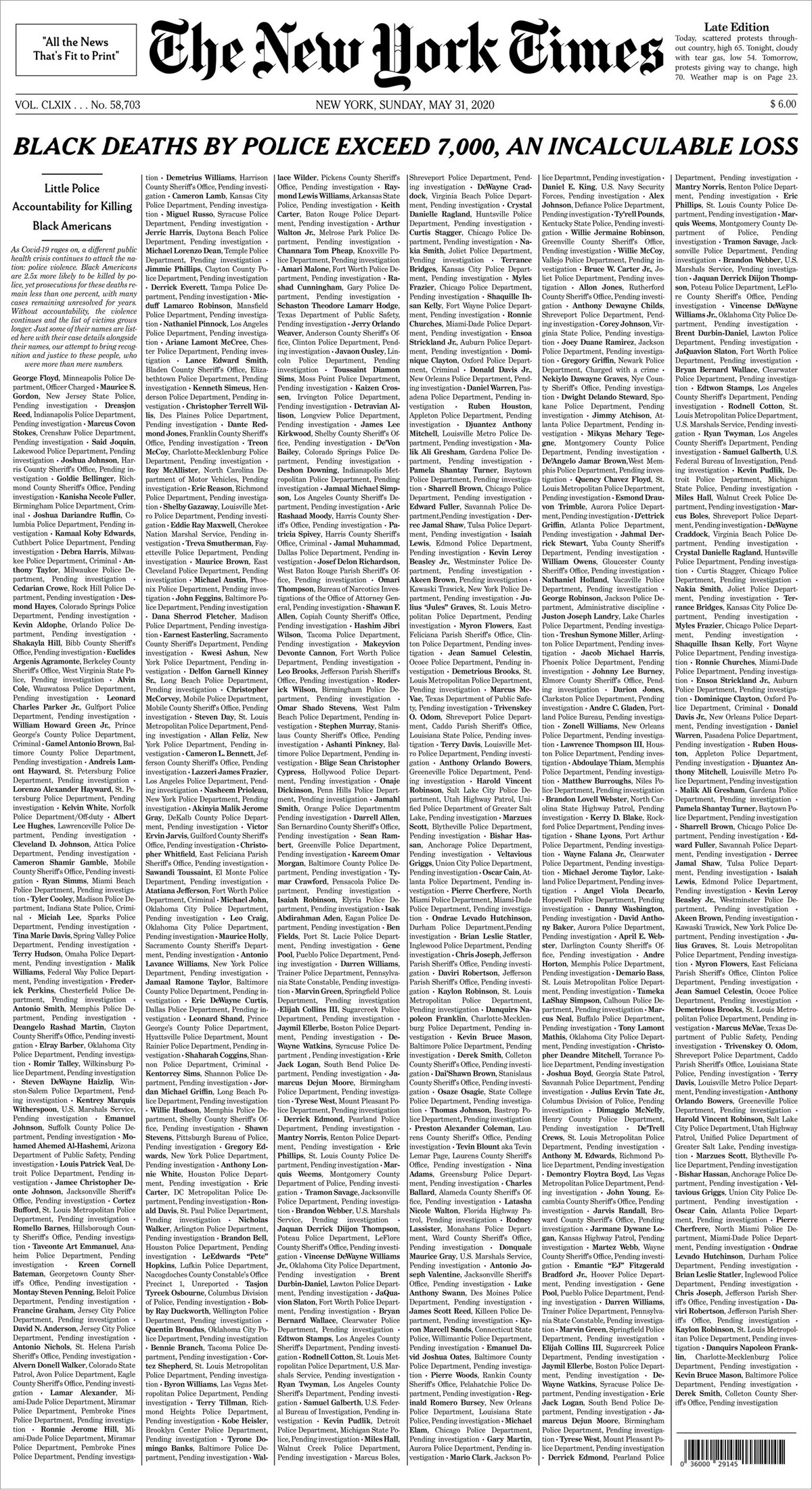
In the time between Eric Garner’s “I can’t breathe” and George Floyd’s “I can’t breathe” police in the United States killed at least (AT LEAST) 5,947 people. #WeCantBreathe
Ella Baker:
Until the killing of black men, black mothers’ sons, becomes as important to the rest of the country as the killing of a white mother’s son, we who believe in freedom cannot rest.
Peter Daou:
America, where it’s okay to kneel on a black man’s neck and murder him, but it’s “unpatriotic” to kneel in protest of that murder.
#BlackLivesMatter #TakeAKnee
Luvvie Ajay, About the Weary Weaponizing of White Women Tears:
White people will never have to deal with the fact that their skin is considered a weapon but they use their skins as ammunition by using all the privileges that come with it to terrorize the world. White women use their tears as pity me bombs all the time and it often instigates Black people being punished.
Ajay again:
I’ve traveled all over the world. And have never felt as unsafe as I do at home, in the United States.
Never.
@jxparisxo:
Can we stop calling it “police brutality” it’s murder, M-U-R-D-E-R
Nikole Hannah-Jones, Yes, Black America Fears the Police. Here’s Why.:
For those of you reading this who may not be black, or perhaps Latino, this is my chance to tell you that a substantial portion of your fellow citizens in the United States of America have little expectation of being treated fairly by the law or receiving justice. It’s possible this will come as a surprise to you. But to a very real extent, you have grown up in a different country than I have.
As Khalil Gibran Muhammad, author of The Condemnation of Blackness, puts it, “White people, by and large, do not know what it is like to be occupied by a police force. They don’t understand it because it is not the type of policing they experience. Because they are treated like individuals, they believe that if ‘I am not breaking the law, I will never be abused.’”
We are not criminals because we are black. Nor are we somehow the only people in America who don’t want to live in safe neighborhoods. Yet many of us cannot fundamentally trust the people who are charged with keeping us and our communities safe.
Jemele Hill:
Trump to the white people with AR-15s throwing a temper tantrum over a haircut — “Liberate”
Trump to those protesting the lack of justice in Minneapolis — “THUGS”
A whole, racist clown.
Tarana Burke:
A few years ago me and dude are out and come back to his car to find it vandalized. He parked by a driveway and partially blocked it and we concluded that the owners had vandalized the car. I get pissed and go knock on the door. They don’t answer so I’m yelling!
He’s telling me to calm down and forget it but I’m pissed! A few minutes later cop car rolls by and they stop and get out. I start to tell them what happened and they walk up on him and immediately start questioning him. I interrupt and say “excuse me HIS car was vandalized!”
The cops tell me to ‘be quiet’ and just as I’m about to turn all the way up on them he turns to me and says “Baby, please…” firmly. Then he calmly answers the cops questions even though they are rude and invasive. They take his license and keep asking ridiculous questions…
“What are you all doing here?”
“Did you get into an altercation earlier tonight?”
“If I knock on these people’s door what are they going to say?”
I was fuming. Now I’m nervous.
Damon Young, Thoughts on Forgiving Amy Cooper (aka ‘Darth Karen’), Who Got Fired, Banned From Central Park, and Lost Her Dog:
LOLOLOLOLOLOLOLOLOLOL…
Ibram X. Kendi (via Nicole Parker):
The greatest white privilege is life itself. People of color are being deprived of life.
Dr. Kendi again:
They say they can’t be racist because they are northerners. They say they can’t be racist because they are progressives. They say they can’t be racist because they are Democrats.
Why are they saying they can’t be racist? Because they are racist.
Dr. Kendi for a third time (he wrote a whole book about moments like these):
It feels like Black people were running for their lives from racist terror only to run into the murderous face of COVID-19, only to start running for their lives from COVID-19 only to run into the murderous face of racist terror.
Maurice Moe Mitchell:
If you have trouble imagining the concept of “police abolition,” look no further than the many live experiments being played out in upper middle class white suburbs across the country where people carry on their lives with little to no interaction with law enforcement.
Ernest Owens, I Have Not Missed the Amy Coopers of the World:
I’m doing better these days because staying home alone and practicing social distancing has meant I’m avoiding many of the racist encounters that used to plague my daily life.
The video that circulated this weekend of a white woman calling the police with a false report about threats by a black man who simply asked her to leash her dog in Central Park illustrates exactly why I’m so happy to be spending more time inside.
Blair Imani:
Murder is worse than property destruction. Every single time. Don’t let capitalism fool you.
Ruby Hamad, A White Damsel Leveraged Racial Power and Failed:
The damsel-in-distress archetype probably conjures up images of delicate maidens and chivalrous gentlemen. That is precisely what it is designed to do — for white people. To people of color, and especially African-Americans who have borne the brunt of her power in the United States, the image is very different. The damsel in distress is an illusion of innocence that deflects and denies the racial crimes of white society.
J. Drew Lanham, Birding While Black:
Up until now the going has been fun and easy, more leisurely than almost any “work” anyone could imagine. But here I am, on stop number thirty-two of the Laurel Falls Breeding Bird Survey (BBS) route: a large black man in one of the whitest places in the state, sitting on the side of the road with binoculars pointed toward a house with the Confederate flag proudly displayed. Rumbling trucks passing by, a honking horn or two, and curious double takes are infrequent but still distract me from the task at hand. Maybe there’s some special posthumous award given for dying in the line of duty on a BBS route-perhaps a roadside plaque honoring my bird-censusing skills.
Tyler Merritt, Before You Call the Cops:
Alexandria Ocasio-Cortez:
I’ll just say it: a lot of politicians are scared of the political power of the police, and that’s why changes to hold them accountable for flagrant killings don’t happen. That in itself is a scary problem.
We shouldn’t be intimidated out of holding people accountable for murder.
Ernest Owens:
BEFORE Y’ALL KEEP GOING: Christian Cooper could have had tattoos on his face, hated birds, been smoking a blunt and listening to Future, and #CentralParkAmy WOULD HAVE STILL BEEN AS GUILTY AND RACIST AND WRONG AF FOR TERRORIZING HIM.
Enough with the respectability politics.
Alicia Crosby:
I really can’t shake how profoundly evil it is to tear gas folks protesting the suffocation of a man by the police during a pandemic driven by a respiratory disease.
Shenequa Golding, Maintaining Professionalism In The Age of Black Death Is….A Lot:
Your black employees are exhausted.
Your black employees are scared.
Your black employees are crying in between meetings.
Your black employees have mentally checked out.
Your black employees are putting on a performance.
Charles Blow, How White Women Use Themselves as Instruments of Terror:
At a time of so much death and suffering in this country and around the world from the Covid-19 pandemic, it can be easy, I suppose, to take any incidents that don’t result in death as minor occurrences.
But they aren’t. The continued public assault on black people, particularly black men, by the white public and by the police predates the pandemic and will outlast it. This racial street theater against black people is an endemic, primal feature of the Republic.
Specifically, I am enraged by white women weaponizing racial anxiety, using their white femininity to activate systems of white terror against black men. This has long been a power white women realized they had and that they exerted.
Michael Harriot (from this thread):
There has NEVER been a successful protest movement in modern history that succeeded without violence.
Not Christianity. Not democracy. Not civil rights.
The choice is, which side is going to do the donate their blood?
We’re damn near out of blood to give.
So, if you want to change the system, history has repeatedly told us how to do it.
Burn.
That.
Shit.
Down.
And amen, motherfuckers.
James Baldwin (see also How to Cool It and, like, everything else Baldwin has ever written or said):
The reason that black people are in the streets has to do with the lives they’re forced to lead in this country. And they’re forced to lead these lives by the indifference and the apathy and a certain kind of ignorance — a very willful ignorance — on the part of their co-citizens.
Several people on social media have pointed to this list of 75 Things White People Can Do for Racial Justice, including several organizations you can donate to. Ibram X. Kendi compiled an antiracist reading list. I am not any sort of expert, but I personally have found much understanding in listening to the Seeing White podcast, reading Isabel Wilkerson’s The Warmth of Other Suns, and watching Eyes on the Prize, I Am Not Your Negro, & OJ: Made in America among other things. Thanks to everyone listed here for sharing their words and works with us.





Socials & More