kottke.org posts about football
Ken Carbone redesigned three of the crappiest NFL helmets, those of the Tampa Bay Buccaneers, Washington Redskins, and New England Patriots.
Among the weakest designs are the Washington Redskins and Tampa Bay Buccaneers, whose visually complicated logos become a graphic mess when televised and, I imagine, even if you’re sitting on the fifty-yard line. At the very the bottom of the list are the New England Patriots. The Patriots’ helmet is plastered with their logo, which comes dangerously close to looking like a wind-swept John Kerry dressed up like a Minute Man.
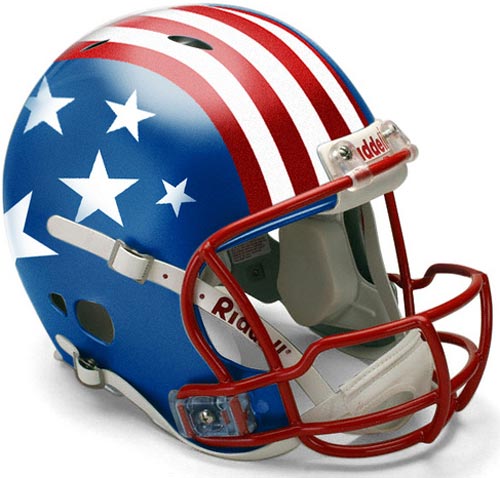
(thx, jason)
Using Michael Vick as a pivot, Malcolm Gladwell compares professional football with dogfighting and asks if the former is just as morally unacceptable as the latter. This is former NFL offensive lineman Kyle Turley:
I remember, every season, multiple occasions where I’d hit someone so hard that my eyes went cross-eyed, and they wouldn’t come uncrossed for a full series of plays. You are just out there, trying to hit the guy in the middle, because there are three of them. You don’t remember much. There are the cases where you hit a guy and you’d get into a collision where everything goes off. You’re dazed. And there are the others where you are involved in a big, long drive. You start on your own five-yard line, and drive all the way down the field-fifteen, eighteen plays in a row sometimes. Every play: collision, collision, collision. By the time you get to the other end of the field, you’re seeing spots. You feel like you are going to black out. Literally, these white explosions-boom, boom, boom-lights getting dimmer and brighter, dimmer and brighter.
Perhaps this is what Gladwell will be talking about at the upcoming New Yorker Festival?
Update: From Stephen Fatsis, a list of improvements for the NFL players union to consider to protect the health of the players.
N.F.L. players often get excellent medical treatment, but the primary goal is to return them to the field as quickly as possible. Players are often complicit in playing down the extent of their injuries. Fearful of losing their jobs — there are no guaranteed contracts in the N.F.L. — they return to the huddle still hurt.
And from GQ comes a profile of Bennet Omalu, one of the few doctors investigating the fate of these NFL players.
Let’s say you run a multibillion-dollar football league. And let’s say the scientific community — starting with one young pathologist in Pittsburgh and growing into a chorus of neuroscientists across the country — comes to you and says concussions are making your players crazy, crazy enough to kill themselves, and here, in these slices of brain tissue, is the proof. Do you join these scientists and try to solve the problem, or do you use your power to discredit them?
Update: Commissioner Roger Goodell defended the NFL’s handling of head trauma in a hearing before the House Judiciary Committee today.
Goodell faced his harshest criticism from Representative Maxine Waters, Democrat of California, who called for Congress to revoke the league’s antitrust exemption because of its failure to care adequately for injured former players. “I believe you are an $8 billion organization that has failed in your responsibility to the players,” Waters said. “We all know it’s a dangerous sport. Players are always going to get injured. The only question is, are you going to pay for it? I know that you dearly want to hold on to your profits. I think it’s the responsibility of Congress to look at your antitrust exemption and take it away.”
Update: The NFL will soon require players with head injuries to receive advice from independent neurologists.
This is Adrian Bejan on how the current offensive explosion in NFL scoring can be thought of in terms of a river’s effect on its basin.
Over time, a river relentlessly wears away its banks and, as a result, water flows faster and faster toward its mouth. When obstacles fall in its way, say, a tree, or a boulder-or in the case of an NFL offense, beefy linebackers like the Baltimore Ravens’ Ray Lewis or the Chicago Bears’ Brian Urlacher-it will figure out how to wear those away, too. “The game is a flow system, a river basin of bodies that are milling around trying to find the most effective and easiest way to move,” says Prof. Bejan. “Over time you will end up with the right way to play the game, with the patterns that are the most efficient.”
If you want to know what football games are going to be on TV in your part of the country on Sunday, check out these maps every week.
Sam Arbesman has a proposal for a new football rule: coaches get one time-in per season.
The possibility of a sudden time-in would loom large in every coach’s mind at the most tense points in the game, introducing just enough concern and uncertainty to make the game different. Timeworn clock-management strategies would no longer be a given. And yet, for the average viewer on a Sunday, the game on the field would still be your father’s football.
Michael Oher, the subject of Michael Lewis’ The Blind Side, got drafted in the first round of the NFL Draft by the Baltimore Ravens. Oher was chosen 23rd.
Update: Lewis comments on the draft here and here. (via unlikely words)
Todd Marinovich was supposed to be the best quarterback of all time. Instead, his life got derailed by drugs and alcohol and even more drugs. His dad has to be the all-time worst sports parent in the history of horrible sports parents…it was difficult to get through page 2 without wanting to FedEx Marinovich Sr. a punch in the face.
For the nine months prior to Todd’s birth on July 4, 1969, Trudi used no salt, sugar, alcohol, or tobacco. As a baby, Todd was fed only fresh vegetables, fruits, and raw milk; when he was teething, he was given frozen kidneys to gnaw. As a child, he was allowed no junk food; Trudi sent Todd off to birthday parties with carrot sticks and carob muffins. By age three, Marv had the boy throwing with both hands, kicking with both feet, doing sit-ups and pull-ups, and lifting light hand weights. On his fourth birthday, Todd ran four miles along the ocean’s edge in thirty-two minutes, an eight-minute-mile pace. Marv was with him every step of the way.
Update: In 1988 Sports Illustrated ran an article about Marinovich while he was still in high school: Bred To Be A Superstar. (via josh)
I was up waaay too early this morning watching some trending topics on Twitter Search and John Madden’s name suddenly appeared. When you see a boldface name pop up on Twitter Search like that, it usually means they’ve died. I’m glad Madden’s not dead but I’m sad that he’s retiring from calling football games. I know he wasn’t everyone’s cup of tea, but I loved listening to him.
Football season is over but if you still want your fix, Mark Bowden wrote an interesting piece for The Atlantic about how NFL games are presented on TV. The camera operators and directors seem as talented and under pressure as the players on the field.
The television crews don’t just broadcast games, they inhabit them. They know the players, the teams, the stats, and the strategies. They interview players and coaches the day before the game. They brainstorm, anticipate, plot likely story lines, prepare graphic packages of important stats, and bundle replays from previous contests to bring a sense of history and context to the event. They are not just pointing cameras and broadcasting the feed, they are telling the story of the game as it happens.
Just this morning I was thinking about how successful the instant replay rule has been for NFL broadcasts. TV instant replay predated its use by the referees, but now the review process has some weight behind it and provides extra drama, particularly in exciting moments of the game. The Santonio Holmes touchdown catch in the final moments of the Super Bowl is the perfect example. From the perspective of “telling the story of the game”, the catch was amazing. But what the review process does is delay the release of tension for a minute or two…it’s a mini-cliffhanger inserted into a sport that doesn’t have any natural cliffhanging moments. Showing the replays over and over while the ref makes his decision also brings the viewer into the story itself, as though he is playing the part of the reviewing referee. (thx, john)
The NY Times has a timeline map showing what people from around the country said on Twitter during the Super Bowl broadcast. I like the emoticons tab but they also should have included a profanity tab.
The Ravens are looking good in the playoffs but Mark Lamster imagines a football team made up of characters from The Wire. The most inspired choices:
Offensive Coordinator: Lester Freamon
FB: Thomas Hauk
MLB: Wee-Bey Brice
MLB: Cheese Wagstaff
Kicker: Ziggy Sobotka
Fan club president: Roland Pryzbylewski
Highlights of yesterday’s Patriots/Bills game, aka The Wind Bowl. We must have rewound that Buffalo field goal attempt at least five times…I still can’t believe it hooked that much in two different directions.
This is more than a week old but I just finished reading it, so stick it. Malcolm Gladwell says that the problem of finding good teachers is the same sort of problem encountered by scouts attempting to find good NFL quarterbacks.
The problem with picking quarterbacks is that [college QB] Chase Daniel’s performance can’t be predicted. The job he’s being groomed for is so particular and specialized that there is no way to know who will succeed at it and who won’t. In fact, Berri and Simmons found no connection between where a quarterback was taken in the draft — that is, how highly he was rated on the basis of his college performance — and how well he played in the pros.
A group of researchers — Thomas J. Kane, an economist at Harvard’s school of education; Douglas Staiger, an economist at Dartmouth; and Robert Gordon, a policy analyst at the Center for American Progress—have investigated whether it helps to have a teacher who has earned a teaching certification or a master’s degree. Both are expensive, time-consuming credentials that almost every district expects teachers to acquire; neither makes a difference in the classroom. Test scores, graduate degrees, and certifications — as much as they appear related to teaching prowess — turn out to be about as useful in predicting success as having a quarterback throw footballs into a bunch of garbage cans.
The upshot is that NFL quarterbacking and teaching are both jobs that need to be performed in order to find out if a certain person is good at them or not. For more, check out a follow-up post on Gladwell’s blog.
Newer posts
Older posts





Socials & More