kottke.org posts about food
What do people drink on trains?
On Metro-North and the Long Island Rail Road, beer is the best seller by far, accounting for more than half of all drink purchases. Budweiser and its calorie-conscious cousin, Bud Light, make up about 45 percent.
Vodka is far more popular than other spirits, making up half of all hard liquor sales. (One bartender, who spoke on the condition of anonymity for fear of losing her job, confided that her stockbroker customers “all drink vodka,” while construction workers “are all about the beer.”) Gin and scotch are a distant second and third.
What do people drink on planes?
While much has been made online about ginger ale’s unexpected aerial dominance (apparently one in ten drinks ordered in economy on American Airlines is a ginger ale, compared to its puny three percent terrestrial market share), there seems not to be a sustained geographical analysis of the beverage consumption patterns on different routes and airlines — or even different seat positions. Do window-seat people disproportionately favour vegetable juice, for example, or is that just the case on the routes I’ve been flying?
And what do people drink with goats? Would you, could you, with a goat? Oop, sorry, things got a little Seussical there.
And as long as we’re on the subject of factory food, this post has been making the rounds lately.
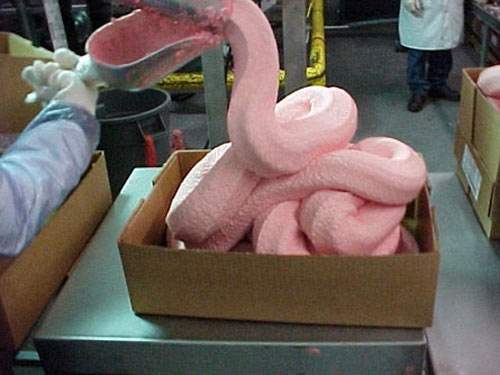
Say hello to mechanically separated chicken. It’s what all fast-food chicken is made from-things like chicken nuggets and patties. Also, the processed frozen chicken in the stores is made from it.
Basically, the entire chicken is smashed and pressed through a sieve — bones, eyes, guts, and all. it comes out looking like this.
There’s more: because it’s crawling with bacteria, it will be washed with ammonia, soaked in it, actually. Then, because it tastes gross, it will be reflavored artificially. Then, because it is weirdly pink, it will be dyed with artificial color.
1. That stuff might not even be chicken. But even if it is:
2. The entire chicken is not ground up to make that paste; the bones and such are removed.
3. The meat is not “soaked” in ammonia. Ammonia is not an approved food additive. (However, a South Dakota processing plant had been injecting ammonia into their hamburger “meat” with USDA approval, but that approval has since been withdrawn.)
I wish the person who wrote the original entry would correct it because I’m tired of seeing it popping up everywhere. The truth is strange enough without having to say that chicken nuggets contain eyeballs, bones, and large quantities of ammonia.
This was a lot more boring than I expected for such a magical food…way fewer rainbows and unicorns than I would have thought. (via devour)
Eater has an interview with Gabe Stulman and Jim McDuffee, proprietors of Joseph Leonard, on how the first year of their West Village restaurant went. Watching the chefs make such good food out of such a small kitchen an impressive spectacle.
The limitations that we have are, I think, severe. We don’t have a freezer, anywhere. We don’t have ice cream or sorbet, we don’t have anything that needs to be frozen, it’s all fresh, fresh, fresh. We’ve got refrigerators touching each other over there. We’ve got ten burners, two ovens, a fryer and a salamander. That’s what most people have as a prep kitchen. It’s really impressive when I look at how we’ve got five seafood entrees, five meat entrees, thirteen appetizers, all done with these varying, beautiful techniques and preparations. I tip my hat to everything that Jim and the team in the kitchen have been able to pull off.
It took awhile for my wife and I to warm up to it, but Joe Leo is our go-to neighborhood restaurant now. On our one child-free night out a week, we generally end up there.
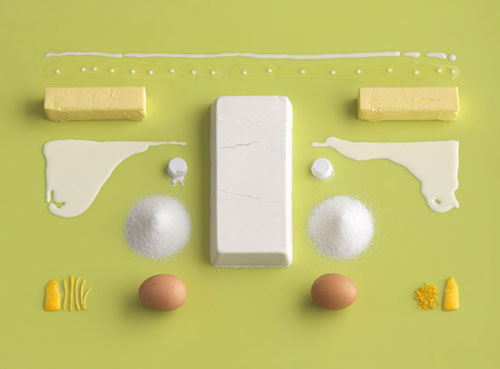
Ikea is coming out with a cookbook — the name translates as “Homemade is Best” — and the photography looks great.
A 13-day time lapse video of food rotting.
If you want to lose weight, I’d suggest the time lapse maggots diet where you watch this video everytime you feel hungry. (via devour)
Restaurants using wine lists on the iPad are reporting increased sales; one restaurant says sales are up 11%.
Mr. Kendall, 43, described himself as a bit of a wine poseur. He has vacationed in Italy and Napa Valley and has a cellar at home, but he cannot remember a label from meal to meal. He knows just enough, or perhaps just little enough, to become suspicious whenever a waiter recommends a vineyard he does not know.
“In the back of your mind,” he said, “you’re always thinking: ‘O.K., is this some kind of used-car special? Did they just get 200 bottles of this?’ “
But Mr. Kendall said the ratings he found on the iPad — by the wine writer Robert M. Parker Jr. — carried credibility. He decided that the price of the cabernet franc was justified by Mr. Parker’s award of 92 points out of 100. “I found a bottle of wine that I never would have tried, and it was wonderful,” he said.
Lady Gaga’s meat dress at the MTV Video Music Awards inspired my local butcher shop to run a special on flank steak.

Over at Serious Eats, Kenji Lopez-Alt assures us that while you can’t make restaurant-quality Neapolitan pizza at home, you can come damn close. Best thing is, his technique doesn’t involve lining your oven with bricks and is actually as easy as making regular pizza at home.
After cooking for around a minute and a half, the bottom crust achieved the perfect degree of char-even better than what I was getting on the stone. Interestingly enough, the pan was actually cooler than the stone I was using, maxing out at around 450 degrees. So how does a 450 degree pan brown better and faster than a 550 degree stone? It’s a matter of heat capacity and density.
The heat capacity of a material is directly related to the amount of energy that a given mass of material holds at a given temperature. Even though stone has almost twice the heat capacity than steel (.2 kcal/kg C vs. .1 kcal/kg C), it loses in two ways: it is far less dense than steel, and it has a much lower rate of heat conduction than steel. The pizza cooking in a skillet is not just getting energy from the pan-it’s getting energy from the burner below the pan as it gets rapidly conducted through the metal.
It’s a clear demonstration of how when cooking foods, what matters it the amount of energy transferred, not just the temperature you cook at. The two are often directly related, but not always.
I have said it before but will repeat: I love Kenji’s nerdiness about the science combined with the ability to come up with the solution that’s easiest for non-nerds to appreciate and implement. It is a rare and wonderful thing to observe.
A short documentary about a grocery store in LA that sells only soda…500 different kinds and very little high fructose corn syrup.
And the store’s inventory seems to be mostly (or completely) glass bottles. (via @dunstan)
From the Guardian, a review of a book called Meat: A Benign Extravagance by Simon Fairlie. In it, Fairlie argues that meat production isn’t actually that inefficient when done properly and veganism as an ethical response leaves something to be desired.
But these idiocies, Fairlie shows, are not arguments against all meat eating, but arguments against the current farming model. He demonstrates that we’ve been using the wrong comparison to judge the efficiency of meat production. Instead of citing a simple conversion rate of feed into meat, we should be comparing the amount of land required to grow meat with the land needed to grow plant products of the same nutritional value to humans. The results are radically different.
If pigs are fed on residues and waste, and cattle on straw, stovers and grass from fallows and rangelands — food for which humans don’t compete — meat becomes a very efficient means of food production. Even though it is tilted by the profligate use of grain in rich countries, the global average conversion ratio of useful plant food to useful meat is not the 5:1 or 10:1 cited by almost everyone, but less than 2:1. If we stopped feeding edible grain to animals, we could still produce around half the current global meat supply with no loss to human nutrition: in fact it’s a significant net gain.
New Yorker Clare Burson has in her possession a 117-year-old piece of cheese that belonged to her great grandfather.
The cheese was a going-away present for Burson’s paternal great-grandfather Charles Wainman (nee Yehezkel), upon his emigration from Lithuania, around 1893, to Johannesburg. For reasons lost to history, he never ate the cheese but kept it in a trunk that travelled with him while he worked as a trader among the Zulus, and then when he fought, on the Dutch side, in the Boer Wars.
Better than the real deal I’ve heard.
Warning: once you make edamame2003’s version, you may never be able to go back to commercial sriracha again. The vibrant color and piquancy of the fresh fresno peppers, combined with plenty of garlic and a boost of vinegar, make for a zippy, versatile condiment that would be great with anything from banh mi to scrambled eggs.
(via dj)
Pseudovariety — “the illusion of diversity, concealing a lack of real choice” — is when you go to the store and see an entire aisle filled with hundreds of different kinds of soda but most of those soda varieties are owned by three companies. Click through to see a neat visualization of soft drink brands and their market shares and owners.
Roger Ebert’s eating career is over, but his career as a food writer is just taking off. His new cookbook, which comes out in three weeks, is about how to prepare just about any meal in a rice cooker.
He both writes and thinks about food in the present tense. Ask about favorite foods and he’ll scribble a note: “I love spicy and Indian.” An offer to bring some New Jersey peaches to his summer home here on the shore of Lake Michigan brings a sharp defense of Michigan peaches and a menu idea. “Maybe for dessert we could have a salad of local fresh fruits.”
“Food for me is in the present tense,” he said. “Eating for me is now only in the past tense.” He says he has a “voluptuous food memory” that gets stronger all the time.
“I can remember the taste and smell of everything, even though I can no longer taste or smell,” he said.
Here are the opening couple of paragraphs from the post that evolved into the cookbook:
First, get the Pot. You need the simplest rice cooker made. It comes with two speeds: Cook, and Warm. Not expensive. Now you’re all set to cook meals for the rest of your life on two square feet of counter space, plus a chopping block. No, I am not putting you on the Rice Diet. Eat what you like. I am thinking of you, student in your dorm room. You, solitary writer, artist, musician, potter, plumber, builder, hermit. You, parents with kids. You, night watchman. You, obsessed computer programmer or weary web-worker. You, lovers who like to cook together but don’t want to put anything in the oven. You, in the witness protection program. You, nutritional wingnut. You, in a wheelchair.
And you, serving in Iraq or Afghanistan. You, person on a small budget who wants healthy food. You, shut-in. You, recovering campaign worker. You, movie critic at Sundance. You, sex worker waiting for the phone to ring. You, factory worker sick of frozen meals. You, people in Werner Herzog’s documentary about life at the South Pole. You, early riser skipping breakfast. You, teenager home alone. You, rabbi, pastor, priest,, nun, waitress, community organizer, monk, nurse, starving actor, taxi driver, long-haul driver. Yes, you, reader of the second-best best-written blog on the internet.
There’s also a Q&A on the Times site with Ebert.
Newer posts
Older posts





Socials & More