kottke.org posts about food
David McCandless made a data visualization comparing the Atlantic Ocean fishing stocks in 1900 and in 2000. It’s a literal jawdropper…here’s just a little bit of it:

That’s not just depleted…the fish are just gone. Click through for the full craziness. (via @daveg)
It seems that item for item, food in New York City is actually cheaper than in many other parts of the country.
Using data from the ACNielsen HomeScan database, which employed bar-code scanners to track every purchase made by roughly 33,000 U.S. households in 2005, the two economists compared identical products sold in cities big and small, both at high-end grocery stores and discount retailers. In nearly every case, New York products were cheaper than in places such as Memphis, Indianapolis and Milwaukee.
(via stellar)
In a somewhat flawed test — e.g. part of the In-N-Out burger package was confiscated by airport security — the Shake Shack beat Five Guys and In-N-Out in a Serious Eats taste test.
Clearly the In-N-Out burgers making their trans-continental trip by plane would be at a disadvantage to the made-fresh-in-the-same-city burgers from Five Guys and Shake Shack, so in order to compensate for this, we made the decision to handicap all three burgers by the same amount. After a careful synchronization of watches, burgers were ordered from their respective establishments at precisely 1 a.m. Greenwich Mean Time (that’s 9 p.m. EST, 6 p.m. Pacific) and not tasted until the following morning.
I used to be a big In-N-Out fan (their burger is still a great fast food burger), but the slightly more upscale Shack Burger is my favorite burger in the whole wide world…it is indeed, as the article states, “a marvel of beefy engineering”.
Why can’t you get a slice of pizza at John’s on Bleecker or Patsy’s? Allegedly because of Al Capone:
In his 1981 book on the mob called Vicious Circles: The Mafia in the Marketplace, the late Jonathan Kwitny detailed how Al Capone — who owned a string of dairy farms near Fond Du Lac, Wisconsin — forced New York pizzerias to use his rubbery mob cheese, so different from the real mozzarella produced here in New York City since the first immigrants from Naples arrived in Brooklyn around 1900.
As the story goes, the only places permitted to use good mozzarella made locally were the old-fashioned pizza parlors like Lombardi’s, Patsy’s, and John’s, who could continue doing so only if they promised to never serve slices. According to Kwitny, this is why John’s Pizzeria on Bleecker Street still has the warning “No Slices” on its awning today.
(via ★kathryn)
Eric Schlosser’s Fast Food Nation came out ten years ago but this chapter on how much the taste and smell of food is chemically manipulated is still well worth a read.
Today’s sophisticated spectrometers, gas chromatographs, and headspace-vapor analyzers provide a detailed map of a food’s flavor components, detecting chemical aromas present in amounts as low as one part per billion. The human nose, however, is even more sensitive. A nose can detect aromas present in quantities of a few parts per trillion — an amount equivalent to about 0.000000000003 percent. Complex aromas, such as those of coffee and roasted meat, are composed of volatile gases from nearly a thousand different chemicals. The smell of a strawberry arises from the interaction of about 350 chemicals that are present in minute amounts. The quality that people seek most of all in a food — flavor — is usually present in a quantity too infinitesimal to be measured in traditional culinary terms such as ounces or teaspoons. The chemical that provides the dominant flavor of bell pepper can be tasted in amounts as low as 0.02 parts per billion; one drop is sufficient to add flavor to five average-size swimming pools. The flavor additive usually comes next to last in a processed food’s list of ingredients and often costs less than its packaging. Soft drinks contain a larger proportion of flavor additives than most products. The flavor in a twelve-ounce can of Coke costs about half a cent.
Not just a Cold War-era relic…
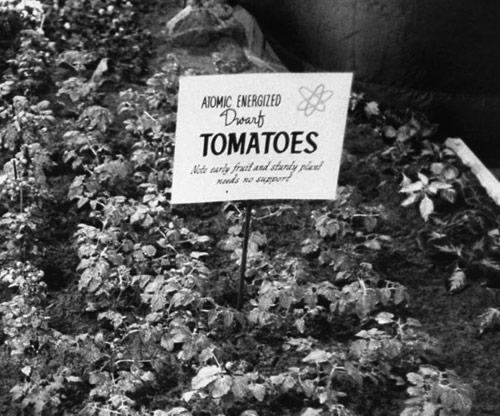
…the use of radiation to introduce genetic changes in food (aka “atomic gardening”) is alive and well today.
What’s more, the Times adds, nearly 2,000 gamma radiation-induced mutant crop varieties have been registered around the world, including Calrose 76, a dwarf varietal that accounts for about half the rice grown in California, and the popular Star Ruby and Rio Red grapefruits, whose deep colour is a mutation produced through radiation breeding in the 1970s. Similarly, Johnson tells Pruned that “most of the global production of mint oil,” with an annual market value estimated at $930 million, is extracted from the “wilt-resistant ‘Todd’s Mitcham’ cultivar, a product of thermal neutron irradiation.” She adds that “the exact nature of the genetic changes that cause it to be wilt-resistant remain unknown.”
The atomic gardening photos from Life magazine in 1961 are kind of great.
Michael Pollan: “Eat food. Not too much. Mostly plants.”
Alex Balk: “Drink alcohol. Quite a bit. Mostly bourbon.”
But it’s more than a cookbook…here’s the description from Facebook (the “me” is Kenji Lopez-Alt, SE’s resident mad scientist):
It’s coming out November, has 50 recipes from me, and whole bunch of awesome recommendations for the best food around the country.
The title is Serious Eats: A Comprehensive Guide to Making and Eating Delicious Food Wherever You Are and it’s available for preorder on Amazon.
Now, I’m not here to judge anyone, but I’m totally judging: this is insane. A gender cake party goes like this:
My husband and I would like to do a cake party to find out the sex of our baby. So basically we will have the ultrasound tech put the sex of the baby in an enveloppe and we will give that enveloppe to our cake maker. The inside of the cake will either be pink or blue so when we cut into it our family, friends, as well as ourselves will find out what were having. We planned on having our close family and freinds over for this big moment….sounds lovely right?
As my friend Adriana said, “to explain this would be to spoil it”.
(via meg)
From John Lanchester’s review of Nathan Myhrvold’s massive cookbook, Modernist Cuisine:
Another thing they love is magic — and recent culinary discoveries have opened up extraordinary possibilities for the chef to serve things that the customers had never thought were possible. Foods that change temperature when you eat them, a cup of tea that is cold on one side and hot on the other, an edible menu, a “Styrofoam” beaker that turns into a bowl of ramen when the server pours hot water over it, edible clay and rocks, a pocket watch that turns into mock-turtle soup, a bar of soap covered in foam that is actually a biscuit with honey bubbles, a milkshake volcano — these are the kinds of thing with which the modernist chefs amaze their audience.
From Roald Dahl’s Charlie and the Chocolate Factory:
“Marshmallow pillows are terrific,” shouted Mr. Wonka as he dashed by. “They’ll be all the rage when I get them into the shops! No time to go in, though! No time to go in!”
Lickable Wallpaper for Nurseries, it said on the next door.
“Lovely stuff, lickable wallpaper!” cried Mr. Wonka, rushing past. “It has pictures of fruits on it — bananas, apples, oranges, grapes, pineapples, strawberries, and snozzberries…”
“Snozzberries?” said Mike Teevee. “Don’t interrupt!” said Mr. Wonka. “The wallpaper has all these pictures of all these fruits printed on it, and when you lick the picture of the banana, it tastes of banana. When you lick a strawberry, it tastes of strawberry. And when you lick a snozzberry, it tastes just exactly like a snozzberry…”
“But what does a snozzberry taste like?”
“You’re mumbling again,” said Mr. Wonka. “Speak louder next time. On we go. Hurry up!”
Hot Ice Cream for Cold Days, it said on the next door.
“Extremely useful in the winter,” said Mr. Wonka, rushing on. “Hot ice cream warms you up no end in freezing weather. I also make hot ice cubes for putting in hot drinks. Hot ice cubes make hot drinks hotter.”
A.A. Gill has a hilarious and epic review of L’Ami Louis in Paris, which he dubs “the worst restaurant in the world”.
What you actually find when you arrive at L’Ami Louis is singularly unprepossessing. It’s a long, dark corridor with luggage racks stretching the length of the room. It gives you the feeling of being in a second-class railway carriage in the Balkans. It’s painted a shiny, distressed dung brown. The cramped tables are set with labially pink cloths, which give it a colonic appeal and the awkward sense that you might be a suppository. In the middle of the room is a stubby stove that also looks vaguely proctological.
Kenji from Serious Eats went to In-N-Out, found a willing employee accomplice (“Awesome! I’ve been waiting for this day ever since I started working here!”), and proceeded to order one of everything off of the menu, the well-known secret menu, and the not-so-well-known super secret menu.
That should make you feel better about yourself when you tuck into the meat and cheese fest known as the Flying Dutchman — the ultimate Atkins-friendly menu item. Two slices of cheese melted between two burger patties. No rabbit food, no wimpy buns, just pure protein and fat. Want to kick up the manliness by yet another factor? Ask for a Flying Dutchman Animal Style and they’ll add a scoop of diced onions to the cheese. Pickles and spread will come on the side, so you’ll have to add them yourself. “I wish we could add the spread and pickles for you, but it’s just too messy for the cooks,” explained an apologetic Thomas. The result definitely wins the award for messiest menu item of all time.
Michael Ruhlman uses a spoon of his own design for making perfect poached eggs.
In On Food and Cooking, Harold McGee notes that there is a liquidy part of the egg white and a viscous one. If you let the liquidy part drain, before poaching, you will have a beautiful poached egg. (People tell you to put vinegar or lemon juice in poaching water — this does nothing in my experience.) The problem was, my perforated spoons were so shallow the egg always wanted to jump out. No longer. The deep bowl of The Badass Perf spoon easily contains even a jumbo egg, as well as heaps of beans, vegetables, and pasta.
Well, sorta kinda maybe almost not really discovered it. But the story is still well worth a listen…I’ve never heard Ira Glass quite so on-the-edge-of-his-seat giddy.

The formula for Coca-Cola is one of the most jealously guarded trade secrets in the world. So we were surprised to come across a 1979 newspaper article with what looked like the original recipe for Coke. Talking to historian Mark Pendergrast, author of For God, Country and Coca-Cola, we were even more surprised when we found reasons to believe the recipe is real.
If you’d like to mix up your own batch of Coca-Cola, here’s the original recipe and instructions.
Newer posts
Older posts





Socials & More