kottke.org posts about food
Momofuku’s David Chang cooks up some gourmet space food for celeb astronaut Chris Hadfield.
Unfortunately, it doesn’t work out so well. Who knew that gravity was so useful? But stay for the best part of the whole thing…right at the end, Hadfield feeds himself asparagus like a fish.
Perfect for a slow Friday afternoon. Have a good weekend everyone.
Adam Davidson on the asinine and broken food truck/cart system in NYC. This short paragraph not only explains what’s wrong with the food cart biz in NYC but also with American politics in general:
Economically speaking, the problem is a standard one, known as the J-curve, which represents a downslope on a graph followed by a steep rise. Some sensible changes to the current food-vendor system may have long-term benefits for everyone, but the immediate impact could spell short-term losses for those who now profit from the system. A small group of New Yorkers — particularly owners of commissaries and physical restaurants — are highly motivated to lobby politicians not to change things. And most of the potential beneficiaries don’t realize they’re missing out. Many of the rest of us would love to have more varied food trucks, but we don’t care enough to pressure the City Council.
(via @tylercowen)
In Lambert’s Cafe in Sikeston, MO, they just throw your bread to you from across the restaurant.
You’ve heard of oobleck, yeah? It’s a non-Newtonian fluid made of corn starch and water that doesn’t act like a normal fluid. Like, for instance, you can run on top of it:
Cooking Issues ran across a video of a cook preparing noodles made from a non-Newtonian batter. Watch as the batter solidifies when he slaps more batter into the sieve and then drains out of the bottom.
Love the technique here. See also the noodle-making robot, power of noodles, Korean honey candy, and, my favorite, flatbread tossing:
(via @Ianmurren)
This video would be a lot better without the first 15 seconds (sippy cups? talking? who cares?) but the rest of it is pants-wettingly amazing.
NPR’s Planet Money talked to Ed Herr of Herr Foods about how potato chip manufacturing has changed since 1946, when the company was housed in a barn on his family’s land.
Herr estimates that if they currently made chips the way they did back in the 1940s, they’d cost about $25 a bag.
Mark Bittman explores the world of healthy fast food and discovers that’s slowly becoming a thing.
Good Fast Food doesn’t need to be vegan or even vegetarian; it just ought to be real, whole food. The best word to describe a wise contemporary diet is flexitarian, which is nothing more than intelligent omnivorism. There are probably millions of people who now eat this way, including me. My own style, which has worked for me for six years, is to eat a vegan diet before 6 p.m. and then allow myself pretty much whatever I want for dinner. This flexibility avoids junk and emphasizes plants, and Lyfe Kitchen, which offers both “chickin” and chicken — plus beans, vegetables and grains in their whole forms (all for under 600 calories per dish) — comes closest to this ideal. But the menu offers too much, the service raises prices too high and speed is going to be an issue. My advice would be to skip the service and the wine, make a limited menu with big flavors and a few treats and keep it as cheap as you can. Of course, there are huge players who could do this almost instantaneously. But the best thing they seem able to come up with is the McWrap or the fresco menu.
Despite progress in recent years on causes and cures, colony collapse disorder has wreaked havoc on honeybee colonies across the country.
A mysterious malady that has been killing honeybees en masse for several years appears to have expanded drastically in the last year, commercial beekeepers say, wiping out 40 percent or even 50 percent of the hives needed to pollinate many of the nation’s fruits and vegetables.
Which is like, yeah, big whoop, it’s just bees, right? Except that:
The Agriculture Department says a quarter of the American diet, from apples to cherries to watermelons to onions, depends on pollination by honeybees.
Earlier in the week I posted about how climate change is affecting wine. Turns out that coffee is in trouble as well.
But in recent years, keeping the world’s coffee drinkers supplied has become increasingly difficult: The spread of a deadly fungus that has been linked to global warming and rising global temperatures in the tropical countries where coffee grows has researchers scrambling to create new varieties of coffee plants that can keep pace with these new threats without reducing quality.
While coffee researchers can do little to prevent climate change, they’re hard at work to keep up as Earth braces for temperature increases of several degrees over the next several decades.
“Coffee is the canary in the coal mine for climate change,” says Ric Rhinehart, executive director of the Specialty Coffee Association of America. “If you can’t think about the long term risk for planetary impacts, think about the short term risk for your coffee. Know that a day without coffee is potentially around the corner.”
(via nextdraft)
Veniamin Konstantinovich Balika recently used false paperwork to load his 18 wheeler with 42,000 pounds of Muenster cheese worth about $200K. Balika’s plan was to sell the cheese to retailers on the east coast.
“There’s a black market for everything,” said Sissman. “We’ve seen everything stolen. We’ve found stolen beer, stolen food, stolen machine parts, but this is the first time, we’ve found stolen cheese.
I wanted the opinion of an industry professional so I reached out to Aaron Foster, Head Buyer at Murray’s Cheese Shop.
I’ve seen a lot of people wondering how the culprit was planning to unload 40,000 lbs of cheese without raising suspicion. Is there such a thing as a cheddar fence? In my opinion, it really wouldn’t be that hard. While the larger retailers and chains — and, of course, Murray’s — have all become much more conscious of food safety and food security, there remains plenty of retailers who would jump at the chance to buy their product for pennies on the dollar, no questions asked. Literally as I wrote this, I received a vague email with the subject “RE: Special sale - Mega aged WI Cheddar”. I’ll pass, thanks. Groceries, specialty shops, and bodegas that work with perishables need every edge they can get to scrape by. Think about that next time you order your egg and cheese from the corner store.
And then I couldn’t help but find out more about stolen cheese. Cheese theft isn’t actually that uncommon. In fact, cheese is the most stolen food item of all with up to 4% of all cheese stolen at some point in it’s journey from maker to mouth. A cursory Google search turned up trunks full of stolen cheese in Michigan, 52-year old naked library denizens arrested with knives and stolen cheese, stolen government cheese in 1983(!), stolen cheese spread all over a Hy-Vee men’s room, video of brazen cheese wheel thieves, “the crushing authoritarianism of the Crown of England,” a cheese thief in Brooklyn, and a shoplifting celebrity chef. (thx, drew)
There’s prior art, but this image toaster is still pretty cool.
Toastagram? Toastr? I foresee BERG putting out a smaller version of this, perhaps printing out the day’s news on a small-crumb cocktail bread; they’ll call it Little Toaster. (via sly oyster)
McDonald’s started out as McDonald’s Bar-B-Q in San Bernardino, CA in 1940. Here’s a copy of the menu from that time:
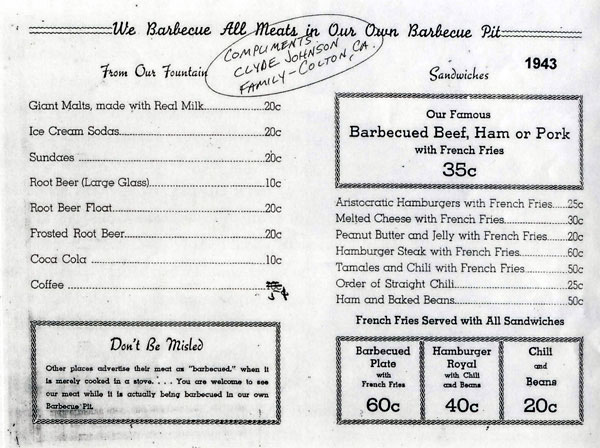
The drive-in BBQ restaurant was a great success:
The restaurant had carhops serving guests and would often see 125 cars crowding the lot on weekends. They quickly saw their annual sales topping $200,000 on a regular basis.
But competitors opened similar restaurants and they were selling more hamburgers than barbequed ham so the McDonald brothers closed their place for three months to retool. They reopened as plain old McDonald’s, serving cheap fare (like hamburgers) quickly. This is what an early version of the menu looked like:
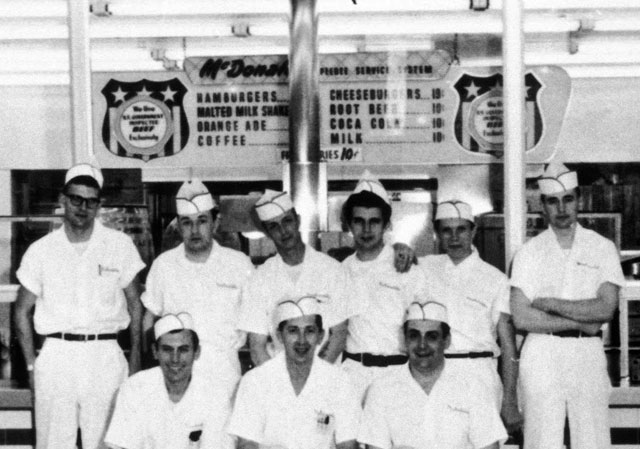
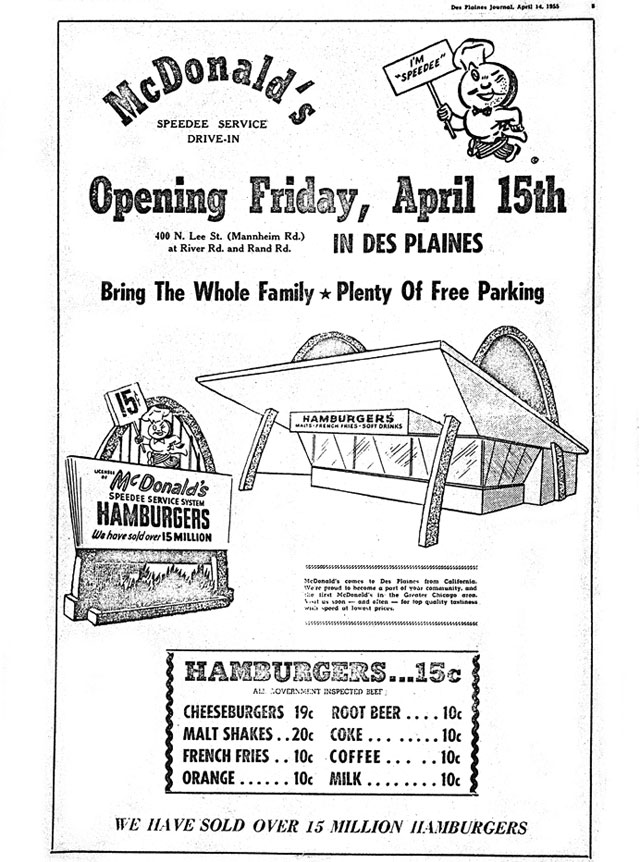
The original McDonald’s served potato chips and pie, which were swapped out for french fries and milkshakes after the first year; that photo must have been taken sometime after the switch. Ray Kroc got involved in 1955 and opened the first McDonald’s franchise east of the Mississippi in Des Plaines, Illinois:
The version of the menu currently going around (on Reddit; I found it here) looks like it’s from the Kroc era, the arches having been introduced in 1953, shortly before he got involved:
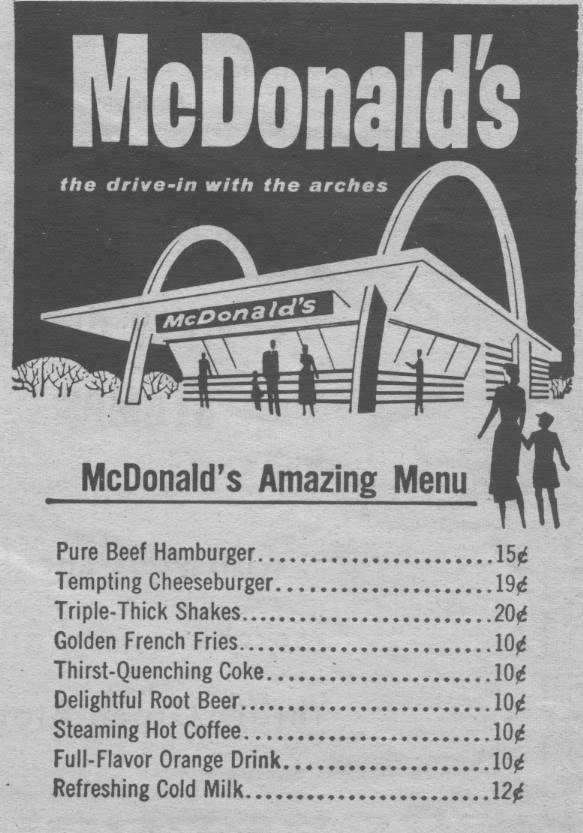
It’s interesting to compare these early McDonald’s menus to the current menus of places like In-N-Out Burger and Five Guys, especially in comparison with the sprawling McDonald’s menu of today:
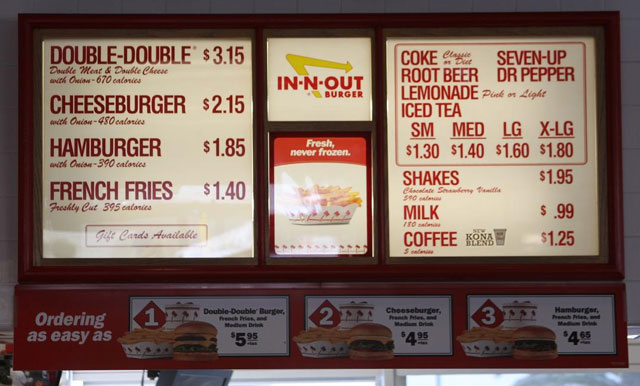
After reading all these menus, you’re probably getting hungry. So here’s how to make a hamburger that tastes like an original McDonald’s hamburger from 1948 (as well as recipes for a bunch of other McDonald’s menu items, from McNuggets to the McRib to the dipping sauces). Enjoy!
This is a clip from Samsara, a 2011 film directed by Ron Fricke, who was the director of photography for Koyaanisqatsi. The chicken picker machine hoovering up chickens and depositing them into drawers is one of the most dystopian things I’ve ever seen.
The whole film doesn’t look this depressing, but this short clip really gives full visual meaning to the mass production of food. (via @colossal)
Danny Meyer’s Union Square Hospitality is opening two Shake Shacks and a Blue Smoke in Delta’s new Terminal 4 at JFK airport.
Newer posts
Older posts





Socials & More