kottke.org posts about cycling
Ethen Godfrey Roberts pulled off a trick called a Superman double backflip the other day and it is a thing to behold:
Sploid says the trick “seems to murder the laws of physics” but if you can close your mouth long enough to stop drooling (this took me several views, BTW), the law of conservation of angular momentum is responsible for the optical illusion that makes the trick look so cool. The trick begins with a tight backwards flip, which happens quickly because all of the weight (human + bike) is distributed close to the center of gravity. By opening his body up in the middle part of the flip, Roberts slows down the rotation, just like a figure skater, diver, or ballerina would by throwing out their arms or legs. And then he gathers himself back onto the bike, which spins quickly again because the weight is all back close to the center. Boom, physics.
Watch as a trio of trials riders zoom across rusty old bridges, up rocky mountains, and down dry water slides on skinny-tired road bikes. An eye-popping collection of tricks.
There’s a bit of a backstory to this video. It’s a sequel to a similar video performed solo by Martyn Ashton. In the middle of filming this sequel, Ashton broke his back during a demonstration and is currently paralyzed from the waist down. Friends and fellow trials riders Chris Akrigg and Danny MacAskill stepped in to help Ashton complete the video. (via digg)
The Sweethome tested a bunch of locks, consulted with bike thieves, and sifted through other reviews and chose the best bike lock for your bike.
The consensus among those in the know was that a u-lock is best for virtually everyone, offering the highest ratio of security to portability. Unconventional devices like folding locks are intriguing, but so far none offer the security of a good u-lock. Chains sometimes offer a slight bump in security, but they often weigh twice as much and still relent to power tools. Let masochists wear belts of hardened steel; all our experts said a good u-lock is the sensible solution.
But before we talked specific lock models, they also insisted we slow down. Most people don’t know how to use their locks, they said. Most people buy big, heavy expensive u-locks and then don’t secure their bike’s frame, or don’t lock to an immobile object, or worse. Videos like this and this and this drive the point home.
Both the professional and petty thieves we talked to suggested that if a cyclist couldn’t take his bike inside, he should lock his bike in a different spot each day, making it harder to case out. And they encouraged people to ride cheaper bikes. After all, the resale value of a bike — and its expensive components — is what makes the thing worth stealing.
BMX rider Tyrone Williams checks out a Citi Bike and puts it though its paces, first with a wheelie or two and eventually on a dirt track.
(via animal & @claytoncubitt)
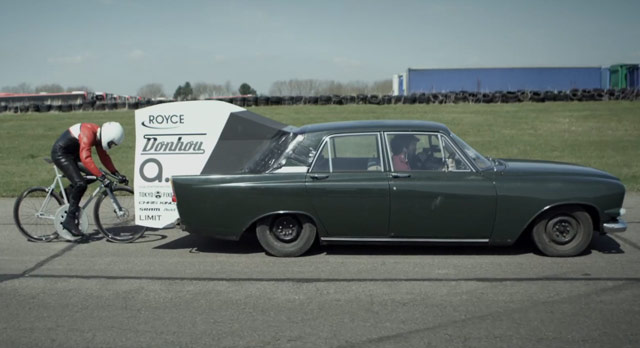
Bike frame builder Tom Donhou, inspired by the home-built cars of yore ripping it up on the salt flats of Utah, wanted to see if he could build a bike in his shop that would do 100 mph. This video documents his quest.
I love everything about this video, but especially the pace car. (via ★interesting)
Five-year-old Jack is trials rider Danny MacAskill’s biggest fan. (Don’t know who MacAskill is? Start here.) Inspired by his hero, Jack made a video of himself riding his bike around and doing some tricks.
Oh man, there’s water coming out of my face now. #cryingatwork (thx, meg)
Hannah Grant, a chef who used to work for highly influential Noma (among other places), is now the chef for the Saxo-Tinkoff cycling team currently competing in the Tour de France. She cooks for the entire team out of a food truck.
First of all, I set the menu. I mean, they can request stuff, the riders, if they want. I’ll note it and I’ll do it if it’s possible. But, obviously, then there’s rules to how to assemble the menu. Today’s a rest day, so we do a low-carb lunch for them. They’re not going so far, they just want to keep their legs going, so we don’t want to fill them up too much. And we don’t want to go too hard on the carbs so they don’t gain weight.
Then we have a philosophy of using lots of vegetables, proteins, and cold-pressed fats, and then we use a lot of gluten-free alternatives. So we try to encourage the riders to try other things than just pasta and bread. I do gluten-free breads as well.
It’s all to minimize all the little things that can stop you from performing 100 percent, that promote injuries, stomach problems, all those things. So that’s a big difference (from cooking in a restaurant), because I have to follow all those rules. I can’t just cook whatever I think is amazing. It has to be within those guidelines.
Then I take it as my personal job to take these guidelines and then make an incredible product from it, so they don’t feel like they’re missing out on things. It shouldn’t be a punishment to travel with a kitchen truck and a chef who cooks you food that’s good for you.
Grant’s cooking seems to be paying off for the team…Saxo-Tinkoff currently has two riders in the top five and is in second place overall in the team classification. (via @sampotts)
Last month, we posted a video of Tim Knoll doing ridiculous and panic-inducing circus style tricks on his bike. In the video below, he explains how he does the bike limbo, riding under several semi trucks in a row. Just because he tells you how to do it, does not mean you should try it. In fact, it is the expressed opinion of this blog you should not try it. However, if you do try it and you do feel yourself falling — which you will, because let’s be honest — don’t try to lift your head up. Just fall, because as Knoll says, “scrapes are better than stitches.”
(via ls)
Here’s an unfortunately short bit of circus riding by Tim Knoll. You often see a lot of the same tricks in bike videos, so Knoll’s style mix of flatland, street, and circus riding is refreshing. I do get nervous when he stands on his handlebars or plays limbo with a row for semi-trucks. Be careful, Tim Knoll!
(thx, alex)
Some interesting data about how protected bike lanes in NYC dramatically increased retail sales of local businesses.
A new study from the New York Department of Transportation shows that streets that safely accommodate bicycle and pedestrian travel are especially good at boosting small businesses, even in a recession.
NYC DOT found that protected bikeways had a significant positive impact on local business strength. After the construction of a protected bicycle lane on 9th Avenue, local businesses saw a 49% increase in retail sales. In comparison, local businesses throughout Manhattan only saw a 3% increase in retail sales.
And that’s just one of the many tidbits from a NYC DOT report released last November (right around the time of Hurricane Sandy, which is probably why no one noticed at the time); read the whole report here:
Among them: “retail sales increased a whopping 172% after the city converted an underused parking area in Brooklyn into a pedestrian plaza”, and traffic calming in the Bronx decreased speeding by ~30% and pedestrian crashes by 67%. (via @lhl)
NYC is set to introduce their bike-share program at the end of the month. I think it’s a great idea and am interested to follow how it does in practice. Many have objected to the share program even before it starts (reminding me of the smoking ban protests, ultimately much ado about nothing) but Sommer Mathis does an admirable job heading them off.
Claim #3: The stations are too ugly for historic neighborhoods, and Citibank’s sponsorship is too crassly commercial.
These are just some of the claims behind a series of lawsuits that are already in the works, brought by specific building owners who argue that docking stations don’t belong next to their beautiful buildings. They’re also worried that delivery truck access may be impeded by the presence of some stations. The lawsuits are being filed within the context of additional complaints that neighbors feel they weren’t consulted on the location of some stations, despite the city’s department of transportation having held nearly 400 meetings on station locations with community boards and other neighborhood groups. This is a classic NIMBY reaction, and by far the easiest one the city could have predicted. The idea that bike-share infrastructure is somehow uglier or more commercial than any other element of New York’s streetscape is easy enough to debunk. But the truth is, one of the best things about the design of the Alta bike-share stations is how easy they are to install and, if need be, later remove. It’s entirely possible that small problems with the specific locations of some stations will become apparent after the program launches, and they’ll need to be moved around the corner or across the street to better serve users. This has happened here in Washington, D.C., and it’ll happen for sure in New York. But that’s all part of the bike-share roll-out process. If there’s a legitimate problem with the location of a single station, that can actually be fixed within in a matter of hours or at worst, a day or two.
Our neighborhood newspaper went full-NIMBY about the bike-share this week and hit all the major points addressed in this article, including the ridiculous “bike racks are taking valuable parking spots” one. (via @jmseabrook)
Martyn Ashton takes a carbon fiber road bike (the same bike Bradley Wiggins won the Tour de France with) and does some trials riding with it. It’s a bit like recreating the Mini Cooper chase scene in the Bourne Identity with a Bugatti Veyron.
(thx, alex)
Izhar Gafni has designed a bike that weighs 20 pounds, costs between $9-12 to build, can hold up to a 485 pound person, and it made out of cardboard.
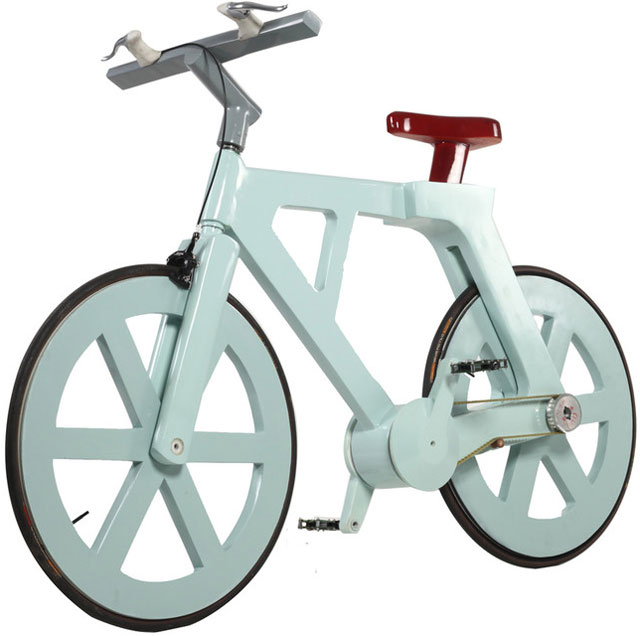
Engineers told Gafni that his idea was impossible. Yet he realized that paper could be strong if treated properly. As in crafting origami and tearing telephone books, he explains, “[if] you fold it once, and it’s not just twice the strength, it’s three times the strength.”
The development to what you see today took three years. Two were spent just figuring out the cardboard complications—leading to several patents—and the last was spent converting a cardboard box on wheels to a relatively normal looking bike.
(thx, mickey & erika)
If you had any remaining doubts about Lance Armstrong’s involvement in doping, Tyler Hamilton’s book should put those to rest. Hamilton was Armstrong’s teammate on the U.S. Postal Service team, and in the book, he tells the story (corroborated by no fewer than nine former Armstrong/Hamilton teammates) of how Armstrong, the USPS team, and practically everyone else on the racing circuit doped in the 1990s/2000s. From an early look at the book by Christopher Keys at Outside Magazine:
The drugs are everywhere, and as Hamilton explains, Armstrong was not just another cyclist caught in the middle of an established drug culture — he was a pioneer pushing into uncharted territory. In this sense, the book destroys another myth: that everyone was doing it, so Armstrong was, in a weird way, just competing on a level playing field. There was no level playing field. With his connections to Michele Ferrari, the best dishonest doctor in the business, Armstrong was always “two years ahead of what everybody else was doing,” Hamilton writes. Even on the Postal squad there was a pecking order. Armstrong got the superior treatments.
What ultimately makes the book so damning, however, is that it doesn’t require readers to put their full faith in Hamilton’s word. In the book’s preface, which details its genesis, Coyle not so subtly addresses Armstrong’s supporters by pointing out that, while the story is told through Hamilton, nine former Postal teammates agreed to cooperate with him on The Secret Race, verifying and corroborating Hamilton’s account. Nine teammates.
No wonder he gave up.
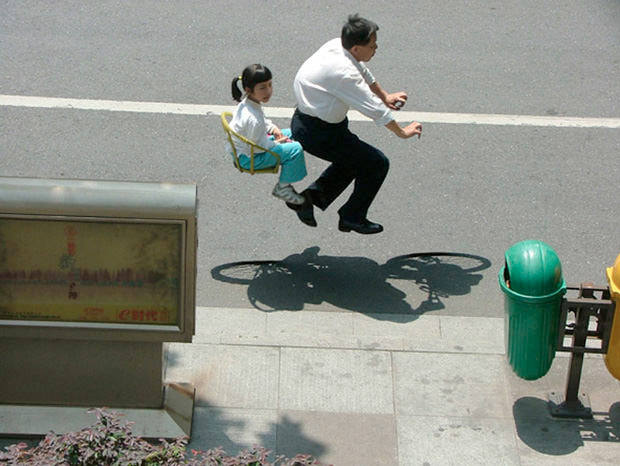
Zhao Huasen takes photos of people on bicycles and erases the bicycles.
Newer posts
Older posts





Socials & More