kottke.org posts about copyright

Yesterday was Public Domain Day and Duke University’s Center for the Study of the Public Domain has the scoop on what works entered the public domain in the US on January 1, 2025. They include:
- William Faulkner, The Sound and the Fury
- Ernest Hemingway, A Farewell to Arms
- Virginia Woolf, A Room of One’s Own
- Dashiell Hammett, The Maltese Falcon (as serialized in Black Mask magazine)
- Agatha Christie, Seven Dials Mystery
- Rainer Maria Rilke, Letters to a Young Poet (only the original German version, Briefe an einen jungen Dichter)
- A dozen more Mickey Mouse animations (including Mickey’s first talking appearance in The Karnival Kid)
- The Cocoanuts, directed by Robert Florey and Joseph Santley (the first Marx Brothers feature film)
- The Skeleton Dance, directed by Walt Disney and animated by Ub Iwerks (the first Silly Symphony short from Disney)
- Spite Marriage, directed by Edward Sedgwick and Buster Keaton (Keaton’s final silent feature)
- E. C. Segar, Popeye (in “Gobs of Work” from the Thimble Theatre comic strip)
- Hergé (Georges Remi), Tintin (in “Les Aventures de Tintin” from the magazine Le Petit Vingtième)
- Singin’ in the Rain, lyrics by Arthur Freed, music by Nacio Herb Brown
- Ain’t Misbehavin’, lyrics by Andy Paul Razaf, music by Thomas W. (“Fats”) Waller & Harry Brooks (from the musical Hot Chocolates)
- An American in Paris, George Gershwin
- Rhapsody in Blue, recorded by George Gershwin
The Internet Archive is hosting several of the newly sprung works, free for you to remix, reuse, misuse, and generally do whatever you would like with. Huzzah!
Oh, and here’s why the public domain matters:
The public domain is also a wellspring for creativity. You could think of it as the yin to copyright’s yang. Copyright law gives authors important rights that encourage creativity and distribution — this is a very good thing. But the United States Constitution requires that those rights last only for a “limited time,” so that when they expire, works go into the public domain, where future authors can legally build on the past — reimagining the books, making them into films, adapting the songs and movies. That’s a good thing too! It is part of copyright’s ecosystem. The point of copyright is to promote creativity, and the public domain plays a central role in doing so.
How does the public domain feed creativity? Here are just two examples from 2024. You may have enjoyed the film Wicked in 2024. Like many of its predecessors, it is based on L. Frank Baum’s The Wonderful Wizard of Oz books, and it offers origin stories for the Wicked Witch of the West and Glinda the Good. From the literary realm, Percival Everett’s 2024 novel James reimagines Mark Twain’s Adventures of Huckleberry Finn from the perspective of Jim, Huckleberry’s friend who is an escaped slave. The novel won the 2024 National Book Award and Kirkus Prize and was a finalist for the Booker Prize. As summed up by a New York Times review: “‘Huck Finn’ Is a Masterpiece. This Retelling Just Might Be, Too.” Mark Twain famously wanted copyright to last forever — if he had his wish, would his heirs have sued Everett? Thankfully, we did not have to find out, and Everett could publish James without such litigation.
One of the biggest hits of the past two years has been Dua Lipa’s Levitating — this catchy disco-inflected tune didn’t hit #1 in the US but has set quite a few records for Billboard chart longevity (e.g. 41 weeks in the top 10). Lipa, her label, and her co-writers were recently hit with a lawsuit 1
by a band called Artikal Sound System alleging that Levitating was ripped off from their song, Live Your Life. At first glance, Artikal Sound System seems to have a point — take a listen to Levitating and then to Live Your Life.
But! As Adam Neely explains in this video, if you listen to it with an expert ear and with the history of music in mind, their case doesn’t seem so ironclad. For starters, Rosa Parks by Outkast (1998) and Blame It on the Boogie from The Jacksons (1978) contain very similar rhythms.

Currently in the United States, an author’s copyright expires 70 years after the author’s death or 95 years after its first publication. But what about when an author of a work grants their exclusive copyright to a publisher or some other partnership? In that case, an author can request that the work’s copyright revert to their sole ownership after 35 years.
It’s called reversion, and it doesn’t happen often, because it’s not automatic; there are legal hurdles to jump through to file copyright termination notices, meaning you need money, help, and strong motivation to make it happen. And in some famous cases (see virtually every famous superhero ever), if you’ve created something as a work for hire, copyright termination alone isn’t always going to get it done. But it does happen, and it’s interesting to see (and to measure, at scale) in just what cases it comes together.
That’s the subject of a new academic study by Joshua Yuvaraj, Rebecca Giblin, Daniel Russo-Batterham, and Genevieve Grant. The authors also created a complete dataset of copyright termination notices from 1978 to 2020 for other researchers to parse; their initial findings are summarized here by Cory Doctorow.
Few creators have managed to revert but the ones that have are fascinating. Stephen King is a leading reverter, as are George RR Martin, Nora Roberts and David Eddings. - successful authors who are able to claim back their works and seek new deals based on their track records.
A single YA author - Francine Pascal_ - accounts for nearly all the YA reversions, thanks to her reclaiming of all 305 of her Sweet Valley High novels (in kids’ books, Ann Martin attains another high-water mark for reverting the Baby-Sitters Club books).
But the most fascinating entry is funk titan George Clinton, who pursued his former manager Nene Montes for years, claiming he’d forged Clinton’s signature and defrauded him to steal the rights to most of Clinton’s prodigious and profitable catalog.
Thanks to reversion, Clinton was able to finally settle all question of title without expensive litigation - he simply reverted 1,413 works.
Other notable filers of termination notices include Philadelphia-based musical partners Gamble and Huff and Hall and Oates, and the heirs of Superman co-creator Jerry Siegel and playwright August Wilson. Another somewhat ironic entry is Pat Boone, who famously re-recorded many, many popular Black artists’ songs to cash in on segregated radio; Boone submitted 643 copyright termination notices for songs under his assigned copyright.
As the authors point out, there are limitations in the data set. Filing a copyright termination notice doesn’t mean that copyright automatically reverts back to the author; an author or their heirs might use the termination notice to successfully renegotiate their deal with the current licensee, or there may have been mistakes in their legal filings, or some other mishap.
Strangely, however, the authors note that while there are periodic spikes in copyright termination notice activity (for example, immediately after the statute was first passed in the 1970s), there’s currently a dip in termination requests under both sections of the copyright law that allows rights to be reverted. And the authors do not precisely whether it’s a periodic flux, or a long-term trend, or why either might be the case.
In this recent TED Talk, lawyer, musician, and technologist Damien Riehl talks about the rapidly diminishing number of melodies available to songwriters under the current system of copyright. In order to help songwriters avoid these melodic legal landmines (some of which are documented here), Riehl and his pal Noah Rubin designed and wrote a program to record every possible 8-note, 12-beat melody and released the results — all 68+ billion melodies, 2.6 terabytes of data — into the public domain.
It’s interesting that the litigious nature of the music business and the finite number of melodies (and the even smaller number of pleasing melodies) has turned an artistic endeavor into a land-grab — whoever gets to a certain melody first owns it forever (or at least for dozens of years). (via @tedgioia)
This video catalogs every borrowed sample from Paul’s Boutique by the Beastie Boys, from the soundtrack to Car Wash to the Sugarhill Gang to the Eagles to the Ramones to the Beatles. They play the original first and then what they did with it on the album.
Somehow this video only has 31,000 views?! You can also listen to this remix of Paul’s Boutique on Soundcloud, which combines the source tracks with Beastie Boys vocals and some audio commentary.
Tim Carmody made a Spotify playlist of all the sampled songs or you can download zip files of the original songs sampled in Paul’s Boutique and five of their other albums.
They just don’t make ‘em like this anymore, mostly because clearing all of the samples would be prohibitively expensive if not impossible.
Hip-hop sampling began as a live technique, with DJs working turntables at parties and clubs. Whether it was strictly legal or not, nobody was going to try to sue anyone about it. As the genre’s popularity grew, people naturally started recording performances and releasing them as albums. Early sampling tended to come fast and furious. In the ’80s, short clips of existing recordings were the order of the day, often — as in the case of the Beastie Boys — lots of them, layered and shuffled in a clearly creative way. As hip-hop pushed further into the mainstream, however, the stakes got bigger and so did the samples.
1990 saw the release of both M.C. Hammer’s “U Can’t Touch This” and Vanilla Ice’s “Ice, Ice, Baby.” Not only did both songs sample, they each relied heavily on one particular sample — the baselines from Rick James’ “Superfreak” and Queen and David Bowie’s “Under Pressure” — for their main hook. Both hits resulted in legal controversy.
In a recent issue of Why is this interesting?, Noah Brier collects a number of perspectives on whether (and by whom) a work created by an artificial intelligence can be copyrighted.
But as I dug in a much bigger question emerged: Can you actually copyright work produced by AI? Traditionally, the law has been that only work created by people can receive copyright. You might remember the monkey selfie copyright claim from a few years back. In that case, a photographer gave his camera to a monkey who then snapped a selfie. The photographer then tried to claim ownership and PETA sued him to try to claim it back for the monkey. In the end, the photograph was judged to be in the public domain, since copyright requires human involvement. Machines, like monkeys, can’t own work, but clearly something made with the help of a human still qualifies for copyright. The question, then, is where do we draw the line?

This week, music fans were rejoicing. The legendary hip-hop group De La Soul’s catalog was finally coming to music streaming services. Three Feet High and Rising on Spotify!
Alas, it was too good to be true. It turned out that De La Soul themselves would only be getting 10 percent of the streaming revenue after costs, with label Tommy Boy taking 90 percent.
Now, everyone had speculated that De La Soul’s catalog wasn’t available on streaming because the label had never resolved the legal issues attendant to De La’s innovative use of sampling. The band and label had been sued by The Turtles for their use of a sample in a landmark case that forever changed hip-hop. In 2014, De La Soul gave away free digital copies of their albums to try to get their music to the fans. But now that the albums were to be made available via streaming, everything must have been sorted, right?
Wrong:
This sparked a boycott movement from artists/De La Soul fans like Nas, Pete Rock, and Questlove. Better to avoid Tommy Boy and the new streaming music entirely than put De La Soul in the jackpot for little reward. Tidal also announced that it wouldn’t stream the new album, in respect of the band’s wishes.
On Thursday, Tommy Boy announced that it was delaying the release of the albums on streaming services, likely missing the window for the 30th anniversary of Three Feet High and Rising, but preserving the possibility of a more equitable agreement.
“Because Tommy Boy has not had the opportunity to sit down together with De La Soul and finalize our negotiations — something we’ve wanted to do for months — we have decided to postpone the digital release of their catalog scheduled for tomorrow,” the statement reads. “We know fans are eager to hear these amazing recordings and we are hopeful for a quick resolution.”
A rep for the group did not immediately respond to Variety’s requests for comment.
While a rep for Tommy Boy stressed to Variety that sampling was not a central issue of the disagreement and “negotiating points are still to be finalized,” the group’s catalog with the label has been plagued by legal issues over uncleared samples since shortly after the release of their first album, “3 Feet High and Rising,” some 30 years ago. That album — widely considered to be one of the best and most influential hip-hop albums ever released — and several other titles from the group never have been legally available on streaming services, as the catalog has moved from Tommy Boy to Warner Bros. and back again without the sampling issues being resolved.
On Friday, De La Soul gave a lengthy interview to Billboard where they spoke on these issues, and their hope that they might be resolved:
“It’s a victory,” Pos, of De La Soul, tells Billboard. “It’s great that people who supported and understood what we mean to the culture, whether it’s someone who’s so dear and close to us like a Q-Tip, or someone who could admire the moves we’ve made creatively, but we ain’t necessarily been in the room with each other nothing but maybe three times together, like a Jay-Z. You can have people just feel like, ‘Culturally, I support and understand where they are coming from.’” …
“He [Tommy Boy’s Tom Silverman] can legally do what he wants, but the issues that I raised [was that] in all that you’re doing with what you’re able to do, did you clear it? Did you clear those samples? When he got the catalog back, is it cleared? What he said on the phone was, ‘If anything comes up, we will deal with it the way we’ve dealt with it in the past.’ And what I know that to be is that if a lawsuit comes up, we’re gonna settle because we’re in the wrong. I say we because we do suffer from that.”
As De La Soul’s Mase told Variety, the band has never earned money from its recorded catalog because of the levies the original copyright owners have placed on the band’s samples. “Let’s be straight up: We don’t really financially benefit — there’s so many infractions around this whole thing that we’ll probably never see no money from it or any project that has these infractions.”
It’s a shame, because De La Soul created some of the most exciting—and original music of the late 1980s and early 1990s. Let’s hope that the band and label can come to an agreement, the samples can be properly cleared, and we can hear these albums on whatever service we want (with the band finally getting their fair share) soon.

Popular Mechanics has a quick look at 15 Patents That Changed the World, including the maglev train from back in 1967, the 3d printer, a “bionic eye” retinal prosthesis from 1968, GPS, CRISPR-Cas9, and graphene. Fun to read through but I’m including it here because it was found through Chris Anderson who had this comment:

Earlier today I tweeted this Boing Boing post about the upcoming US public domain infusion, the first since 1998. In the case of both patents and copyright, it’s important to remember the innovation and creativity their release provides, not just the original work or invention it represents.
The possession of certain prime numbers is illegal in the US. For instance, one of these primes can be used to break a DVD’s copyright encryption.
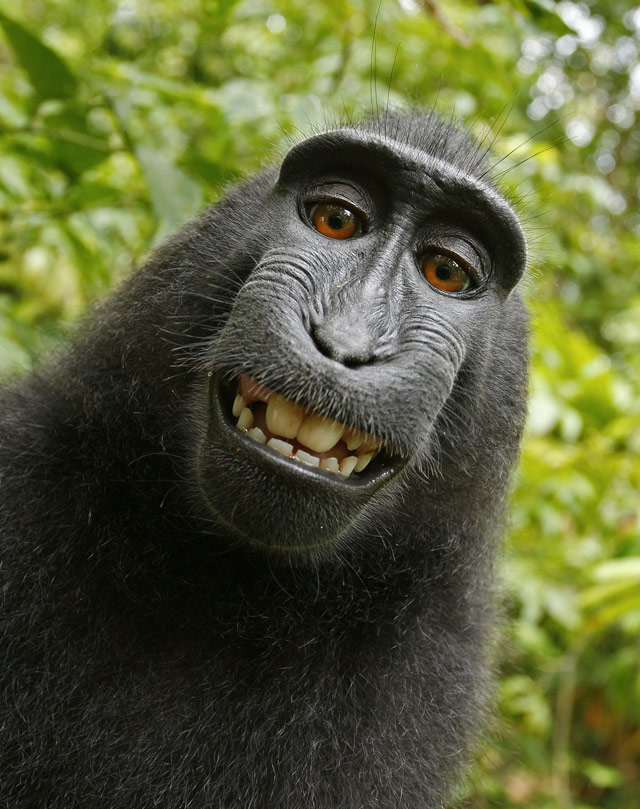
Photographer David Slater wants Wikipedia to remove his photograph of a monkey taking a photo of itself but Wikipedia has refused, saying that as the monkey was the photographer, Slater has no right to the copyright to the photo.
The Gloucestershire-based photographer now claims that the decision is jeopardising his income as anyone can take the image and publish it for free, without having to pay him a royalty. He complained to Wikimedia that he owned the copyright of the image, but a recent transparency report from the group, which details all the removal requests it has received, reveals that editors decided that the monkey itself actually owned the copyright because it was the one that pressed the shutter button.
But shouldn’t Wikipedia take it down anyway because they don’t have the monkey’s permission to release the photo into the public domain? (I mean, probably not…monkeys don’t have any rights under the law, yes?) (via @capndesign)
Update: A previous version of this post stated that Wikipedia said that the monkey held the copyright. They said no such thing…that was my poor paraphrase. In the US at least, monkeys obviously can’t hold copyrights. From the Compendium II of Copyright Office Practices, section 202.02(b) states:
The term “authorship” implies that, for a work to be copyrightable, it must owe its origin to a human being. Materials produced solely by nature, by plants, or by animals are not copyrightable.
Interesting phrase, “owe its origin to”…perhaps Slater has a point. (via @stvnrlly)
Update: According to a recent 1000+ page document produced by the US Copyright Office, a photograph taken by a monkey is “unprotected intellectual property”.
The US Copyright Office, in a 1,222-page report discussing federal copyright law, said that a “photograph taken by a monkey” is unprotected intellectual property.
“The Office will not register works produced by nature, animals, or plants. Likewise, the Office cannot register a work purportedly created by divine or supernatural beings, although the Office may register a work where the application or the deposit copy state that the work was inspired by a divine spirit,” said the draft report, “Compendium of US Copyright Office Practices, Third Edition.”
Update: PETA has filed a lawsuit on behalf of the monkey photographer, seeking to award the copyright and any sales proceeds to the monkey. Alt headline: PETA Thinks Famous Monkey Photographer Is Too Stupid To Manage Own Money.
Sometime around 1918 in Buenos Aires, Marcel Duchamp designed a chess set:
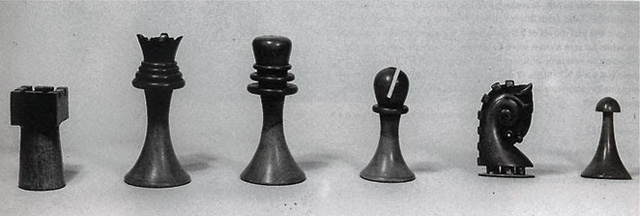
Sometime earlier this year, Scott Kildall and Brian Sera used archival photos of the hard-to-find set, turned them into 3D models of the chess pieces, and made a pattern for 3D printing your own set:

The community at Thingaverse is already busy making interesting variations of Duchamp’s set…look at this one:
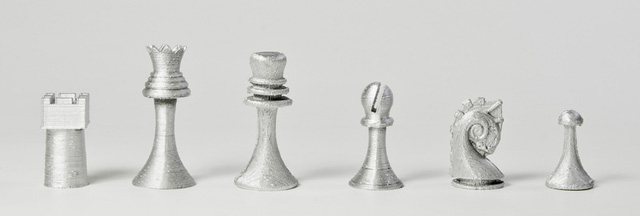
Something tells me Duchamp would have loved this whole thing.
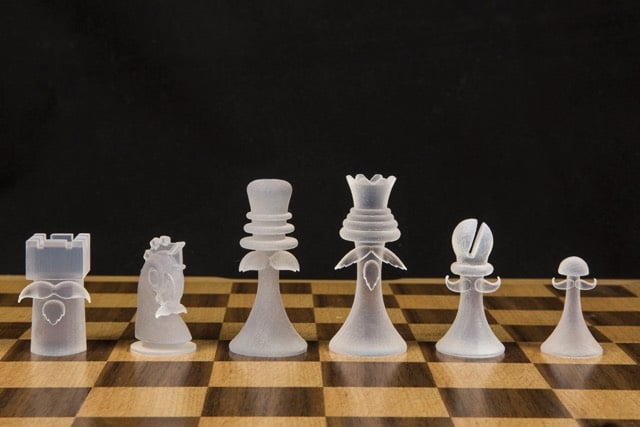
Update: Welllllll, Duchamp may have loved this, but his estate definitely did not. Duchamp’s estate sent Kildall and Sera a cease and desist letter, forcing them to remove the 3D models from Thingiverse. Which, the irony! So, Kildall and Sera, riffing on Duchamp’s mustachioed Mona Lisa, have created a set of six 3D-printed chess pieces with mustaches modeled on the Duchamp set. Fantastic.
When Commander Chris Hadfield covered David Bowie’s Space Oddity on board the International Space Station:
how were the intellectual property rights handled?
The song “Space Oddity” is under copyright protection in most countries, and the rights to it belong to Mr Bowie. But compulsory-licensing rights in many nations mean that any composition that has been released to the public (free or commercially) as an audio recording may be recorded again and sold by others for a statutorily defined fee, although it must be substantively the same music and lyrics as the original. But with the ISS circling the globe, which jurisdiction was Commander Hadfield in when he recorded the song and video? Moreover, compulsory-licensing rights for covers of existing songs do not include permission for broadcast or video distribution. Commander Hadfield’s song was loaded onto YouTube, which delivers video on demand to users in many countries around the world. The first time the video was streamed in each country constituted publication in that country, and with it the potential for copyright infringement under local laws. Commander Hadfield could have made matters even more complicated by broadcasting live as he sang to an assembled audience of fellow astronauts for an onboard public performance while floating from segment to segment of the ISS.
We live in a world where sending a guitar into space is trivial while ironing out rights agreements is the tough part. (via waxy)
Matt Yglesias argues that because of the way copyright is viewed by the public and interpreted by lawmakers and the courts, making an album like The Beastie Boys’ Paul’s Boutique would be nearly impossible today.
The death on Friday of Adam Yauch, best known as the Beastie Boys’ MCA, surely sent many of us back to old albums we may not have heard for a while. And anyone who threw on Paul’s Boutique, the Boys’ best album, was surely struck by the sense that they don’t make records like that anymore. That’s not just because tastes and styles have changed. The entire album is based on lavish sampling of other recordings. “Shake Your Rump,” which leads Slate’s #MCATracks playlist, features samples of 14 songs by 12 separate artists. In all, the album is thought to have as many as 300 total samples. The sampling gave Paul’s Boutique a sound that remains almost as distinctive today as it was when it was released in 1989.
Perhaps the main reason-and certainly the saddest reason-that it still sounds distinctive is that a rapidly shifting legal and economic landscape made it essentially impossible to repeat.
Wow. So remember the photo taken by the monkey and Techdirt’s subsequent musings about who owns the copyright a photo taken by a monkey? Today Techdirt is reporting that Caters News Agency sent a takedown notice to Techdirt asking them to remove the monkey’s photos. Totally not making this up.
We were a bit surprised to receive a notice on Monday from Caters News, telling us they represented David Slater with respect to the syndication of those photos, and asking us to take down the photos. The notice was not a DMCA takedown notice. It doesn’t even mention copyright, though that seems like the only basis upon which they would make such a takedown request. And, to be clear, it was not in the least bit threatening. There is no legal language and no threat at all in the note.
When asked for clarification by Techdirt, a representative from Caters replied:
Michael, regardless of the issue of who does and doesn’t own the copyright — it is 100% clear that the copyright owner is not yourself. You have blatantly ‘lifted’ these photographs from somewhere — I presume the Daily Mail online. On the presumption that you do not like to encourage copyright theft (regardless of who owns it) then please remove the photographs.
Onionesque. Please someone interview the monkey about his/her views on this.
I almost made a joke on this post about getting a takedown notice from the monkey who took the inlined image, but this story on Techdirt explores the copyright issues involved in a more serious way.
Technically, in most cases, whoever makes the actual work gets the copyright. That is, if you hand your camera to a stranger to take your photo, technically that stranger holds the copyright on the photo, though no one ever enforces this.
(via ★tcarmody)
Older posts




Socials & More