

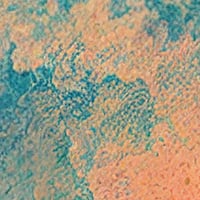

Kazuki Takamatsu
Like Pieter says, these paintings by Kazuki Takamatsu are stunning.


This site is made possible by member support. 💞
Big thanks to Arcustech for hosting the site and offering amazing tech support.
When you buy through links on kottke.org, I may earn an affiliate commission. Thanks for supporting the site!
kottke.org. home of fine hypertext products since 1998.
Beloved by 86.47% of the web.
Dazzling work by Hiroshi Sugimoto.
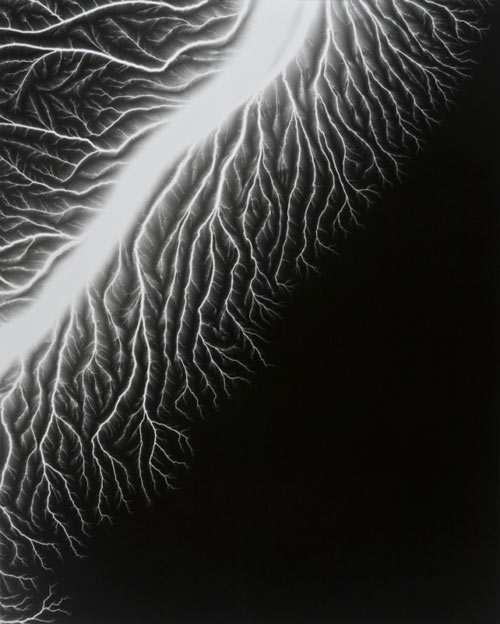
Hiroshi Sugimoto uses a 400,000-volt Van De Graaff generator to apply an electrical charge directly onto his film.
See also Peter Miller’s Polariod experiments.
Update: Robert Buelteman uses electricity to take photos of flowers.
Impressionism - painting outside of a studio with quick, loose brushstrokes to capture an evocative impression of their subject. Van Gogh was an Impressionist but wanted to express how he felt about what he saw so he distorted the subject. This helped to lead to Expressionism practised by artists from Edvard Munch through to Francis Bacon. The Fauves (wild beasts) expressed themselves by painting with bright colours. Jackson Pollock did it by throwing or dripping paint on a canvas. His paintings were abstract — Abstract Expressionism.
Cezanne was very important. He began as an Impressionist but then started to look at a subject from two different perspectives to represent how we see. Picasso and his friend Georges Braque were very impressed and started to paint subjects from lots of different views. This is Cubism. Marcel Duchamp was a Cubist but then changed art for ever. He said the idea is more important than the medium and refused to stick with the limited choice of canvas or stone. So he chose everyday objects and called them art because he had altered their context. This led to Conceptual Art where the idea becomes the medium.
The Dadaists were very cross. They blamed the horrors of the First World War on the Establishment’s reliance on rational and reasoned thought. They radically opposed rational thought and became nihilistic — the punk rock of modern art movements. Dada plus Sigmund Freud equals Surrealism. The Surrealists were fascinated by the unconscious mind, as that’s where they thought truth resided. Piet Mondrian thought he could paint everything he knew, felt and saw by using two lines placed at rectangles and three primary colours. This was called Neo-Plasticism and was inspired by Cubism. So was Futurism, which is Cubism with motion added. Vorticism is the same as Futurism, but British. The Minimalists might represent the real truth because they weren’t trying to represent anything. Performance Art is Dada live.
That’s from Will Gompertz in the Times. (via sippey)
Drei Klavierstücke op. 11 is a set of pieces written for the piano by Arnold Schoenberg in 1909, some of the first western music to written in an atonal style. Cory Arcangel took a bunch of YouTube videos of cats playing the piano and fused them together into a performance of op. 11.
This project fuses a few different things I have been interested in lately, mainly “cats”, copy & paste net junk, and youtube’s tendency in the past few years to host videos that are as good and many times similar to my favorite video artworks. I think all this is somehow related.
Cory’s no-bullshit statements about his art are just as entertaining as the work itself:
So, I probably made this video the most backwards and bone headed way possible, but I am a hacker in the traditional definition of someone who glues together ugly code and not a programmer. For this project I used some programs to help me save time in finding the right cats. Anyway, first I downloaded every video of a cat playing piano I could find on Youtube. I ended up with about 170 videos…
You can catch Cory’s project in-person at Team Gallery in NYC and at Kunsthaus Graz in Austria.
David Galbraith calculates that if buildings by famous architects were priced like paintings, a Le Corbusier building would be worth more than the entire US GDP.
The top floor of Corbusier’s Villa Stein (one of perhaps the top 500 most important houses of the late 19th/early 20th centuries - i.e. a Van Gogh of houses) is for sale for the same price per sq.ft. (approx $1400) as buildings in the same area of suburban Paris, designed by nobody in particular. Meanwhile, Van Gogh’s Portrait of Dr. Gachet sold for an inflation adjusted price of $136 million yet a poster of similar square footage and style costs around $10.
In terms of signaling, it’s difficult to hang a house on one’s parlor wall…buying a Corbusier means living in it wherever it happens to be located, at least part of the year.
Errol Morris follows up on his recent series about Dutch forger Han van Meegeren by addressing some of the comments he received. Here’s Morris on the interaction of historical research and modern content management techniques.
The first version of the Time article that I saw was the “electronic” version from the Web. It is particularly strange, if only because the text (from 1947) is surrounded by modern information, including contemporary advertisements for Liberty Mutual, teeth whitening preparations, wrinkle-cream, and most e-mailed articles. Emmy Göring and Henriette von Schirach complaints are directly adjacent to “Will Twitter Change the Way We Live.”
I also enjoyed the discussion of “Hitler-soup” at the end.
Global Street Food is an exhibition the various contraptions people use to make and sell food on the street.

“Global Street Food” is dedicated to the fascination with improvised kitchens in public places. Urban fast food stations navigating the contrast between pragmatic dilettantism and complexity in the smallest of spaces. Mike Meiré will be presenting several objects and street kitchens from different parts of the world in the Buckmneister Fuller Dome. An exhibition depicting the sculptural quality of authentic objects and their cultural identity
(via today and tomorrow)
The recent acquisitions should give you some idea of the curatorial vision of the Museum of Bad Art. (thx, joe)
Over on his NY Times blog, Errol Morris finishes up his excellent seven-part series on Vermeer forger Han van Meegeren. Here are the links to all seven parts: one, two, three, four, five, six, and seven.
In a piece from 1979 called Big Wheel, artist Chris Burden took a massive 19th century iron flywheel and set it spinning with the rear wheel of a small motorcycle. The flywheel spins for *three hours* on a single charge.
A description of the work from the NY Times:
Several of his larger works present a characteristic blend of purity, violence and monumentality now aimed at demonstrating simple principles of motion or mass in breathtakingly sculptural ways. In “The Big Wheel,” Burden uses a motorcycle’s rear wheel to set a three-ton iron flywheel, the survivor of a 19th-century factory, into a fast and furious spin that lasts about three hours. The contrast is wonderful: this old, simple Goliath of a wheel, man’s first “machine,” powered by a modern David — small, complex and delicate.
A project from Jin-wook Hwang:
Seedbomb is a non-military bomb that protects earth from worsening desertification and lessens sandstorms. […] When a Seedbomb is released from an airplane, Seedbomb is disassembled in the air and seed capsules inside of the bomb spread out widely and fall on the ground.
As individual seeds grow into plants, the case surrounding each seed breaks down due to the moisture generated by the plant through transpiration.
Artist Daniel Martinico took William Shatner’s finest moment as an actor and stretched it out into a 15-minute video.
You’ll notice the crowd gets quiet after the first few seconds. It draws you in, forces you to pay attention, even if it’s just staring at the back and forth eye tics on Shatner’s face for a minute at a time. “In that moment everyone responds to it,” Martinico says. There’s laughing at first, but then people get into the rhythm of it and study the various little muscles as they pull and twitch on Kirk’s face. “It’s a phenomenal range in just a few seconds.”
Here’s the first two minutes of the video.
It’s pretty mesmerizing, even small and at poor quality. (via greg)
For his The Girl Studies project, Charlie White paired photographs of two groups of people becoming women in very different ways: teen girls and adult male-to-female transsexuals.

In the images in White’s series, both figures are blossoming into womanhood, though each along a different path. As observers, however, we have been taught to view the subjects in much the same way: with sheer terror.
These are fascinating. (via bygone bureau)
From part three of Errol Morris’ investigation into Dutch forger Han Van Meegeren, here’s art historian Jonathan Lopez:
Forgery is about the way the present looks at the past. The best forgeries may imitate the style of a long dead artist, but to appeal to people at the moment that they’re being tricked, forgeries must also incorporate some of the aesthetic prejudices of the moment. When fakes work well, they give us a vision of the past that seems hauntingly up to date. And that’s one of the things that makes forgery so seductive.
Errol Morris posted the first part of a seven-part series of posts about Han van Meegeren, art forger extraordinaire.
To be sure, the Van Meegeren story raises many, many questions. Among them: what makes a work of art great? Is it the signature of (or attribution to) an acknowledged master? Is it just a name? Or is it a name implying a provenance? With a photograph we may be interested in the photographer but also in what the photograph is of. With a painting this is often turned around, we may be interested in what the painting is of, but we are primarily interested in the question: who made it? Who held a brush to canvas and painted it? Whether it is the work of an acclaimed master like Vermeer or a duplicitous forger like Van Meegeren — we want to know more.
Morris ends the post with a cliffhanger that, if I didn’t know any better, was written specifically for me: “The Uncanny Valley.”
Update: Part two has been posted.
Socials & More