kottke.org posts about art
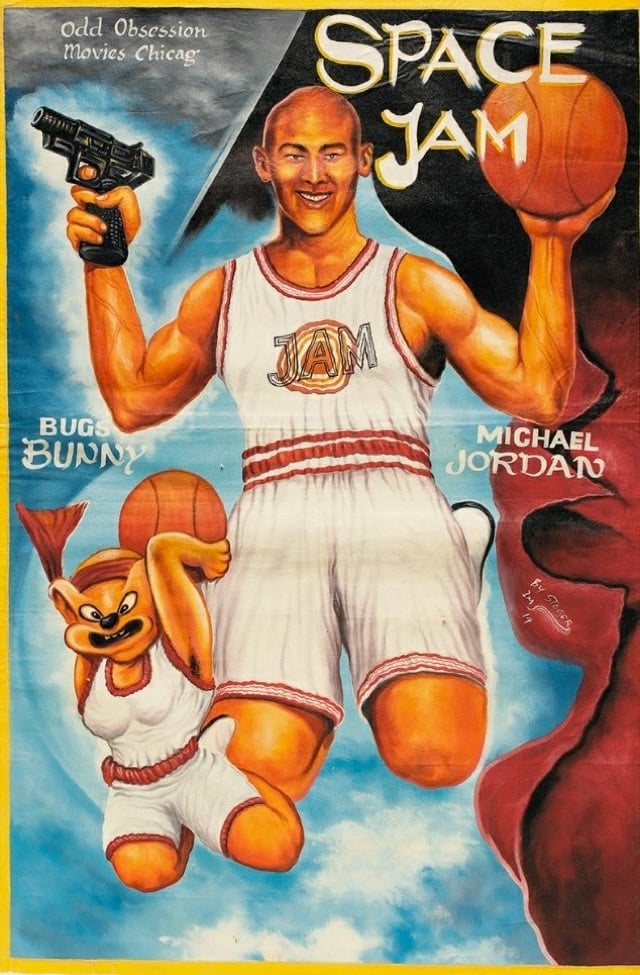
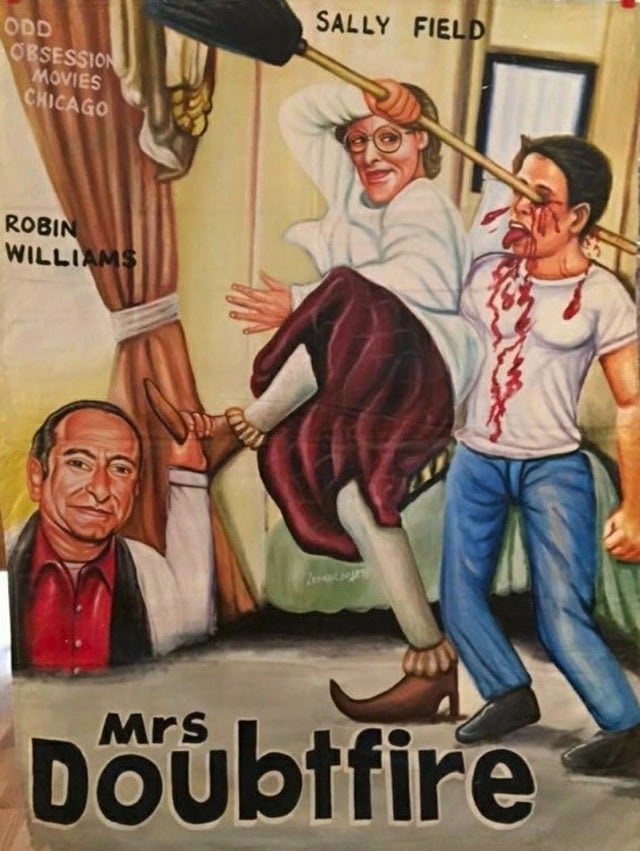
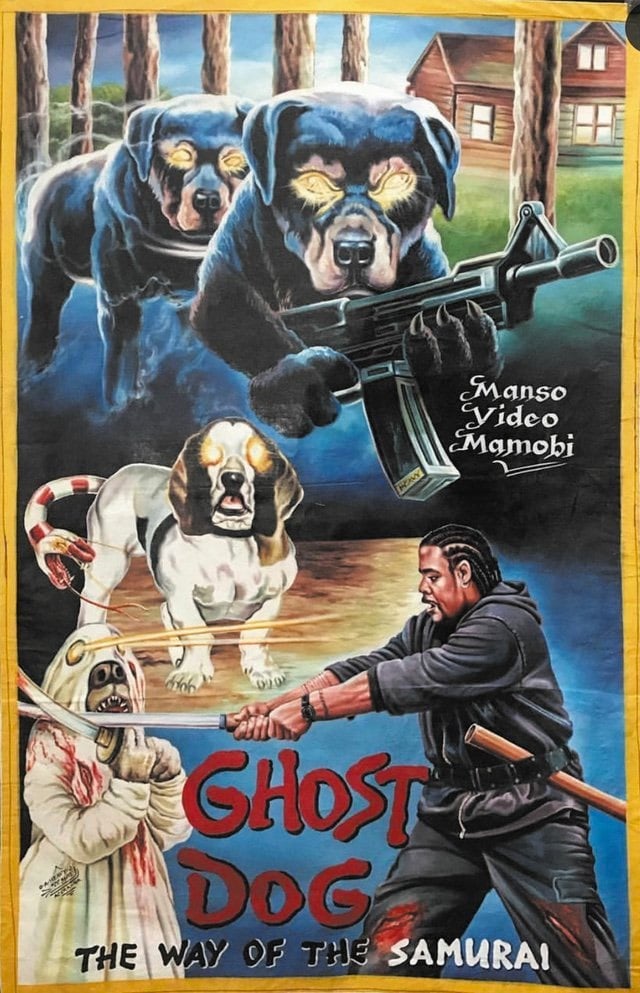
In order to drum up business for local movie theaters in Africa (most notably in Ghana), theater owners would commission local artists to paint movie posters.
When Frank Armah began painting posters for Ghanaian movie theaters in the mid-1980s, he was given a clear mandate: Sell as many tickets as possible. If the movie was gory, the poster should be gorier (skulls, blood, skulls dripping blood). If it was sexy, make the poster sexier (breasts, lots of them, ideally at least watermelon-sized). And when in doubt, throw in a fish. Or don’t you remember the human-sized red fish lunging for James Bond in The Spy Who Loved Me?
“The goal was to get people excited, curious, to make them want to see more,” he says. And if the movie they saw ended up surprisingly light on man-eating fish and giant breasts? So be it. “Often we hadn’t even seen the movies, so these posters were based on our imaginations,” he says. “Sometimes the poster ended up speaking louder than the movie.”
You can check out more of these amazing artworks in this Twitter thread, this BBC story, on the AIGA site, and at Poster House, which has an exhibition of these posters up through Feb 16.
Update: I removed this modern-day spoof of the Ghanaian posters from the post. The tell is the reference to this amazing GIF. (thx, erik)
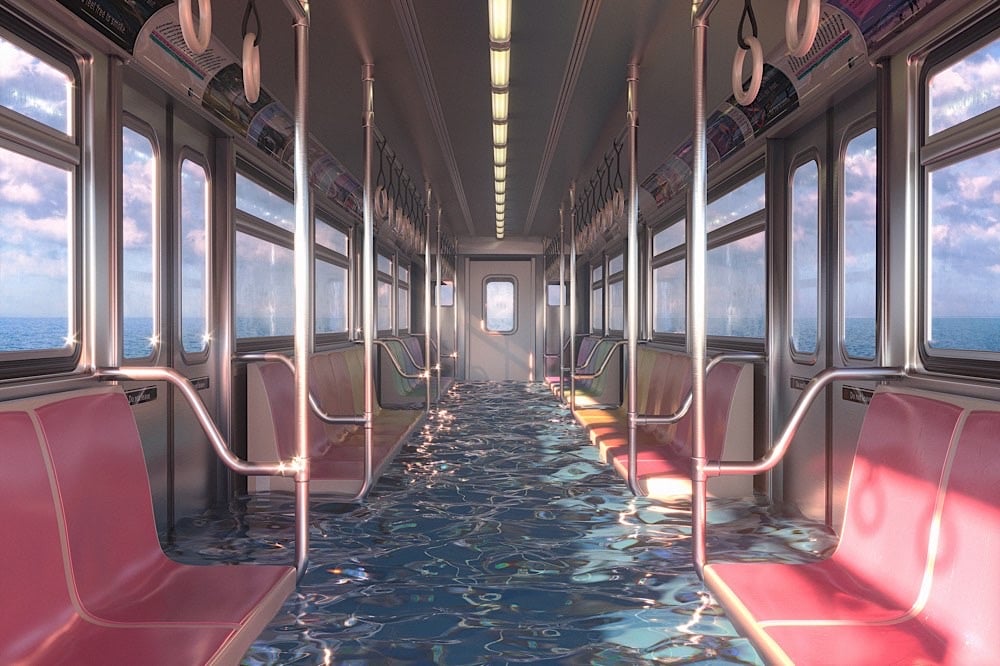
Inspired by a trip to Venice, the world’s most prominent example of what life could be like in many of our coastal cities in the years to come, Hayden Williams made a series of 3D rendered images showing what our world might look like underwater. (via the morning news)
Boston Rare Maps recently sold a nine-foot-high cloth map from 1899 that shows a geographic interpretation of the Book of Mormon.
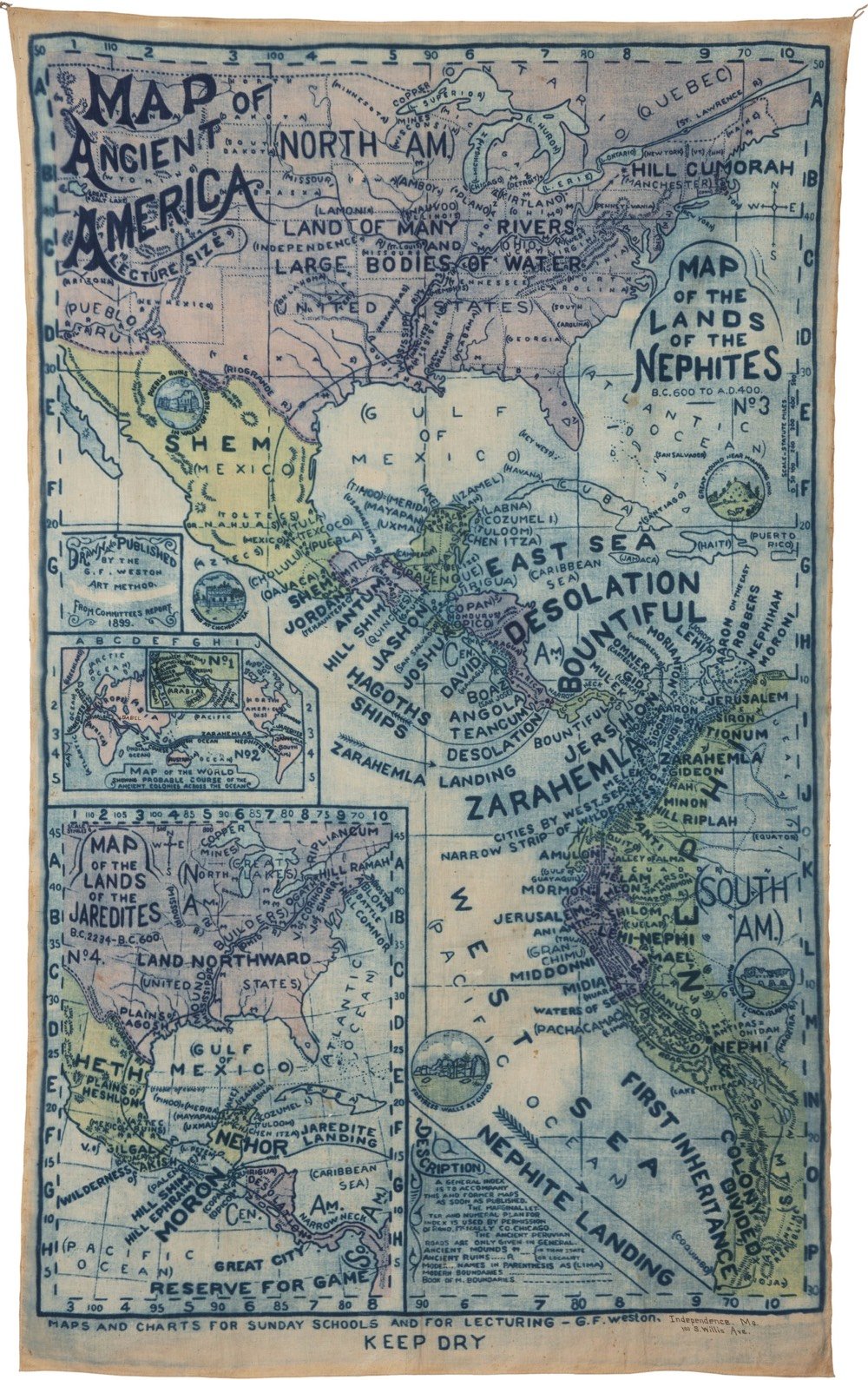
The map was an official production of the Reorganized Church of Jesus Christ of Latter Day Saints (RLDS) in Independence, Missouri. The RLDS (known since 2001 as the Community of Christ), is a reformist branch of the Church of Latter Day Saints, established in 1860.
You can read more about the proposed setting of the Book of Mormon on Wikipedia and its adherents’ belief that the indigenous peoples of the Americas are descended from Israelites.
The Book of Mormon is based on the premise that two families of Israelites escaped from Israel shortly before the sacking of Jerusalem by Nebuchadnezzar and that they constructed a ship, sailed across the ocean, and arrived in the New World as founders of Native American tribes and eventually the Polynesians. Adherents believe the two founding tribes were called Nephites and Lamanites, that the Nephites were white and practiced Christianity, and that the Lamanites were rebellious and received dark skin from God as a mark to separate the two tribes. Eventually the Lamanites wiped out the Nephites around 400 AD, leaving only dark skinned Native Americans. The descent of Native Americans from Israel is a key part of The Church of Jesus Christ of Latter-day Saints’s foundational beliefs.
(via @john_overholt)
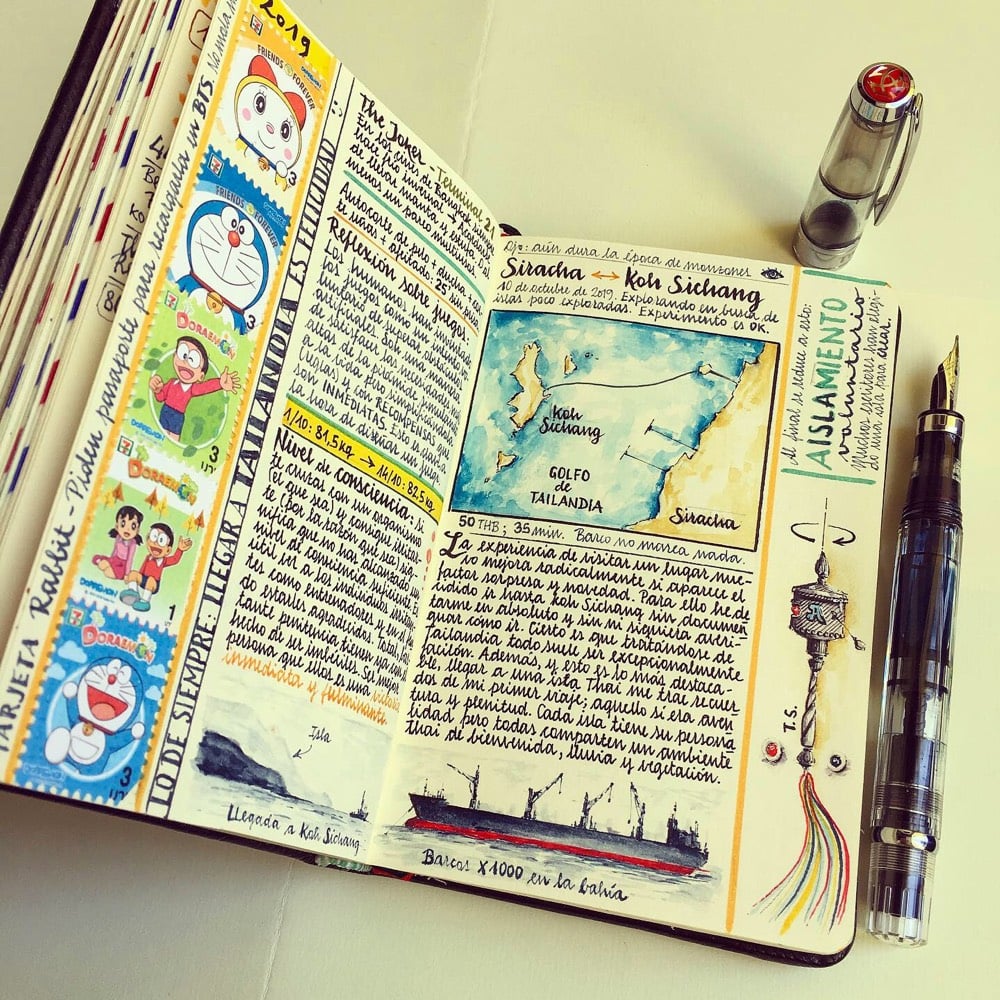
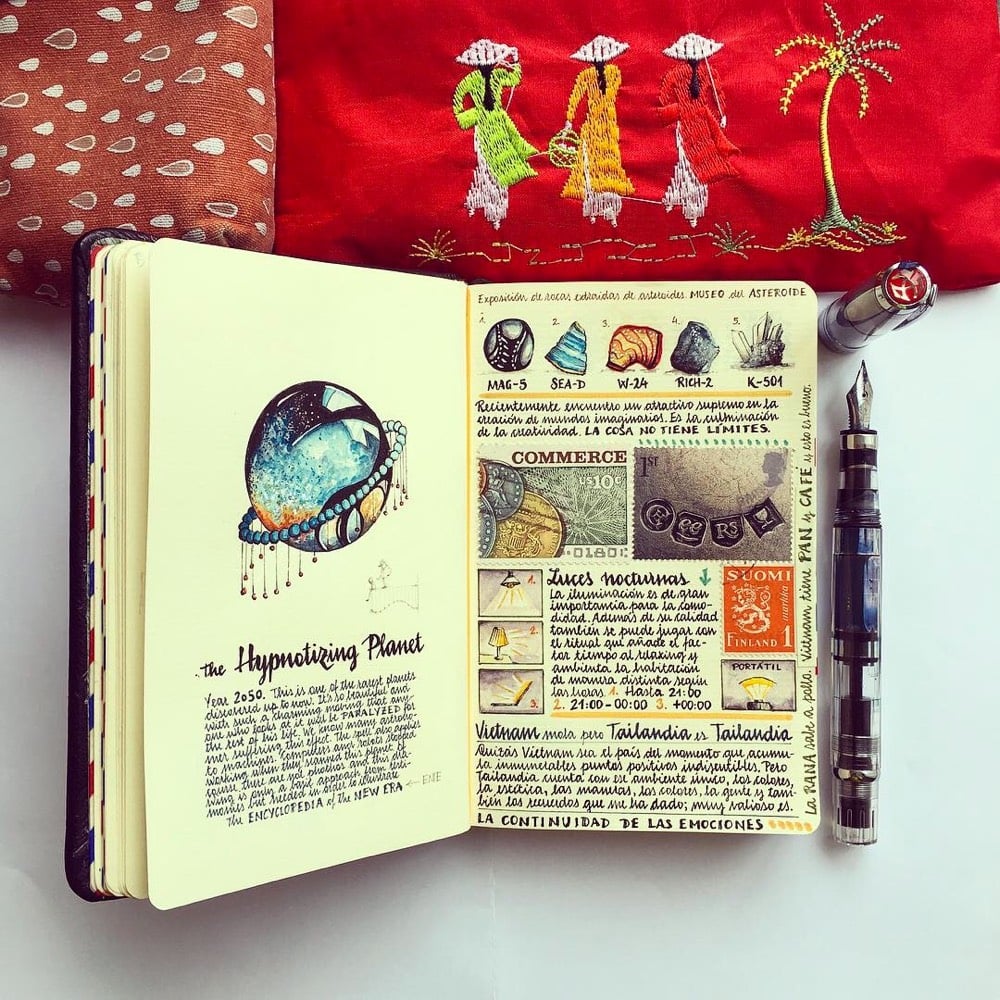
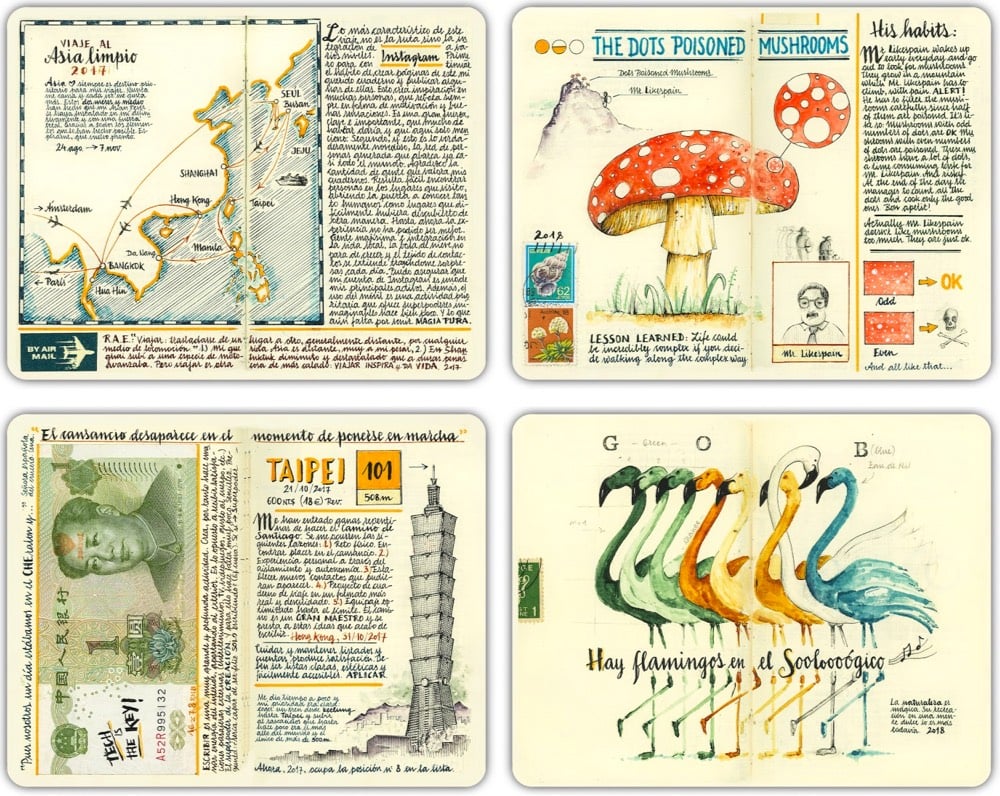
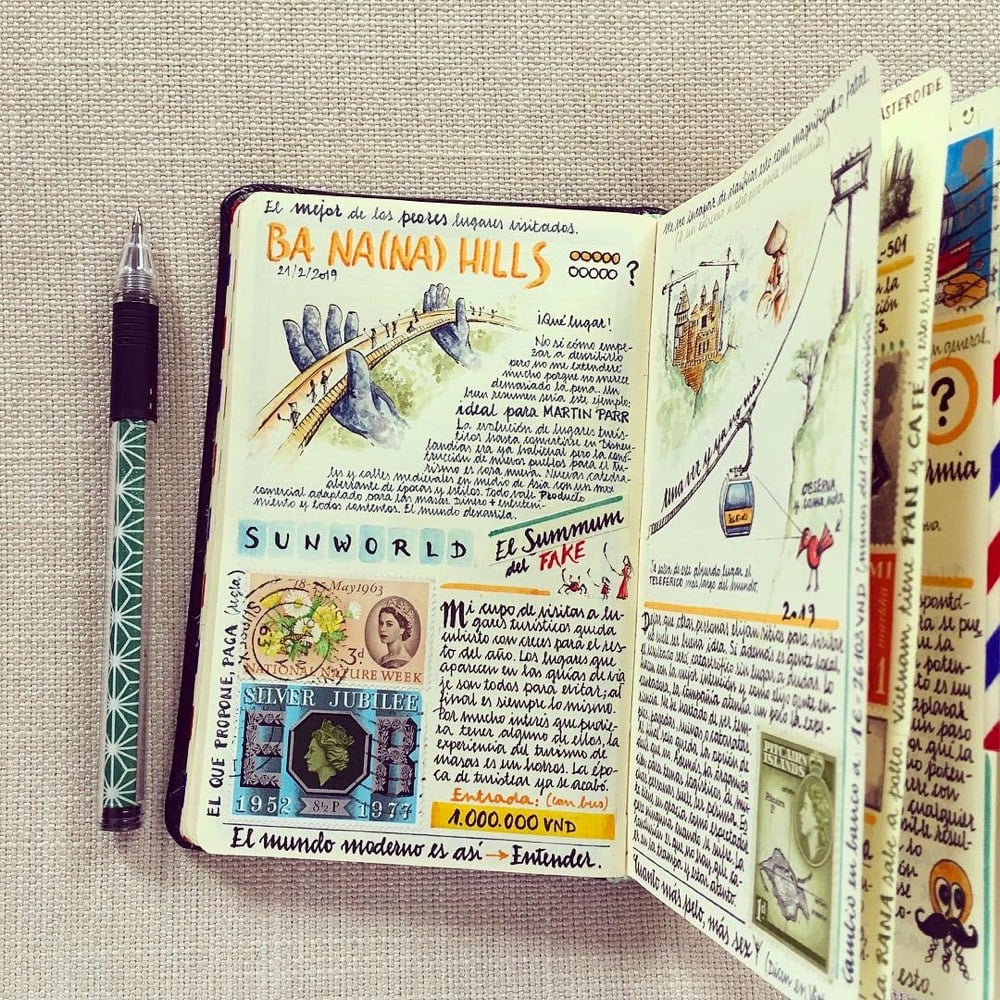
Good God, these hand-drawn & painted notebooks by José Naranja documenting his travels are fantastic! From Colossal:
Formerly an aeronautic engineer, Naranja now archives his thoughts while visiting foreign countries by hand-crafting journals replete with items like collected stamps, an illustration of the periodic table, and a study of fountain pens. Each mixed-media page centers on a theme, such as the culture surrounding eating a bowl of ramen or the flamingos found in a zoo.
Whenever I see something like this, it makes me want to learn how to draw/paint better than my current 4th grade level.1 I spent about 45 minutes poring over his work just now. So creative & exacting…look at that handwriting! And check out the tiny box of watercolors he carries with him.
You can keep up with Naranja’s latest adventures on his blog or on Instagram. If you’d like to buy some of his art — including a bound copy of some of his notebooks — there’s a small shop. (via colossal, which is also endlessly creative & meticulous)
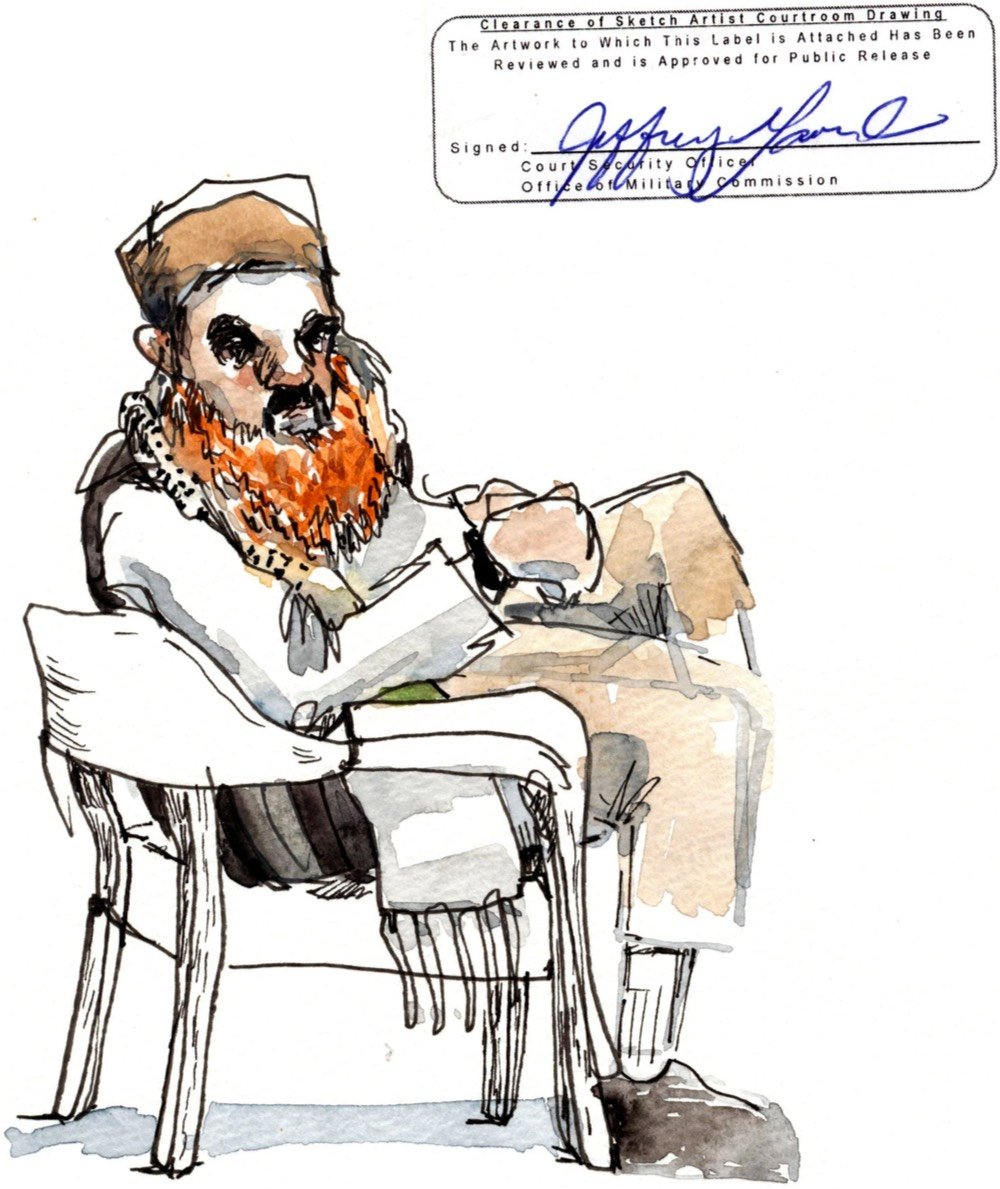
Illustrator Wendy MacNaughton spent a week at Guantánamo Bay sketching the proceedings at the 9/11 military court for this NY Times piece. In a behind-the-scenes piece, MacNaughton describes how she made the drawings, including the creative challenge posed by the restrictions and censorship enforced by US military officials.
Of the 30-something drawings I presented, Mr. Lavender shook his head at only two. The first contained some classified items in the courtroom. That made sense. The second was a handwritten list of everything that I was not allowed to draw, which I’d made to use as a reminder while working. I wanted to keep it. He refused.
I argued that the information it contained had been disclosed elsewhere. But Mr. Lavender and his supervisor came to the conclusion that my handwritten list was indeed a drawing, technically containing things I couldn’t draw. My “No” list was a no-go.
That’s Guantánamo.
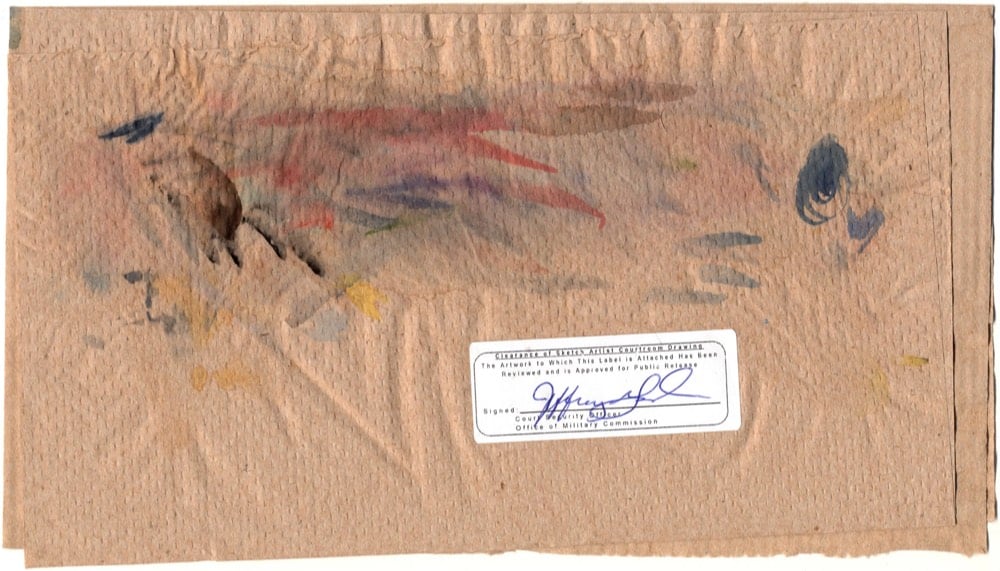
Every drawing she made needed a signed approval sticker from the court’s censor, and in this piece and on Instagram, MacNaughton didn’t photoshop the sticker out, reinforcing that the censorship is a vital part of the story she’s trying to tell. Even the paper towel she used to clean her paint brushes needed a sticker:
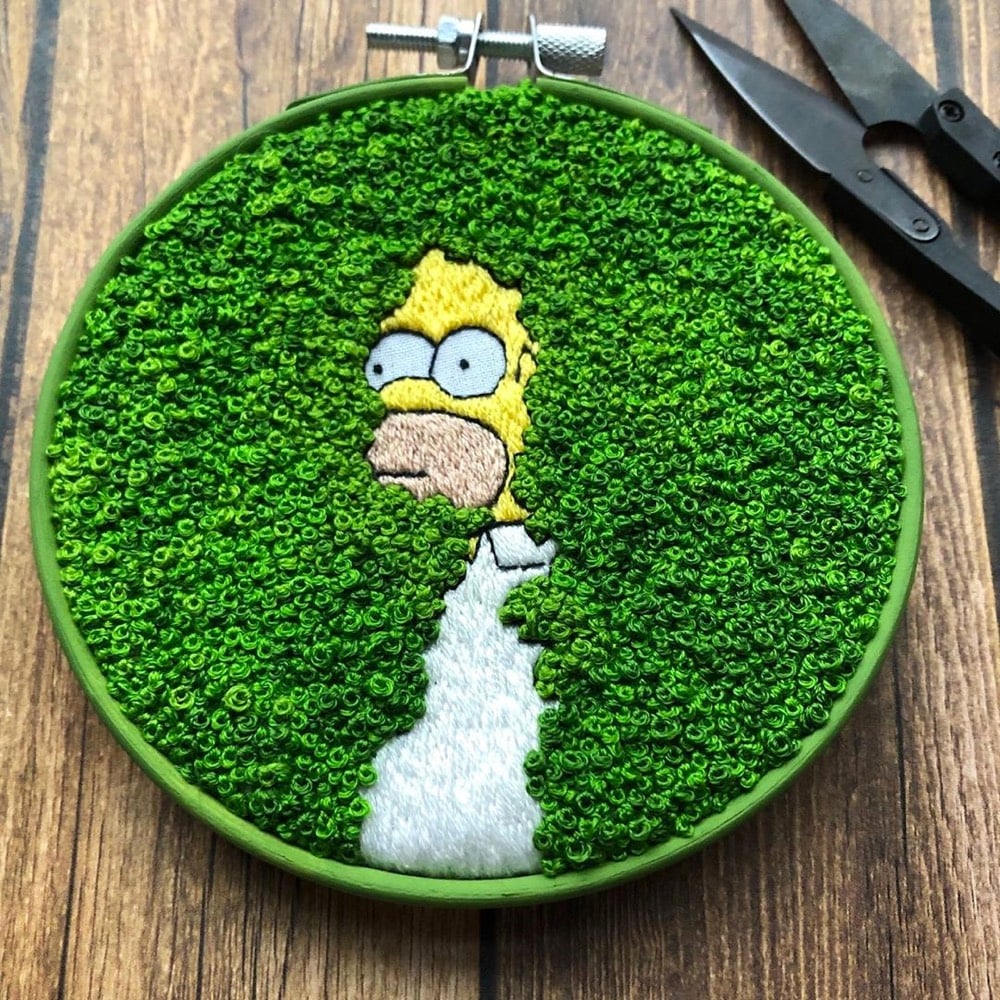
Move over, every other craft project — this Homer Simpson disappears into the bushes embroidery piece by Rayna of Hermit Girl Creations is the best embroidery in the history of the world. The scene is taken from a 1994 episode of The Simpsons called Homer Loves Flanders and has become a bit of a meme in recent years; here’s the clip:
Check out her Instagram or Etsy shop — she does a lot of other Simpsons-based embroidery as well as Charlie Brown, The Office, Dr. Seuss, Frog & Toad, Stranger Things, and Futurama. Looks like she takes commissions via Instagram DM.
Hélène Delmaire paints portraits of girls without eyes.
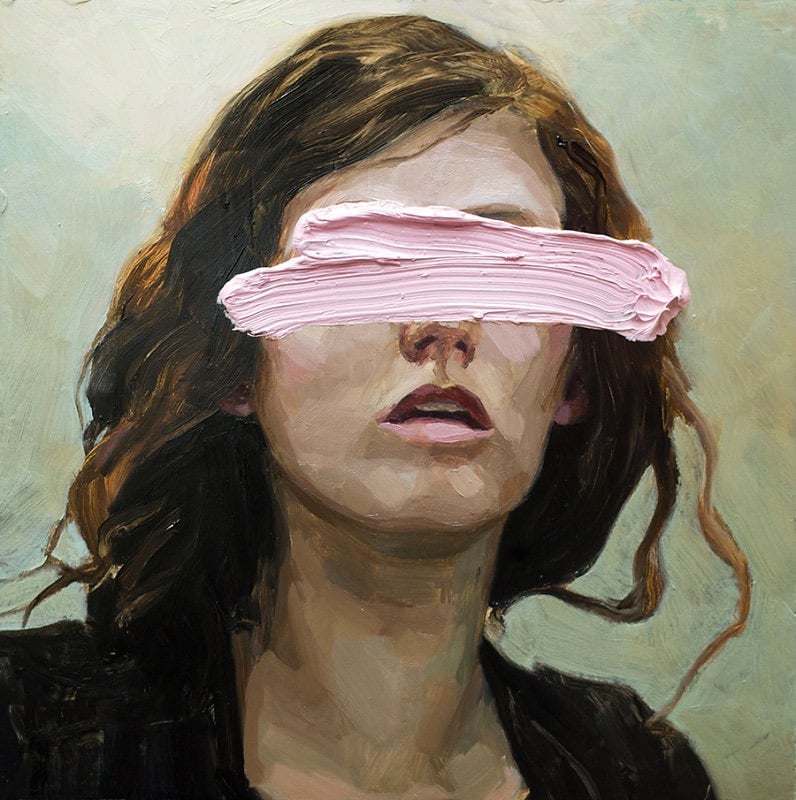
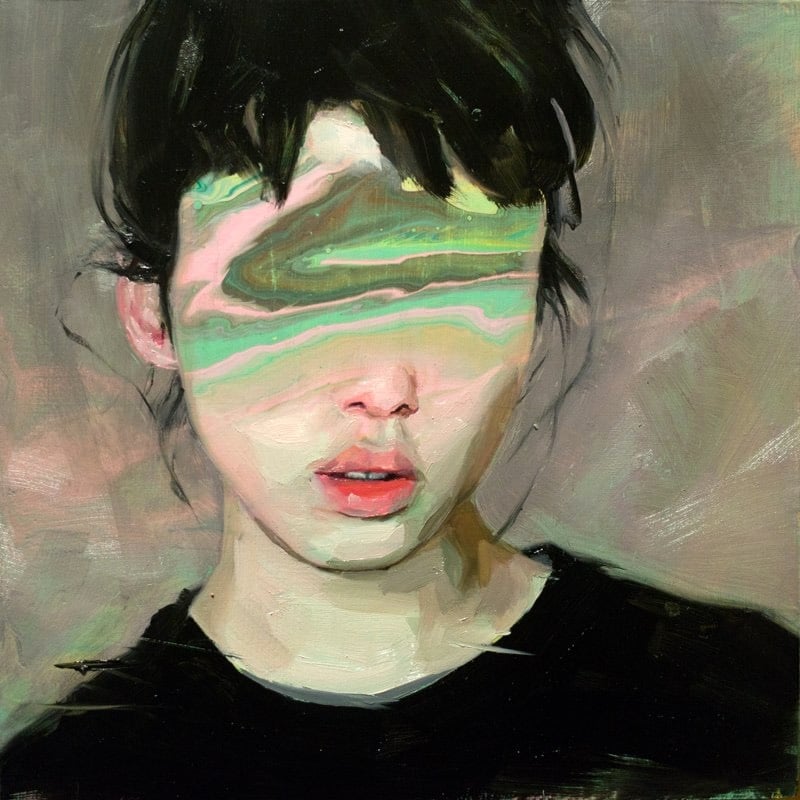
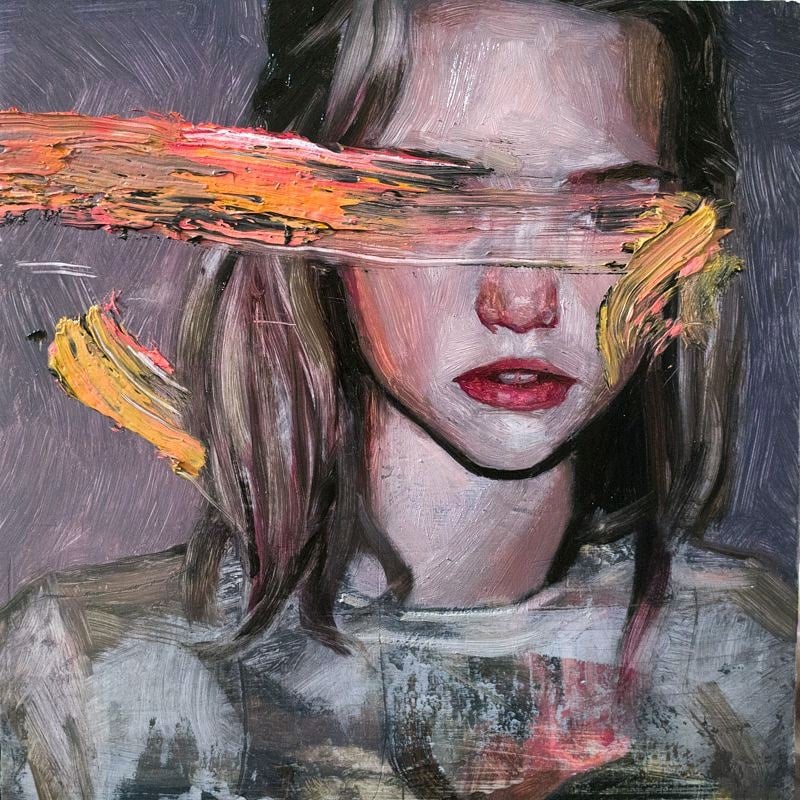
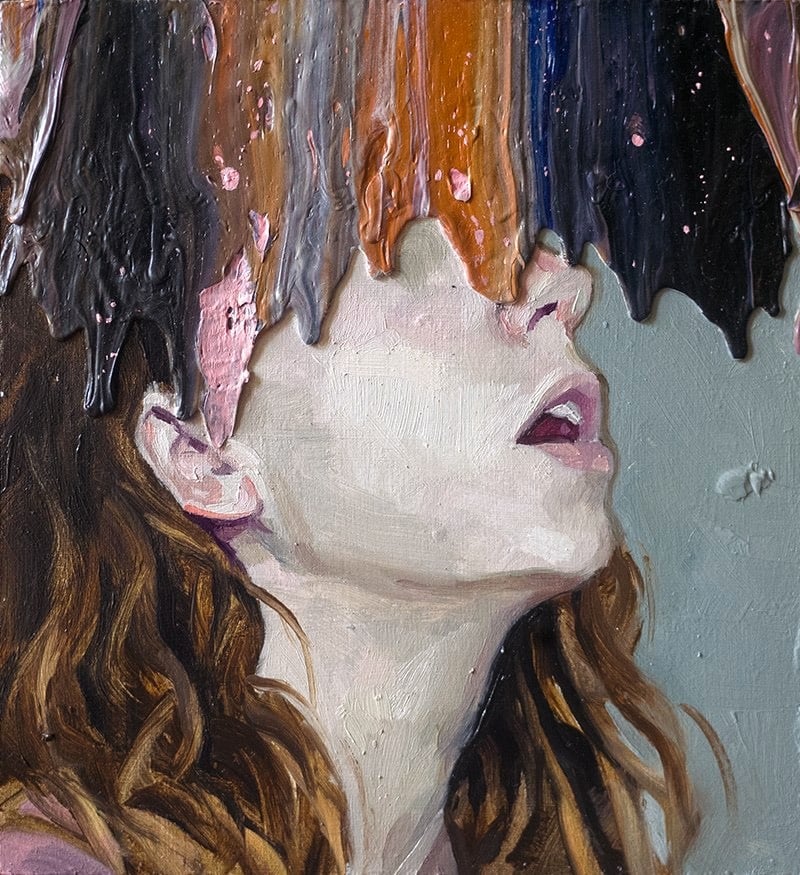
Delmaire did all of the paintings for the film Portrait of a Lady On Fire and even appears painting in the film.
I did pretty much all the paintings except the one that’s without a face. Céline and the actresses would work out how the scene was going to go. Once that was set up, I’d come, take a photo and while they were shooting the scenes, I went to a little corner of the castle and did my sketches.
Delmaire sells originals and prints of her work here. (via @alteredq)
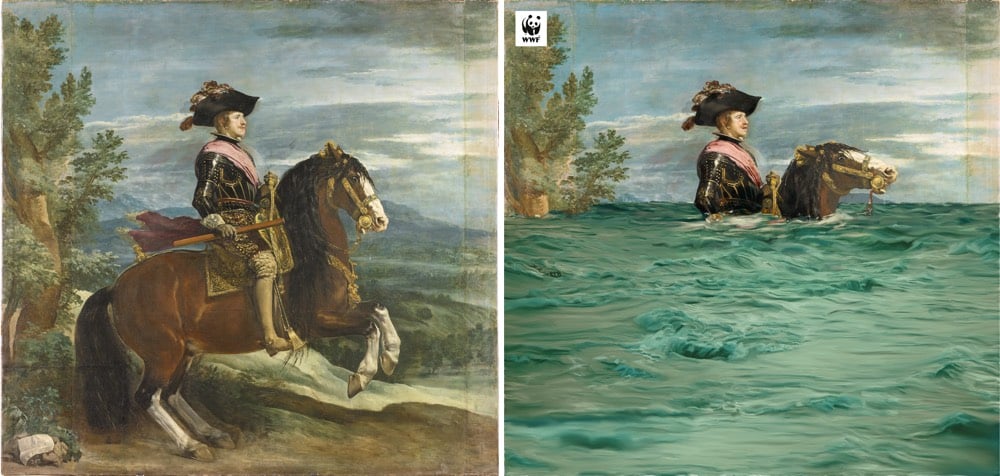
In collaboration with the Prado Museum in Madrid, the World Wildlife Fund altered a few paintings from the museum’s collection to highlight the future effects of climate change: extinction of species, sea level rise, desertification, and climate refugees.
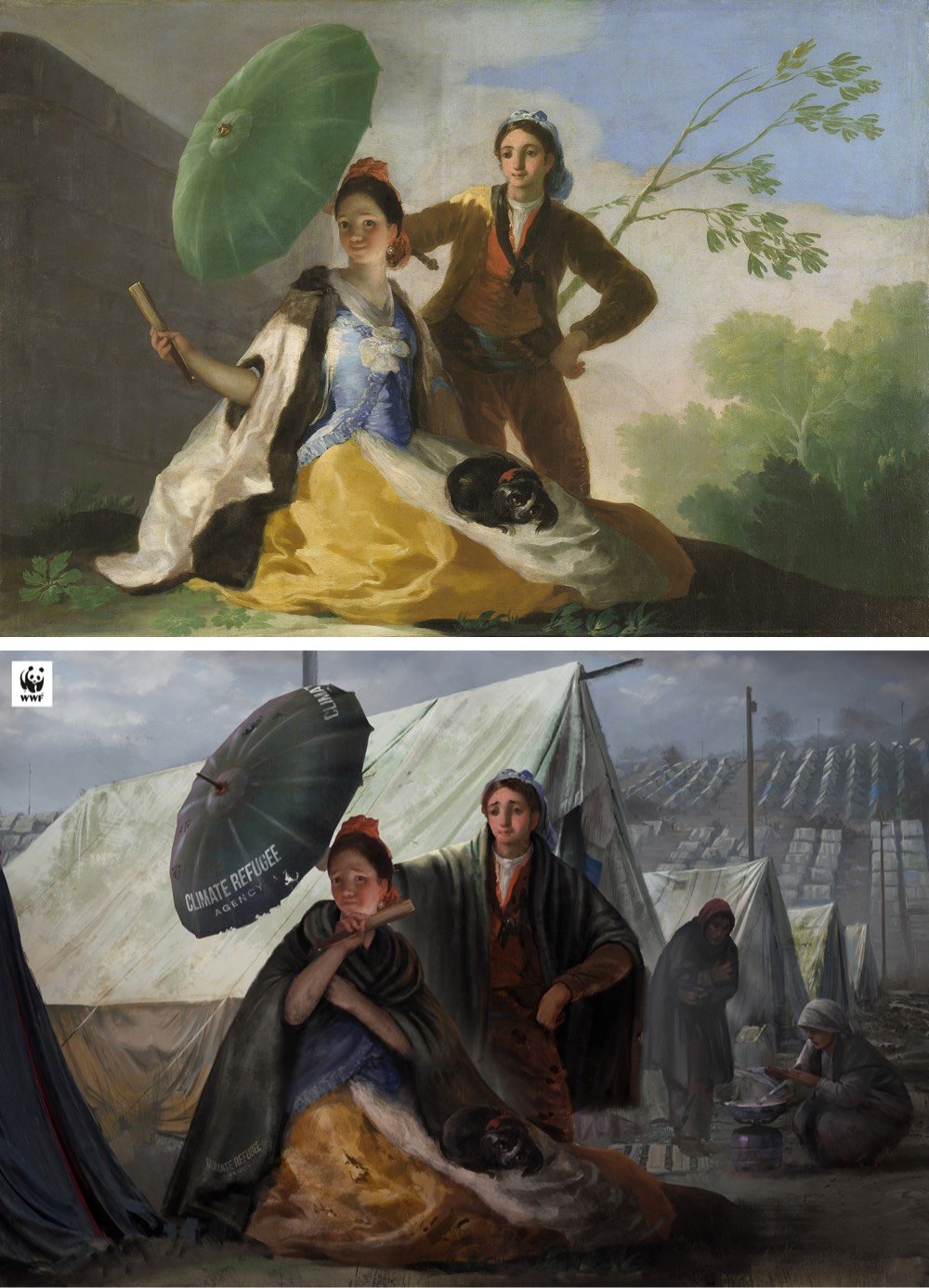
(via open culture)
A team of archaeologists has found a massive painting in a cave in Indonesia that uranium dating analysis shows to be around 43,900 years old, which they say is “currently the oldest pictorial record of storytelling and the earliest figurative artwork in the world”.
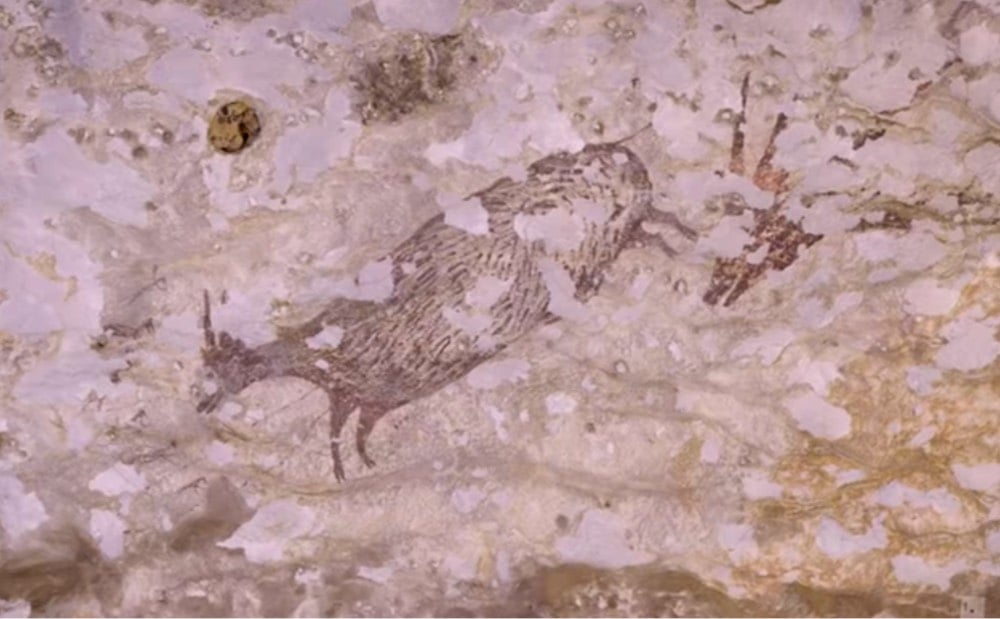
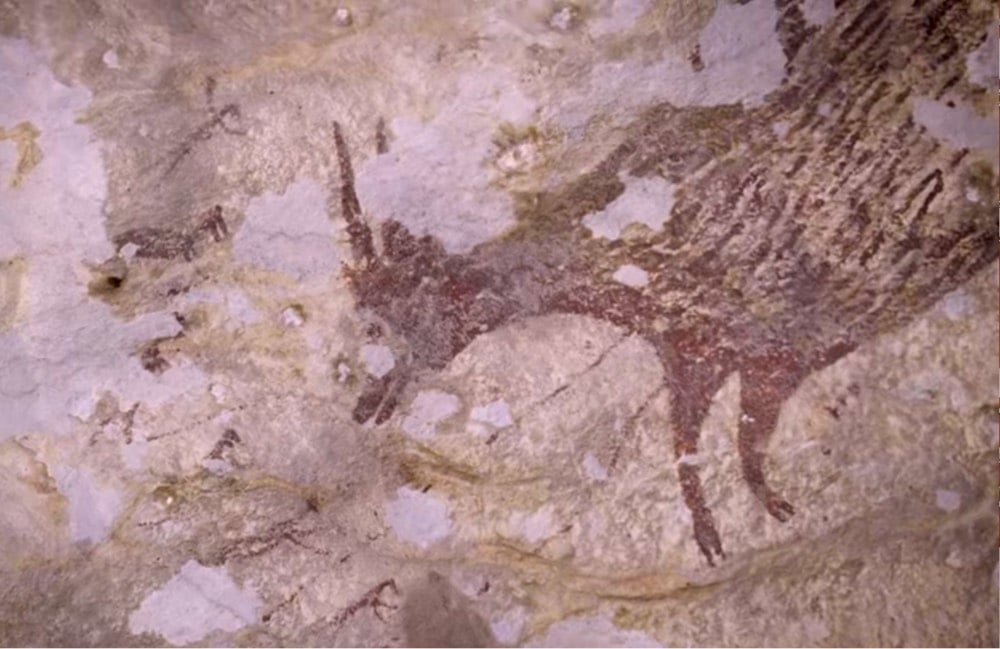
Cave painting was assumed to have originated in Europe, but these Indonesian paintings are thousands of years older. From an NPR piece on the discovery:
Genevieve von Petzinger, a paleoanthropologist at the University of Victoria, says the discoveries in her field are happening very quickly, thanks to newer technology such as the technique used to date the hunting scene. “I think the overall theme here really is that we’ve vastly underestimated the capacity of our ancestors,” she says.
She says the oldest cave paintings in Europe and Asia have common elements. And she thinks that even older paintings will eventually be found in the place where both groups originated from.
“Personally, I think that our ancestors already knew how to do art before they left Africa,” von Petzinger says.
Von Petzinger is the scientist behind one of the most intriguing things I learned this year, that the Stone Age symbols found in caves all over the world may be part of a single prehistoric writing system.
I ran across the work of Yellena James on Instagram the other day and my inner emoji face went all heart-eyes. I love her delicate organic imagery inspired by flowers, coral, and other natural forms.
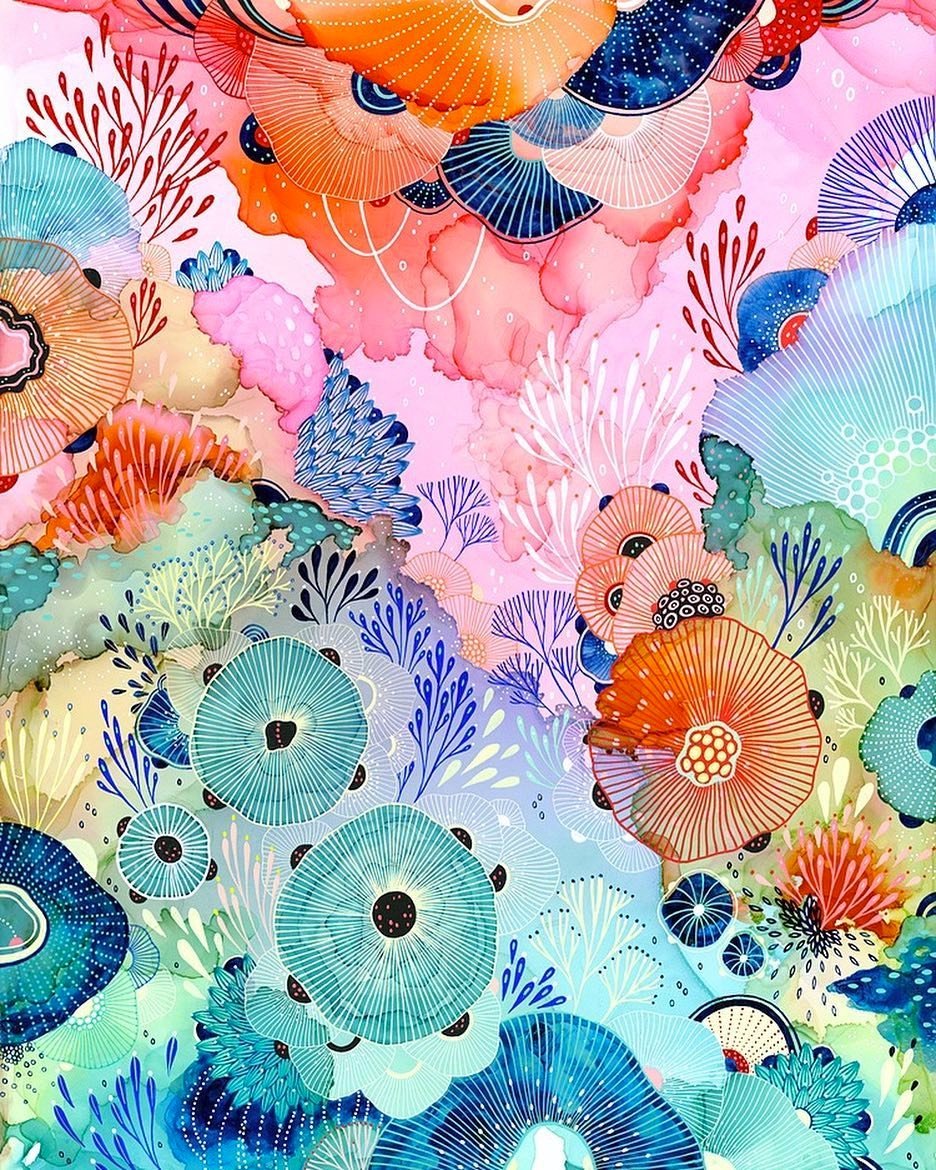
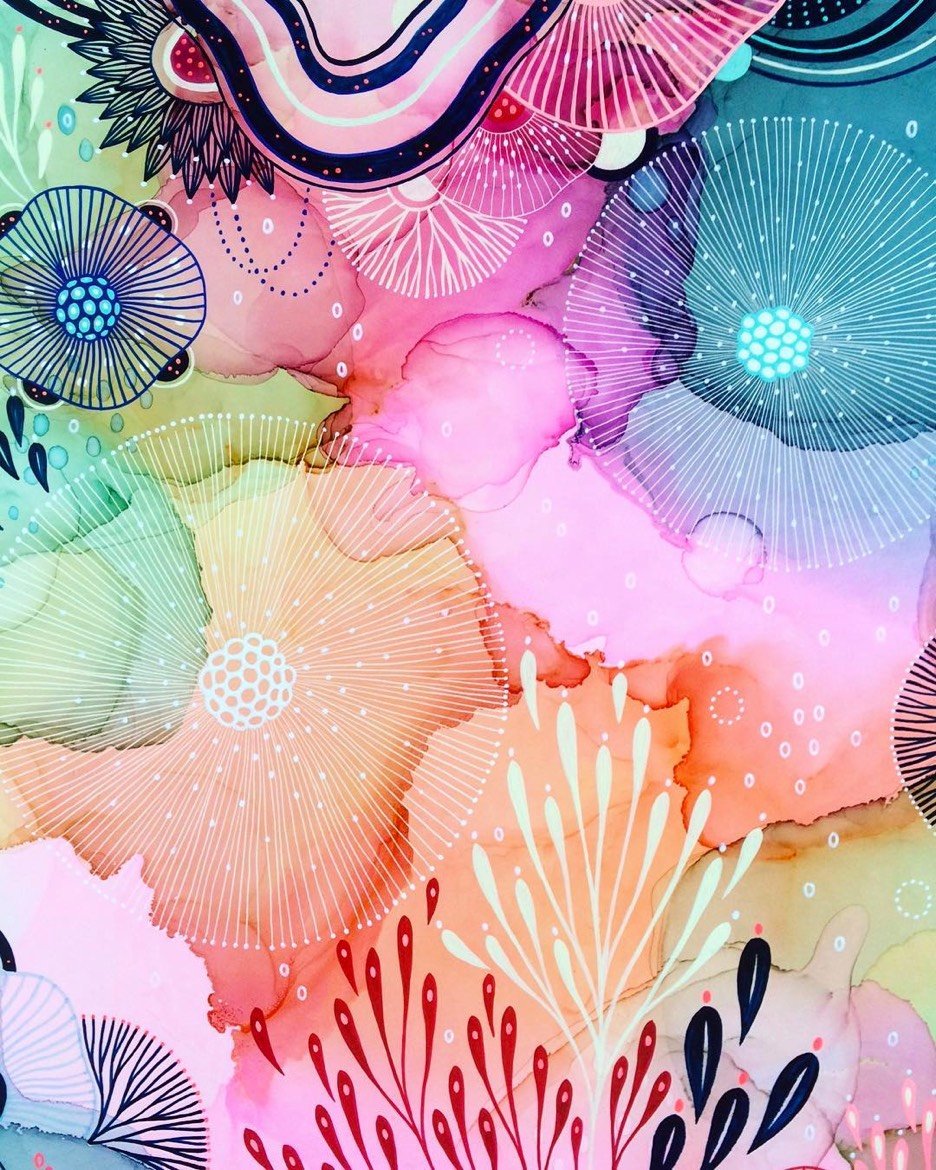
James has a lot of irons in the fire: she sells prints of her work on Etsy (scarves too!), works with a number of brands on design projects, published a book on learning how to draw using nature as a guide, regularly exhibits her art in galleries & shows, and does painting tutorials for the likes of Adobe.
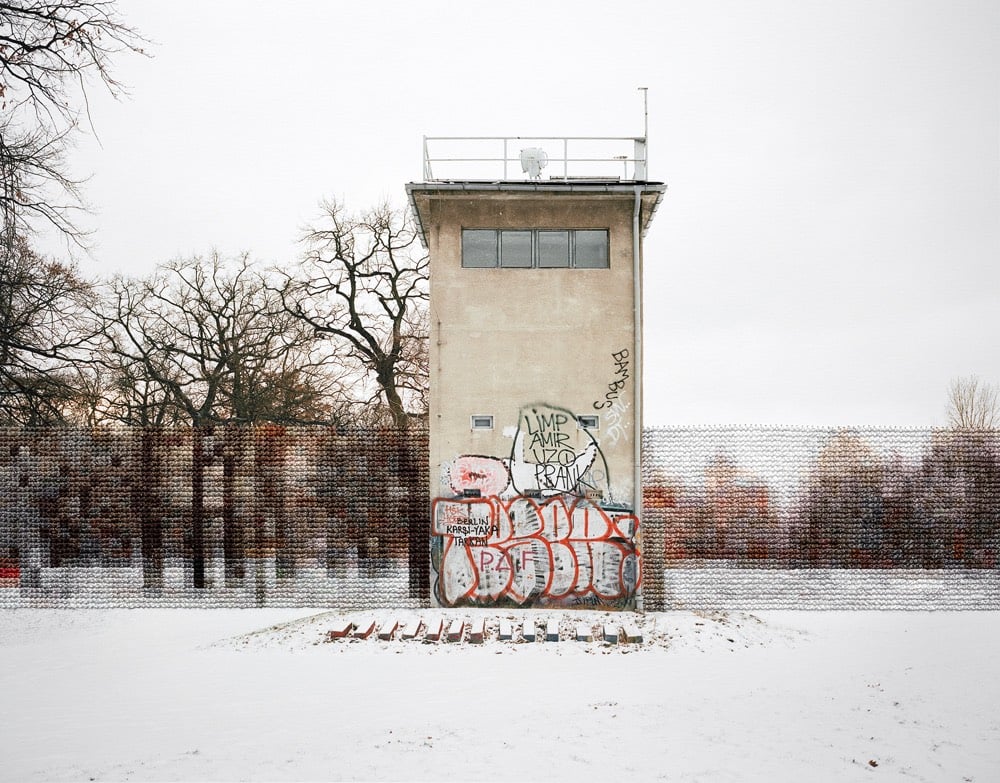
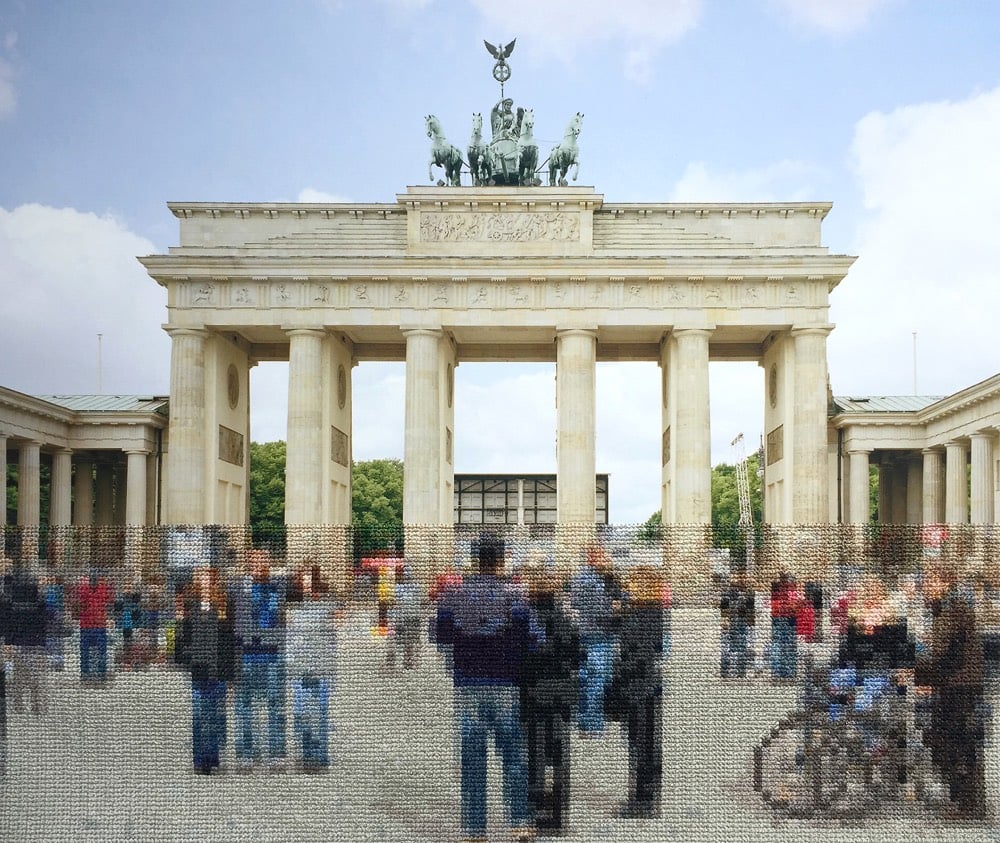
For her series called Berlin, artist Diane Meyer embroiders the Berlin Wall back into modern-day scenes of the once-divided German city. Meyer hand-sews the thread right onto the photographs.
In many images, the embroidered sections represent the exact scale and location of the former Wall offering a pixelated view of what lies behind. In this way, the embroidery appears as a translucent trace in the landscape of something that no longer exists but is a weight on history and memory.
(via colossal)
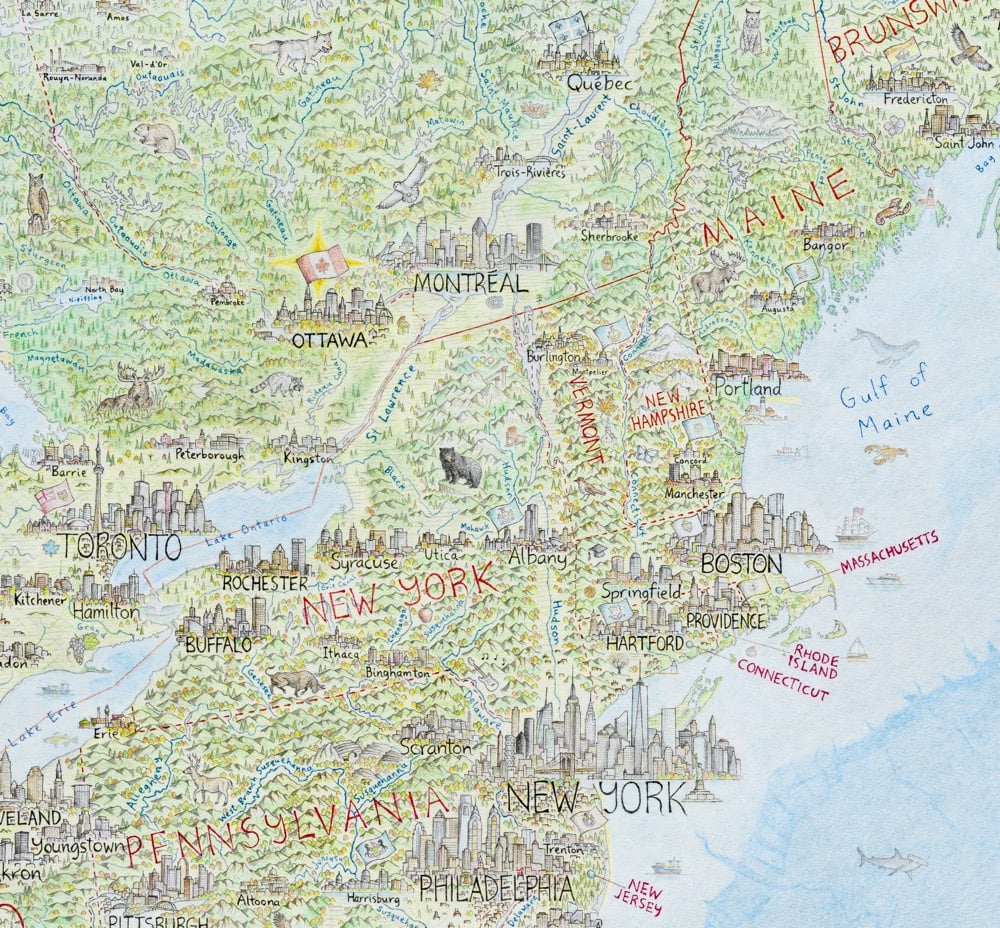
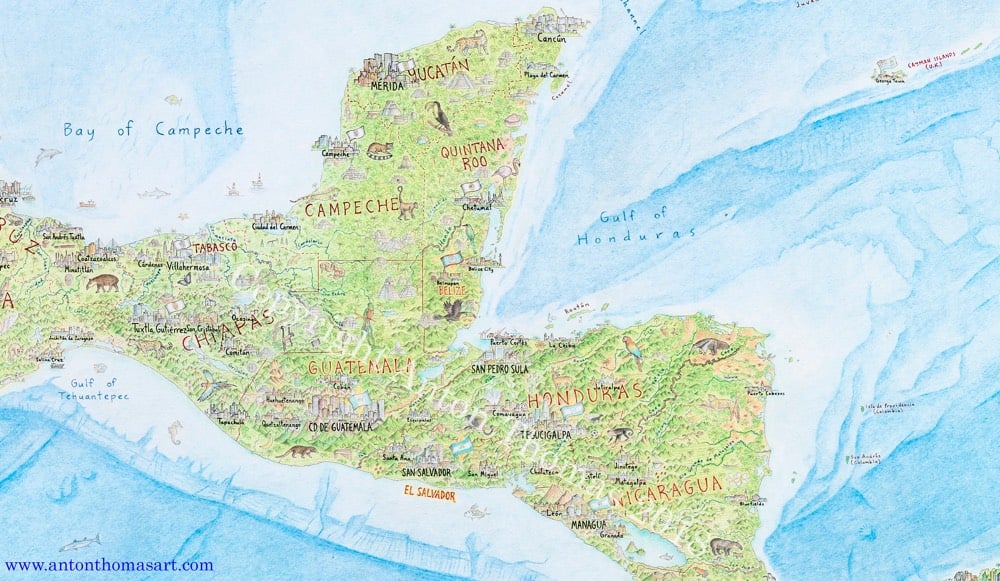
Anton Thomas has been working for the last five years on a huge hand-drawn map of North America.
North America: Portrait of a Continent is drawn completely by hand with colour pencil and pen. It is a 5 x 4 feet (150 x 120 cm) perspective projection of the entire region, spanning from Alaska to Panama; Greenland to the Caribbean. There are tens of thousands of features, including 600 individual cities and towns.
Looks fantastic. He finished it in February and is getting ready to open pre-orders for prints sometime this month.
Update: Prints of the map are available on Thomas’ store. He also made a video tour of the Mississippi River, in which he shares what all the little details on the map signify along the river’s meandering course.
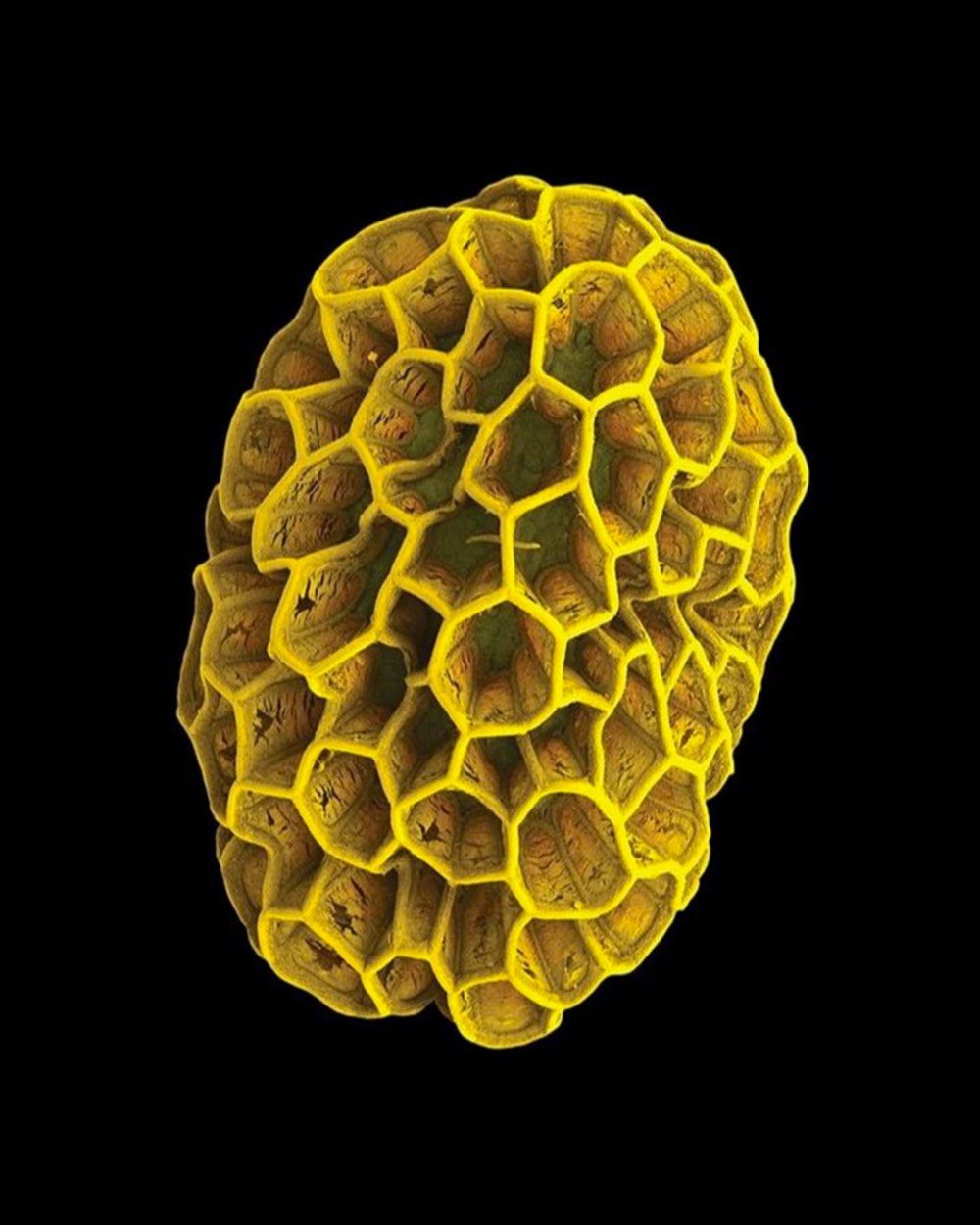
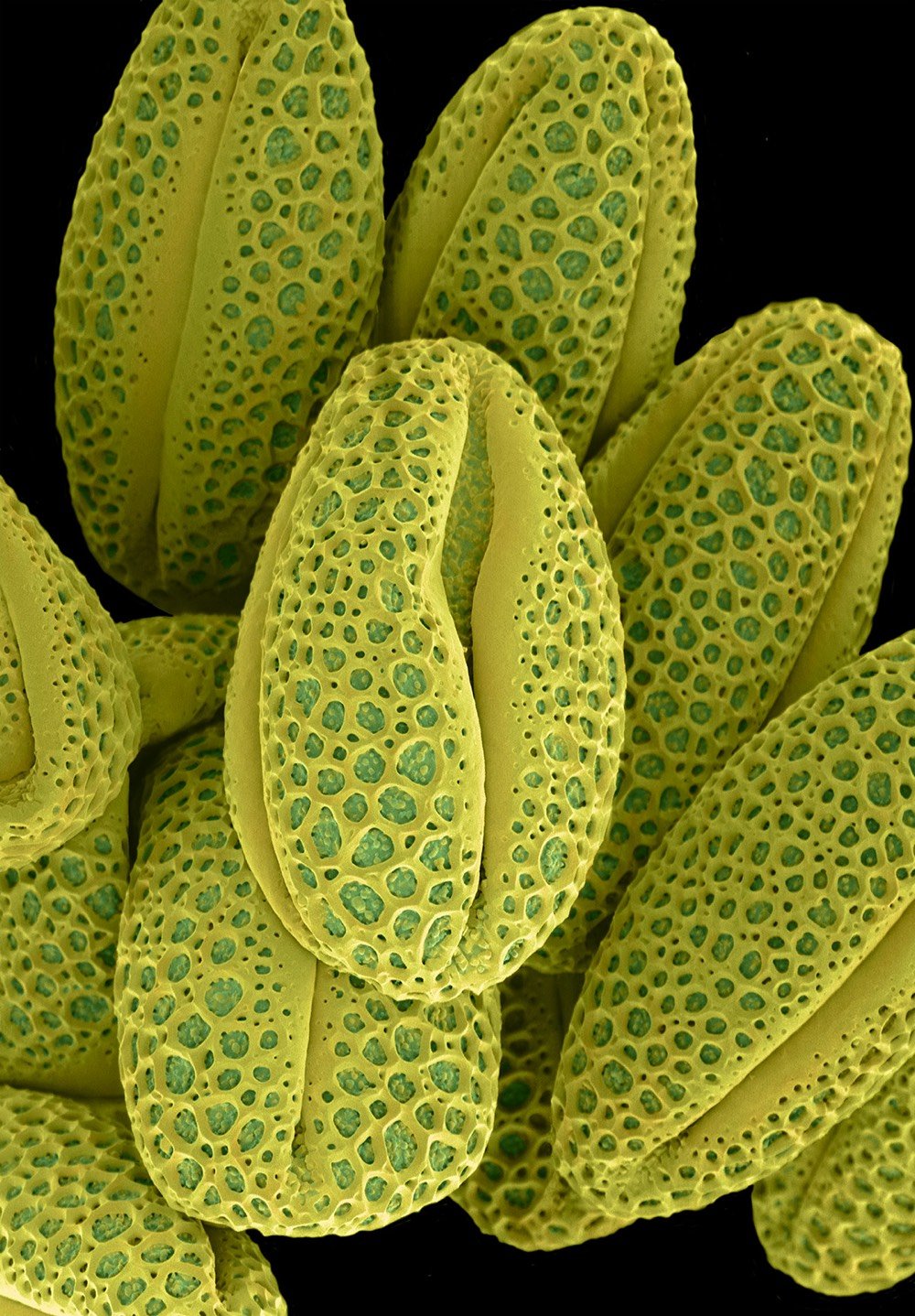
Artist Rob Kesseler is a master of the microphotography of plants and their intricately small parts (like pollen, cells, and seeds). At Colossal, Kessler says a childhood gift of a microscope set him on his way.
“What the microscope gave me was an unprecedented view of nature, a second vision,” he writes, “and awareness that there existed another world of forms, colours and patterns beyond what I could normally see.” The artist says his use of color is inspired by the time he spends researching and observing, and that just like nature, he employs it to attract attention.
Check out much more of Kesseler’s work on his website. (via colossal)
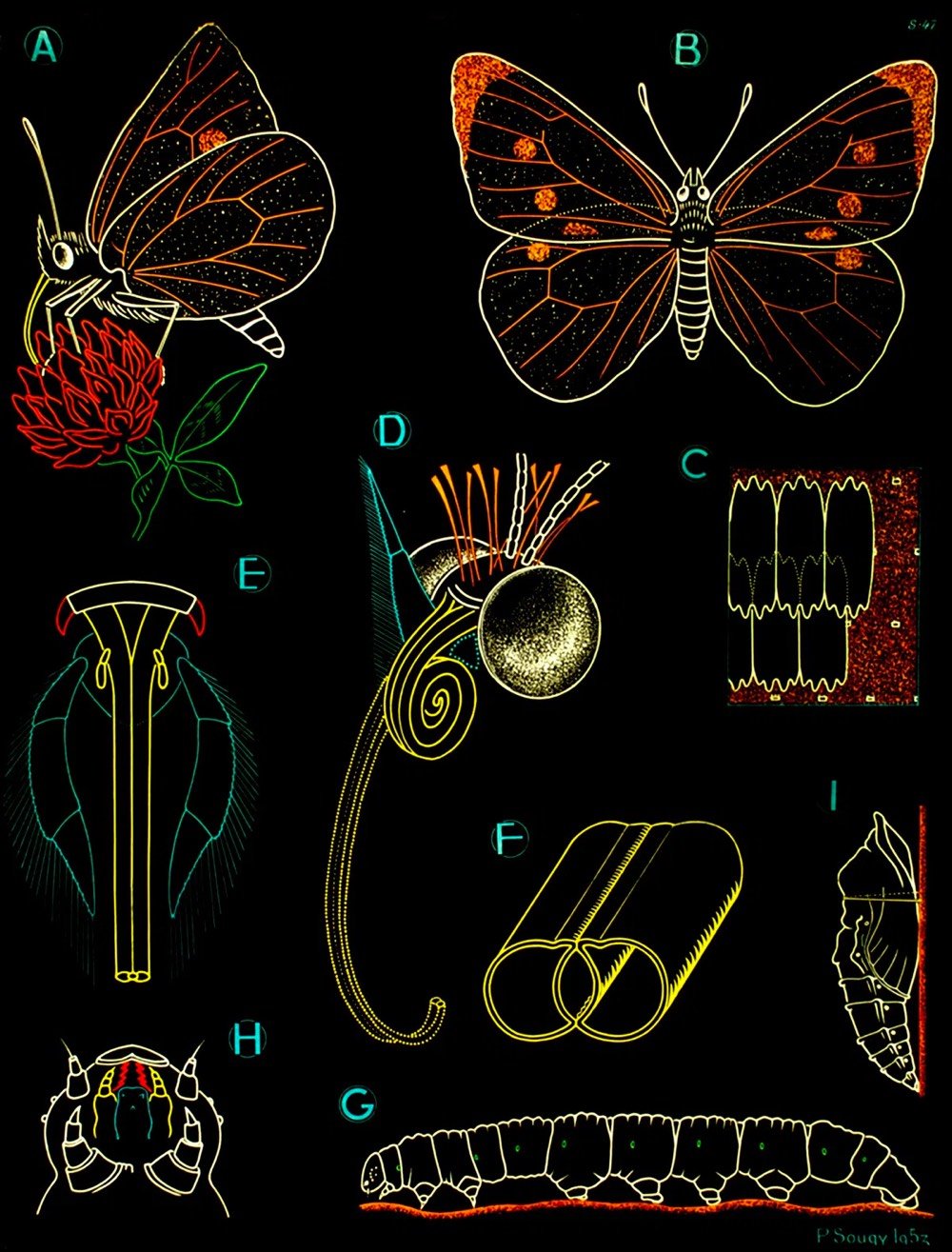
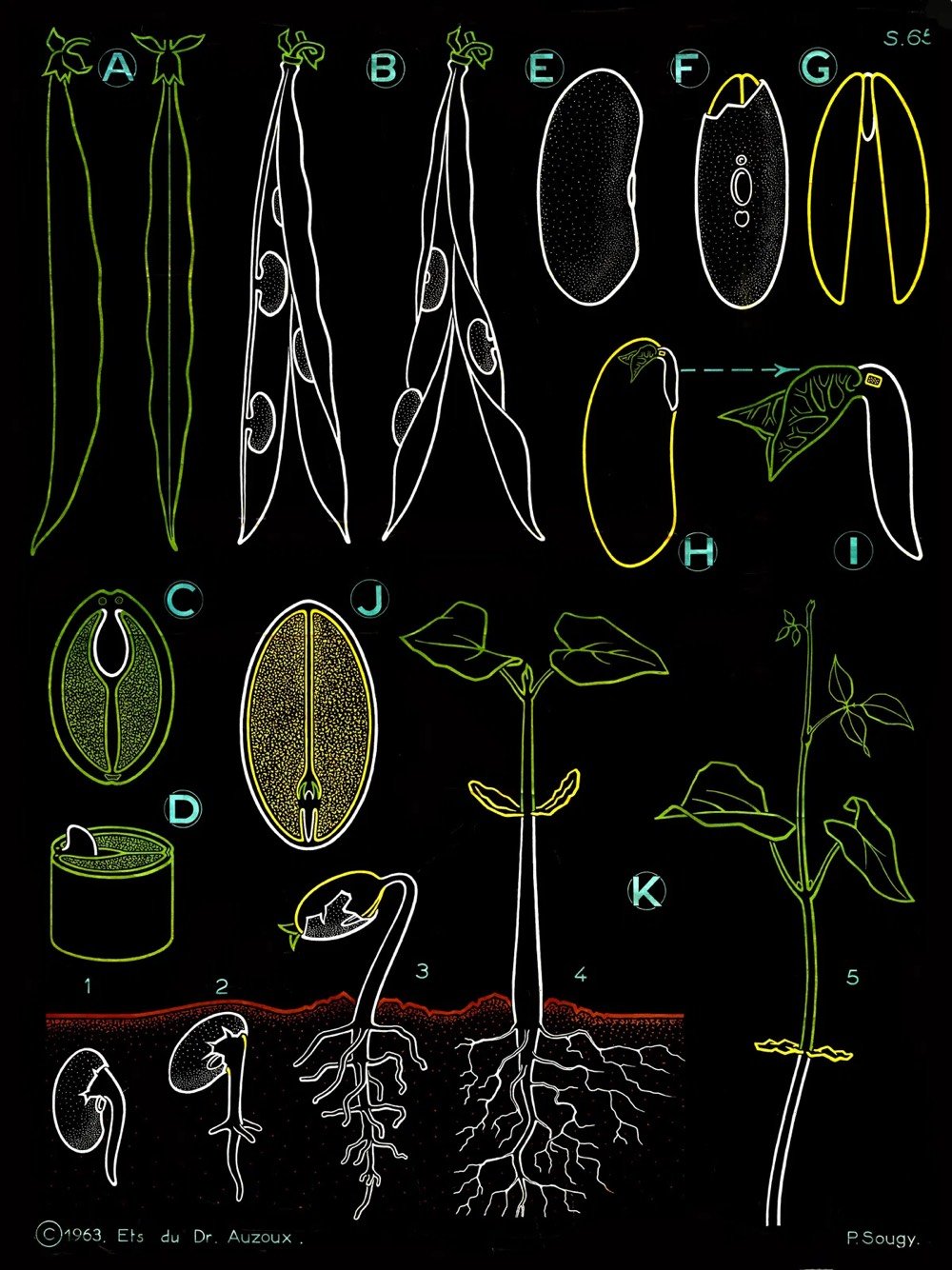
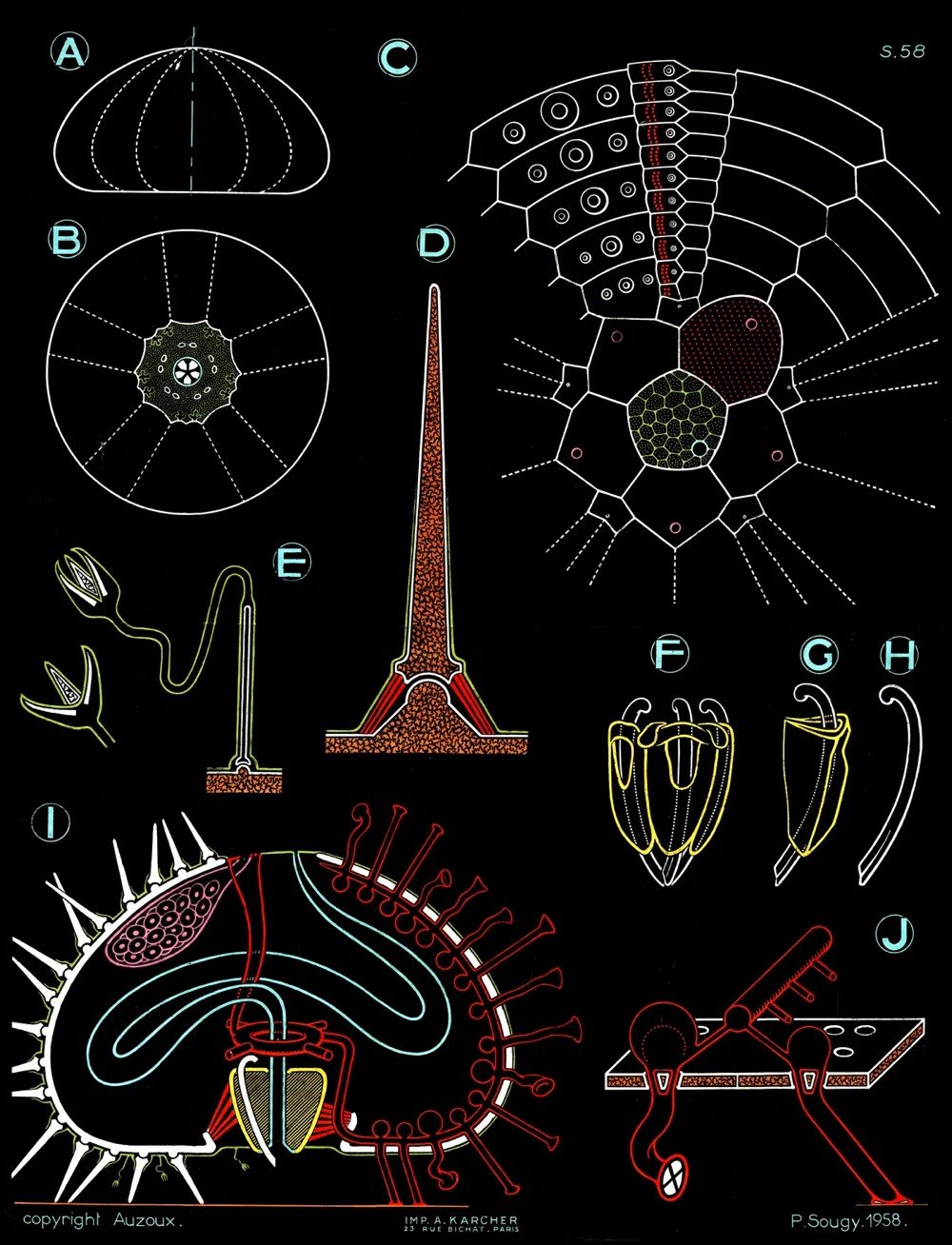
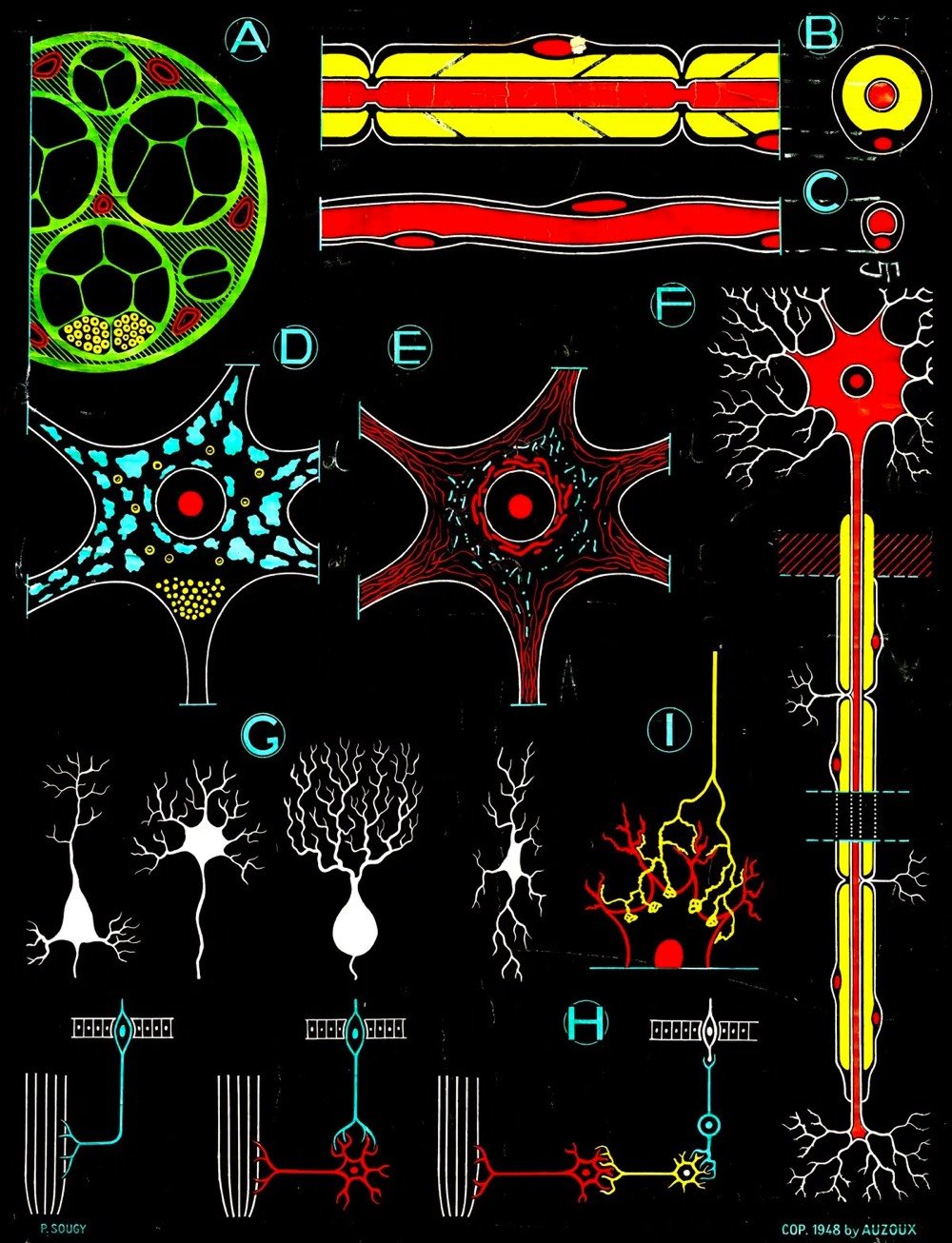
A flea market find by a friend spurred Maria Popova to rediscover and restore Paul Sougy’s mid-century educational illustrations of plants, animals, and the human body.
In the 1940s, Paul Sougy — a curator of natural history at the science museum of the French city of Orléans, and a gifted artist — was commissioned by the estate of the pioneering 18th-century French naturalist and anatomist Louis Thomas Jérôme Auzoux to create a series of illustrations based on Auzoux’s work, to be used in textbooks, workbooks, transparencies, and large-scale educational charts for classroom walls.
Lovely work. The restored illustrations are available as prints — just click on any of the images in the post or visit Popova’s Society6 shop. A portion of the proceeds go to benefit The Nature Conservancy.
Newer posts
Older posts



Socials & More