kottke.org posts about TV
HLN (which used to be CNN Headline News) needed someone to talk about Edward Snowden, US government whistleblower. They meant to invite a gentleman named John Hendren, a journalist for Al Jazeera, onto the show but instead invited funnyman Jon Hendren, who goes by the username of @fart on Twitter. Hendren, Jon used the opportunity to defend both Edward Snowden, briefly, and then sexy-but-misunderstood barber Edward Scissorhands.
Well, you know, to say he couldn’t harm someone, well, absolutely he could. But I think to cast him out, to make him invalid in society, simply because he has scissors for hands, I mean, that’s strange. People didn’t get scared until he started sculpting shrubs into dinosaur shapes and whatnot.
The best part is that anchor Yasmin Vossoughian just keeps on plowing right through her script like they’re not talking suddenly about a man with scissors for hands, deftly demonstrating what a farce these TV news “conversations” are. (via nymag)
From the landmark science series Cosmos, Carl Sagan narrates the evolution of humans from the first cells billions of years ago.
That’s Yoann Hervo’s tribute to The Simpsons in the form of a glitchy opening scene. I watched this last week and wasn’t going to post it but found myself thinking about it over the weekend so heeeeeere you go.
Netflix and Charlie Brooker have agreed to make 12 more episodes of the fantastic Black Mirror.
Netflix has commissioned House of Tomorrow to produce the twelve new episodes as a Netflix original series. House of Tomorrow’s Charlie Brooker and Annabel Jones, who executive produced the first seven episodes of the series, will continue to serve as executive producers and showrunners for the new episodes. Brooker has commenced writing the new episodes, which are scheduled to begin production in late 2015 from the series’ production base in the UK.
“It’s all very exciting — a whole new bunch of Black Mirror episodes on the most fitting platform imaginable. Netflix connects us with a global audience so that we can create bigger, stranger, more international and diverse stories than before, whilst maintaining that ‘Black Mirror’ feel. I just hope none of these new story ideas come true,” said Brooker.
My three favorite TV shows from the past 5 years: Mad Men, Transparent, and Black Mirror. Second tier: Breaking Bad, Sherlock, Game of Thrones, Halt and Catch Fire, and Boardwalk Empire. (via @mccanner)
The opening credits sequence of The Wire done using clips from The Simpsons. The theme song and clips are from the third seasons of the respective shows.
Who would have guessed 15 years ago that this self-styled rebel, who wrote about waitress blow jobs and shooting heroin in his best-selling 2000 memoir, Kitchen Confidential, would become America’s contemporary answer to, say, Mark Twain — our most enthusiastic chronicler of life outside our borders?
Josh Eells tags along to get a firsthand look at Anthony Bourdain’s world domination.
Wesley Morris expertly examines the show’s achievements:
American television has always been fundamentally white. Its points of view emanate from the vantages of those who control the industry and create its content. If it deals with race as a problem, it typically can do so only if it believes there’s a solution. But as a black viewer, I’m never looking for contrition, simply an acknowledgement of a condition; I don’t need television — or American culture — to provide a remedy. Black America has tended to see the discrepancy between the cultural importance to diagnose and the delusion to attempt to cure. Merely giving a nonwhite person a speaking role is not absolution. That contradiction is visible to a black audience almost anytime it sees itself chauffeuring, housekeeping, mammying, best-friending, sidekicking, saying everything about white characters while saying nothing about itself. That was the biracial brilliance of Key and Peele. It understood race as real and racism as inevitable, and never lost sight of the way in which individual white people can be agents of change but also of offense, wittingly or not supporting a system of demoralization.
Kwame Opam discusses how the show lived and grew across the world wide web:
Key & Peele’s greatest strength and weakness was its format; as a sketch show, it’s best remembered for its bite-sized bits — most of which wound up online. “Substitute Teacher,” which first aired in 2012, is one of the show’s earliest highlights. It quickly went viral, and right it now boasts more than 80 million views on YouTube. Earlier this year, Paramount even announced it plans on turning it into a feature-length film. But the episode it premiered on only pulled in 1.16 million viewers at the time, a drop in the bucket compared to its online views. And it makes sense, especially for a huge swath of the population that doesn’t have cable. Why wait for the show when you can watch the best clips on the internet?
This is a complex but not unique irony: how a slice of pop culture in 2015 can be popular enough for the President himself to take notice (and embrace it), and to seem to have zeitgeist-defining properties, but not be quite popular enough to sustain a half hour in basic cable.
Maybe that’s tied to something Morris and Opam touch on but don’t quite name. More than any show on television, to my mind, Key and Peele felt young. Not young in the shallow way that all media, maybe especially television, seem to exploit young talent; not young in the same reckless, juvenile way Chappelle’s Show or vintage Saturday Night Live was; young in the open, searching, insouciant, absurdist key that’s so important to sketch comedy.
That’s what’s in the mix of what Morris rightly identifies as the show’s blend of sadness and acceptance. It’s youth knowing that this is not forever, that it would be wrong to linger, that the future (and everything good, bad, and unchanging that comes with it) is inevitable.
Twenty-five years after its first airing on PBS, Ken Burns has remastered his epic documentary, The Civil War, and PBS will be airing the new version all this week, starting tonight. The remastered series will also be available on Blu-ray in October.
If you recut the scenes from seasons seven & eight of Seinfeld to emphasize certain aspects of Susan’s death-by-envelope, you get a feel-good TV movie about George Costanza, a man who finds triumph in the midst of tragedy.
Her death takes place in the shadow of new life; she’s not really dead if we find a way to remember her.
Everyone knows that The Karate Kid is the story of Daniel LaRusso, an undersized new-kid-in-school who, with the help of a wise mentor and unconventional training in the martial arts, is able to triumph over a gang of bullies picking on him. What this video presupposes is, maybe Daniel is the real bully?
To no one’s surprise, Johnny advances to the final round and karma catches up with Daniel when his leg is injured by the boy he wantonly attacked on the soccer field. However, just as Johnny is about to be awarded his trophy, Daniel is granted unnatural strength by the demon sorcerer Miyagi, enabling him to defeat Johnny and win the tournament in an upset.
See also more revisionist history of beloved media: Hermione Granger as the real hero of the Harry Potter books and Tim Carmody’s The Iceman List, which is about “classic movie antagonists who were actually pretty much right all along”.
Update: Another one to add to the list: Ross Geller is the hero of Friends, an intellectual and romantic man who is brought low by his so-called friends:
But the characters of the show were pitted against him from the beginning (consider episode 1, when Joey says of Ross: “This guy says hello, I wanna kill myself.”) In fact, any time Ross would say anything about his interests, his studies, his ideas, whenever he was mid-sentence, one of his “friends” was sure to groan and say how boring Ross was, how stupid it is to be smart, and that nobody cares. Cue the laughter of the live studio audience. This gag went on, pretty much every episode, for 10 seasons. Can you blame Ross for going crazy?
And like a Greek tragedy, our hero is caught in a prophecy that cannot be avoided. The show’s producers, akin to the immutable voice of the gods, declared that Ross must end up with Rachel, the one who shops. Honestly, I think he could’ve done better.
PBS is airing a documentary in September about Muppets creator Jim Henson called In Their Own Words: Jim Henson.
I had never really noticed before that Henson’s natural speaking voice obviously sounds a lot like Kermit. (via @khoi)
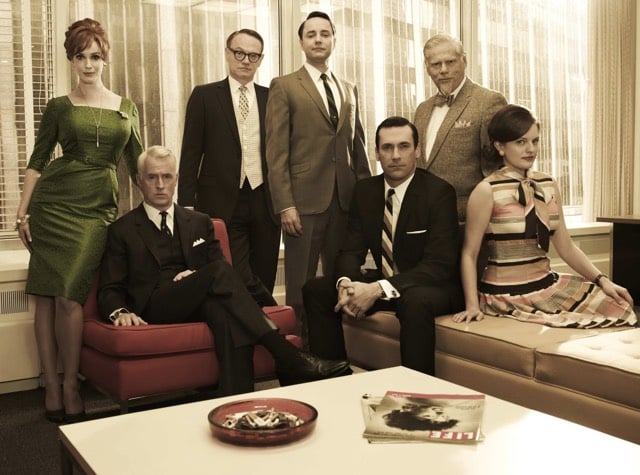
One of my favorite movie/TV critics, Matt Zoller Seitz, is coming out with a book this fall on Mad Men called Mad Men Carousel: The Complete Critical Companion.
Mad Men Carousel, authored by Abrams’ bestselling author Matt Zoller Seitz, will gather all of Seitz’s widely read (and discussed) Mad Men essays in a single volume. Rather than simply recalling the plot through lengthy summary, Seitz’s essays dig deep into the show’s themes, performances and filmmaking, with the tone and spirit of accessible, but serious, film or literary criticism. This novel-sized volume will be designed to have a 1970s feel and will be broken into seven sections, one for each season.
Seitz wrote the dreamy The Wes Anderson Collection.
Still, where did the lighter fluid come from?
Sister is my new mother, Mother.
I’m afraid I just blue myself.
I’m about halfway through season two of Arrested Development again on Netflix and it might be the best show ever on television. I’m not even kidding.
Update: NPR has been obsessively cataloging the show’s running gags here. Holy shit, the extensive foreshadowing of Buster losing his hand! This show is amazing. (via @Nick__Vance)
In the mid-90s, Stewart Brand published a fantastic book called How Buildings Learn: What Happens After They’re Built.
Buildings have often been studies whole in space, but never before have they been studied whole in time. How Buildings Learn is a masterful new synthesis that proposes that buildings adapt best when constantly refined and reshaped by their occupants, and that architects can mature from being artists of space to becoming artists of time.
From the connected farmhouses of New England to I.M. Pei’s Media Lab, from “satisficing” to “form follows funding,” from the evolution of bungalows to the invention of Santa Fe Style, from Low Road military surplus buildings to a High Road English classic like Chatsworth-this is a far-ranging survey of unexplored essential territory.
In 1997, Brand and the BBC did a six-part TV series based on the book. Brand has put the series on his YouTube channel; here’s the first part to get you going:
(via open culture)
Newer posts
Older posts





Socials & More