kottke.org posts about Russia
As we saw yesterday in this compilation, a lot of vehicular bad behavior is caught on camera. Marina Galperina explored why Russians get into so many traffic accidents and where all the video footage comes from.
Dash-cam footage is the only real way to substantiate your claims in the court of law. Forget witnesses. Hit and runs are very common and insurance companies notoriously specialize in denying claims. Two-way insurance coverage is very expensive and almost completely unavailable for vehicles over ten years old-the drivers can only get basic liability. Get into a minor or major accident and expect the other party to lie to the police or better yet, flee after rear-ending you. Since your insurance won’t pay unless the offender is found and sued, you’ll see dash-cam videos of post hit and run pursuits for plate numbers.
And sometimes drivers back up or bump their pre-dented car into yours. It used to be a mob thing, with the accident-staging specialists working in groups. After the “accident,” the offending driver — often an elderly lady — is confronted by a crowd of “witnesses,” psychologically pressured and intimidated to pay up cash on the spot. Since the Age of the Dash-cam, hustle has withered from a flourishing enterprise to a dying trade, mainly thriving in the provinces where dash-cams are less prevalent.
Here’s a video compilation of scam attempts foiled by cameras. (thx, andrew & sam)
This video is 13 minutes of traffic accidents in Russia and totally amazing.
Question #1: Why did I end up watching all 13 minutes of this video? A: Because it’s one literally unbelievable thing after another.
Question #2: Was that a jet? A: Yes! And a helicopter.
Question #3: Why does everyone in Russia record their drives? A: Because this sort of thing happens all the time?
Question #4: I didn’t know a powerline could flip a car over. A: Not a question, but yeah, WTF!?
Question #5: Have you ever seen so many tires fall off of cars before? A: No. No I haven’t.
A NY Times foreign correspondent formerly stationed in Russia tells the story of placing his three kids into an unusual school in Moscow where all the instruction is done in Russian.
My three children once were among the coddled offspring of Park Slope, Brooklyn. But when I became a foreign correspondent for The New York Times, my wife and I decided that we wanted to immerse them in life abroad. No international schools where the instruction is in English. Ours would go to a local one, with real Russians. When we told friends in Brooklyn of our plans, they tended to say things like, Wow, you’re so brave. But we knew what they were really thinking: What are you, crazy? It was bad enough that we were abandoning beloved Park Slope, with its brownstones and organic coffee bars, for a country still often seen in the American imagination as callous and forbidding. To throw our kids into a Russian school — that seemed like child abuse.
Be sure to watch the video.
Anna Skladmann takes photographs of the children of rich Russian families.
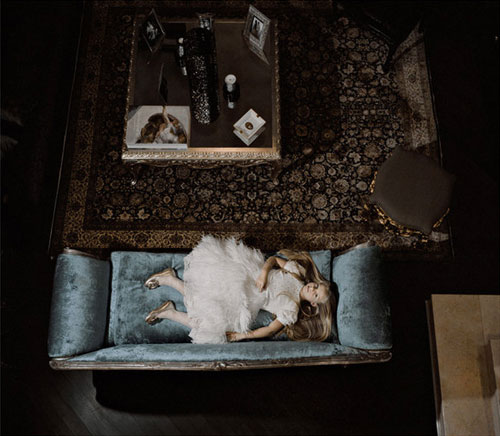
When I came to photograph Eva, she was at home with her two nannies, one British and one Russian. She had planned everything in advance: the dress she had chosen hung already perfectly ironed and pressed with matching tights and shoes carefully next to it. I felt that I had been hired by Eva to do this shoot rather than the other way around. She was experienced and knowledgeable as she showed me the rooms we were allowed to photograph. She placed herself carefully on the edge of a couch, stood in front of her favorite painting, and posed in her parents’ library. At the end of this photo session she was exhausted and lay down on the sofa. Finally I was able to take the only photograph that I had composed myself.
More here.
Russia is building eight floating nuclear power stations for deployment in the Arctic Ocean to support their efforts to drill for oil near the North Pole.
He says each power station, costing $400m, can supply electricity and heating for communities of up to 45,000 people and can stay on location for 12 years before needing to be serviced back in St Petersburg.
And while initially they will be positioned next to Arctic bases along the North coast, there are plans for floating nuclear power stations to be taken out to sea near large gas rigs.
“We can guarantee the safety of our units one hundred per cent, all risks are absolutely ruled out,” says Mr Zavyalov.
Yeah, what could possibly go wrong? (via @polarben)
A Russian man has come forward with his collection of CPUs, which could be the largest in the world. The collection consists of vintage Soviet CPUs, as well as several newer models. I’m a little out of my comfort zone with this one, and it’s completely possible this is a hoax. If so, it’s worth it just for the picture of the dude in a muscle shirt displaying his collection. Click through and tell me it’s not.
There are some tsarist Russia posters in the collection as well. (via do)
Nikolai Sutyagin decided to build himself a home befitting the owner of a lumber and construction company. This resident of Archanglesk, Russia, built a regular Izba, or wooden country dwelling, that was the standard two stories, because anything higher is considered a fire hazard by law. Once complete, he began to add to the roof bit by bit, using leftover lumber from his company. Eventually his home teetered at an unbelievable 12-15 stories, tall enough to view the White Sea from the top. Though Nikolai ran into some trouble with an embezzling employee and jail time for beating up said employee, he and his family are rumored to still dwell in the timber tower, which looks like something out of an Edward Gorey etching.
To sort out the uncultured, ill-tempered, and just plain ugly, Moscow clubs use a process called face control (or feis kontrol), a particularly picky version of the typical velvet rope system employed at clubs around the world.
Not that Pasha doesn’t take his role seriously. As he sees it, his job, or that of any face control expert, is necessary because Russia is filled with “people who have just made their first million and think they deserve to be in the club, that they should get everything they want.” This, of course, is a problem. “But in fact they’re just a bunch of miners and day laborers,” Pasha said. “They don’t have respect or culture.”
The color photography of Sergei Mikhailovich Prokudin-Gorskii, who plied his trade in Russia in the early 1900s, is making the rounds online again. It’s always worth a look. Prokudin-Gorskii made color photographs using a clever filtering system years before color photography would be widely available. As a result, his work goes on the list of things that seem contemporary but really aren’t.


As Mike notes, I first linked to Prokudin-Gorskii’s work more than 8 years ago (!!).
Update: Clayton James Cubitt reminded me that Prokudin-Gorskii took a color portrait of Leo Tolstoy in 1908. (thx, clayton)
Synchonized jumping from bridges is a thing in Russia now.
It’s new fun in some Russian cities, to jump from the bridge with the rope in a big group, when there is no water under the bridge but raw firm ice, also they use to jump at that same moment when the train is going thru the bridge — just imagine what the machinist could think when he sees a bunch of people standing on the rails just before the moving train, so he probably starts slowing down and then all those people jump out of the bridge…
As a companion to an offline article about illegal logging, the New Yorker has a video that traces illegally cut wood in Russia to distribution and manufacturing centers in China and eventually a finished toilet seat is shipped to Wal-Mart in the US.
Chip Kidd’s copy of the New York Times reveals the truth behind Russia’s new President: Trickery. (via book design review)
Wonderful timelapse photos by Alexey Titarenko of “shadow” people in St. Petersburg just after the collapse of the Soviet Union. This one is stunning. (via heading east)
Newer posts
Older posts






Socials & More