kottke.org posts about Infinite Jest
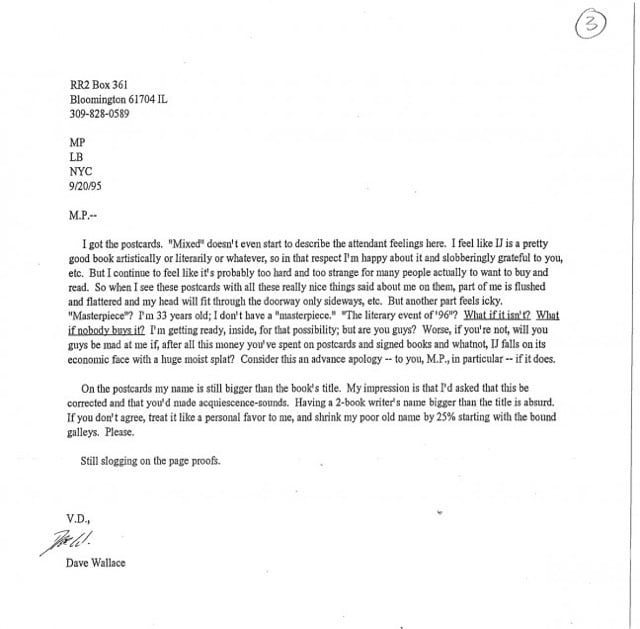
David Foster Wallace’s Infinite Jest turns 20 years old this month. To mark the occasion, the Harry Ransom Center, home of DFW’s archive of papers, is posting some of the more interesting findings by visiting scholars. Here, for instance, is a letter written by Wallace to his editor a few months before IJ’s publication.
(via @john_overholt)
Update: In a NY Times essay adapted from his forward to an upcoming 20th anniversary edition of IJ, Tom Bissell reflects on why Infinite Jest still resonates 20 years later.
In interviews, Wallace was explicit that art must have a higher purpose than mere entertainment: “Fiction’s about what it is to be a … human being.” And here, really, is the enigma of David Foster Wallace’s work generally and “Infinite Jest” specifically: an endlessly, compulsively entertaining book that stingily withholds from readers the core pleasures of mainstream novelistic entertainment, among them a graspable central narrative line, identifiable movement through time and any resolution of its quadrumvirate plotlines. “Infinite Jest,” in other words, can be exceedingly frustrating. To fully understand what Wallace was up to, the book bears being read, and reread, with Talmudic focus and devotion. For many Wallace readers this is asking too much. For many Wallace fans this is asking too much.
Just after Infinite Jest was published, David Foster Wallace came to Boston and did a radio interview with Chris Lydon. Radio Open Source recently unearthed that interview, probably unheard for the past 18 years, and published it on their site.
When I started the book the only idea I had is I wanted to do something about America that was sad but wasn’t just making fun of America. Most of my friends are extremely bright, privileged, well-educated Americans who are sad on some level, and it has something, I think, to do with loneliness. I’m talking out of my ear a little bit, this is just my opinion, but I think somehow the culture has taught us or we’ve allowed the culture to teach us that the point of living is to get as much as you can and experience as much pleasure as you can, and that the implicit promise is that will make you happy. I know that’s almost offensively simplistic, but the effects of it aren’t simplistic at all.
In July, we mentioned Infinite Boston, a project from William Beutler to map and photo the Boston-related locations in Infinite Jest. Today Beutler announced Infinite Atlas, which expands nationally on this project, and Infinite Map, a limited edition print featuring 250 “of the most interesting locations” from Infinite Jest.

Infinite Boston is a photo tour of some of the Boston locations that inspired locations in David Foster Wallace’s Infinite Jest.
In July of what might have been Year of Glad, one year ago this week, I traveled to Boston, Massachusetts with the express purpose of visiting as many of the landmarks and lesser known precincts that appear in, or provide inspiration for, the late David Foster Wallace’s 1996 novel Infinite Jest as I could manage on a Thursday-Sunday trip. My reasons for doing so will become apparent at a later date, but for now I am pleased to present what I am calling “Infinite Boston”: a ruminative travelogue and photographic tour of some fifty or so of these locations, comprising one entry each non-holiday weekday, from now until sometime in early autumn.
A German experimental theater recently put on a production of Infinite Jest. They turned the 1079-page book into a 24-hour play that took place all over Berlin.
The play is Infinite Jest. Yes, the 1,079-page David Foster Wallace novel. Germany’s leading experimental theater, Hebbel am Ufer, had the gall not only to stage the world theatrical premiere of an Infinite Jest adaptation, but to play it on the grandest stage possible: the city of Berlin itself. Over the course of 24 hours, the shell-shocked and increasingly substance-dependent audience is transported to eight of the city’s iconic settings, which serve as analogs for the venues to which the discursive novel continually returns.
But so we’re at this AA meeting in a Boston school cafeteria, which in this case is the cultural center of a city quarter that was drawn up from scratch in the 1960s in the far, far north of Berlin, like practically halfway to the Baltic, this sticks-of-the-sticks-type section of town. And the actor sharing his history of teen addiction to Quaaludes and Hefenreffer-brand beer is droning on far too long and starting to give me the howling fantods.
Every internet article about Wallace is required by law to include footnotes and this one is no exception. (thx, paul)
In Infinite Jest, David Foster Wallace wrote that videophone technology wasn’t popular due in part to vanity.
And the videophonic stress was even worse if you were at all vain. I.e. if you worried at all about how you looked. As in to other people. Which all kidding aside who doesn’t. Good old aural telephone calls could be fielded without makeup, toupee, surgical prostheses, etc. Even without clothes, if that sort of thing rattled your saber. But for the image-conscious, there was of course no answer-as-you-are informality about visual-video telephone calls, which consumers began to see were less like having the good old phone ring than having the doorbell ring and having to throw on clothes and attach prostheses and do hair-checks in the foyer mirror before answering the door.
Now DC-area plastic surgeon Dr. Robert Sigal is offering what he calls the “FaceTime Facelift”.
“Patients come in with their iPhones and show me how they look on [Apple’s video calling application] FaceTime,” says Dr. Sigal. “The angle at which the phone is held, with the caller looking downward into the camera, really captures any heaviness, fullness and sagging of the face and neck. People say ‘I never knew I looked like that! I need to do something!’ I’ve started calling it the ‘FaceTime Facelift’ effect. And we’ve developed procedures to specifically address it.”
(via @timbritton)
Chris Ayers is designing posters, logos, and magazine spreads for the fictional people, places, and things in David Foster Wallace’s Infinite Jest, including movie posters for Himself’s films, a magazine layout for an article on Orin, and this poster for the Whataburger Southwest Junior Invitational tennis tournament:

(via @tcarmody)
Someone at Yahoo Answers posted the first page of Infinite Jest with the title “First page of my book. what do you think?” The crowd was not impressed:
No discernible voice/tone in this writing. Rambling descriptions. I, frankly, do not care where each and every person is seated. I don’t care what shoe you’re wearing. If you take out all the unnecessary details, you’d be left with about seven words.
See also what happens when a photo by Henri Cartier-Bresson gets critiqued on Flickr.
so small
so blurry
to better show a sense of movement SOMETHING has to be in sharp focus
(thx, timothy)
This infographic attempts to explain all the interpersonal connections in Infinite Jest. (via personal report)
The recently announced iPhone 4 includes a feature called FaceTime; it’s wifi videophone functionality. In Infinite Jest, David Foster Wallace wrote that within the reality of the book, videophones enjoyed enormous initial popularity but then after a few months, most people gave it up. Why the switch back to voice?
The answer, in a kind of trivalent nutshell, is: (1) emotional stress, (2) physical vanity, and (3) a certain queer kind of self-obliterating logic in the microeconomics of consumer high-tech.
First, the stress:
Good old traditional audio-only phone conversations allowed you to presume that the person on the other end was paying complete attention to you while also permitting you not to have to pay anything even close to complete attention to her. A traditional aural-only conversation […] let you enter a kind of highway-hypnotic semi-attentive fugue: while conversing, you could look around the room, doodle, fine-groom, peel tiny bits of dead skin away from your cuticles, compose phone-pad haiku, stir things on the stove; you could even carry on a whole separate additional sign-language-and-exaggerated-facial-expression type of conversation with people right there in the room with you, all while seeming to be right there attending closely to the voice on the phone. And yet — and this was the retrospectively marvelous part — even as you were dividing your attention between the phone call and all sorts of other idle little fuguelike activities, you were somehow never haunted by the suspicion that the person on the other end’s attention might be similarly divided.
[…] Video telephony rendered the fantasy insupportable. Callers now found they had to compose the same sort of earnest, slightly overintense listener’s expression they had to compose for in-person exchanges. Those caller who out of unconscious habit succumbed to fuguelike doodling or pants-crease-adjustment now came off looking extra rude, absentminded, or childishly self-absorbed. Callers who even more unconsciously blemish-scanned or nostril explored looked up to find horrified expressions on the video-faces at the other end. All of which resulted in videophonic stress.
And then vanity:
And the videophonic stress was even worse if you were at all vain. I.e. if you worried at all about how you looked. As in to other people. Which all kidding aside who doesn’t. Good old aural telephone calls could be fielded without makeup, toupee, surgical prostheses, etc. Even without clothes, if that sort of thing rattled your saber. But for the image-conscious, there was of course no answer-as-you-are informality about visual-video telephone calls, which consumers began to see were less like having the good old phone ring than having the doorbell ring and having to throw on clothes and attach prostheses and do hair-checks in the foyer mirror before answering the door.
Those are only excerpts…you can read more on pp. 144-151 of Infinite Jest. Eventually, in the world of the book, people began wearing “form-fitting polybutylene masks” when talking on the videophone before even that became too much.
A 1996 profile of David Foster Wallace from Details magazine. An early mainstream magazine interview with Wallace about Infinite Jest, it hasn’t been seen since its initial publication. Craig Fehrman dug it up in the Yale Library.
Brought up an atheist, he has twice failed to pass throguh the Rite of Christian Initiation for Adults, the first step toward becoming a Catholic. The last time, he made the mistake of referring to “the cult of personality surrounding Jesus.” That didn’t go over big with the priest, who correctly suspected Wallace might have a bit too much skepticism to make a fully obedient Catholic. “I’m a typical American,” says Wallace. “Half of me is dying to give myself away, and the other half is continually rebelling.”
The Ransom Center at the University of Texas has acquired the archives of David Foster Wallace, joining those of Don DeLillio and Norman Mailer.
The archive contains manuscript materials for Wallace’s books, stories and essays; research materials; Wallace’s college and graduate school writings; juvenilia, including poems, stories and letters; teaching materials and books.
Highlights include handwritten notes and drafts of his critically acclaimed “Infinite Jest,” the earliest appearance of his signature “David Foster Wallace” on “Viking Poem,” written when he was six or seven years old, a copy of his dictionary with words circled throughout and his heavily annotated books by Don DeLillo, Cormac McCarthy, John Updike and more than 40 other authors.
Materials for Wallace’s posthumous novel “The Pale King” are included in the archive but will remain with Little, Brown and Company until the book’s publication, scheduled for April 2011.
The web site currently contains some tantalizing examples of what the archive will eventually hold, including the first page of a handwritten draft of Infinite Jest, his annotated dictionary — circled words included benthos, exergue, hypocorism, mendacious, rebus, and witenagemot — and some heavily annotated books he owned, including his copy of Players by DeLillo.

This is really exciting and sad all at once. (thx, matt)
Someone sent this to me ages ago and I forgot to post it but luckily I ran across it again this morning: A Failed Entertainment is a show at The LeRoy Neiman Gallery featuring the films of James Incandenza…you know, the ones from the 8-page footnote in Infinite Jest.
Included as a footnote in Wallace’s novel is the Complete filmography of James O. Incandenza, a detailed list of over 70 industrial, documentary, conceptual, advertorial, technical, parodic, dramatic non-commercial, and non-dramatic commercial works. The LeRoy Neiman Gallery has commissioned artists and filmmakers to re-create seminal works from Incandenza’s filmography.
No word on whether any of the filmmakers made JOI’s Infinite Jest…I guess we’ll find out if anyone emerges from the opening reception tonight.
Those of you still plugging away at Infinite Summer may not want to read this (i.e. spoilers!), but Brian Barone finished early and found some interesting mathematical themes in the book.
Now, here’s the part that really boggled me: the Consumption/Waste idea is a 1:1 correspondence (something in yields something out), what mathematicians call a linear function. The Parabola idea connects, pretty obviously, with parabolas — now we’re looking at x raised to the power of two. Annular Systems are modeled by circles which are given in analytic geometry by equations with both x^2 and y^2. Limits and Infinity, of course, become necessary in order to find the area of shapes under curves like parabolas and three-dimensional projections of circles.
Whoa. That is a tiny bit mind-blowing…do I really have time for a reread right now? (thx, nick)
A few weeks ago, I wrote the foreword for Infinite Summer, a summer-long collective read of Infinite Jest, David Foster Wallace’s big-ass novel and one of my favorite books. That piece was actually my second draft. My first attempt was a list of advice on reading the novel…the submission of which prompted InfSum’s dungeon master, Matthew Baldwin, to write back with a frowny face and a pointer to this piece published — unbeknownst to me (I have the Time Machine backups to prove it!) — the day before I submitted my draft.
Anyway, here’s that first draft on how to read Infinite Jest:
1. If you haven’t already, buy the book, get it from your local library, or download to your Kindle. I got my copy in 2001 at a local San Francisco bookstore; I bought it used along with a used copy of Don DeLillo’s Underworld (which I started but never finished). I was upset at something that day and purchased the books as a sort of Fuck You to whatever it was that was pissing me off. “Oh yeah? Well, I’m gonna read both of these huge books. Fuck You!” Best $10.80 I ever spent.
2. Warning! This book contains several footnotes. Hundreds, in fact. They run on, at a very small point size, for almost 100 pages at the conclusion of the main text. One of the footnotes, which contains the complete filmography of a fictional filmmaker, goes for more than 8 pages and itself has 6 footnotes. Every single oh-my-God-this-thing-is-a-doorstop review of IJ since 1996 has trumpeted this fact so you’re probably already up to speed re: the footnotes but I didn’t want you to be caught unawares or pants down.
3. You’re going to want to but don’t skip the footnotes. They are important. Yes, even the filmography one.
4. Physically, Infinite Jest is a large book: 2.2 inches thick and, according to Amazon.com, has a shipping weight of 3.2 pounds. Some readers have found it useful to rip the book in half for easier reading on the subway or on the beach. If you do this, you also need to tear the footnotes from the back half and tape them to front half. This technique has the side effect of giving you the appearance of A Very Serious Reader of Infinite Jest, which will either keep onlookers’ questions to a minimum or maximum, depending on the onlooker.
5. If you opt not to destroy your copy of IJ, you should use the three bookmark method. One bookmark for where you are in the main text, another for your current footnote location, and a third for page 223, which lists the years covered by the novel in chonological order, from the Year of the Whopper (which corresponds to 2002) to the Year of Glad (2010). To say that IJ skips around quite a bit chronologically is an understatement, so keeping the timeline straight is important.
6. Along with the footnotes, another thing that most reviews mention w/r/t Wallace is his use of words that appear rarely outside of dictionaries. If you get stuck, keep a dictionary handy or consult one of the following online collections: the David Foster Wallace Dictionary, Words I Learned From Reading David Foster Wallace, and the Infinite Jest Vocabulary Glossary.
7. Get a copy of Greg Carlisle’s Elegant Complexity, *the* reference book for Infinite Jest. Reading EC’s notes for each IJ section after you finish will greatly increase your understanding and enjoyment of the book. Here’s an informative review of the guide. As a bonus: “The book is 99% spoiler-free for first-time readers of Infinite Jest.”
8. Finally, you may have heard or read that Wallace committed suicide last year. He was 46 and left a wife and dogs and at least one unpublished novel and a vast literary legacy. This will be difficult, but try not to think too much about the suicide and Wallace’s life-long struggle with depression while reading Infinite Jest. The book is undoubtably autobiographical in some aspects — tennis: check; addiction: check; depression: check; grammar: check — but a strict reading of IJ as a window into Wallace’s troubled soul is a disservice to its thematic richness.
The great thing about Infinite Jest is that it begins at the end, so even though you’re only a few pages in at this point, you already know how the whole thing is going to end. So get to it, it’ll be easier than you think. I wish you way more than luck.
Older posts






Socials & More