From Ed Yong at the Atlantic, a great article on the current state of the pandemic in the United States, what will happen over the next few months, how it will end, and what the aftermath will be.
With little room to surge during a crisis, America’s health-care system operates on the assumption that unaffected states can help beleaguered ones in an emergency. That ethic works for localized disasters such as hurricanes or wildfires, but not for a pandemic that is now in all 50 states. Cooperation has given way to competition; some worried hospitals have bought out large quantities of supplies, in the way that panicked consumers have bought out toilet paper.
Partly, that’s because the White House is a ghost town of scientific expertise. A pandemic-preparedness office that was part of the National Security Council was dissolved in 2018. On January 28, Luciana Borio, who was part of that team, urged the government to “act now to prevent an American epidemic,” and specifically to work with the private sector to develop fast, easy diagnostic tests. But with the office shuttered, those warnings were published in The Wall Street Journal, rather than spoken into the president’s ear. Instead of springing into action, America sat idle.
Rudderless, blindsided, lethargic, and uncoordinated, America has mishandled the COVID-19 crisis to a substantially worse degree than what every health expert I’ve spoken with had feared. “Much worse,” said Ron Klain, who coordinated the U.S. response to the West African Ebola outbreak in 2014. “Beyond any expectations we had,” said Lauren Sauer, who works on disaster preparedness at Johns Hopkins Medicine. “As an American, I’m horrified,” said Seth Berkley, who heads Gavi, the Vaccine Alliance. “The U.S. may end up with the worst outbreak in the industrialized world.”
If you’ve been reading obsessively about the pandemic, there’s not a lot new in here, but Yong lays the whole situation out very clearly and succinctly (he easily could have gone twice as long). The section on potential after effects was especially interesting:
Pandemics can also catalyze social change. People, businesses, and institutions have been remarkably quick to adopt or call for practices that they might once have dragged their heels on, including working from home, conference-calling to accommodate people with disabilities, proper sick leave, and flexible child-care arrangements. “This is the first time in my lifetime that I’ve heard someone say, ‘Oh, if you’re sick, stay home,’” says Adia Benton, an anthropologist at Northwestern University. Perhaps the nation will learn that preparedness isn’t just about masks, vaccines, and tests, but also about fair labor policies and a stable and equal health-care system. Perhaps it will appreciate that health-care workers and public-health specialists compose America’s social immune system, and that this system has been suppressed.
Aspects of America’s identity may need rethinking after COVID-19. Many of the country’s values have seemed to work against it during the pandemic. Its individualism, exceptionalism, and tendency to equate doing whatever you want with an act of resistance meant that when it came time to save lives and stay indoors, some people flocked to bars and clubs. Having internalized years of anti-terrorism messaging following 9/11, Americans resolved to not live in fear. But SARS-CoV-2 has no interest in their terror, only their cells.
I really hope that Betteridge’s law is wrong about that headline I wrote.
Science writer Ed Yong noticed that the stories he was writing quoted sources that were disproportionately male. Using a spreadsheet to track who he contacted for stories and a few extra minutes per piece, Yong set about changing that gender imbalance.
Skeptics might argue that I needn’t bother, as my work was just reflecting the present state of science. But I don’t buy that journalism should act simply as society’s mirror. Yes, it tells us about the world as it is, but it also pushes us toward a world that could be. It is about speaking truth to power, giving voice to the voiceless. And it is a profession that actively benefits from seeking out fresh perspectives and voices, instead of simply asking the same small cadre of well-trod names for their opinions.
Another popular critique is that I should simply focus on finding the most qualified people for any given story, regardless of gender. This point seems superficially sound, but falls apart at the gentlest scrutiny. How exactly does one judge “most qualified”? Am I to list all the scientists in a given field and arrange them by number of publications, awards, or h-index, and then work my way down the list in descending order? Am I to assume that these metrics somehow exist in a social vacuum and are not themselves also influenced by the very gender biases that I am trying to resist? It would be crushingly naïve to do so.
Journalism and science both work better with the inclusion and participation of a diverse set of voices bent on the pursuit of truth.
Update: NY Times’ columnist David Leonhardt conducted his own experiment and discovered I’m Not Quoting Enough Women.
Blue Planet II, the latest BBC nature documentary narrated by David Attenborough, is finally set to air in the US this Saturday on BBC America, AMC, and other networks. Here’s a five-minute preview…if this doesn’t pique your interest, you might actually be dead:
In a review of the program at The Atlantic, Ed Yong makes a bold declaration:
Blue Planet II is the greatest nature series that the BBC has ever produced.
Coming on the heels of Planet Earth II, which I thought was the best thing I watched last year, that’s really saying something. Here’s Yong on the difference between the two:
Who can forget the marine iguanas of Planet Earth II, escaping from the jaws of hungry racer snakes? But in chasing drama, some of the shows became thinner and messier. Many episodes of Planet Earth II felt like glorious visual listicles — selections of (admittedly awesome) set pieces woven together by the flimsiest of narrative gossamer.
By contrast, the threads that hold Blue Planet II together are thick and tightly woven. Each episode flows. For example, the second episode, on the deep ocean, achieves narrative depth through actual depth, sinking deeper and deeper so that each new spectacle is anchored in space. Where previous series felt like they sacrificed the storytelling craft and educational density for technical wizardry and emotional punch, Blue Planet II finally marries all of that together.
Blue Planet II was watched by more people in the UK than Planet Earth II and has seemingly influenced the UK government’s stance on pollution:
Cutting plastic pollution is the focus of a series of proposals being considered by the UK environment secretary, Michael Gove, who has said he was “haunted” by images of the damage done to the world’s oceans shown in David Attenborough’s Blue Planet II TV series.
The government is due to announce a 25-year plan to improve the UK’s environmental record in the new year. Gove is understood to be planning to introduce refundable deposits on plastic drinks bottles, alongside other measures.
I got a sneak peek at the first few episodes of Blue Planet II, and it certainly is a great program. I watched it with my kids and they were riveted the entire time. After the fourth or fifth episode, my son said, “I think I like this better than Planet Earth II.” I’m not quite sure it’s peak Attenborough — I’m still partial to Planet Earth II — but it’s still a must-see and I’m certainly not going to argue with Ed Yong and my son about it.
Researchers at Harvard have come up with a novel way of studying how bacteria evolve to become drug resistant. They set up a large petri dish about the same shape as a football field with no antibiotics in the end zones and increasingly higher doses of antibiotics toward the center. They placed some bacteria in both end zones and filmed the results as the bacteria worked its way toward the center of the field, evolving drug resistance as it went. Ed Yong explains:
What you’re seeing in the movie is a vivid depiction of a very real problem. Disease-causing bacteria and other microbes are increasingly evolving to resist our drugs; by 2050, these impervious infections could potentially kill ten million people a year. The problem of drug-resistant infections is terrifying but also abstract; by their nature, microbes are invisible to the naked eye, and the process by which they defy our drugs is even harder to visualise.
But now you can: just watch that video again. You’re seeing evolution in action. You’re watching living things facing down new challenges, dying, competing, thriving, invading, and adapting — all in a two-minute movie.
Watch the video…it’s wild. What’s most interesting — or scary as hell — is that once the drug resistance gets going, it builds up a pretty good momentum. There’s a pause at the first boundary as the evolutionary process blindly hammers away at the problem, but after the bacteria “learn” drug resistance, the further barriers are breached much more quickly, even before the previous zones are fully populated.
Antonie van Leeuwenhoek ran a draper’s shop and was a local politician in Delft, Netherlands in the mid-17th century. During this time, he developed an interest in making lenses and hit upon a technique for making lenses with extremely high magnifications for the time, 270x and perhaps even 500x normal magnification. These lenses allowed him to discover that there were tiny organisms living in his mouth.
Ed Yong, Joss Fong, and Julia Belluz discuss van Leeuwenhoek’s achievement and microorganisms in general in the video above and in an interview.
It is undeniable that antibiotics have been a tremendous health good, maybe one of the greatest health goods of all time. They have brought so many infectious diseases to heel and saved so many lives.
But it’s also clear that they have negative effects on our microbiome. So they are indiscriminate weapons. They kill the microbes that we depend upon and that are good for us as well as the ones that are causing disease and causing us harm. They’re like nukes, rather than precision weapons.
So we’re in a difficult situation now, where on the one hand we’re running out of antibiotics, and the rise of antibiotic-resistant bacteria is a huge public health threat. But at the same time we’re aware of the need to preserve the microbiome.
Yong just came out with a book on microbes called I Contain Multitudes. (Perhaps Whitman was speaking literally?)
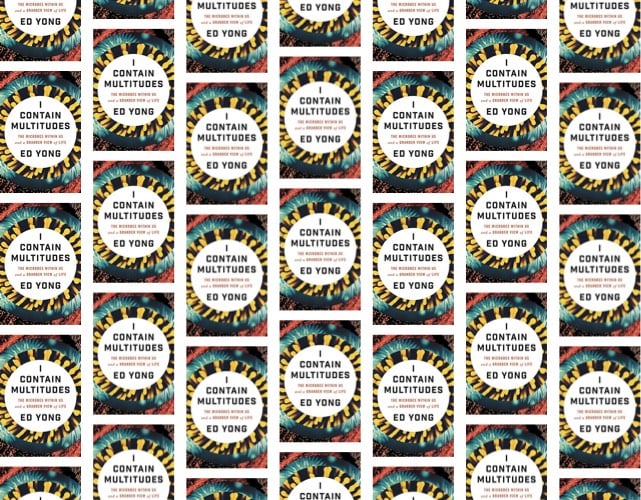
Crackerjack science writer Ed Yong is coming out with his very first book in a month’s time. It’s called I Contain Multitudes (good title!) and is about “astonishing partnerships between animals and microbes”.
Every animal, whether human, squid, or wasp, is home to millions of bacteria and other microbes. Ed Yong, whose humor is as evident as his erudition, prompts us to look at ourselves and our animal companions in a new light-less as individuals and more as the interconnected, interdependent multitudes we assuredly are.
The microbes in our bodies are part of our immune systems and protect us from disease. In the deep oceans, mysterious creatures without mouths or guts depend on microbes for all their energy. Bacteria provide squid with invisibility cloaks, help beetles to bring down forests, and allow worms to cause diseases that afflict millions of people.
I will read anything described as “like a David Attenborough series shot through a really good microscope”.
Update: Bill Gates liked I Contain Multitudes so much he sat down for a chat with Yong to discuss the particulars.
We are also utterly inseparable from them. Yong illustrates that we are at least as much microbe as human. We literally have more microbial cells living inside our bodies than human cells. And even the cells we label “human” are part microbe. With the exception of red blood cells and sperm, all our cells are powered by mitochondria, which are likely the descendants of ancient bacteria that became integrated into the type of cells that subsequently gave rise to all complex life.
Scientists have discovered the first promising new antibiotic in 25 years. And even better, says Ed Yong, is that the antibiotic in question is “resistant to resistance”.
A team of scientists led by Kim Lewis from Northeastern University have identified a new antibiotic called teixobactin, which kills some kinds of bacteria by preventing them from building their outer coats. They used it to successfully treat antibiotic-resistant infections in mice. And more importantly, when they tried to deliberately evolve strains of bacteria that resist the drug, they failed. Teixobactin appears resistant to resistance.
Bacteria will eventually develop ways of beating teixobactin — remember Orgel — but the team are optimistic that it will take decades rather than years for this to happen. That buys us time.
…and also that the process by which teixobactin was discovered is the real breakthrough:
Teixobactin isn’t even the most promising part of its own story. That honour falls on the iChip-the tool that the team used to discover the compound. Teixobactin is a fish; the iChip is the rod. Having the rod guarantees that we’ll get more fish-and we desperately need more.


Socials & More