I awoke at 3am last night, perhaps having sensed a disturbance in the Force, read a late-night text from a friend that said, “BREXIT!!” and spent the next two hours reading, shocked and alarmed, about Britain’s voting public’s decision to leave the European Union. Although according to a piece by David Allen Green in the FT, the decision is not legally binding and nothing will immediately change with regard to Britain’s laws or EU member status, the outcome is nevertheless distressing for the reasons outlined succinctly by an FT commenter.
A quick note on the first three tragedies. Firstly it was the working classes who voted for us to leave because they were economically disregarded and it is they who will suffer the most in the short term from the dearth of jobs and investment. They have merely swapped one distant and unreachable elite for another one. Secondly, the younger generation has lost the right to live and work in 27 other countries. We will never know the full extent of the lost opportunities, friendships, marriages, and experiences we will be denied. Freedom of movement was taken away by our parents, uncles, and grandparents in a parting blow to a generation that was already drowning in the debts of our predecessors. Thirdly and perhaps most significantly, we now live in a post-factual democracy. When the facts met the myths they were as useless as bullets bouncing off the bodies of aliens in a HG Well novel. When Michael Gove said ‘the British people are sick of experts’ he was right. But can anybody tell me the last time a prevailing culture of anti-intellectualism has lead to anything other than bigotry?
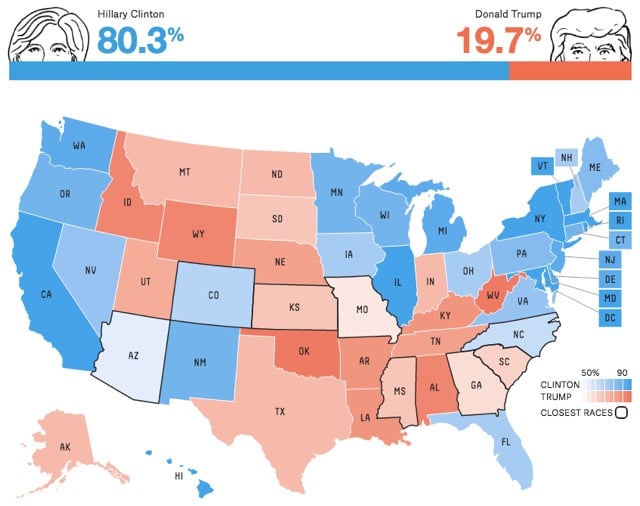
Reading this and casting your mind to Trump and the upcoming US election is not that difficult.
I’ve been thinking a lot about a book I read several years ago by Robert Wright called Nonzero: The Logic of Human Destiny. In it, Wright argues that cooperation among individuals and ever-larger groups has been essential in pushing biological and cultural evolution forward. From the first chapter of the book:
The survey of organic history is brief, and the survey of human history not so brief. Human history, after all, is notoriously messy. But I don’t think it’s nearly as messy as it’s often made out to be. Indeed, even if you start the survey back when the most complex society on earth was a hunter-gatherer village, and follow it up to the present, you can capture history’s basic trajectory by reference to a core pattern: New technologies arise that permit or encourage new, richer forms of non-zero-sum interaction; then (for intelligible reasons grounded ultimately in human nature) social structures evolve that realize this rich potential — that convert non-zero-sum situations into positive sums. Thus does social complexity grow in scope and depth.
This isn’t to say that non-zero-sum games always have win-win outcomes rather than lose-lose outcomes. Nor is it to say that the powerful and the treacherous never exploit the weak and the naive; parasitic behavior is often possible in non-zero-sum games, and history offers no shortage of examples. Still, on balance, over the long run, non-zero-sum situations produce more positive sums than negative sums, more mutual benefit than parasitism. As a result, people become embedded in larger and richer webs of interdependence.
The atmosphere of xenophobia on display in the US, Britain, and elsewhere in Europe is affecting our ability to work together for a better future together. World War II ended more than 70 years ago, long enough in the past that relatively few are still alive who remember the factors that led to war and the sort of people who pushed for it. Putin, Brexit, Trump, the Front National in France…has the West really forgotten WWII? If so, God help us all.
P.S. I also have a couple of contemporary songs running through my head about all this. The first is What Comes Next? from the Hamilton soundtrack:
What comes next?
You’ve been freed
Do you know how hard it is to lead?
You’re on your own
Awesome. Wow
Do you have a clue what happens now?
And the second is a track from Beyonce’s Lemonade, Don’t Hurt Yourself:
When you hurt me, you hurt yourself
Try not to hurt yourself
When you play me, you play yourself
Don’t play yourself
When you lie to me, you lie to yourself
You only lying to yourself
When you love me, you love yourself
Britain just played itself.
Update: Excellent op-ed in the LA Times by Brian Klaas and Marcel Dirsus.
This is the glaring contradiction in the muscular nationalism of right-wing populism, blended with isolationism, that seeks to withdraw from international unions: It cannot shape a better world by shutting the world out. The same people who cheer when Trump laments the decline of American leadership want to ignore key global issues and put “America First.” The people who voted for Brexit, attempting to create a border between Britain and challenges such as the refugee crisis, seem to think Britain can solve such problems without consulting Germany or France or, worst of all to them, Brussels.
The world doesn’t work that way, and it hasn’t for decades. Ever-increasing globalization has created an unprecedented surge in prosperity, but it has also ushered in jarring changes. The rough edges of those changes can only be overcome with more aggressive cooperation and engagement, not less. Whether it’s the risks of terrorism, the tragic flow of refugees, or economic shocks, Britain cannot solve problems alone and neither can the United States.
In this video, Harry Frankfurt, author of On Bullshit, talks about what bullshit is and how dangerous it is to society.
The reason why there’s so much bullshit I think is that people just talk. If they don’t talk, they don’t get paid. The advertiser wants to gain sales. The politician wants to gain votes. Now, that’s ok but they have to talk about things that they don’t really know much about. So, since they don’t have anything really valid to say, they just say whatever they think will interest the audience, make it appear they know what they’re talking about. And what comes out is bullshit.
The bullshitter is more creative. He’s not submissive. It’s not important to him what the world really is like. What’s important to him is how he’d like to represent himself. He takes a more adventurous and inventive attitude towards reality, which may be sometimes very colorful, sometimes amusing, sometimes it might produce results that are enjoyable. But it’s also very dangerous.
It’s at this point that the video cuts to Donald Trump, who is the Lionel Messi of bullshitting; it is his singular dazzling gift. He cultivates convenient facts and deliberately remains ignorant of inconvenient ones so as to be most effective. As Frankfurt notes, bullshit is a serious threat to the truth because it’s not the opposite of truth…it cannot be refuted like a lie can:
Liars attempt to conceal the truth by substituting something for the truth that isn’t true. Bullshit is not a matter of trying to conceal the truth, it is a matter of trying to manipulate the listener, and if the truth will do, then that’s fine and if the truth won’t do, that’s also fine. The bullshitter is indifferent to the truth in a way in which the liar is not. He’s playing a different game.
It is Trump’s indifference to the truth that makes him so effective and so powerful. Much of what I read from people who oppose Trump attempts to counter his rhetoric with facts. That hasn’t worked and is not going to work. The truth is not the antidote for bullshit. So how do you defeat the bullshitter? This has been a genuine problem for his political opponents thus far. Frankfurt doesn’t offer any advice in the video (perhaps his book does?), and I’m at a loss as well, but I do know that factual refutation will not make any difference. I hope someone figures it out soon though.
In Trump Taps Into the Anxiety of American White Males, Anand Giridharadas writes:
Yet there is some evidence that a sizable number of white men see the push toward diversity, along with the larger changes it telegraphs, as less about joining and more about replacement, and a country that is less hospitable to them.
That sentiment is perhaps expressed in a quote widely circulated online in these discussions, though the origin is unknown: “When you’re accustomed to privilege, equality feels like oppression.”
This is perhaps what Tyler Cowen was getting at with his highly speculative and provocative What the hell is going on?
The contemporary world is not very well built for a large chunk of males. The nature of current service jobs, coddled class time and homework-intensive schooling, a feminized culture allergic to most forms of violence, post-feminist gender relations, and egalitarian semi-cosmopolitanism just don’t sit well with many…what shall I call them? Brutes?
Quite simply, there are many people who don’t like it when the world becomes nicer. They do less well with nice. And they respond by in turn behaving less nicely, if only in their voting behavior and perhaps their internet harassment as well.
I wouldn’t recommend it, but a spin through the comments on Cowen’s piece provides some examples of what he’s talking about.
A few days ago, I watched An Honest Liar, a documentary about the magician and charlatan-debunker The Amazing Randi. I had forgotten that in the 70s and 80s in America, belief in psychics like Uri Geller, faith healers like Peter Popoff, extraterrestrial abductions, and the like was not all that far from the mainstream. Such events and people were covered in newspapers, on the evening news, and featured on talk shows, including The Tonight Show with Johnny Carson.
The media is awash in pieces attempting to explain the success of the Presidential campaign of Donald Trump. Many are puzzled…how could this happen in America!? After watching Randi debunking hoaxes, I’m no longer surprised at Trump’s success. Maria Konnikova, author of a recent book on scams and cons, wrote about Trump and con artists for the New Yorker.
A line, thin but perceptible, divides even egregious liars from confidence men. People deceive one another for all sorts of reasons: they might lie to stay out of trouble, for example, or to make themselves seem more interesting, or to urge a business deal toward its consummation. David Maurer, a linguist turned historian of the con, said, “If confidence men operate outside the law, it must be remembered that they are not much further outside than many of our pillars of society who go under names less sinister.” Still, there is a meaningful difference between an ordinary liar and a con artist. A grifter takes advantage of a person’s confidence for his own specific ends — ends that are often unknowable to the victim and unrelated to the business at hand. He willfully deceives a mark into handing over his trust under false pretenses. He has a plan. What ultimately sets con artists apart is their intent. To figure out if someone is a con artist, one needs to ask two questions. First, is their deception knowing, malicious, and directed, ultimately, toward their own personal gain? Second, is the con a means to an end unrelated to the substance of the scheme itself?
She doesn’t express an opinion on whether Trump is a con artist — it’s difficult to tell without knowing his intent — but it’s clear that like Uri Geller and Peter Popoff, Trump is adept at making people believe what he is saying without a lot of hard evidence. Like The Amazing Randi said in the movie: “no matter how smart or well educated you are, you can be deceived.” Hopefully, like Geller, Popoff, and UFOs eventually did, the idea of Trump as a viable candidate for President will soon disappear back into the fringes of American discourse.
On Last Week Tonight last night, John Oliver took on the #brand running for President known as Donald Trump. Or, as he would have been known had one of his ancestors not changed his last name, Donald Drumpf. If you’d like to play along at home, you can install the Drumpfinator Chrome extension, which will replace any mentions of “Trump” on the web with “Drumpf”.
Many years ago, Errol Morris interviewed Donald Trump about Citizen Kane as part of a project called The Movie Movie.
The table getting larger and larger and larger with he and his wife getting further and further apart as he got wealthier and wealthier, perhaps I can understand that.
Trump acquits himself pretty well on Kane and its lessons — although I would not characterize Kane’s fall as “modest” — and his commentary about the film is probably the first actually interesting thing I have ever heard him say. But I watched all the way to the end and he shoots himself in the foot in the most Trumpian & misogynistic way — it’s actually perfect.
The Movie Movie, according to Morris’ web site, was based on the idea of putting modern day figures like Trump and Mikhail Gorbachev into the movies that they most admire. So Trump would star as Kane in Citizen Kane and Gorby would be in Dr. Strangelove as who, Strangelove himself? Man, what a fantastic idea. Joshua Oppenheimer used a variant of this idea to powerful effect in The Act of Killing, a film executive produced by Morris.
Morris himself turned a bit of the original The Movie Movie idea into a 4-minute clip for the 2002 Oscars of people — some of them famous: Trump, Gorbachev, Tom Brady, Christie Turlington, Keith Richards, Philip Glass, Al Sharpton — talking about their favorite movies.





Socials & More