

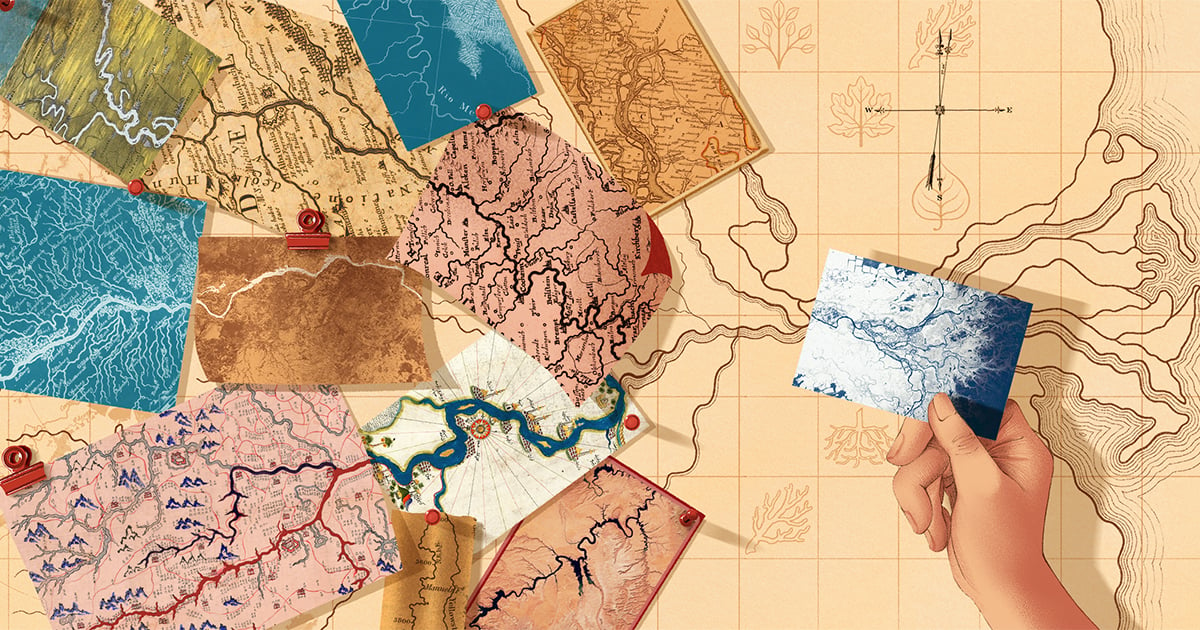
Why Are Rivers So Mathematical? “Any stream, from the littlest brook to the mightiest river, has a length that’s proportional to its drainage area raised to the power of 0.6.”

Advertise here with Carbon Ads
This site is made possible by member support. 💞
Big thanks to Arcustech for hosting the site and offering amazing tech support.
When you buy through links on kottke.org, I may earn an affiliate commission. Thanks for supporting the site!
kottke.org. home of fine hypertext products since 1998.
Beloved by 86.47% of the web.

Comments 4
It’s a fascinating natural occurrence. I read the article and agree it’s likely explained by the least amount of energy to move water downhill. I’d go farther and say there are probably properties of water molecules themselves that determine the slope.
A lot of rocks you find in nature that have a common shape to the naked eye (some rocks always looking like parallelograms) are reflections of the actual atomic structures that make them up. Where iron and oxygen might form a bond at a 45° angle in a specific type of rock, you’ll often find those same rocks in nature with 45° cleavage angles where they naturally break along those lines.
It was always the most fascinating thing I learned in geology classes: that atomic level structures of rocks determines how they look to us in nature.
This is one of those weird cases where the arrogant physicist gets an answer which is almost right and would then sneer at the mere geomorphologists, but the less-arrogant physicist would, I hope, realise there's something much more complex going on.
The arrogant physicist's answer would be that, naïvely, stream length goes like the square root of basin area (so 0.5 is a spherical cow estimate of the power), and then to handwave the fact that rivers meander and almost certainly have a fractal dimension greater than 1, so a power of 0.6 smells fine.
The less-arrogant physicist (there are no physicists who are not at least fairly arrogant) would realise that things must be more complicated because the geomorphologists are not stupid.
But then they'd say, well, 0.5 is close enough (they'd be wrong).
Tim, are you a geomorphologist?
I'm an arrogant physicist. And I'm also absolutely sure that the arrogant physics answer fails to captire what's going on.
If you feel like this comment goes against the grain of the community guidelines or is otherwise inappropriate, please let me know and I will take a look at it.
In order to comment or fave, you need to be a kottke.org member. Check out your membership options.
Note: If you are a member and tried to log in, it didn't work, and now you're stuck in a neverending login loop of death, try disabling any ad blockers or extensions. Or try logging out and then back in. Still having trouble? Email me!