




All US Cities Which Used to Have More Than 100,000 People But Don’t Anymore
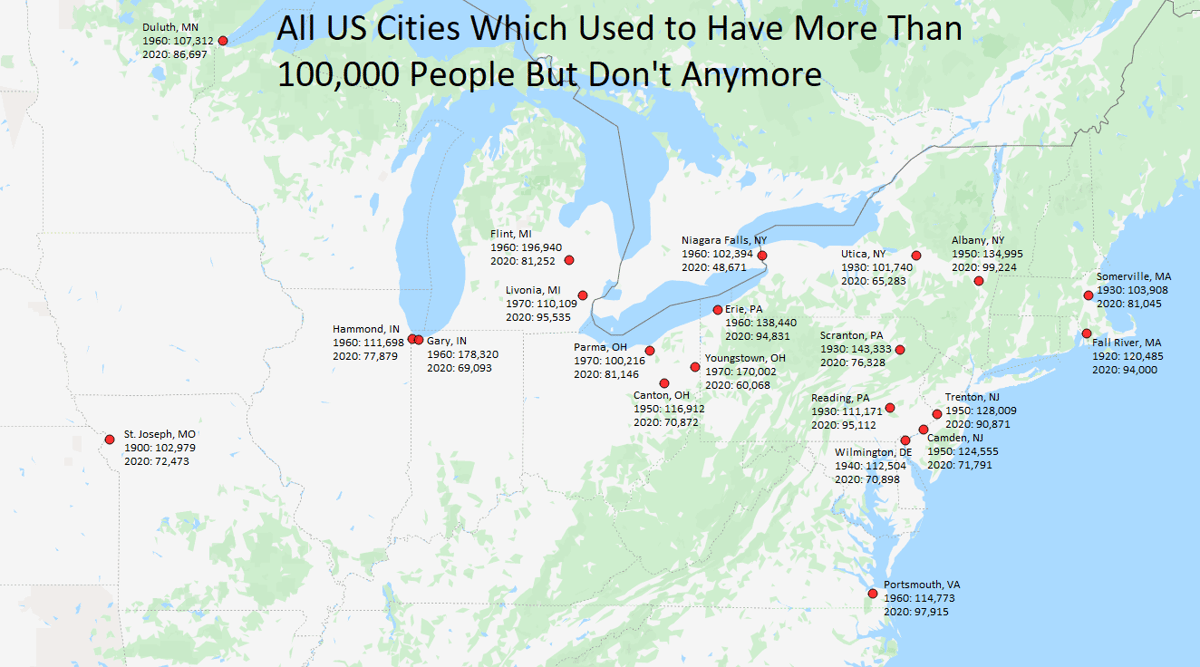
Here’s a map of the 21 US cities that used to have a population of 100,000 people but don’t anymore. Many of these are Rust Belt cities, in which manufacturing employment fell steeply during the latter part of the 20th century.
The thread at Reddit mentions Detroit and St. Louis as two other cities whose population has dropped during that same time period. Detroit went from 1.85 million in 1950 to 639,000 in 2020 and St. Louis dropped from 857,000 to 300,000 over the same time period:
St. Louis was once the country’s 4th largest city. Worlds Fair and Olympics in 1904. Two Major League Baseball teams. It didn’t boom as much as the Great Lakes cities in between the wars and it declined just as much after.
Comments 7
thread
latest
popular
This is an interesting thread, but that point about Detroit and St. Louis misses the extent to which Detroit’s and St. Louis’s population losses reflected suburban flight rather than people leaving the regions altogether.
Metro Detroit had about 4.48 million residents in 1990 and still has more than 4.4 million today, making it the country’s 14th-largest metropolitan area. The St. Louis metro area had about 2.56 million residents in 1990 and has roughly 2.8 million today, ranking around 23rd.
For both regions, the more accurate story is decades of stagnation combined with a dramatic shift from the central city to the suburbs. Detroit is now experiencing a meaningful urban revival. St. Louis is not.
I say that as a St. Louis resident with an interest (as an amateur) of the region’s development history, including that I wish we would learn from Detroit and others. St. Louis remains a vibrant metropolitan area, but we’ve done the entire metro-area a disservice by continuing practices that make the City languish.
It began with the City-County split in 1876 and continues today: St. Louis County has 80-plus separate municipalities. Add state leadership that equates downtown and Black communities with crime, including taking control of the St. Louis City Police Department despite falling crime. All of this means it's become extraordinarily difficult to develop cohesive metro area leadership. St. Louis’s problem is not that the metropolitan area disappeared. It’s that we’ve spent nearly 150 years dividing it against itself.
{this doesn't even begin to take into account histories of inequitable land use policies, mishandling development priorities, education funding tied to local property tax revenues, etc. that contribute to the current state}
Somerville, MA is a similar story, with a twist. Much of the manufacturing left Somerville, and neighboring Cambridge, followed by the suburban flight of both residents and nascent tech companies. In the past 30 years, the next generations of upper middle class college grads started swarming back, thanks to the extension of the MBTA Red Line and the rebirth of Cambridge and downtown Boston as high tech and pharma hubs.
You would think this would lead to a population increase, however the money involved led to a mass renovation of the existing stock of ubiquitous triple decker Victorian houses, which traditionally housed 3-4 distinct households, into single family and duplex condo housing.
Same amount of land, far fewer housing options.
Coming here to say the same thing. Too many Reddit discussions about cities focus on municipal boundaries, which are political social constructs. In the Northeast U.S., city consolidations stopped in the 19th century (e.g., Philadelphia 1854, NYC 1898) and so much of the post-war suburban expansion gets tallied in surrounding counties. Contrast that to places like Phoenix and Houston, whose incorporated square mileage is far larger than their historic city centers.
Being in South Jersey, I can tell you that plenty of families and businesses in Camden and Trenton just moved out a little further with the advent of cars and suburbia. Just one township outside Camden has 80,000 people; Camden county altogether has half a million. Check the about section on any of its churches and you'll see the congregation started in Camden but moved out in the 1950-60s.
Now there's so much you can say about the toxicity of white flight, the divestment and ghettoization of the core cities, the collapse of educational opportunities, the loss of jobs, rise of crime, lack of pubic transit etc. But that's very different than implying that the city area lost population.
I want to know about St. Joseph, MO; it seems such an outlier compared to the others in terms of the year in which its population was over the threshold.
Off to find out why!
Short answer: fraud. Even the 1910 census had a comment on the data indicating the population number was “overestimated.”
In my relatively brief online perusal of this topic, I haven’t found direct information on how it happened, but the why is proposed to be that this was the peak of Saint Joseph’s rivalry with Kansas City.
I grew up in Brook Park, OH, one town over from Parma. I left the area in 1979, but I was back frequently these last few years. Honestly, I don't see much difference. There are no blighted areas, no stretches of abandoned retail, no obvious signs of sub/urban decay.
But Parma was always a suburban bedroom community. Could a 20% drop in population largely be attributed to smaller families? Mom+Dad+2 kids is 20% fewer people than Mom+Dad+3 kids.
YMMV.
According to Wikipedia, Albany (where I live) is now projected to be over 100k so will likely disappear in the next version of this map. In general, the Capital Region is growing faster than most of the rest of New York state (including NYC). I can attest to this in part by the delicious food easily available here that you used to have to go to Queens to get.
If you feel like this comment goes against the grain of the community guidelines or is otherwise inappropriate, please let me know and I will take a look at it.
In order to comment or fave, you need to be a kottke.org member. Check out your membership options.
Note: If you are a member and tried to log in, it didn't work, and now you're stuck in a neverending login loop of death, try disabling any ad blockers or extensions. Or try logging out and then back in. Still having trouble? Email me!