

Learn How to Play Chess Free Online: Tutorials for Beginners, Intermediate Players & Beyond.

Advertise here with Carbon Ads
This site is made possible by member support. 💞
Big thanks to Arcustech for hosting the site and offering amazing tech support.
When you buy through links on kottke.org, I may earn an affiliate commission. Thanks for supporting the site!
kottke.org. home of fine hypertext products since 1998.
Beloved by 86.47% of the web.
Entries for November 2020
How Are You Doing?
As a companion of sorts to the previous post, I ran across this infographic on a site of pandemic resources for Colorado healthcare workers that shows some typical responses to different levels of stress.

Sometimes having a tough time can make it difficult to determine just how tough a time you’re having. Using a chart like this can help you figure out where you are on the stress continuum (as long as you remember that everyone is different) and then seek out the proper kind of assistance. (via @TheRaDR)
How to Help a Friend Through a Tough Time
Based on the four separate conversations I had with friends this weekend (and reading/watching assorted social media posts), it seems like everyone is really struggling with the pandemic right now, perhaps more so than back in March/April/May. Fatigue is really starting to set in, misinformation is wearing people down, there’s disease and death all around us, it’s tough to keep going towards an ill-defined finish line, and dealing with 9 straight months of grief is just not sustainable. I myself have been all right recently, thankful I’m able to do what I can to support others, but it really varies from week to week.
A year ago, before the pandemic set in, clinical psychologist Kathryn Gordon wrote a piece for Vox on how to help people that you know through a tough time. You may have seen similar advice before — e.g. How Do You Help a Grieving Friend? — but now seems like a good time for a refresher. Here’s one of Gordon’s four tips on how to help:
Ask them how they are feeling. Then, listen non-judgmentally to their response. The simple act of asking someone how they’re doing, with an open-ended question, shows that you care. Listen attentively rather than interrupting or offering your opinion. Ask simple follow-up questions like, “What does that feel like?” or “What has been on your mind as you’re going through this?” This communicates that you genuinely want to know how they’re doing and feel comfortable hearing the truth.
I hope you’re getting the support you need during all of this and are able to find small pockets of time & energy in which to be useful to those around you. ♥
11 facts about coast redwoods. They drink fog, their bark is a foot thick, and some were alive during the Roman Empire. I love redwoods.
Pandemic Stories from Around the World, Fall 2020
My friend Jodi Ettenberg spent a decade traveling around the world, so she’s got friends and followers from all over the place. Over the weekend, she asked her Instagram followers to share their pandemic experiences and she’s been republishing them in Story collections: one, two, three. (You can also find them on her Instagram profile page.) Individually and as a collection, the stories she’s received are fascinating and heartbreaking to read. Almost 11 months into the pandemic — Wuhan’s lockdown began on Jan 23 — folks out there are really struggling and the response of governments around the world has varied widely (and wildly). Here are a few of the stories…check out the links above to read the rest.
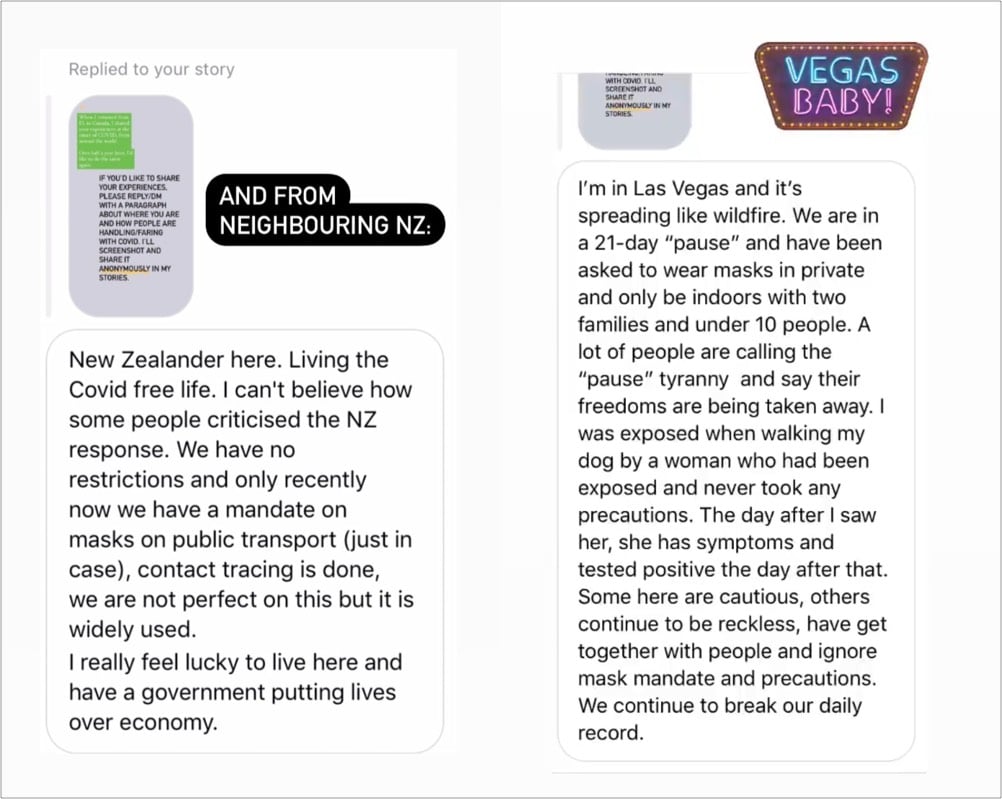
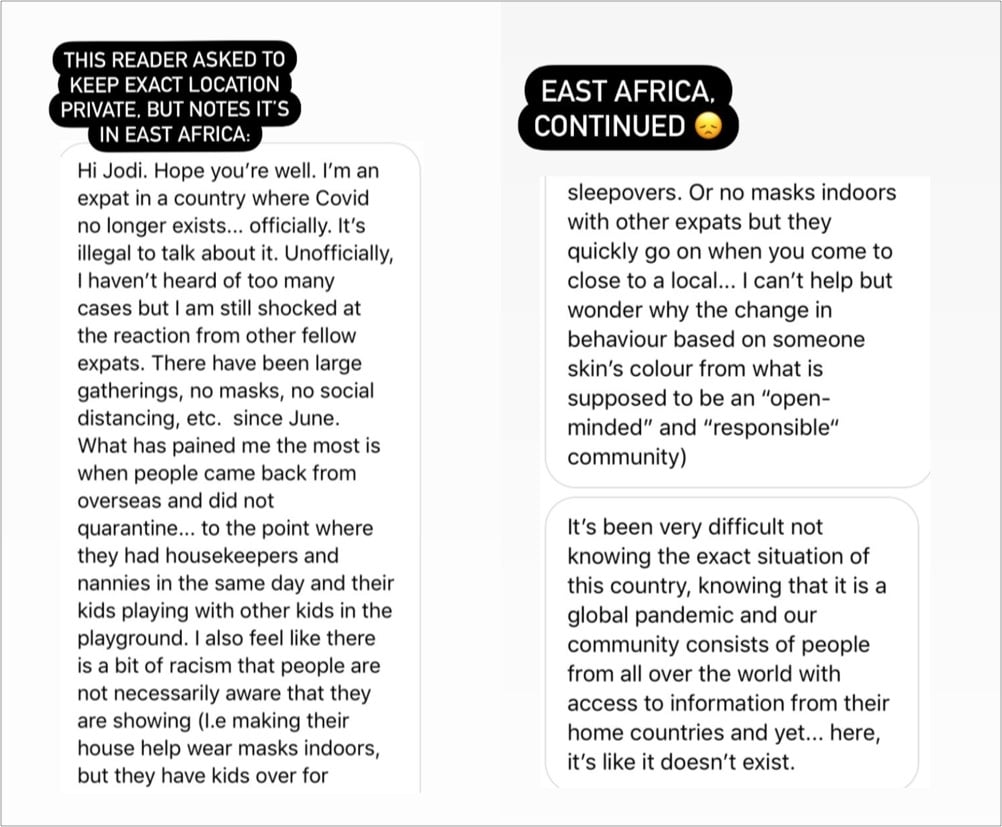
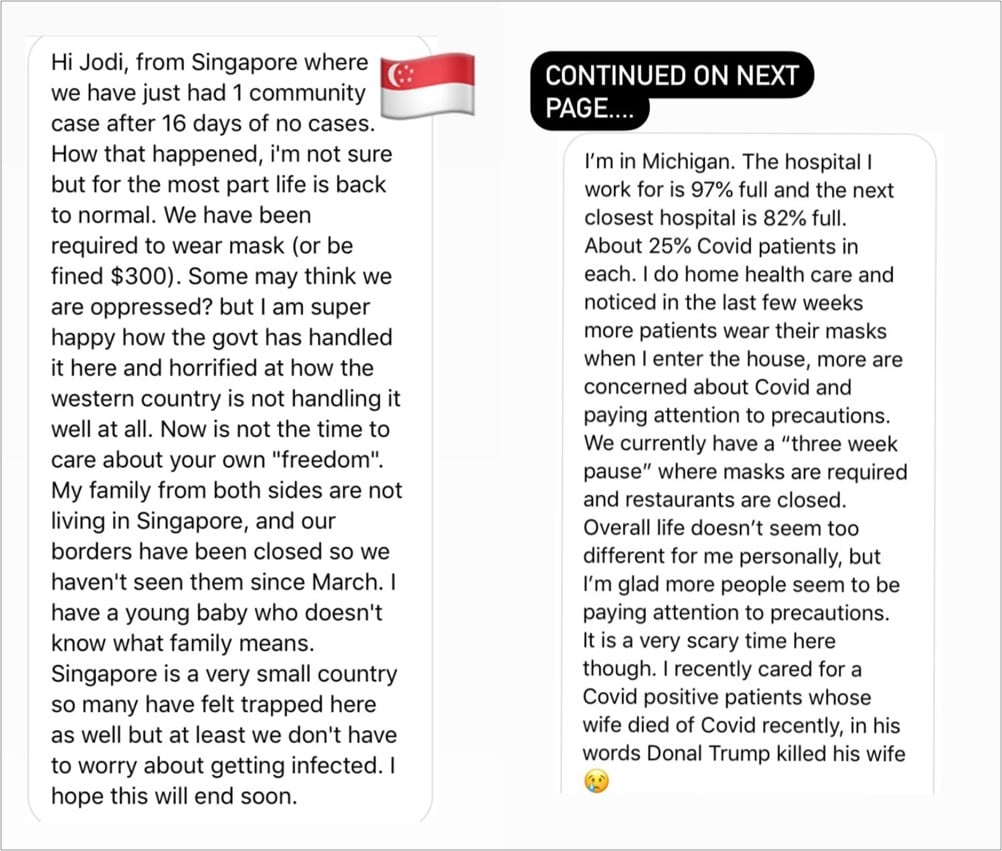
She’s still gathering & sharing stories from people, so send her a DM on Instagram about how things are going in your part of the world if you’d like to participate.
I solicited stories like this from folks back in early April. It’s surreal reading those responses now — so much completely avoidable death and suffering has occurred between then and now.
Speculation: Scented Candle Ratings Down Due to Covid-19 Loss of Smell
After Terri Nelson noticed people complaining online about a lack of scent from newly purchased scented candles, Kate Petrova analyzed Amazon reviews for candles from the past three years and found a drop in ratings for scented candles beginning in January 2020 (compared to a smaller ratings decline for unscented candles).
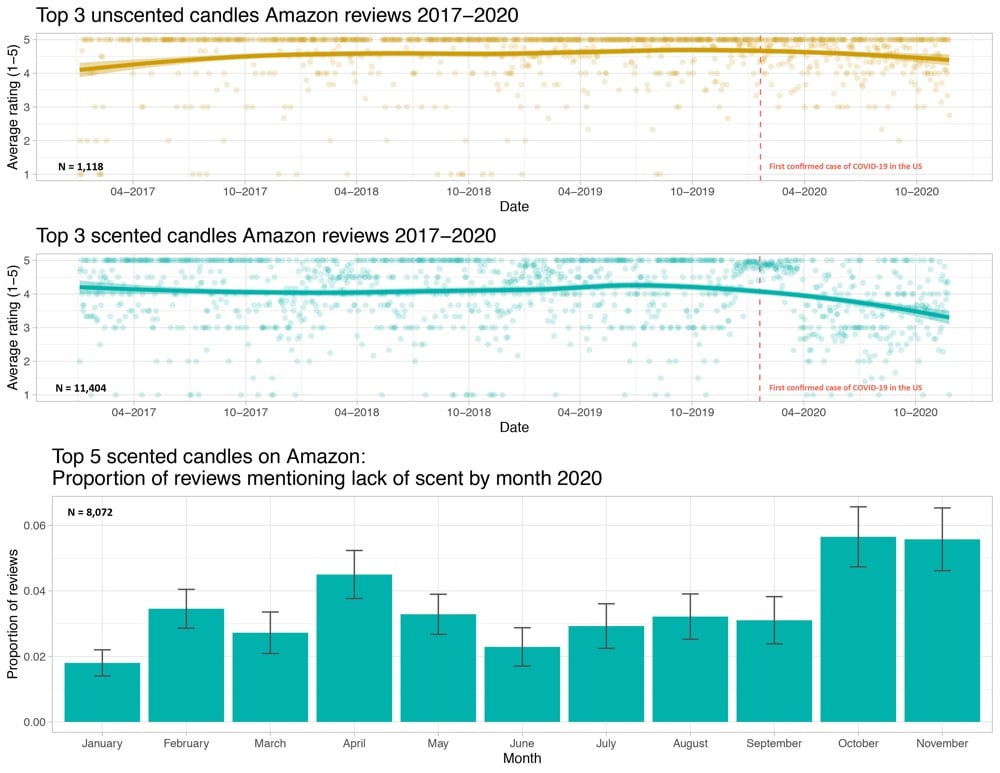
The hypothesis is that some of these buyers have lost their sense of smell due to Covid-19 infections and that’s showing up in the ratings.
1000s of cover videos of Billie Eilish’s Bad Guy, auto-synched by AI. “Machine learning keeps all these covers on the same beat and lets you jump from video to video seamlessly.”
55 Ways White People Say ‘White People’ Without Actually Saying ‘White People’, including “real Americans”, “soccer moms”, “law-abiding citizens”, “taxpayers”, and “families”.
How to Socialize in the Cold Without Being Miserable. “It’s like a chess match — you need to be thinking two or three moves ahead.”
Their Patients Have COVID-19 and Still Think It’s a Hoax. Said one nurse: “We never have had people who thought we were lying to them. It feels like the public doesn’t trust us anymore.”
Rotating Circles Optical Illusion
This is one of the best optical illusions I’ve ever seen: aside from rotating, these circles don’t move.
The left/right/up/down arrows were freaky enough but the in & out arrows really blew a gasket in my brain. For proof that the circles don’t move, blink your eyes quickly as you watch or check out this gif. (via @jagarikin)
The Pandemic Is a Marathon Without a Finish Line. How Can We Win?
With the positive news about the Covid-19 vaccine trials, I assume many of you have started to think about the potential end of the pandemic — what we’ll do, where we’ll go, who we’ll see, and reckon with what’s changed and what’s been lost. I know I have. Alex Hutchinson has written an intriguing piece on what sports science might be able to tell us about the psychology of a situation like the pandemic, where the finish line is poorly defined, ever-changing, or even non-existent.
As it happens, there’s a whole subfield of sports science, at the intersection of physiology and psychology, that explores this terrain. It’s called teleoanticipation, a term coined in 1996 by German physiologist Hans-Volkhart Ulmer to describe how our knowledge of an eventual endpoint (or telos) influences the entirety of an experience. Using endurance sports as their medium, researchers in this subfield have probed what happens when you hide the finish line, surreptitiously move it or take it away entirely. For those of us tempted by promising vaccine updates to start fantasizing about an end to the pandemic, these researchers have some advice: don’t.
Instead, the key seems to be remaining in the moment instead of focusing on the goal.
It turns out that, if you ask yourself “Can I keep going?” rather than “Can I make it to the finish?” you’re far more likely to answer in the affirmative.
This squares with mindfulness practices from Buddhism and Stoicism but also reminds me of a motivational trick I first heard a few years ago: that you can do anything for 10 seconds — and then you just begin a new 10 seconds. Turns out that was popularized by Unbreakable Kimmy Schmidt. Good advice can come from anywhere.
Social Unrest Is the Inevitable Legacy of the Covid Pandemic. “Throughout history, plagues have caused upheaval and revolts. This pandemic will be no different.”
Imagining a Covid-19 Pandemic Memorial

Even though we’re still in the midst of it, The Atlantic commissioned three designers/artists to design hypothetical Covid-19 memorials. Ian Bogost writes:
So this might seem like a strange time to imagine memorializing the pandemic in a formal way. A premature time. Maya Lin’s Vietnam Veterans Memorial was conceived in 1981, six years after the United States had withdrawn from the conflict. Michael Arad and Peter Walker’s 9/11 memorial broke ground at the site of the World Trade Center in 2006, almost five years after the attacks.
But there are downsides to waiting. A traumatic event is an author of its own memorial; as a famous anecdote attests, when a Nazi soldier asked Pablo Picasso if he had made Guernica, the famous painting the artist created during the month following the Luftwaffe’s bombing of its Basque namesake in 1937, Picasso replied, “No, you did.” The feelings, facts, and ideas available during a calamity dissipate as it ebbs. The temptation arises to contain tragedy in a tidy box, closing the book on its history.
Each of the three ideas is intriguing in its own way. I liked how Ronald Rael and Virginia San Fratello (who made those border wall teeter-totters last year) explained their thought process (which Rael elaborated on here).
Quarantine has limited our ability to use smell and touch for communion, so she and Rael became interested in finding a way to replicate the experience. That’s where pennies come in: Copper is an antiviral — a quality with obvious symbolism in the moment — and one that evolves over time, developing a patina as it interacts with water and air. So the pair latched on to it as a material.
Rael San Fratello’s first idea was a pragmatic one: a traditional memorial made of copper molded into a bulbous, organic wall. The copper material would invite the touch lost to quarantine. Outdoors, it could develop a green or purple patina. “If touched constantly,” San Fratello said, “the patina might never occur, and the memorial will remain shiny.”
See also the design for a pandemic memorial already in the planning stages in Uruguay.
An analysis of representation in crossword puzzles. “Our finding: crossword puzzles are dominated by men of European descent, reserving little space for everyone else.”
Our Friend
That’s the trailer for Our Friend, a movie based on the true story told in this Esquire article by Matthew Teague: The Friend: Love Is Not a Big Enough Word.
His wife was just thirty-four. They had two little girls. The cancer was everywhere, and the parts of dying that nobody talks about were about to start. His best friend came to help out for a couple weeks. And he never left.
I remember very clearly that essay and the day I read it — I think about it all the time. I don’t know if the movie is going to be any good (I hope so), but if you’ve never read this essay, carve out some time to do so today.
How to get good at chess. “You need to be endlessly fascinated by it and see its infinite potential. Be willing to embrace the complexity; enjoy the adventure.”
A Framework for the Equitable Allocation of a COVID-19 Vaccine
Now that the preliminary results of various Covid-19 vaccine trials are coming out (and looking promising), attention is turning to the eventual distribution of the vaccines. The logistics of getting the doses out to hospitals, clinics, and doctor’s offices is one concern but so is the question of who should get vaccinated first. Supplies of the vaccines will be limited at first, so we’ll need to decide as a society what distribution method is most fair and is of the most benefit to the greatest number of people.
To this end, and in response to a request by the CDC and NIH, the National Academies of Sciences, Engineering, and Medicine formed a committee to produce a report called Framework for Equitable Allocation of COVID-19 Vaccine. The 252-page report is available to the public for free to read online or download.
In addition several recommendations — including that the vaccine be distributed to everyone free of charge — a central feature of the report is a four-phase system of vaccine distribution, summarized in this graphic:
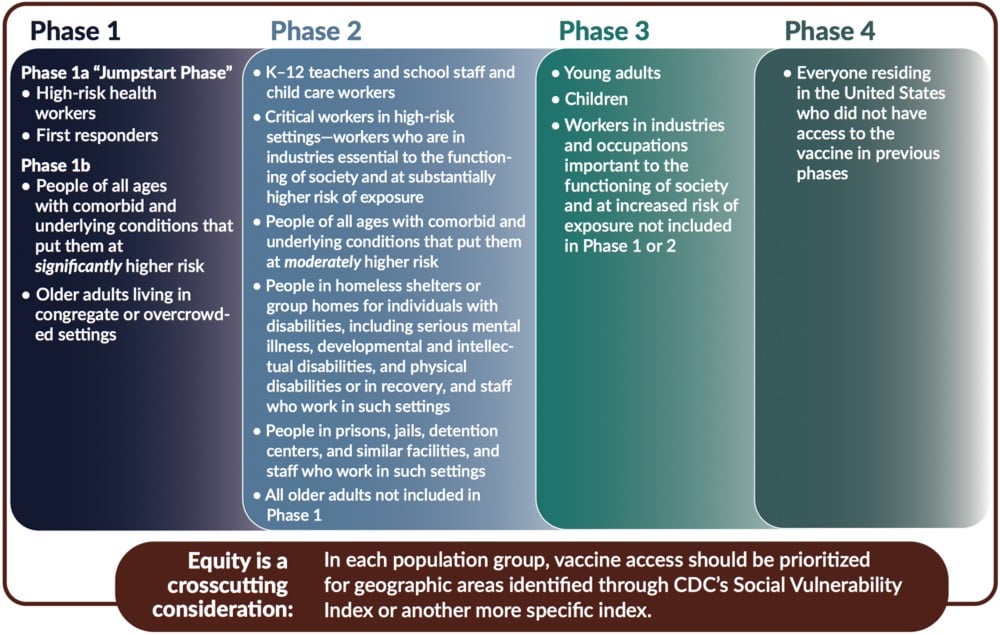
I’d like to stress that this graphic does not show all groups of people included in each phase — please consult the text of the report for that before you go sharing that graphic on social media without context. For example, here’s the full description for “high-risk health workers” in Phase 1a:
This group includes frontline health care workers (who are in hospitals, nursing homes, or providing home care) who either (1) work in situations where the risk of SARS-CoV-2 transmission is higher, or (2) are at an elevated risk of transmitting the infection to patients at higher risk of mortality and severe morbidity. These individuals — who are themselves unable to avoid exposure to the virus — play a critical role in ensuring that the health system can care for COVID-19 patients.
These groups include not only clinicians (e.g., nurses, physicians, respiratory technicians, dentists and hygienists) but also other workers in health care settings who meet the Phase 1a risk criteria (e.g., nursing assistants, environmental services staff, assisted living facility staff, long-term care facility staff, group home staff, and home caregivers). The health care settings employing these workers who are at increased risk of exposure to the virus may also include ambulatory and urgent care clinics; dialysis centers; blood, organ, and tissue donation facilities; and other non-hospital health care facilities. Finally, there are community and family settings where care for infected patients occurs. Not all the workers in these settings are paid for their labor, but, while they are caring for infected people, they all need to be protected from the virus.
Situations associated with higher risk of transmission include caring for COVID-19 patients, cleaning areas where COVID-19 patients are admitted, treated, and housed, and performing procedures with higher risk of aerosolization such as endotracheal intubation, bronchoscopy, suctioning, turning the patient to the prone position, disconnecting the patient from the ventilator, invasive dental procedures and exams, invasive specimen collection, and cardiopulmonary resuscitation. In addition, there are other frontline health care workers who, if they have uncontrolled exposure to the patients or the public in the course of their work, should be in this initial phase. This group includes those individuals distributing or administering the vaccine — especially in areas of higher community transmission — such as pharmacists, plasma and blood donation workers, public health nurses, and other public health and emergency preparedness workers. The committee also includes morticians, funeral home workers, and other death care professionals involved in handling bodies as part of this high-risk group.
The report declines to list specific industries which would be covered in Phase 2’s “critical workers in high-risk settings” but generally says:
The industries in which these critical workers are employed are essential to keeping society and the economy functioning. Since the beginning of the pandemic, millions of people have been going to work and risking exposure to the virus to ensure that markets have food; drug stores have pharmaceutical products; public safety and order are maintained; mail and packages are delivered; and buses, trains, and planes are operating.
Note also the text at the bottom of the graphic: they recommend that within each phase, priority be given to geographic areas where folks are more socially vulnerable in situations like these (e.g. as represented in the CDC’s Social Vulnerability Index).
In developing this phased approach, the committee focused on those who are at the most risk of exposure, severe illness or death, and passing along the virus to others as well as critical workers:
Risk of acquiring infection: Individuals have higher priority to the extent that they have a greater probability of being in settings where SARS-CoV-2 is circulating and of being exposed to a sufficient dose of the virus.
Risk of severe morbidity and mortality: Individuals have higher priority to the extent that they have a greater probability of severe disease or death if they acquire infection.
Risk of negative societal impact: Individuals have higher priority to the extent that societal function and other individuals’ lives and livelihood depend on them directly and would be imperiled if they fell ill.
Risk of transmitting infection to others: Individuals have higher priority to the extent that there is a higher probability of their transmitting the infection to others.
You should read (or at least skim) the full report for more information about the plan and the rationale behind it.
On a personal parting note, as someone who is squarely in the 5-15% of Americans covered in Phase 4 — more specifically: as a 40-something straight white man who non-essentially works from home, isn’t low-income, doesn’t socialize widely even under normal circumstances, and should probably be the very last person on this whole Earth scheduled to be vaccinated under an equitable framework — I am content to wait my turn should the US adopt this framework or something like it.1 Distributing vaccines to those who need them most is absolutely the right thing to do, both ethically and from the standpoint of getting society “back to normal” as quickly as possible and with as little additional death and suffering as possible.
Being that equity often isn’t America’s thing, especially during the pandemic, I could see this going either way. And even if this framework is adopted, those who can afford it will undoubtably be able to procure themselves a dose right alongside those medical workers in Phase 1a.↩
Raising Baby Grey, a Gender-Neutral Child
In this short film from Alex Mallis, we meet a Bronx couple who are raising their child Grey in a gender-neutral way until they make a decision for themselves. No single gender wardrobes or toy collections and they/them pronouns.
Really the goal here is, it’s not about me trying to force anything on Grey, it’s actually the exact opposite. And we don’t know their gender yet, and when they tell us, they’ll tell us. And it might change over time and that’s okay too.
Crispin Long wrote an accompanying piece for the New Yorker on the film.
Watching Grey’s parents navigate this terrain inspires questions about how Grey might one day respond to being brought up this way. Of course, it’s impossible to parent without error, and society does its share of damage, to many of us, without the help of parents. Asking a child to inhabit such a complex and politicized position is demanding, but so is asking a child to perform femininity or masculinity. I get the sense that many trans people would unambivalently prefer to have been raised without the gender they were assigned at birth and its attendant expectations. For me, it’s less clear. If my parents had made every effort to free me from the strictures of the gender binary, I might have rebelled against their liberal piety or appreciated their efforts — or maybe both.
The gadget comeback of 2020. “Did you expect to spend your summer trying to figure out if an air purifier made by a Bluetooth speaker company was going to be sufficient to clear the atmosphere in your isolation pod on an increasingly hostile planet?”
250 Days of Daily Pandemic Drawings
Author and illustrator Edward Carey has been making a drawing a day since the beginning of the pandemic. He recently completed his 250th drawing, with “no end in sight, alas”. He’s posting each day’s drawing to Instagram; here are a few of my recent favorites:
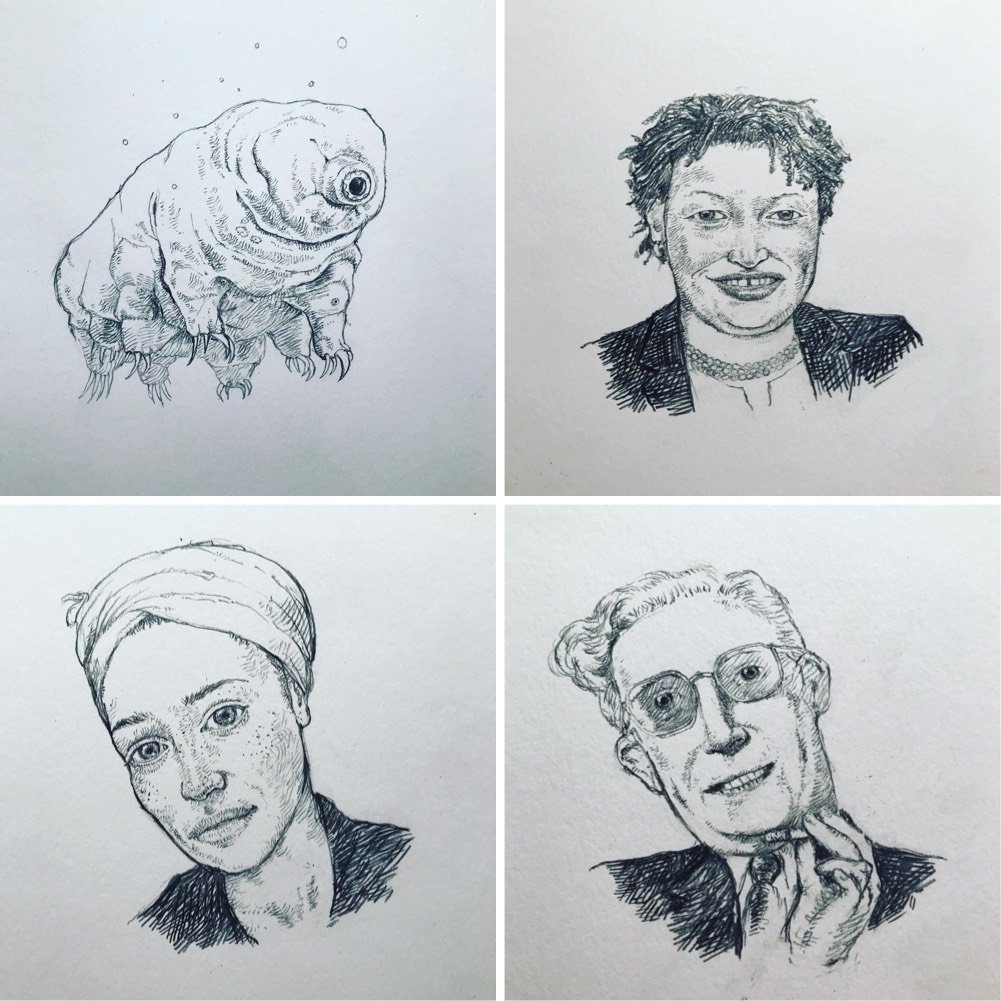
And the whole lot laid out on the floor:
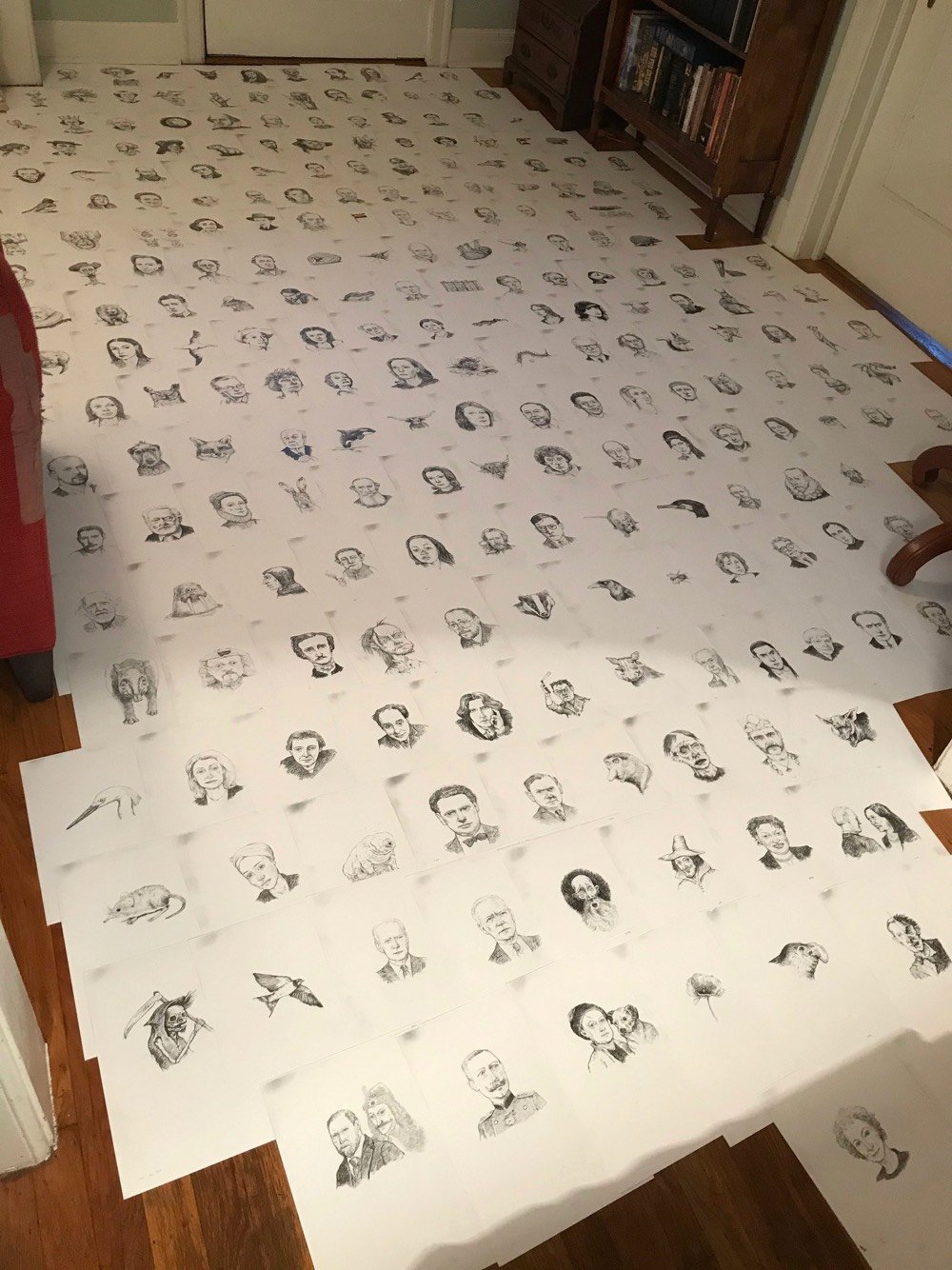
That’s so many days. (via austin kleon)
Ernest Cline’s Ready Player Two is out today. “Days after winning OASIS founder James Halliday’s contest, Wade Watts makes a discovery that changes everything.”
Tracking Pre-Pandemic “Lasts” and Post-Lockdown “Firsts”
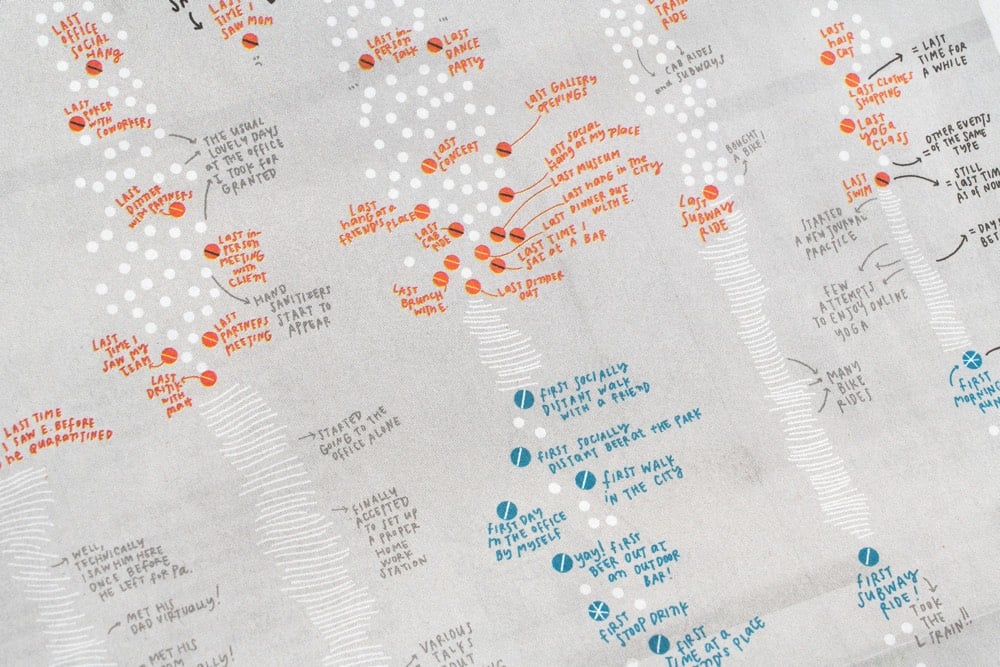
For the print version of the NY Times from this past Sunday, information designer Giorgia Lupi created a hand-drawn visualization that “tracks the last time [she] did something before the pandemic hit, and the first time she did something new with social distancing”.
Our lives have been transformed during the Covid-19 pandemic as the activities we used to do every day have been put on hold and new, socially distanced routines have taken their place. Pentagram partner Giorgia Lupi documents these changes in her own life in a data visualization commissioned by The New York Times for the cover of its “At Home” section, which runs as part of the newspaper’s Sunday edition. The hand-drawn visualization is a personal timeline that tracks the “last” time Giorgia did something before the pandemic hit, and the “first” time she did something new as she started to emerge from lockdown.
Not hand-drawn, but I remember pretty clearly what my lasts were:
- Last movie (w/ kids): Onward in mid-March
- Last movie (solo): Portrait of a Lady on Fire in mid-March
- Last visit to NYC: late October 2019
- Last trip: Vietnam/Singapore/Qatar in Jan/Feb 2020
- Last restaurant (solo): a forgettable ramen place in Burlington in mid-March
- Last restaurant (w/ a friend): better local ramen place in early March
- Last cocktail bar: Bar Stories in Singapore in early February
- Last museum: Museum of Islamic Art in Doha, Qatar in early February
I don’t remember my firsts as well, although one that sticks out is eating french fries (take-out) in July. On a normal day, french fries are delicious but when you haven’t had them in months, they are otherworldly.
Helicopter pilot finds “strange” monolith in Utah wilderness. “I’m assuming it’s some new wave artist or something or, you know, somebody that was a big 2001: A Space Odyssey fan.”
The Birther Myth Stuck Around For Years. The Election Fraud Myth Might Too. “A significant number of Americans currently believe the 2020 election was stolen, even though it wasn’t.”
Rebecca Solnit: We Don’t Need to Meet Nazis Halfway
Writing for Lithub, Rebecca Solnit on On Not Meeting Nazis Halfway.
Supreme Court Justice Samuel Alito just complained that “you can’t say that marriage is a union between one man and one woman. Now it’s considered bigotry.” This is a standard complaint of the right: the real victim is the racist who has been called a racist, not the victim of his racism, the real oppression is to be impeded in your freedom to oppress. And of course Alito is disingenuous; you can say that stuff against marriage equality (and he did). Then other people can call you a bigot, because they get to have opinions too, but in his scheme such dissent is intolerable, which is fun coming from a member of the party whose devotees wore “fuck your feelings” shirts at its rallies and popularized the term “snowflake.”
Nevertheless, we get this hopelessly naive version of centrism, of the idea that if we’re nicer to the other side there will be no other side, just one big happy family. This inanity is also applied to the questions of belief and fact and principle, with some muddled cocktail of moral relativism and therapists’ “everyone’s feelings are valid” applied to everything. But the truth is not some compromise halfway between the truth and the lie, the fact and the delusion, the scientists and the propagandists. And the ethical is not halfway between white supremacists and human rights activists, rapists and feminists, synagogue massacrists and Jews, xenophobes and immigrants, delusional transphobes and trans people. Who the hell wants unity with Nazis until and unless they stop being Nazis?
Reading this, I was reminded of the paradox of tolerance:
Unlimited tolerance must lead to the disappearance of tolerance. If we extend unlimited tolerance even to those who are intolerant, if we are not prepared to defend a tolerant society against the onslaught of the intolerant, then the tolerant will be destroyed, and tolerance with them.
And also, I can’t remember where I heard this recently, but it’s perhaps worth noting that in game theory (I know, I know), when you’re dealing with an iterated prisoner’s dilemma situation (where two competitors are engaged in repeated confrontation), one of the the best strategies is called generous tit-for-tat. Playing a generous tit-for-tat strategy means cooperating on the first move and then mirroring whatever the other player did on their previous move — but, crucially, occasionally cooperating after an attack as a opening to potential future collaboration. So, if the other party cooperates, so do you. And if the other party attacks, attack back…but not every time. Attempting to collaborate in the face of repeated attack leaves the door open to reestablish a virtuous cooperation cycle. The real world of national politics is not quite so simple, but it seems like a shift in strategy for progressives might be in order. (via christopher jobson)
How to make an AC/DC song in 30 seconds. “What’s that? Look out! Dog on the road!”
The Benefits of Collecting - “One Thing Leads to Another”
This video is a lovely little rumination by Iancu Barbarasa “about collecting, cycling caps, art and design, personal connections and why it’s worth doing something for a long time, even if the benefits are not clear at first.”
Many think some people are special but usually those people just put a lot more time in it than others. This applies to sports, arts, almost everything. It’s worth doing something for a long time, even if the benefits are not always clear. Good surprising things come out of it. You also learn about yourself in the process.
His inspiration in doing the film was to “inform, delight, and inspire”:
I mentioned above Milton Glaser’s “inform and delight” definition of art. It’s brilliant, but I always felt something was still missing from it. So I’d say that art — and any creative’s work — should aim to “inform, delight and inspire”. Hopefully my film will inspire people to start something of their own, or share what they’re already doing with other people. That would bring joy to everyone, and there’s never too much of it.
You can check out Barbarasa’s cycling cap collection on Instagram. I have never been much of a collector, but my 22+ years of efforts on this site (collecting knowledge/links?) and my sharing of photos on Flickr/Instagram over the years definitely have resulted in some of the same benefits.
Recommended: this You’re Wrong About episode about the Electoral College w/ special guest @jbouie. I particularly enjoyed the “what if?” discussion – it’s not so straightforward what the result of EC abolishment would be on national elections.
“I Lived Through A Stupid Coup. America Is Having One Now.”
Indi Samarajiva on living through a stupid political coup in Sri Lanka and a warning to Americans.
Two years ago, I lived through a coup in Sri Lanka. It was stupid. The minority party threw chili powder at everyone in Parliament and took over by farce. Math, however, requires a majority and the courts kicked them out. They gave in. We’d been on the streets for weeks but yay, we won.
No.
I didn’t know it at the time, but we had already lost. No one knew — but oh my God, what we lost. The legitimate government came back but it was divided and weak. We were divided and weak. We were vulnerable.
Four months later, on Easter Sunday, some assholes attacked multiple churches and hotels, killing 269 of us. My wife and kids were at church, I had to frantically call them back. Our nation was shattered. Mobs began attacking innocent Muslims. It was out of control. The coup broke our government, and four months later, that broke us.
The coup was a farce at the time but how soon it turned to tragedy. They called it a constitutional crisis, but how soon it became a real one. Right now, the same thing is happening to you. I’m trying to warn you America. It seems stupid now, but the consequences are not.
See also Samarajiva’s “I Lived Through Collapse. America Is Already There.”
Don’t Eat Inside a Restaurant. “Each of us, to get through this terrible time, has clung to some coronavirus factoid or another that we believe protects us. Here’s mine: The odds of catching the coronavirus are about 20 times higher indoors than outdoors.”
Socials & More