



Online version of Charles Darwin’s On the Origin of Species
Online version of Charles Darwin’s On the Origin of Species.

This site is made possible by member support. 💞
Big thanks to Arcustech for hosting the site and offering amazing tech support.
When you buy through links on kottke.org, I may earn an affiliate commission. Thanks for supporting the site!
kottke.org. home of fine hypertext products since 1998.
Beloved by 86.47% of the web.
Online version of Charles Darwin’s On the Origin of Species.
Michael Hawley gave the Poptech audience a wonderful tour of Bhutan and the giant book that resulted from his journeys there. A couple of photos of the book at Poptech:
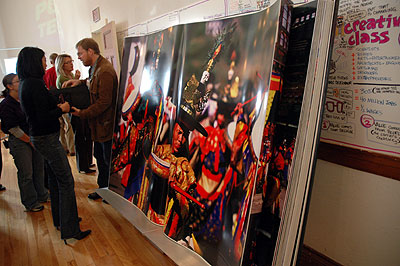
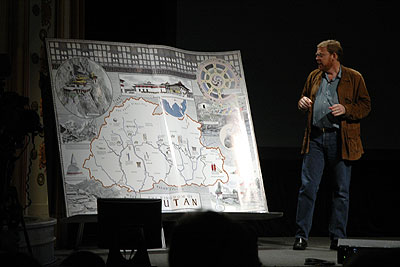
Turning the pages involved a short walk. If you’d like to own this baby, it’s available for only $10,000 on Amazon.
Spinalcat is an optical turntable that plays paper records that are printed out.
A list of human universals. All known human cultures share these attributes.
Maybe it’s the vicodin talking, but I’m really wanting to share with all you beautiful people the aftermath of getting my wisdom teeth yanked out.
1. Yay, vicodin!
2. I’m running out of spoons. Everything I’ve eaten the last two days has been in the so-called “liquid food” group.
3. I’ve been pondering the nutritive value of pudding. How long can one eat a diet consisting only of Swiss Miss Chocolate Pudding and Haagen Dazs Vanilla Ice Cream before dying of malnutrition? If I don’t survive my liquid diet, a loved one armed with my MT username and password will let you know the answer in a few days.
4. The left side of my face looks like Muhammad Ali and I went a few rounds in the ring. Well, maybe only a few seconds. He floated like a butterfly and stung like a bee…I cried like a baby and ran like a frightened child. Point is, I have a swollen left jaw and a lopsided face.
5. Been watching lots of movies. God bless cable television and TiVo. Wish I still had Netflix tho.
6. I can use my laptop while lying down. If I had a bed and laptop at work, I’d probably be there. The loss of work productivity in the US by workers recovering from wisdom teeth removal due to a lack of beds in the office must be staggering.
7. I haven’t had to worry about the religious discussion of database normalization happening elsewhere on this site. A helpful side effect of all this pain and pudding consumption.
Brown Paper Tickets, “the first and only fair-trade ticketing company. Event producers, use this please instead of evil Ticketmaster. People shouldn’t have to pay 20% extra to TM just to buy tickets.
One of my favorite talks at Poptech was Janice Benyus’ presentation on biomimicry, or innovation inspired by nature:
Biomimicry is a new science that studies nature’s models and then imitates or takes inspiration from these designs and processes to solve human problems, e.g., a solar cell inspired by a leaf. [It] uses an ecological standard to judge the “rightness” of our innovations. After 3.8 billion years of evolution, nature has learned: What works. What is appropriate. What lasts. Biomimicry is a new way of viewing and valuing nature. It introduces an era based not on what we can extract from the natural world, but on what we can learn from it.
In the talk, Janine outlined 12 ways in which nature can inform the development of technology:
1. Self assembly
2. Chemistry in water
3. Solar transformations
4. The power of shape
5. Materials as systems
6. Natural selection as an innovation engine
7. Material recycling
8. Ecosystems that grow food
9. Energy savvy movement and transport
10. Resilience and healing
11. Sensing and responding
12. Life creates conditions conducive to life
Those are a little vague and I wish I’d written down more notes, but it was hard to type and really listen at the same time. To fill in the gaps, you can listen to the audio of her 30 minute presentation.
Steven Johnson announces his new book, Everything Bad Is Good For You. Pop culture is making us smarter, not dumber…it’ll be an interesting read because I’m not entirely sure I agree with that (and not just in a knee jerk sort of way).
Never Forget is an online political film festival. Includes clips from a lot of the different shows and films currently going around.
Thinking Machine 4. Watch a chess playing computer work through what moves to make. I like the waves of influence.
Typographica thread on Clearview, the new typeface for US highways.
The special kottke.org version of the iPod. It comes stocked with 25,000 photos of me.
Wow, new hominid species discovered on small Indonesian island. The tiny humans — they were around 1m tall — potentially inspired island folklore and may still be around today.
Some behind-the-scenes photography from Jeff Bridges. The Dude abides with photos.
Steve Landsburg is voting for George Bush because John Edwards is xenophobic for opposing the outsourcing of American jobs. In most cases, America should have to compete for jobs, but calling Edwards a bigot is ridiculous. Is it bigoted to prefer that your spouse has a certain job rather than your neighbor? To discriminate on the arbitrary basis of marriage?
I’m not a hot shot programmer by any means, but I’ve done quite a bit of playing around with getting data in and out of databases programmatically. Something that’s always confused me is the near-religion of data normalization among programmers and database admins. Every developer I’ve ever worked with has told me that when you’re building a database, you need to normalize your data — basically this means organizing your data in such a way that removes redundancy — and failure to do so would result in public ridicule and possible revocation of access to any computing device. But I’ve always wondered, given that hard drives are cheap and getting cheaper, what’s the problem with using more storage space in exchange for greater speed?
I was delighted when I read Cal Henderson’s take on normalized data from a recent talk he gave about Flickr (from page 27):
- Normalised data is for sissies
- Keep multiple copies of data around
- Makes searching faster
- Have to ensure consistency in the application logic
To which I would add: hard drives are cheap.
Cal presents normalization as a trade-off that, depending on your circumstances, might be worth looking at…which is a much more useful way of approaching the situation than what I’ve typically heard (normalize or die!). Want faster access to your data? Replicate it in the database but be aware that it’ll cost you some storage space and you’ll need to keep track of the extra data in your application (which can be a pain in the ass). In Flickr’s case, they have 13 SELECTs for every INSERT, DELETE, and UPDATE statement hitting their database. Normalization can slow SELECT speed down while denormalization makes your I/D/Us more complicated and slower. Since the application part of Flickr depends so heavily on SELECTs from the database, it makes sense for them to denormalize their data somewhat to speed things up.
Here’s an analogy for the smokers in the audience…what sucks worse than realizing you left your lighter at home and you’re stuck in traffic on the way to the office? The solution is to buy a bunch of lighters, one for your car, one for your coat pocket, one for the drawer in your office, one for your purse, etc. It’s a trade-off. Your initial cash investment is greater (but lighters, like hard drives, are cheap) and you need to be diligent about leaving each lighter in its proper place, but you’re never without a lighter when you need one.
Fundrace Block Party. Input your address and you get back a list of politically active folks that you can contact for a neighborhood Kerry, Bush, or democracy party.
iPod Photo turns your iPod into a portable photo gallery thingie. Conceivably you could do crude movies with them…play an mp3 soundtrack as you scroll slowly through the frames of the “film”.
Gothamist interviews Errol Morris about his Kerry switch ads and The Fog of War. I liked his take on an old adage: “those who are unfamiliar with the past are condemned to repeat it without a sense of ironic futility”.
Alex Ross posted a story he wrote for the New Yorker about Radiohead, the last few paragraphs of which recount the Oxford show I attended in 2001:
Radiohead came onto the South Park stage at eight-thirty. It was not the most flawless show of the past few weeks, but it may have been the most intense. Yorke’s voice glowed with emotion. If Terence Gilmore-James had been there, he would have been happy; you could hear how Radiohead’s storm of sound was centered on a singing line. During “How to Disappear Completely,” a drenching rain began to fall. The crowd, religiously attentive, stayed in place. Yorke appeared alone for the last number, and hit a few plangent chords. His instrument went dead. “Es ist kaputt, ja?” he said. “I have another idea.” The others came back onstage, and together they launched into the familiar strains of “Creep,” which had gone unplayed since 1998. G major wheeled majestically into B. Jonny made his Beavis-and-Butt-head noise. Yorke sang, “What the hell am I doing here?”
Afterward, in the dressing room, Yorke looked happy. “Don’t know if you could tell,” he said to Colin’s wife, Molly, “but I was in tears for the last part of it.” Then the perfectionist in him reawakened. “Horrible diesel smell coming from somewhere,” he said.
Good times.
Might be possible to use Bayesian techniques to detect when people are lying. “If people truly hold a particular opinion, they tend to give higher estimates that other people share it.”
CEO of Google says “We are not building a browser”. Note that this is not the same as “we’re not releasing a browser” or “we’re not building a Web-enabled desktop app that we’re not calling a browser for whatever reason”.
A Very Long Engagement, a new film starring Audrey Tautou by the director of Amelie.
The New Yorker’s endorsment of Kerry was the first endorsement in the magazine’s history.
Joe’s Pizza location to close. This is a real bummer…cities and neighborhoods need diversity to thrive and high rents are driving out certain types of businesses.
Google’s stock price is going bonkers. It’s up 22% in the last two days.
Literal movie posters. “Back to the Future” becomes “Oh Shit, My Car is On Fire”
A reblog of a post about a reblog of a post about a reblog (I think). Can’t help it, gotta keep it going…remember folks, I’m just a vessel through which content flows.
Unsurprisingly, The New Yorker endorses John Kerry for President. Although from reading the article, it’s more about emphatically not endorsing Bush.
As I mentioned earlier this fall, Errol Morris has produced several political ads in the vein of his Apple Switch ads. The 30-second spots feature folks that voted for Bush in 2000 that are voting for Kerry in 2004.

They’re presented in Morris’ signature style, regular folks talking directly to the camera against a white background about why they’re switching. I find these highly effective, but I (and many of you) are already planning to vote for Kerry. Some of these are going to show on TV (I think), but how can we get these ads in front of undecided-but-leaning-Republican voters in swing states? Paging George Soros…surely you’ve got enough money to get these suckers on Fox News during primetime…
The Earth drags space-time around as it spins, just like the theory of relativity says. It’s amazing that relativity still works after 100 years given the pace of change in that time.
Ben and Mena reblog my post about them reblogging. We’re factchecking each others’ asses!
Alphachimp comes to your conference, gathering, etc. and draws comics to help people understand what went on. “You talk. We draw. The pictures tell the story.”
Brand association charts for Bush and Kerry. Kerry is Starbucks, Bush is Bud Light.
I’ll write more in-depth about a few of the speakers here, but for now, here are some soundbites (my comments in brackets):
- Andrew Zolli: All societies have an image of the future. Those that have optimistic images have better outcomes than those with pessimistic images. [The US right now seems optimistic overall, but getting a bit more pessimistic. At PopTech this year and last, about 1/2 the speakers said during their talks something to the effect of “we’re screwed”.]
- Malcolm Gladwell talking about a chapter from Blink:
One of the many ways in which asking someone what they think isn’t necessarily the best way to find out what they want: people move away from the more sophisticated idea and they go for the simpler choice because they don’t have the necessary “vocabulary” to explain their real feelings. [You may prefer The Hours to Goldeneye, but when asked to justify that choice, you may find yourself favoring the Bond flick more than you would if you didn’t have to justify it.]
- Frans de Waal studies primate behavior to gain insight into human behavior. One of his findings: aggression does not disperse, it brings primates together more often than normal. [Destruction is creative. Creativity is destructive. Or something.]
- Bruce Mau: Not all countries have embraced democracy, but most have embraced traffic (individual transportation). [There are many different ways in which openness can be introduced into a culture.]
- Thomas Barnett: China is 30% Marxist Communist, 70% The Sopranos.
- Phillip Longman: Secular societies that cannot reproduce will be replaced by fundamentalist countries where children are an economic asset and a gift from God. And in Brazil, television viewing time predicts birth rate…the more TV a woman watches, the less likely she is to have children.
Socials & More