



This sort of thing is infuriating: Connecticut Parents Arrested for Letting Kids, Ages 7 and 9, Walk to Dunkin’ Donuts. Kids need to develop independence away from their parents and “stranger danger” is overblown.

Advertise here with Carbon Ads
This site is made possible by member support. 💞
Big thanks to Arcustech for hosting the site and offering amazing tech support.
When you buy through links on kottke.org, I may earn an affiliate commission. Thanks for supporting the site!
kottke.org. home of fine hypertext products since 1998.
Beloved by 86.47% of the web.
Entries for February 2023
Fodor’s No List for 2023, a list of places you probably shouldn’t travel (because people are ruining them), e.g. Lake Tahoe, Antarctica, Venice, and Thailand.
Marcin Wichary’s Shift Happens, a book about the history of keyboards, is now available for purchase on Kickstarter. Instant buy for me.
The Kottke.org T-shirt, a Fine Hypertext Product
For much of the nearly 25-year lifespan of kottke.org, the site’s tagline has been “home of fine hypertext products”. I always liked that it felt olde timey and futuristic at the same time, although hypertext itself has become antiquated — no one talks of hypertextual media anymore even though we’re all soaking in it.
And so but anyway, I thought it would fun to turn that tagline into a t-shirt, so I partnered with the good folks at Cotton Bureau to make a fine “hypertext” product that you can actually buy and wear around and eventually it’ll wear out and then you can use it to wash your car. If you want to support the site and look good doing it, you can order a Kottke.org Hypertext Tee right now.

The shirts are short-sleeved and available in men’s, women’s, and youth sizes in three colors (black, white, and heather black) and sizes from S to 3XL, which I hope will work for almost everyone. The text is Gotham Light (from Hoefler&Co., designed by Tobias Frere-Jones) and takes the colors of the current kottke.org header background, which I brightened up to look better on the shirt. Prices are $33 for adult sizes and $29 for kids, plus shipping.
I have several Cotton Bureau shirts in my closet and the samples I ordered of the hypertext shirt look great. If you want my advice, it looks slightly better in solid black, but you can’t go wrong with any of the colors and nothing is stopping you from ordering one of each color.
The Kottke.org Hypertext Tee will only be available to order for the next two weeks — after that: poof, gone. So order yours today!
Creatures That Don’t Conform. “In the woods near her home, Lucy Jones discovers the magic of slime molds and becomes entangled in their fluid, nonbinary way of being.”
In this comic, Rueben Bolling dreams up some “non-woke” children’s books that won’t get teachers charged with felonies in fascist Florida. “The Very Fine Stop & Frisk” is particularly (depressingly) on-point.
The Snowy Day Stamps

I’d missed that the USPS released a set of stamps commemorating Ezra Jack Keats’ The Snowy Day back in 2017. From the Smithsonian National Postal Museum:
It was the first full-color picture book to have an African American protagonist. Keats received the 1963 Caldecott Medal for his illustrations.
This book was solidly in the regular reading rotation when my kids were little and I remember it fondly from my childhood as well.
How to Paint Like Hayao Miyazaki, a small guide to painting from the animation master. “What Miyazaki makes clear throughout the guide is that he is, proudly, a cheapskate who isn’t fussy about tools.”
Was not aware that Vermont has the second-highest per capita homeless rate in the US. But VT also “provides temporary shelter to a higher share of its unhoused residents than any other state”.
James Webb Telescope’s Incredibly Deep View of the Universe

The European Space Agency has released a gobsmacking deep field image of thousands of galaxies taken by the James Webb Space Telescope.
A crowded field of galaxies throngs this Picture of the Month from the NASA/ESA/CSA James Webb Space Telescope, along with bright stars crowned with Webb’s signature six-pointed diffraction spikes. The large spiral galaxy at the base of this image is accompanied by a profusion of smaller, more distant galaxies which range from fully-fledged spirals to mere bright smudges. Named LEDA 2046648, it is situated a little over a billion light-years from Earth, in the constellation Hercules.
I know we’ve seen deep field images from the Hubble, but I don’t know how you can tire of looking at actual images created by human technology that shows thousands of galaxies, billions of years, trillions of stars, quadrillions of planets, untold numbers of potential intelligences & civilizations, and who really knows what else. It boggles the mind, every time.
You can download/view a massive high-res copy of this image right here.
Update: Here’s a video that zooms in from a wide view of the Milky Way all the way into galaxy LEDA 2046648 pictured above.
Wow. (via @cparnot)
As part of this profile, David Remnick nabs the first on-the-record interview with Salman Rushdie since last year’s attempt on his life. “I’ve found it very, very difficult to write. I sit down to write, and nothing happens.”
Ted Gioia offers 8 techniques for judging someone’s character (even, perhaps most usefully, your own). “See how they treat service workers. Their true self comes to the forefront.”
You guys, new kind of ice just dropped. The new ice “more closely resembles liquid water than any other known ices” and “may rewrite our understanding of water”.
H5N1 Bird Flu: “An Even Deadlier Pandemic Could Soon Be Here”
Zeynep Tufekci on the H5N1 strain of the avian influenza, which is showing some recent signs of spreading in mammals.
Bird flu — known more formally as avian influenza — has long hovered on the horizons of scientists’ fears. This pathogen, especially the H5N1 strain, hasn’t often infected humans, but when it has, 56 percent of those known to have contracted it have died. Its inability to spread easily, if at all, from one person to another has kept it from causing a pandemic.
But things are changing. The virus, which has long caused outbreaks among poultry, is infecting more and more migratory birds, allowing it to spread more widely, even to various mammals, raising the risk that a new variant could spread to and among people.
Alarmingly, it was recently reported that a mutant H5N1 strain was not only infecting minks at a fur farm in Spain but also most likely spreading among them, unprecedented among mammals. Even worse, the mink’s upper respiratory tract is exceptionally well suited to act as a conduit to humans, Thomas Peacock, a virologist who has studied avian influenza, told me.
The three relevant facts here are: 56% of humans who’ve contracted H5N1 have died, there are signs of spreading among mammals, and that particular mammal is “exceptionally well suited” to pass viral infections along to humans. Tufekci, who attempted to sound the alarm relatively early-on about Covid-19, goes on to urge the world to action about H5N1, before it’s too late. Will we act? (No. The answer is no.)
*sigh*
You know, it’s a little shocking to read about a potential solution to the Fermi paradox on a random February Monday, but here we are.
If you missed it (better vid): the Grammys incredible 50 years of hip hop performance (ffwd to ~1:46:00). Like I said, it was thrilling to see all those artists sharing a stage – none of those folks have lost a single step. Wow.
This is the best video I can find of the Grammys incredible 50 years of hip hop performance. It was thrilling to see all those artists sharing a stage – none of those folks have lost a single step. Wow.
“2001: A Space Odyssey” Directed by George Lucas
From YouTuber poakwoods, a pair of criss-cross mashups of Star Wars and 2001: A Space Odyssey, but with their directors switched. When George Lucas takes the helm of 2001, you get a more crowd-pleasing and freewheeling movie while Stanley Kubrick’s Star Wars becomes more balletic and contemplative. Both are pitch-perfect.
See also Wes Anderson’s Star Wars. (via daringfireball)
Viola Davis achieved EGOT status last night. Emmy: How To Get Away With Murder (actress). Grammy: Finding Me (audiobook recording). Oscar: Fences (actress). Tony: King Hedley II, Fences (both actress).
HBO’s Gritty Prestige TV Adaptation of Mario Kart
If you’ve ever wondered what HBO and the producers of The Last of Us might do with some slightly different source material, Pedro Pascal and the cast of Saturday Night Live took a crack at a gritty adaptation of Mario Kart. I mean, I would 100% watch this.
Gene editing company Colossal Biosciences is going to try to bring back the dodo bird. It wouldn’t be an exact replacement…more of a dodo-ish pigeon.
It’s so cold in New England right now that “the troposphere could dip below the summit of Mount Washington”, which would then be briefly located *in the stratosphere*. WHAT?! This is literally a plot point in The Day After Tomorrow.
How Fairy Tales Break All The Rules
Fairy tales are fun to read not least because they violate every rule of what makes “good” literary fiction:
Instead of “show don’t tell,” fairy tales prioritize telling over showing. Instead of demanding “round characters,” fairy tales embrace flat ones. Instead of logical “worldbuilding,” fairy tales operate with a surreal dream logic in abstract settings. Instead of starting “in media res,” they start “once upon a time.” Instead of “telling the story only you can tell,” fairy tales ask you to retell stories that have been told for centuries. So on and so forth.
In The Writer’s Notebook, Kate Bernheimer identifies four key structural qualities of fairytale storytelling:
Flatness—specifically flatness of character. Fairy tales don’t delve into the psychology or interiority of characters, and typically limit them to one or two adjectives. The beautiful princess. The evil king. Etc. Similarly, fairy tales don’t have traditional character arcs or worry about “dynamic characters.” The evil witch at the start is probably going to be an evil witch at the end.
Abstraction—a general minimalism of description. Only a few colors are used and details are abstracted. “A young woman lived in a small house by the dark woods,” rather than a detailed layout of the house and a catalogue of the the types of trees in the forest.
Intuitive logic—essentially a dream logic or poetic logic, not far removed from what we would call “surrealism” or “magical realism” in a contemporary story.
Normalized magic—probably self-explanatory: magic is normalized. Characters are unsurprised if a cat begins to talk or a mermaid swims by. There is no SFF worldbuilding to explain or rationalize the fantastic elements.
Lincoln Michel, who wrote this summary, adds two more:
Open artifice—fairy tales eschew the standard methods of hiding fictional artifice and instead present themselves as pure story. As yarn, joke, fable. Fairy tale narrators often interject commentary or address the reader. And the classic fairy tale frame tells us we’re entering and then leaving pure story. These days, the classic frame has been reduced to “Once upon a time…” and “…happily ever after.” In traditional fairy tales, the openings and closings were even more overt in telling you “this isn’t real”: “Once there was, there never was” to start, say, and something absurd like the following to close: “I was also there in my red trousers and ate a lentil on a spit and if that lentil fits on the spit then you also have to believe my tale.”
A non-setting—fairy tales typically take place in a vague non-setting, in which we are never pinned down in specific time periods or locations. “Once upon a time a beautiful princess lived in a golden castle” instead of “In the 12th century, the heir to the Hapsburg dynasty lived in a castle by the Aar river” or what not. Specific names, dates, and locations—whether real or invented—deflate the fairy tale mode.
All of this again is contrary to the rulebound advice writers get for modern storytelling, making fairytales (in Michel’s formulation) “a kind of MFA antidote.” Stories seem to work when they have rules; it doesn’t always seem to matter what those rules are.
Another Rosetta Stone

Two ancient clay tablets discovered in Iraq in the 1980s and possibly smuggled illegally to the United States during the Iran-Iraq War (!) bear cuneiform-like writing. But while one of the scripts is in Akkadian, a kind of Babylonian lingua franca that is well-known to scholars of ancient writing, the other is in Amorite, a “lost” Semitic/Canaanite language that is not well-attested elsewhere. Put the two together, and you have another Rosetta Stone for deciphering an ancient script scholars otherwise couldn’t read.
The account of the Amorite language given in the tablets is surprisingly comprehensive. “The two tablets increase our knowledge of Amorite substantially, since they contain not only new words but also complete sentences, and so exhibit much new vocabulary and grammar,” the researchers said. The writing on the tablets may have been done by an Akkadian-speaking Babylonian scribe or scribal apprentice, as an “impromptu exercise born of intellectual curiosity,” the authors added.
Yoram Cohen, a professor of Assyriology at Tel Aviv University in Israel who wasn’t involved in the research, told Live Science that the tablets seem to be a sort of “tourist guidebook” for ancient Akkadian speakers who needed to learn Amorite.
One notable passage is a list of Amorite gods that compares them with corresponding Mesopotamian gods, and another passage details welcoming phrases.
“There are phrases about setting up a common meal, about doing a sacrifice, about blessing a king,” Cohen said. “There is even what may be a love song. … It really encompasses the entire sphere of life.”
Amorite is a western Semitic language, like ancient Hebrew, but these tablets, estimated to be 4000 years old, are at least 1000 years older than any extant Hebrew writing. (The Amorites were one of the frequent enemies of the ancient Hebrews.)
Layoffs on TikTok
Just about everything on the web is on TikTok, and going viral there too, so it shouldn’t be a surprise that people who’ve been laid off are there too, trying to figure out what it all means.
Part of me is cynical about this. You mean that as people, we’re so poorly defined without our jobs that our only resource is to grind out some content about it? But on the other side of the coin, making content is what human beings do. Other animals use tools, but do they make content? Apart from some birds, probably not.
My favorite TikTok layoff video is by Atif Memon, a cloud engineer who offers a clear-eyed appraisal of her situation:
@atif_kaloodi So true !! #cloudengineer #sysadmin #layoffs #microsoftlayoffs #googlelayoffs original sound - Atif Memon
“At the company offsite, we celebrated our company tripling its revenue in a year. A month later, we are so poor! Who robbed us?”
“Even if ChatGPT can take away our jobs, they’ll have to get in line behind geopolitics and pandemic and shareholders and investors. I lost my job because the investors of the company were not sure will become 400x in the coming year. ‘How will we go to Mars?’ Someone else lost their job because the investors thought ‘Hmm, if this other company can lay off 12k people and still work as usual, shouldn’t we also try?”
“Artificial intelligence can never overtake human paranoia and human curiosity. AI can only do what human beings have been doing. Only humans can do what no human has done before.”
A lot to chew on in four minutes.
Update: Apparently this is not native to TikTok, but was posted to YouTube by a comedian, Aiyyo Shraddha. It really is a perfect TikTok story! The video is a ripoff.
The Italian Futurists declared war on pasta on the early 20th century. “Too traditional!” said Filippo Marinetti. “Holding us back!” - so of course they named a pasta sauce after him.
A Eulogy for Gawker. Despite having designed the logo & the initial website (for a pittance, I might add), I do not have fond feelings for Gawker. “Gawker sometimes bullied people, and it sometimes punched down.”
Another Castle Built On Shit

Twitter has announced that it will end free access to its API, likely bringing to an end most of the sites’ popular bot accounts (including @kottke, which powers this site’s QuickLinks feature). At BuzzFeed, Katie Notopoulos and Pranav Dixit interviewed some of the bots’ creators.
Daniel, the 23-year-old student in Germany behind @MakeItAQuote, told BuzzFeed News he would have never started it if there were a fee attached. “It’s a step in the wrong direction, as most of the API usage brings a lot of value to the platform,” he said. “And the fact that even myself, operating one of the biggest bots on the platform, has to consider shutting it down is very concerning. There are a lot of awesome, less popular bots. I don’t think any of them can be sustainable.”
I think @oliviataters creator Rob Dubbin may have said it best:
“Vichy Twitter had already stopped being a cool place to put bots or art in general, but the fact that until today you could still run your bots if you wanted to was a tether to a better time in its history, when it was more of a social canvas for goofy experimentation and feedback,” Dubbin told BuzzFeed News. “Is charging for API access a good business idea? Who cares! It’s another castle built on shit.”
You can follow the @kottke bot anywhere on the Fediverse. RSS remains free.
Kafka’s Diaries / The Writer’s Desk as Theater

Franz Kafka’s Diaries, a combination of a private journal and a sketchbook for stories and essays, have been available in English since 1948, but in a much altered form, prepared by Kafka’s friend and literary executor Max Brod (who famously ignored his friend’s instructions to burn whatever remained). Brod tidied up the diaries for publication, removing multiple aborted drafts and excising anything that he thought might be embarrassing.
A new German edition published in 1990 restored some of the chaos to Kafka’s diaries, but it’s only in this year that the unexpurgated diaries have been translated into English, by Ross Benjamin. The overall impression is of a Kafka who is less censored, more frank, more Jewish, and funnier, but also remorseless in his self-upbraiding to write more, to write better, to write something true.
The translation is not always as sure-footed as its predecessor; sometimes its literalness ignores idioms and hews too closely to the original punctuation, producing a clumsy impression where Kafka’s German is as graceful and artful as ever.
Here is Benjamin’s version of one of my favorite early passages of the Diaries, from Notebook 2, written over Christmas Eve and Christmas Day 1910:
24 (December 1910) Now I have taken a closer look at my desk and realized that nothing good can be done on it. There’s so much lying around here, forming a disorder without regularity and without any compatibility of the disordered things, which otherwise makes every disorder bearable. Let there be whatever disorder there may on the green cloth, the same was allowed in the orchestra of old theaters. But the fact that from the standing room…
25 (December 1910)… from the open compartment under the upper part of the desk there are brochures, old newspapers, catalogues picture postcards, letters, all partly torn, partly opened coming out in the form of a staircase, this undignified state spoils everything. Individual relatively huge things in the orchestra appear in the greatest possible activity, as if it were permitted in the auditorium of the theater for the merchant to put his account books in order, the carpenter to hammer, the officer to brandish his saber, the priest to speak to the heart, the scholar to the intellect, the politician to the public spirit, for lovers not to restrain themselves, etc. Only on my desk the shaving mirror stands upright, the way one needs it for shaving, the clothes brush lies with its bristle surface on the cloth, the wallet lies open in case I want to pay, from the key ring a key sticks out ready for work and the tie is still partly looped around the taken-off collar. The next higher open compartment, already hemmed in by the small closed side drawers, is nothing but a junk room, as if the low balcony of the auditorium, basically the most visible part of the theater were reserved for the most vulgar people for old bon vivants, among whom the filth gradually comes from the inside to the outside, coarse fellows who let their feet hang down over the balcony railing, families with so many children that one takes only a brief glance without being able to count them introduce here the filth of poor nurseries (indeed there’s already a trickling in the orchestra) in the dark background sit incurably sick people, fortunately one sees them only when one shines a light in, etc. In this compartment lie old papers I would have long since thrown away if I had a wastepaper basket, pencils with broken points, an empty matchbox, a paperweight from Karlsbad, a ruler with an edge the bumpiness of which would be too awful for a country road, many collar buttons, dull razorblades (for them there is no place in the world), tie clips and another heavy iron paperweight. In the compartment above —
Wretched, wretched and yet well meant. Yes, it’s midnight, but since I’ve slept very well, that is an excuse only insofar as during the day I would have written nothing at all. The burning electric light, the silent apartment, the darkness outside, the last waking moments they give me the right to write and be it even the most wretched things. And this right I use hastily. So that’s who I am.
“In academia the Soviet Jew has long been seen as an ideological suitcase ripe for stuffing.” Gary Shteyngart reviews a new book about the national ethnic group that’s usually been marked more by what it’s not than what it is:
The True Origins of Lorem Ipsum
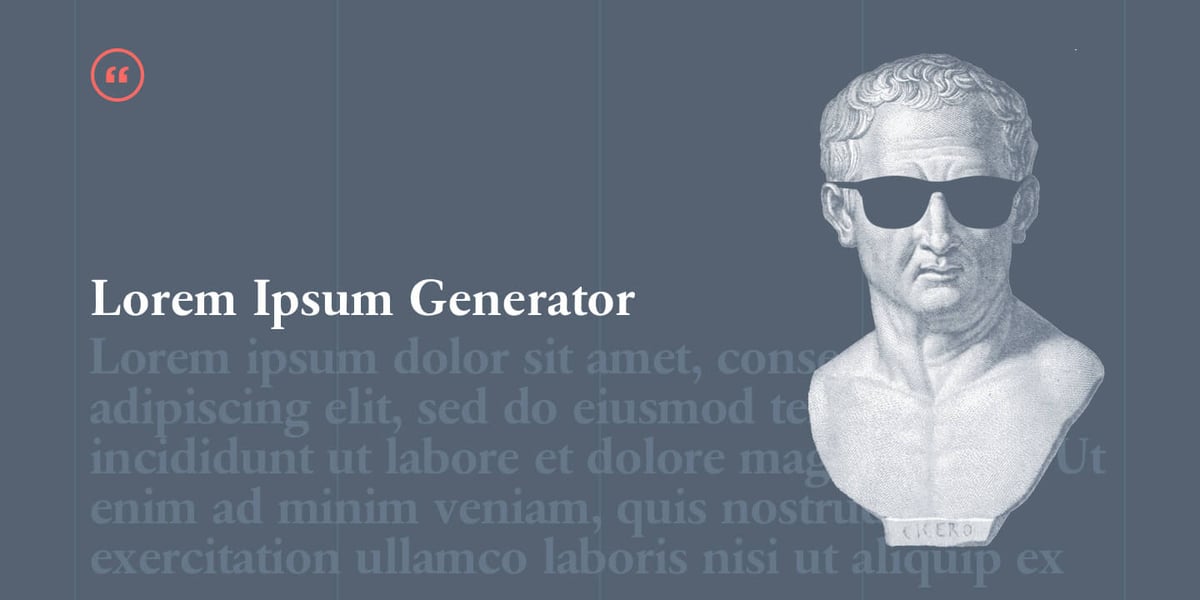
“Lorem ipsum” is a shorthand for placeholder text, usually beginning with this not-quite-meaningful-Latin phrase. Many folk genealogies date the practice to the Latin-loving Renaissance humanists, and who knows? Maybe Aldus Manutius did have some dummy Latin that he liked to use to test a page design. But it probably wasn’t the same text we use today, and Aldus himself only enters the story in a marginal way.
Jack Shepherd argues persuasively for a much more recent lorem ipsum origin story.
The source text is definitely Cicero, although it’s two mishmashed quotes from De Finibus Bonorum et Malorum (About the Ends of Good and Evil) with words cut in half:
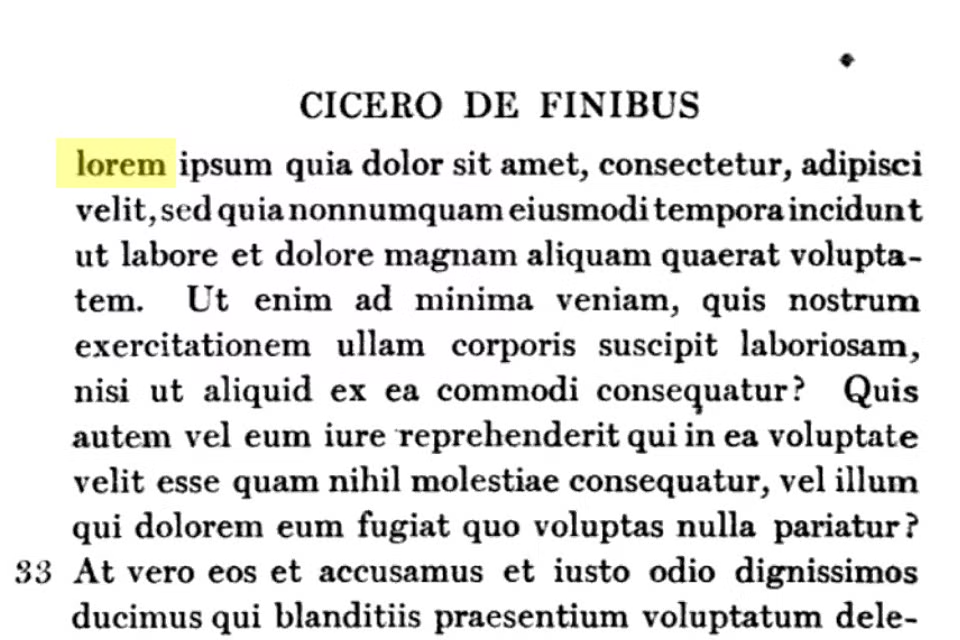
You’ll notice that this image, from the Loeb Classical Library 1914 opposing-face translation of Cicero’s work, doesn’t cut off “delorem ipsum,” or rather it does: this page is the second half of the cut. And that’s one clue that we have that this particular truncation of the text is a twentieth century practice, not a fifteenth century one.
The earliest example that anyone seems to have been able to find of Random Selections of the 1914 Loeb Facing Translation of Sections 1.10.32 and 1.10.33 of Cicero’s De Finibus Used as Dummy Text (aka, mercifully, Lorem Ipsum) is from the 1960s. At the time, if you wanted to mock up an ad or a flier for a punk show and you didn’t have a bunch of bespoke font settings on your Imperial Model 70 typewriter, your best bet was a British company called Letraset, which sold adhesive transfer sheets with different typefaces.
Letraset used Lorem Ipsum in their advertisements, and the layout-design software company Aldus (maker of the popular PageMaker layout tool) duplicated the practice in the ’80s, which is presumably the origin point of ChatGPT’s tall tale about Aldus Manutius using Lorem Ipsum in the 16th Century.
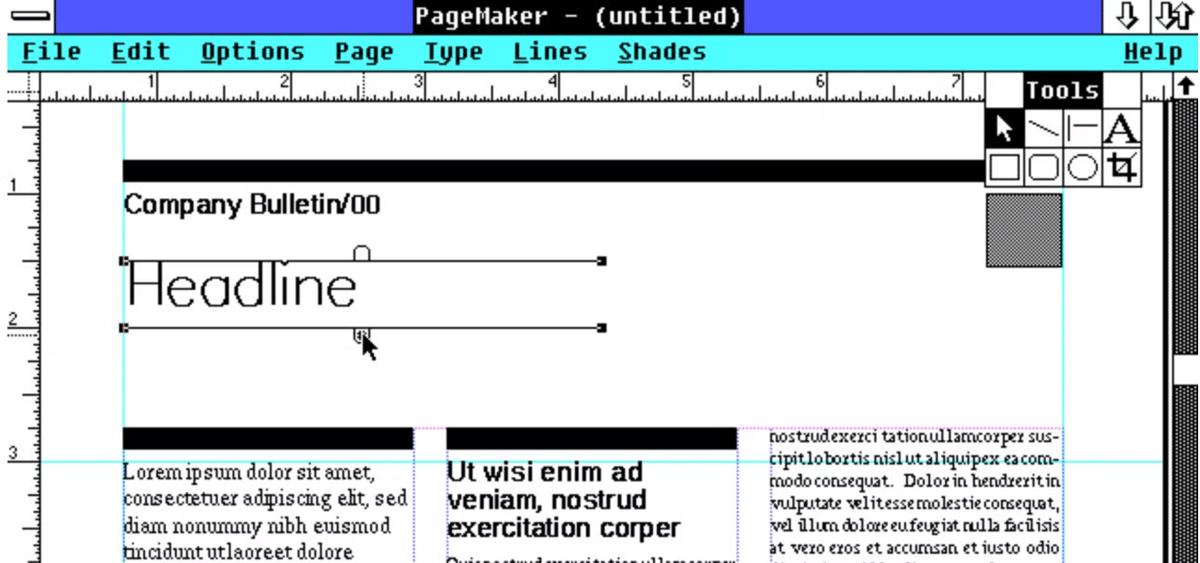
You might feel a little deflated by this revelation. You mean, that’s it? It’s been software all along? We don’t stand in a noble tradition of humanist lettersetters?
Ah, but the thing is we do! Nothing screams “Renaissance humanism” more than inventing a practice and then assigning it a venerable pseudo-archaic origin. Imitation here is genuinely the sincerest form of flattery. This is perfect.
What’s the most successful Hollywood movie of all time? By gross = Avatar. By inflation-adjusted gross… still Avatar. But if you start to look at other metrics, like return on investment, the data gets a little more surprising…
The Academy loves the gritty, gory new German adaptation of All Quiet on the Western Front, rewarding it with nine Oscar nominations, including Best Picture. Who hates it? German critics.
We Don’t Need To Go To Mars
Buckle up, this one is fun: Maciej Cegowski has begun what promises to be a multi-part essay arguing against a crewed mission to Mars. It’s called “Why Not Mars,” it’s 8000 words long, with 66 footnotes, and it sings. I’m not even sure I agree, but I enjoy the hell out of it.
The goal of this essay is to persuade you that we shouldnt send human beings to Mars, at least not anytime soon. Landing on Mars with existing technology would be a destructive, wasteful stunt whose only legacy would be to ruin the greatest natural history experiment in the Solar System. It would no more open a new era of spaceflight than a Phoenician sailor crossing the Atlantic in 500 B.C. would have opened up the New World. And it wouldnt even be that much fun.
A few choice lines:
Even billionaires who made their fortune automating labor on Earth agree that Mars must be artisanally explored by hand.
There is a small cohort of people who really believe in going to Mars, the way some people believe in ghosts or cryptocurrency, and this group has an outsize effect on our space program.
I think it’s time we brought the Mars talk down to earth, and started approaching a landing there as an aerospace project rather than the fulfillment of God’s plan.
The things that make going to Mars hard are not fun space things, like needing a bigger rocket, but tedious limits of human physiology.
I would compare keeping primates alive in spacecraft to trying to build a jet engine out of raisins. Both are colossal engineering problems, possibly the hardest ever attempted, but it does not follow that they are problems worth solving.
I would pay large sums of American money to be a fly on the wall at the meeting where someone tries to pitch senior career civil servants on working for Elon Musk.
And so forth. If you don’t find yourself persuaded, you should at least be hectored into entertainment. (And what a position it is, to be a citizen of a civilization in the 21st century, where one ought to be persuaded to attempt interplanetary flight).
Via Baratunde Thurston.
The Tenth Anniversary of the Twentieth Anniversary Groundhog Day Liveblog

I know, I know — recursive humor is tricky, and most of the time, it doesn’t really work. But I was nearly as thrilled as Ned Ryerson bumping into an old friend when I noticed that my guestblogging time was going to coincide with the Thirtieth Anniversary of the classic Bill Murray / Andie MacDowell / Harold Ramis romantic comedy Groundhog Day — i.e., the tenth anniversary of Kottke.org’s 2013 twentieth anniversary Groundhog Day liveblog, written by Jason Kottke, Aaron Cohen, Sarah Pavis, and me.
Can you believe it’s been ten years? Feels like both just one day and a whole lifetime. It’s true; sometimes today is tomorrow.
For those few of you not content with reliving old Groundhog Day content, here are some deleted scenes of Phil Connors shooting pool and bowling a perfect game. (Look how gloriously 1993 it is! Scoring by hand!)
“The Coding Is The Easy Part”: A Conversation About Accessibility In Journalism

I enjoyed this Nieman Lab interview with Holden Foreman, the first-ever Accessibility Engineer at the Washington Post. I’m particularly pleased to see that Foreman is thinking about accessibility as, well, not solely a problem that can be solved by better engineering:
The coding is the easy part. Centering our work in listening, and elevating voices that have long been marginalized, is essential to improving accessibility in journalism. Trust has to be earned, and I think this is the biggest opportunity and challenge of being the first in this role. It’s counterproductive for accessibility work to be siloed from broader audience engagement and DEI work. Keeping that in mind, a lot of my initial work has included conversations with various stakeholders to get a better understanding of where and how engineering support, education, and documentation are needed. Accessibility may be viewed as a secondary concern or just a technical checklist if we don’t engage with real people in this area just as we do in others…
It’s essential to think about accessibility not just in the context of disability but also in the context of other inequities affecting news coverage and access to news. For instance, writing in plain language for users with cognitive disabilities can also benefit users with lower reading literacy. [The Post published a plain language version of Foreman’s introductory blog post.] Making pages less complex can make them more user-friendly and also possible to load in the first place for folks in areas with bad internet, etc…
There are nuances specific to the accessibility space. Not everyone with a disability has access to the same technology. Screen reader availability varies by operating system. JAWS, one of the popular screen readers, is not free to use. And there are many different types of disability. We cannot focus our work only on disabilities related to vision or hearing. We need separate initiatives to address separate accessibility issues.
Ultimately, better accessibility tools for disabled users translates to better services for everyone. That’s not the only reason to do it, but it is an undeniable benefit.
Cell Phones In Prison
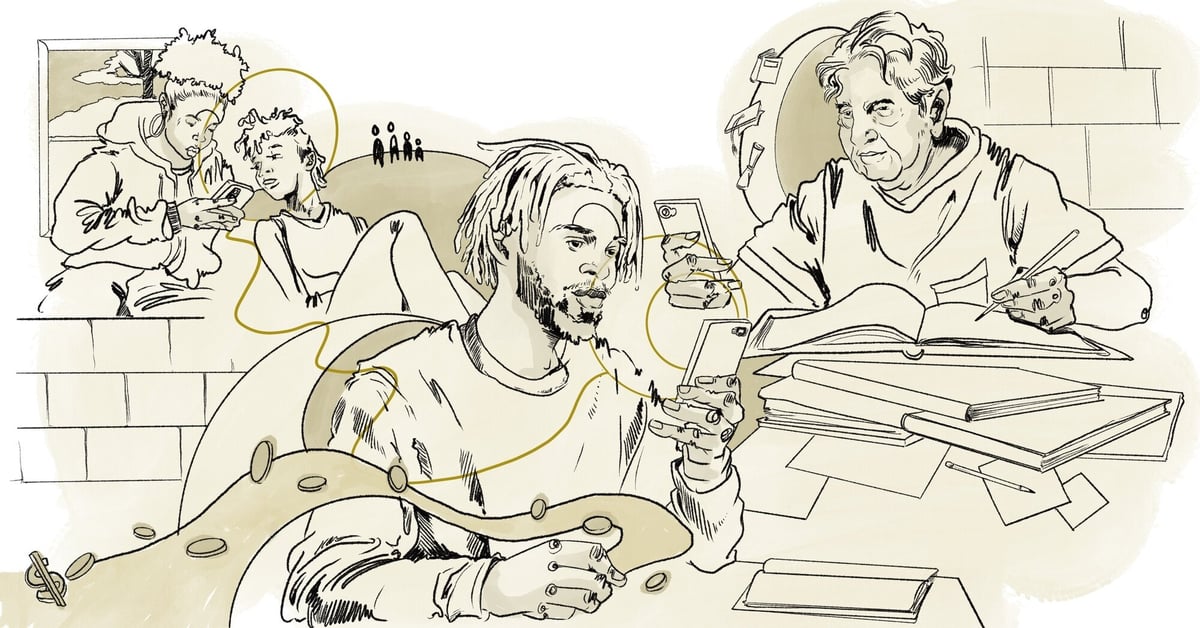
In most jails and prisons, cellular phones are considered contraband and can be confiscated if they’re found in a prisoner’s possession. If they’re lucky, that’s the limit of the punishment. But just because something isn’t allowed doesn’t mean it doesn’t exist, and phones inside lockup are popular for most of the same reasons they’re popular on the outside: they’re fun, useful tools for work or communication.
Keri Blakinger writes about the wide range of uses inmates have found for mobile phones:
Most of what I knew about illicit electronics came from press releases and news stories that offered example after example of all the bad things people could do with contraband phones, things like trafficking drugs, making threats and running scams. While it’s true those things can happen, over the past three years I’ve also seen a lot of people use their phones for good. Some use them to self-publish books or take online college classes. Others become prison reform advocates, teach computer skills, trade bitcoin or write legal briefs. I’ve seen a whole plethora of savvy and creative uses that fly in the face of stereotypes about people behind bars. “Our cell phones have saved lives,” a man in prison in South Carolina told me.
Along with communication, activism, and journalism, cell phones are popular not least because they can be used for profit (helped, not hindered, by the peculiarities of the prison economy):
Even though contraband phones can cost anywhere from around $300 to $6,000, sometimes the devices pay for themselves, because a lot of prisoners use them to earn money. One Texas prisoner I interviewed had been selling his artwork online, while others say they have used their phones to learn how to trade stocks or do online gig work. More commonly, I know guys who use their phones to get work as freelance writers. You might read their stories and not even know the author penned them from prison. Unfettered internet access makes research quicker, and one man explained that a pricey contraband phone can still end up being cheaper and more reliable than communicating in approved ways.
“Typewriter ribbons here are extortionately priced,” one federal prisoner explained. “Talk-to-text makes writing articles so much cheaper, even including the cost of the phone and the rate plan”… Some people earn money by renting out their phones or charging people to use them as hotspots to secretly connect their prison-issued tablets to the internet. “You can buy hotspot time for $1 a day,” a prisoner in one Southern state told me. “A dollar is two ramen noodle soups, and that’s how it’s paid for.”
But the most popular use for a phone in jail or prison is simply to keep in touch with friends and family outside.
When the California prisoner I spoke to got his first phone about a decade ago, the first thing he did, he said, was call his wife and ask to speak to his son. Ordinary uses like that, he said, are why most people in prison want phones.
“I mean, there are some people where you might have legitimate concerns about them having phones, and they might want to order a hit,” he said. “But in the prison I’m at, the only thing we want to order is a pizza.”
Socials & More