


Advertise here with Carbon Ads
This site is made possible by member support. 💞
Big thanks to Arcustech for hosting the site and offering amazing tech support.
When you buy through links on kottke.org, I may earn an affiliate commission. Thanks for supporting the site!
kottke.org. home of fine hypertext products since 1998.
Beloved by 86.47% of the web.
Entries for February 2023
Google’s MusicLM Generates Music from Text
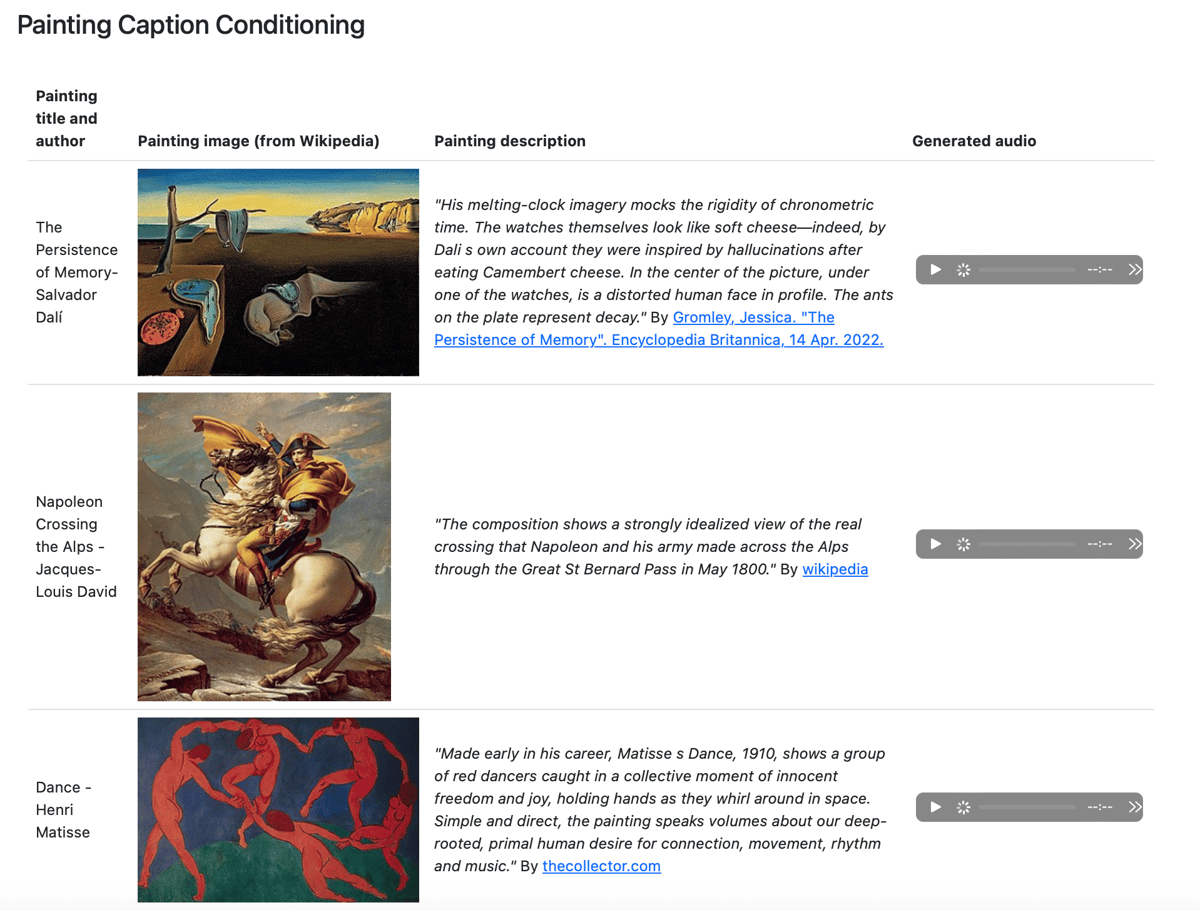
Google Research has released a new generative AI tool called MusicLM. MusicLM can generate new musical compositions from text prompts, either describing the music to be played (e.g., “The main soundtrack of an arcade game. It is fast-paced and upbeat, with a catchy electric guitar riff. The music is repetitive and easy to remember, but with unexpected sounds, like cymbal crashes or drum rolls”) or more emotional and evocative (“Made early in his career, Matisse’s Dance, 1910, shows a group of red dancers caught in a collective moment of innocent freedom and joy, holding hands as they whirl around in space. Simple and direct, the painting speaks volumes about our deep-rooted, primal human desire for connection, movement, rhythm and music”).
As the last example suggests, since music can be generated from just about any text, anything that can be translated/captioned/captured in text, from poetry to paintings, can be turned into music.
It may seem strange that so many AI tools are coming to fruition in public all at once, but at Ars Technica, investor Haomiao Huang argues that once the basic AI toolkit reached a certain level of sophistication, a confluence of new products taking advantage of those research breakthroughs was inevitable:
To sum up, the breakthrough with generative image models is a combination of two AI advances. First, there’s deep learning’s ability to learn a “language” for representing images via latent representations. Second, models can use the “translation” ability of transformers via a foundation model to shift between the world of text and the world of images (via that latent representation).
This is a powerful technique that goes far beyond images. As long as there’s a way to represent something with a structure that looks a bit like a language, together with the data sets to train on, transformers can learn the rules and then translate between languages. Github’s Copilot has learned to translate between English and various programming languages, and Google’s Alphafold can translate between the language of DNA and protein sequences. Other companies and researchers are working on things like training AIs to generate automations to do simple tasks on a computer, like creating a spreadsheet. Each of these are just ordered sequences.
The other thing that’s different about the new wave of AI advances, Huang says, is that they’re not especially dependent on huge computing power at the edge. So AI is rapidly becoming much more ubiquitous than it’s been… even if MusicLM’s sample set of tunes still crashes my web browser.
Were the Earliest Cave Paintings Calendars?

Since striking ancient cave paintings in southern Europe were first discovered more than a century ago, modern humans have tried to figure out if they have a meaning beyond being staggering works of art. Are they early animations? Examples of a primeval need to tell stories? An antique backdrop for us to project contemporary mistakes?
A new theory proposes that the repeatedly occurring nonfigurative signs (the ones that don’t look like anything concrete) are a kind of protowriting. This guess has been floated before, but this time, a number of earlier proposals are synthesized, and there’s a semantics attached: the symbols in the caves, these researchers argue, were used to mark time:
We hypothesize that the number of lines/dots, or the ordinal position of
symbols, in sequences associated with depictions of prey taxa in Upper Palaeolithic art, convey information about events in those animals’ annual lives important to hunter-gatherers, expressed in lunar months RBS, i.e. anchored to the start of the bonne saison. That information is likely to reflect birthing, and possibly mating and/or migration of the animals of concern in the region in which the images are found (or originated).
A relatively simple statistical analysis shows good correlation with the number of marks and the number of lunar months between cycles of mating/birthing. In this way, early hunter/gatherers might have been able to track the availability of bird eggs, or to find new prey.
This would be a revolution in the history of recorded information:
Although a series of marks can of course be ambiguous, the Upper Palaeolithic written system was thus clear, unambiguous and permanent, and could have widespread meaning irrespective of any linguistic barriers (about which, of course, we know nothing), particularly given the fact that our database contains samples from across western—and some central—Europe. It made possible the accumulation and transmission of intelligible information over multiple generations, independent of the need to maintain parallel oral explanations (although of course we do not propose that these simply disappeared). This was clearly much more than a simple ‘tally’ of accumulated information. We believe that the numeric notational marks associated with the animals constituted a calendar, and given that it references natural behaviour in terms of seasons relative to a fixed point in time, we may refer to it as a phenological calendar, with a meteorological basis. It may be of greater significance, however, that it significantly backdates by thousands of years the permanent combination of information (in the form of numerosity/ordinality) with its subject (the animal/symbol).
But is it writing?
In our reading, the European Upper Palaeolithic system functioned to record a subject and information about the behaviour of that subject expressed in relation to natural events; it therefore expressed far more than the tablets recording numbers of commodities from Uruk-period Mesopotamia (Steinkeller 1992). In the sense of the Sumerological use of the terms, we suggest that we can accord it the function of a script. But could the information that it recorded really be intelligible without at least the underpinning nouns for the animals, the moon and its phases, and the bonne saison and its defining events, in addition to the actions of mating and birthing? We will presumably never know the specific words for these in whatever languages were spoken in Upper Palaeolithic Europe, but we can assume that our script could be communicated orally by using them. Is this, then, not the definition of writing?
We may not be convinced that the Upper Palaeolithic sequences and associated symbols can be described as written language, given that they do not represent grammatical syntax, but they certainly functioned in the same way as proto-cuneiform… We do not want to press the controversial (and in many senses, semantic) question of whether writing was a Palaeolithic invention; perhaps it is best described as a proto-writing system, an intermediary step between a simpler notation/convention and full-blown writing. Assuming we have convinced colleagues of our correct identification, there will no doubt be a lively debate about precisely what this system should be called, and we are certainly open to suggestions. For now, we restrict our terminology to proto-writing in the form of a phrenological/meteorological calendar. It implies that a form of writing existed tens of thousands of years before the earliest Sumerian writing system.
To translate this out of scholarly passive-aggressiveness: “you don’t have to call it writing if you want to be dicks about it, but we all know it’s writing, chumps.”
Apollo, As Seen by Young Girls

On February 7, 1971, the Billings Gazette, a local Montana newspaper, ran a story by Carol Perkins titled “Apollo — As Kids See It.” They interviewed young kids, from 5 to 11, and a range of boys and girls, to get their opinion about NASA’s then-current manned moon missions. Paleofuture’s Matt Novak zeroes in on the girls:
“I wouldn’t like to go to the moon. It’s not really a place for girls,” said 7-year-old Joan Anderson, who would be about 58 years old now.
“I think it would be fun to marry an astronaut. He would be rich and famous,” said 5-year-old Gail Standard.
“He’d be gone away a lot, so I would go with him. I’d wear a girl’s astronaut uniform and cook a lot of potatoes,” said 6-year-old Jennifer Dettmann, speaking of her potential astronaut husband.
There are a lot of myths about the Apollo space program. Chief among them is that most Americans fervently supported the space program’s enormous costs. In reality, most Americans of the 1960s thought the Apollo space program wasn’t a good use of taxpayer funds, with many people asking why that money wasn’t being spent to fight homelessness or hunger in the U.S.—the same criticisms you hear today.
In fact, one of the girls quoted in the article, 11-year-old Betsy Longo, expressed a similar sentiment.
“I don’t think they should use so much money to go to the moon,” Longo said. “They should use it to stop cancer and help people here on Earth.”
One 10-year-old, Amy Ponich, was the only girl in the article who seemed receptive to the idea that she could have a role to play in America’s exploration of space, telling the reporter that she wanted to be a scientist to “discover more frontiers.”
“We need to know what the moon is made of and how it related to the Earth,” Ponich said.
The US Apollo program only included men, but the USSR’s Valentina Tereshkova was the first woman in space in 1963. Sally Ride was the first American woman in space in 1983, twelve years after this article. Since the Apollo program ended in 1972, no human beings have landed on the moon.
Socials & More