Entries for February 2023
Riffing on a recent piece by Izzie Ramirez, Vo’x Kim Mas educates us on why the quality of consumer goods has dropped over the past several years.
Maybe you’ve noticed: In the past 10 years everything we buy from clothes to technology has gotten just a little bit worse. Sweaters are more likely to tear. Phones are more likely to break. Smart toasters and TVs burn out and die after only a few years. It might seem like consumer products just aren’t built to last anymore. What’s going on?
Unfortunately (and fortunately!), part of the problem is us. For decades, we’ve been conditioned to buy, buy, buy, and today it’s normal for many consumers to shop for new clothes at least once a month. In order to keep up, many companies have to prioritize making things in the fastest and least expensive way possible. To do that, they cut corners with materials and labor. In turn, quality suffers, which leaves consumers with a lot of crappy things.
So, here’s how they make vinyl records at Third Man Records in Detroit. As you might expect, the process is a bit less automated than what you’d imagine for digital music media — those records are human-handled dozens of times before they are finally placed into their jackets.
Vinyl is in the real world. It’s not something that exists only on your computer or your phone, it’s three-dimensional. Your nervous system is designed to take in the sound. It heals you. It’s a nutrient. It’s like vitamins. You feel it. It’s like getting a massage or eating a beautiful sandwich.
See also this slow-motion video of a vinyl record playing, recorded with an electron microscope. You can see how the soundwaves are encoded in the grooves. (via open culture)
Teaser trailer for season three of Ted Lasso. “In this third season of Ted Lasso, the newly-promoted AFC Richmond faces ridicule as media predictions widely peg them as last in the Premier League…”
America’s teenagers aren’t getting enough sleep because school starts too early. “Despite years of evidence that starting school later promotes better health and improved grades, too few schools have adopted this measure.”
Cars are rewiring our brains to ignore all the bad stuff about driving. “People tend to have a giant blindspot when it comes to certain behaviors associated with driving, whether it’s speeding, carbon emissions, traffic crashes…”
10 rules for communicating with Gen Z online. “2. Never text without emojis or text emojis.”
This will probably get taken down soon, but in the meantime… This is the ASL performance of Rihanna’s Super Bowl halftime show by Justina Miles. So good — I love how her long fingers and fingernails accentuate and amplify her signing.
CNBC ran a short profile of Miles and other Super Bowl ASL performers yesterday before the game.
Miles, a Philadelphia native and current nursing student at HBCU Bowie State University, is hard of hearing, according to reporting from Billy Penn. Her mom is deaf, and her family is mixed with hearing people.
Miles was also part of the USA team that went to the 2021-22 Deaflympics in Brazil and won a silver medal as part of the 4x100 women’s track relay team. She was the valedictorian at the Model Secondary School for the Deaf in Washington D.C., according to the National Association of the Deaf.
You can find more of Miles on TikTok.
See also Translating Music Into American Sign Language and Eminem’s Lose Yourself in ASL.
George Toma, now 94, is a groundkeeper who has worked on the field for all 57 Super Bowls. “Still hale despite walking with a cane, he suffers from a lifelong case of perfectionism.”
TIL that Super Bowl halftime performers get paid union scale for their performance. Their actual pay is in exposure – a SB halftime show usually means a huge jump in album sales, tour ticket sales, etc.
I have never seen this before so maybe you haven’t either: a full-length video recording of Prince and the Revolution playing at First Avenue in 1983. This show marked the first time Prince played Purple Rain in public; it’s this recording of the song (lightly edited and reworked) that you hear on the album of the same name released the next year. From a piece in The Current about the show:
Before the 1984 blockbuster Purple Rain catapulted Prince on to the national stage, there was an Aug. 3, 1983 benefit concert for the Minnesota Dance Theatre at the recently re-branded First Avenue. It was there that the budding pop star debuted much of the Purple Rain album tracks, and recorded the versions of “Purple Rain,” “I Would Die 4 U” and “Baby I’m A Star” heard in the film and soundtrack.
“Those versions were almost exactly what he did live,” said longtime Prince producer David Rivkin, also known as David Z.
Since technology at the time couldn’t record wireless bass well, Rivkin said, Prince later added bass overdubs. He did some content edits, cutting the song down from about 14 to nine minutes.
“It was incredible; I mean little did I know it was gonna be that big of a recording,” Rivkin said. “Prince was really not a well-known figure back then. This is the kind of recording that launched him into super stardom.”
From Anil Dash’s piece on how Purple Rain came to be:
While Prince and the Revolution had been carefully rehearsing Purple Rain all summer, adjusting each detail of how the song was structured and played, Prince’s nearly-unequalled ability to spontaneously take a live performance to the next level was certainly on display that August night.
Exemplifying this ability is the repeated lilting motif that Prince begins playing on his guitar at 4:40 in the song. For all the countless times they’d practiced the song, even earlier on the same day as the First Avenue performance, Prince had never played this riff during Purple Rain before. In the original live show, it’s clear that Prince realizes he’s found something magical, returning again and again to this brief riff, not just on guitar but even singing it himself during the final fade of the song.
Just as striking is how this little riff shows the care and self-criticism that went into making the song Purple Rain. Like any brilliant 25-year-old guy who’s thought of something clever, Prince’s tendency when he thought of this little gem was to overdo it. In the unedited version of the song, Prince keeps playing the riff for almost another minute, pacing around the stage trying to will the audience into responding to it.
Update: From Louder, an oral history of Purple Rain and the night it was recorded.
After Melvoin’s opening acoustic chords, Bobby Z’s drums — mostly acoustic, and triggering Linn drums later added to in the mix — accompanied Prince’s singing for the first two minutes. “It’s just a back-beat and him from his guts,” Bobby says. “It’s just so raw for him. I remember those two minutes. Because the room is silent except for the pattern you’re playing. He was in the moment, and you’re in it with him, and it was a special place to be. It was a whole different planet.”
(via @peterbutler
Nope, coffee won’t give you extra energy. It’ll just borrow a bit that you’ll pay back later. “While it feels energising, this little caffeine intervention is more a loan of the awake feeling, rather than a creation of any new energy.”
Yesterday, Fox aired a very short, very good Rihanna concert, preceded and succeeded by a football game — you can watch it in its entirety on YouTube (possibly US-only). I caught this live and loved every second of it. The set design, choreography, costumes, the baby bump, and, of course, the music & singing: all pitch-perfect.
Update: I took out the embedded video because for some dumb reason the NFL doesn’t allow embeds on that video.
An imperfect list of books like Tomorrow and Tomorrow and Tomorrow. “Never before have I read a book and felt as seen across multiple dimensions of my personality.”
The Relentless Attack on Trans People Is an Attack on All of Us. “There is no world in which their freedom is suppressed and yours is sustained.”

When I saw a link to Lisa Whiteman’s photo essay on “muleskinning”, I was like oh dear god what am I getting myself into here. But it turns out that a muleskinner is a mule driver, particularly one who travels by mule in groups.
I met Ronald in 2009, when I attempted to make a shot-but-never-finished documentary about him and a group of his muleskinner friends who regularly take recreational road trips across North Carolina. A “muleskinner” is the term used for a mule driver, but it also refers to the microculture of the caravan. They pull over at night to sleep on farms and in the yards of churches and friends, their sleeping bags or old quilts laid out in the backs of their wagons. They open up a can of Beanee Weenee, or splurge on a “fish dinner” — what they affectionately call a tin of sardines. Sometimes they chase it down with a few sips of homemade moonshine they’ve brought in Mason jars, sitting around a campfire and telling stories they’ve shared a thousand times.
A lovely story and photos of a US subculture I knew nothing about until today. You can check out more of Whiteman’s work on her website or on Instagram.
English football club Bristol City has not been awarded a penalty kick for 65 straight matches. “Amateur statisticians have created charts to demonstrate how ludicrous the streak has become.”


Thanks to a planet-wide collaboration, scientists have released an image of the Milky Way that contains 3.32 billion individually identifiable objects, most of which are stars.
Gathering the data required to cover this much of the night sky was a Herculean task; the DECaPS2 survey identified 3.32 billion objects from over 21,400 individual exposures. Its two-year run, which involved about 260 hours of observations, produced more than 10 terabytes of data.
Most of the stars and dust in the Milky Way are located in its spiral disk — the bright band stretching across this image. While this profusion of stars and dust makes for beautiful images, it also makes the galactic plane challenging to observe. The dark tendrils of dust seen threading through this image absorb starlight and blot out fainter stars entirely, and the light from diffuse nebulae interferes with any attempts to measure the brightness of individual objects. Another challenge arises from the sheer number of stars, which can overlap in the image and make it difficult to disentangle individual stars from their neighbors.
It’s worth checking out the largest size of the image published on the web (which is actually much smaller than the image’s actual size) as well as a tiny portion of the full image (second image above) that shows just how much detail is there. A zoomable interface for the entire image is available here.
The Greek government and activists have long been calling for the return of the Parthenon Marbles from the British Museum to Greece. But how did the marbles get to Britain in the first place?
In the early 19th century, a British lord named Elgin removed a significant portion of the remaining marble decoration and statuary from The Parthenon in Athens and brought it back to Britain. To cover his debts, he sold the marbles to the British government and they eventually made their way into the British Museum. In the video above, Evan Puschak provides more detail about how it all went down.
For its part, the British Museum isn’t budging, although their official stance on the matter seems defensive, almost like they know they’re on thin ice, morally speaking. It’s long past time the marbles were repatriated and they should just get it over with already.
Update: This is interesting from David Allen Green: the return of the Parthenon Marbles isn’t up to the British Museum.
The fourth point is that the current legislation does make it difficult-to-impossible for the museum to dispose (to use the legal word) of the marbles as it wishes, either by returning them to Greece or otherwise.
An elaborate legal basis could, perhaps be provided, but — on balance — one suspects an English court would rule such a disposal as unlawful.
This means this is not a matter solely for the trustees of the museum (as I explain here).
For the marbles to be returned properly to Greece would require a change in primary legislation, which in turn means it has to have government support (or at least no government opposition).
(via someone I can’t remember but thank you!)

From comments made by Knives Out and Glass Onion director Rian Johnson, it doesn’t seem likely that a Benoit Blanc mystery movie with the Muppets or a Muppet movie with Benoit Blanc will ever happen. So, we’ll have to settle for this mashup of Blanc and The Great Muppet Caper made by Nerdist:
I dunno Johnson, that works pretty well…
The cover story of the current issue of New York magazine is a collection of tips, rules, and etiquette for how to behave in contemporary society (ok, urban east coast society). It’s a good list for the most part, if unnecessarily provocative in places — gotta sell those magazines and rile up whoever remains on Twitter. I snipped out several of the rules and gently annotated them with my opinionated thoughts below. Just like bloggers used to do in the olden days. Quaint!
6. Never wake up your significant other on purpose, ever.
And don’t turn on the lights when they’re asleep. Jet-lagged and want to talk? Don’t do it. Think someone is coming in to kill you? Work it out yourself.
Huh? I think it’s the “ever” that bugs me here. Don’t get me wrong, I love my sleep and if I don’t get 7-8 solid hours, I’m more or less worthless the next day. But if you actually need me at 3am, by all means, wake me up. (I feel like the person who wrote this doesn’t have children? Getting woken up in the middle of the night is de rigueur w/ kids around, so your partner rousing you in the middle of the night bc they’re, for instance, having a panic attack or are sick & wondering if they need to go to the ER not only isn’t a big deal but is part of the reason you’ve partnered up in the first place.)
27. The proper response to being told something you already know isn’t “I know.” It’s “You’re right.”
I would like to tattoo this on my son’s arm for reference; I hear “I know” from him like 90 times a day when what he really means is, “That’s right” or “Thanks for the reminder”.
30. When casually asked how you are, say “Good!”
It’s neutral and doesn’t force someone to endure a trauma dump or a spiel on how “the world is up in flames.”
I have some trouble with this one. Even when the grocery store cashier is just being polite, I sometimes answer them like my therapist is asking.
33. If you bring up astrology and it isn’t met enthusiastically, change the topic.
Not everyone believes in your made-up star bullshit.
“Made-up star bullshit”: thank you. Religion too. But this probably goes for anything — if your conversational partner isn’t digging it, move along to something else.
47. Listening is not the time for you to silently rehearse what you want to say next.
We can see your eyes glazing over.
I know what they’re trying to get at here — listening, really listening, is important! — but this isn’t great advice for folks who aren’t neurotypical… Some people simply cannot participate in conversations without being extremely in their own heads about how to respond to what is being said, especially when they don’t know their convo partner well.
50. If your burger is becoming a salad, your restaurant-order modifications have gone too far.
You’re allowed to ask for things based on allergies and preferences. But when your dish transforms into another dish, you’re a problem.
Yes, exactly. This is the dunderheaded “the customer is always right” run amok.
59. The correct number of slices of pizza to order for a group of X people is 2X + X/3.
Any fewer is for misers; any more risks catatonia. N.B.: This rule holds for “classic” New York-style pizza.
I’d never heard this rule of thumb before. Let’s see if it checks out. For 3 people, you’d get 7 slices. For 8 people, you’d get 19 slices. Everyone gets two slices, plus one out of three people gets an extra slice. I feel like this might fail sometimes with smaller groups but with larger ones, things will tend to average out more (some ppl will eat more, some less).
78. Don’t talk about a movie when leaving the theater.
You never know who might overhear you raving about the big twist or panning an actor’s overhyped performance. At a certain point, people have to accept that they’re going to hear spoilers for the film, but not three minutes before seeing it.
Yes! I am always very quiet when leaving the theater, aside from non-specific utterances like, “that was great!” It’s easy to wait like 30 seconds for when you make it to your car or out on the street.
83. Go on, take the last bite.
Nobody wants to be the person who swipes that lone, lingering croquette or slurps down the final oyster from a communal seafood tower. Are you selfish? A glutton? All of the above? No. You are sparing everyone — your guests, yourself, your server — from the limbo of leaving one last bite on a shared plate. Letting something sit on the table uneaten while the bussers wonder whether they should clear the dish: That’s not polite. It’s annoying. Eat the food! That’s why it’s there.
Oh man. As a midwesterner who went to sooooo many potlucks and church picnics as a kid, this has been a tough habit to shake — taking the last morsel of something might as well be a felony in some parts of rural Wisconsin. But I’ve learned that if you’re paying attention (which is the key to many points of etiquette), you can tell when it’s alright to take the final bite of something, when to leave it for someone else, and when to urge someone you noticed enjoying a particular dish to grab the last bit of it.
94. It’s okay to email, text, or DM anyone at any hour.
There’s nothing worse than being woken up at 2:30 a.m. with a dumb text or a Slack notification. So why did you do that to yourself? Phones and computers have great tools now to manage your time away, including setting working hours and muting types of notifications. We’re responsible for which flashing lights and noises we let into our lives. Because of that, anyone should feel free to text a friend or message a co-worker at any hour. We can’t successfully move into the future unless we recognize that the onus is on the receiver, not the sender.
No. I get that other people’s notification strategies should not be your problem, but sending work-related emails and messages at all hours may generate a corresponding pressure in recipients to be awake to respond to them and normalizes the sense that you should be on the clock 24/7/365, which is no way at all to live and should be discouraged at every turn.
108. Don’t try to help a stranger parallel park.
People should be allowed the grace to park alone without being perceived. If you are walking down the street and see that a stranger is parallel parking, avert your eyes. “What if they need my help?” you ask. You are allowed to help only if you are directly and explicitly asked to by the driver. Otherwise, keep walking — it’s what’s best for everyone.
Yes! This is related to a current pet peeve of mine here in VT: people who wave at you or flash their lights for you to turn across traffic in front of them, even though you don’t have the right of way. I get why people do this: traffic is “heavy”, they have a clearer view of oncoming traffic than you do, and/or they are trying to be nice. But in reality, it creates a dangerous situation for you: you feel rushed into accepting their offer of help and move into the intersection before you’ve checked if it’s safe. Or someone behind them gets antsy and passes them on the right and suddenly they’re in the intersection when you’re pulling out. It’s just safer and better if everyone just takes their turn when they have the right of way.
111. It’s perfectly fine to walk through someone’s scene.
Whether it’s Marty Scorsese or someone filming an outfit-of-the-day TikTok, they don’t own the sidewalk.
Absolutely. Especially with people on busy streets taking photos with digital cameras, just walk in front of them…they can always take another one.
139. Post like the wind.
On Instagram, where best practices are unspoken but nearly universal, the conventional wisdom is that you should post on your main feed no more than once a day. Infrequent posting is perfectly in line with Instagram’s social mechanisms — it maximizes likes on each post, prioritizes the consumer, and lends itself to a tasteful, optimized feed where only the best-of-the-best pics make the cut. But if you’re going to participate in social media, the only way to have any fun with it is by consciously defying the incentives it dangles in front of you. Post excessively, indulgently, tastelessly. Maybe even take some shots with the in-app camera and post them as-is (it only seems unimaginable because you’re not thinking big enough). The curated photo-dump carousel, polite and unintrusive, is dead; posting 15 individual photos to your main grid in one day is what freedom feels like.
Ha, I like this advice! But I do not do it. Curators gonna curate, so my social media is pretty metered and controlled and all that jazz. Gonna think about letting loose a bit more often.
140. Don’t post RIPs for celebrities.
“Only the most moronic amongst us post photos of famous people seconds after they die,” Keith McNally recently wrote on Instagram. “It’s not a form of respect for the dead, but an attempt to sycophantically associate themselves with the famous. It’s their 15 minutes of fame, the necrophiliac bastards.” We tend to agree: Unless David Crosby was your actual uncle, or cousin, or whatever, refrain.
Huh? No. The public displays by strangers of remembrance, condolence, and, yes, even grief in the wake of a beloved celebrity’s death is one of the best things about social media. What this point should have been instead: If the dead were monstrous, go ahead and speak ill of them after they die. When Dick Cheney finally goes, I want to hear all about how he helped fuck America up for decades to come, please and thank you.
The subway in San Francisco still runs on 5 1/4-inch floppies. “Our train control system in the Market Street subway is loaded off of five-and-a-quarter inch floppy drives.”
This is a fantastic piece by writer Ted Chiang about large-language models like ChatGPT. He likens them to lossy compression algorithms:
What I’ve described sounds a lot like ChatGPT, or most any other large-language model. Think of ChatGPT as a blurry jpeg of all the text on the Web. It retains much of the information on the Web, in the same way that a jpeg retains much of the information of a higher-resolution image, but, if you’re looking for an exact sequence of bits, you won’t find it; all you will ever get is an approximation. But, because the approximation is presented in the form of grammatical text, which ChatGPT excels at creating, it’s usually acceptable. You’re still looking at a blurry jpeg, but the blurriness occurs in a way that doesn’t make the picture as a whole look less sharp.
Reframing the technology in that way turns out to be useful in thinking through some of its possibilities and limitations:
There is very little information available about OpenAI’s forthcoming successor to ChatGPT, GPT-4. But I’m going to make a prediction: when assembling the vast amount of text used to train GPT-4, the people at OpenAI will have made every effort to exclude material generated by ChatGPT or any other large-language model. If this turns out to be the case, it will serve as unintentional confirmation that the analogy between large-language models and lossy compression is useful. Repeatedly resaving a jpeg creates more compression artifacts, because more information is lost every time. It’s the digital equivalent of repeatedly making photocopies of photocopies in the old days. The image quality only gets worse.
Indeed, a useful criterion for gauging a large-language model’s quality might be the willingness of a company to use the text that it generates as training material for a new model. If the output of ChatGPT isn’t good enough for GPT-4, we might take that as an indicator that it’s not good enough for us, either.
Chiang has previously spoken about how “most fears about A.I. are best understood as fears about capitalism”.
I tend to think that most fears about A.I. are best understood as fears about capitalism. And I think that this is actually true of most fears of technology, too. Most of our fears or anxieties about technology are best understood as fears or anxiety about how capitalism will use technology against us. And technology and capitalism have been so closely intertwined that it’s hard to distinguish the two.
Let’s think about it this way. How much would we fear any technology, whether A.I. or some other technology, how much would you fear it if we lived in a world that was a lot like Denmark or if the entire world was run sort of on the principles of one of the Scandinavian countries? There’s universal health care. Everyone has child care, free college maybe. And maybe there’s some version of universal basic income there.
Now if the entire world operates according to — is run on those principles, how much do you worry about a new technology then? I think much, much less than we do now.
See also Why Computers Won’t Make Themselves Smarter. (via @irwin)
A flowchart of when it’s acceptable to turn the heat on in New England. “Chrissakes, just put on a sweater! If you’re still cold in an hour (I bet you won’t be), then we can talk about touching the dial.”
Leave it to The Kid Should See This for finding this gem of a video, featuring the hatching and early life of a tiny zebra finch.
This is the smallest bird I’ve ever hatched. After a little Finch had lost her partner, I was asked if she could stay in my big Aviary. When I returned home after picking her up, on the way back she had laid an egg in the little transport box! Birds only do this when they have an egg that needs to be laid. I knew there was only a small chance she would accept and hatch this egg in an actual nest herself, but I wanted to try before I set plan B in motion…
The mother bird didn’t accept the egg, it was moved to an incubator, and after a couple of weeks the tiniest bird you’ve ever seen hatches. The birth and first feeding were absolutely riveting — I was on the edge of my chair! What weird little alien creatures baby birds are. (via the kid should see this)
Billy Mitchell and the telltale joystick. The entertaining saga of the disgraced Donkey Kong champion rolls on; this time, a photo suggests his world record was set using an improper joystick.
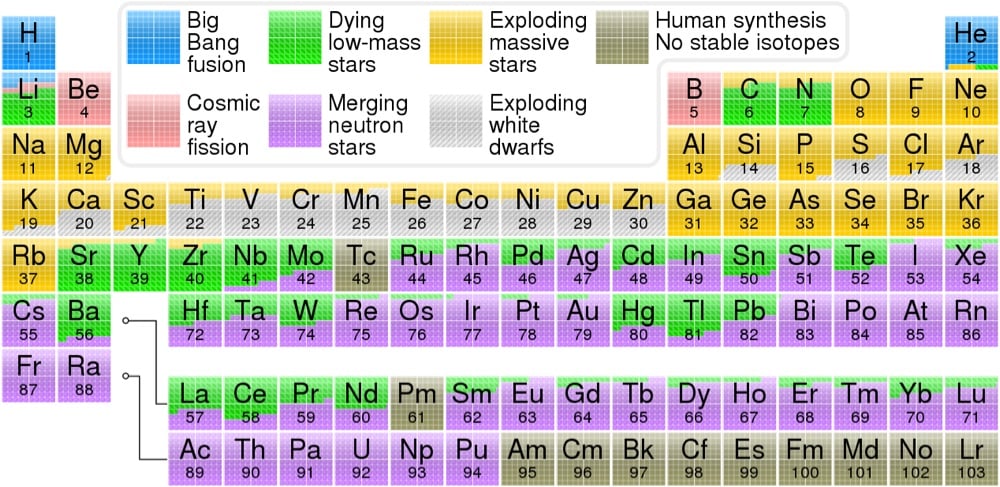
From Wikipedia contributor Cmglee and Astronomy Picture of the Day, a color-coded periodic table that displays which cosmic events — the Big Bang, exploding stars, merging neutron stars, etc. — was responsible for creating each element, according to our present understanding of the universe.
The hydrogen in your body, present in every molecule of water, came from the Big Bang. There are no other appreciable sources of hydrogen in the universe. The carbon in your body was made by nuclear fusion in the interior of stars, as was the oxygen. Much of the iron in your body was made during supernovas of stars that occurred long ago and far away. The gold in your jewelry was likely made from neutron stars during collisions that may have been visible as short-duration gamma-ray bursts or gravitational wave events.
The data for the table came from OSU’s Jennifer Johnson, who quotes Carl Sagan:
The nitrogen in our DNA, the calcium in our teeth, the iron in our blood, the carbon in our apple pies were made in the interiors of collapsing stars. We are made of starstuff.
(thx, caroline)
The Fleishman Effect. “In a city of Rachels and Libbys, [Fleishman Is in Trouble] has some New York moms worried they’re the ones in trouble.”
Last night, in the third quarter of an eventual loss to the Oklahoma City Thunder (a team name that didn’t even exist when James made his NBA debut), LA Lakers forward LeBron James broke the once-untouchable all-time NBA scoring record, formerly 38,387 points and held by the great Kareem Abdul-Jabbar. Afterward, James had this to say about the moment:
Everything just stopped. It gave me an opportunity to embrace it and look around and seeing my family, the fans, my friends. It was pretty cool. I probably can count on my hands how many times I have cried in 20 years, either in happiness or in defeat. So that moment was one of them when I kind of teared up a little bit. It was ‘I can’t believe what’s going on’ tears.
The Athletic liveblogged the occasion as it happened and detailed how James was able to break the record.
James’ path to the all-time scoring record will look much different than his predecessor, and it’s quite obvious why: 3-pointers.
The impact of long-range shooting within the NBA has grown since the league embraced 3-pointers during the 1979-80 season. How has that affected James’ path to the top of the NBA’s scoring list? During Abdul-Jabbar’s final season in 1988-89, NBA teams averaged 6.6 3-point attempts per game. This season, James is averaging 6.7 3-point attempts on his own.
But let’s pause for a tribute to man James passed for the record: Kareem Abdul-Jabbar Is Greater Than Any Basketball Record.
Guided by the footsteps of Jackie Robinson and Bill Russell, Abdul-Jabbar pushed forward, stretching the limits of Black athlete identity. He was, among other qualities, brash and bookish, confident and shy, awkward, aggressive, graceful - and sometimes an immense pain to deal with. He could come off as simultaneously square and the smoothest, coolest cat in the room.
In other words, he was a complete human being, not just the go-along-to-get-along, one-dimensional Black athlete much of America would have preferred him to be.
James has run with the branding concept that he is “More Than an Athlete.” Fifty-plus years ago, Abdul-Jabbar, basketball’s brightest young star, was already living that ideal.
From The Ringer, How LeBron James Broke the All-Time Scoring Record:
Just how long has James been playing in the NBA at a high level? Long enough to face nine father-son duos in games.
LeBron James opened his NBA career on Oct. 29, 2003, scoring 25 points in 42 minutes in a loss to the Sacramento Kings. On the Kings’ bench sat Jabari Smith, a 6-foot-11 center in his third year who wouldn’t remove his warmups that night.
Nineteen years, two months and 18 days later, James would be reminded of that matchup by another Smith, Jabari Smith Jr., a rookie with the Houston Rockets who is Jabari Smith’s son.
“Hey, you played against my dad in your first NBA game ever,” the rookie told LeBron.
“Why you do that to me,” a chuckling James said, to which Smith responded, “You feel old, don’t you?”
From The NY Times, How LeBron James Outscored Kareem Abdul-Jabbar and All the N.B.A. Greats:
James had a head start on catching Abdul-Jabbar because he was drafted out of high school, which wasn’t allowed in Abdul-Jabbar’s day. Then known as Lew Alcindor, Abdul-Jabbar first spent four years at U.C.L.A., where he was one of the most dominant college basketball players in the country.
James, at 38, is one of the oldest players in the league and in his 20th season. When Abdul-Jabbar was 38, he was in just his 17th professional season. By the time he hit his 20th year, he was no longer as dominant as he had been. James, with the good timing of being able to start this journey at 18 years old, is still proving every day just how much he has left, scoring 40 points on several nights this season and almost reaching 50 in a January game against Houston. He could be the first player to score 40,000 points.
On a personal note, I’ve never been that excited about LeBron James. I don’t hate him, but I didn’t really root for him or enjoy watching him play. Part of my aversion was no doubt due to many people trying, far too early, to place James on the GOAT throne, ahead of the player I grew up watching and rooting for, Michael Jordan. If I were in charge of drafting players for an all-time team, I’d still select Jordan first — his unique combination of drive, athleticism, and skill is still, IMO, the best in the game, ever. But with his versatility and longevity, LeBron James has more than earned the status of the NBA’s greatest player of all time.
City of the Rails, a new podcast series about railroads and hobos. “When journalist Danelle Morton’s daughter skips town to hop trains, she follows her into the train yard, and across America.”
James Cameron is not one for half-measures. When making Titanic, he used every image and description of the ship he could lay his hands on to build accurate sets & models and financed 12 dives to the ship’s actual wreckage on the bottom of the ocean floor to gather footage to use in the film. For the mega-blockbuster’s 25th anniversary, Cameron has returned his attention to Titanic, to scientifically test the fan theory that there was enough room on the door for Jack at the end of Titanic (see the video above).
In order to reexamine Jack’s final moments, Cameron enlisted help from a team of scientists and two stunt people to test four different scenarios to examine whether two people could have shared the door.
“Jack and Rose are able to get on the raft, but now they’re both submerged in dangerous levels of freezing water,” Cameron explains as the stunt people prove it.
Meanwhile in another example, Cameron details, “Out of the water, violent shaking was helping him and projecting it out, he could’ve made it pretty long, like hours.”
If you can stand the forced-cheer morning show banter, there’s a bit more footage of Cameron and the testing from Good Morning America:
Cameron’s ultimate conclusion: “Jack might’ve lived, but there’s a lot of variables.”
Newer posts
Older posts






Socials & More