
A four-day workweek pilot was so successful most firms say they won’t go back. “15% of employees who participated said that ‘no amount of money’ would convince them to go back to working five days a week.”

Advertise here with Carbon Ads
This site is made possible by member support. 💞
Big thanks to Arcustech for hosting the site and offering amazing tech support.
When you buy through links on kottke.org, I may earn an affiliate commission. Thanks for supporting the site!
kottke.org. home of fine hypertext products since 1998.
Beloved by 86.47% of the web.
Entries for February 2023
Ruthless: Monopoly’s Secret History
Now showing on American Experience on PBS: Ruthless: Monopoly’s Secret History.
For generations, Monopoly has been America’s favorite board game, a love letter to unbridled capitalism and — for better or worse — the impulses that make our free-market society tick. But behind the myth of the game’s creation is an untold tale of theft, obsession and corporate double-dealing. Contrary to the folksy legend spread by Parker Brothers, Monopoly’s secret history is a surprising saga that features a radical feminist, a community of Quakers in Atlantic City, America’s greatest game company, and an unemployed Depression-era engineer. And the real story behind the creation of the game might never have come to light if it weren’t for the determination of an economics professor and impassioned anti-monopolist.
You can watch the first ten minutes of the show on YouTube or see the whole thing on the PBS website.
See also The Antimonopolist Origins of Monopoly Differ from Hasbro’s Official Story. (via @Kitbuckley)
New Synthetic Antibiotic “Cures Superbugs Without Bacterial Resistance”
Well, this is potentially a huge deal:
In a potential game changer for the treatment of superbugs, a new class of antibiotics was developed that cured mice infected with bacteria deemed nearly “untreatable” in humans — and resistance to the drug was virtually undetectable.
Developed by a research team of UC Santa Barbara scientists, the study was published in the journal eBioMedicine. The drug works by disrupting many bacterial functions simultaneously — which may explain how it killed every pathogen tested and why low-level of bacterial resistance was observed after prolonged drug exposure.
Huge if true, etc. What really caught my attention is how they discovered this in the first place…they were working on a way to charge cell phones:
The discovery was serendipitous. The U.S. Army had a pressing need to charge cell phones while in the field — essential for soldier survival. Because bacteria are miniature power plants, compounds were designed by Bazan’s group to harness bacterial energy as a “‘microbial”’ battery. Later the idea arose to re-purpose these compounds as potential antibiotics.
“When asked to determine if the chemical compounds could serve as antibiotics, we thought they would be highly toxic to human cells similar to bleach,” said Mahan, the project lead investigator. “Most were toxic — but one was not — and it could kill every bacterial pathogen we tested.”
Here’s the original paper if you’d like to take a look.
Ford Motor Company’s “Utopian Turtletop”

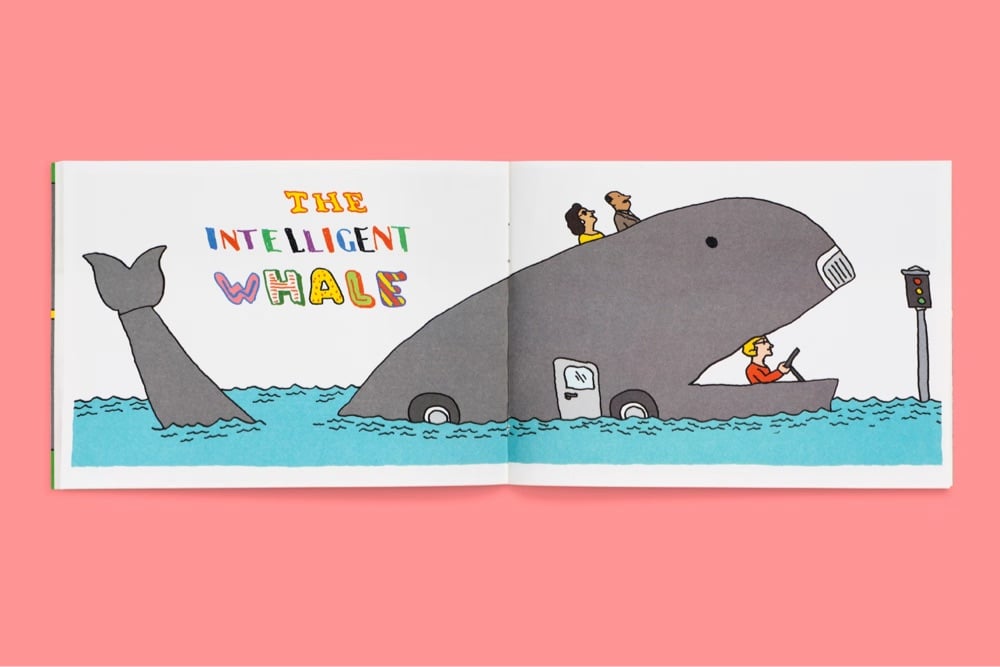
In 1955, the Ford Motor Company hired poet Marianne Moore to come up with some names for their revolutionary new car. Moore ended up submitting some amazing names, including “Silver Sword”, “Intelligent Whale”, “Angel Astro”, and “Utopian Turtletop”.
What Moore lacked in corporate nomenclature experience, she made up for in enthusiasm and imagination: she submitted over two dozen names for consideration, each one more delightful — and unlikely — than the last. In the end, the poet’s suggestions were rejected and the company’s chairman himself named the vehicle. Thus was born the notorious car known as the Edsel.
Ford realized perhaps too late that they shouldn’t have, in fact, sent a poet — but we’re sure glad they did.
Back here in the present day, Pentagram commissioned the legendary Seymour Chwast to turn Moore’s amazing collection of names into a booklet of illustrations that imagine what these cars might look like.
What a lovely little adventure for Craig Mod: he got a small Japanese city a big mention in the NY Times and ended up getting wholly embraced by the city’s residents. “Morioka. Holy smokes.”
In Order to Keep Our Editorial Page Completely Balanced, We Are Hiring More Dipshits. “We believe that the truth lies in the middle. The exact mathematical middle. This holds true no matter how far right ‘the right’ actually is.”
Richard Belzer, who played detective John Munch on Homicide: Life on the Street (and other shows), has died aged 78. “He had lots of health issues, and his last words were, ‘Fuck you, motherfucker.’”
Making a Very Tiny Watch Screw
This is pretty amazing: a guy making a 0.6mm screw for a watch using a very precise watchmaker’s lathe. It’s so small! I love that the hardest part is trying to find the impossibly tiny thing after it detaches from the high-RPM lathe. (thx, mick)
The Onion: It Is Journalism’s Sacred Duty To Endanger The Lives Of As Many Trans People As Possible. “It’s about asking the tough questions and ignoring the answers you don’t like, then offering misleading evidence…”
A massive collection of travel tips from the vibrant Cup of Jo community. “Always pack a swimsuit.”
8-Bit Martial Arts Choreography
Watch as Polish dance troupe Fair Play Crew brings the twitchy movements from old school martial arts video games into the real world with a funny and perfectly choreographed routine (it starts at the 3:50 mark in the video above. It seems like they’re riffing on a few different games here — Karate on the Atari 2600, Black Belt, Karate Champ, Karateka, International Karate, and even a little Mortal Kombat — instead of just a single game.
An Introduction to the World-Renowned Architect Zaha Hadid, “the Queen of the Curve”. If you don’t know much about Hadid and her work, now’s your chance to catch up.
An interview with the cast of Star Trek: TNG on their chance to have a proper ending in season three of Star Trek: Picard. I was lukewarm on catching up on Picard (I’ve only seen s01) but will after reading this.
They’re Making a Tetris Movie. And It’s a Thriller?
Well, I was not expecting the next video game to be turned into an edgy drama (an 80s Cold War techno-thriller, no less) to be Tetris, but here we are.
Taron Egerton stars in a new Apple Original Film inspired by the true story of how one man risked his life to outsmart the KGB and turn Tetris into a worldwide sensation.
If you’d have told me that this trailer was a Saturday Night Live sketch from 6 years ago, I would have believed you — and as it is, the release date of March 31 gives me pause.1 But I’ll give it a shot.
I don’t actually think this is an April Fools joke — Apple doesn’t usually go in for such nonsense.↩
“American drivers have a blinding headlight problem.” Increasingly prevalent trucks and SUVs are so tall that their lights shine in the faces of mere car drivers. It sucks.
An Ode to Swearing. “You can establish familiarity, even make friends, with swearing. Start gently.”
Leonardo da Vinci’s Surprisingly Accurate Experiments with Gravity

This is super-interesting: in papers written by Leonardo da Vinci collected in the Codex Arundel, he documents experiments that show that gravity is a form of acceleration and also calculated the gravitational constant to within 97% accuracy, hundreds of years before Newton formalized gravity in theory.
In an article published in the journal Leonardo, the researchers draw upon a fresh look at one of da Vinci’s notebooks to show that the famed polymath had devised experiments to demonstrate that gravity is a form of acceleration — and that he further modeled the gravitational constant to around 97 percent accuracy.
Da Vinci, who lived from 1452 to 1519, was well ahead of the curve in exploring these concepts. It wasn’t until 1604 that Galileo Galilei would theorize that the distance covered by a falling object was proportional to the square of time elapsed and not until the late 17th century that Sir Isaac Newton would expand on that to develop a law of universal gravitation, describing how objects are attracted to one another. Da Vinci’s primary hurdle was being limited by the tools at his disposal. For example, he lacked a means of precisely measuring time as objects fell.
As the piece notes, Leonardo didn’t get things exactly right:
Da Vinci sought to mathematically describe that acceleration. It is here, according to the study’s authors, that he didn’t quite hit the mark. To explore da Vinci’s process, the team used computer modeling to run his water vase experiment. Doing so yielded da Vinci’s error.
“What we saw is that Leonardo wrestled with this, but he modeled it as the falling object’s distance was proportional to 2 to the t power [with t representing time] instead proportional to t squared,” Roh says. “It’s wrong, but we later found out that he used this sort of wrong equation in the correct way.” In his notes, da Vinci illustrated an object falling for up to four intervals of time-a period through which graphs of both types of equations line up closely.
But it’s still pretty impressive how far he did get. The piece also notes that this work was discovered because the codex was made available online to the general public, demonstrating the value of easy access of materials like this.
Interesting shapes cause crazy slow motion fluid dynamics. I am not entirely convinced this isn’t computer generated but neither am I convinced it is.
Sky Collages
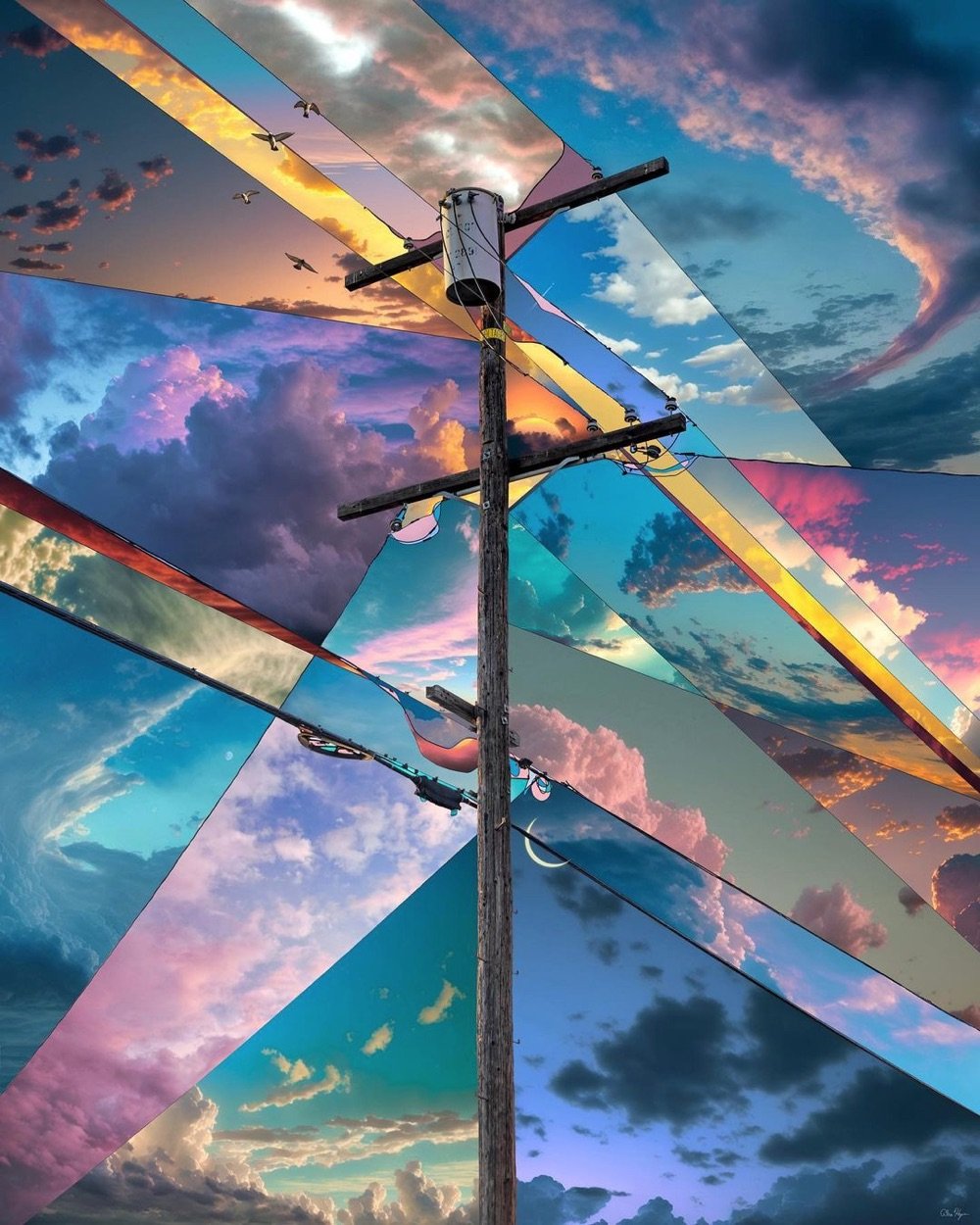
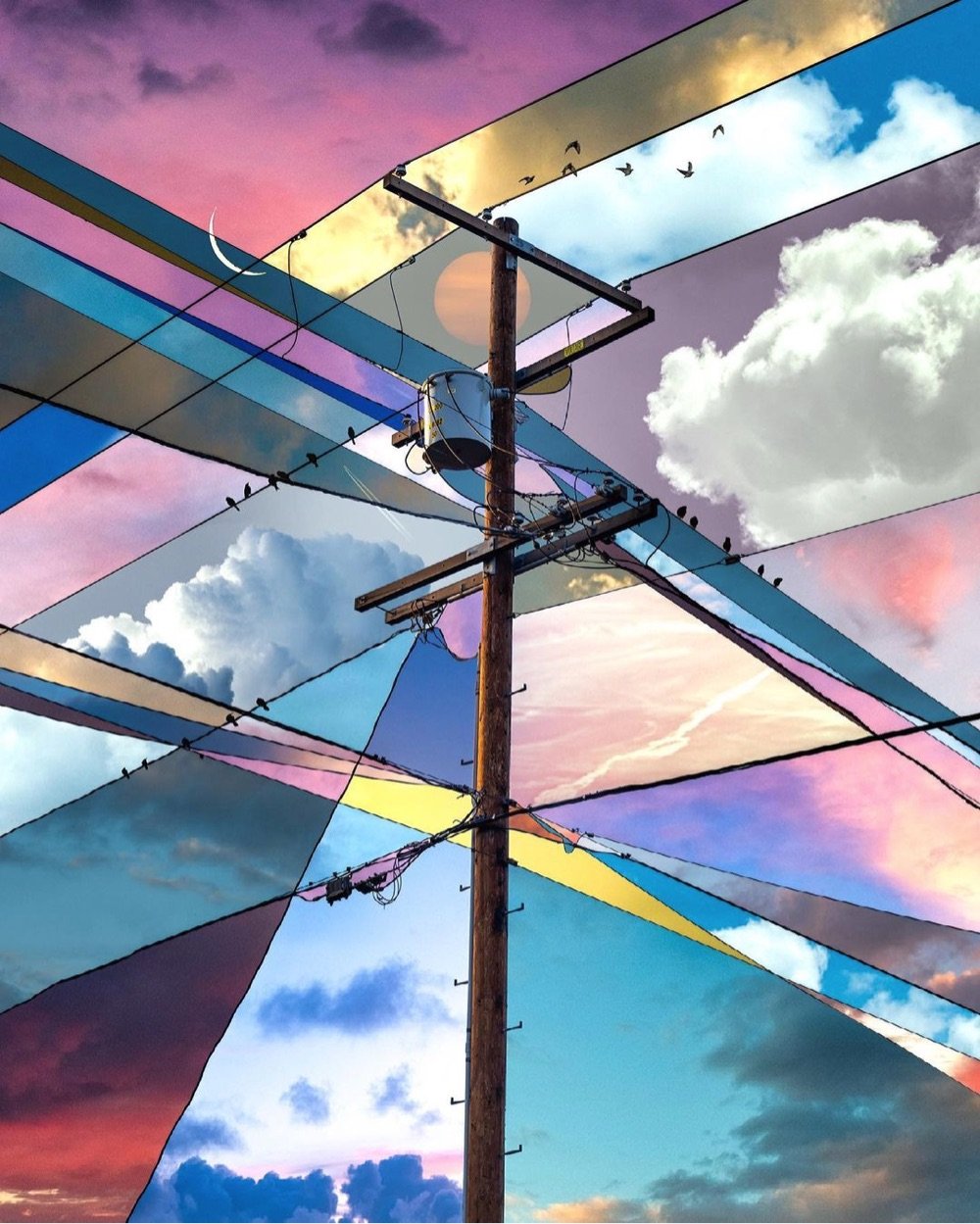
I love these photographic collages by Alex Hyner centered around images of power lines — the intersections of the lines form geometric shapes that each get their own different shade and texture of sky. Such a simple idea done really well.
You can see more of Hyner’s work on Instagram or buy prints of his Skies series on his website.
All the Beauty in the World

After leaving a job at The New Yorker in the wake of his older brother’s death, Patrick Bringley spent 10 years working as a guard at the Metropolitan Museum of Art in NYC. He wrote a book about his experience at the museum, All the Beauty in the World: The Metropolitan Museum of Art and Me (ebook). From a review at NPR:
In the wake of his 27-year-old brother Tom’s death from cancer in 2008, Bringley, two years his junior, gave up a prestigious “high-flying desk job” at The New Yorker, where “they told me I was ‘going places,’” for a job in which “I was happy to be going nowhere.” He explains, “I had lost someone. I did not wish to move on from that. In a sense I didn’t wish to move at all.”
Drawn to “the most straightforward job I could think of in the most beautiful place I knew” — a job that promised room to grieve and reflect in the wake of his loss — Bringley arrived at the Met in the fall of 2008. He explains his state of mind when he pivoted toward this union position for which he donned a cheap, blue, polyester uniform and received an allowance of $80 a year for socks: “My heart is full, my heart is breaking, and I badly want to stand still a while,” he writes.
From a piece in the New Yorker in which Bringley tours his old stomping grounds:
He answered an ad in the Times and went to an open house. “They tell you the hours” — for beginners, twelve hours on Fridays and Saturdays and eight hours on Sundays — “and half the people leave,” he recalled. After a week of training (“Protect life and property, in that order,” he was told), he joined the Met’s largest department: some five hundred guards, who work in rotating “platoons.” Bringley spent the next decade at the museum, and has now written a guard’s-eye memoir, “All the Beauty in the World,” detailing a job that is equal parts dreamy, dull, and pragmatic. “You can spend an hour deciding to learn about ancient Egypt, or look around at people and write a short story about one in your head,” he explained.
Bringley’s website has a page that lists all the art he mentions in the book, with links to each artwork on the Met’s website. I love this sort of thing from authors — it’s where I found the image at the top of the page: Titian’s Venus and Adonis. You can also book a tour of the museum with Bringley.
A collection of emulated calculators from The Internet Archive. Alas, they do not have the trusty Casio fx-300H that I all but wore out in college.
“There was a time when shame was a powerful force in American politics. That time is not now.” This is the true legacy of Trump: if you’re shameless & your group stays united in support, you can do almost anything you set your mind to.
Supermassive Black Holes: A Possible Source of Dark Energy
A group of astronomers say they have evidence that links supermassive black holes at galactic centers with dark energy, the mysterious force that accounts for roughly 68% of the energy in the universe. Here’s the news release and the paper. From the Guardian:
Instead of dark energy being smeared out across spacetime, as many physicists have assumed, the scientists suggest that it is created and remains inside black holes, which form in the crushing forces of collapsing stars.
“We propose that black holes are the source for dark energy,” said Duncan Farrah, an astronomer at the University of Hawaii. “This dark energy is produced when normal matter is compressed during the death and collapse of large stars.”
The claim was met with raised eyebrows from some independent experts, with one noting that while the idea deserved scrutiny, it was far too early to link black holes and dark energy. “There’s a number of counter-arguments and facts that need to be understood if this claim is going to live more than a few months,” said Vitor Cardoso, a professor of physics at the Niels Bohr Institute in Copenhagen.
And here’s a short video explainer:
It’s a radical claim to be sure — it’ll be interesting to see how it shakes out in the weeks and months to come as other scientists interpret the results.
The Winners of the 2023 Underwater Photographer of the Year Competition


The winners of the 2023 Underwater Photographer of the Year competition have been announced — you can check out all of the winners here. The photos above are by Gregory Sherman, Kat Zhou, and Shane Gross. Sherman’s photo of stingrays swimming near the Cayman Islands is just spectacular; I can’t stop looking at it. (via colossal & petapixel)
Blue Origin says they can make solar cells and wire from simulated lunar regolith (the rocks and dust on the Moon’s surface). “Oxygen for propulsion and life support is a byproduct.”
An Oral History of Raccacoonie
In the midst of the zaniness of Everything Everywhere All at Once is one of the funniest things I have seen in a movie theater in years: Raccacoonie. (If you know, you know.) Inverse talked to a bunch of people involved with the film about how Raccacoonie came about and what the folks at Pixar thought about the riff on Ratatouille. First off, here’s the initial mention of Raccacoonie in the movie:
The initial idea came from stories that producer Jonathan Wang would tell about his father messing up the names of American movies:
I think it’s pretty common when you have parents who are speaking English as a second language: They butcher movie titles. [My dad] would call James Bond “double seven” instead of “double-O seven.” He would just mess up movie titles all the time. My favorite one he would say was “Outside Good People Shooting” — that one is Good Will Hunting.
Costume designer Shirley Kurata added:
Being an Asian American and having parents where English isn’t their native language, I was used to hearing my parents mispronounce things. I had this memory when I was really young and I saw this word and I didn’t know what it said. I asked my mom. She was like, “Pin-oh-shee-oh.” I think both of us just laughed because we realized she totally mispronounced Pinocchio.
What did the folks at Pixar think? Of course, they loved it — because it’s great.
I never even thought about whether or not we would get a call from Disney or if Pixar was going to be mad. We did a tour of the Pixar campus and got to hang out with [animator/director] Domee Shi, and she’s so great. We were like, “Have you guys talked about, uh… us ripping off Ratatouille?” Everyone loves it there, and it seemed like no one was really upset. That was the only thing we thought of: Are we going to get flagged for this? But lawyers cleared it; everyone cleared it.
It’s worth reading the whole thing — I hadn’t realized they got Randy Newman to do a song for it.
What’s Homelessness Really Like? The NY Times asked 30 people about their experiences of being homeless.
Proteins and Life: How Do Dead Things Become Alive?
DNA and RNA get all of the headlines, but it’s not difficult to argue that much of the glorious complexity and possibility of life is due to proteins. In the latest episode of Kurzgesagt, they explain the role of cellular proteins in creating life.
You are cells. Your muscles, organs, skin and hair. They are in your blood and in your bones.
Cells are biological robots. They don’t want anything, they don’t feel anything. They are never sad or happy. They just are, right here, right now. They are as conscious as a stone or a chair or a neutron star. Cells just follow their programming that has been evolving and changing for billions of years, molded by natural selection.
They are impossible machines and yet, here they are, driven entirely by the fundamental forces of the universe. The smallest unit of life, right at the border where physics becomes biology.
Sometimes, to get a truer understanding of how amazing something is, you need to hold your breath and dive in really deep. So, what are cells and how do they work?
As always, you can see a list of their sources and further reading for the video.
Bill Watterson (of Calvin and Hobbes fame) has a new book coming out, a collaboration with caricaturists John Kascht called The Mysteries. “In a fable for grown-ups…a long-ago kingdom is afflicted with unexplainable calamities.”
A fantastic unofficial archive of Melvyn Bragg’s radio show In Our Time, organized by Dewey Decimal category and year. Related episodes, track guests across multiple episodes, reading lists, and more.
The stock market is broken. “In an ideal world, there would be no continuous trading. A series of auctions would be much more effective at providing investors with the liquidity they need.”
Tuning Into Brainwave Rhythms Dramatically Accelerates Learning in Adults. “Participants who received a simple 1.5-second visual cue at their personal brainwave frequency were at least three times faster…”
The Art of the Logo Refresh
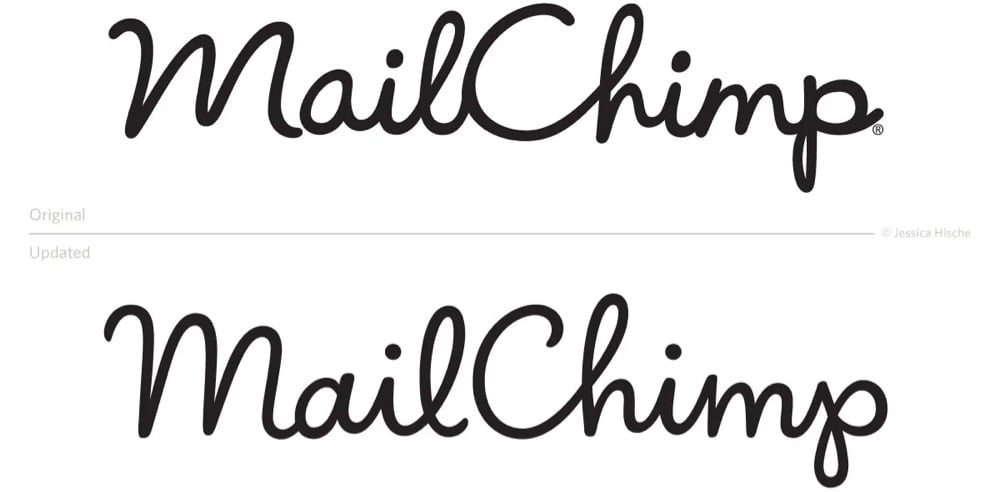
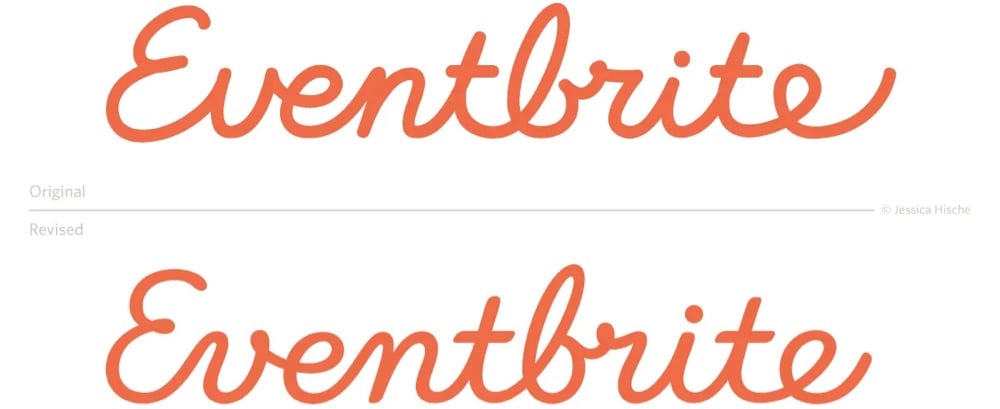
This is a nice little interview with designer Jessica Hische on how she steps in to help companies refresh their logos.
There are a number of reasons why companies decide that a refresh — rather than a rebrand — is the right move. Many of the companies I work with simply want a logo asset that is easier for their designers to work with. Sometimes there are issues with the current logo that make it harder to design around, or make it less flexible on different design applications. For example, logos with long ascenders and descenders create difficulties with balancing whitespace, and logos with tight counterforms or complex details don’t scale well.
Aside from adding utility, refreshes can be a nice way to make an older logo asset play well with a new brand system — we can make subtle tweaks to letterforms that make it better match new typefaces chosen for the brand or blend with the mood of photography better.
You can see a bunch of logo before & afters at Print or on her website — and her recent work for Squier is here. The differences may look negligible, but in each case, the new version is cleaner and easier to read — they just look nicer and smoother after Hische is done with them.
Review of a gasoline car from the alt-universe where EVs are standard. “Imagine if a steam locomotive had a baby with a machine gun. That’s the sort of noise that comes out of a gas car.”
Fears about nuclear energy, and nuclear waste in particular, have been overstated. “We should celebrate what humankind can achieve with clean energy: a high quality of life for everybody, without the negative impacts of burning fossil fuels.”
Socials & More