Entries for October 2021
If you’re even just a little bit interested in The Beatles, popular music, or making creative work, The Beatles: Get Back looks really good. Directed by Peter Jackson and utilizing dozens of hours of footage shot in 1969, this six-hour series documents the Beatles recording Let It Be, their final studio album release, and playing their infamous rooftop concert. The series premieres on Disney+ on November 25 and an accompanying book is out now.
Previously: a six-minute preview of the series introduced by Jackson.
The Great Escape. “Follow Aaron Rolph’s 2700km bikepacking trip up the United Kingdom, taking anything but the shortest route.”
In trying to explain what you’re about to see here, I cannot improve upon the Dr. Adrian Smith’s narration at the beginning of this video:
But sometimes I think the most useful thing I can do as a scientist is to point the fancy science cameras at some moths flapping their wings in front of a purple backdrop. I mean, whose day isn’t going to be better after watching a pink and purple rosy maple moth flying in super slow motion? This is a polyphemus moth, a gigantic species of silk moth. What you are seeing, like all the rest of the clips in this video, was filmed at 6,000 frames per second.
Most of the moths in the video are delightfully fuzzy and chonky — if these moths were birds, they’d be birbs. Shall we call them mopfs?
The rest of Smith’s AntLab videos are worth looking through — I’ve previously posted about his slow motion videos here. (via aeon)
The three-point shot has become the focus of the offensive strategy of every successful NBA team. But is it also making the game boring?
The math states that scoring one-third of your shots from behind the 3-point line is as good as scoring half your shots from inside the line. In other words: Shooting as many 3s as possible will likely lead to a higher score.
The league took notice, and teams and players followed suit. 3s have become so prevalent in recent years that fans are criticizing the league for being oversaturated with them. Critics worry that the game is on the verge of becoming boring because everyone is trying to do the same thing. And that’s led some to wonder if the NBA should move the 3-point line back.
Check out the “additional reading” in the YouTube description, like The NBA is at a breaking point with three-point shooting and Is It Time to Move the NBA 3-Point Line Back? (2014).
Updating Disaster Films to Be More Realistic. Like Independence Day: “Humans continue to fight one another up to the moment that they are annihilated by hostile space aliens.”


From Literary Hub, The 25 Most Iconic Book Covers in History. Some good ones shared in the comments as well. (thx, serge)
The 9090-piece Titanic is the largest Lego set ever built (and retails for $630). “You can be blasé about some things, Rose, but not about Titanic. It’s over 1500 more pieces than the Millennium Falcon and far more luxurious.”
Holy crap, Michael Hobbes is leaving You’re Wrong About. Epic, epic run…good luck w/ your future endeavors @RottenInDenmark!


In 1927, photographer and ethnologist Edward S. Curtis travelled to the US territory of Alaska to photograph indigenous peoples and their cultures for his seminal work, The North American Indian. Some of the photos he took in Alaska were never published and make up a new exhibition at the Muskegon Museum of Art, Edward S. Curtis: Unpublished Alaska, The Lost Photographs.
Begun in 1906, The North American Indian was the defining passion of Curtis’s life, an attempt to record, in writing and photography, the lives of the Indigenous peoples of the Southwestern, Western, and Northwestern United States. This trip, planned for a single season, would be the final voyage to complete his epic quest. Curtis took hundreds of images on his journey, only part of which were ultimately published. The rest sat, unseen, passed down through the family until today.
Edward Curtis: Unpublished Alaska, The Lost Photographs presents, for the first time to the public, images made from the unused original negatives. Over 100 images will comprise the exhibition, along with excerpts from the personal journals of Curtis and his daughter Beth that describe their often harrowing adventures in the Bering Sea.
You can see a selection of these photos online here and previously published photos by Curtis in Northwestern’s archive.
Update: Curtis’s photos are the subject of controversy and criticism, some of which you can read about here.
The North American Indian is a seminal and controversial blend of documentary and staged photography — one which contributes to much of the foundational imagery and, often-stereotypical, understanding possessed by white America about some 82-plus native tribes that the United States eradicated over a century of colonization. Much has been made about the complexities, contradictions, and conflicts of interest in Curtis’s masterwork, by Native and non-Native scholars. Some argue that in staging photographs and, at times, adding props or accessories, Curtis took liberties with the concept of ethnography, both imposing and reinforcing white notions of Native American appearances and culture. Others argue that without Curtis, there would be hardly any extant imagery of the cultural heritage of the tribes he worked with.
In the United States and in many other countries around the world, we’re slowly shifting away from the Covid-19 pandemic to SARS-CoV-2 being endemic (like the flu), Dr. Lucy McBride argues that we need to recalibrate our risk calculations and expectations of what’s safe & dangerous. From A COVID Serenity Prayer in The Atlantic:
For the past 18 months, my patients have craved straightforward answers: a simple “Yes-it’s perfectly safe” or “Go for it. Have fun!” or even a “No, you absolutely cannot” to quiet the endless loops of risk calculations. But medicine is not about certainty. It never has been.
The two things that patients want-reassurance that they won’t get COVID-19 and permission to engage in life-I cannot deliver, and I never will be able to. SARS-CoV-2 is here to stay. The virus will be woven into our everyday existence much like RSV, influenza, and other common coronaviruses are. The question isn’t whether we’ll be exposed to the novel coronavirus; it’s when.
And although many of us will inevitably get COVID-19, for the majority of vaccinated people, it won’t be so bad. The vaccines weren’t designed to wholly prevent COVID-19; they transformed it into a manageable illness like the flu.
That means that, from a decision-making perspective, we’re starting to reach the acceptance phase of the pandemic: a time when we must recalibrate our individual risk gauges, which have been completely thrown out of whack. The approach I’m embracing with patients boils down to a secular version of the serenity prayer. We need “the serenity to accept the things [we] cannot change, courage to change the things [we] can, and the wisdom to know the difference.”
The Walk of Life Project has set out to prove a simple hypothesis: Walk of Life by Dire Straits is the perfect song to end any movie. Like There Will Be Blood:
Or Dr. Strangelove:
Or Terminator 2:
Case closed, I think! (via fave 5)
From 2019 to 2021, a small Spanish football team was renamed Flat Earth FC, both as a publicity stunt and because club president Javi Poves couldn’t understand how water “curves”.
“Football is the most popular sport and has the most impact worldwide, so creating a club dedicated to the flat earth movement is the best way to have a constant presence in the media,” said Poves earlier this year. “Flat Earth FC is the first football club whose followers are united by the most important thing, which is an idea.”
The club’s crest is now a circular image of the earth, pressed flat on to all kits, and fans are encouraged to spark regular conversations in their pursuit of answers from the powers that be. The team mascot? An astronaut. It’s a radical move, but the club is bringing in supporters from afar. “It’s really amazing to be part of this amazing movement,” says Flat Earth player Mario Cardete. “I think it’s more than a club.”
During the pandemic, the club also became anti-mask and anti-vax — because conspiracy theories come in price-saving 3-packs, I guess? Poves resigned in late 2020 and the club was renamed and then purchased by a larger club to become their reserve team. The Earth remains round.





I love these colorfully chromed-out logos designed by Martin Naumann — you can find dozens of them on his Instagram and at Behance. You can also buy an icon set of these logos for your phone.
As he explained on Behance, Naumann’s process for designing these is surprisingly simple — he zooms way in on RGB noise to generate a background gradient, blurs the logo, and then refracts the background using the height map. Cool! (via moss & fog)



Using foraged mushrooms, berries, leaves, moss, and other natural materials, Heather Brooks makes these lovely and lively colorful collages, which she displays on Instagram and offers prints of on Etsy and on her website. (via life is so beautiful)
A NY state drinking law prompted the creation of the world’s worst sandwich. “It would be served to a guest with their beer or whiskey, then whisked away and given to someone else. A single Raines Sandwich might last the day, or even the whole week.”
A mashup of I Can’t Go For That (No Can Do) by Hall & Oates and Closer by Nine Inch Nails. It’s perfect, absolutely perfect, like dipping french fries into a Frosty or rolling in the snow after the sauna. It shouldn’t be, but it is.
I want to fuck you like an animal
(I can’t go for that)
I want to feel you from the inside
(No can do)
I got this from Dave Pell at Nextdraft — he said simply “trust me” and I’m glad I did.
See also Taylor Swift × Nine Inch Nails and Carly Rae Jepsen × Nine Inch Nails, both of which are better than they should be.
Feeling down in the dumps? Maybe go experience some awe. “Awe can reduce stress, help inflammation, increase creativity and sociability and make you happy.”
Anne Helen Petersen wrote about revenge bedtime procrastination, a familiar self-sabotage technique of the iPhone/timeline era.
Here is a potentially familiar scene. You are exhausted after working a full day, the sort of day when you felt like your attention was drawn in 20 different directions, where you were ricocheting between obligations and meetings and running six minutes late to pick-up and realizing that if you didn’t put that load of laundry in the wash now, at 9 pm, the rest of the week could very well collapse in on itself. You answered emails while stirring something on the stove. You answered different emails while half-listening to a story from a family member or roommate. You might have squeezed in some time for exercise, but you spent most of that time thinking about work: either periodically checking your phone or making mental to-do lists. You put your kids to bed, you let the dog outside, you turn off the lights, you’re ready for a much needed good night’s sleep — but then you can’t put yourself to bed.
You stay up binging a mediocre show. You can’t stop scrolling Instagram or Twitter or a dating app. You’re reading some overly-detailed breakdown of a sporting event, past or present or upcoming. You’re playing whatever dumb game you play on your phone.
I have been struggling mightily with this lately. I’ve been busier over the last few weeks than I have in years (since the kids were toddlers) and bedtime is generally the only time I have completely to myself. Refreshing Instagram or playing a game on my phone is the best way to mindlessly maximize that time in a low-energy way — and ensure that the next day will suck even more because I haven’t gotten enough rest. As Petersen puts it:
When you stay up late talking with friends of dancing or playing D&D, you are procrastinating going to bed, but you are also making a pretty good deal with yourself: the fun I’m having now is worth whatever suffering I’ll endure later. But most of the activities performed while revenge procrastinating don’t really compensate for the exhaustion they cause. They might feel essential and non-negotiable in the moment, as some semblance of “alone time,” but they’re really a double fuck you: they kinda suck in the moment, and they really suck in the cascading after-effects. You might feel like you’re soothing yourself, but maybe you’re just….punishing yourself?
Walnut is a white-naped crane that lives in a Virginia endangered species breeding facility. She’s 23 years-old, was raised by humans, and developed a reputation for murdering potential mates. But Walnut eventually found a good match in bird keeper Chris Crowe, a 42 year-old human who she has bonded with. Crowe, as part of his duties at the zoo, has embraced his role as Walnut’s mate in order to inseminate her with semen from a male crane.
That summer, however, Crowe noticed that Walnut seemed interested in, well, him. When Crowe stopped by her yard, she would bow her head and raise her wings — motions that Crowe now recognizes as the first moves of a mating dance. “At first, I thought that she was just excited to see me,” Crowe says. “But then I’d see the other pairs doing the same things, and it kind of dawned on me.” Crowe accepted Walnut’s invitation to dance. Though he felt a little silly, he bobbed his head when Walnut bobbed hers, and raised and lowered his arms like wings. The two circled each other, and sometimes Walnut would make a loud, trumpeting call — the beginning of the white-naped crane love duet. If no one was around, Crowe would try to do the male part of the song — making a Homer Simpson-like “woo-hoo” — but Walnut never found his efforts satisfactory.
As the weather cooled, so did Walnut’s ardor. But in the spring, Walnut began greeting her keeper with bows again. This gave Crowe an idea: If Walnut thought he was her mate, maybe Crowe could make that year’s artificial insemination less stressful for both of them. “If we could get her able to do it without catching her, there’s no stress, no risk of injury,” Crowe says. “It’s much better for us and for the crane.” Lynch agreed. “As far as we knew, it had never been done before, but it seemed like a good thing to try,” he recalls.
Walnut no longer needs to be inseminated to help save her species but since cranes mate for life, her relationship with Crowe continues.
Like an old couple, Crowe and Walnut have fallen into a comfortable routine. After “mating” with Crowe, Walnut will often lay unfertilized eggs. Crowe replaces them with fake ones; the real ones would rot and get eaten by crows, which would prompt Walnut to lay more. The bird then spends long hours sitting on the dummy eggs, so Crowe helps her out whenever he gets the chance. “I go over and stand near the nest and I say, ‘You take a break.’ And she’ll wander off. She’ll go down into the creek and take a bath. Then she walks back after 15 or 20 minutes, and she’s ready to sit back on the nest again.”
Though he does his best to not be a deadbeat dad, Crowe knows he falls short of crane standards. These are creatures that, once paired up, rarely lose sight of their partner; Crowe, in contrast, disappears every weekend. But despite Crowe’s shortcomings, Walnut loves him unconditionally. In fact, this 12-pound bird’s capacity for boundless affection sets a standard that we all could learn from, Crowe says. “The ideal partner doesn’t exist. You have to accept certain things that people can’t change,” he explains. “I mean, she puts up with me even though I can’t dance or sing.”
After 30+ years, legendary ski resort trail map painter James Niehues is retiring. “A good design is relevant for a few years, maybe even a decade. But a well-made map is used for generations.”


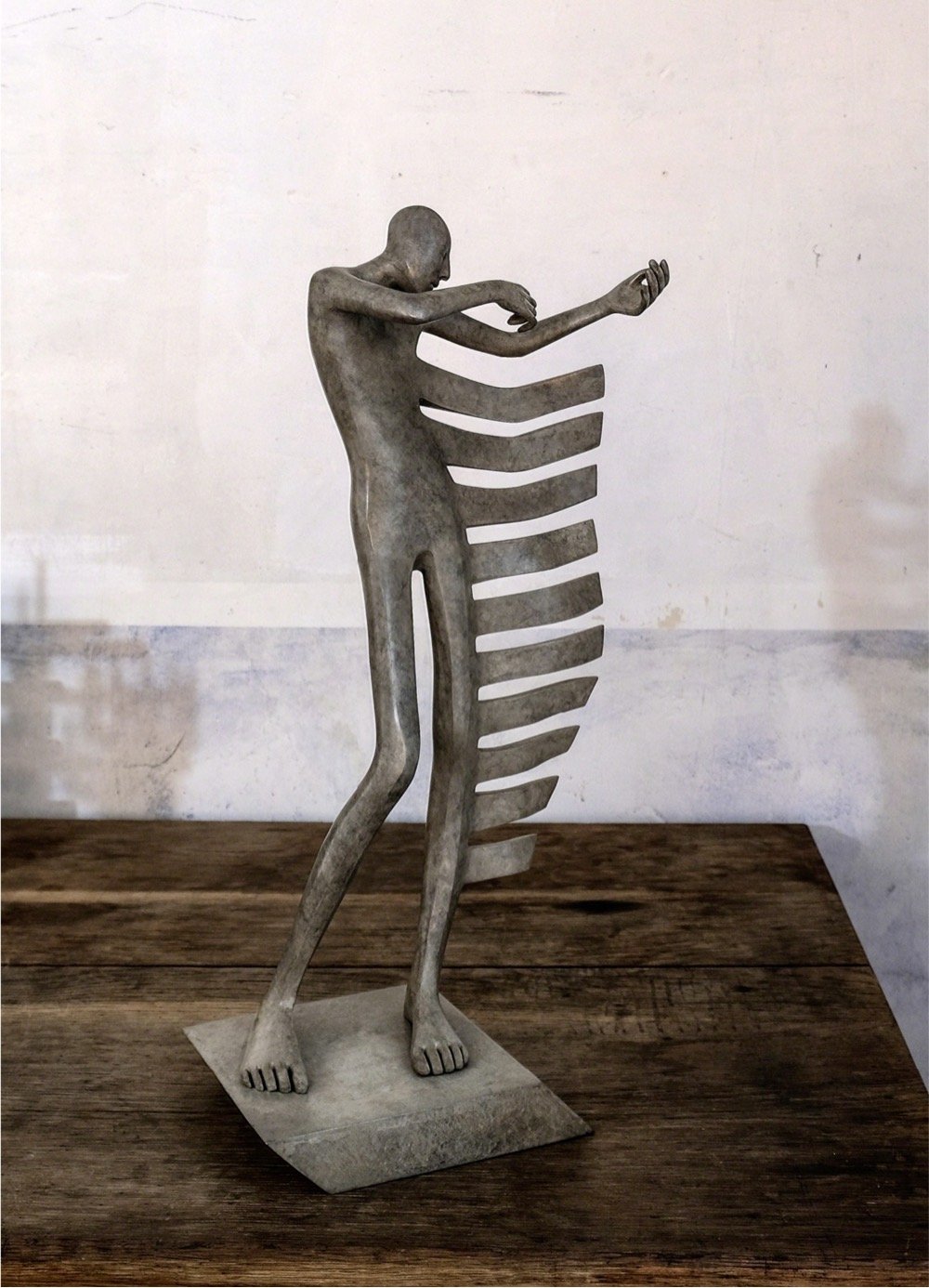
It’s quite a neat trick of the artistically gifted to make figures cast in solid bronze seem like they’re moving, and that’s exactly what Isabel Miramontes has done with her ribboned sculptures of people. (via colossal)
A pair of 1300-year-old skis has been discovered in an ice field in Norway. They are believed to be the best-preserved ancient skis ever found — even the bindings are mostly intact. The first of the pair was found back in 2014 and its mate was recently retrieved, an expedition you can witness in the video above.
It has been seven years since the discovery of the first ski at the Digervarden ice patch. We have patiently monitored the melt of the ice patch, in case the second ski of the pair should melt out. We were back in 2016 for a general survey of the ice patch, but the ice had not retreated much then. This year, we could see on satellite imagery that the ice patch had retreated compared to 2014. We decided to send out an archaeologist to check it.
One of the things they were hoping to find is how the skier was able to maintain forward motion with the skis, especially uphill. Modern cross-country skis rely on a texture (or wax) on the bottom of the ski to grip the snow while downhill skiers can apply skins to their skis to climb uphill. More than a thousand years ago, the choice was texture or animal fur:
One of the questions raised by the ski found in 2014 was if it originally had fur on the underside. This has major implications for the use of the ski. There were no nail holes along the sides of the 2014 ski which would have been a clear sign of the fastening of the fur. However, fur can also be glued to the underside, so we could not rule it out.
A furrow on the underside along the length of the ski, as you find on other prehistoric skis (and on modern cross-country skis), would solve the question. Such a furrow would have no function with an underside covered by fur. The 2014 ski did not show a furrow, but the new and better preserved ski does! So, probably no fur-lining.
(thx, meg)
From a YouTube channel called There I Ruined It, this is NWA’s Straight Outta Compton reimagined as a Bavarian polka. You’re….welcome? (via digg)
Bewilderment is Richard Powers’ first book since his Pulitzer-winning The Overstory. “At its heart lies the question: How can we tell our children the truth about this beautiful, imperiled planet?”
The first part of an FT series on “how the electric vehicle market is rapidly taking off” (in Europe). The charging situation in cities is going to need to get a lot better for widespread adoption of non-hybrid EVs.
Even for mathematically minded folks, statistics can be hard to grasp. Take statistical paradoxes for example: Simpson’s Paradox is a real mind-boggler. Ryan Anderson explains this paradox in a recent issue of Why is this interesting?
It’s simple to describe, yet it still stops me in my tracks when I see it in the wild. The paradox is that a measurable effect on a large population disappears, or even reverses when that population is split into subgroups. The cause of these results is almost always a material change in the denominators from one period to the next.
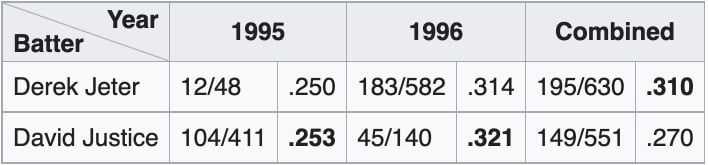
Showing is easier than telling with paradoxes, so here is a classic example: In 1995 and 1996, David Justice had a higher batting average than Derek Jeter in each year. However, Jeter had a higher cumulative batting average over those two years.
It’s true; look:
Anderson continues:
How does this work? Jeter’s 1996 stats accounted for over 92% of his total performance over the two years, as he was 20 years old and only called up to the major league for a few games in 1995. Meanwhile, Justice’s 1996 stats were only 25% of his total performance due to a separated shoulder he suffered barely two months into the season. So while Justice performed better on smaller sample size, Jeter’s 183 hits in 1996 were the strongest signal for overall performance.
Read the rest of the piece; he goes on to connect statistical paradoxes to efforts to mislead people about the pandemic and vaccine effectiveness.
Update: A pair of videos on Simpson’s Paradox, in case you need some more explanation or examples.
(thx, @JunieGrrl)
Tycho, who you might remember from his annual Burning Man sunrise sets, recently released his first DJ set in two years: a 1.5-hour session at Red Rocks from July.
Why Are Americans Still – Still! – Wearing Cloth Masks? “Much of our approach to the pandemic has changed in the past 18 months, our approach to masking largely has not. So why are we still strapping pieces of fabric to our face?”
Using data from Johns Hopkins, this time lapse video shows the spread of Covid-19 across the US from Feb 2020 to Sept 2021. This looks so much like small fires exploding into raging infernos and then dying down before flaring up all over again. Indeed, forest fire metaphors seem to be particularly useful in describing pandemics like this.
Think of COVID-19 as a fire burning in a forest. All of us are trees. The R0 is the wind speed. The higher it is, the faster the fire tears through the forest. But just like a forest fire, COVID-19 needs fuel to keep going. We’re the fuel.
In other forest fire metaphorical scenarios, people are ‘kindling’, ‘sparks being thrown off’ (when infecting others) and ‘fuel’ (when becoming infected). In these cases, fire metaphors convey the dangers posed by people being in close proximity to one another, but without directly attributing blame: people are described as inanimate entities (trees, kindling, fuel) that are consumed by the fire they contribute to spread.
See also A Time Lapse World Map of Every Covid-19 Death (from July 2020).
Newer posts
Older posts



Socials & More