Entries for October 2021
This is Samson and Delilah, a painting attributed to the Flemish master Peter Paul Rubens that hangs in the National Gallery in Britain.
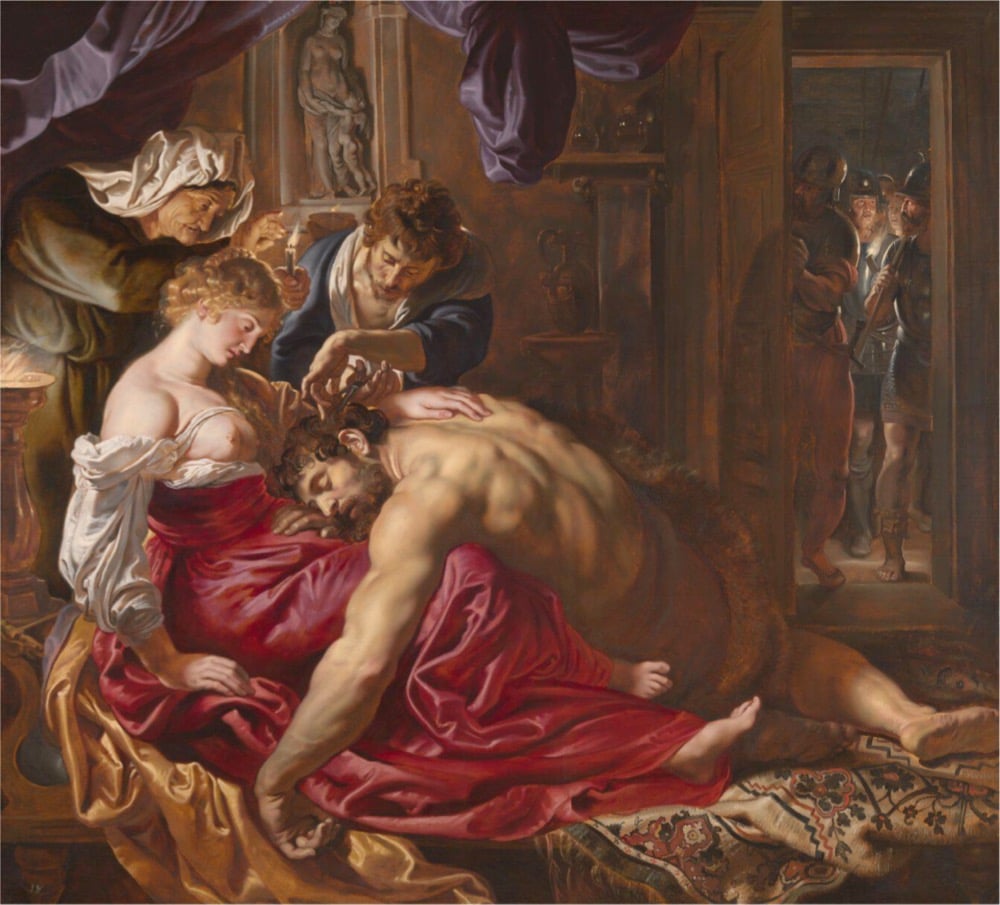
Since the late 90s, there’s been some doubt cast upon the painting’s authorship, summarized in this short video:
From a recent piece in the Guardian about an AI art-analysis algorithm that declared Samson and Delilah is not a Rubens painting:
Critics have long argued that it is only a copy of a Rubens original that is known to have been painted between 1608 and 1609 for his Antwerp patron Nicolaas Rockox which then disappeared after his death in 1640.
They argue that the National Gallery picture is a different painting, one that only surfaced in 1929, declared a Rubens by Ludwig Burchard, an expert who, after his death in 1960, was found to have misattributed paintings by giving out certificates of authenticity for commercial gain.
The picture’s critics dismiss its colours as uncharacteristic of Rubens’s palette and its composition as awkward. They question why, for example, it differs from two contemporary copies made from Rubens’s original. The toes of Samson’s outstretched right foot, for example, are cropped in the National Gallery version, while they are shown in an engraving by Jacob Matham and a painting that depicts the Samson and Delilah hanging in Rockox’s home by Frans Francken the Younger.
Pitchfork went back and rescored some of their old reviews. Grimes got bumped down while Rilo Kiley and Daft Punk got bumped up.
A proposed Richter scale for network system outages. “2.0. Facebook down, Gmail down, Apple App Store down, HSBC contactless cards not working on London transport. Duration of shorter than a day.”
So let’s say, for the sake of argument and against all scientific evidence to the contrary, the Earth was flat instead of being an oblate spheroid. What would life on a flat Earth be like? Well for one thing, gravity would present some challenges. From a 2018 piece by Doug Main at the Columbia Climate School:
People who believe in a flat Earth assume that gravity would pull straight down, but there’s no evidence to suggest it would work that way. What we know about gravity suggests it would pull toward the center of the disk. That means it would only pull straight down at one point on the center of the disk. As you got increasingly far from the center, gravity would tug more and more horizontally. This would have some strange impacts, like sucking all the water toward the center of the world, and making trees and plants grow diagonally, since they develop in the opposite direction of gravity’s pull.
And even more than that, gravity would tend to pull a flat disc shape back into a spheroid, so absent an intense spinning force (for which there is zero evidence) or some other completely unknown effect, a flat Earth couldn’t even exist:
For Earth to take the shape of a flat disk in the first place, gravity — as we know it — must be having no effect. If it did, it would soon pull the planet back into a spheroid.
A flat Earth would also likely not have a magnetic field (or at least one that is scientifically possible), meaning no atmosphere:
Deep below ground, the solid core of the Earth generates the planet’s magnetic field. But in a flat planet, that would have to be replaced by something else. Perhaps a flat sheet of liquid metal. That, however, wouldn’t rotate in a way that creates a magnetic field. Without a magnetic field, charged particles from the sun would fry the planet. They could strip away the atmosphere, as they did after Mars lost its magnetic field, and the air and oceans would escape into space.
Oh and no tectonic plates, volcanos, mountains, etc. Or GPS. Or weather. Or satellites. Or different night skies in, say, South Africa and Denmark. Or the Sun behaving the way it does in respect to the Earth. Or air travel. Or plant and animal life as it exists presently. To suppose a flat Earth also supposes that physics doesn’t explain our observable universe the way in which it reliably and comprehensively does. The simplest, best evidence for a round Earth is that we’re here living on it in the manner in which we are living on it.

See also What If the Earth Suddenly Turned Flat?, Flat Earthers and the Double-Edged Sword of American Magical Thinking, and Flat Earthers Listening to Daft Punk.

Remember the Tetris challenge, the trend where workers of various professions laid out all of their gear in a neat, pleasing fashion, aka knolling? Well, the Bulgarian Air Force really knocked it out of the park with this photo by Ognyan Stefanov. Yes, those are all actual planes and objects and people, not miniatures. Never has the military industrial complex seemed so twee.
See also Things Organized Neatly, Common Objects Painstakingly Organized into Patterns, and Saltine Crackers Arranged Artfully Is Extremely My Jam. (via @davidgagne)
How many episodes should you watch of a new TV show before it fully reveals itself? (I’ve found that some of my favorite shows clicked in the third episode, incl. The Wire & Mad Men.)
On the Internet, We’re Always Famous. “Never before in history have so many people been under the gaze of so many strangers.”


The Nature Conservancy is a non-profit organization focused on conservation and addressing the climate and biodiversity crises. The winners of their 2021 Global Photo Contest have interpreted the Conservancy’s mission in a number of different ways. Above are three of my favorite shots from the contest; photo credits from top to bottom: Anup Shah, Daniel De Granville Manço, Manh Cuong Vu.
I love Evan Puschak’s short analysis of a two-and-a-half minute scene from Sam Raimi’s 2004 film, Spider-Man 2. Raimi, a horror movie veteran, basically snuck a tight horror sequence into a PG-13 superhero movie — it’s a little cheesy, bloodless, and terrifying.
Train wheels do not sit completely flat on the tracks — they’re designed with a slight taper that increases the stability of the train and allows the train to go around curves without any of the wheels skidding. In this short video, Tadashi Tokieda explains how those conical wheels keep trains on track.
See also Richard Feynman’s explanation of this and this science project at Scientific American. (via the prepared)


To raise awareness around plastic’s resistance to decomposition (it won’t break down for 1000 years), Vietnamese creative agency Ki Saigon has designed a book out of recycled plastic containing letters to read a millennium from now.
“There was a lot of trial and error” when putting the book together, says Kumkum. For starters, what does one say to their future family members? Ki Saigon decided to provide a guide for the letters, asking each participant to imagine what they would like to hear from them, given the fact the book will still be around in 1000 years. Each letter is also hand written, adding another dimension to the project while “staying true to the spirit of the project.”
A time capsule with no container needed.
Live bird migration maps. Love looking at these every year.
What’s the weirdest question someone’s ever asked you? “A guy once emailed me about how hard you’d have to fan a tornado to make it start spinning in the other direction…”
Newer posts



Socials & More