




Advertise here with Carbon Ads
This site is made possible by member support. 💞
Big thanks to Arcustech for hosting the site and offering amazing tech support.
When you buy through links on kottke.org, I may earn an affiliate commission. Thanks for supporting the site!
kottke.org. home of fine hypertext products since 1998.
Beloved by 86.47% of the web.
Entries for May 2020
The Plan Is to Have No Plan
This short description by Jay Rosen accurately describes the Trump administration’s plan for dealing with the Covid-19 pandemic.
The plan is to have no plan, to let daily deaths between one and three thousand become a normal thing, and then to create massive confusion about who is responsible — by telling the governors they’re in charge without doing what only the federal government can do, by fighting with the press when it shows up to be briefed, by fixing blame for the virus on China or some other foreign element, and by “flooding the zone with shit,” Steve Bannon’s phrase for overwhelming the system with disinformation, distraction, and denial, which boosts what economists call “search costs” for reliable intelligence.
Stated another way, the plan is to default on public problem solving, and then prevent the public from understanding the consequences of that default. To succeed this will require one of the biggest propaganda and freedom of information fights in U.S. history, the execution of which will, I think, consume the president’s re-election campaign.
While his actions often have complex effects, Trump has never been a complicated person. This “plan” fits with what we know about Trump’s personality & behavior, plays to his strengths by relying on reactions & tactics and not strategy, is consistent with Occam’s razor, allows his administration to continue pursuing his aggressive agenda (restricting immigration, strengthening big business, weakening public institutions, enriching himself, consolidating power, getting re-elected), and whips his base into a frenzy. As Dave Eggers put it in a satirical opinion piece for the NY Times:
Having no plan is the plan! Haven’t you been listening? Plans are for commies and the Danish. Here we do it fast and loose and dumb and wrong, and occasionally we have a man who manufactures pillows come to the White House to show the president encouraging texts. It all works! Eighteen months, 800,000 deaths, no plan, states bidding against states for medicine and equipment, you’re on your own, plans are lame.
There’s no galaxy brain here, only a twitchy muscle attached to a frayed nerve.
Have a Good Trip: Adventures in Psychedelics
Have a Good Trip is an upcoming Netflix documentary about tripping on psychedelics, like a celebrity/comedy version of Erowid’s drug trip report database.
Mixing comedy with a thorough investigation of psychedelics, HAVE A GOOD TRIP explores the pros, cons, science, history, future, pop cultural impact, and cosmic possibilities of hallucinogens. The film tackles the big questions: Can psychedelics have a powerful role in treating depression, addiction, and helping us confront our own mortality? Are we all made of the same stuff? Is love really all we need? Can trees talk?
The celebs telling their trip stories include Sting, Sarah Silverman, Ad-Rock, and Rosie Perez. I Laughed Out Loud at A$AP Rocky’s short anecdote in the trailer. I hope we’ll hear more about his musical rainbow when Have a Good Trip premieres on May 11.
Some Pandemic Real-Talk from Epidemic Expert Laurie Garrett
This too-short profile of Pulitzer Prize-winning journalist Laurie Garrett, who has been writing about epidemics since the 90s, is closer to my personal feelings as to how the pandemic plays out in the US than almost anything else I’ve read.
But she can’t envision that vaccine anytime in the next year, while Covid-19 will remain a crisis much longer than that.
“I’ve been telling everybody that my event horizon is about 36 months, and that’s my best-case scenario,” she said.
“I’m quite certain that this is going to go in waves,” she added. “It won’t be a tsunami that comes across America all at once and then retreats all at once. It will be micro-waves that shoot up in Des Moines and then in New Orleans and then in Houston and so on, and it’s going to affect how people think about all kinds of things.”
They’ll re-evaluate the importance of travel. They’ll reassess their use of mass transit. They’ll revisit the need for face-to-face business meetings. They’ll reappraise having their kids go to college out of state.
Much of the federal government’s response has been to help big business, and the wealthy are going to have opportunities to not only ride out the storm more easily but to take advantage:
If America enters the next wave of coronavirus infections “with the wealthy having gotten somehow wealthier off this pandemic by hedging, by shorting, by doing all the nasty things that they do, and we come out of our rabbit holes and realize, ‘Oh, my God, it’s not just that everyone I love is unemployed or underemployed and can’t make their maintenance or their mortgage payments or their rent payments, but now all of a sudden those jerks that were flying around in private helicopters are now flying on private personal jets and they own an island that they go to and they don’t care whether or not our streets are safe,’ then I think we could have massive political disruption.”
I could quote something from just about every paragraph, but for now I’ll just do one more excerpt and you can go and read the rest.
Garrett recounted her time at Harvard. “The medical school is all marble, with these grand columns,” she said. “The school of public health is this funky building, the ugliest possible architecture, with the ceilings falling in.”
“That’s America?” I asked.
“That’s America,” she said.
See also Dave Eggers’ pandemic Q&A, which shares a certain pessimistic honesty with Garrett’s thoughts.
An honest pandemic Q&A with Dave Eggers. “Having no plan is the plan! Haven’t you been listening? Plans are for commies and the Danish. Here we do it fast and loose and dumb and wrong…”
The Man Who Runs 365 Marathons a Year. “People are capable of way more than they think they are.”
What Happens Next? Our Possible Covid-19 Futures…
Creative technologist Nicky Case and epidemiologist Marcel Salathé have teamed up to produce a concise but thorough playable explainer about important epidemiological concepts, how we could/should respond to the Covid-19 pandemic, and different scenarios about what the next few years could look like.
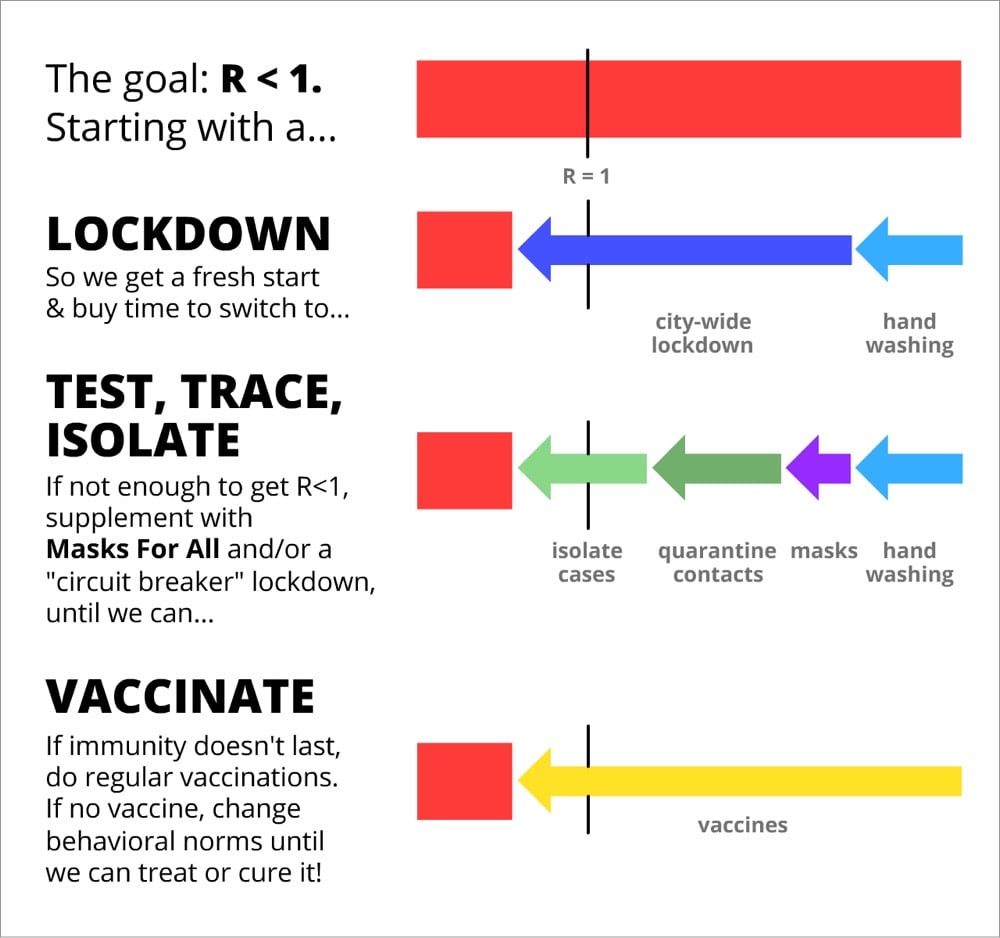
If you’ve been keeping up with the various models and experts’ plans (test/trace/isolate, etc.), there’s not a lot new here until close to end, but it is pretty comprehensive and the playable simulations are really useful. The whole thing takes about 30 minutes to get through, but at the end, you will have an excellent simplified understanding of what this virus could do to us and what we can do to mitigate its effects.
Isolating symptomatic cases would reduce R by up to 40%, and quarantining their pre/a-symptomatic contacts would reduce R by up to 50%:
Thus, even without 100% contact quarantining, we can get R < 1 without a lockdown! Much better for our mental & financial health. (As for the cost to folks who have to self-isolate/quarantine, governments should support them — pay for the tests, job protection, subsidized paid leave, etc. Still way cheaper than intermittent lockdown.)
The problem with this explainer, as excellent as it is, is the problem with all of these plans: many government officials on both the state & federal level don’t seem interested in listening to the experts. It is also unclear — if the unmasked crowds gathering in American cities during this past weekend’s warm weather are any indication — that Americans will be willing to take the steps necessary to keep each other safe. I’m not sure what it’s going to take to address those situations, but I don’t think playable graphs are going to help that much.
Juilliard Students Go All Out for Online Performance
Like other schools, performing arts conservatory The Juilliard School is closed due to the pandemic. But constraints drive creativity, and a group of dance, drama, and music students at the school (along with some alumni like Yo-Yo Ma, Laura Linney, Patti LuPone, and Itzhak Perlman) have created this wonderful performance of Ravel’s Bolero, each performing from their own home.
This is one of the best and most creative grid music videos I’ve seen. The meeting through the glass at 3:40 was genuinely moving. You can read about how the performance came together.
Created with the support of a roster of internal producers, staff, and faculty members as well as a team of external artistic and technical personnel, Bolero Juilliard is a complex online puzzle with many components being conceived, rehearsed, and produced simultaneously. Keigwin and his co-choreographer, Nicole Wolcott, created a storyboard based on states of being and emotional concepts like “Interior Lives” or “Soothing.” Juilliard dancers learn Keigwin’s choreography in Zoom sessions, creating a simulacrum of unity and cohesion very much in spite of the reality of social isolation. Juilliard actors, singers, and alumni contribute videos of emotionally specific gestures and actions. Rather than gathering in-person as they normally would, members of the Juilliard Orchestra and Juilliard Jazz — from wherever they happen to be — video-record themselves playing individual lines, which are edited together to create a complete piece from disparate parts.
The problem with “natural” herd immunity & Covid-19 is that millions will die. “If the pandemic went uncontrolled in the United States, it could continue for months after herd immunity was reached, infecting many more millions in the process.”
“The world is on lockdown. So where are all the carbon emissions coming from?” Emissions have only dropped 5.5%. At this pace, even if the pandemic lasted for years, it wouldn’t be enough to keep the world under 1.5°C of warming.
This article’s title contains the phrase “Murder Hornet”. I needn’t say anything more – you’re either going to click or not.
My Recent Media Diet, The Pandemic Edition
Well, it has been awhile. I have not done one of these since late December. First I was away for a few weeks and then, well, you know. I’m not even sure if anyone wants to read this sort of thing right now — I barely wanted to write it — but I know a lot of people are stuck at home, looking for stuff to watch, read, and listen to. Plus, keeping the media diet going feels normal, at least a little.
If you’re strapped for time/attention, my top recs are Portrait of a Lady on Fire, Devs, Exhalation, Little Women, Unbelievable, Future Nostalgia, The Overstory, and You’re Wrong About.
Devs. Fantastic. I loved every minute of this gem. (A)
Unbelievable. Based on a true story. Excellent performances by Toni Collette and (especially) Merritt Wever. (A)
The Report. Also based on a true story. The Bush presidency still does not get the credit in terms of the harm it did, and continues to do, to America. (B+)
Exhalation by Ted Chiang. Killer collection of tech/science stories. (A)
Slow Burn (season 3). Not just about Biggie/Tupac, but about 90s hip-hop & the cultural reaction to it. (B+)
AirPods Pro. Wearing these feels a little like the future. (A)
Aeronauts. Perfectly fine. (B)
Portrait of a Lady on Fire. Straight-up masterpiece. (A)
Don’t F**k with Cats. How on Earth did I not hear anything about this case when it originally happened and why is it not more widely known? A media-obsessed wanna-be serial killer caught by online sleuths? It seems like fiction. (B+)
How to Change Your Mind by Michael Pollan. This maybe would have been better at half the length. (B+)
1917. Technically stunning but I never truly got involved in the story because I was trying to see where the cuts were. (B+)
Icarus. Almost unbelievable where the story goes in this. (A-)
Little Women. My choice for the best 2019 movie. (A)
My Brilliant Friend (season 2). The second part of the first season set a high bar to clear, but I’m loving this season so far. (A)
Jojo Rabbit. Like Inglourious Basterds directed by Wes Anderson. (A-)
On Earth We’re Briefly Gorgeous by Ocean Vuong. Fittingly finished this on the plane to Vietnam. (B+)
Anthropocene. Typically excellent look at the impact of humans on the Earth by Edward Burtynsky. (A-)
Frances Ha. Baby Adam Driver! (B+)
Catch Me If You Can. Spielberg (and DiCaprio) at their most entertaining. (A-)
Edge of Tomorrow. Love this movie. An underrated gem. (A)
The Overstory by Richard Powers. A wonderful novel about trees and the natural world. (A)
Titanic. A masterclass of blockbuster filmmaking and storytelling. (A)
Good Place (season 4). Loved the ending to this. (A-)
Outbreak. Contagion. Deep Impact. 2012. The Core. I Am Legend. I have been watching all of the disaster movies. They are terrible and I love them. (A/C-)
The Aftermath. The ending of this felt random, a gotcha to the audience rather than the natural end to the story. (B)
Breakfast, Lunch & Dinner. I had medium hopes for this, but the Seth Rogan episode made me laugh harder than I have in months. (B+)
Watchmen. The first three episodes gave me this-is-gonna-end-like-Lost vibes and then they announced there wasn’t going to be second season, so I stopped watching. (B-)
The Farewell. Wonderful. (A-)
A Shaun the Sheep Movie: Farmageddon. Started slow but finished strong. Keep your eyes peeled for all of the sci-fi references. (B+)
Birds of Prey. This was mindless. And not in a good way. (D)
McMillion$. My main takeaway was being aghast at how much time, energy, and money the FBI put into this case, which one of the lead investigators only pursued because it was fun. (B)
Star Trek: Picard. I would have voted against bringing this beloved character back (for fear they’d ruin it) but I enjoyed almost every second of this. (B+)
The Splendid and the Vile by Erik Larson. Another great book from Larson. The Battle of Britain is surprisingly relevant to these pandemic times. (A-)
Onward. Not my favorite Pixar, but solid as always. (B)
Future Nostalgia. Love this album, not a single weak song. (A)
The Mandalorian. It took me too long to realize that this was a western. I don’t care that much for westerns. (B)
Star Wars Episodes I II III. I needed some true garbage to watch about two weeks into my self-quarantine. These movies are mostly terrible. (C-)
You’re Wrong About. I’ve mentioned this podcast before, but You’re Wrong About has become essential listening for me. The OJ and DC Sniper series are both great, and their episode Why Didn’t Anyone Go to Prison for the Financial Crisis was excellent and surprisingly didn’t really mention the actual crisis at all. (A)
Iron Man. Iron Man 2. Thor. Captain America: The First Avenger. The Avengers. The kids and I are rewatching all the MCU movies in release order. Some are better than others. (B)
Tiger King. I watched the first episode and…is this anything more than just gawping at yokels? Does this documentary have anything important to say about society or is it just reality TV? (C)
LBJ and the Great Society. A fascinating look at a brief moment in time when our government worked and how that happened. (A-)
The Case of the Missing Hit. You’ve likely heard this instant-classic episode of Reply All by now, but if you haven’t, it’s worth the hype. (A-)
Tempest in a Teacup. Outside/In talks to Charles Mann about a passage in 1491 about passenger pigeons, which suggested that their famous abundance was a relatively recent occurence caused by the decimation of indigenous populations in the Americas by Europeans and their diseases. (B+)
The Living Room. The episode of Love + Radio that inspired the Oscar-winning The Neighbor’s Window. (A-)
Simulcast. Tycho’s instrumental companion album to Weather. (B+)
Minority Report. This was cheesier than I remembered it. Hasn’t aged well in some ways. (B)
Pelican Brief. So 90s. But I’d forgotten the star power of Denzel and Julia Roberts, even in a mediocre movie. (B)
Murder on the Orient Express. Rewatch. Branagh sure does chew the scenery, but it is fun to watch. (B+)
Gemini Man. Action. Sci fi. Mostly forgettable. (B-)
Yesterday. Cute flick. (B)
Monsters University. This was the only Pixar movie I had never seen. And now I have. (B)
Dark Phoenix. Slightly more entertaining than I was expecting. (B)
Past installments of my media diet are available here.
What to Ask Instead of ‘How Are You?’ During a Pandemic. “Everyone’s doing badly. We need better questions to ask.”
Jim Henson Demonstrates How to Make Your Own Puppets
In this charming video from 1969, right before Sesame Street premiered on PBS, Jim Henson spends about 15 minutes showing how to make simple puppets out of materials you might have handy at home: cardboard, plastic cups, fabric, wooden spoons, potatoes, etc. Joining him was the designer of the Muppets, Don Sahlin.
He is “the inventor” of the Muppet look, from a design point of view. As discussed in the book Jim Henson’s Designs and Doodles, many of the Muppets began as Henson’s rough sketches, which Sahlin then built and modified as needed… Sahlin was known to refer to himself as the “guardian of the essence” of the Muppets.
Henson’s Kermit-y voice is super soothing. What a great find by the indispensable Kid Should See This.
Zip tie art? Zip tie art!
The Songs of 1984, 1985, 1986, 1987, 1988, and 1989
You might remember last year1 when the Hood Internet released a series of videos mashing up the top songs of 1979-1983. Over the next few weeks, they’re going to finish up the 80s. The video from 1984 is up first:
As previously noted, 1984 was perhaps mass pop culture’s high tide, a great year for music, and the most 80s year of the 1980s.
Update: Here are the videos for 1985, 1986, 1987, 1988, & 1989.
Update: Steve Reidell and Aaron Brink of The Hood Internet talk about how they do these year-by-year mixes.
Oftentimes we’ll have an idea of where we want to start and where we want to end, and the work is figuring out how to get from one place to another. We’re changing song speeds and tempos to match and pulling in individual instrumental or vocal tracks if we can find them. Sometimes the thing that matches is a musical similarity and sometimes it’s lyrical. In the 1981 video, there’s a section where we string together Rick Springfield singing “Jessie’s Girl” and Rick James singing “Superfreak” and made it sound kind of like a duet about the same girl. Dropping that on top of Vangelis’ theme to Chariots Of Fire just ups the intensity and the absurdity of it all.
Update: They’ve released the entire 1979-1989 mix as a continuous mix on Soundcloud.
I know, I probably lost a bunch of you at “remember last year”. But I’m pressing on regardless.↩
Lunar Landing Recreated from Archival NASA Photos
Using thousands of original photographs taken by astronauts during the Apollo missions, motion designer Christian Stangl and composer Wolfgang Stangl worked for 18 months to create this animated short film depicting a flight to the Moon, culminating in a landing and the exploration of the surface. (via moss & fog)
A visualization of wealth shown to scale. 1 pixel = $1000. Keep scrolling through the wealth of Jeff Bezos (it takes awhile). “Jeff is so wealthy, that it is quite literally unimaginable.”
Socials & More