



Director David Lynch is doing a daily weather report on YouTube. “Here in LA, we’ve got clouds and kinda foggy weather with some blue shining through, 62 degrees Fahrenheit…”

Advertise here with Carbon Ads
This site is made possible by member support. 💞
Big thanks to Arcustech for hosting the site and offering amazing tech support.
When you buy through links on kottke.org, I may earn an affiliate commission. Thanks for supporting the site!
kottke.org. home of fine hypertext products since 1998.
Beloved by 86.47% of the web.
Entries for May 2020
The Real Lord of the Flies
For his new book, Humankind: A Hopeful History, Rutger Bregman uncovered the real-life story of 6 schoolboys who were stranded on a Pacific island for 15 months in 1965-66. What he learned was not the familiar tale of savagery & death told in William Golding’s novel Lord of the Flies. Instead, the boys cooperated and thrived.
But “by the time we arrived,” Captain Warner wrote in his memoirs, “the boys had set up a small commune with food garden, hollowed-out tree trunks to store rainwater, a gymnasium with curious weights, a badminton court, chicken pens and a permanent fire, all from handiwork, an old knife blade and much determination.” While the boys in Lord of the Flies come to blows over the fire, those in this real-life version tended their flame so it never went out, for more than a year.
On Twitter, Bregman shared how he came to learn about this story:
As a proper investigative journalist, I started Googling. Search terms: ‘Kids shipwrecked’. ‘Real-life Lord of the Flies’ etc. After a while, I came across a blog that told this story.
Wow, I thought. If this really happened, then why isn’t it a super famous story? The article did not provide sources. After a couple of hours, I discovered that it came from a book by the anarchist Colin Ward from 1988. He cited an Italian politician Susanna Agnelli.
From a second-hand bookshop in the UK, I ordered her 1986 book, got it two weeks later, and found the story on page 94. But again: same details, same wording, no source. At that point I started to think that it probably didn’t happen.
Here’s a photo of the six boys with Peter Warner, the sea captain who rescued them:

After the rescue, Warner hired the boys as crew members and they worked with him for years. you can read more about Bregman and his new book in this related article.
Update: You may have noticed that Bregman’s piece is told from the perspective of the discoverer of a good story and the sea captain who rescued the boys, and there’s actually relatively little from the boys themselves. Tongan writer Meleika Gesa-Fatafehi wrote a pair of threads on Twitter about how problematic it is that a story about six indigenous schoolboys became one about two white men. First of all, the story was not unknown or forgotten:
I’ve been told many stories about (both) my people getting lost by sea and being stuck on either a boat or Island. But I remember this one significantly because the boys were stuck on ‘Ata. I remember it being called the rock Island.
The local culture that the boys grew up in is essential to the story, particularly w/r/t the lesson Bregman wants to assign to it:
Tongans are taught to share from the beginning. You’re also taught to treat everyone like family. You’re taught to survive together not “Everyman to himself”. It’s hard to exist without community. So when one person is ill or hurt, it’s an automatic reaction to help
To heal and to use knowledge passed down to you. This is seen in every aspect of how the boys survived. They created a community, a small family and worked together.
The white boys of LotF cannot relate because of the very fact they are rich white school boys who aren’t from an Island nation.
LotF isn’t what would happen amongst Tongans because of the value system we have. This is true for every Island nation.
Filmmaker Taika Waititi had this to say about a possible film adaptation:
Personally, I think you should prioritize Polynesian (Tongan if possible!) filmmakers as to avoid cultural appropriation, misrepresentation, and to keep the Pasifika voice authentic.
(via @tinakittelty)
Bypassing a theatrical release, the video recording of Lin Manuel-Miranda’s Hamilton is coming to Disney+ on July 3. “The 2 hour, 40 minute movie was shot two weeks before the original cast left.”
The United States of Voronoi
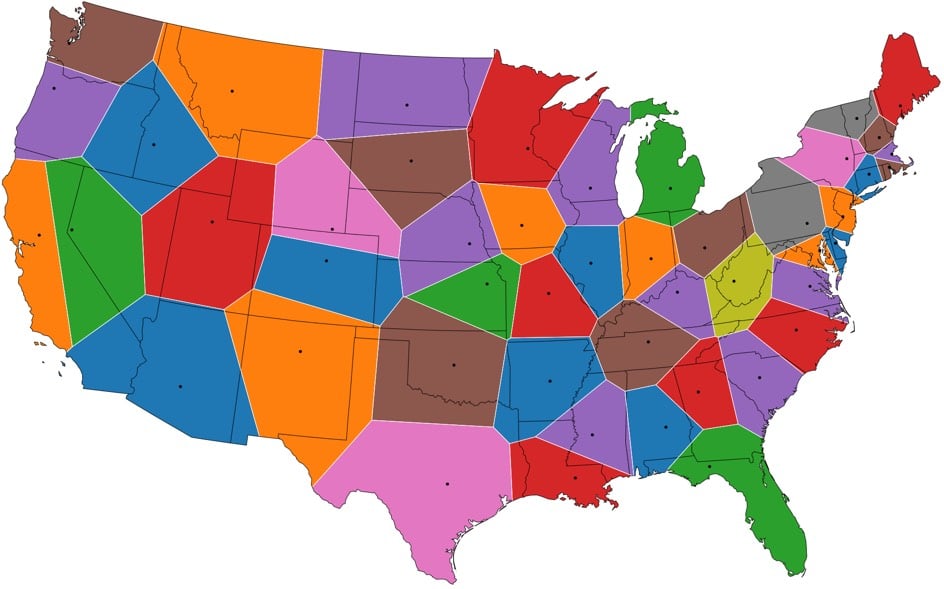
From Jason Davies, this is a US map where the state borders have been redrawn so that all points closest to a state capital than to any other form a state a la Voronoi diagrams. See also Voronoi maps of world airports and world capitals.
It’s interesting that many of the states’ new shapes are similar to their current ones, suggesting that the placement of the capitals relative to borders was somewhat naturally Voronoi-esque, like how people naturally space themselves in elevators or parks.
“The Coronavirus Was an Emergency Until Trump Found Out Who Was Dying”
There are a lot of different lenses you can use to look at how the United States and its government have confronted the Covid-19 pandemic. Race is a particularly useful one. As a reminder, here’s America’s current operating racial contract (from an Atlantic piece by Adam Serwer):
The implied terms of the racial contract are visible everywhere for those willing to see them. A 12-year-old with a toy gun is a dangerous threat who must be met with lethal force; armed militias drawing beads on federal agents are heroes of liberty. Struggling white farmers in Iowa taking billions in federal assistance are hardworking Americans down on their luck; struggling single parents in cities using food stamps are welfare queens. Black Americans struggling in the cocaine epidemic are a “bio-underclass” created by a pathological culture; white Americans struggling with opioid addiction are a national tragedy. Poor European immigrants who flocked to an America with virtually no immigration restrictions came “the right way”; poor Central American immigrants evading a baroque and unforgiving system are gang members and terrorists.
Serwer goes on to argue that the recently shifting American response to the pandemic, primarily in conservative circles, is due to an increasing awareness of which groups are bearing the brunt of the crisis: black and Latino Americans.
That more and more Americans were dying was less important than who was dying.
The disease is now “infecting people who cannot afford to miss work or telecommute-grocery store employees, delivery drivers and construction workers,” The Washington Post reported. Air travel has largely shut down, and many of the new clusters are in nursing homes, jails and prisons, and factories tied to essential industries. Containing the outbreak was no longer a question of social responsibility, but of personal responsibility. From the White House podium, Surgeon General Jerome Adams told “communities of color” that “we need you to step up and help stop the spread.”
This is a response that America is quite comfortable with because it fits with our racial contract, under which Jim Crow never actually ended. The US isn’t the only place this is happening btw. Early on, Singapore was praised for its response to the pandemic, but their reliance on and mistreatment of an underclass of migrant workers caused a secondary surge in cases.
Singapore is a small city-state with a population of just under 6 million inhabitants. On a per capita basis, it’s the second-richest country in Asia.
But its economy relies heavily on young men from Bangladesh, India and other countries who work jobs in construction and manufacturing. Singapore has no minimum wage for foreign or domestic employees. The foreign workers’ salaries can be as low as US$250 per month, but a typical salary is $500 to $600 a month.
The 4-Second Workout!
Recent research has 4-hour workweeked the 7-minute workout and the NY Times is on it!
Four seconds of high-intensity exertion repeated periodically throughout the day might counteract some of the unhealthy metabolic consequences of sitting for hours, according to a surprising and timely new study of the potentially large benefits of diminutive workouts.
The study relied on a specialized type of stationary bicycle that few of us will have available at home, but its implications remain broadly applicable and suggest that even a few minutes - or seconds - of exercise each day could help substantially to bolster our health.
See also greasing the groove:
One way to grease the groove is to just do the exercise whenever you think of it. Ben Greenfield, in Beyond Training, describes how he would do three to five pull-ups every time he walked under a pull-up bar installed in his office doorway. By the end of the day, he’d have performed 30 to 50 pull-ups with minimal effort.
Using a standing desk (featured here in sit-down mode) has made getting short bursts of regular exercise much easier.
I work from home and sprinkle exercise throughout my day. Working at a standing desk makes it easy to walk away from the screen, do a few pull-ups, plank for a minute, do some jumping jacks, and then get right back into whatever I was doing.
I stopped in the middle of writing this post to do some bodyweight exercises on my pull-up bar for about a minute and now I’m back at it — it didn’t even feel like an interruption because I never really lost my train of thought. Now, where’s the 4-millisecond PhD? (via moss & fog)
Virologist Peter Piot, one of the co-discoverers of the Ebola virus, came down with Covid-19 and had to be hospitalized. “Now that I have felt the compelling presence of a virus in my body myself, I look at viruses differently.”
A Practical Guide to Covid-19 Risks and How to Avoid Them
As some places in the United States and other countries are opening back up (some very prematurely), immunologist and biologist Dr. Erin Bromage has written a practical guide to the known Covid-19 risks and how to avoid them that’s based on recent scientific research. He begins:
It seems many people are breathing some relief, and I’m not sure why. An epidemic curve has a relatively predictable upslope and once the peak is reached, the back slope can also be predicted. We have robust data from the outbreaks in China and Italy, that shows the backside of the mortality curve declines slowly, with deaths persisting for months. Assuming we have just crested in deaths at 70k, it is possible that we lose another 70,000 people over the next 6 weeks as we come off that peak. That’s what’s going to happen with a lockdown.
As states reopen, and we give the virus more fuel, all bets are off. I understand the reasons for reopening the economy, but I’ve said before, if you don’t solve the biology, the economy won’t recover.
But since things are opening up anyway (whether epidemiologists like it or not), Bromage goes through a number of scenarios you might potentially find yourself in over the next few months and what the associated risks might be. His guiding principle is that infection is caused by exposure to the virus over time — increase the time or the exposure and your risk goes up. For example, public bathrooms might give you a ton of exposure to the virus over a relatively short period of time:
Bathrooms have a lot of high touch surfaces, door handles, faucets, stall doors. So fomite transfer risk in this environment can be high. We still do not know whether a person releases infectious material in feces or just fragmented virus, but we do know that toilet flushing does aerosolize many droplets. Treat public bathrooms with extra caution (surface and air), until we know more about the risk.
But being in the same room with another person simply breathing may not carry a large risk if you limit the time.
A single breath releases 50-5000 droplets. Most of these droplets are low velocity and fall to the ground quickly. There are even fewer droplets released through nose-breathing. Importantly, due to the lack of exhalation force with a breath, viral particles from the lower respiratory areas are not expelled.
But that time would drop sharply if the person is speaking:
Speaking increases the release of respiratory droplets about 10 fold; ~200 copies of virus per minute. Again, assuming every virus is inhaled, it would take ~5 minutes of speaking face-to-face to receive the required dose.
Again, this is all indoors. Being in enclosed spaces with other humans, particularly if they are poorly ventilated, is going to hold higher risks for the foreseeable future.
The reason to highlight these different outbreaks is to show you the commonality of outbreaks of COVID-19. All these infection events were indoors, with people closely-spaced, with lots of talking, singing, or yelling. The main sources for infection are home, workplace, public transport, social gatherings, and restaurants. This accounts for 90% of all transmission events. In contrast, outbreaks spread from shopping appear to be responsible for a small percentage of traced infections. (Ref)
Importantly, of the countries performing contact tracing properly, only a single outbreak has been reported from an outdoor environment (less than 0.3% of traced infections). (ref)
The Michael Pollan version of advice for socializing during the pandemic might be: Spend time with people, not too much, mostly masked and outdoors.
An interesting thread about the extensive measures taken by South Korea to stem the spread of Covid-19. In America, we’d rather let hundreds of thousands of people die than submit to something so inconvenient.
Trains Speed Through the Swiss Countryside to Techno Beats
Perhaps my fondness for Michel Gondry’s video for The Chemical Brothers’ Star Guitar has primed me to enjoy these POV Swiss train videos paired with techno music. The driving beat of the music, the forward motion of the train, and the soaring scenery complement each other perfectly. (via why is this interesting?)
There is only one known strain of SARS-CoV-2. The term strain is “reserved only for special changes that confer a new property to the virus”.
Pandemic Creativity: Edible Versions of Famous Artworks


In yet another example of how the constraints of the pandemic are fostering creativity, LA-based artist Claire Salvo is creating edible versions of notable artworks and posting the results to Instagram. Says Salvo of her new pursuit:
i make art using a bunch of media, but one sleepless night a few weeks ago, i thought i’d try playing with food. these pieces make me laugh while i’m creating them, and i’m really enjoying the response from everyone watching the process. thanks for all the kind feedback.
i’ve spent nearly 30 years honing my drawing skills, and approximately 1 week pushing banana peels and lentils around a canvas. but i’m learning to #trusttheprocess because #art.
I think the Dali portrait is my favorite, closely followed by the Lichtenstein. And you know I love this: Girl with a Pea Earring.
See also Famous Art Recreated at Home During the Pandemic. (via jenni leder)
The experience of air travel has long been terrible and the pandemic has made it worse. “At the food court, a shouting match broke out among several stressed-out strangers, and police had to intervene.”
Scunthorpe Sans is a font that automatically censors bad language. “Modern fonts can combine letters into a single ligature, usually for things like fi or fl but you can pick anything so we’ve done it for swears.”
Andy Serkis Is Reading The Hobbit Aloud for 12 Straight Hours
Andy Serkis, who played Gollum in the Lord of the Rings movies, is reading The Hobbit (the entire book!) aloud for 12 straight hours today to raise money for Covid-19 relief.
So many of us are struggling in isolation during the lockdown. While times are tough, I want to take you on one of the greatest fantasy adventures ever written, a 12 hour armchair marathon across Middle Earth whilst raising money for two amazing charities which are doing extraordinary work right now to help those most in need in the UK: Best Beginnings and NHS Charities Together.
He’s been going since 5am EST, so you can join in progress or rewind your way back to the beginning. The campaign has already reached its initial goal of £100,000 — you can contribute here. A “special surprise” was promised if the goal was met…I wonder if Ian McKellen or Martin Freeman will be stopping by for a chapter or two?
Music for Empty Malls
Listening to recorded music as if it’s being played in empty malls1 is a thing that I find incredibly soothing and nostalgic and also a little creepy?
An entire playlist is available here. Some of these sound more convincing than others, but almost any of them with 80s music instantly transports me back to wandering past Kay Bee Toys, Chess King, and Spencer’s while wearing my Hypercolor t-shirt, KangaROOS, and Guess jeans.1 (via @Remember_Sarah)
A la running Christian choral music through digital filters to make it sound like it was sung in the Hagia Sophia mosque in Istanbul.↩
Just kidding on the Guess jeans…my family couldn’t afford those! They were like $60! Even Levi’s were a luxury good. I wore mostly Lee or Bugle Boy jeans from Farm & Fleet. The Hypercolor shirt was a Christmas present.↩
On the Accuracy of Covid-19 Testing
As someone who suspects I may have had a mild case of Covid-19 a couple of months ago, I’ve been thinking about getting tested for antibodies. But as this video from ProPublica shows, even really accurate tests may not actually tell you all that much.
And the thing is, the “do I have Covid-19 right now” tests are plagued by the same issue.
For patients getting tested, the main concern is how to interpret the outcome: If I test negative with an RT-PCR genetic test, what are the chances I actually have the virus? Or if I test positive with an antibody test, does it actually mean I have the antibodies?
It turns out that the answers to these questions don’t just hinge on the accuracy of the test. “Mathematically, the way that works out, that actually depends on how many people in your area have Covid,” Eleanor Murray, an assistant professor of epidemiology at the Boston University School of Public Health, said.
The rarer the disease in the population, the less you’ll learn by testing.
Let’s say we have a hypothetical Covid-19 test for antibodies that is both 99 percent sensitive — meaning almost all people with antibodies will test positive — and 99 percent specific, meaning almost all people who were never infected will yield a negative result.
If you test a group of 100 uninfected people, odds are one of them will still test positive even though they don’t have the virus. Conversely, if you test 100 people who were infected, it’s likely one of them will still test negative.
Now let’s presume the virus has a prevalence rate of 1 percent, so one person in 100 carries antibodies to it. If you test 100 random people and get a positive result, what is the chance that this person was truly infected?
Deborah Birx, the White House Covid-19 response coordinator, explained the answer at a press conference on April 20: “So if you have 1 percent of your population infected and you have a test that’s only 99 percent specific, that means that when you find a positive, 50 percent of the time will be a real positive and 50 percent of the time it won’t be.”
So even if I test positive for antibodies and I assume that confers immunity, given that the number of confirmed infections in Vermont is so low (~900 statewide), it doesn’t seem like I would be justified in changing my behavior at all. I would still have to act as though I’ve never had the virus, both for my own health and the health of those around me. Maybe if I had two or three corroborating tests could I be more certain…
Copy & Paste Your Surroundings into Photoshop with a Magical AR App
Designer Cyril Diagne has developed a prototype of an augmented reality app that can copy objects from the real world and paste them into a Photoshop document. Here’s how it works: you point your phone at a book sitting on your desk, the software produces an image of just the book on your phone screen, you point the phone at your computer, and the book image gets pasted into the Photoshop document. It looks like straight-up magic (or at least like a scene from Minority Report or something):
Diagne wrote a thread on Twitter with more technical details. The code is available on Github if you’d like to give it a try. (via colossal)
To deal with the stress, anxiety, and boredom of the pandemic, some are turning to cannabis. “Smoking cannabis has helped people stay inside for generations!”
Radiohead’s Rejected Spectre Theme Song Played Over the Film’s Opening Credits
My kids have been making their way through the Daniel Craig Bond movies so when I mentioned that our local theater was planning on showing drive-in movies on a screen in the parking lot, my son said, “ooh, maybe they’ll show the new Bond movie”.1 Then they began to speculate who would be singing the theme song in the new movie, and I piped in: it’s Billie Eilish and they’ve already released the song.
So we listened to it and, since they had just watched Spectre, I also played Radiohead’s rejected theme song, which I obviously prefer to Sam Smith’s bland Oscar-winning song. This morning, while trying to figure out who sang the official one, I ran across the video of Radiohead’s version played over the opening credits (embedded above). Gah, so much better. What a missed opportunity.
P.S. Funny story from my research: not only was Smith unaware that Radiohead had been asked to do the theme song before them, they were also apparently unaware of who Radiohead frontman Thom Yorke even was.
We’ll have to wait until at least November for that, although I suspect that as the summer goes on and people don’t go back to movie theaters even if they reopen, the studios will have to start releasing films straight to digital/Blu-ray. The can’t delay everything for a year or two.↩
Hiking the Pacific Crest Trail in Three Minutes
The Pacific Crest Trail runs 2650 miles from the border of Mexico to the border of Canada through California, Oregon, and Washington. Hiking the whole thing usually takes months, but this video by Mac of Halfway Anywhere compresses the entire experience down to just three minutes presented in 1-second snippets.
I was skeptical about this going in — I thought it was going to be like watching one of those impossible-to-follow “my life in one-second increments” videos — but the consistent presence of the path tied all the disparate moments into a cohesive journey. You can check out a much longer cut of the same journey and a similar edit of the Continental Divide Trail in four minutes.
The scenery in both of these videos are spectacular and remind me of my roadtrips from the past two years. (via @stewartbrand)
Tips From Someone With Nearly 50 Years Of Social Distancing Experience. “1. Keep track of something. 2. Keep a routine.”
Becoming, a Film About Michelle Obama
Based on her memoir of the same name and produced by the production company she created with her husband, Becoming is a film about Michelle Obama that premiered on Netflix today.
Becoming is an intimate look into the life of former First Lady Michelle Obama during a moment of profound change, not only for her personally but for the country she and her husband served over eight impactful years in the White House. The film offers a rare and up-close look at her life, taking viewers behind the scenes as she embarks on a 34-city tour that highlights the power of community to bridge our divides and the spirit of connection that comes when we openly and honestly share our stories.
The trailer and a clip from the film are embedded above. The clip features Obama talking with a group of young black women on her book tour and one of them asks about getting her life “back on track” after her husband’s presidency. Obama’s answer is remarkably timely:
What I’ve learned is that…get back on what track? It’s a whole new track. It’s not going back — it’s just all different and it’s different forever. So it’s not getting back on track, it’s creating my next track.
I think many Americans and people across the world are struggling with accepting that idea in the midst of the pandemic.
The heavy price of the American brand of freedom & liberty. “This country seems resigned to preventable firearm deaths. It appears that the same is starting to happen with fatalities from the pandemic.”
SARS-CoV-2, An Emerging Portrait
From Nature’s David Cyranoski, a piece that takes a look at what the latest research says about SARS-CoV-2, where it came from, and how it is able to infect the human body. I’m going to highlight a few things from the article I thought were particularly interesting. As Cyranoski has done throughout, I’d like to stress that because this virus is so new to us and the situation is moving so quickly, many of these results are based on preliminary research, have been published in pre-print papers, and haven’t been peer-reviewed.
The first is about the detective work being done to trace where SARS-CoV-2 came from and how long it’s been in existence (possibly decades).
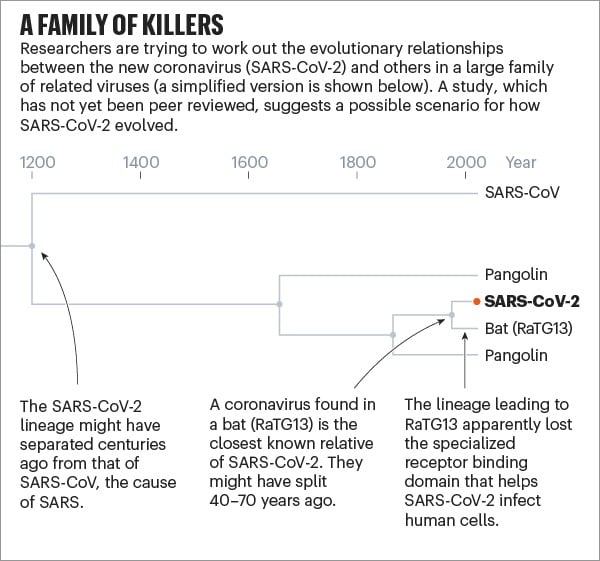
But studies released over the past few months, which have yet to be peer-reviewed, suggest that SARS-CoV-2 — or a very similar ancestor — has been hiding in some animal for decades. According to a paper posted online in March, the coronavirus lineage leading to SARS-CoV-2 split more than 140 years ago from the closely related one seen today in pangolins. Then, sometime in the past 40-70 years, the ancestors of SARS-CoV-2 separated from the bat version, which subsequently lost the effective receptor binding domain that was present in its ancestors (and remains in SARS-CoV-2). A study published on 21 April came up with very similar findings using a different dating method.
The section on how the virus acts in the body is particularly interesting because it attempts to explain the unusual and varying behaviors SARS-CoV-2 exhibits and causes in different parts of the human body. For example, SARS-CoV-2, unusually, can initially infect two places in the body: the throat and lungs.
Having these two infection points means that SARS-CoV-2 can mix the transmissibility of the common cold coronaviruses with the lethality of MERS-CoV and SARS-CoV. “It is an unfortunate and dangerous combination of this coronavirus strain,” he says.
The virus’s ability to infect and actively reproduce in the upper respiratory tract was something of a surprise, given that its close genetic relative, SARS-CoV, lacks that ability. Last month, Wendtner published results of experiments in which his team was able to culture virus from the throats of nine people with COVID-19, showing that the virus is actively reproducing and infectious there. That explains a crucial difference between the close relatives. SARS-CoV-2 can shed viral particles from the throat into saliva even before symptoms start, and these can then pass easily from person to person. SARS-CoV was much less effective at making that jump, passing only when symptoms were full-blown, making it easier to contain.
These differences have led to some confusion about the lethality of SARS-CoV-2. Some experts and media reports describe it as less deadly than SARS-CoV because it kills about 1% of the people it infects, whereas SARS-CoV killed at roughly ten times that rate. But Perlman says that’s the wrong way to look at it. SARS-CoV-2 is much better at infecting people, but many of the infections don’t progress to the lungs. “Once it gets down in the lungs, it’s probably just as deadly,” he says.
And this is a somewhat hopeful speculation on one of the many possible ways the Covid-19 pandemic could go:
“By far the most likely scenario is that the virus will continue to spread and infect most of the world population in a relatively short period of time,” says Stöhr, meaning one to two years. “Afterwards, the virus will continue to spread in the human population, likely forever.” Like the four generally mild human coronaviruses, SARS-CoV-2 would then circulate constantly and cause mainly mild upper respiratory tract infections, says Stöhr. For that reason, he adds, vaccines won’t be necessary.
Some previous studies support this argument. One showed that when people were inoculated with the common-cold coronavirus 229E, their antibody levels peaked two weeks later and were only slightly raised after a year. That did not prevent infections a year later, but subsequent infections led to few, if any, symptoms and a shorter period of viral shedding.
The OC43 coronavirus offers a model for where this pandemic might go. That virus also gives humans common colds, but genetic research from the University of Leuven in Belgium suggests that OC43 might have been a killer in the past.
But then, from a few paragraphs down:
People like to think that “the other coronaviruses were terrible and became mild”, says Perlman. “That’s an optimistic way to think about what’s going on now, but we don’t have evidence.”
For now, it’s just another thing we don’t know about this virus we learned about only 5 months ago. It’s a long road ahead, but I’m thankful that so many scientists are bent on making sense of it all.
A short piece on what it’s like to fly an electric airplane. “For the moment, what gets from a battery to the propeller is about one-fifteenth, per pound, of what we get from avgas.”
This Japanese Man Paints a Picture of Every Meal He Eats


For 32 years, Itsuo Kobayashi has been painting top-down pictures of the meals he eats. The paintings are accompanied by descriptions of each meal. Kobayashi worked as a chef for years until he suffered an illness that left his movement impaired, causing him to double-down on his art.
An interview with Estelle Caswell, creator of Vox’s excellent Earworm video series. The bit about YouTube demonetizing their videos is infuriating. “YouTube’s content ID algorithm has no idea what fair use is.”
I love this: The Pudding is testing the “infinite monkey theorem” by having a computer program randomly try to play the first notes of familiar songs. The Imperial March from Star Wars took ~1.3 billion attempts to get right.
The Art of the New Deal: Why the Federal Government Funded the Arts During the Great Depression. “He turns the question about who ‘deserves’ relief on its head. Dance may not be necessary by some people’s lights but eating most certainly is.”
Not liking the thing that everyone else is (very publicly) loving can be a tough row to hoe. “It seems like everyone in the world loves [Fiona Apple’s] “Fetch the Bolt Cutters.” So why don’t I? On the isolation of disconnection.”
Daniel Radcliffe Reads the First Chapter of Harry Potter and the Sorcerer’s Stone
As part of the Wizarding World’s Harry Potter at Home initiative, they’re having an all-star cast read the first book in the series aloud on video. The first chapter was just released and it’s read by none other than Daniel Radcliffe himself. You can also listen on Spotify:
A new chapter with a different reader will be released each week — readers of future chapters include Stephen Fry, Dakota Fanning, and Eddie Redmayne.
Update: The next few chapters have been released: Noma Dumezweni’s chapter 2, Eddie Redmayne reads chapter 3, and Stephen Fry does chapter 4. The kids and I have been listening to this on Spotify in the car and we’re loving it. I liked Redmayne’s narration the best so far and Fry does an uncanny impression of Robbie Coltrane’s Hagrid voice.
Recent testing shows a man tested positive for Covid-19 in France in late December 2019. “The absence of a link with China and the lack of recent travel suggest that the disease was already spreading among the French population at the end of Dec 2019.”
The Missing Sounds of New York
The NYPL has released an album of sound-based experiences that you might be missing right now as we all shelter at home: Missing Sounds of New York.
It’s a short album (16 min) and includes soundscapes like Serenity Is a Rowdy City Park, I’d Call a Cab to Anywhere, and The Not-Quite-Quiet Library.
See also this 3+ hour album of ambient city sounds. There are also many videos of ambient city sounds on YouTube, like this 10-hour video of ambient NYC sounds:
This is a mix of ambience sounds recorded around Christmas Eve as well as St Patrick’s Day. Enjoy the sounds of people talking, traffic noises, police sirens, subway sounds, footsteps around NYC. City sounds at night and day.
Or perhaps you’d like to go for a stroll in the city instead? (via the morning news)
Socials & More