Entries for May 2020
On the occasion of ESPN’s hit documentary The Last Dance finishing up, Axios’ Kendall Baker shared his list of the top 50 sports documentaries of all time.
It’s unsurprising that Hoop Dreams comes out on top — I need to make some time to watch that again. OJ: Made in America comes in at #2 and is indeed excellent, one of the best things I’ve seen on TV in recent years. But is it actually a sports documentary? It’s about a guy who used to play sports… The Last Dance finishes in third place; I haven’t seen it yet1 but my guess is that’s too high, especially considering Jordan had a lot of control over the finished product.
Loved seeing some of my other favorites on there too: Senna, When We Were Kings, Pumping Iron, The King of Kong: A Fistful of Quarters, Dogtown and Z-Boys, and Minding the Gap (which should have been way higher on the list). (via @mikeindustries)
When he was a kid, Rob Kenney had a rough family life and grew up without stable parents around to teach him how to do common household chores. He and his wife successfully raised two children and Kenney decided to use his parenting experience to help those who may be lacking parental guidance. He’s started a YouTube channel called “Dad, how do I?” that offers “practical ‘dadvice’ for every day tasks” like how to fix a running toilet, how to check the oil in your car, and how to shave your face.
My god, the dad joke he tells at the beginning of the running toilet video is just *chef’s kiss* perfect.

Marker’s David Freedman has a great look at how Vermont’s own King Arthur Flour has dealt with a massive increase in demand for their best-in-class flour and other challenges during the pandemic. The piece is a textbook example of what Tim Carmody calls the systemic sublime.
The company knew something weird was going on when they noticed a 600% sales jump almost overnight and started seeing different kinds of questions coming into their consumer call center.
So tricky and specific are some of the bread-baking questions that even though Ely is one of the bread specialists working the hotline, she sometimes puts callers on hold and yells over the cubicle walls to colleagues for second opinions.
But in early March, Ely noticed a change in the questions. Partly it was an increase in the sheer number of calls, a jump that seemed more sudden and pronounced than the normal mild pre-Easter build-up. But even stranger was how many of the callers seemed, well, clueless. How do you tell if bread is done? Do I really need yeast? And strangest of all: What can I use instead of flour?
In a matter of weeks, the employee-owned company transformed several aspects of their business and tripled their flour output in order to keep up with the demand.
As a first step to ramping up the flow of flour to consumers, King Arthur added one to two shifts at all its facilities and contracted with an additional fulfillment center. It shifted most of its long-distance product transportation from rail to trucks, which are more expensive per bag but add speed and flexibility. It stopped international sales to divert all incoming inventory to U.S. customers. To make shipping operations more efficient and get orders out the door faster, the company switched to all “ship-complete” shipping — that is, if one item in a multi-item order was temporarily out of stock, the entire order was held until the item was back in stock.
The company also managed to find a new partner that could mill and bag more flour. The wrinkle was that the partner was only set up to fill three-pound plastic bags, not King Arthur’s five- and 10-pound paper bags. So King Arthur quickly whipped up a new three-pound plastic bag and threw it up on the website as a new product. That move alone would add up to a half-million new units a month to the company’s shipments.
The company has also done right by their employee-owners:
Altogether, three-quarters of the company’s employees were sent home. In many cases, the work went with them, as was the case with the Baker’s Hotline, and with most managers. Many of those whose jobs couldn’t be performed at home were trained to help out with tasks that could. So far, not a single employee has been furloughed; everyone is being paid — including 12 employees who stay busy sewing masks for other employees.
They’ve helped out companies they supply as well:
While home baking was taking off, bakeries were being closed down, sharply reducing demand for the big bags of flour. (To help keep some of them afloat, the company has spent $30,000 so far during the pandemic paying some of its bakery customers around the country — including Empire Baking — to bake bread and donate it to local good causes. Its own bakers have been doing the same for essential workers and those in need in Norwich.)
And I love the photos that accompany the article by Stephanie Gonot — that must have been a fun & messy photoshoot to do at home. (via @robinsloan)
Ed Yong on America’s Patchwork Pandemic. “In a pandemic, the actions of 50 uncoordinated states will be less than the sum of their parts. Only the federal government has pockets deep enough to fund the extraordinary public-health effort now needed.”
This lovely short film by Cristóbal Vila shows how the simple Fibonacci sequence manifests itself in natural forms like sunflowers, nautilus shells, and dragonfly wings.
See also Arthur Benjamin’s TED Talk on the Fibonacci numbers and the golden ratio and the Fibonacci Shelf. (via @stevenstrogatz)
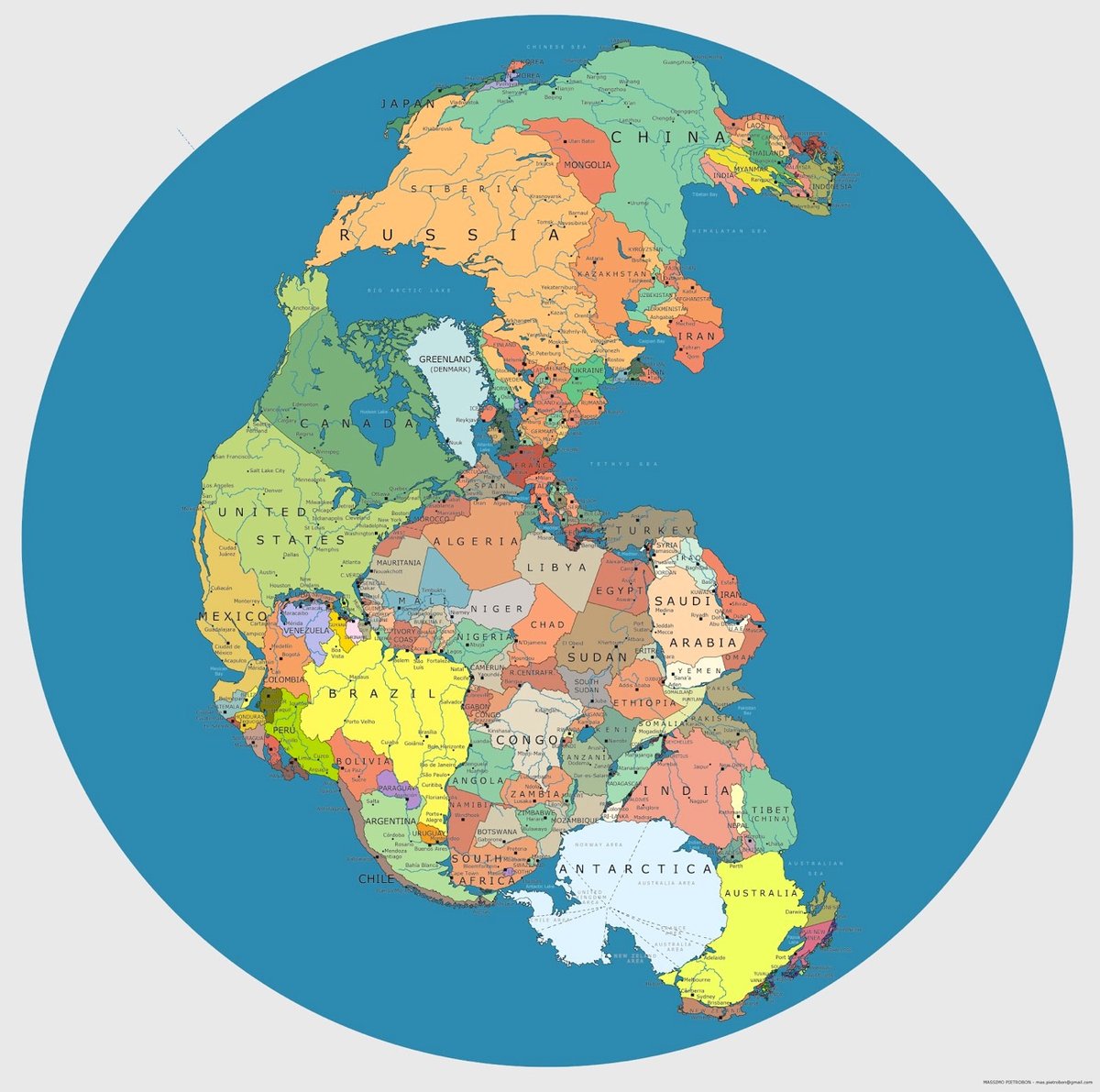
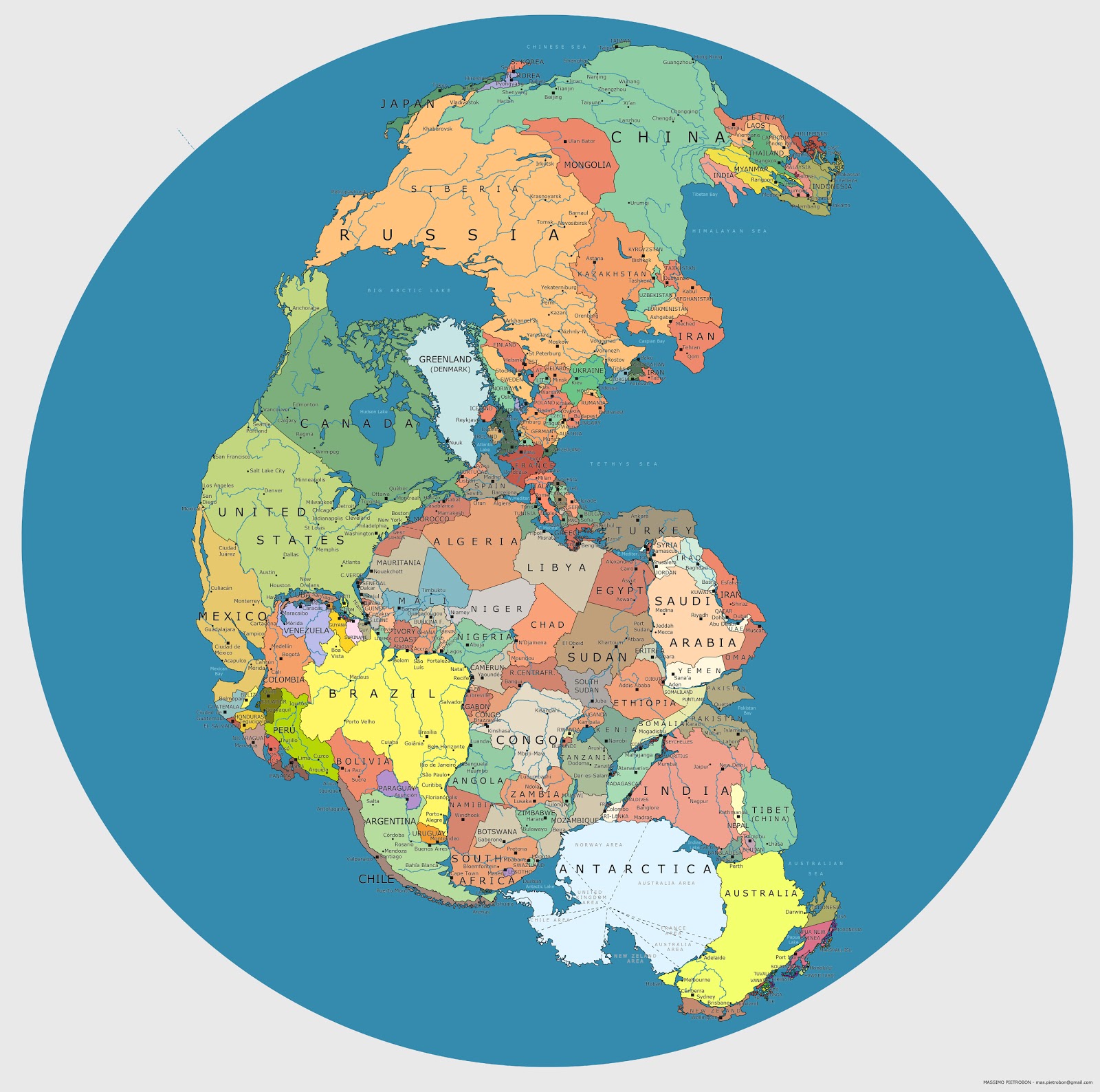
Pangaea is a supercontinent that formed on Earth about 335 million years ago and began to break up about 175 million years ago, eventually forming the familiar continents of today. Massimo Pietrobon made a map that shows where our modern country borders would appear on Pangaea. Check out the full-size version here.
See also Locate Modern Addresses on Earth 240 Million Years Ago. (via @owacle)
After 2+ months of lockdown in most areas, a small minority of Americans want our country to go back to “normal” despite evidence and expert advice to the contrary. They want to get haircuts, not wear masks in public, go to crowded beaches, and generally go about their lives. These folks couch their desires in terms of freedom & liberty: the government has no right to infringe on the individual freedoms of its citizens.
But governments routinely do just that for all kinds of good reasons — e.g. you can’t murder someone just because you feel like it — and as Johns Hopkins’ public health historian Graham Mooney points out, there’s a precedent for a different way of thinking about freedom in the context of public health.
In response to these vehement appeals to individual freedom, public-health leaders in London, Liverpool, Manchester and elsewhere developed a powerful counterargument. They too framed their argument in terms of freedom — freedom from disease. To protect citizens’ right to be free from disease, in their view, governments and officials needed the authority to isolate those who were sick, vaccinate people, and take other steps to reduce the risk of infectious disease.
One of the most important reformers was George Buchanan, the chief medical officer for England from 1879 to 1892. He argued that cities and towns had the authority to take necessary steps to ensure the communal “sanitary welfare.” He and other reformers based their arguments on an idea developed by the 19th-century English philosopher John Stuart Mill, who is, ironically, remembered largely as a staunch defender of individual liberty. Mill articulated what he called the “harm principle,” which asserts that while individual liberty is sacrosanct, it should be limited when it will harm others: “The sole end for which mankind are warranted, individually or collectively, in interfering with the liberty and action of any of their number, is self-protection,” Mill wrote in On Liberty in 1859. Public-health reformers argued that the harm principle gave them the authority to pursue their aims.
An essay published in The Lancet in 1883 sums up this view nicely: “We cannot see that there is any undue violation of personal liberty in the sanitary authority acting for the whole community, requiring to be informed of the existence of diseases dangerous to others. A man’s liberty is not to involve risk to others,” the author wrote. “A man with smallpox has the natural liberty to travel in a cab or an omnibus; but society has a right that overrides his natural liberty, and says he shall not.”


Designer Jim Malloy has reimagined the books of Dr. Seuss for the coronavirus age by altering the titles & cover illustrations and changing the author to “Dr. Fauci”. You can check out the results on Instagram and in this Instagram Story. (via print)
A Succession insult generator. “FitBit moron whatever people.” “He looks waxy, like an unshaven candle.”
In celebration of the documentary Beastie Boys Story coming out, the Beastie Boys and their record label have remastered dozens of the group’s music videos in HD and uploaded them to YouTube. The videos include heavy-hitters like Sabotage and (You Gotta) Fight for Your Right (to Party!) but also some more obscure stuff as well. Check out the entire remastered playlist here.


The AIGA has announced the winners of its annual 50 Books / 50 Covers competition for books published in 2019. The competition recognizes excellence in both book design and book cover design — some of the winners placed in both categories. You’ll notice there are not a lot of books here that you’d find on the front table of the bookstore — the winners tend to be from smaller publishers and/or academic in nature and/or about art or design. For lists containing more mainstream books, check out the lists from the NY Times, Buzzfeed, and Lithub.
The books pictured above (from top to bottom) are Rusty Brown by Chris Ware, When Brooklyn Was Queer by Hugh Ryan, Love Drones by Noam Dorr, Signal. Image. Architecture. by John May, and False Bingo by Jac Jemc.
Every once in a while during my internet travels, I run across something like this video: something impossibly mundane and niche (a ~26-minute video of someone solving a sudoku puzzle) that turns out to be ludicrously entertaining. I cannot improve upon Ben Orlin’s description:
You’re about to spend the next 25 minutes watching a guy solve a Sudoku. Not only that, but it’s going to be the highlight of your day.
The solver himself calls it “a work of sublime genius” and “one of the most extraordinary puzzles we’ve ever seen”. It’s fascinating listening to him slowly uncover different aspects of the puzzle — watching him methodically figure out the 3s was genuinely thrilling. And the symmetry thing at the end…
If you fancy yourself a sudoku master, you can try solving the puzzle yourself here (keeping in mind the special chess-related rules laid out in the video). (via @robinsloan)
In this charming little film (that feels very Wes Andersonian), we get to visit the Union Glacier Camp in West Antarctica, see what life is like there, and meet the people who run it. The camp is situated next to a blue-ice runway (which makes the area accessible to large aircraft) and serves as the jumping-off point for many kinds of activities, projects, and expeditions.
Union Glacier Camp is the only facility of its kind in Antarctica. Our full-service private camp operates during the Antarctic summer (November through January) and is dismantled at the end of each season. Our camp not only provides accommodations to guests on guided experiences but also serves as a logistics hub, supporting private expeditions and National Antarctic Programs.
I love the grid of tents for guests.
We can house up to 70 guests in our dual occupancy Clam Tents. These double-walled sleeping tents are designed to withstand Antarctic conditions with a high-tech nylon covering and durable aluminum frame that opens up like a clam shell. They are also incredibly comfortable to live in with large doors and a tall interior that allows you to stand upright and move around easily (16 ft x 8 ft or 5 m x 2.4 m). Tents are naturally heated by the 24-hour sunlight up to 60^0-70^0F (15^0-21^0C) but also have a wooden floor underneath to provide insulation from the snow and solid footing. Each guest is provided with a cot, mattress, pillow, linens, towels, and wash basin.
Tourist trips to Union Glacier start at $26,000 for six days.
Spike Lee’s newest film, Da 5 Bloods, is coming to Netflix on June 12 and the trailer, driven by the Chambers Brothers’ psychedelic rock anthem Time Has Come Today, is really compelling.
From Academy Award(R) Winner Spike Lee comes a New Joint: the story of four African-American Vets — Paul (Delroy Lindo), Otis (Clarke Peters), Eddie (Norm Lewis), and Melvin (Isiah Whitlock, Jr.) — who return to Vietnam. Searching for the remains of their fallen Squad Leader (Chadwick Boseman) and the promise of buried treasure, our heroes, joined by Paul’s concerned son (Jonathan Majors), battle forces of Man and Nature — while confronted by the lasting ravages of The Immorality of The Vietnam War.
Having recently been to Vietnam and done a bit of reading about US veterans retiring there, I’m interested to see how Lee handles that dynamic and portrays the country.
Mount St. Helens erupted 40 years ago today. Here are some photos of the eruption and the aftermath.
We should all be required to wear masks in public. “This evidence seems, to me, clear and simple: COVID-19 is spread by droplets. We can see directly that a piece of cloth blocks those droplets and the virus those droplets contain.”
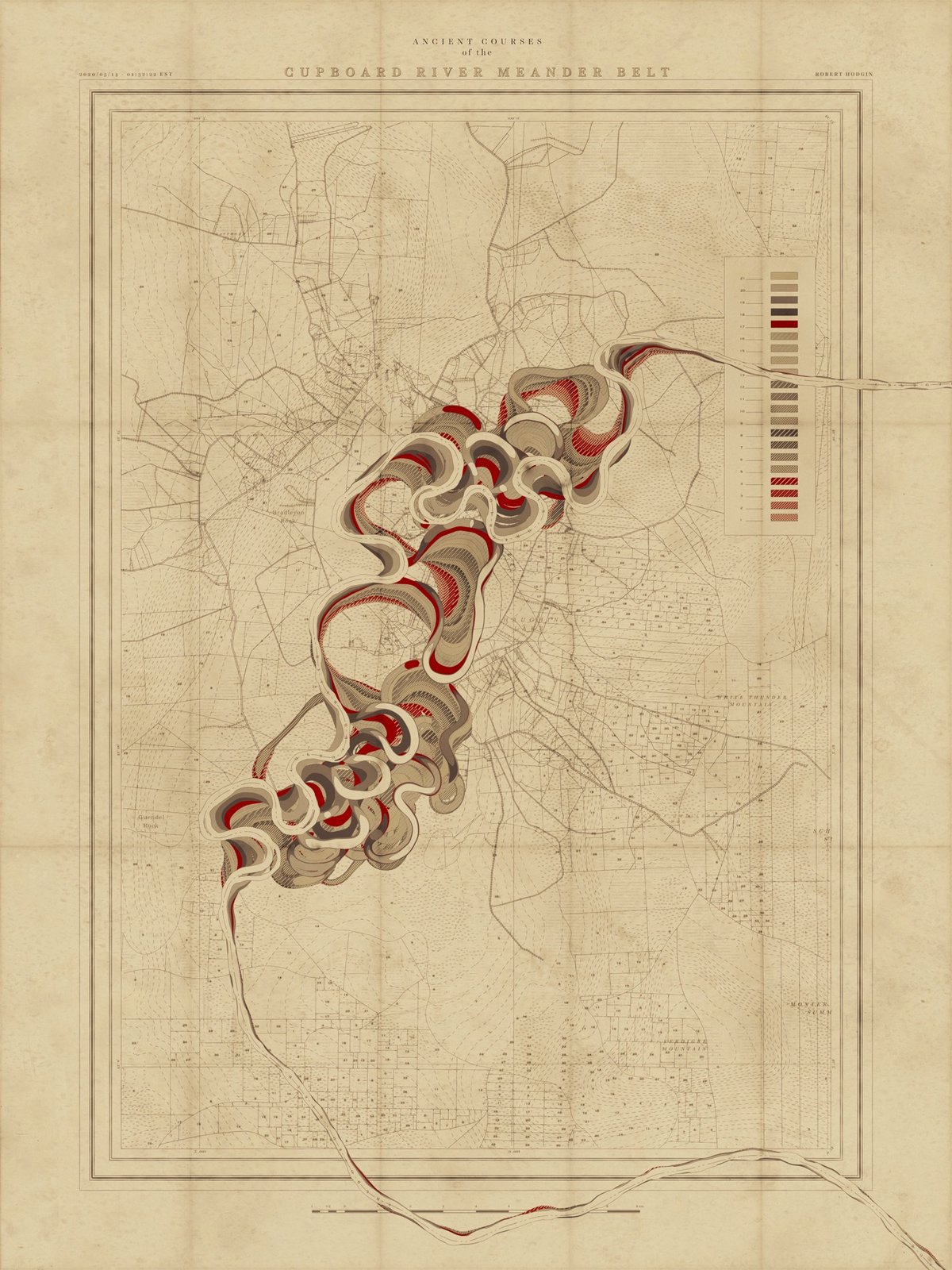
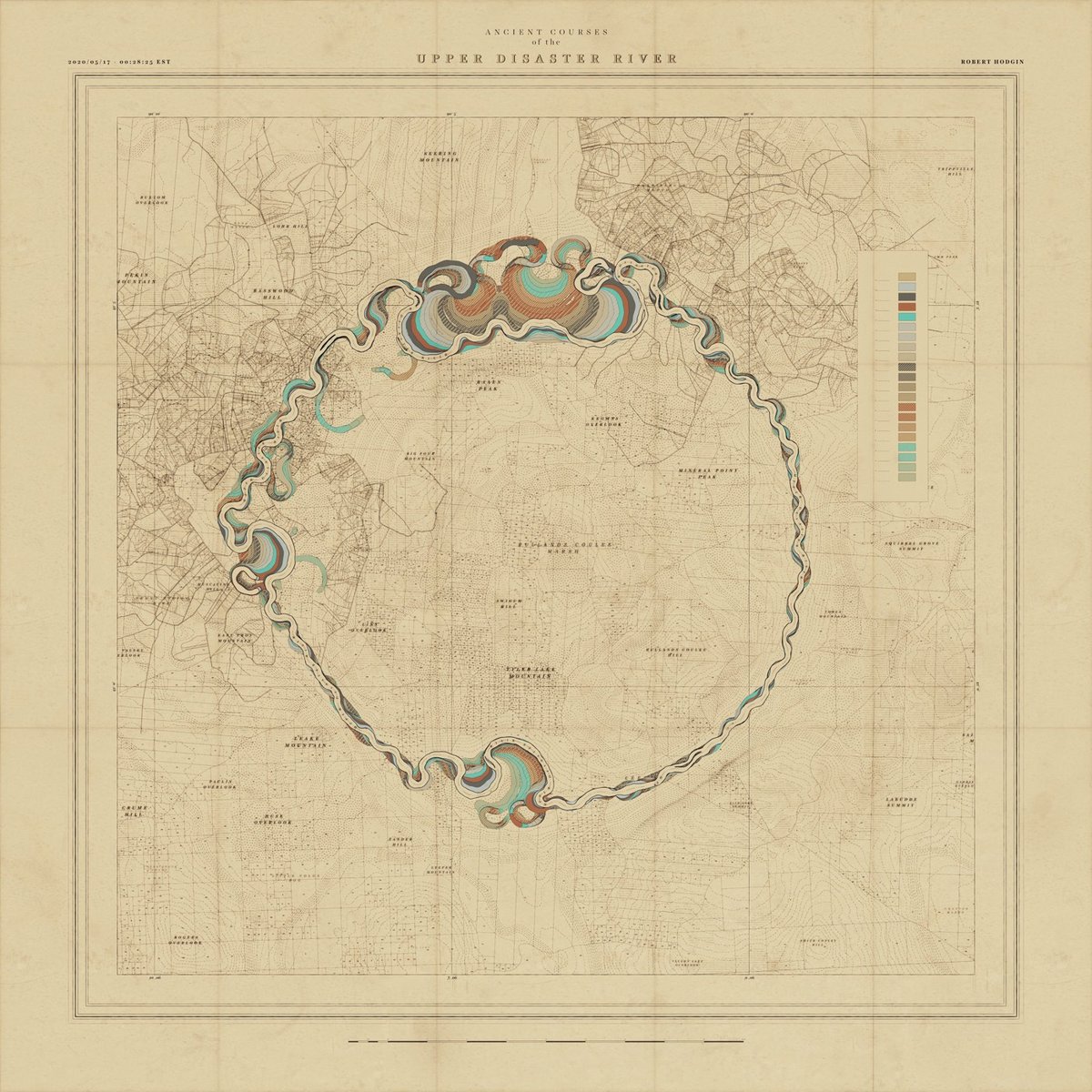
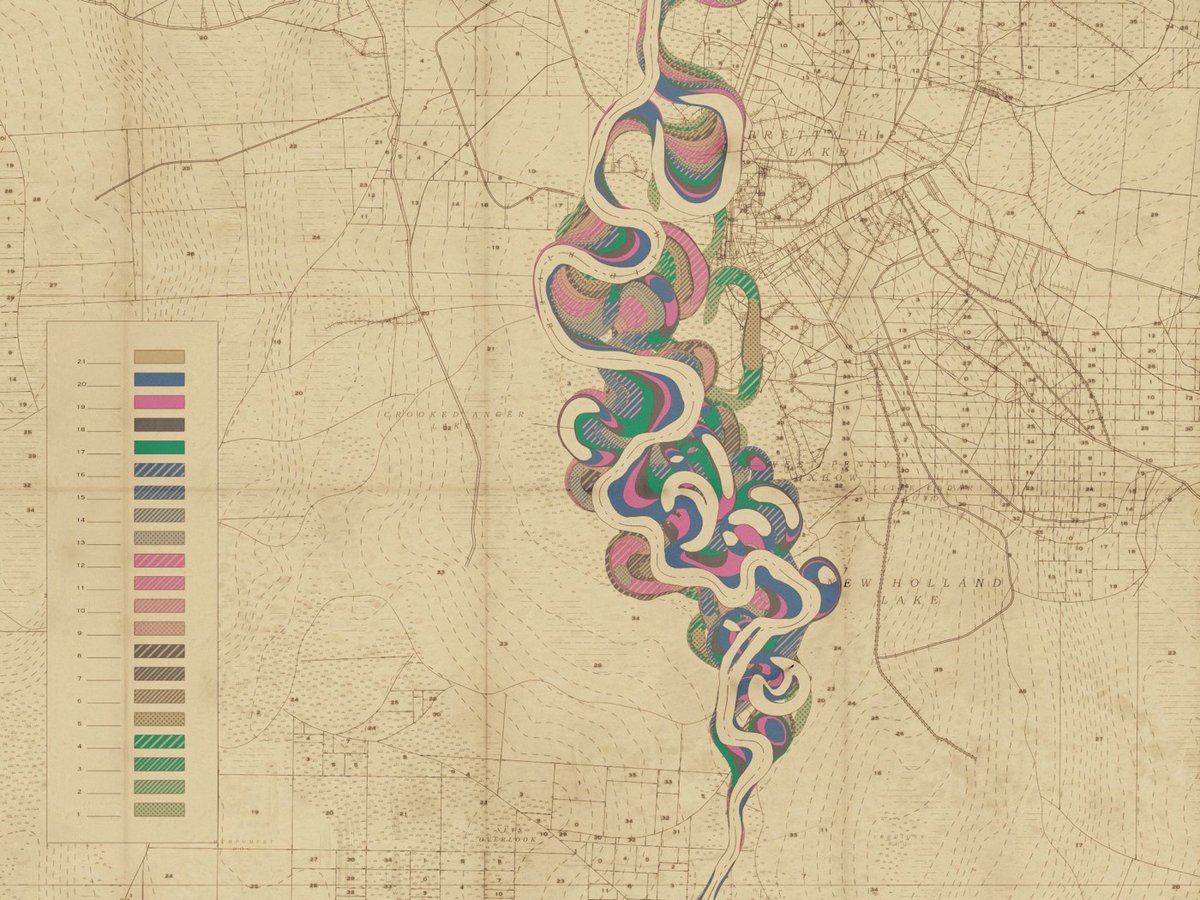
I have written previously about cartographer Harold Fisk’s wonderful meander maps of the Mississippi River produced for the Army Corps of Engineers. Borrowing the aesthetic of these maps, interactive artist & engineer Robert Hodgin wrote some software called Meander to generate meander maps for fictional rivers.
From an input curve, the terrain, land plots, side roads, highways, marsh land and mountain peaks are generated and prominent features are named. The map is then weathered and rendered in the style of old US Army Corp of Engineers maps from the 1930s and 40s.
You can check some of the generated maps out on Twitter or on Instagram, including some prototypes and animations (this one is my favorite). Hodgin has promised a full write-up of the project; I’ll link to it when he publishes it.
Coincidentally, while I was writing this post I got an email from a reader about an audiovisual installation called Meandering River that displayed “real-time visuals generated by an algorithm and music composed by an A.I.”
Synchronicity!
Update: Hodgin wrote about the Meander project on his website and included several more gorgeous examples of his output.
Pizza Arbitrage. “If someone could pay Doordash $16 a pizza, and Doordash would pay his restaurant $24 a pizza, then he should clearly just order pizzas himself via Doordash, all day long. You’d net a clean $8 profit per pizza.”
Here’s How Time Works Now. “A minute can now either be one hour, or it can take 3.5 seconds. We hope you enjoy this new feature.”
One of many cancellations due to the pandemic is the Public Theater’s annual Shakespeare in the Park performances. But for the next three weeks, PBS is streaming their Great Performances recording of last year’s Shakespeare in the Park production of Much Ado About Nothing for free on their site (embedded above, reviews here).
This bold interpretation of Shakespeare’s comedic masterpiece features Danielle Brooks (“Orange is the New Black,” Broadway’s “The Color Purple”) and Grantham Coleman (“Buzzer,” “The Americans”) as the sparring lovers Beatrice and Benedick. Tony Award winner Kenny Leon (“American Son,” “A Raisin in the Sun”) directs with choreography by Tony Award nominee Camille A. Brown (“Choir Boy”).
To whet your appetite, you can check out some of the highlights of the performance in this short video.
P.S. You can also watch this 2009 production of Macbeth starring Patrick Stewart in the lead role. (via laura olin)
I recently came across this quote from Kirkpatrick Sale’s 1980 book Human Scale and it succinctly relates a fundamental truth about the purpose of cities.
Cities are meant to stop traffic. That is their point. That is why they are there. That is why traders put outposts there, merchants put shops there, hoteliers erected inns there. That is why factories locate there, why warehouses, assembly plants and distribution centers are established there. That is why people settle and cultural institutions grow there. No one wants to operate in a place that people are just passing through; everyone wants to settle where people will stop, and rest, and look around, and talk, and buy, and share.
Cities, in short, should be an end, not a means. Rationally one wants to have traffic stop there, not go through, one wants movement within it to be slow, not fast.
Sale goes on to list four ways in which cities should think about slowing traffic down:
- Cities should not try to move people to facilities but provide facilities where the people are.
- Cities should be small enough so that inter-community trips, when necessary, could be managed either on foot, by bike, or with some simple subway or trolley system.
- Cities should attempt to slow down the flow of traffic, particularly with plenty of squares and plazas and parks, places where wheeled vehicles are forced to halt, endpoints that invite stopping and resting.
- Cities should try to bring home and workplace back together.
You can read the entire excerpt on Google Books. (via @grescoe)
Update: Some alert readers let me know that Kirkpatrick Sale is a left-wing secessionist, which has brought him and his various organizations into contact & cooperation with racist hate groups and white supremacist organizations. I’m not going to link to it, but he’s written some stuff recently about how the Confederacy and slavery weren’t so bad (with tired arguments like white slave owners treating their slaves well) for an organization dedicated to exploring the “Southern tradition”. The white Southern tradition, mind you — there are no black voices or faces represented on their site as far as I can tell. I will leave it as an exercise for the reader as to whether that changes how you feel about his views on how to fix cities.1 (thx, edward & @paulbeard)

The NY Times’ Michael Kimmelman has been taking a series of virtual walks around NYC, exploring different aspects of the city. His latest walk is with Eric Sanderson, conservation ecologist and author of Mannahatta: A Natural History of New York City. The pair of them start at the southern tip of Manhattan over 400 years ago, with Sanderson explaining how the island would have appeared when Henry Hudson arrived in 1609.
Michael Kimmelman: Aside from Hudson’s ship, what do we see?
Eric W. Sanderson: Whales and porpoises. One of the earliest sketches we have of Manhattan shows a whale in the Hudson River. The charter of Trinity Church includes a provision specifically saying dead whales found on beaches in the province of New York are property of the church, which could use them to make oil and whale bone. So whales were clearly a meaningful part of the local economy and ecosystem.
Kimmelman: What was the ecosystem?
Sanderson: Ecosystems, actually. Manhattan is something like one percent the size of Yellowstone. Yellowstone is 2.2 million acres and it has 66 ecosystems. Mannahatta had 55.
It’s an interesting thought exercise to imagine what might have happened had the United States been colonized from the West, instead of from the East. We might have decided to make Manhattan a national park. We would be coming to New York for an entirely different sort of wildlife.
Most nights since mid-March, The Roots’ Questlove has been doing lengthy DJ sets for fans, kind of like a series of distributed house parties. The shows range in length from 2.5 hours to more than 6 hours — most are in the 3-4 hour range. The past shows have been collected in this playlist. The most recent show, from Tuesday, celebrated the 70th birthday of Stevie Wonder:
He did a 3-hour set made up of audience requests:
And of course there were sets focused on particular artists and bands — the Beastie Boys, James Brown, and Prince:
From a Fast Company piece about how The Roots have adapted their approach to entertainment during the pandemic:
“My whole narrative is that I’m this musical griot or this musical expert with 170,000 pieces of vinyl that you can Google, but now that I’m thrown in the pool, I realized, yeah, I have 170,000 records, but at the end of the day, I know maybe 400.”
Questlove has digital access to about 30% of that massive collection and decided to get to know more of his songs in front of a live audience. It’s different when that audience is the internet, but Questlove gets it now. He can reach more people. He’s having fun with his selections, and his diverse and meticulous approach to music shows up in his nightly playlists.
“I challenged myself to do a dancehall set that didn’t require me to play ‘Murder She Wrote.’ I’m gonna try and do the salsa set that doesn’t require me to play like ‘Suavemente,’ all the Captain Obvious stuff,” he explains. “So, I mean just as a music lover and a musician, it’s challenging me to find exciting ways to present music.”

For a limited time, you can view the feature length documentary Chair Times: A History of Seating online for free courtesy of Vitra, a Swiss design company. Here’s a trailer:
In the focus are 125 objects from the Collection of the Vitra Design Museum. Arranged according to their year of production, they illustrate development from 1807 to the very latest designs straight off the 3D printer, forming a timeline to modern seating design.
Accompanying the film is a book of the same name. (via moss & fog)
I missed this David Marchese interview of Werner Herzog back in March but was happy to run across it today — it is the perfect lunchtime read.
When you pulled Joaquin Phoenix from a car accident, did you know it was him? Yes, although he was upside down in this car, squished between airbags that had deployed and wildly trying to light a cigarette.
That could be an image from one of your films. I knew he must not light his cigarette, because there was gasoline dripping and he would have perished in a fireball. So I tried to be clearly commandeering to him and tell him not to. But I was worried that if you gave him a command, he would strike his lighter even harder. So I managed to snatch the cigarette lighter from his hand. Then it became completely clear that it was Joaquin. But I didn’t want to speak to him after. I saw he wanted to come over and thank me. I just drove off.
Herzog talking about his time making The Mandalorian:
What about baby Yoda? Did you think baby Yoda was cute? No, not cute. It was a phenomenal achievement of sculpting mechanically. When I saw this, it was so convincing, it was so unique. And then the producers talked about, Shouldn’t we have a fallback version with green screen and have it be completely digitally created? I said to them: It would be cowardly. You are the trailblazers. Show the world what you can do.
See also 24 Pieces of Life Advice from Werner Herzog, including “Take revenge if need be” and “Carry bolt cutters everywhere”.


In Focus has a selection of the winners of the 2020 BigPicture Natural World Photography Competition organized by the California Academy of Sciences. Here’s how Andy Parkinson got that amazing photo of the hare:
To get this intimate shot of a mountain hare (Lepus timidus) curled up against a Scottish winter storm, Andy Parkinson endured weeks of ferocious cold and wind that drove shards of ice into his face. Britain’s only native rabbit species, on the other hand, is utterly at home in these inhospitable conditions. Groups of twenty or more hares gather each winter to nibble heather on leeward slopes, where the snow tends to be shallower. Before resting, they jump away from their tracks to confuse predators. And while some ride out storms in burrows or depressions, this female created her own shelter, tucking herself into a ball to conserve heat and minimize exposure to the elements. It’s a nifty strategy for surviving the kind of weather that drives most creatures indoors or underground.
You can view the winners and category finalists on the BigPicture Competition website. Photos above (top to bottom) by Andy Parkinson, Jes Stockhausen, and Amy Vitale.
On March 24, Janice Brown was the first person to test positive for SARS-CoV-2 in her CA town. After recovering, she tested positive for a second time on April 21. “Is it a reinfection or the same infection? We don’t know.”
I really enjoyed this discussion between Ezra Klein and Madeline Miller (author of Circe & Song of Achilles). “When you do get everything you want, when you do have absolutely everything, it doesn’t make you a good person, actually.”

Kate Burridge and Howard Manns recently wrote a piece about how the Covid-19 pandemic is changing the English language. It’s written from an Australian perspective, so some of the slang might be a bit hard to follow for Americans et al.
In these times of COVID-19, there are the usual suspects: shortenings like “sanny” (hand sanitizer) and “iso” (isolation), abbreviations like BCV (before corona virus) and WFH (working from home), also compounds “corona moaner” (the whingers) and “zoombombing” (the intrusion into a video conference).
Plenty of nouns have been “verbed” too — the toilet paper/pasta/tinned tomatoes have been “magpied”. Even rhyming slang has made a bit of a comeback with Miley Cyrus lending her name to the virus (already end-clipped to “the Miley”). Some combine more than one process — “the isodesk” (or is that “the isobar”) is where many of us are currently spending our days.
“I’ve got the Miley”…I’ve always been a fan of rhyming slang. Linguist Tony Thorne, who specializes in slang & jargon, has compiled a list of new language introduced to (and by) the general public because of the pandemic.
Quarantimes - a hashtag or label for the prevailing circumstances under lockdown due to the coronavirus pandemic
Rona, Lady Rona, roni, rone - the coronavirus personified/familiarised
Boomer remover - the coronavirus viewed as a phenomenon resulting in the decimation of the baby boomer demographic
Covidiot - a person behaving irresponsibly in conditions of containment
Doomscrolling/doomsurfing - obsessively accessing upsetting news online
Infits - outfits worn in conditions of confinement
Zoom mullet - a hairstyle developed in lockdown which is ‘camera-ready’ (presentable to a webcam) at front and sides and dishevelled at the rear
Covid waltz - manoeuvring to avoid close contact with passers-by while distance restrictions are in place
Apropos Couchella illustration by the awesome Gemma Correll. (via lera boroditsky)
The cast & crew of Back to the Future reunite via video chat, incl. Christopher Lloyd, Michael J. Fox, Lea Thompson, Elizabeth Shue, Huey Lewis, etc.

The endlessly rewatchable Mad Max: Fury Road has become one of my absolute favorite films, so I really enjoyed digging into this oral history of the movie (with contributions from director George Miller, editor Margaret Sixel, Charlize Theron, Tom Hardy, and many others). It is a miracle this thing got made and downright impossible that it was so good.
HARDY: Charlize arguably laid down the finest lead character in an action movie, and that credit is much deserved, in my opinion; both to her as a phenomenal talent and also to George for recognizing from the very start that it was time to pass Mel’s shoes onto Furiosa.
THERON: At first, Furiosa was this very ethereal character, with long hair and some African mud art on her face. It was a different costume designer back then, before Jenny Beavan, and the costume felt a little more Barbarella-y. I worried about it.
JENNY BEAVAN (costume designer): I am not into fashion, and I don’t particularly care what people look like — the clothes have to come out of the stories they tell. Since she travels long distances, Furiosa needed very practical clothing, and when I met with Charlize, that was one of the things we talked about. That, and what on earth would she do with her hair?
THERON: George was really incredible in just hearing me out. I called him and said, “I don’t know how she’s getting by in the mechanics’ room with all this hair. I think we need to shave my head, and she needs to be a more androgynous, grounded character.” You know, he trusted me so much that it kind of makes me emotional. In that sense, I feel like I let him down.
Sixel won an Oscar for her editing of Fury Road:
SIXEL: There was this constant thing from the studio: “How much shorter is it?” That’s all they wanted to know. I just got so sick of it. They were just obsessed with getting the film under 100 minutes, which I knew was impossible.
MILLER: When someone is directing a film, they’re thinking about it every waking hour, and even processing it in their dreams. The problem is, if you’re a studio executive, you tend to think about it for 10 minutes on a Wednesday.
SIXEL: It was an incredibly painful film to cut. I think the studio didn’t believe in it, so it was really difficult to keep going. Eventually George and I decided, “We’re just going to make the film we want to make, and if no one else likes it, that’s fine.” And that last four months is when the film really came together.
And it blew people away and was taken seriously when it came out, which surprised the filmmakers:
MILLER: In Japan, there was a critic who was telling me about the film, and I was astonished by the degree to which he read the subtext, all the stuff you hope is there. I said, “How many times did you see the film?” He said, “Only once. Can I show you something?” And he opened up his shirt, and he had the logo of the Immortan tattooed in red on his chest. So when you see things like that, you’re sort of humbled by it.
(thx, david)
Update: The author of the oral history shared some outtakes on Twitter.
The first time Charlize Theron saw FURY ROAD, it was a 3-and-a half hour cut, and she fell hard for it: “I felt like for the first time in my career, I was part of something where you could truly say, ‘This feels original.’”
And Theron herself posted some photos, videos, and memories of the filming, including this:
I’ll never forget the feeling of seeing my war rig for the first time and realizing holy shit, George is not f*cking around.
She also posted the photo at the top of this post. (via @thatneilguy)
As part of a benefit for Covid-19 relief, The Prince Estate will be broadcasting a classic concert by Prince & the Revolution from 1985’s Purple Rain tour on YouTube. The stream (embedded above) will begin on Thursday, May 14 at 8pm ET and will only be available through Sunday, May 17.
The concert was recorded in Syracuse, NY on March 30, 1985 and is considered a classic, a show that found Prince at the crest of his pop culture stardom. Laurie Gwen Shapiro recounted going to the show in college — a friend of hers camped out in the ticket line to get front row seats.
In the past decade it has been very difficult to find this legendary concert film in the United States that was later released in the 1991 as “Prince and the Revolution Live!” on VHS only. If you watch the film — and I swear this is true — I am the person the cameras flashes on first in a venue that holds 40,000 plus, and I am making a rather ridiculous orgiastic face for the ages. To understand how I was the beneficiary of such dumb luck, and the greatness of Prince’s performance, let’s go back to 1985 when the internet was yet to come.
The setlist includes many of his most popular songs — Let’s Go Crazy, When Doves Cry, 1999, Little Red Corvette — and the show ended with a 20-minute rendition of Purple Rain (10 minutes of which is a Prince guitar solo).
By the time they finished a towering 20 minute rendition of “Purple Rain,” featuring what is probably the best single guitar solo I’ve ever witnessed in the flesh, most of the crowd would have let Prince do anything with them that he wished. What Prince did to us, and for us, was the best gift of all.
The show is also available on DVD as part of this remastered edition of Purple Rain. The remastered audio from the concert will also be released to streaming services on Friday.
Update: The live album is now available on streaming music platforms: Spotify, Apple Music, Amazon, Pandora.
The Purple Rain closer clocks in at 19 minutes 26 seconds.
Update: Prince superfan Anil Dash wrote up some notes about this show.
Finally, we come to Prince’s scorching final guitar coda to “Let’s Go Crazy” where he brings out his entire palette of Guitar Face expressions, from playful smirk to full Mustachioed Telecaster Orgasm.
This made me laugh really hard today:
Gotta be frustrating. ♪ Around the world, around the world, around the world, around the world, around the world, around the world… ♪ (thx, naomi)
Recent polling compiled by Randall Munroe indicates that Americans agree on what to do about the Covid-19 pandemic to a greater extent than they “feel positively about kittens” or even “enjoy apple pie”.
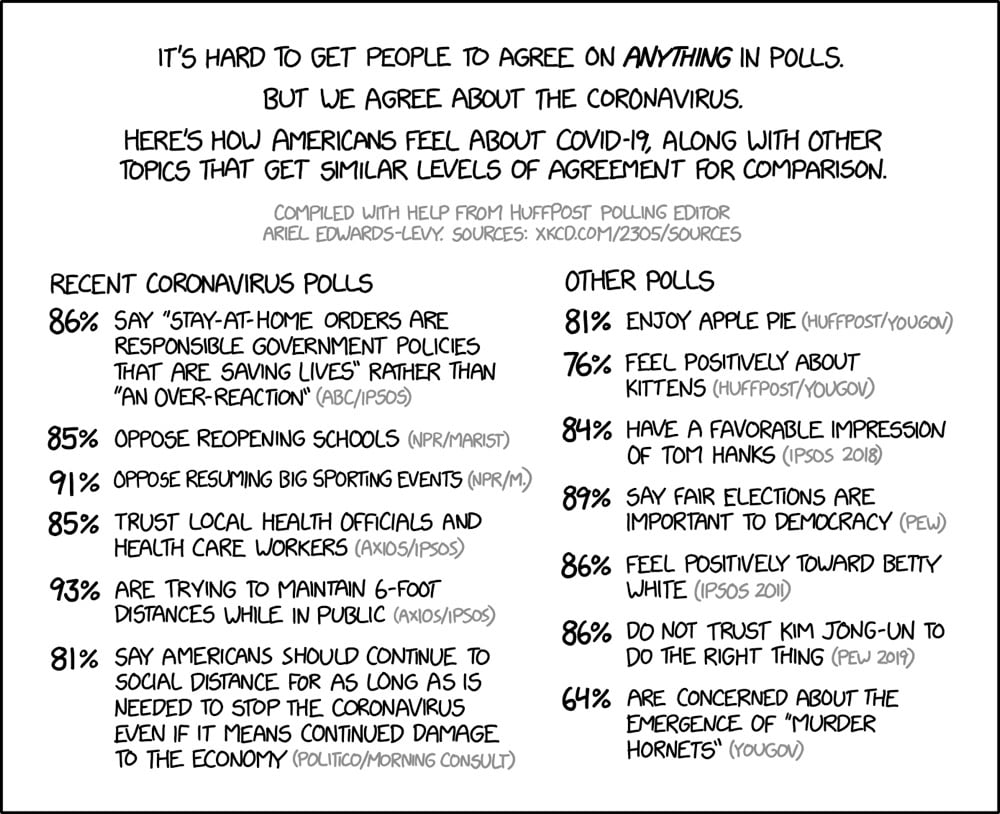
Here’s a list of his sources.
In the “couch gag” preceding The Simpsons episode that aired on May 3, 2020, they did a pitch-perfect parody of the opening title sequence of Succession, complete with the iconic theme song. (via @omcfarlane)
The only way to order KFC in Gaza is via an ad hoc Instagram service. “The KFC order will only make it to Gaza after crossing checkpoints supervised by Israel, the Palestinian Authority, and finally, Hamas.”

One of Rembrandt van Rijn’s most iconic paintings The Night Watch is currently undergoing restoration at the Rijksmuseum in Amsterdam. As part of the effort, the team took hundreds of photographs of the Dutch master’s painting and stitched them together into a massive 44.8 gigapixel image, which they have released online in a zoomable interface. The level of detail available here is incredible. Here’s the max zoom level on the right eye of the gentleman in the middle, the captain of the company that paid Rembrandt to do the painting:

Crazy right? You can see the brushstrokes better than if you were standing in front of the actual painting in the museum.
The Rijksmuseum’s imaging team led by datascientist Robert Erdmann made this photograph of The Night Watch from a total of 528 exposures. The 24 rows of 22 pictures were stitched together digitally with the aid of neural networks. The final image is made up of 44.8 gigapixels (44,804,687,500 pixels), and the distance between each pixel is 20 micrometres (0.02 mm). This enables the scientists to study the painting in detail remotely. The image will also be used to accurately track any future ageing processes taking place in the painting.
Ok, I told you a little fib just now. Actually, this is his eye at the true maximum zoom level:

Each pixel is 0.02mm across — and keep in mind that this painting is almost 12 feet high and more than 14 feet across. An astounding level of detail and a gigantic image.
11-year-old skateboarder Gui Khury has become the first person ever to land a 1080 on a vert ramp. That’s 3 full spins.
More than two decades after Tony Hawk completed the first 900-degree turn, Khury shattered a long-standing record by flying off the top of a ramp and completing three full spins in the air before landing cleanly and skating off. The manoeuvre has long been one of the holy grails of skateboarding.
“The isolation for the coronavirus helped because he had a life that was about school and he didn’t have a lot of time to train, when he got home from school he was tired,” the skater’s father Ricardo Khury Filho told Reuters.
“So now he is at home more, he eats better and he has more time to train and can focus more on the training so that has helped. He has an opportunity to train here, if he didn’t have [the skate facilities] … he would be stuck at home like everyone else and unable to do sport. So the isolation helped him focus.”
Wow.
Update: Now 12, Khury landed a 1080 at the X Games yesterday and collected a gold medal for best trick. Better yet, he did it in front of Tony Hawk.
Newer posts
Older posts




Socials & More