



Advertise here with Carbon Ads
This site is made possible by member support. 💞
Big thanks to Arcustech for hosting the site and offering amazing tech support.
When you buy through links on kottke.org, I may earn an affiliate commission. Thanks for supporting the site!
kottke.org. home of fine hypertext products since 1998.
Beloved by 86.47% of the web.
Entries for April 2020
“Strong Evidence” That Social Distancing Is Working to Slow the Spread of Covid-19
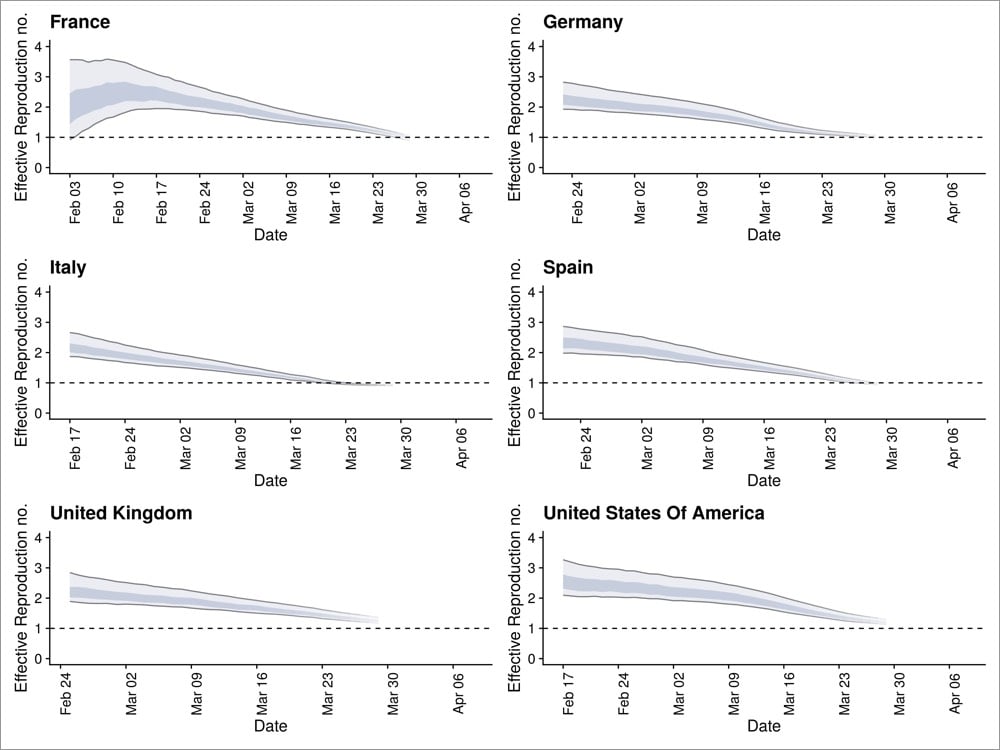
Trevor Bedford, who does research on epidemics and infectious diseases, has compiled a number of papers and data sets with “strong evidence” that social distancing measures have slowed Covid-19 transmission rates around the world.
This report (from the Imperial College team who produced the sobering report that has been the blueprint for pandemic responses around the world) estimates that measures taken in several European countries have lowered their effective reproduction numbers (the R value) to close to 1.
Overall, we estimate that countries have managed to reduce their reproduction number. Our estimates have wide credible intervals and contain 1 for countries that have implemented all interventions considered in our analysis. This means that the reproduction number may be above or below this value. With current interventions remaining in place to at least the end of March, we estimate that interventions across all 11 countries will have averted 59,000 deaths up to 31 March [95% credible interval 21,000-120,000]. Many more deaths will be averted through ensuring that interventions remain in place until transmission drops to low levels. We estimate that, across all 11 countries between 7 and 43 million individuals have been infected with SARS-CoV-2 up to 28th March, representing between 1.88% and 11.43% of the population. The proportion of the population infected to date — the attack rate — is estimated to be highest in Spain followed by Italy and lowest in Germany and Norway, reflecting the relative stages of the epidemics.
And this was published on March 30 — here’s the latest data. The paper goes on to say (italics mine):
We cannot say for certain that the current measures have controlled the epidemic in Europe; however, if current trends continue, there is reason for optimism.
An Institute for Disease Modeling report from March 29 shows a similar reduction in their effective reproduction number in King County, Washington (the 12th most populous county in the US).
The graphs at the top of the post are from the latest data compiled by the Centre for the Mathematical Modelling of Infectious Diseases. Lots of countries looking like they are headed for an effect R value of 1, which would indicate a slowing (rather than growing) epidemic.
Pandemic Stories, Part 2
In Sunday’s newsletter, I asked people to share what they’ve been up to during the pandemic and how their families and communities are coping. I’ve collected all those responses on one page and will be sharing excerpts over the next couple of days here and in the newsletter.
From a reader in Germany:
My husband and I split up in February after 16 years together. It was — and is — devastating. I haven’t been sleeping or eating much. The pandemic has put my personal pain into perspective. I feel for the people who lost so much more than their spouse. As for me, I think that if I can hug my friends again, eat at a restaurant and go back to my gym, I just might be able to survive the end of my marriage.
Travel writer Amelia Rayno has a report from El Salvador:
In El Salvador, we have been under martial law for more than 2 weeks. Multiple kinds of paperwork is required to go outside. Hundreds have been arrested for violating the law, as interpreted by the military and more than 4,000 are in containment centers around the nation.
Perhaps even more pressing is the creep of hunger, in so many homes that can’t afford to miss work for 2 days, much less 2 weeks. I am fortunate to have some liberties as press, that have allowed me to continue working, photographing and in the process, do a little bit of volunteering, while my travels up to the villages above Santiago Nonualco provided a rare opportunity to be surrounded by nature once more (even at 97 degrees, it was welcomed) and receive another important dose of perspective.
I am fortunate to have income still coming in, plenty of food to eat and a comfortable place to live. I am lucky, I am privileged beyond belief. Never does that hit me harder than when I walk into the villages of this beautiful country and see those whose homes are made of stick and mud and plastic bags, who barely had enough to eat before, when they were selling their goods. And now… and now. The reality is, this does not affect all of us equally, and while it can be easy to look inward during this time and focus on our own anxiety and boredom, I hope we do not stop looking outward, too.
Doing it differently in Stockholm, Sweden:
Right now, Sweden is not suffering any worse than nations which have locked down and so people are nervous, anxious because almost everywhere else is doing it differently. It’s an odd mix of trust in the health authorities (they’re calling the shots, not the government) and sort of holding your breath. Hoping, trusting, praying that they called it right.
An anonymous reader from Washington DC shares:
My spouse works on advocating for better government policy concerned with a vulnerable population that happens to be disproportionately affected by the pandemic. I work for a 24hr crisis hotline supporting a constituency that isn’t directly related but for whom resources are being affected by the pandemic. Our jobs are degrees removed from the people we help others serve, but we are both seeing and hearing of what a decimated safety net can’t do — as we always feared — as we do our bit parts in the relentless tides of adaptation now demanded by our jobs.
In Tokyo, Japan:
I work in Tokyo and live just outside, in a very large city. People here are pretty much ignoring the warnings from the health administrators, and the government waffling makes Trump look good. My wife stopped going to the health club even though they opened up again last week. The church across the street had a service yesterday. You can see kids in the park and more people than ever in the residential areas. We had a run on TP early on, then on groceries when the Tokyo mayor told everyone to stay home…for the weekend.
Family worries in New Jersey:
I have a family of four — two kids, a daughter who had her Freshman year in college ripped away from her and a son who is a Junior in high school. At this point, I am happy to report that all of us are completely healthy and have not had any signs of the virus. Probably the hardest part of this whole experience has been to watch the way it has impacted my kids academic and social lives during what are some of the most important and impactful years of their lives. Nothing crushed me more than having to drive to my daughter’s college to clear out her dorm room during the first week of March because of the virus. Even though her school’s administration had not made any decisions on the remainder of the school year, my wife and I made the “executive decision” to take everything home because we had a feeling she was not going back there any time before September (and who knows if that will happen!). She had developed a wonderful group of friends at her school, she was crushing it academically (Dean’s List first semester!) and she was absolutely thriving in her new college environment, and now she is stuck taking virtual classes and having video chats with her friends near and far. She has been handling it exceptionally well; however, as her Dad, it crushes me.
You can read more of the collected responses here.
Dave Eggers imagines a briefing by the White House Coronavirus Task Force. The twisted joke here is that surprisingly little of this is actually made up. “MAN WHO MAKES PILLOWS: I am a man who makes pillows.”
A look at how jigsaw puzzles are made. Demand for puzzles has shot up with so many people looking for pandemic quarantine activities.
Dr. Seuss’s Fox in Socks Rapped Over Dr. Dre’s Beats
As someone who a) thinks Dr. Dre was an amazing producer, and b) read Dr. Seuss’s Fox in Socks to his children roughly 1 million times (enough to be able to, eventually, get through the entire book at a comically high rate of speed w/o any tongue twisting slip-ups), I thought Wes Tank’s video of himself rapping Fox in Socks over Dre’s beats was really fun and surprisingly well done.
Tank has also done Green Eggs and Ham (over the beats from Forgot About Dre) and The Lorax. (thx, andrew)
This Woman Can Smell Parkinson’s. Fascinating, people with Parkinson’s disease give off a distinct odor that some “super-smellers” can detect (even ahead of symptoms). The women in this article even predicted a diagnosis just by smell.
Gustave Eiffel’s Original Drawings for the Statue of Liberty


Long thought destroyed or lost forever, a cache of original engineering drawings & blueprints for the Statue of Liberty done by Gustave Eiffel were found among some of Eiffel’s papers purchased at auction last year. Smithsonian magazine has the story of how they came to be found and why the drawings are so significant.
Berenson thinks the drawings may nail down something that historians have long suspected but not been able to prove: that Bartholdi disregarded Eiffel’s engineering plans when it came to the statue’s upraised arm, electing to make it thinner and tilted outward for dramatic and aesthetic appeal. Several drawings appear to depict a bulkier shoulder and more vertical arm — a more structurally sound arrangement. But one of these sketches (below) was marked up by an unidentified hand with red ink that tilts the arm outward, as Bartholdi wanted. “This could be evidence for a change in the angle that we ended up with in the real Statue of Liberty,” Berenson says. “It looks like somebody is trying to figure out how to change the angle of the arm without wrecking the support.”
High-res digital versions of the drawings & blueprints are available to view at raremaps.com. (via @mapdragons)
Dozens of Science & Engineering Activities for Kids from The James Dyson Foundation
The James Dyson Foundation has designed a set of 44 challenges related to science & engineering specifically for kids (ages 7 & older), which are perfect for these at-home learning times. The challenges include making an air-powered car out of a balloon, strong bridges out of spaghetti, and a cardboard chair strong enough to hold a person:
Here’s the PDF with all 44 challenges. What I like about these projects is that they’re hands-on, you can do them with stuff you already have around the house, and they’re educational in the best way: there’s no “teaching” really…the challenges are designed to appeal to the natural curiosity of kids.
Reading through these, the one that blew my mind was that you can determine the speed of light by melting a chocolate bar in the microwave.
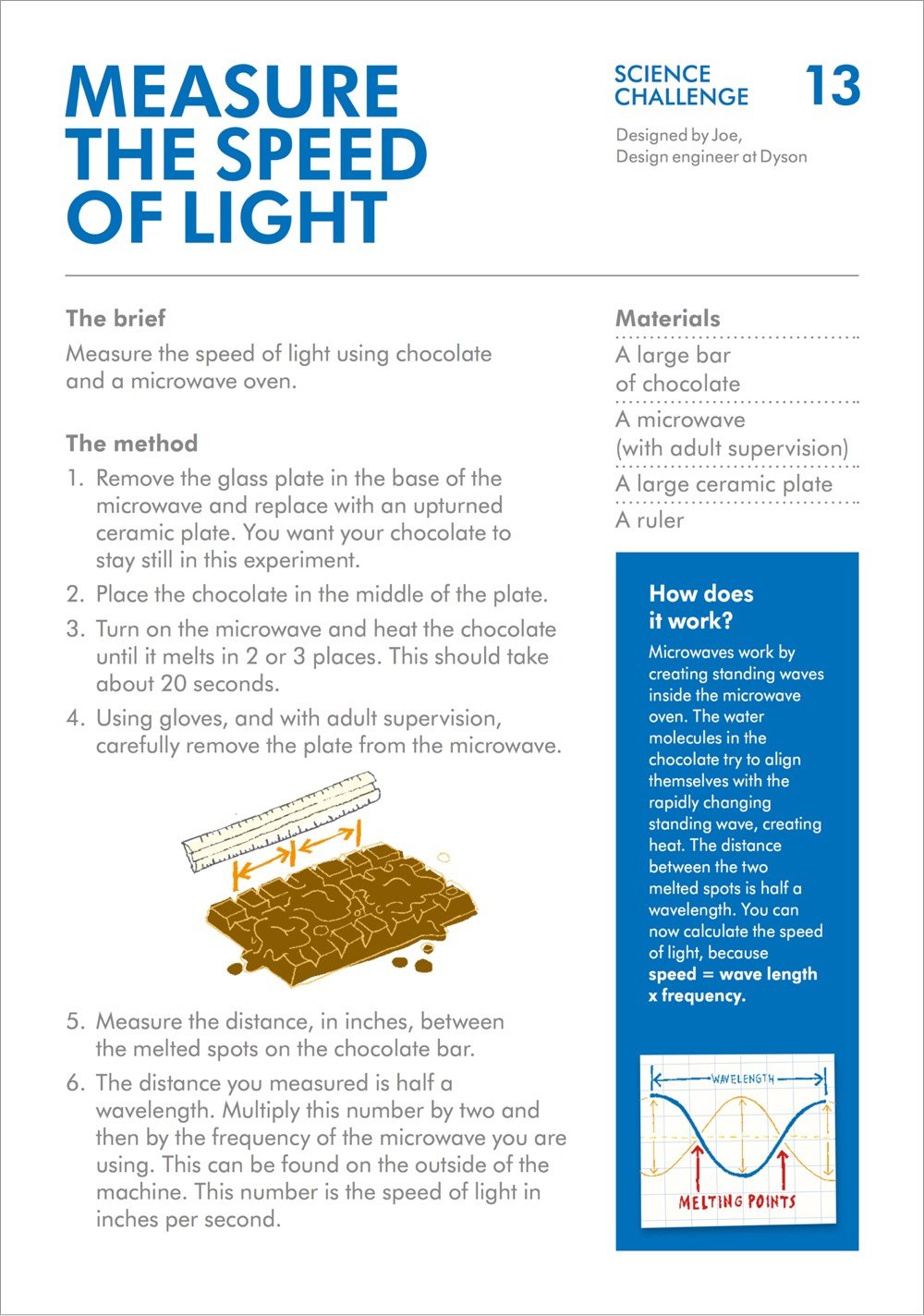
That’s so cool! (via open culture)
The rise of quarantine UX: How COVID-19 has upended the very idea of convenience. “Much of the last decade of smash-hit UX has been more or less abandoned in the wake of COVID-19.”
Reminder: wearing a mask or staying six feet away from people is not an invitation to continue your normal routine or to gather regularly with groups of friends. The best advice is still to stay home as much as possible.
Dazzling Coronavirus Painting by Biologist David Goodsell
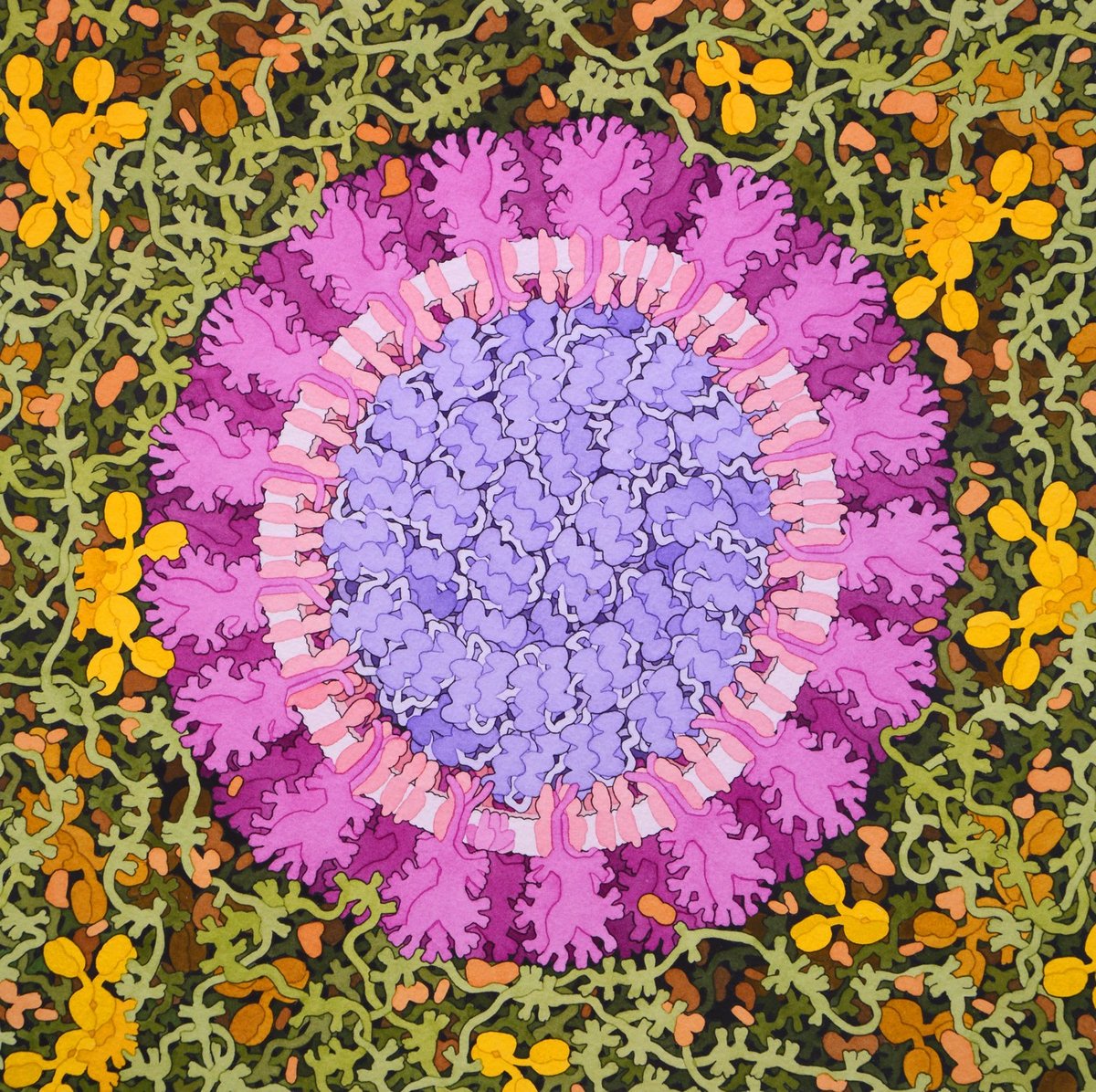
Since the early 90s, biologist David Goodsell (previously) has been creating scientifically accurate paintings of the structures of cells, molecules, and, yes, viruses. In early February, Goodsell completed a painting of a SARS coronavirus (above).
This painting depicts a coronavirus just entering the lungs, surrounded by mucus secreted by respiratory cells, secreted antibodies, and several small immune systems proteins. The virus is enclosed by a membrane that includes the S (spike) protein, which will mediate attachment and entry into cells, M (membrane) protein, which is involved in organization of the nucleoprotein inside, and E (envelope) protein, which is a membrane channel involved in budding of the virus and may be incorporated into the virion during that process. The nucleoprotein inside includes many copies of the N (nucleocapsid) protein bound to the genomic RNA.
In a brief interview with the NY Times, Goodsell explained why he made the image:
“You have to admit, these viruses are so symmetrical that they’re beautiful,” said Mr. Goodsell, an associate professor at Scripps Research Institute in La Jolla. “Are bright colors and pretty stuff the right approach? The jury’s still out. I’m not trying to make these things look dangerous, I want people to understand how they’re built.”
Seeing the infection count rise, Mr. Goodsell said he worried about the health of his aging parents in Los Angeles. But he hopes his painting can quell fears about the novel coronavirus by educating people on the virus’s workings: “I want people to think of viruses as being an entity that we can learn about and fight. They’re not nebulous nothings.”
Goodsell is currently working on a painting featuring the life cycle of a coronavirus and sharing his progress on Twitter. (via @christopherjobs)
This Video Has 5,152,061 Views (and counting). The clever title is just a hook for a discussion about the pros & cons of online platforms & their APIs.
For the past few weeks, I’ve been sharing selections from my daily work playlist in this Twitter thread. Think of it as a kind of soundtrack for @kottke.
Ken Burns Presents The Gene: An Intimate History
From Ken Burns and Dr. Siddhartha Mukherjee, The Gene: An Intimate History, a series about the history of genetics based on Mukherjee’s book of the same name. Here’s a trailer:
The series tells the story of the rapid evolution of genetic science from Gregor Mendel’s groundbreaking experiment in the 19th century to CRISPR, and the hope that newfound powers to alter DNA with pinpoint precision will transform the treatment of some of the world’s most complex and challenging diseases. The series also tackles the daunting ethical challenges that these technologies pose for humankind.
This looks great, especially if this clip about Nancy Wexler’s crusade to find a cure for Huntington’s disease is representative of the whole:
In 1968, Nancy Wexler’s mother was diagnosed with a rare genetic disease - Huntington’s. Facing a 50-50 chance of contracting Huntington’s herself, Wexler — a non-scientist — began an odyssey to find the gene that causes the disease. For three decades, Wexler searched for treatments but chose not to get tested. As time passed, she noticed changes in the way she moved. Finally, in early 2020, Wexler decided to face her fears.
Part 1 of the series is now streaming on PBS with part 2 set to premiere next week.
Watch as Jeremy Blake makes a track on the Teenage Engineering OP-1 portable synthesizer. What a fun little machine.
This is one of the best DIY mask designs I’ve seen. Two thin layers of cloth with a pouch to insert a paper towel or tissue. Tested with a single paper towel, the mask achieved “73.7% filtration efficiency at 0.3 micron”.
Film release delays caused by the pandemic. Black Widow, Wonder Woman, The French Dispatch, Top Gun, Indiana Jones, Bond, and Minions have all been pushed back months.
Pandemic Stories from Readers Around the World
In the latest issue of the kottke.org newsletter sent out on Sunday evening, I asked readers if they would share what they’ve been up to during the pandemic and how their families and communities are coping. I received a bunch of responses from people all over the world and beginning today, I will be sharing a few excerpts on kottke.org and in the newsletter — you can read all of the responses here.
A doctor writes in from Cape Town, South Africa:
We are well accustomed to working in a resource-scarce setting, and improvisation and decisions about which patients qualify for resuscitation, ventilation and ICU care are the order of the day for us generally. I have been very interested to read media reports about the moral dilemmas facing doctors; first in Italy and now in other parts of the first world where these types of ethical decisions are less commonplace.
From a French schoolteacher:
I am glad I live in France and I know that no matter your social background and bank account status, if you get sick, you get treated the same way and for free.
A pastor from Jackson, Mississippi:
I live in Jackson, MS, which is somewhere between Yonkers and Syracuse in size — something like 170,000 people, and the largest city in Mississippi. Some things about Jackson that make this particularly difficult is that Jackson was already desperately poor before all this went down — 25% of the city has a household income of less than $15,000 a year, and 75% of the the city was a USDA food desert when everything is “normal”.
As a result, most of Jackson has to travel significant distances to go to the grocery store, and there aren’t huge amounts of money floating around to buy up supplies, anyway. So a big part of my work, as the pastor of a small church down here has been helping people get access to food and supplies.
A report from a central Ohio suburb:
Here in our small tree-lined suburb in central Ohio, we have been carefully observing the social distancing and stay home instructions for nearly four weeks now. As native southerners, we count ourselves lucky to live in Ohio where our (Republican, wow!) governor acted early and rapidly to take measures to flatten the curve of Covid-19. In his first address on the subject he proclaimed that he would be “guided by science” in passing guidelines to protect us, and we look at other less-proactive states and worry about our families there.
New Zealand is in lockdown:
The fallout from our lockdown is going to be massive. No one is really confident at what it will look like, but numbers being thrown around are 30% of small to medium businesses (the category which most of our businesses fall into) will not be able to reopen when the lockdown is lifted. Thousands of people are being made redundant. It’s like nothing most of us have seen in our lifetimes here. Even the GFC didn’t have this bad an impact on our economy. Our parliament (the house of government) is closed, with most of our Members of Parliament locked down at home like the rest of us. What we have in place of the normal sitting of both government and the opposition parties, is a committee made up of representatives of all parties who scrutinise how the government is responding to the virus. The daily sittings of this committee are broadcast online so anyone can see what’s being asked and answered. This seems to be working well and at least safeguards some of our democracy in a time when we’re effectively on a war-footing.
A reminder from Winnipeg, Canada:
School is suspended indefinitely and everyone is home. I’m fortunate to have a family who gets along well and children (10 and 12) who I don’t have to worry about if they miss school for an extended run. I’ve tried to focus on how lucky we are as a family to be able to be together and sustain ourselves. One of the things I heard on the radio early in this period was a discussion on CBC Radio’s As It Happens (one of the nation’s greatest radio programmes, and a great source of information at a time like this) with authors Margaret Atwood, Waubgeshig Rice and Daniel Kalla. Something Rice, an Indigenous author, said, really stuck with me: “I think we’re all scared in some ways. But I think if your first response is fear, it’s important to acknowledge your privilege in that you maybe haven’t been to the brink before. Whereas a lot of marginalized communities have experienced that and continue to experience that. And there’s a long list of examples in Canada of world ending for different communities. You know, you can look at the destruction of Africville in Nova Scotia or the internment of Japanese Canadians. You know, it’s important to take a look at what your personal perspective is and your place in society and just, you know, acknowledge that privilege of being part of the dominant culture and things being generally good in Canada in the last 150 years or so.” I try to remember this as I think about my own fears and my own family’s situation.
The independent spirit of southwest Wyoming:
It’s strange to think about having to shelter in place when we have so much empty space that we can occupy our time with outside, so people are still out and about around our town. And I am completely in favor of shelter in place policies in major metro areas, but somehow it just doesn’t seem like it would work here given the political and personal leanings of the people of Wyoming. I am new to Wyoming (have lived here 2.5 years), but there is a certain way people seem to think this is still the old west and, for better or worse, they tend to have that independent spirit. The virus has just recently arrived in our county, but to be honest the scariest thing for me is the fact that this is Trump country and that people believe him. I’m more scared of jackasses flaunting this as a hoax and not taking the proper precautions when they are at the grocery store with me or my family.
Again, you can read all of the responses right here.
A Lego Justin Trudeau Talks to Children About the Covid-19 Pandemic
During a press conference last month, Canadian Prime Minister Justin Trudeau spent a couple of minutes talking directly to the nation’s children, acknowledging their hardships and role in mitigating the effects of the pandemic. Tyler Walsh and his two sons spent a week making this Lego stop motion animation of Trudeau’s address, something that kids might be more likely to watch.
In an interview with the CBC, Walsh described their process:
“[It took] a fair amount of time and hundreds and hundreds of photos,” he said.
Each working to their strengths, Walsh said the kids were primarily in charge of piecing together the Lego elements — such as a podium, as well as hair and a bearded head for Trudeau — to bring the set to life.
“I would have questions for them like, ‘I need a sad kid. Do we have any sad kid Lego heads?’”
Trudeau himself responded to the Lego version of his address:
This is really great, Tyler. I think my kids — and a whole lot of others — will get a kick out of this, all while hearing how they can help out too. Thanks for helping spread that message.
(via @auntmaureen)
The Pandemic Has Driven Twitter to New Lows in Happiness
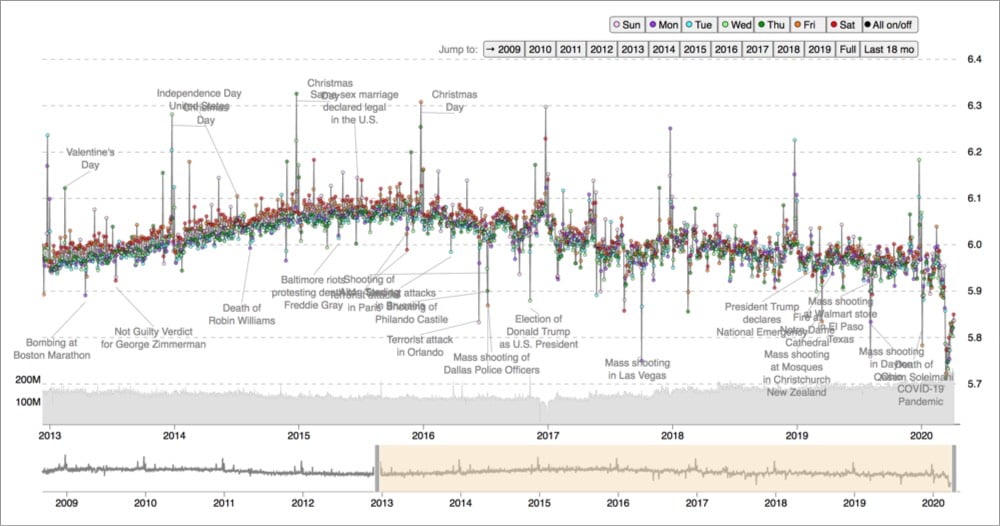
Since 2008, the Hedonometer has been tracking the language we use on Twitter to assign a daily score that measures how collectively happy we are (English tweets only). From the data, you can see that happiness spikes on holidays & after notable news events (same-sex marriage legalization) and unhappiness follows mass shootings, terrorist events, and Trump’s election. But the Covid-19 pandemic has brought Twitter’s collective happiness rating to an overall new low and its first sustained period of unhappiness.
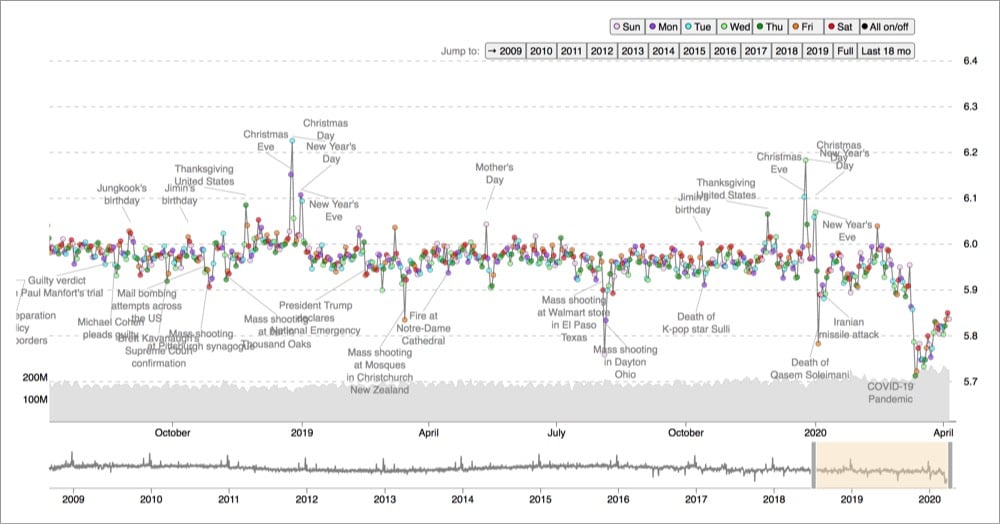
The day they identify as the unhappiest is March 12, 2020, which is the day after Americans finally took Covid-19 seriously. Within the space of a few hours on March 11, the NBA announced it was suspending its season, Tom Hanks revealed that he and his wife Rita Wilson had Covid-19, the WHO declared Covid-19 a pandemic, Donald Trump went on primetime TV to address the nation, and the DJIA closed down 1400 points (it would drop another 2350 points on Mar 12).
See also the previous low point after the Las Vegas shootings and my initial post on the Hedonometer from July 2016. In that initial post, I shared a hunch that Twitter’s happiness seemed to have reached a peak in early 2016. With four years of additional data, it’s obvious that the happiness peaked in late 2015 or early 2016 (at least according to their methodology).
Phoebe Waller-Bridge’s Fleabag Play to be Streamed Online
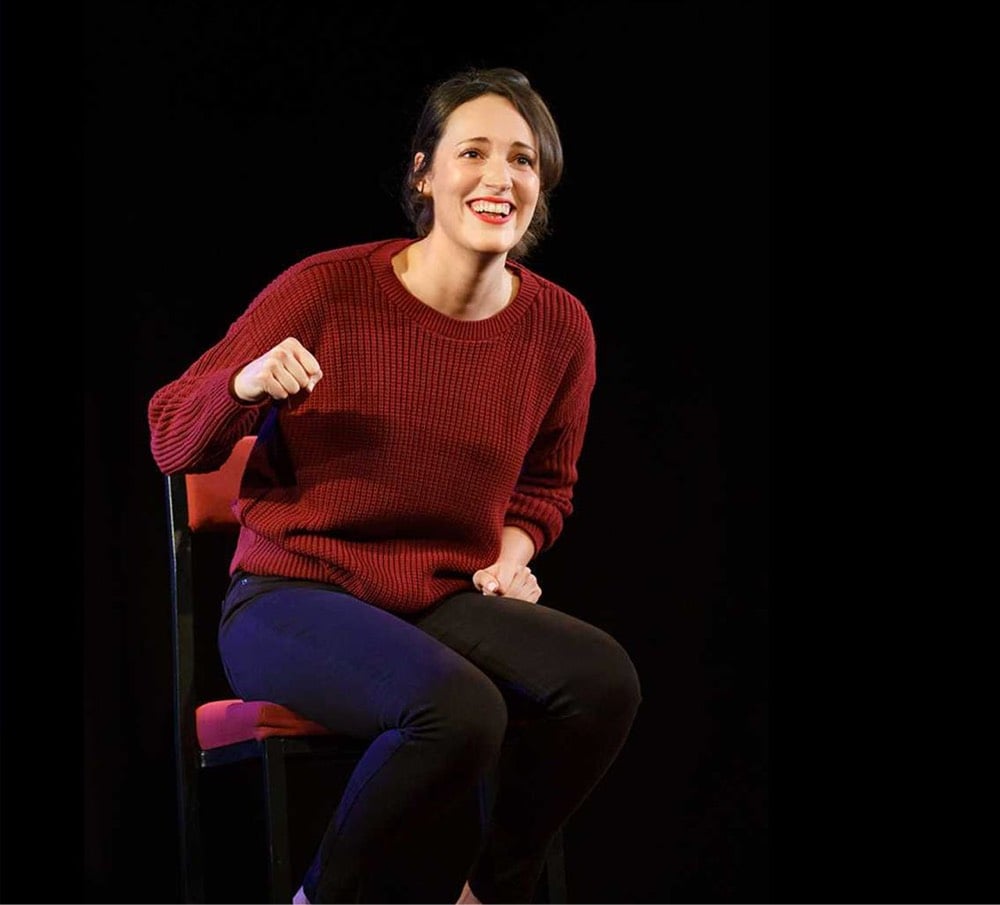
A recording of a live performance of Phoebe Waller-Bridge’s play Fleabag (on which the TV show is based) is going to be streamed online to raise money for those affected by the Covid-19 pandemic. Said Waller-Bridge:
I hope this filmed performance of Fleabag can help raise money while providing a little theatrical entertainment in these isolated times. Thank you to all our partners and to the creative team who have waived their royalties from this production to raise money for such vital causes in this unbelievably challenging situation. All money raised will support the people throughout our society who are fighting for us on the frontlines and those financially devastated by the crisis, including those in the theatre community. Thank you in advance to those who donate. Now go get into bed with Fleabag! It’s for charity!
It’s available in the UK & Ireland right now and will appear on Amazon Prime in the US on April 10. (thx, caroline)
Update: Here it is on Amazon — “all proceeds, outside of taxes, go to charities supporting those affected by COVID-19 pandemic”.
A personality quiz that will tell you which fictional characters you most resemble. This got me pretty well: Sam Tarly from GoT and MCU’s Bruce Banner. Lisa Simpson, Lester Freamon, and C-3PO all in my top 25.
A Pandemic Strikes Business Town
I featured Business Town, an ultra-capitalist spoof of Richard Scarry’s Busy Busy Town, on this site a few years ago. Their last few entries have focused on the pandemic and they are devastatingly spot on.


(via waxy)
Boots & Cats: A World Champ Explains the 13 Levels of Beatboxing Complexity
This is fantastic: former beatboxing world champion Butterscotch explains the 13 levels of complexity involved in beatboxing, from the simple “bass drum” to how to breathe while beatboxing to singing to emulating real instruments.
Expert beatboxers go so fast that it’s amazing to see someone with Butterscotch’s skill level break this down — like watching a water balloon bursting in slow motion. Her short explanation & demonstration of “breathing within the beat” bleeeewww my tiny little mind. Also, she is soooo good — what a treat to watch.
See also Robert Lang on the 11 Levels of Complexity of Origami, Tony Hawk on the 21 Levels of Complexity of Skateboard Tricks, and A Demonstration of 16 Levels of Piano Playing Complexity.
Update: Phil Guillory is a speech-language pathologist and he wrote up a technical analysis of Butterscotch’s explanation of beatboxing. It is gloriously nerdy and I love it.
Humming adds a really interesting layer to this. The act of humming itself is a natural nasal sound. The soft palate, or velum, is relaxed, allowing airflow into the nasal passages. Humming requires glottic closure in order to vibrate vocal folds, and those vibrations resonate up the oropharynx and, because the lips are closed, the air then has to travel into the nasopharynx to be released. When Butterscotch adds percussive beats on top of the hum, if there truly is nasal airflow, that would mean that her velum isn’t fully contacting the pharyngeal wall, and there would be a combination of nasal and pharyngeal air flow. Obviously, a video like this won’t allow us to visualize, so we’ll have to make a couple of assumptions here: a combination of oral and nasal airflow would (1) reduce the loudness of the beats while (2) also reducing the loudness of the hum itself. This is because air would be traveling in two directions, so there would be less pressure for both, and thus, less loudness and resonance. Given that the hum sounds pretty consistent, I think it’s safe to guess that Butterscotch is able to relax her velum to allow for nasal airflow voluntarily, which is indeed a very challenging thing to do given that velar movement is largely automatic. Super cool.
Why Has Germany Been Effective at Limiting Covid-19 Deaths?
As I’m writing this, according to Johns Hopkins’ Covid-19 tracker, Germany has recorded 100,186 confirmed cases of Covid-19 (fourth most in the world) and 1590 deaths — that’s a death rate of about 1.6%. Compare that to Italy (12.3%), China (4%), the US (2.9%), and even South Korea (1.8%) and you start to wonder how they’re doing it. This article from the NY Times details why the death rate is so low in Germany.
Another explanation for the low fatality rate is that Germany has been testing far more people than most nations. That means it catches more people with few or no symptoms, increasing the number of known cases, but not the number of fatalities.
“That automatically lowers the death rate on paper,” said Professor Kräusslich.
But there are also significant medical factors that have kept the number of deaths in Germany relatively low, epidemiologists and virologists say, chief among them early and widespread testing and treatment, plenty of intensive care beds and a trusted government whose social distancing guidelines are widely observed.
This article is a real punch in the gut if you’re an American. Obviously there are bureaucracies and inefficiencies in Germany like anywhere else, but it really seems like they listened to the experts and did what a government is supposed to do for its people before a disaster struck.
“Maybe our biggest strength in Germany,” said Professor Kräusslich, “is the rational decision-making at the highest level of government combined with the trust the government enjoys in the population.”
This whole crisis is really laying bare many of the worst aspects of American society — it’s increasingly obvious that the United States resembles a failed state in many ways. I can’t be the only American whose response to the pandemic is to think seriously about moving to a country with a functioning government, good healthcare for everyone, and a real social safety net.
Pandemic Paradoxically Offers Relief from Depression & Anxiety for Some
This is an interesting piece by The Daily Beast’s Laura Bradley, who is one of a number of people who have seen their symptoms of anxiety and depression actually lessen during the pandemic. Part of it is the odd sense of joy experienced by some people going through disasters, but there are other possible explanations:
“I’m used to being in a room alone with my thoughts for an extended period of time,” Weinstein said, adding that under quarantine, “You kind of run through the gamut of, ‘OK what if I’m not out of here in 20 days; what if I’m not out of here in 40 days; what if I’m not out here in 60 days? What will happen to me?” Due to her history of depression and anxiety, Weinstein is also used to, as she put it, “shrinking away from life” for a period of time.
“These are thought processes I am used to having and welcome — and know how to cut off in a kind, loving way after they’ve been around a little too long,” Weinstein said.
It would also make sense that if your depression or anxiety focuses on being out in a busy and complicated world, dealing with a greatly simplified situation might be beneficial. Either way, this is another reminder of the infinite number of ways that different people can react to a crisis.
Really interesting thread from virologist @PeterKolchinsky about how SARS-Cov-2 goes about its business in the human body. SARS-Cov-2 “is stealthier [than SARS-1], spreading first before revealing itself (and causing harm).”
Some Good News: The Hamilton Edition
So, the second episode of John Krasinski’s Some Good News might be even better than the first one (which included, if you recall, an The Office reunion with Steve Carell). I don’t want to entirely ruin it, but in the second half of the show, John and some co-conspirators totally make the day/year/century of a young Hamilton fan who missed going to the live show because of the pandemic.
I baked a loaf of this white sandwich bread last week and it was delicious. Flour + yeast + water is an ancient magic – no wonder so many folks have gotten hooked on bread baking.
Freeride Skiing at Home
In the northern hemisphere, the Covid-19 pandemic ramped up right at the tail end of the ski & ride season, so many skiers and snowboarders had to cut their seasons short.1 Philipp Klein Herrero decided to take one more run — in his living room.
Just before the current health situation locked us in, I was about to go Freeriding with my family. It was supposed to be the big adventure of the year, the one I had been eagerly awaiting for a year. Therefore, the lockdown had me thinking about skiing the whole time, so I started to think how I could ski without leaving my living room.
The result is a cute stop motion hike to the top of a mountain followed by a ski down. As my kids would say: “sick!” (via the kid should see this)
Here in VT, they even had to close all of the ski hills & resorts to uphill travel (i.e. skinning or snowshoeing up to ski down) to discourage people from travelling (from out of state!) to do it. They’ve closed all the mountain biking trails and it’s probably just a matter of time before they close hiking trails as well.↩
The Vermontilator: Scientists, engineers, and doctors at the Univ of Vermont “have developed a new design – and built a working model – for a simple, inexpensive ventilator”. They’re seeking FDA emergency approval.
Cut Your Own Records with the Easy Record Maker

Sound artist & designer Yuri Suzuki has designed the Easy Record Maker, an affordable machine for cutting your own records. Suzuki explains how it works on Instagram:
To cut a record, you simply play audio through an aux cable and lift the cutting arm onto a blank disc. Once the record is cut, you can instantly play back your recording through the tone arm and the in built speaker!
More like cute your own records — look at how wee this thing is:

It’s out now in Japan and will be released in the US & UK later in the year. The price seems to be in the $80-100 range. Read more about the Easy Record Maker at Design Week. (via boing boing)
HBO Is Streaming Dozens of Shows & Movies for Free in April

During the month of April, HBO is streaming dozens of shows, documentaries & movies for free via HBO GO & HBO NOW. Shows include The Wire (my personal fave), Succession, VEEP, The Sopranos, True Blood, Six Feet Under, and Silicon Valley. HBO usually offers a few things outside their paywall, but never anything this extensive.
Portrait of a Coronavirus
Soon after the CDC started to mobilize to address Covid-19, medical illustrators Alissa Eckert & Dan Higgins were asked to create this illustration of a coronavirus that could be used as the “face” of the epidemic.
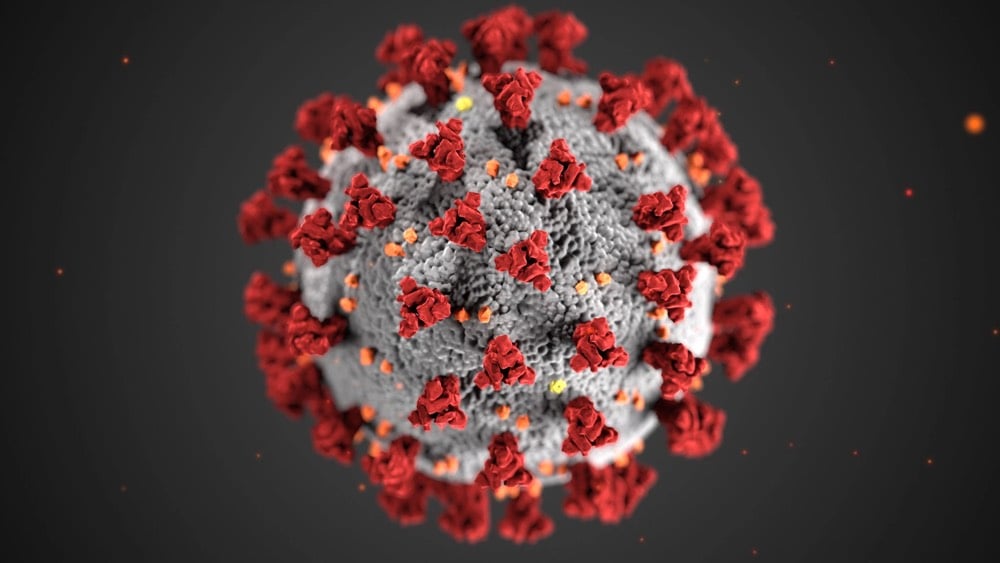
The novel coronavirus, like all viruses, is covered with proteins that give it its character and traits. There are the spike proteins, or S-proteins — the red clusters in the image — which allow the virus to attach to human cells. Envelope or E-proteins, represented by yellow crumbs, help it get into those cells. And membrane proteins, or M-proteins, shown in orange, give the virus its form.
In a video released last February, Eckert explained a little about what she does at CDC.
This is one of the many horrifying stories of what dealing with a Covid-19 infection is like, but what struck me is the 4 sick people in NYC who weren’t tested and aren’t part of the official infection count. How many others are there?
This could be helpful for researchers and media: aggregated and anonymized foot traffic data from Foursquare showing where people are & aren’t going in different parts of the country. Raw data available, updated daily.
A look at how restaurateur Tom Colicchio shut down his business due to Covid-19. As Colicchio says, he was luckier than most, but this same thing, at different scales & degrees, happened all across America.
Rainbows in the Darkness


These are from Lucas Zimmermann’s Traffic Lights series (part two). Lovely. Desolate. Alien.
We’re All Dancers Now - Mindful Movement Is Key to Social Distancing
I really liked How We Use Our Bodies to Navigate a Pandemic by NY Times dance critic Gia Kourlas on how many people struggle with the awareness of what their bodies are doing in public and that social distancing measures require a higher level of attentiveness to how we move and coordinate our movements with others.
In this time of confinement, we have been given one immeasurable gift — the freedom to go outside. In exchange, we must abide by a simple rule: Stay six feet away from others. As choreographic intentions go, that’s not remotely vague. Yet during my runs and walks in Brooklyn over the past few days, I’ve noticed that six feet doesn’t mean the same thing to everybody.
Spatial awareness, like coordination, isn’t a given. Watching the choices people make when they move in public, much less in this time of social distancing, can be shocking, from the much-bemoaned tourist who comes to a grinding halt in Times Square to the woman with a yoga mat knocking people aside to get her spot on the floor. (It’s OK; she’ll still feel good about bowing her head and saying namaste.)
Now the choreography of the streets has taken on higher stakes. It’s the difference between health and sickness, life and death. Inside we’re alone. Outside, a new alertness is in order, one that demands a deep connection to the position and movement of the body — or proprioception, sometimes referred to as the sixth sense.
NASA is reintroducing its 70s “worm” logo. It’ll be displayed on the side of the Falcon 9 rocket that will take astronauts to the ISS.
Ching Ming Stories is encouraging families in the Chinese diaspora to observe the tradition of Ching Ming (remembering ancestors) virtually this year. Includes a discussion guide to help get you & your family started.

Socials & More