

Advertise here with Carbon Ads
This site is made possible by member support. 💞
Big thanks to Arcustech for hosting the site and offering amazing tech support.
When you buy through links on kottke.org, I may earn an affiliate commission. Thanks for supporting the site!
kottke.org. home of fine hypertext products since 1998.
Beloved by 86.47% of the web.
Entries for March 2020
Washing Your Hands Is Important Because Soap “Absolutely Annihilates” Coronavirus
The number one recommendation on the list of protective measures for COVID-19 from both WHO and the CDC is to regularly wash your hands. The CDC in particular recommends hand-washing over using hand sanitizer.
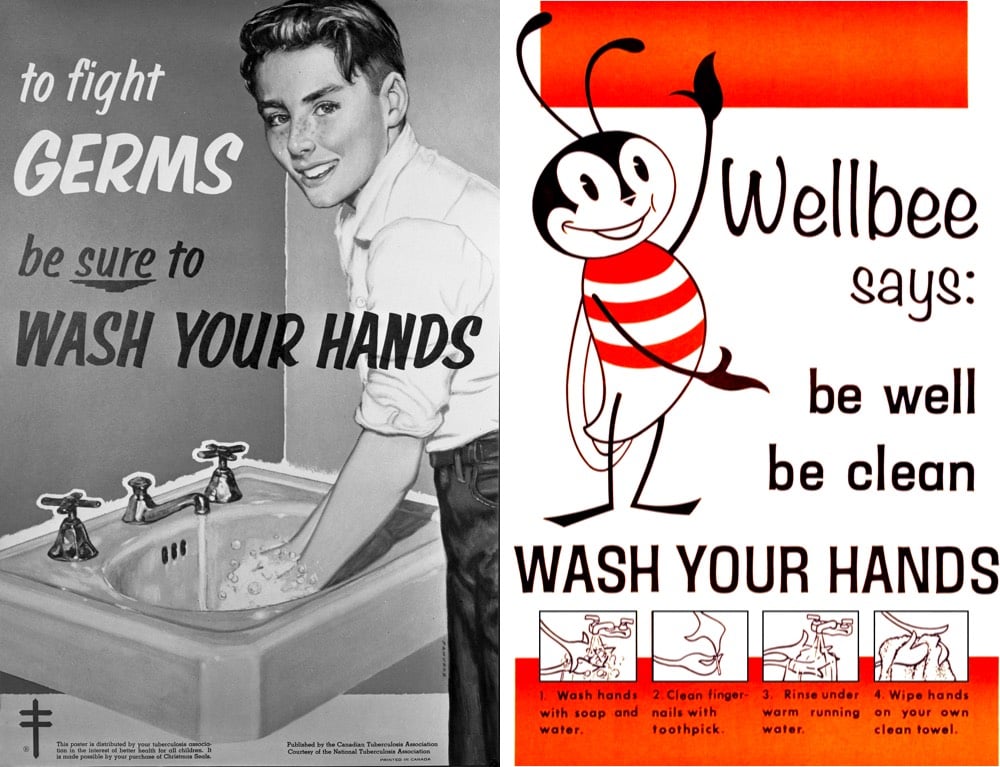
Vox recently talked with chemistry professor Palli Thordarson about why washing with soap is so effective when dealing with coronaviruses.
The soap takes care of the virus much like it takes care of the oil in the water. “It’s almost like a crowbar; it starts to pull all the things apart,” Thordarson says.
One side of the soap molecule (the one that’s attracted to fat and repelled by water) buries its way into the virus’s fat and protein shell. Fortunately, the chemical bonds holding the virus together aren’t very strong, so this intrusion is enough to break the virus’s coat. “You pull the virus apart, you make it soluble in water, and it disintegrates,” he says.
Then the harmless shards of virus get flushed down the drain. (And even if it the soap doesn’t destroy every virus, you’ll still rid them from your hands with soap and water, as well as any grease they may be clinging to.)
And why do you need to wash for 20 seconds? Because that gives soap time to do its work.
First off, your skin is wrinkly, and it takes time for soap to penetrate into all the tiny folds and demolish the viruses that lurk within. Then the soap needs a few moments to do its chemical work. “You do need a bit of time for all the soap to interact back and forth with the virus particle,” he says. Twenty seconds should do the trick just fine.
See also Why Soap Works from the NY Times, which explains why soap & water is better than hand sanitizer in these cases:
On the whole, hand sanitizers are not as reliable as soap. Sanitizers with at least 60 percent ethanol do act similarly, defeating bacteria and viruses by destabilizing their lipid membranes. But they cannot easily remove microorganisms from the skin. There are also viruses that do not depend on lipid membranes to infect cells, as well as bacteria that protect their delicate membranes with sturdy shields of protein and sugar. Examples include bacteria that can cause meningitis, pneumonia, diarrhea and skin infections, as well as the hepatitis A virus, poliovirus, rhinoviruses and adenoviruses (frequent causes of the common cold).
Update: Thordarson also wrote an article for The Guardian on how effective soap is at killing coronavirus.
A Joyful Flash Mob Plays Beethoven’s Symphony No. 9
This is an oldie but a goodie. Watch as a single busking bass player grows into the Vallès Symphony Orchestra and a pair of choirs to perform a rousing rendition of Beethoven’s Symphony No. 9 (Ode to Joy) in front of a delighted crowd. (via @victoriamia)
Recipe for Making Your Own Hand Sanitizer
Many stores have long since sold out of hand sanitizer in the US and washing your hands is a better move anyway, but if you’d like to have some sanitizer on hand for when you can’t get to a sink, the World Health Organization has you covered. The WHO recipe is for making 10-liter batchs, so Popular Science helpfully scaled it down to a more reasonable size:
1 cup 99% isopropyl alcohol
1 tablespoon 3% hydrogen peroxide
1 teaspoon 98% glycerin/glycerol
1/4 cup, 1 tablespoon, and 1 teaspoon sterile distilled or boiled cold water
To the alcohol, add the hydrogen peroxide & glycerin and stir or shake if you’re mixing in a container with a lid. Then add the water.
For COVID-19 prevention, the CDC recommends a hand sanitizer that contains at least 60% alcohol; this recipe will end up being about 75% alcohol. The Popular Science piece also includes another recipe for a hand sanitizing gel that’s much closer to store-bought gels that involves mixing isopropyl alcohol, aloe vera gel, and tea tree oil. They also note that vodka does not contain enough alcohol to meet the CDC’s recommendation, especially when mixed with the other ingredients.
Surreal Video of a Soccer Match Played In an Empty Stadium
Yesterday I watched a bit of the Champions League match between PSG and Borussia Dortmund, played at the Parc des Princes stadium in Paris, which has a seating capacity of almost 48,000 under normal circumstances. But for yesterday’s game, the game was played in a completely empty stadium in order to help prevent the spread of COVID-19. Without the chants, jeers, and cheers of the crowd, you can clearly hear the actual sounds of the game like the players talking to each other and the ball being kicked.
Here’s another video from a Borussia Monchengladbach & FC Koln match played under similar circumstances. This shot from just before kickoff really underscores just how huge and empty these stadiums are.

I’m not sure how much the empty stadium hampered the potential spread of the virus though — PSG fans gathered in huge numbers outside Parc des Princes to cheer on their team during the match and celebrate the win afterwards.
The NBA was considering playing their games in front of empty stadiums, but then Utah Jazz player Rudy Gobert tested positive for COVID-19 (after touching all the microphones as a way to mock coronavirus fears — life comes at you fast!) and now the NBA has suspended its season for at least a month. MLB and the NHL have done likewise.
How Delays in Testing Set Back the U.S. Coronavirus Response. “A series of missed chances by the federal government to ensure more widespread testing came during the early days of the outbreak, when containment would have been easier.”
No Frills Branding
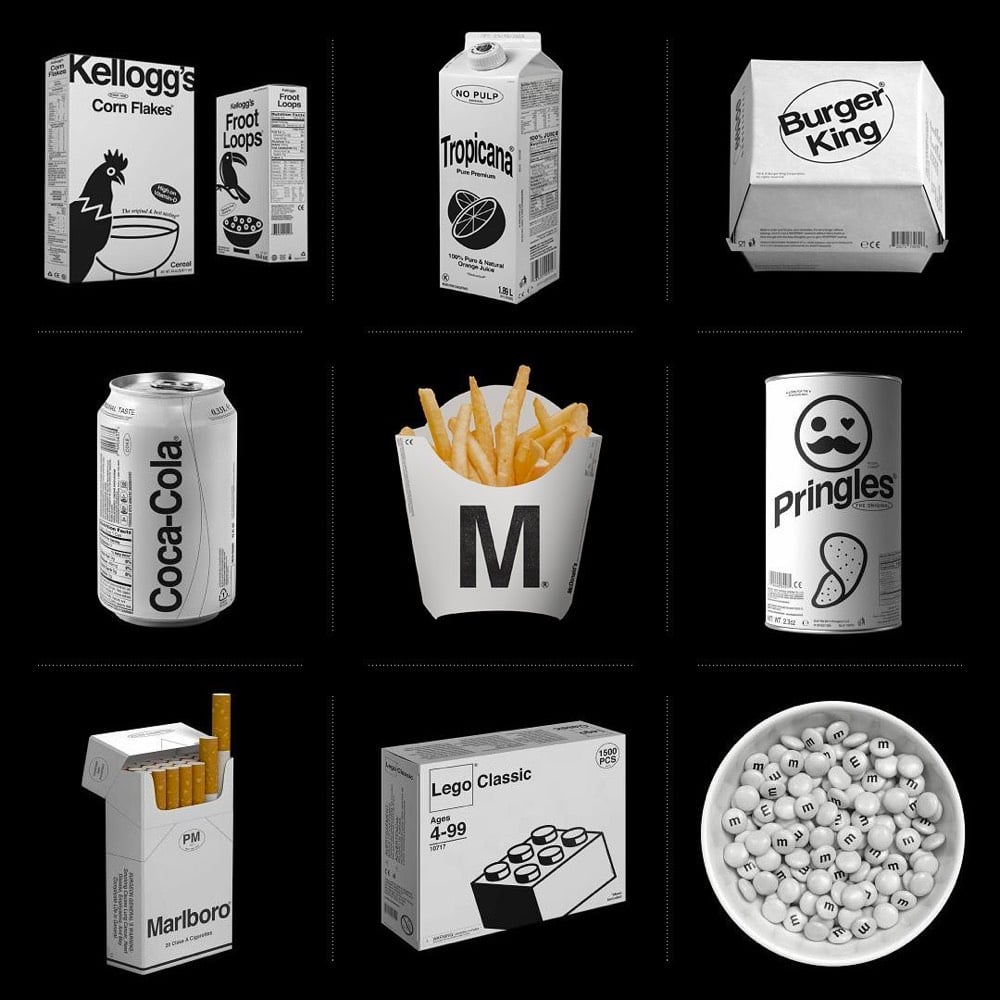

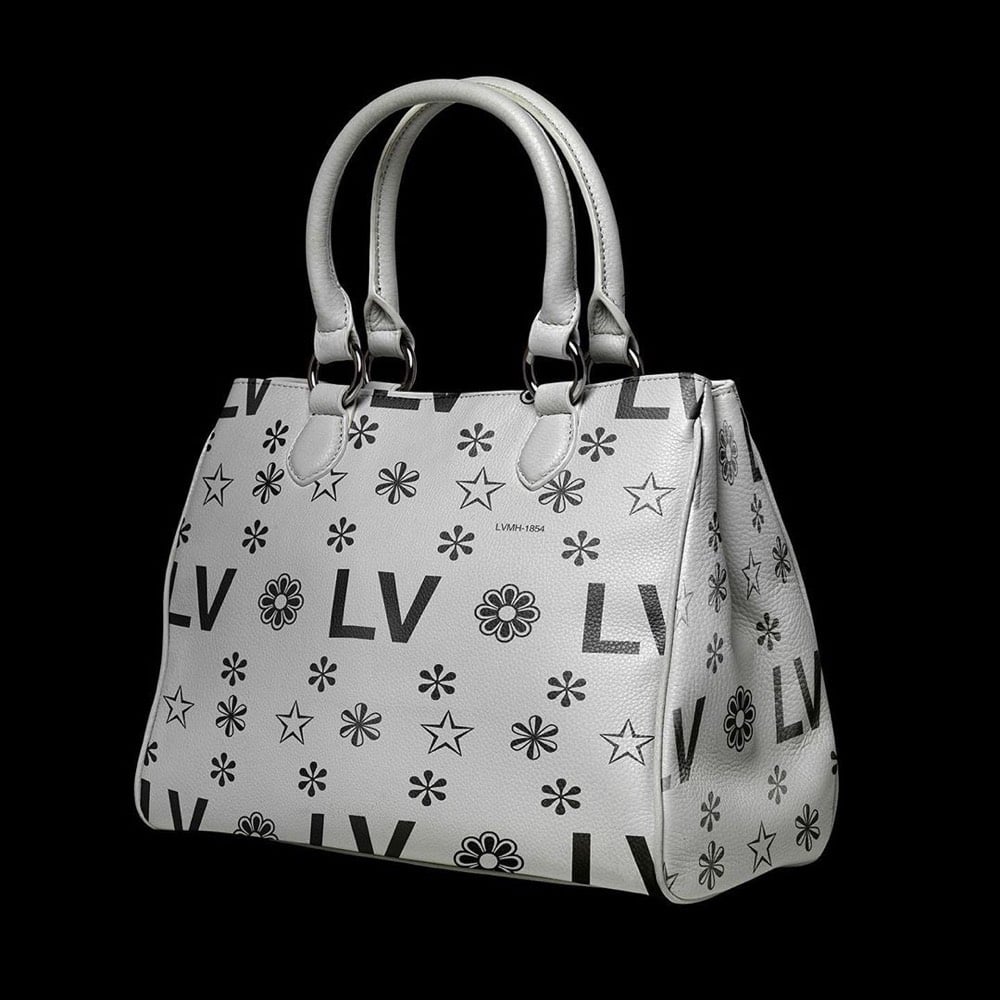
Designer Kunel Gaur, head of a creative agency called Animal, has redesigned the packaging for several familiar brands using minimal black & white graphics and unadorned typography. The designs don’t seem to be collected in one place, so you’ll have to poke around his Instagram to find them.
That LV bag actually looks like something Virgil Abloh would design — it would sell like hotcakes. Dye it millennial pink and you’ve got a freaking worldwide sensation. Fashion design is so easy!! (via moss & fog)
Why Do New Diseases Like COVID-19 Appear First in China?
This video from Vox is a few days old but is still a good look at why diseases like SARS and COVID-19 originate in China. It involved the designation of wild animals as “natural resources” by the Chinese government, which caused a large increase in wildlife farming, with many more and different kinds of animals being put into contact with humans and each other on a regular basis. Add illegally trafficked animals into the mix, and you’ve got the right conditions for diseases to jump from the animals to humans. Then potentially infected animals and their meat, accompanied by potentially infected humans who raised those animals and butchered that meat, are then brought to the wet markets for sale to the public.
It’s important to note, as Christopher St. Cavish says in the LA Times, “most wet markets are not wildlife markets, and confusing the two is dangerous”:
“Wet” markets are what China calls its fresh food markets, the kind you see all over the developing world and in many parts of Europe, where small stalls sell fresh vegetables and butchers sell meat, primarily pork. They are the daily market for tens of millions of Chinese who prefer to talk to the people who sell them produce, meat, seafood and tofu, and in small cities, are often the only outlet for small-scale farmers who can’t meet the supplier requirements for supermarkets.
I couldn’t find any up-to-date information on which animal is suspected of passing the coronavirus responsible for COVID-19 along to humans, but bats are a prime suspect with a possible pangolin intermediary. (via open culture)
Tom Hanks and his wife Rita Wilson have tested positive for COVID-19. Pls pls don’t let anything happen to the one of the only genuinely nice guys in Hollywood…
Media Paywalls Dropped for COVID-19 Crisis Coverage
In recent years, many media outlets have joined publications like the WSJ and NY Times in erecting paywalls around their online offerings, giving visitors access to a few articles a month before asking them to pay for unlimited access. Due to the continuing worldwide COVID-19/coronavirus crisis and in order to make information about the pandemic more accessible to the public, several publications have dropped their paywalls for at least some of their coronavirus coverage (thanks to everyone who responded to my tweet about this).
Among them are The Atlantic, WSJ, Talking Points Memo, Globe and Mail, Seattle Times, Miami Herald (and other McClatchy-owned properties), Toronto Star, Stat, Dallas Morning News, Medium, NY Times, Washington Post, Baltimore Sun, Chicago Tribune, Christian Science Monitor and several medical/science journals. Notably, The Guardian relies on online subscription revenue but doesn’t put anything behind a paywall, including their coronavirus coverage.
In addition, a group of archivists have created an online directory of scientific papers related to coronaviruses, available for free download.
“These articles were always written to be shared with as many people as possible,” Reddit user “shrine,” an organizer of the archive, said in a call. “From every angle that you look at it, [paywalled research] is an immoral situation, and it’s an ongoing tragedy.”
Kudos to those media organizations for doing the right thing — this information can save people’s lives. Let’s hope others (*cough* Washington Post) will soon follow suit. And if you find the coverage helpful, subscribe to these outlets!
BTW, like The Guardian, kottke.org is supported by readers just like you who contribute to make sure that every single thing on the site is accessible to everyone. If you’re a regular reader, please consider supporting this experiment in openness.
Update: Added the NY Times to the list above. I am also hearing that many European papers are not dropping their paywalls in the face of the crisis.
Update: Added several media outlets to the list, including Washington Post and Chicago Tribune. At this point, it seems to be standard practice now (at least in the US & Canada) so this will be the final update. (thx, @maschweisguth)
WHO Declares COVID-19 Outbreak Is Officially a Pandemic
In a media briefing that’s still ongoing as I’m writing this, Dr. Tedros Adhanom Ghebreyesus, the Director General of the World Health Organization, has officially characterized the COVID-19 outbreak as a pandemic. A pandemic is defined as:
An influenza pandemic is a global epidemic caused by a new influenza virus to which there is little or no pre-existing immunity in the human population. Influenza pandemics are impossible to predict; and they may be mild, or cause severe disease or death. Severe disease may occur in certain risk groups, which may correspond to those at risk of severe disease due to seasonal influenza.
Here’s a transcript of Dr. Tedros’s opening remarks from the briefing.
WHO has been assessing this outbreak around the clock and we are deeply concerned both by the alarming levels of spread and severity, and by the alarming levels of inaction.
We have therefore made the assessment that COVID-19 can be characterized as a pandemic.
Pandemic is not a word to use lightly or carelessly. It is a word that, if misused, can cause unreasonable fear, or unjustified acceptance that the fight is over, leading to unnecessary suffering and death.
Describing the situation as a pandemic does not change WHO’s assessment of the threat posed by this virus. It doesn’t change what WHO is doing, and it doesn’t change what countries should do.
Progress on fighting COVID-19 can be made everywhere when the right steps are taken:
If countries detect, test, treat, isolate, trace, and mobilize their people in the response, those with a handful of cases can prevent those cases becoming clusters, and those clusters becoming community transmission.
Even those countries with community transmission or large clusters can turn the tide on this virus.
Several countries have demonstrated that this virus can be suppressed and controlled.
The challenge for many countries who are now dealing with large clusters or community transmission is not whether they can do the same — it’s whether they will.
But WHO also acknowledges how disruptive the pandemic can be:
We are grateful for the measures being taken in Iran, Italy and the Republic of Korea to slow the virus and control their epidemics.
We know that these measures are taking a heavy toll on societies and economies, just as they did in China.
All countries must strike a fine balance between protecting health, minimizing economic and social disruption, and respecting human rights.
And in closing he deflects attention from the word “pandemic”:
Let me give you some other words that matter much more, and that are much more actionable.
Prevention.
Preparedness.
Public health.
Political leadership.
And most of all, people.
We’re in this together, to do the right things with calm and protect the citizens of the world. It’s doable.
Decrease in Economic Activity Due to COVID-19 Reduced Air Pollution and Saved Lives
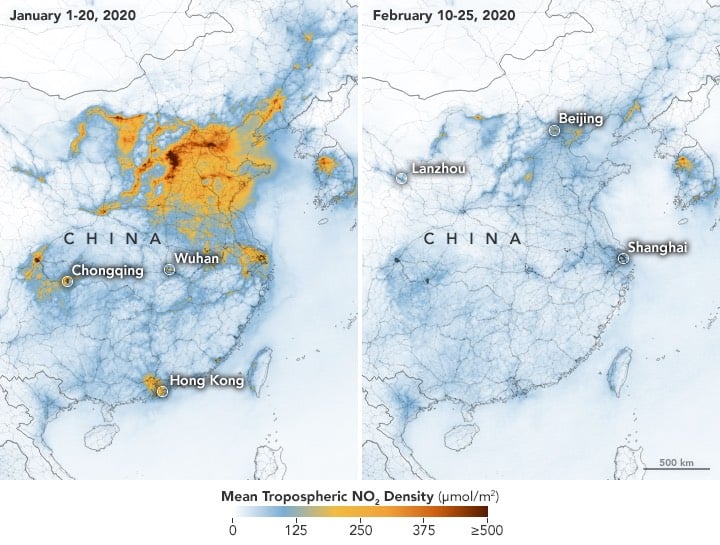
Stanford professor Marshall Burke, who does research on the social and economic impacts of environmental change, wrote a post about how the decrease in economic activity in China due to COVID-19 quarantine and other countermeasures resulted in a significant drop in air pollution, which Burke estimates will save more lives than deaths caused by COVID-19.
Putting these numbers together [see table below for details] yields some very large reductions in premature mortality. Using the He et al 2016 estimates of the impact of changes in PM on mortality, I calculate that having 2 months of 10ug/m3 reductions in PM2.5 likely has saved the lives of 4,000 kids under 5 and 73,000 adults over 70 in China. Using even more conservative estimates of 10% reduction in mortality per 10ug change, I estimate 1400 under-5 lives saved and 51700 over-70 lives saved. Even under these more conservative assumptions, the lives saved due to the pollution reductions are roughly 20x the number of lives that have been directly lost to the virus.
And his conclusion is not that viral pandemics are a net positive for the world (you will see people naively arguing this, siding a little too closely with a snapping Thanos for my comfort) but that situations like this remind us, as Burke summarized on Twitter: “the way our economies operate absent pandemics has massive hidden health costs”:
But it seems overall incorrect and foolhardy to conclude that pandemics are good for health — and again I emphasize that the effects calculated above are just the health benefits of the air pollution changes, and do not account for the many other short- or long-term negative consequences of social and economic disruption on health or other outcomes. But the calculation is perhaps a useful reminder of the often-hidden health consequences of the status quo, i.e. the substantial costs that our current way of doing things exacts on our health and livelihoods.
Graphic above via NASA.
Tutorials from Stanford Online High School about how to create an online classroom. “We want to emphasize that you don’t need to ‘reinvent the wheel’ for online teaching.”
How to Stop the Spread of COVID-19: Cancel Everything
Yascha Mounk writing for The Atlantic:
These three facts imply a simple conclusion. The coronavirus could spread with frightening rapidity, overburdening our health-care system and claiming lives, until we adopt serious forms of social distancing.
This suggests that anyone in a position of power or authority, instead of downplaying the dangers of the coronavirus, should ask people to stay away from public places, cancel big gatherings, and restrict most forms of nonessential travel.
Given that most forms of social distancing will be useless if sick people cannot get treated-or afford to stay away from work when they are sick-the federal government should also take some additional steps to improve public health. It should take on the costs of medical treatment for the coronavirus, grant paid sick leave to stricken workers, promise not to deport undocumented immigrants who seek medical help, and invest in a rapid expansion of ICU facilities.
This is very close to my own personal thinking right now, particularly after watching this excellent video about exponential growth and epidemics.
Exponential Growth and Epidemics
From 3blue1brown’s Grant Sanderson, this is an excellent quick explanation of exponential growth and how we should think about it in relation to epidemics like COVID-19. Depending on how rusty your high school math is, you might need to rewind a couple of times to fully grasp the explanation, but you should persevere and watch the whole thing.
The most important bit is at the end, right around the 7:45 mark, when he talks about how limiting person-to-person exposure and decreasing the probability of exposures becoming infections can have a huge effect on the total number of people infected because the growth is exponential. If large numbers of people start doing things like limiting travel, cancelling large gatherings, social distancing, and washing their hands frequently, the total number of infections could fall by several orders of magnitude, making the exponential work for us, not against us. Small efforts have huge results. If, as in the video, you’re talking about 100 million infected in two months (at the current transmission rate) vs. 400,000 (at the lowered rate) and if the death rate of COVID-19 is between 1-3%, you’re looking at 1-3 million dead vs. 4-12,000 dead.
So let’s start flattening that exponential curve. South Korea and China both seem to have done it, so there’s no reason the rest of the world can’t through aggressive action. (thx, david)
Update: Vox has a nice explainer on what epidemiologists refer to as “flattening the curve”.
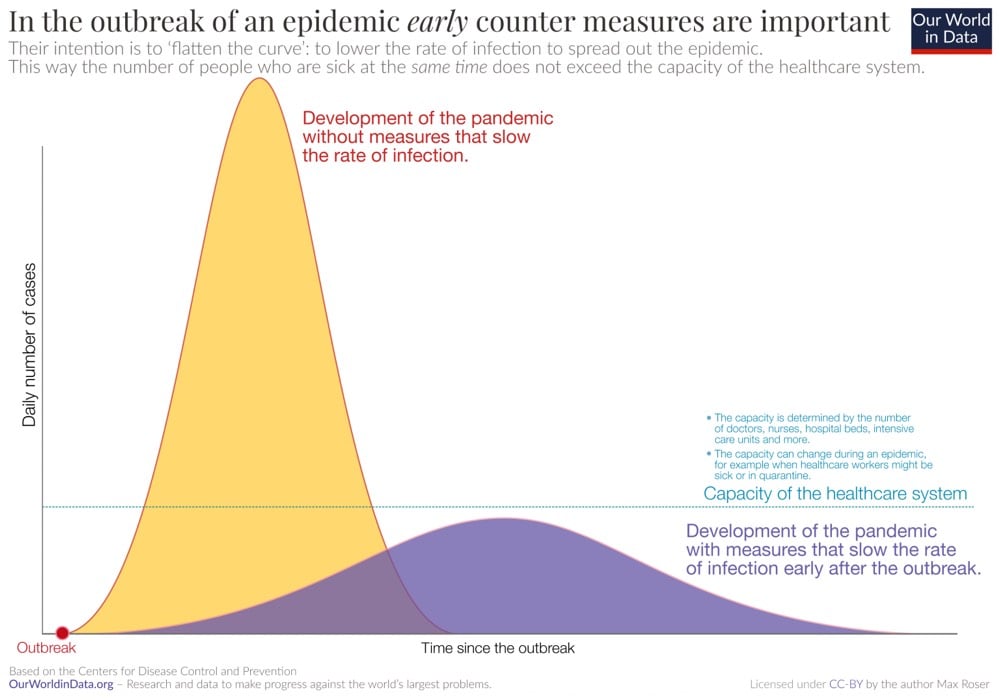
Yet the speed at which the outbreak plays out matters hugely for its consequences. What epidemiologists fear most is the health care system becoming overwhelmed by a sudden explosion of illness that requires more people to be hospitalized than it can handle. In that scenario, more people will die because there won’t be enough hospital beds or ventilators to keep them alive.
A disastrous inundation of hospitals can likely be averted with protective measures we’re now seeing more of — closing schools, canceling mass gatherings, working from home, self-quarantine, avoiding crowds - to keep the virus from spreading fast.
Epidemiologists call this strategy of preventing a huge spike in cases “flattening the curve”.
Here’s the relevant graphic explanation from Our World in Data’s COVID-19 package:
Our Subpar National Parks
Amber Share of Subpar Parks is producing illustrations of real one-star reviews of America’s National Parks from apparently dissatisfied park visitors. Zion National Park is a bit standoffish:

Newsflash: Sequoia National Park is outdoors and has insects:

From a bored Joshua Tree guest:

Follow along with the rest of these on Instagram — Share is doing one drawing for each National Park and she’s got many more still to go. Prints, postcards, stickers, and tshirts are available from her shop (or will be soon).
Update: See also beautiful photos paired with one-star reviews of the places in question and Snowbird’s creative ad campaign based on one-star reviews. (via @ebellm & @mattgist)
Roxane Gay’s Ode to Baking
For Wirecutter, Roxane Gay talks about her love of baking and how her KitchenAid stand mixer helps her achieve the consistent results that baking demands.
I’ve always loved baking, the patience and precision it requires, the end result when baking goes well, the lessons learned when it doesn’t. It’s actually quite conducive to writing because it forces you to step away from your work and tend to the baking process at specific intervals. When I am feeling down, when I am stressed, when I want to procrastinate, when I want to nourish people I love, I bake, which is to say I bake a lot.
I found this link via my friend David, who has gotten into baking in a big way over the past couple of years, perfecting his recipes for pizza dough and bread. I got a KitchenAid for Christmas this year, but I haven’t had a chance to use it yet. Maybe this week…
COVID-19 Empties Out Public Spaces
For the Atlantic, Alan Taylor compiled a bunch of photos of normally bustling places that are a lot emptier due to the COVID-19 crisis. This is the Grand Mosque in Mecca:

A Europa league football match played in an empty stadium (play in Italy’s Serie A league has been suspended until at least April 3):

And here’s Sunday mass at a church in Milan:

You can see the whole photo gallery here.
See also Ghost City Photos of a Usually Bustling Shanghai During Coronavirus Outbreak.
Update: Several more photo collections of the outside world’s increasingly empty spaces:
- New York Was Not Designed for Emptiness (NY Times)
- The Great Empty (NY Times)
- Life in the Coronavirus Era (The Atlantic)
- An Eerily Empty NYC Just Before The PAUSE (Gothamist)
- Scenes from live feed webcams from around the world (Noah Kalina)
- Empty streets and disrupted lives: A world in the wake of coronavirus (Washington Post)
- The Quiet Emptiness of a World Under Coronavirus (The Atlantic)
- Coronavirus concerns empty public spaces around the world (Boston Globe)
- Coronavirus impact: Satellite images show world cities before and after outbreak (CNBC)
- 14 Photos of What Public Life Looks Like During a Coronavirus Outbreak (New York)
- See Photos Of Eerily Deserted Places Around The World As A Result Of The Coronavirus (Forbes)
- The Visual Landscape of a World Shaped by Pandemic (The Atlantic).
- Surreal Drone Tour of a Pandemic-Emptied San Francisco (YouTube)
- After the end of the world: the eerie silence of the Las Vegas Strip (Guardian)
For Nieman Lab, Cherine Fahd and Sara Oscar wrote about the uncanny melancholy of empty photographs in the time of coronavirus.
These artists demonstrate a longstanding fascination with photographing architecture devoid of human subjects.
This fascination may be due to what architectural historian Anthony Vidler described as “the architectural uncanny.” Abandoned and deserted spaces, he said, make our familiar spaces become unfamiliar. For Vidler, this estrangement from space hinges on visual representation, such as in photography. These photographs of empty public spaces capture a departure from our everyday and instead visualize this uncanniness: an alternative reality emptied of our presence.
COVID-19: Not Just A Bad Flu
A few days ago, Dr. Daniele Macchini, a physician in Bergamo, Italy, made a long post on Facebook (also reprinted here) about how the outbreak of COVID-19 (coronavirus) is overwhelming the hospitals there and pleads with the rest of the world to take the virus seriously. The original post is in Italian and Google Translate does pretty well with it. Dr. Silva Stringhini translated the important bits of Dr. Macchini’s post in this Twitter thread and is somewhat easier to read:
After much thought about whether and what to write about what is happening to us, I felt that silence was not responsible.
“I will therefore try to convey to people far from our reality what we are living in Bergamo in these days of Covid-19 pandemic. I understand the need not to create panic, but when the message of the dangerousness of what is happening does not reach people I shudder.
“I myself watched with some amazement the reorganization of the entire hospital in the past week, when our current enemy was still in the shadows: the wards slowly ‘emptied’, elective activities were interrupted, intensive care were freed up to create as many beds as possible.
“All this rapid transformation brought an atmosphere of silence and surreal emptiness to the corridors of the hospital that we did not yet understand, waiting for a war that was yet to begin and that many (including me) were not so sure would ever come with such ferocity.
“I still remember my night call a week ago when I was waiting for the results of a swab. When I think about it, my anxiety over one possible case seems almost ridiculous and unjustified, now that I’ve seen what’s happening. Well, the situation now is dramatic to say the least.
“The war has literally exploded and battles are uninterrupted day and night. But now that need for beds has arrived in all its drama. One after the other the departments that had been emptied fill up at an impressive pace.
“The boards with the names of the patients, of different colours depending on the operating unit, are now all red and instead of surgery you see the diagnosis, which is always the damned same: bilateral interstitial pneumonia.
Dr. Macchini urges: “Let’s stop saying it’s a bad flu.” But this is the part that stopped me in my tracks and got me to write this post:
So have patience, too, that you cannot go to the theater, museums or gym. Try to have mercy on that myriad of older people you could exterminate.
His overall message is that we shouldn’t panic, but that we should take COVID-19 seriously. The goal here is to keep the most vulnerable of us as safe as possible and work to slow the spread of the virus so it doesn’t overwhelm our healthcare system. So let’s do that — the elderly and those most at risk are counting on us.
New York Apartment For Sale, Only $43.9 Billion

For New York Apartment, an art project commissioned by The Whitney, artists Sam Lavigne and Tega Brain compiled actual NYC real estate listings into a listing for one mega apartment for sale.
Compiled from actual online real estate listings, the artwork collapses the high and low ends of the market, architectural periods and styles, and neighborhoods and affordability into a single space that cumulatively creates a portrait of New York’s living spaces and the real estate market. Like a standard real estate ad, the listing shows the price, number of bed- and bathrooms, and square footage, all of which are updated weekly based on the city’s aggregated real estate listings.
Take some time to explore the project — take the 3D virtual tour, scroll through all of the bathrooms & closets, peruse the apartment features, and take the video tour:
Do you crave brilliant sunshine and the peace Zen behind closed doors at home, and the bustle and excitement of the big city at your doorstep?
Do you dream of a Manhattan life?
Do you dream of Brooklyn living with Manhattan in reach?
Do you have a thing for top floor apartments?
Do you have vision?
Do you like light?
Do you love to cook?
Do you love to entertain?
Do you need lots of closet space?
Do you own or plan to buy a car?
Do you prefer simple shaker style wood cabinets with solid surface counters or custom lacquer cabinets paired with a travertine marble?
Do you want a home just steps to the beach?
Do you want Katz Deli, Russ and Daughters or maybe some Economy Candy?
Contact information for all of the brokers is listed on the site in case you’re interested.
You might find this online Zamboni game soothing today. You steer the Zamboni to clear the ice. That’s it. (Unless you leave the ice. In which case, it’s a metaphor for *gestures at everything*.)
The Long Goodbye
British rapper and actor Riz Ahmed released an album last week called The Long Goodbye. It’s a breakup album with a twist — Ahmed is not breaking up with a partner but with a racist, post-Brexit Britain. A Guardian review describes it as “a conceptual work based around the idea that British Asians are locked in an abusive relationship with the UK and that the rising tide of racism spawned by Brexit might represent the moment at which they’ve finally been dumped”.
To accompany the album, Ahmed collaborated with director Aneil Karia to make a short film (embedded above). It starts out with a typical British domestic scene but after a few minutes, it becomes something else entirely. Be warned: this film is quite intense & dystopian. (via dunstan)
Weird Internet Careers
Gretchen McCulloch, author of Because Internet, has developed a Weird Internet Career as an internet linguist. In the first installment in a series on such jobs, McCulloch explains what they are:
Weird Internet Careers are the kinds of jobs that are impossible to explain to your parents, people who somehow make a living from the internet, generally involving a changing mix of revenue streams. Weird Internet Career is a term I made up (it had no google results in quotes before I started using it), but once you start noticing them, you’ll see them everywhere.
Weird Internet Careers are weird because there is no one else who does exactly what they do. They’re internet because they rely on the internet as a cornerstone, such as bloggers, webcomics, youtubers, artists, podcasters, writers, developers, subject-matter experts, and other people in very specific niches. And they’re careers because they somehow manage to support themselves, often making money from some combination of ad revenue, t-shirt sales, other merch, ongoing membership/subscription (Patreon, Substack), crowdfunding (Kickstarter, Indiegogo, Ko-Fi), sponsorship deals, conventional book deals, self-published ebooks, selling online courses, selling products or apps or services, public speaking, and consulting.
I’ve had a Weird Internet Career for more than 15 years and even though it’s much more normalized now than when I started (folks generally know that people make money from being popular on YouTube or Instagram), it’s still a struggle to explain. Usually someone will ask me what I do and I tell them. Them, wide-eyed: “That’s your job?!” Then there’s a long pause and eventually their curiosity overwhelms their politeness and they tentatively say: “Can I ask…uh…how do you make money doing that?”
For awhile, in an attempt to have more symmetrical relationships with new friends — because 5 minutes of googling yields so much about who I am, leading to weird information imbalances — I would be vague about my profession, saying that I managed a website and not offering any further information. This approach often backfired because you’ve essentially given people a mystery, and mysteries must be solved. More than one person looked at me with a cocked eyebrow and asked, “Do you run a porn site? Is that why you don’t want to tell me?” *facepalm*
Mysterious Sources of Light Pollution
If you look at online light pollution maps, most light pollution comes from cities, but Alex Altair noticed that there are some unexpected sources of light out there as well. For instance, this sprawling site in North Dakota is one of the brightest places in the country despite what Altair calls “an intense lack of urbanization”.

The light in that area is from oil drilling & extraction in the area.
The light pollution comes from the associated gas flares. These flares are deliberate, continuously burning fires, and they convert methane, a potent greenhouse gas, into CO2, a much less potent greenhouse gas.
Intense heat also accounts for an odd light source in Hawaii — you can probably guess, but you’ll have to click through to confirm.
See also Lost in Light: How Light Pollution Obscures Our View of the Night Sky.
The Drawings Secretly Inserted into Official Swiss Topographical Maps
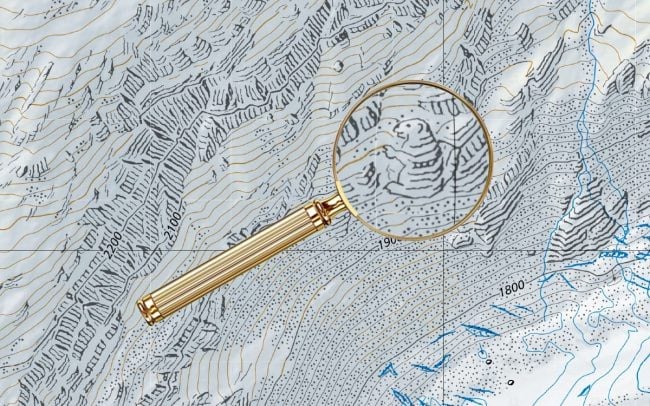
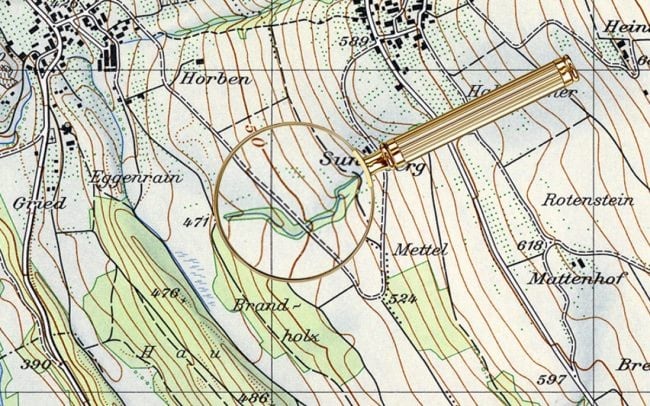
For decades, mapmakers working for the Swiss Federal Office of Topography have defied their mandates to create the most accurate maps possible by covertly inserting drawings in official maps.
But on certain maps, in Switzerland’s more remote regions, there is also, curiously, a spider, a man’s face, a naked woman, a hiker, a fish, and a marmot. These barely-perceptible apparitions aren’t mistakes, but rather illustrations hidden by the official cartographers at Swisstopo in defiance of their mandate “to reconstitute reality.” Maps published by Swisstopo undergo a rigorous proofreading process, so to find an illicit drawing means that the cartographer has outsmarted his colleagues.
It also implies that the mapmaker has openly violated his commitment to accuracy, risking professional repercussions on account of an alpine rodent. No cartographer has been fired over these drawings, but then again, most were only discovered once their author had already left. (Many mapmakers timed the publication of their drawing to coincide with their retirement.)
Some of these blend remarkably well within the usual details of the maps — I never would have noticed the reclining nude in the second image above if it weren’t highlighted.
See also trap streets, errors deliberately introduced by mapmakers to catch others copying their work. (via @jschulenklopper)
Some guidelines on how journalists and newsrooms can cover COVID-19 more responsibly. “The public is starting to freak out. Don’t add to it with screaming clickbait headlines and scary generic images.”
An interview with a man who held a plank for more than 8 hours. “When it was over, Mr. Hood did not sink onto his belly…he eased back into the yoga position called child’s pose.”
Hear How Choral Music Sounded in the Hagia Sophia More Than 500 Years Ago
When the Ottomans invaded and conquered Constantinople in 1453, the Orthodox Christian church Hagia Sophia was converted into a mosque. As a result, the Christian choral music that had reverberated in this acoustical masterpiece for centuries was not allowed. But thanks to a digital filter developed by a pair of Stanford researchers, one an art historian (Bissera Pentcheva) and the other an acoustics expert (Jonathan Abel), we are now able to hear what a choir might have sounded like in the Hagia Sophia before the mid 15th century.
When they met, Pentcheva started telling Abel about the Hagia Sophia — how we couldn’t really understand the experience of worshipers there unless we could hear the music the way they did. And as she talked, Abel started to feel a prickling of excitement. They could recreate what that music would sound like. If only they could get in the Hagia Sophia and pop a balloon.
When a balloon pops, it makes an impulse, a sharp, quick sound that takes on the character of whatever space it’s in. So when a balloon pops, you’re really hearing the acoustics of the space itself, says Abel.
In this clip from 2013, the Cappella Romana choir sings a hymn passed through an early version of the Hagia Sophia filter:
The marble interior of Hagia Sophia was 70 meters long, while in height it reached 56 meters at the apex of the great dome. The vast chamber and its reflective surfaces of marble and gold resulted in unprecedented acoustics of over ten seconds reverberation time. As a museum Hagia Sophia today has lost its voice, no performances could take place in it. Using new digital technology developed at CCRMA, the second portion of Cappella Romana’s concert at Bing aims to recreate sound of what singing in Hagia Sophia must have been like. Each singer caries a microphone that records the sound transforming it into a digital signal, which is then imprinted with the reverberant response of Hagia Sophia. What you hear as a wet sound is the product of a digitally produced signal transmitted through loudspeakers placed strategically to create an enveloping soundfield. This digital signal may shock you with the way it relativizes speech, transforming its content into a chiaroscuro of indistinct but immersive sound. For the Byzantines, this sonic experience was associated with the water: the waves of the sea.
Last year, the Cappella Romana released an entire album of choral music recorded with the filter — you can listen on Spotify, Apple Music, Amazon, Tidal, or Pandora.
Needless to say, the album sounds better with the best pair of headphones you can muster. You can find out more information about the filter and the acoustics of the Hagia Sophia at Icons of Sound.
See also this online Gregorian chant generator.
The Cephalopoda, a Hand-Drawn Atlas of Octopus and Squid (1910)


The Valdivia Expedition, led by German marine biologist Carl Chun in 1898-1899, was the first time humans had explored the ocean depths below 500 fathoms. What they found changed our conception of the oceans. The results, in the form of 24 volumes of text and illustrations, took decades to be published. Among the volumes was The Cephalopoda, published in 1910 and filled with colorful hand-illustrated drawings of octopuses and squid, courtesy of the Biodiversity Heritage Library.
I found this on Brain Pickings, which identifies the illustrator as Friedrich Wilhelm Winter, a credit I couldn’t find in the actual book itself. They’re also selling some of the illustrations as prints, like this one of the octopus featured above.
Fossilized Skulls of Cartoon Characters
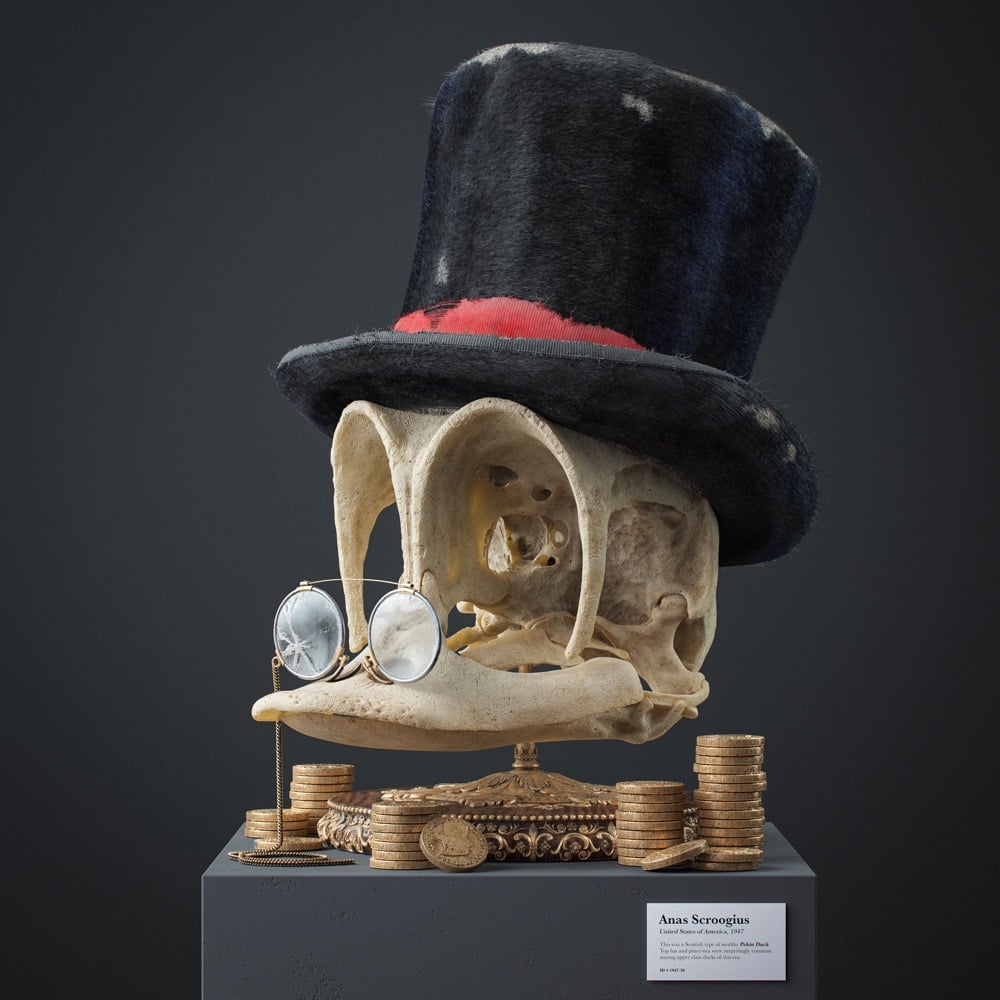

For his Cartoon Fossils series, Filip Hodas used 3D modelling software to create fossilized skulls of cartoon characters like Scrooge McDuck, Tweetie Bird, Minnie Mouse, and Goofy.
These remind me of Michael Paulus’s Character Studies, drawings of the skeletons of the likes of Lucy from Peanuts, Betty Boop, Marvin the Martian, and Pikachu. I have his Hello Kitty drawing hanging in my living room, purchased after Leslie Harpold pointed me towards his work back in the day. (via colossal)
The Curiosity Rover Captures a 1.8 Gigapixel Panorama of Mars

Late last year, NASA’s Curiosity rover took over a thousand photos of the Martian landscape while exploring a mountainside. NASA stitched the photos together and recently released this 1.8 gigapixel panorama of Mars (along with a mere 650 megapixel panorama, pictured above). Here’s a version you can pan and zoom:
And a narrated video of the panorama:
Both panoramas showcase “Glen Torridon,” a region on the side of Mount Sharp that Curiosity is exploring. They were taken between Nov. 24 and Dec. 1, when the mission team was out for the Thanksgiving holiday. Sitting still with few tasks to do while awaiting the team to return and provide its next commands, the rover had a rare chance to image its surroundings from the same vantage point several days in a row.
I like how NASA is casually suggesting that the rover is just kinda taking some vacation snaps while waiting on friends.
The Disposables – the Washington Post sent disposable cameras to 25 women around the country and here’s what they captured. “This transported me to a time before instant gratification.”
This winter was the hottest ever on record for Europe. The average temps for Dec, Jan, & Feb were *1.4C above* the previous record. I mean!!!!!
Here’s What a Googol-to-One Gear Ratio Looks Like
To celebrate being alive for a billion seconds, Daniel Bruin built a machine with 100 gears with a 10-to-1 gear ratio…meaning that the overall gear ratio is a googol-to-one. (A googol is 1 with 100 zeros.)
This machine has a gear reduction of 1 to 10 a hundred times. In order to get the last gear to turn once you’ll need to spin the first one a google [sic] amount around. Or better said you’ll need more energy than the entire known universe has to do that. That boggles my mind.
You can watch the machine spin for an hour — it’s kinda relaxing:
Bruin says his machine was inspired by Arthur Ganson’s Machine with Concrete, a contraption whose gears spin so slowly that the final gear is embedded in concrete. (via digg)
Socials & More