



We worry about the effect of deepfake videos on politics & journalism, but 96% of the total deepfake videos online involve the sexual exploitation & abuse of women (e.g. “face-swap” videos & photos in which clothes are digitally removed).

Advertise here with Carbon Ads
This site is made possible by member support. 💞
Big thanks to Arcustech for hosting the site and offering amazing tech support.
When you buy through links on kottke.org, I may earn an affiliate commission. Thanks for supporting the site!
kottke.org. home of fine hypertext products since 1998.
Beloved by 86.47% of the web.
Entries for February 2020
How to Make a Kurzgesagt Video (in Just 1200 Hours)
In this video, Kurzgesagt shares their process of making their unique brand of explainer video.
They estimate it takes about 1200 hours of time for each video. I love Kurzgesagt’s videos and am happy to support them on Patreon.
A 1929 Interview with a 103-Year-Old Man
The Great Span was Alger Hiss’s term for the personal links of living humans across large periods of time. For instance, Supreme Court Justice Oliver Wendell Holmes, Jr. shook hands with both John Quincy Adams and John F. Kennedy, linking the Revolutionary War with the Vietnam War. This interview with 103-year-old Galusha Cole filmed in 1929 is another instance of this phenomenon:
This was part of a series of interviews with the elderly on the cusp of the Great Depression. Cole was born in 18261 during the administration of John Quincy Adams, was alive at the same time as Ludwig van Beethoven, and lived just long enough to be captured in voice and picture on film.
Although this page on Find a Grave claims that Cole was actually only 92 at the time of the interview. Which would be interesting vis a vis his proclamation that he doesn’t have any vices.↩
The New York Public Library’s List of “125 Books We Love”

To celebrate their 125th anniversary, the New York Public Library has created a list of 125 Books We Love, books published in the past 125 years “that made us fall in love with reading”. First on the list (alphabetically) is 1984, which was the first adult book I fell in love with. Other personal favorites on the list include The Warmth of Other Suns, The Devil in the White City, Cleopatra: A Life, Wolf Hall, My Brilliant Friend, and The Remains of the Day.
You can check out the entire list or read about how the books were selected. (via open culture)
Historian and political scientist Stephen Walt: “After impeachment, the president has been passing most of the checkpoints on the way to authoritarianism.” And: “There are some flashing red lights on the dashboard.”
The Dance by FriendsWithYou

The latest exhibition by art duo FriendsWithYou is currently on view at Dallas Contemporary and includes a piece called The Dance that features two fuzzy orb-ish heads that slowly bobble around the room.
An interactive and communal experience, the exhibition actively incorporates audiences: two moving orbs serve as ambassadors as they meander along in a spiritual, cleansing, and comforting ritual set to a custom soundtrack in celebration of the beauty and power of togetherness.
You can see The Dance in motion on FriendsWithYou’s Instagram here and here. Natalie Gempel wrote about what it was like to pilot one of the orbs.
Submerged in my pink bubble, I spin, wobble, and drift aimlessly. Between the darkness and the humming of the air compressor, it’s almost like being in a sensory deprivation tank. I’m brought out of my haze when Carolina Alvares-Mathies, the Contemporary’s new Deputy Director, comes to check on me. It’s been cool, but I’m ready to exit.
The zipper opens and I stumble out. I don’t remember being born, but I assume it’s a similarly jarring feeling. Everything is too bright and I’m a little queasy. Still, I reentered the real world with the information I needed: It was weird in there, but I did have fun.
(thx, jenni)
Deepfake Video of Robert Downey Jr. and Tom Holland in Back to the Future
This deepfake video of Back to the Future that features Robert Downey Jr. & Tom Holland as Doc Brown & Marty McFly is so convincing that I almost want to see an actual remake with those actors. (Almost.)
They really should have deepfaked Zendaya into the video as Lorraine for the cherry on top. Here’s an earlier effort with Holland as Marty that’s not as good.
A space tourism company is partnering with SpaceX to send 4 paying customers into orbit for 3-5 days (40-50 orbits). Price rumored to be “not dramatically less” than $50 million per person.
“Has Britain finally lost its marbles?” The British Museum may have to return the Parthenon Marbles to Greece under the UK’s new Brexit-induced trade agreement with the EU.
Wikipedia article titles that are singable to the Teenage Mutant Ninja Turtle theme song, incl. “Microsoft Solutions Framework”, “Side Impact Protection System”, and “Lincoln County, South Dakota”
The Swim that Kicked Off China’s Cultural Revolution

In 1966, Chinese leader Mao Zedong had a PR problem. His Great Leap Forward policy had resulted in tens of millions of deaths from famine, his health was rumored to be failing, and he was afraid, following the recent de-Stalinization of the Soviet Union, that his legacy was not secure. So he went for a swim.
Mao wanted to leave behind a powerful Communist legacy, like Marx and Lenin before him. And in order to do so, he needed to connect with the younger generation before he died. So after announcing his Great Proletarian Cultural Revolution, he swam across the Yangtze River. Mao had done the same swim 10 years earlier to prove his vitality, and he hoped it would work again.
His “Cultural Revolution” was a call to hunt down and eliminate his enemies, and reeducate China’s youth with the principles Maoism. Led by the fanatical Red Guards, the Cultural Revolution was a devastating 10-year period in Chinese history that didn’t end until Mao died in 1976.
You can read and watch more about the Cultural Revolution.
The Long Life and Fun Times of Roger Angell
This interview with living legend Roger Angell, whose writing first appeared in the New Yorker in 1944 and is still writing for them at the age of 99, is full of gems like this one, when he interview Benny Goodman as a high schooler:
Then in high school, at Pomfret, I tried out for the school newspaper, and one of the first people I interviewed was Benny Goodman. I was fourteen or fifteen, and I went to the Madhattan Room, at the Hotel Pennsylvania, where he was playing, and one of the people there was S.J. Perelman, a young humor writer my mother knew, and he knew Benny Goodman.
I asked Benny Goodman if I could interview him, and he said, “Come to my hotel room tomorrow, at one in the afternoon.” So I went up at one and rang his bell and rang it and rang it, and then he came to the door wearing his jockey shorts and his eyeglasses, very sleepy. I’d woken him up. My lede on the story was “Great bandleaders get to sleep late.”
And this one, about Joseph Mitchell:
The thing about Joe Mitchell is that he knew everything. No subject escaped him, from James Joyce to horse breeding, backcountry life, culture. A.J. Liebling, his close friend and colleague, resented this. So one day Liebling is wandering around Sixth Avenue — it still had the elevated track — and there was a little taxidermy shop under the subway, and he goes in and finds a little set of bones. The owner says, “These are very interesting. They’re the bones of a young male opossum, which has a bone in its penis.” Liebling buys this collection of bones for six dollars and brings it over to the office wrapped up in a paper bag. Mitchell is typing. Liebling knocks on the door, comes in, unwraps the package, and puts it on the table. Mitchell looks at it and says, “Pecker bone of a young male opossum — anything you want to know about that?”
Amazing Senegalese Sand Painting
In less than a minute, this Senegalese sand artist working on the island of Gorée creates a portrait by pouring sands of different colors over a wooden board with glue on it. The way that the painting emerges at the last second out of seeming disorder is a lovely shock, like a magic trick.
Was the World’s Oldest Person a Fraud?
Maybe it was all the Guinness Book of World Records reading when I was a kid, but I probably pay more attention than many people to the list of the world’s oldest people. At 122 years and 164 days, Jeanne Calment is the oldest person to have ever lived. At the time of her death, she had lived for almost 5 years longer than the previous record-holder, which I have always found a little fishy. So it was with great interest that I read Lauren Collins’ New Yorker piece on a recent challenge to Calment’s age.
The passage of time often quells controversy, but, in the Calment case, it only unsettled the dust. As the world’s population continued to grow, the cohort of people living to the age of a hundred and twenty-two did not. More than two decades after Calment’s death, her record still stood, making her a more conspicuous outlier with every year that went by. Either she had lived longer than any human being ever or she had executed an audacious fraud. As one observer wrote, “Both are highly unlikely life stories but one is true.” In “Les 120 Ans de Jeanne Calment,” her validators had reproduced the only picture known to exist of the two Calment women as adults. In it, Yvonne appears to be sitting on a windowsill. Jeanne stands to her left, behind a table, looking down at a basket of flowers and a wrapped gift. The women are both wearing white shirts and dark sweaters. Accompanying the photograph was a tantalizing caption: “Jeanne and Yvonne, her daughter. Which one is which?”
I won’t spoil the ending, but if you’re aware of Betteridge’s law you may already have a good idea what it is.
In Focus is featuring photo stories of all 50 states this year. This week’s installment is Vermont! Lots of fall foliage, water, green, and snow.
An Online Collection of Mexican Cookbooks (1789-Present)

The University of Texas at San Antonio maintains a collection of over 2000 Mexican cookbooks dating from as far back as 1789 and a selection of those is available online.
UTSA’s Mexican Cookbook Collection is comprised of more than 2,000 cookbooks, from 1789 to the present, with most books dating from 1940-2000. In addition to broad general coverage, the collection includes concentrations in the areas of regional cooking, healthy and vegetarian recipes, corporate advertising cookbooks, and manuscript recipe books.
A guide to the entire collection is available or you can just dive in to the digitized content. (thx, megan)
The Times of Bill Cunningham
In 1994, legendary street fashion photographer Bill Cunningham gave a six-hour interview about his life and work. This interview was recently rediscovered and made into a documentary called The Times of Bill Cunningham. Here’s a trailer:
The movie is out in theaters, but the reviews so far are mixed, especially when compared to the rave reviews received by 2011’s Bill Cunningham New York. Still, Cunningham is a gem and I will watch this at some point soon. (via recs)
The Neighbor’s Window
From filmmaker Marshall Curry, The Neighbor’s Window is a poignant short film about the odd relationships you can sometimes form with your neighbors in big cities, even if you never meet in real life.
For real! Do they have jobs? Or clothes? All they do is host dance parties and sleep ‘til noon and screw.
This film recently won the Academy Award for Best Live Action Short Film. (via open culture)
Update: I forgot to mention that this film was based on a true story told by Diane Weipert on the Love + Radio podcast. Somewhat randomly, the film’s husband and wife ended up looking a lot like Weipert and her partner. (via @BenHoste)
Face ID Compatible Respirator Masks
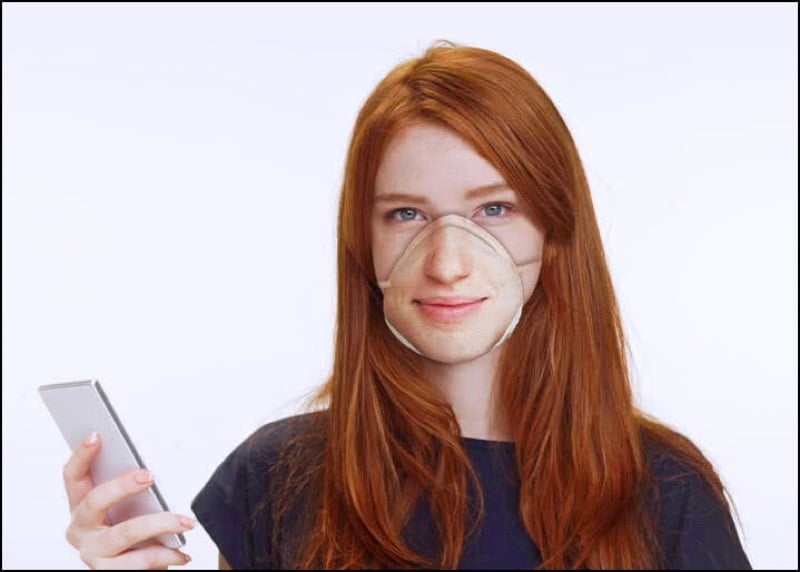
This site is making N95 respirator masks that work with facial recognition software, so that, for example, you can unlock your phone while still wearing a mask.
After uploading your face, we use computational mapping to convert your facial features into an image printed onto the surface of N95 surgical masks without distortion.
Our printer uses inks made of natural dyes. It’s non-toxic and doesn’t affect breathability.
You can use your mask for everyday life as a barrier for airborne particle droplets.


It is unclear whether these will actually ship or not — “Q: Is this a joke? A: Yes. No. We’re not sure.” — but they’re definitely not planning to make them while there are mask shortages related to COVID-19. And it appears the masks will work with iPhones…you just add a new face (while wearing the mask) to your phone’s face database.
Backgammon legend Matvey Natanzon (aka Falafel) has died. This 2013 New Yorker profile of Falafel is supremely entertaining.
Researchers have discovered a T-cell found in human blood that can target cancerous cells while leaving healthy cells alone. The hope is that it can be used to develop a universal cancer therapy.
Map of Areas Most Often Missing During Handwashing
With news of more than 70,000 confirmed cases and 1700 deaths from the COVID-19 virus, the importance of handwashing is once again front and center. Using data from a 1978 study on the hygiene of health professionals, this is a map of the most missed areas when washing hands.
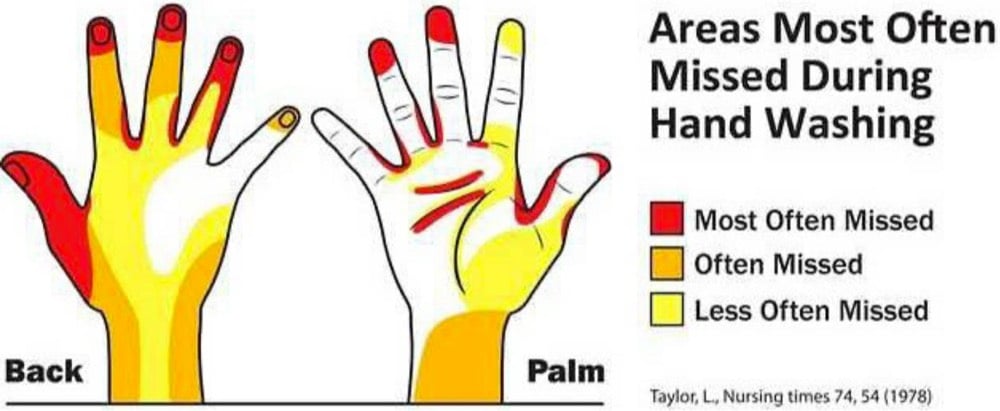
This more recent paper contains a short review of various studies of missed areas, most of which conclude that people often forget to wash their fingertips:
In 2008, the WHO designed a handwashing leaflet, making reference to Taylor, who indicated that the fingertips, interdigital areas, thumbs, and wrists are the most commonly missed areas in handwashing. Pan et al. also found that the tips of the nails and the fingertips had the largest amount of residual florescent stains left after handwashing among healthcare workers in Taiwan. The commonly missed areas among medical students in the study conducted by Vanyolos et al. was the first metacarpal, the proximal part of the palm (lateral), the distal phalanges, and the nail beds. In healthcare workers in Škodová et al.’s study, the thumbs and fingertips were the most commonly missed areas. In this study, the most frequently missed area was also the fingertips. However, the medial aspect and back of the hand were the second and third most missed areas, respectively. Moreover, the interdigital area and the front and back of the fingers were the least missed areas, which is in contrast to Taylor’s study.
So wash those fingertips! Here’s the CDC-recommended guide to washing your hands properly.
- Wet your hands with clean, running water (warm or cold), turn off the tap, and apply soap.
- Lather your hands by rubbing them together with the soap. Lather the backs of your hands, between your fingers, and under your nails.
- Scrub your hands for at least 20 seconds. Need a timer? Hum the “Happy Birthday” song from beginning to end twice.
- Rinse your hands well under clean, running water.
- Dry your hands using a clean towel or air dry them.
See also this TED Talk on how to properly dry your hands with a paper towel. (via a map a day)
Universe Sandbox
Universe Sandbox is a interactive space & gravity simulator that you can use to play God of your own universe.
You can create star systems: “Start with a star then add planets. Spruce it up with moons, rings, comets, or even a black hole.” You can collide planets and stars or simulate gravity: “N-body simulation at almost any speed using Newtonian mechanics.” You can model the Earth’s climate, make a star go supernova, or ride along on space missions or see historical events.
I found Universe Sandbox after watching this video about what would happen if the Earth got hit by a grain of sand going 99.9% the speed of light (spoiler: not much). This game/simulator/educational tool is only $30 but I fear that if I bought it, I would never ever leave the house again.
The Process Genre
From Duke University Press and author Salomé Aguilera Skvirsky comes what looks like an intriguing book on the beloved phenomenon of “how things are made” media — you know, things like “how to” cooking videos and IKEA instructions — The Process Genre: Cinema and the Aesthetic of Labor (at Amazon). From the book’s introduction:
Chapter 3, “Aestheticizing Labor,” argues that the category of labor is central to the process genre. In my account, the process genre is, in effect, always symptomatically reflecting on the interactions of human labor, technology (i.e., tools, instruments, machines), and nature. The chapter first examines the genre’s relation to technique. Then it surveys the political implications of the ways in which labor is poeticized in the genre. In its most exalted examples, the process genre presents a striking paradox. On the one hand, it is the most instrumentalist of genres. After all, it is a genre constituted by the presentation of a sequential series of steps, all aiming at a useful result; it is a genre that is usually associated with what scholars call “useful cinema.” On the other hand, it is a genre that has produced some of the most romantic, utopian depictions of labor in which labor figures not as that from which human beings seek relief in the form of listless leisure, but as the activity that gives human life meaning. The philosophical basis for the centrality of labor to life — what has been called the “metaphysics of labor” — finds expression in the process genre; thus, the genre stands in opposition to the politics of antiwork.
The photos on the cover of the book are stills from the Mister Rogers video on how crayons are made:
As you’ve probably observed, I am an unabashed fan of the process genre, with dozens of videos & tutorials in kottke.org’s how to tag alone. Some of my particular favorites are the crayon video above (along with a similar one from Sesame Street), an Oscar-winning short from 1958 about glassmaking, the Primitive Technology videos, how marbled paper is made, how candy is made at the Teddy Grays factory, and the National Film Board of Canada’s video about how to make an igloo. (thx, jason! (no relation))
Recording All the Melodies
In this recent TED Talk, lawyer, musician, and technologist Damien Riehl talks about the rapidly diminishing number of melodies available to songwriters under the current system of copyright. In order to help songwriters avoid these melodic legal landmines (some of which are documented here), Riehl and his pal Noah Rubin designed and wrote a program to record every possible 8-note, 12-beat melody and released the results — all 68+ billion melodies, 2.6 terabytes of data — into the public domain.
It’s interesting that the litigious nature of the music business and the finite number of melodies (and the even smaller number of pleasing melodies) has turned an artistic endeavor into a land-grab — whoever gets to a certain melody first owns it forever (or at least for dozens of years). (via @tedgioia)
Billie Eilish Interviewed by AI Bot
Collaborating with the team at Conde Nast Entertainment and Vogue, my pal Nicole He trained an AI program to interview music superstar Billie Eilish. Here are a few of the questions:
Who consumed so much of your power in one go?
How much of the world is out of date?
Have you ever seen the ending?
This is a little bit brilliant. The questions are childlike in a way, like something a bright five-year-old would ask a grownup, perceptive and nonsensical (or even Dr. Seussical) at the same time. As He says:
What I really loved hearing Billie say was that human interviewers often ask the same questions over and over, and she appreciated that the AI questions don’t have an agenda in the same way, they’re not trying to get anything from her.
I wonder if there’s something that human interviewers can learn from AI-generated questions — maybe using them as a jumping off point for their own questions or asking more surprising or abstract questions or adapting the mentality of the childlike mind.
See also Watching Teen Superstar Billie Eilish Growing Up.
The Dancing Baby Meme, Digitally Remastered
In 1996, Dancing Baby was one of the earliest big memes to cross over from the nerd space of Usenet to the wider population; it even appeared on the popular TV show Ally McBeal. 18-year-old English college student Jack Armstrong, born more than 5 years after the meme debuted, decided to digitally remaster the original in 1080p and 60FPS:
Armstrong shared how he tracked down the original 3D file on Twitter. (via waxy)
Inglourious Basterds’ Witty Slate Clapper
Geraldine Brezca has worked on several of director Quentin Tarantino’s movies,1 and for Inglourious Basterds, she was the slate operator — i.e. she clapped the clapper before each scene. And as this video shows, she was very entertaining and creative in her duties:
For each scene’s label, Brezca came up with something funny (A66F = “au revoir 66 fuckers”), ribald (29B = “29 blowjobs”), appropriate (39FE = “39 feet essential” on a scene featuring feet), respectful (4AK = “4 Akira Kurosawa”), or profane (79E = “79 fucking explosives”, which got quite a chuckle from Brad Pitt). See also Here’s Why Slate Operators Matter (And Why Quentin Tarantino’s is So Great).
Brezca’s IMDB page shows that the last movie she worked on was Django Unchained in 2012. Not sure if she left the industry or passed away or what…↩
“Children can foster climate change concern among their parents”. Daughters were particularly effective in shifting perspectives and male conservative parents “more than doubled their concern level”.
Alternate Map of the Americas Features “Long Chile”

Long-time readers know that I like me some maps and in particular hand-drawn/homemade maps and maps of alternate realities. So I was charmed by Anna Calcaterra’s alternate map of the Americas, which features geographic entities like Long Chile, Ohio 2 (“Four Corners replaced w/ Ohio 2”), and East Dakota (RIP Minnesota). The kids are alright, y’all.
The Delightfully Nerdy Rotary Cellphone
Scientist Justine Haupt recently built herself a rotary cellphone as a “statement against a world of touchscreens, hyperconnectivity, and complacency with big brother watchdogs.” Look at this gloriously eccentric gadget:

So it’s not just a show-and-tell piece… My intent is to use it as my primary phone. It fits in a pocket.; It’s reasonably compact; calling the people I most often call is faster than with my old phone, and the battery lasts almost 24 hours.
Haupt has open sourced the technical design files so you can build your own rotary cell if you’d like. The files are currently unavailable though due to (I’m assuming) the interest in the project; this Wired piece says her website crashed. So check back in a couple days after the hubbub dies down?
Our Belligerent Political Process
Brent Simmons writes about the Democratic primaries and keeping our eyes on the real prize:
Odds are that your favorite is not going to be the nominee. And that nominee, whoever it is, needs to not have been already labeled a garbage candidate by you and by everyone whose favorite he or she isn’t.
Here’s the thing: we’re fighting to stop the spread of right-wing extremism. It will get so much worse if we reelect the president. It has to be stopped now. No other issue matters, because nothing else can be done without doing this.
I feel like there’s a deep sickness in our culture in how people express solidarity with the side they’ve chosen. It’s most visible in sports and politics and is related to nationalism versus patriotism. Many people tend to root for their preferred team or candidate in a nationalistic way (destructive, antagonistic) rather than a patriotic way (productive, positive) — more “Bernie rules, all the other candidates can suck it” versus “Bernie is my candidate because he supports several issues I care about”. That’s not to say that there isn’t room for strident activism or for criticism addressing real problems with candidates or entire political parties (gestures broadly), but as Simmons notes, this belligerent attitude is counterproductive, no matter how good it might feel personally.
And this bit is sadly true and I have not heard anyone else really talking about it:
I don’t care about any of the wonderful liberal and progressive policies our candidates propose — because they’re not going to get through.
(Well, I do care about them, deeply, but the point stands.)
It’s not that it would take 60 Democratic senators — it would take more like 65 or even more, and that’s not going to happen. We can elect the most wonderful progressive person ever and they’ll just beat their head against the wall.
There’s no magic coming. There’s no amount of will-of-the-people that will move Republican senators. All of the policy we talk about is just fantasy.
Who Was the Most Isolated Person In History?
This video, based on this What If? question, tries to answer the question of who the most physically isolated person in history was. The top candidates include Michael Collins and the five other command module pilots who stayed in the Moon’s orbit during the Apollo Moon landings as well as perhaps an ancient and unnamed Polynesian explorer who got lost exploring the Pacific Ocean over 1000 years ago.
See also The McFarthest Spot.
A 2020 Overview of Global Population Trends
Demography is destiny, or so the saying goes. So this YaleGlobal report on the global population trends is worth paying attention to if you want to know where the world (and world politics) is going. Here’s the gist:
The world population now stands at 7.8 billion inhabitants, having reached the 7 billion milestone in 2011. Demographers expect the 8 billion milestone in 2023, with global population projected to reach 9 billion by 2037 and 10 billion by 2056. This growth is slightly faster than projections from just a few years ago.
World population currently grows at 1 percent annually, having peaked at 2.1 percent in 1968. That annual growth rate is expected to continue declining, reaching 0.5 percent by midcentury. The current annual increase of world population is 81 million, lower than the peak level of 93 million in 1988. Annual additions are projected to continue declining, reaching 48 million by 2050. Of the nearly 2 billion increase in world population expected by midcentury, most will take place in less developed regions. Africa leads, expected to add more than 1 billion people over the coming three decades, followed by Asia with about 650 million. Europe’s population, in contrast, is projected to decrease by 37 million over this period.

India will soon pass China as the most populous country in the world and Nigeria’s population will double to blow right by the US for #3 in the world:
Two countries have reached the billion mark: China and India, each with current populations of 1.4 billion, reached that milestone in 1980 and 1997, respectively. India’s current rate of demographic growth is double China’s, 1.0 versus 0.5 percent. India’s population could overtake China’s by 2027. No other country is expected to reach a billion during the 21st century. Nigeria, projected to grow to 733 million by century’s close, will move into third place by midcentury, overtaking the United States, anticipated to have 434 million people by 2100.
The populations of some countries will more than double by the middle of this century while the populations in other countries will decline:
The population growth is extraordinary, with most occurring in the world’s poorer countries. More than 50 developing countries, most in Africa, post growth rates no less than 2 percent per annum. By midcentury about half of those countries are projected to see their populations more than double, including Angola, Burkina Faso, Democratic Republic of Congo, Mozambique, Niger, Nigeria, Tanzania and Uganda.
At the same time, some 20 countries, particularly more developed countries, navigate uncharted demographic territory of population decline and rapid aging. These include Greece, Hungary, Italy, Japan, Poland and Spain. This number could nearly triple by midcentury, and expected newcomers to population decline will soon include China, Germany, Russia and South Korea.
Socials & More