




Advertise here with Carbon Ads
This site is made possible by member support. 💞
Big thanks to Arcustech for hosting the site and offering amazing tech support.
When you buy through links on kottke.org, I may earn an affiliate commission. Thanks for supporting the site!
kottke.org. home of fine hypertext products since 1998.
Beloved by 86.47% of the web.
Entries for October 2019
Eliud Kipchoge broke the 2-hour barrier in the marathon. On a flat course with dozens of pacesetters to help him, he finished in 1:59:40.
A Video Timeline of Seven Million Years of Human Evolution
From the American Museum of Natural History in NYC, an animated timeline of human evolution, from when hominins first show up in the fossil record in Africa some seven million years ago to the appearance of Homo sapiens about 200,000 years ago. You can see artifacts and fossil remains of many of the hominins at the museum in the Hall of Human Origins. I haven’t been there in awhile…might be time for a visit.
I got this from Open Culture, where Colin Marshall goes into more detail:
And though hominins may have walked upright, they also climbed trees, but eventually lost the grasping feet needed to do so. Later they compensated with the very human-like development of making and using stone tools. Two million years ago, the well-known Homo erectus, with their large brains, long legs, and dextrous hands, made the famous migration out of Africa.
We know that by 1.2 million years thereafter Homo erectus’ brains had grown larger still, fueled by new cooking techniques. Only about 200,000 years ago do we, Homo sapiens, enter the picture, but not long after, we interbreed with the various hominin species already in existence as we spread outward to fill “every geographic niche” of the Earth.
The last bit of the video was unexpectedly sobering:
Homo sapiens were highly adaptable, quickly filling nearly every geographic niche. Other hominins went extinct. Climate pressures and competition with Homo sapiens may have wiped them out.
If we don’t change our ways soon, one way to look at the recent history of life on Earth is that modern humans came along 200,000 years ago and systematically conquered and killed the all of the animals on the planet larger than an ant. Not such a great deal for anything but people.
700-Year-Old French Mill Still Cranking Out Handmade Paper
For their latest video, Great Big Story visits a French mill that’s been making paper for 700 years. The Richard de Bas mill has supplied paper to the likes of Picasso and Dali and is today one of the few remaining places in France where paper is still made by hand; they only produce about 2 tons of paper a year. That flower paper is incredible. My only complaint about this video is that it wasn’t 6-7 minutes longer. You can see more of the mill in this video (in French, although YT’s auto-translated captions work ok).
The mill and the associated museum in Ambert, France are open to visitors and you can buy some of their paper from the online store. A pack of dozen sheets of their floral paper is €30.
See also this 1970 short film on marbled paper, a personal favorite of mine.
What Happened to the West Village? The newest “anti-urban” residents have changed the neighborhood. “They don’t interact with the city at all; they have a suburban existence.”
America’s Unjust Regressive Tax System and How to Fix It
On Monday, I posted a link to David Leonhardt’s NY Times piece, The Rich Really Do Pay Lower Taxes Than You.
For the first time on record, the 400 wealthiest Americans last year paid a lower total tax rate — spanning federal, state and local taxes — than any other income group, according to newly released data. That’s a sharp change from the 1950s and 1960s, when the wealthy paid vastly higher tax rates than the middle class or poor. Since then, taxes that hit the wealthiest the hardest — like the estate tax and corporate tax — have plummeted, while tax avoidance has become more common. President Trump’s 2017 tax cut, which was largely a handout to the rich, plays a role, too. It helped push the tax rate on the 400 wealthiest households below the rates for almost everyone else.
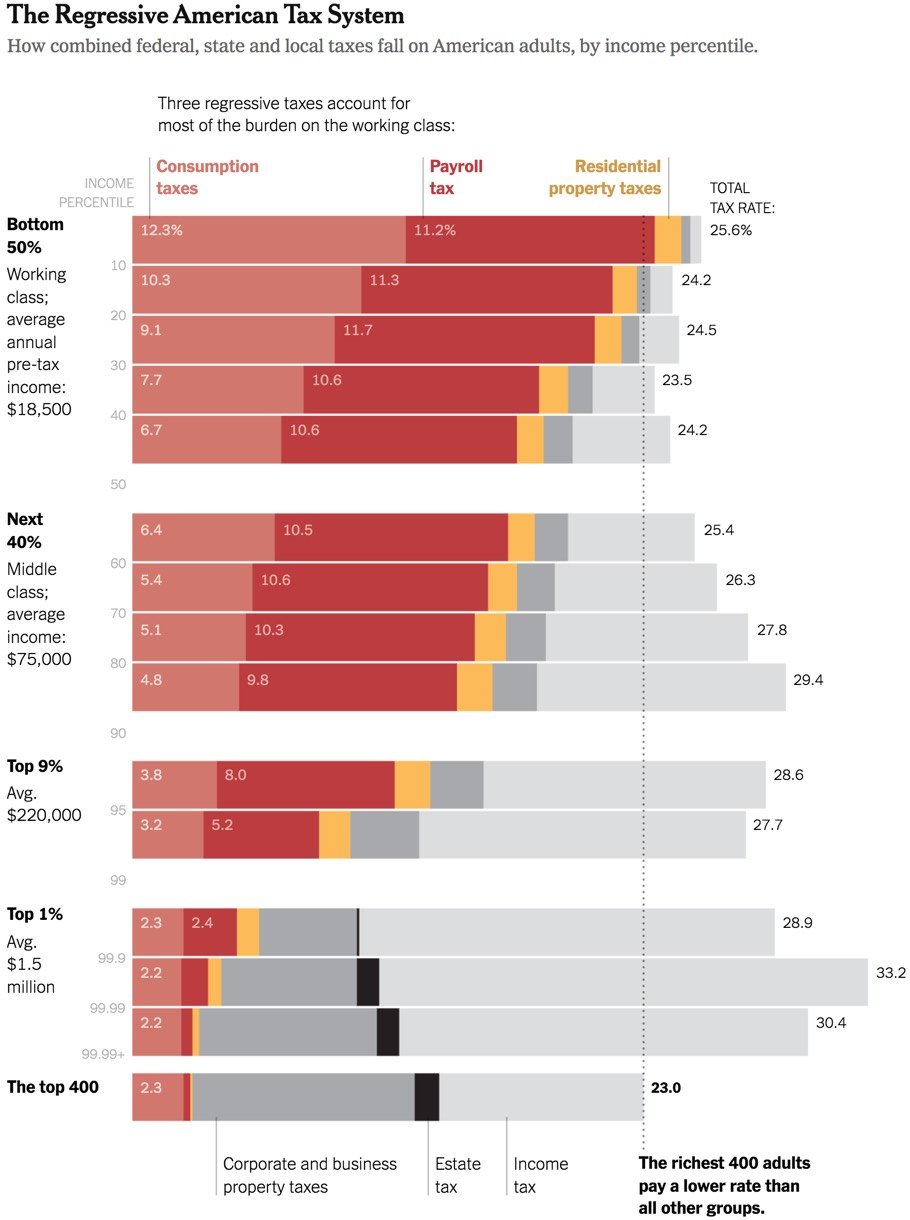
The result is a tax system that is much less progressive than it used to be. And unjust. The economists who compiled this data, Emmanuel Saez and Gabriel Zucman, have written a book called The Triumph of Injustice: How the Rich Dodge Taxes and How to Make Them Pay. In this piece called How to Tax Our Way Back to Justice, the pair lay out the problem and how we can fix it to make our tax system more just for the majority of Americans.
The good news is that we can fix tax injustice, right now. There is nothing inherent in modern technology or globalization that destroys our ability to institute a highly progressive tax system. The choice is ours. We can countenance a sprawling industry that helps the affluent dodge taxation, or we can choose to regulate it. We can let multinationals pick the country where they declare their profits, or we can pick for them. We can tolerate financial opacity and the countless possibilities for tax evasion that come with it, or we can choose to measure, record and tax wealth.
If we believe most commentators, tax avoidance is a law of nature. Because politics is messy and democracy imperfect, this argument goes, the tax code is always full of “loopholes” that the rich will exploit. Tax justice has never prevailed, and it will never prevail. […] But they are mistaken.
Breakfast, Lunch & Dinner, David Chang’s new Netflix series
Despite some reservations (a little too bro-y for one thing), I really enjoyed David Chang’s Netflix series Ugly Delicious. So I’m happy to see that he’s got a new series coming out called Breakfast, Lunch & Dinner. The trailer:
In this one, he’s traveling the world with some non-food celebs: he hits Los Angeles with Lena Waithe, Marrakesh with Chrissy Teigen, Phnom Penh with Kate McKinnon, and Vancouver with Seth Rogen. Will watch.
What to Expect When Expecting the Displeasure of the Chinese Government
The partnership between China and Western governments & corporations has hit a rough patch recently, namely the Hong Kong protests and how the NBA, Apple, and gaming company Blizzard have handled various responses to them on their platforms. I don’t have a lot to add on the matter, but I have read some interesting takes in the past few days that you might also want to take a look at.
Ben Thompson, The Chinese Cultural Clash:
I am not particularly excited to write this article. My instinct is towards free trade, my affinity for Asia generally and Greater China specifically, my welfare enhanced by staying off China’s radar. And yet, for all that the idea of being a global citizen is an alluring concept and largely my lived experience, I find in situations like this that I am undoubtedly a child of the West. I do believe in the individual, in free speech, and in democracy, no matter how poorly practiced in the United States or elsewhere. And, in situations like this weekend, when values meet money, I worry just how many companies are capable of choosing the former?
John Gruber riffing on Thompson’s piece:
The gist of it is that 25 years ago, when the West opened trade relations with China, we expected our foundational values like freedom of speech, personal liberty, and democracy to spread to China.
Instead, the opposite is happening. China maintains strict control over what its people see on the Internet — the Great Firewall works. They ban our social networks where free speech reigns, but we accept and use their social networks, like TikTok, where content contrary to the Chinese Community Party line is suppressed.
Farhad Manjoo, Dealing With China Isn’t Worth the Moral Cost:
The People’s Republic of China is the largest, most powerful and arguably most brutal totalitarian state in the world. It denies basic human rights to all of its nearly 1.4 billion citizens. There is no freedom of speech, thought, assembly, religion, movement or any semblance of political liberty in China. Under Xi Jinping, “president for life,” the Communist Party of China has built the most technologically sophisticated repression machine the world has ever seen. In Xinjiang, in Western China, the government is using technology to mount a cultural genocide against the Muslim Uighur minority that is even more total than the one it carried out in Tibet. Human rights experts say that more than a million people are being held in detention camps in Xinjiang, two million more are in forced “re-education,” and everyone else is invasively surveilled via ubiquitous cameras, artificial intelligence and other high-tech means.
None of this is a secret.
Om Malik, Our Collective Chinese Conundrum:
We in the West should very well know what and who we are dealing with — China might be decked out in Louis Vuitton, but underneath, it is still a single-party, quasi-communist nation. Knowing the Western desperation for growth and the insatiable needs of the stock markets, China also knows it can yank anyone’s chain.
Huawei isn’t a recent problem. It was a problem a decade ago. The dynamic in this spat between the NBA and China isn’t new — China gets what China wants, not the other way around. Why are we being outraged now? The West signed up for this.
Malik quotes from Ian Bremmer’s newsletter:
in the west, the past decades have been marked by a view that china would eventually adapt to western norms, institutions, political and economic systems. but from an asian perspective, the opposite appears more likely. after all, of the last 2,000 years, china and india have led the global economy for the first 1800; europe and the united states only flipped the script for the last 200. now that’s about to change. and when it does, it’s going to happen quickly, powered by 1.4 billion increasingly urban, educated and technologically-connected chinese citizens. take the long view (and an asian perspective) and it’s a better bet that the west will adapt to the realities of chinese economic power, not the other way around.
The updated terms and conditions for Earth. “You get one (1) Earth™. If you permanently damage your Earth™, you will not be able to trade it in for a new one.”
Misremembered Landscapes and Nearly Forgotten Memories


Creative director and artist Matt Jukes makes these lovely prints of “misremembered landscapes and nearly forgotten memories”. To me, they look like depictions of landskein, “the weaving & braiding of horizon lines, often seen most clearly on hazy days in hill country”.
You can purchase various editions of Jukes’ work from the shop on his website or Saatchi Art. (via tmn)
Really interesting discussion of the women on Succession and how they do (and don’t) wield power. “I’m left with this sense that pretty much every expression of female power on the show backfires in some way.”
2001: A Space Odyssey, The Frank Poole Epilogue
From Steve Begg (who I would guess is this Steve Begg, who has done VFX on the recent Bond films) comes an epilogue of Stanley Kubrick’s 2001: A Space Odyssey. The scene picks up 203 years after the events of 2001, following Frank Poole’s body as it encounters a monolith.
How Flu Vaccines Are Made
Ten years ago, in the midst of the 2009 swine flu pandemic, I wrote about the manufacturing process for the H1N1 flu vaccine. It involves billions of chicken eggs.
The most striking feature of the H1N1 flu vaccine manufacturing process is the 1,200,000,000 chicken eggs required to make the 3 billion doses of vaccine that may be required worldwide. There are entire chicken farms in the US and around the world dedicated to producing eggs for the purpose of incubating influenza viruses for use in vaccines. No wonder it takes six months from start to finish.
The post holds up pretty well because, according to the CDC, this is still the way most flu vaccines in America are manufactured. Here’s a look at pharmaceutical company GSK’s egg-based process:
Two other techniques for making flu vaccines were approved for use in the US in 2012 and 2013 respectively, cell-based flu vaccines:
‘Cell-based’ refers to how the flu vaccine is made. Most inactivated influenza vaccines are produced by growing influenza viruses in eggs. The influenza viruses used in the cell-based vaccine are grown in cultured cells of mammalian origin instead of in hens’ eggs.
A cell-based flu vaccine was developed as an alternative to the egg-based manufacturing process. Cell culture technology is potentially more flexible than the traditional technology, which relies upon adequate supply of eggs. In addition, the cell-based flu vaccine that uses cell-based candidate vaccine viruses (CVVs) has the potential to offer better protection than traditional, egg-based flu vaccines as a result of being more similar to flu viruses in circulation.
NIAID and its industry partners have made progress in moving from both the egg-based and cell-based flu vaccine production methods toward recombinant DNA manufacturing for flu vaccines. This method does not require an egg-grown vaccine virus and does not use chicken eggs at all in the production process. Instead, manufacturers isolate a certain protein from a naturally occurring (“wild type”) recommended flu vaccine virus. These proteins are then combined with portions of another virus that grows well in insect cells. The resulting “recombinant” vaccine virus is then mixed with insect cells and allowed to replicate. The flu surface protein called hemagglutinin is then harvested from these cells and purified.
Both of these new techniques make production quicker, thereby resulting in more effective vaccines because they are more likely to match the strains of whatever’s “going around”.
As a reminder, you should get a flu shot every year in the fall. The CDC recommends that “everyone 6 months of age and older should get a flu vaccine every season with rare exception”, especially those “who are at high risk of serious complications from influenza”. Flu vaccines are covered by your health insurance without copay (thanks, Obama!) and are often available at drug stores without an appointment or a long wait. So go get one!
Silence Is the Presence of Everything
This morning, instead of crawling straight from bed to desk and diving into the internet cesspool, I went for a walk. I went because I needed the exercise, because it was a nice sunny day out, because the changing leaves are super lovely right now. (Check out my Instagram story for some of what I saw along the way.) But I also wanted to listen to this episode of On Being with Gordon Hempton called Silence and the Presence of Everything. Hempton is an acoustic ecologist who has a lot of interesting things to say about silence and natural sounds.
Oh, grass wind. Oh, that is absolutely gorgeous, grass wind and pine wind. We can go back to the writings of John Muir, which — he turned me on to the fact that the tone, the pitch, of the wind is a function of the length of the needle or the blade of grass. So the shorter the needle on the pine, the higher the pitch; the longer, the lower the pitch. There are all kinds of things like that, but the two folders where I collected, I have, oh, over 100 different recordings which are actually silent from places, and you cannot discern a sense of space, but you can discern a sense of tonal quality, that there is a fundamental frequency for each habitat.
It sounds paradoxical, but I wanted to listen to this podcast in a setting with natural sounds, rather than in my car or on a plane. I had my AirPods in because they don’t block all outside sound, so I could hear the crunch of the road beneath my shoes as I walked and listened. The nature and animal sounds in the episode sounded like they were actually coming from all around me. I paused the episode for a minute or two to listen to a burbling brook I passed along the way. The whole experience was super relaxing and informative.1
You can read more about Hempton and his efforts in preserving the world’s silence places on his website The Sound Tracker or in his book, One Square Inch of Silence. Outside magazine recently profiled Hempton, who, in cruel twist of fate, has suffered dramatic hearing loss in recent years.
The problem Hempton hopes to take on is gargantuan. To understand it, try a little experiment: when you reach the period at the end of this sentence, stop reading for a moment, close your eyes, and listen.
What did you hear? The churn of the refrigerator? The racing hiss of passing traffic? Even if you’re sitting outside, chances are you heard the low hum of a plane passing overhead or an 18-wheeler’s air horn shrieking down a not-so-distant highway.
If you heard only the sounds of birds and the wind in the trees, you’re one of a lucky few. But it’s likely that quiet won’t last.
This short documentary, Sanctuaries of Silence, follows Hempton to some of the quietest places on Earth, including the Hoh Rain Forest in Olympic National Park.
I think what I like most about listening is that I disappear.
If you’d like to disappear for awhile but don’t have access to a quiet place, you should check out some of Hempton’s recordings on Spotify — I’m listening to Forest Rain right now.
Or try out the Sound Escapes podcast to check out some of his best natural soundscapes. (thx Meg, who sent along a link to the On Being episode after reading yesterday’s post on noise pollution)
And it was another good example of the AirPods as an AR device.↩
Are we living in a simulation? “If our reality were a simulation, how could we possibly step outside it to confirm?”
An interview with pilot Tammie Jo Shults, who landed Southwest flight 1380 when an engine failure blew a hole in the cabin. This woman has pure ice water in her veins.
The World’s Quiet Places Are Disappearing In a Technological Cloud of Noise
For The Atlantic, Bianca Bosker writes about the growing problem of noise pollution (because of our love of technology and hands-off governments) and why so few people take it seriously (because of our love of technology and hands-off governments).
Scientists have known for decades that noise — even at the seemingly innocuous volume of car traffic — is bad for us. “Calling noise a nuisance is like calling smog an inconvenience,” former U.S. Surgeon General William Stewart said in 1978. In the years since, numerous studies have only underscored his assertion that noise “must be considered a hazard to the health of people everywhere.” Say you’re trying to fall asleep. You may think you’ve tuned out the grumble of trucks downshifting outside, but your body has not: Your adrenal glands are pumping stress hormones, your blood pressure and heart rate are rising, your digestion is slowing down. Your brain continues to process sounds while you snooze, and your blood pressure spikes in response to clatter as low as 33 decibels-slightly louder than a purring cat.
Experts say your body does not adapt to noise. Large-scale studies show that if the din keeps up-over days, months, years-noise exposure increases your risk of high blood pressure, coronary heart disease, and heart attacks, as well as strokes, diabetes, dementia, and depression. Children suffer not only physically-18 months after a new airport opened in Munich, the blood pressure and stress-hormone levels of neighboring children soared-but also behaviorally and cognitively. A landmark study published in 1975 found that the reading scores of sixth graders whose classroom faced a clattering subway track lagged nearly a year behind those of students in quieter classrooms-a difference that disappeared once soundproofing materials were installed. Noise might also make us mean: A 1969 study suggested that test subjects exposed to noise, even the gentle fuzz of white noise, become more aggressive and more eager to zap fellow subjects with electric shocks.
Being pretty sensitive to noise, I read this piece with a great deal of interest. One of the benefits of living in the middle of nowhere in the country is that when I go outside, the sounds I hear are mostly natural: birds, streams, wind, frogs, and insects. In the winter, the quiet is sometimes so complete that you can only hear the sound of your own heart beating in your ears. But lately, some dipshit who owns a car with a deliberately loud after-market muffler has been driving through the surrounding hills, disrupting the peace. I can’t usually hear cars passing on the nearby road, but this muffler jackass you can hear literally miles away. It makes me want to smash things! I feel like a bit of a crank, but why does this person’s freedom to have a loud muffler override the freedom of the thousands of people within earshot to have quiet? (See also positive versus negative liberty and How Motorcyclists Think People React When They Drive By.)
Beading the Cosmos

Inspired by some photos taken by the Hubble Space Telescope, Margaret Nazon began in 2009 to make beaded artworks of stars, galaxies, planets, and nebula. I love her representation of the Milky Way, pictured above. Nazon grew up in a First Nation community in Canada’s Northwest Territories and in this interview she talks about using traditional materials for her cosmic drawings.
I consider my art to be “abstract.” Aboriginal people have used animal skins, bones, seeds, quills and rocks for decoration, and I figured it would fit in my artwork. I was given buttons made of caribou bones as a gift and I decided I should try to incorporate a solid piece of bone into one of my galaxy pictures. Viewers loved that. I spent last December in Salt Spring Island B.C. One of my friends asked if I was going to incorporate B.C. rocks or shells in my work and I thought that was a great idea. I started receiving rocks and shells as inspiration. Just recently a Gwich’in friend gave me willow seeds to use. The Gwich’in people used to use willow seeds to decorate their clothing.
(via brain pickings)
Amazon is introducing a Kindle for kids. It includes a case, a 2-year replacement guarantee, and 1-year subscription to a extensive collection of books.
Beautiful Drone-Lit Landscapes by Reuben Wu


I’ve featured Reuben Wu’s work here before so when I saw via Colossal that he’s got some new stuff going on, I immediately went to check it out. In his Aeroglyphs, Lux Noctis, and Field of Infinity projects, Wu achieves a minimalist sci-fi lighting effect by using drones to light desolately beautiful natural landscapes. Check out his Instagram and Facebook for more images, particularly this video.
Oh, and he also caught the recent total solar eclipse in Chile in this video and this photo. Wow. Kicking myself a little bit that I did not get organized to head to Chile for this.
True Facts About the Ogre-Faced Spider
Ze Frank released the most recent video in his True Facts series about animals last month. Meet the ogre-faced spider. Admittedly I haven’t watched any of the other True Facts videos in awhile, but this one seemed unusually informative (while retaining Frank’s signature humorous asides). I would watch an entire nature series like this: funny but not dumbed down on the science side.
1869 US Patent Drawing for a Human Flying Machine

From the catalog of the National Archives, a drawing from US Patent #95513 filed by W.F. Quinby in 1869 for “Improvement in Flying-Machines”. This could easily be the cover of a lost 2003 Neutral Milk Hotel album. (via @john_overholt)
Wait, the last woolly mammoths died out only 4000 years ago?! They were still alive hundreds of years after the Giza pyramids were built and indoor plumbing was used in the Indus Valley.
My Favorite Talks from XOXO 2019
I was fortunate enough to make it out to Portland, OR for the 2019 XOXO festival back in September. It was my third time attending — I went the first year and in 2015 — and, goodness, the conference has changed a lot. XOXO used to be comfortably in my wheelhouse and now it’s more on the outskirts, so instead of hearing a bunch of stuff I want to hear, I trust the conference organizers to present some things that I need to hear, to keep me curiously exploring new ideas, viewpoints, and experiences unlike my own.
XOXO has started posting videos of all their talks online (one new video each weekday), and I’m going to share some of my favorites here. The first video is of Tracy Clayton’s barnburner of a talk: Log Off, Fam — Self Care in the Timeline Era.
Clayton and I overlapped at Buzzfeed (she was an employee and I had a desk there working on kottke.org) but have never met, so it was interesting to hear about her success and ultimately bad experience there.
I’ll updating this post with the rest of my favorites as they’re posted on YouTube.
Update: I enjoyed Soleil Ho’s talk about how the drive by her and others to shift the food world’s conversation on representation and cultural appropriation is starting to bear some fruit.
Update: My favorite talk, the one that hit me most squarely in the feels, was by Emily & Amelia Nagoski. It was about burnout, which I have been, I think, struggling with lately w/r/t to this here website. There were several points during this talk when I felt absolutely naked, exposed — like they were talking just to me.
Harry Brewis told us about the time when a goofy project he started spun out of his control in the most wonderful way:
To close the conference, Rhea Butcher talked about the importance of seeking without necessarily worrying about the finding:
You can find all of the 2019 talks right here.
The BBC’s Abridged Reading of Margaret Atwood’s The Testaments
BBC Radio 4 has done an abridged audio reading of Margaret Atwood’s The Testaments, her followup to The Handmaid’s Tale. The series is composed of 15 episodes that run 14 minutes each — a total of 3.5 hours compared to the full 13+ hour audiobook. The episodes are only going to be available online for a short time though — the first one expires Oct 15 — so get in there if you’re going to listen. I’m reading the book right now, otherwise I’d be right there with you. (via open culture)
Writing advice from JK Rowling. “You can’t be a good writer without being a devoted reader.”
Five True Tales of Manhattan
Great Big Stories has collected five of their video short stories into a collection: 5 True Tales of Manhattan. The stories include a restaurant that serves Cuban-Chinese cuisine, Sunday night jazz concerts in a Harlem apartment, and a woman who rehabs dozens of turtles in her small apartment.
The Fantastical Flying Machines of Hayao Miyazaki
Riffing off a remark made by Guillermo del Toro that a director’s output is all part of the same movie, Andrew Saladino of The Royal Ocean Film Society looks at the many airships in Hayao Miyazaki’s films. What does the director’s continued use of flying machines tell us about filmmaking, technology, and everything else he’s trying to communicate though his films?
What’s Weirder: Glenlivet’s Tide Pods or Le Creuset’s Star Wars Collection?
Last week we saw two absolutely incredible product introductions, and I’m having trouble picking a favorite. First, there were Glenlivet’s cocktail capsules that immediately reminded the entire internet of Tide Pods.

And then there was Le Creuset’s Star Wars collection of cookware, including a Darth Vader dutch oven, R2-D2 cooker, a Han Solo in carbonite roasting pan, and a “hand-painted, special-edition Tatooine™ Round Dutch Oven, inspired by the desert planet with captivating binary sunsets”.
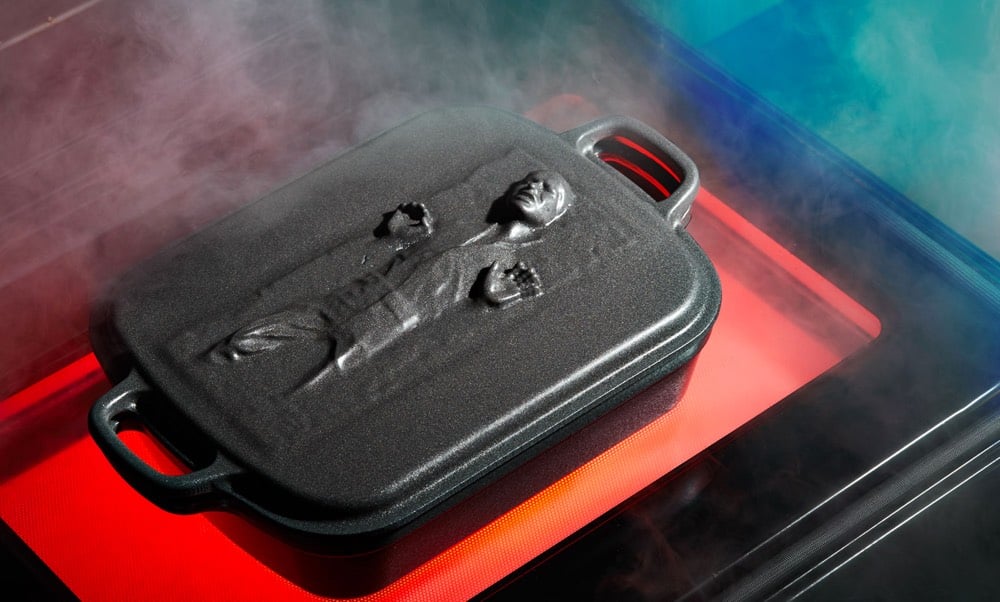

People, we are living in a true golden age.
An Animated 3D Video Tour of Paris Through History from 52 BCE to 1889
In 2012, a company called Dassault Systèmes launched an interactive application that allowed you to move about in a 3D historical reconstruction of Paris at different points in its history. The application seems to have fallen into disrepair so that you can’t actually use it, but the 13-minute video above offers a tour through several time periods, including:
- 52 BCE. The area was home to a Celtic group called the Parisii, just before the Romans conquered the settlement.
- 2nd century CE. The Romans ruled here until 486 CE; they called the city Lutetia.
- 1165-1350. The medieval period. Paris was one of the largest cities in Europe.
- 1789. A look at the Bastille during the French Revolution.
- 1887-1889. The construction of the Eiffel Tower for the 1889 World’s Fair. It was the tallest man-made structure in the world for more than 40 years (eclipsed by the Chrysler Building).

Socials & More