

You know who is really good at Ninja Warrior? Chimpanzees. Watch this one casually destroy a course in Japan.

Advertise here with Carbon Ads
This site is made possible by member support. 💞
Big thanks to Arcustech for hosting the site and offering amazing tech support.
When you buy through links on kottke.org, I may earn an affiliate commission. Thanks for supporting the site!
kottke.org. home of fine hypertext products since 1998.
Beloved by 86.47% of the web.
Entries for August 2019
The Antarctic Iceberg Tracking Database. The largest iceberg tracked had an area of 4000 sq. miles.
The Bear with Its Own ZIP Code
Today I learned that ZIP Codes do not strictly represent geographic areas but rather “address groups or delivery routes”.
Despite the geographic derivation of most ZIP Codes, the codes themselves do not represent geographic regions; in general, they correspond to address groups or delivery routes. As a consequence, ZIP Code “areas” can overlap, be subsets of each other, or be artificial constructs with no geographic area (such as 095 for mail to the Navy, which is not geographically fixed). In similar fashion, in areas without regular postal routes (rural route areas) or no mail delivery (undeveloped areas), ZIP Codes are not assigned or are based on sparse delivery routes, and hence the boundary between ZIP Code areas is undefined.
The White House has its own ZIP Code (20500), as does the shoe floor of Saks Fifth Avenue in NYC (10022-SHOE). US mail to Santa Claus gets sent to the town of North Pole, Alaska (99705) but in Canada, Santa gets his own postal code (H0H 0H0). And Smokey Bear has his own ZIP Code (20252) because he gets so much mail.
ZIP Codes are therefore not that reliable when doing geospatial analysis of data:
Even though there are different place associations that probably mean more to you as an individual, such as a neighborhood, street, or the block you live on, the zip code is, in many organizations, the geographic unit of choice. It is used to make major decisions for marketing, opening or closing stores, providing services, and making decisions that can have a massive financial impact.
The problem is that zip codes are not a good representation of real human behavior, and when used in data analysis, often mask real, underlying insights, and may ultimately lead to bad outcomes. To understand why this is, we first need to understand a little more about the zip code itself.
For instance, in Miami’s 33139 ZIP Code the difference between the highest median income (as measured in much more granular US Census Block Groups) and lowest median income is over $240,000. So you can imagine it would be difficult to know or even assume anything in general about those residents based on their ZIP Code alone.
Lizzo does a Tiny Desk Concert at NPR. “How we feelin’ at this tiny-ass desk?”
The Version Museum
The mission of Version Museum is to record and present what the interfaces of software and websites looked like, from their earliest versions until now. The site’s tagline is “a visual history of your favorite technology”. Here’s the history of Facebook; an early screenshot:

The first version of Microsoft’s Excel for Windows:


Internet Explorer (screenshot of the 1.0 version displaying a circa-1995 Yahoo! homepage):

The collection isn’t huge, but the father/son team behind it hits the high points, including Amazon, New York Times, OS X, and iTunes.
Update: One of the Facebook screenshots that the Version Museum is using included Brian Moore’s phone number and other personal information. Per Moore’s general request, I have blurred out that information and I hope the museum does the same. (thx, all)
Scientists have discovered a cure for extreme drug-resistant tuberculosis. “Once, a diagnosis of extensively drug-resistant TB meant quick death. A three-drug regimen cures most patients in just months.”
Four Neutral Milk Hotel singles & EPs previously released on vinyl are now available as digital downloads. They’re pay as you wish, with all proceeds going to the band.
Tracking Overnight Use of US National Parks
Designer Jordan Vincent has created a visualization tracking overnight stays in US National Parks, i.e. people using tents & RVs at campsites, backcountry camping, and lodging.

As you can see from the charts, the usage of many parks is heaviest in the summer. For instance, Yellowstone is used heavily until the beginning of September and then drops off to almost nothing by mid-October. For some parks, like the Great Smoky Mountains and Shenandoah, usage spikes in the fall during peak foliage.1
Just typing the phrase “peak foliage” during the dog days of summer in Vermont is making me anxious of the approaching winter. Winter here kicked my ass the past two years, so I’m really motivated to not be depressed for 6 months this year. Any (non-obvious) tips? Already planning trips to warm places, socializing, getting outdoors more, and SAD lamping…↩
Urban Nudges
Urban Nudges is a site that documents small efforts by cities and the people who live in them to slightly change the behaviors of their inhabitants in some way. A 2008 book by Richard Thaler and Cass Sunstein defines a nudge as “any aspect of the choice architecture that alters people’s behavior in a predictable way without forbidding any options or significantly changing their economic incentives”. That sounds a bit academic but some examples from the site clarify things. For instance, protected bike lanes encourage bike riding:
The study “Lessons from the Green Lanes: Evaluating Protected Bike Lanes in the U.S.” was conducted in eight protected bike lanes in Austin, Chicago, Portland, San Francisco, and Washington, DC and the major findings were that bike lanes induced new bikers, mostly because they feel safer about the experience.
The researchers interviewed 2,283 cyclists using the bike lanes and found out that nearly ten percent of the users would have taken another mode of transportation if the bike lane hadn’t existed and around one percent of the interviewed said they would not have taken the trip at all.
Dancing zebras in Bolivia cajole motorists into minding crosswalks and other rules of the street:

Inspired by the Colombian experience, in Bolivia the Department of transportation developed a program where urban educators get dressed as zebras, teaching children and adults urban values through empathy and comedy. The project’s initial concept was to teach pedestrians and drivers the appropriate use of the pedestrian crossing and reduce congestion: urban zebras rejoice when pedestrians wait for green light and grab their head in agony when pedestrians jaywalk. Empathy, humility and comedy made them popular.
A speedometer in Amsterdam raises money for the neighborhood when drivers do the speed limit:
Every driver that passes by the speedometer below the speed limit of 30 km per hour raises EUR0,03 for the neighborhood. “The city’s slogan: Max 30 — Save for the Neighborhood” (Pop Up City). The money raised by this initiative is granted by the city of Amsterdam and is meant to be invested in local community projects.
What kind of nudges could you imagine in your town or city?
Study finds NYC restaurant industry thriving after $15 minimum wage increase. “Contrary to fears of massive job losses, $20 Big Macs, and shuttered restaurants, we found a thriving industry.”
The Racial History of Soda in America
In 2013, University of Virginia historian Grace Elizabeth Hale wrote about “the long and often fractious history of soft drinks, prohibition laws and race” for the NY Times.
Coke’s recipe wasn’t the only thing influenced by white supremacy: through the 1920s and ’30s, it studiously ignored the African-American market. Promotional material appeared in segregated locations that served both races, but rarely in those that catered to African-Americans alone.
Meanwhile Pepsi, the country’s second largest soft drink company, had tried to fight Coke by selling its sweeter product in a larger bottle for the same price. Still behind in 1940, Pepsi’s liberal chief executive, Walter S. Mack, tried a new approach: he hired a team of 12 African-American men to create a “negro markets” department.
Elsewhere in the soft drink industry, though, the oversimplification of target consumers has had its questionable if not altogether offensive moments, too. Mountain Dew, for instance, originally based its entire brand around making fun of poor Appalachians, also known as hillbillies. In the late 40s and early 50s, its label featured the official Mountain Dew mascot “Willy the Hillbilly” and the slogan: “Ya-Hoo! Mountain Dew. It’ll tickle yore innards.” (The name of the soft drink, of course, refers to the Southern slang for moonshine.)
In a not-very-convincing rebuttal to Hale’s article, Coke’s “Chief Historian” argues that the company has always been America’s “most inclusive drink” and more oddly, that Coke has never contained cocaine, which Snopes handily debunked. (thx, caroline)
Is Your Journalism a Luxury or Necessity? “We hear a chorus of hot tips for ‘smarter living,’ and near silence on how to survive in America. … There is no Wirecutter for the poor.”
The Gerrymandered Font

Gerry is a typeface where the letterforms are created from heavily gerrymandered Congressional districts. For example, the letter U is the 4th district in Illinois:

Click through to download the font for free and to tweet at your representative to stop gerrymandering.
This is a powerful piece: Dear Disgruntled White Plantation Visitors, Sit Down. “The Old South may be your American Downton Abbey but it is our American Horror Story.”
Ebola now appears curable. “For newly infected patients on one of the drugs, the mortality rate dropped to 6 percent.”
Measuring the Popularity of the Falsetto in Pop Music
In today’s episode of Earworm, Estelle Caswell teams up with Matt Daniels from The Pudding to track the popularity of the falsetto in pop music from the 50s to today. Caswell has a hunch that falsetto has been getting more popular, so they end up getting a bunch of data from Pandora that tracks the amount of falsetto used in a song and the vocal register of the singer, which they compared against Billboard Top 100 songs. The verdict? You’ll have to watch the video, but just remember all of those soul songs in the 70s and heavy metal & pop songs in the 80s…
Caswell compiled a Spotify playlist of songs with prominent use of falsetto:
In the recommended reading list, I found this Frieze piece from 2010, The Evolution of the Male Falsetto.
By reputation the falsetto voice is both angelic and diabolical, depending on who is singing, and to what purpose. Jónsi Birgisson, vocalist with Sigur Rós, is revered for his keening falsetto, the most ethereal element inside a great wash of sound. Birgisson is openly gay; on the other hand I still remember, at age 13, hearing Robert Plant singing Led Zeppelin’s ‘Black Dog’ (1971) for the first time, and how its devilish heterosexual lust scared me to bits. Plant is a truly outrageous singer, possessing a voice so alight with desire that he sounds in imminent danger of burning up. He is predatory but vulnerable, a bare-chested rock god who sings from a place of sexual rapture that cancels out the boundaries of his own body. He got there through intensive study of the blues: as with most tropes in popular music, the falsetto is in continual transit between black and white performers and their audiences.
But back to the video, I LOL’d at ~3:30 when they went through the raw data of falsettos, which goes from George P. Watson in 1911 (a yodeler) to contemporary Radiohead. I am a big Radiohead fan. And my kids? Not so much. In fact, my son has been trying to convince me for the past year that Thom Yorke doesn’t so much sing as yodel. I’ve explained falsettos to him but I will invariably hear “ugh, yodeling!” from the backseat when Radiohead comes on in the car. This Watson/Radiohead connection though…maybe he has a point? Maybe I just like yodeling?
More than 50% of Google searches result in zero clicks. That is, presumably people are getting their answers directly on the search page and not from the sites crawled. **BIG MIDDLE FINGER TO GOOGLE**
The Railrodder, Buster Keaton’s Final Silent Film from 1965
In 1965, long after his days making some of the most iconic and physically demanding silent films, pioneering physical comedian Buster Keaton made one last silent flick with the National Film Board of Canada.
This short film from director Gerald Potterton (Heavy Metal) stars Buster Keaton in one of the last films of his long career. As “the railrodder”, Keaton crosses Canada from east to west on a railway track speeder. True to Keaton’s genre, the film is full of sight gags as our protagonist putt-putts his way to British Columbia. Not a word is spoken throughout, and Keaton is as spry and ingenious at fetching laughs as he was in the old days of the silent slapsticks.
Buster Keaton Rides Again, a 55-minute documentary about the making of The Railrodders, might be even more interesting because you hear Keaton talking about his craft and career.
See also The Scribe, a film that was released the following year that was Keaton’s final starring role, Buster Keaton and the Art of the Gag, the small collection of posts about Keaton here at kottke.org, and this video of some of his most amazing stunts (with a voiceover of Keaton talking about his career):
(thx, marcus)
Scientists have identified (in mice) the proteins that control the birth of sound-detecting cells in the ear. This may lead to a regenerative therapeutic treatment for hearing loss.
Taking a Full Photo of the Earth Every Day
This is a really cool visualization of how Planet’s 150+ imaging satellites take a complete satellite photo of the Earth every single day.

Every few seconds, the visualization picks a new satellite to track, allowing you to see the location, height, and speed. The satellites are 300 miles from the surface of the Earth moving at about 17,000 mph.
Insects in the US are dying at record rates because *checks notes* humans are killing them with pesticides. “America’s agricultural landscape is now 48 times more toxic…than it was 25 years ago.”
Making Food from Carbon Dioxide & Water
Using a concept from NASA, a Finnish company called Solar Foods has figured out how to manufacture protein from carbon dioxide, water, and electricity. They call it Solein.
A company from Finland, Solar Foods, is planning to bring to market a new protein powder, Solein, made out of CO2, water and electricity. It’s a high-protein, flour-like ingredient that contains 50 percent protein content, 5-10 percent fat, and 20-25 percent carbs. It reportedly looks and tastes like wheat flour, and could become an ingredient in a wide variety of food products after its initial launch in 2021.
It’s likely to first appear on grocery shelves in protein shakes and yogurt. It could be an exciting development: Solein’s manufacturing process is carbon neutral and the potential for scalability seems unlimited — we’ve got too much CO2, if anything. Why not get rid of some greenhouse gas with a side of fries?
The production of food (and the protein contained in meat in particular) is responsible for a large percentage of our planet’s changing climate, so if Solein pans out, it could be a huge development. It will be interesting to see if the wizards or prophets win the battle to “fix” climate change…Solein is one hell of a salvo by the wizards.
Rebecca Boice, chef at Oakland’s Flora, created a menu inspired by Robin Sloan’s novel Sourdough. Here’s an annotated look at the menu.
The Mosquito: Humanity’s Greatest Enemy
For the New Yorker, Brooke Jarvis reviews Timothy C. Winegard’s The Mosquito: A Human History of Our Deadliest Predator.
It turns out that, if you’re looking for them, the words “mosquitoes,” “fever,” “ague,” and “death” are repeated to the point of nausea throughout human history. (And before: Winegard suggests that, when the asteroid hit, dinosaurs were already in decline from mosquito-borne diseases.) Malaria laid waste to prehistoric Africa to such a degree that people evolved sickle-shaped red blood cells to survive it. The disease killed the ancient Greeks and Romans — as well as the peoples who tried to conquer them — by the hundreds of thousands, playing a major role in the outcomes of their wars. Hippocrates associated malaria’s late-summer surge with the Dog Star, calling the sickly time the “dog days of summer.” In 94 B.C., the Chinese historian Sima Qian wrote, “In the area south of the Yangtze the land is low and the climate humid; adult males die young.” In the third century, malaria epidemics helped drive people to a small, much persecuted faith that emphasized healing and care of the sick, propelling Christianity into a world-altering religion.
And then there’s this:
In total, Winegard estimates that mosquitoes have killed more people than any other single cause — fifty-two billion of us, nearly half of all humans who have ever lived. He calls them “our apex predator,” “the destroyer of worlds,” and “the ultimate agent of historical change.”
Two other recent reviews of the book: In ‘The Mosquito,’ Humans Face A Predator More Deadly Than The Rest (NPR) and The mosquito isn’t just annoying — Timothy C. Winegard says we’re at war (LA Times).
It’s time to get rid of the lottery. “States should not rely on a scam to fund much-needed services.”
The Border Wall Seesaw
I realize that many of you have probably seen it already, but I ran across this while away on vacation and thought it was one of the most clever, moving, and powerful creative projects I’ve seen recently. Working off of a concept from 2009, activist architects Ronald Rael and Virginia San Fratello installed three seesaws through the US/Mexico border wall near El Paso which allowed children on both sides of the border to enjoy playing together.

Here’s video of the seesaws in action (from Rael’s Instagram post):
Brilliant. Damon Stapleton says that the seesaw has a “gentle anarchy” to it.
Their beautiful intention was to bring people together through design. As you may have guessed, I really like this idea. It has power, playfulness, humanity, humour and simplicity in equal measure. But most importantly, it has a gentle anarchy at its core. Great ideas like these have this essential creative point of view. There are no rules. Reject the world as it is or how others tell you to see it. Realise you have the ability to make the world the way you want it to be. And, it will be fun or at the very least, unboring. Gentle anarchy. This point of view can be scary for many. But without it, almost nothing will change or move forward.
The plans for the seesaw are on the cover of Rael’s 2017 book, Borderwall as Architecture: A Manifesto for the U.S.-Mexico Boundary, in which he documents similar projects like Burrito Wall, where the border wall is converted into a small restaurant.
Short teaser trailer featuring a first look at Olivia Colman as Queen Elizabeth in The Crown. Season 3 premieres Nov 17 on Netflix.
The Greta Thunberg Effect
According to recent statistics, the number of books published about the climate crisis & the natural world aimed at children has more than doubled over the last year. Children’s publishers are crediting climate activist Greta Thunberg with igniting interest in the climate among the younger set.
“I absolutely would say there has been a Greta Thunberg effect,” says Rachel Kellehar, head of nonfiction. “She has galvanised the appetite of young people for change, and that has galvanised our appetite, as publishers, for stories that empower our readers to make those changes.”
I’d give David Attenborough’s recent run of nature documentaries some credit as well…the young people in my household are big fans of Planet Earth II and Blue Planet II.
Here are a few recent and upcoming children’s books about climate and nature, in addition to Thunberg’s own No One Is Too Small to Make a Difference, of course.

A Wild Child’s Guide to Endangered Animals by Millie Marotta. “A Wild Child’s Guide to Endangered Animals highlights the plight of 43 endangered species from around the world, including rare and well-known animals living in freshwater, oceans, forests, mountains, tundras, deserts, grasslands, and wetlands.”
Earth Heroes: Twenty Inspiring Stories of People Saving Our World by Lily Dyu. “With twenty inspirational stories celebrating the pioneering work of a selection of Earth Heroes from all around the globe, from Greta Thunberg and David Attenborough to Yin Yuzhen and Isatou Ceesay, each tale is a beacon of hope in the fight for the future of our planet, proving that one person, no matter how small, can make a difference.”
Ninita’s Big World: The True Story of a Deaf Pygmy Marmoset by Sarah Glenn Marsh. “Published in partnership with the RSCF, this charming true story of how one little orphaned monkey got a second chance to have a family gently introduces kids to disability, biodiversity, and wildlife conservation.”
Where the River Runs Gold by Sita Brahmachari. “The few live in luxury, whilst the millions like them crowd together in compounds, surviving on meagre rations and governed by Freedom Fields — the organisation that looks after you, as long as you opt in. The bees have long disappeared; instead children must labour on farms, pollinating crops by hand so that the nation can eat.”
America’s National Parks by Lonely Planet Kids. “With awesome facts, photos and illustrations on every page, you’ll discover erupting geysers, exploding volcanoes, howling wolves, soaring eagles, mountains, glaciers, rainforests and more throughout the continental USA, Hawaii, American Samoa and the US Virgin Islands.”

Kids Fight Plastic: How to be a #2minute Superhero by Martin Dorey. “Read this essential book and find out how you can become a #2minutesuperhero by completing 50 missions to fight plastic at home, school and on your days out.”
Don’t Let Them Disappear by Chelsea Clinton. “Taking readers through the course of a day, Don’t Let Them Disappear talks about rhinos, tigers, whales, pandas and more, and provides helpful tips on what we all can do to help prevent these animals from disappearing from our world entirely.”
Evie and the Animals by Matt Haig. “Eleven-year-old Evie has a talent. A SUPERTALENT. A talent that can let her HEAR the thoughts of an elephant, and make friends with a dog and a sparrow. The only problem is, this talent is dangerous. VERY dangerous. That’s what her dad says.”
If Thunberg doesn’t win the Nobel Peace Prize in the next few years for her efforts, I’ll be very surprised.
Questionnaire
I read a short poem by Wendell Berry this morning called Questionnaire that has relevance to some of the things our society and culture have been chewing on over the past few years. The last two stanzas read:
4. In the name of patriotism and
the flag, how much of our beloved
land are you willing to desecrate?
List in the following spaces
the mountains, rivers, towns, farms
you could most readily do without.5. State briefly the ideas, ideals, or hopes,
the energy sources, the kinds of security,
for which you would kill a child.
Name, please, the children whom
you would be willing to kill.
Questionnaire is from Berry’s 2009 collection, Leavings. (via fave 5)
Zero-Waste Cooking
Nolla is a zero-waste restaurant in Helsinki, Finland.
At Nolla there is no waste bin in the kitchen nor can you find any single use plastic in the restaurant either. No produce wrapped in plastic, no cling film, no vacuum bags. Every detail from staff clothing and napkins to tableware has been thought of. Even the gift cards are made of compostable paper that has poppy seeds in them.
We don’t produce waste nor do we cook from waste.
We work directly with suppliers to rethink, reject and control packaging while at the same time sourcing local and organic produce, which are the core of our menus.
See also WastED, a pop-up series conceived by Blue Hill’s Dan Barber where dishes on the menu were made of so-called waste food.
And if you would like to use less plastic in your own home, Trash Plastic offers a bunch of tips to make that happen.
See You Next Week
Hey, just a short note to say that kottke.org won’t be published this week. This is the first break in publishing the site since…well, I don’t really know. Maybe 5 years? Or even 10? I had a guest editor last week (thanks Patrick!) but this feels like a good time for a break break. Your regularly scheduled information & nonsense will resume on August 12.
Tim will be sending out an installment of the Noticing newsletter this Friday, so make sure to sign up for that if you’re not already on board.
And me? I’m on a LA-to-Portland road trip. I’ll share my adventures from the trip when I get back, but for now you can follow along on Instagram (especially via Stories). So, far, it’s been pretty fun + interesting.

The United States of Guns
Like many of you, I read the news of a single person killing at least 20 people in El Paso, Texas yesterday and another person killing at least 9 people In Dayton, Ohio early this morning. While these are outrageous and horrifying events, they aren’t surprising or shocking in any way in a country where more than 33,000 people die from gun violence each year.
America is a stuck in a Groundhog Day loop of gun violence. We’ll keep waking up, stuck in the same reality of oppression, carnage, and ruined lives until we can figure out how to effect meaningful change. I’ve collected some articles here about America’s dysfunctional relationship with guns, most of which I’ve shared before. Change is possible — there are good reasons to control the ownership of guns and control has a high likelihood of success — but how will our country find the political will to make it happen?
An armed society is not a free society:
Arendt offers two points that are salient to our thinking about guns: for one, they insert a hierarchy of some kind, but fundamental nonetheless, and thereby undermine equality. But furthermore, guns pose a monumental challenge to freedom, and particular, the liberty that is the hallmark of any democracy worthy of the name — that is, freedom of speech. Guns do communicate, after all, but in a way that is contrary to free speech aspirations: for, guns chasten speech.
This becomes clear if only you pry a little more deeply into the N.R.A.’s logic behind an armed society. An armed society is polite, by their thinking, precisely because guns would compel everyone to tamp down eccentric behavior, and refrain from actions that might seem threatening. The suggestion is that guns liberally interspersed throughout society would cause us all to walk gingerly — not make any sudden, unexpected moves — and watch what we say, how we act, whom we might offend.
We’re sacrificing America’s children to “our great god Gun”:
Read again those lines, with recent images seared into our brains — “besmeared with blood” and “parents’ tears.” They give the real meaning of what happened at Sandy Hook Elementary School Friday morning. That horror cannot be blamed just on one unhinged person. It was the sacrifice we as a culture made, and continually make, to our demonic god. We guarantee that crazed man after crazed man will have a flood of killing power readily supplied him. We have to make that offering, out of devotion to our Moloch, our god. The gun is our Moloch. We sacrifice children to him daily — sometimes, as at Sandy Hook, by directly throwing them into the fire-hose of bullets from our protected private killing machines, sometimes by blighting our children’s lives by the death of a parent, a schoolmate, a teacher, a protector. Sometimes this is done by mass killings (eight this year), sometimes by private offerings to the god (thousands this year).
The gun is not a mere tool, a bit of technology, a political issue, a point of debate. It is an object of reverence. Devotion to it precludes interruption with the sacrifices it entails. Like most gods, it does what it will, and cannot be questioned. Its acolytes think it is capable only of good things. It guarantees life and safety and freedom. It even guarantees law. Law grows from it. Then how can law question it?
Roger Ebert on the media’s coverage of mass shootings:
Let me tell you a story. The day after Columbine, I was interviewed for the Tom Brokaw news program. The reporter had been assigned a theory and was seeking sound bites to support it. “Wouldn’t you say,” she asked, “that killings like this are influenced by violent movies?” No, I said, I wouldn’t say that. “But what about ‘Basketball Diaries’?” she asked. “Doesn’t that have a scene of a boy walking into a school with a machine gun?” The obscure 1995 Leonardo Di Caprio movie did indeed have a brief fantasy scene of that nature, I said, but the movie failed at the box office (it grossed only $2.5 million), and it’s unlikely the Columbine killers saw it.
The reporter looked disappointed, so I offered her my theory. “Events like this,” I said, “if they are influenced by anything, are influenced by news programs like your own. When an unbalanced kid walks into a school and starts shooting, it becomes a major media event. Cable news drops ordinary programming and goes around the clock with it. The story is assigned a logo and a theme song; these two kids were packaged as the Trench Coat Mafia. The message is clear to other disturbed kids around the country: If I shoot up my school, I can be famous. The TV will talk about nothing else but me. Experts will try to figure out what I was thinking. The kids and teachers at school will see they shouldn’t have messed with me. I’ll go out in a blaze of glory.”
In short, I said, events like Columbine are influenced far less by violent movies than by CNN, the NBC Nightly News and all the other news media, who glorify the killers in the guise of “explaining” them. I commended the policy at the Sun-Times, where our editor said the paper would no longer feature school killings on Page 1. The reporter thanked me and turned off the camera. Of course the interview was never used. They found plenty of talking heads to condemn violent movies, and everybody was happy.
Jill Lepore on the United States of Guns:
There are nearly three hundred million privately owned firearms in the United States: a hundred and six million handguns, a hundred and five million rifles, and eighty-three million shotguns. That works out to about one gun for every American. The gun that T. J. Lane brought to Chardon High School belonged to his uncle, who had bought it in 2010, at a gun shop. Both of Lane’s parents had been arrested on charges of domestic violence over the years. Lane found the gun in his grandfather’s barn.
The United States is the country with the highest rate of civilian gun ownership in the world. (The second highest is Yemen, where the rate is nevertheless only half that of the U.S.) No civilian population is more powerfully armed. Most Americans do not, however, own guns, because three-quarters of people with guns own two or more. According to the General Social Survey, conducted by the National Policy Opinion Center at the University of Chicago, the prevalence of gun ownership has declined steadily in the past few decades. In 1973, there were guns in roughly one in two households in the United States; in 2010, one in three. In 1980, nearly one in three Americans owned a gun; in 2010, that figure had dropped to one in five.
A Land Without Guns: How Japan Has Virtually Eliminated Shooting Deaths:
The only guns that Japanese citizens can legally buy and use are shotguns and air rifles, and it’s not easy to do. The process is detailed in David Kopel’s landmark study on Japanese gun control, published in the 1993 Asia Pacific Law Review, still cited as current. (Kopel, no left-wing loony, is a member of the National Rifle Association and once wrote in National Review that looser gun control laws could have stopped Adolf Hitler.)
To get a gun in Japan, first, you have to attend an all-day class and pass a written test, which are held only once per month. You also must take and pass a shooting range class. Then, head over to a hospital for a mental test and drug test (Japan is unusual in that potential gun owners must affirmatively prove their mental fitness), which you’ll file with the police. Finally, pass a rigorous background check for any criminal record or association with criminal or extremist groups, and you will be the proud new owner of your shotgun or air rifle. Just don’t forget to provide police with documentation on the specific location of the gun in your home, as well as the ammo, both of which must be locked and stored separately. And remember to have the police inspect the gun once per year and to re-take the class and exam every three years.
Australia’s gun laws stopped mass shootings and reduced homicides, study finds:
From 1979 to 1996, the average annual rate of total non-firearm suicide and homicide deaths was rising at 2.1% per year. Since then, the average annual rate of total non-firearm suicide and homicide deaths has been declining by 1.4%, with the researchers concluding there was no evidence of murderers moving to other methods, and that the same was true for suicide.
The average decline in total firearm deaths accelerated significantly, from a 3% decline annually before the reforms to a 5% decline afterwards, the study found.
In the 18 years to 1996, Australia experienced 13 fatal mass shootings in which 104 victims were killed and at least another 52 were wounded. There have been no fatal mass shootings since that time, with the study defining a mass shooting as having at least five victims.
From The Onion, ‘No Way To Prevent This,’ Says Only Nation Where This Regularly Happens:
At press time, residents of the only economically advanced nation in the world where roughly two mass shootings have occurred every month for the past eight years were referring to themselves and their situation as “helpless.”
But America is not Australia or Japan. Dan Hodges said on Twitter a few years ago:
In retrospect Sandy Hook marked the end of the US gun control debate. Once America decided killing children was bearable, it was over.
This can’t be the last word on guns in America. We have to do better than this for our children and everyone else whose lives are torn apart by guns. But right now, we are failing them miserably, and Hodges’ words ring with the awful truth that all those lives and our diminished freedom & equality are somehow worth it to the United States as a society.
Incredible. Every Noise, an algorithmically-generated “map” of musical genres.
An enjoyable week of discovery

Well this was fun! I’m not sure to which degree readers realize how much work goes into a week of kottke.org, and I’m sure Jason has a number of habits and a flow to things but wow! It’s an occasion to discover things hour after hour and find out what readers enjoy, but it is a lot of work. Hats off to you Jason.
I hope you enjoyed what I shared here this week. I encourage you to have a look at my newsletter Sentiers. Check out the archives and subscribe to keep up with where my curiosity takes me.
In case you missed them the first time around, and perhaps to give you a better idea of what usually draws my attention for Sentiers, here are some favorites from what I posted over the last few days, written as an homage to Tim Carmody’s style in the Kottke newsletter.
There’s a kind of superpower in walking, which is also a good way of encouraging serendipity, you might even find things like these storefronts in Tokyo. Much of my life and career was made possible by reading. I’ve never been to a desert library but I do have ghosts on my shelves. With books you can create futures by inventing utopias, and you can draw lessons from them, like cautionary tales from Frankenstein’s Monster or the many teachings of the great Ursula K. Le Guin.
(Header image, Mountain House in Mist / Shulin Architectural Design.)
Recreating the sun’s plasma in a laboratory

Since it’s quite hard to study the sun, “a team of researchers decided to try to re-create the sun’s magnetic field structure in a ball of plasma in their laboratory.” Although the conditions were obviously quite different and their model incomplete, they did manage to delve deeper into how the magnetic field of the sun works and how our star’s plasma flows through it.
The sun’s magnetic fields form enormous loops that extend from the sun’s surface into space. Some of these loops are small enough to fit entirely within the sun’s corona, while others stretch to the edges of the solar system.
The experiment was also able to mimic a region around the sun where the plasma hangs in a precarious balance. Within this boundary, plasmas are contained by magnetic fields, but outside it, centrifugal forces from the sun’s rotation overpower the magnetic fields, and plasmas stream outward. The researchers found that “if you spin [the plasma] hard enough, you can get it to spin out from centrifugal force.”
Note: The image up top is an image captured from the video in the article, make sure to click through and admire.
Time-lapse film of two seasons of supercell storms
We often talk about the damage we are doing to nature, and as often about the catastrophes this is bringing across the globe. And well we should. But we have to also remember that even when it looks enraged, nature is also worth our admiration. Mike Oblinsky gives us a good opportunity for this with his Vorticity 2 film.
For seven and a half minutes massive clouds tear through open skies across plains and mountain ranges, rainbows brighten the calm after the storms, and sheets of rain obliterate horizon lines.

An annotated “Frankenstein” brings lessons for today
Amidst all the calls for more ethics and considerations for social issues on the part of tech companies, this looks like quite an interesting and innovative way of approaching the problem. This review of the book Frankenstein: Annotated for Scientists, Engineers, and Creators of All Kinds gives a good overview of the contents and thinking.
The critical essays accompanying the text are eclectic, cross-disciplinary, and incisive, and they include contributions from beyond the academy, such as the essays by science fiction authors Elizabeth Bear and Cory Doctorow.
Using the novel as a canvas on which to think through contemporary issues.
These annotations often raise novel questions about technology and society, extrapolating from the technological conditions suggested by the novel into terms that might emerge today, alongside the more usual role of explanatory footnotes in a student text.
Mary Shelley wrote Frankenstein’s Monster in another time of technological transition, the Industrial Revolution.
It is an important part of what gives “Frankenstein” its enduring hold on our contemporary imagination: Both the novel and the cultural icon derive their special pathos from what Heather E. Douglas’s critical essay shrewdly calls the “bitter aftertaste of technical sweetness”—tragedy set in the distinctly modern conditions of secular science and technology.
The piece and the book it refers also cover how Shelley’s work is regarded by many as the first work of science-fiction and how it was made possible not only by her great talent but also her education. She studied the humanities—literature, philosophy and classics, as well as the science of the day. Today these two aspects of education are often times presented as opposites, and in some kind of fight, where on the contrary they need to coexist and feed from each other. It’s something that more and more people realize and integrate in their teaching, planning, and hiring but which is still regularly disregarded in many technology circles.
From Elizabeth Bear’s essay, this sounds familier:
Victor, she says, is morally culpable for not taking responsibility for his creation and for his refusal to acknowledge his responsibility because he cannot see it for what it is. He runs away from it and refuses to engage with it. He refuses to engage with the creature and flees, and he does so because he is not able to see its essential nature, its needs and his part in their fulfilment—and that, Bear says, is on account of his monstrous “narcissism, this inability to engage with other creatures” as creatures like himself.
And brings two kinds of cautionary tales, both very much worthy of deeper reflection and of today’s challenges:
We can thus discern two kinds of cautionary tales in “Frankenstein” (there are others): one Miltonian and the other Promethean. The former is a warning to “creators”—scientists, engineers and what this new edition of “Frankenstein” calls “creators of all kinds”—of the risks of hubris: reaching to exercise knowledge and powers that are not fully understood, whose consequences cannot be predicted and which cannot be controlled. The latter, however—the Promethean—is a warning to these same creators that, when they *do* exercise that knowledge and power, they must be willing to take responsibility for the things they create, for the work of their hands, which is what Prometheus did and what Victor failed to do. [Emphasis mine.]
(Via Stuart Candy.)
Update: Sam Arbesman (who write a mean newsletter) sent me Frankenbook, an open access version of the book referenced above. It’s powered by PubPub which you should also check out.
Deep dive into uber-obscure video game research

Interested in gaming? Old-school 80s-90s games? NES? Chinese shenzhen-speed recombination and innovation? Then I’ve got the thread for you! Or rather, Frank Cifaldi has the thread for you (and it’s a long and detailed one with lots of his research and how he proceeded).
Plug & play game consoles:
In the early 2000s, a new toy category gained popularity in the United States: the “plug & play” video game console. You probably remember seeing a lot of these! The Jakks Pacific stuff was probably the most prolific.
New NES games!
I recently became enamored with a particular sub-set of plug & play history: systems that secretly housed brand new games written for the old 8-bit Nintendo Entertainment System! If you were following me toward the end of 2018 you might remember me blathering on about this stuff.
Thanks to Chinese manufacturers in the 90s:
Why were there NES games in these things? Well:
- In the 90s, Chinese manufacturers cloned the NES and put all of its components on one chip
- These were used in all kinds of applications: cloned systems, plug & plays with pirated games, even educational computers!
And this side note is important to remember and be thankful for, around the web in general, the internet archive
I can’t stress enough what a godsend The Wayback Machine is for research. So much real history would literally disappear from the world if not for them.
(Via Darren Wershler.)
Spirograph-like multi-color ellipses
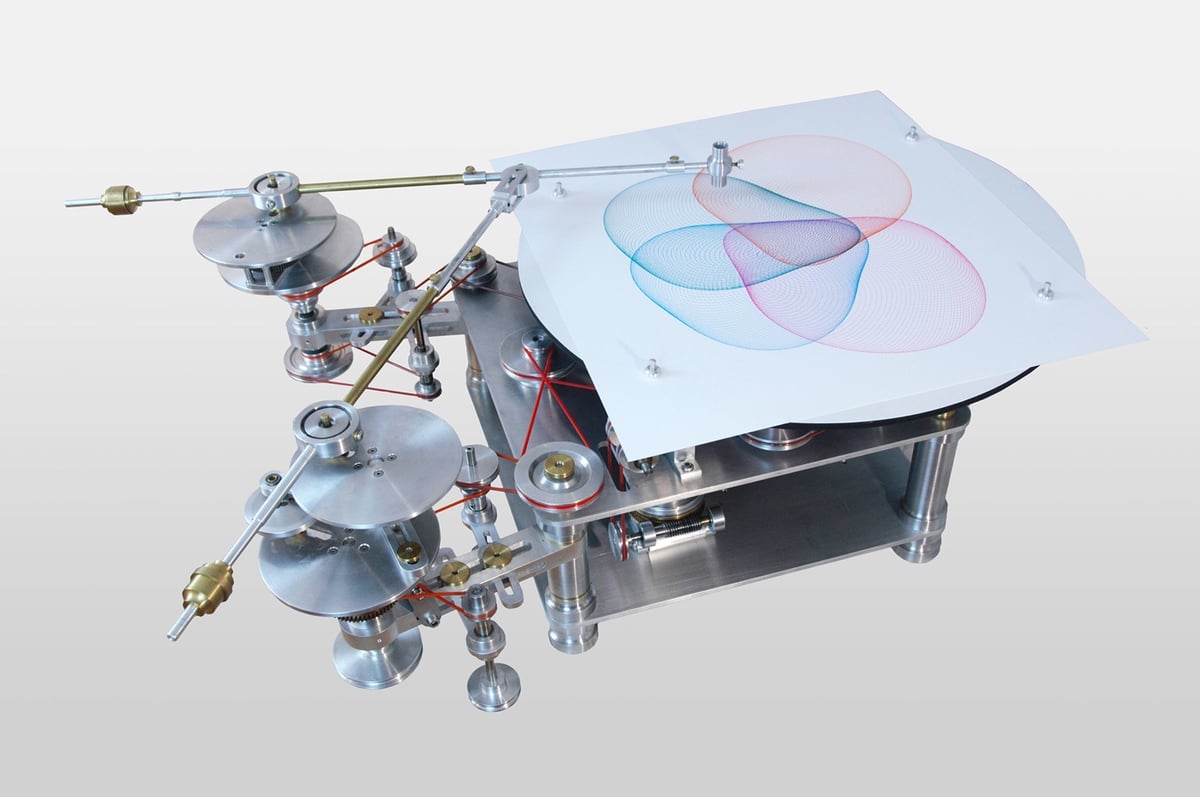
If you are old enough, you probably have fond memories of the kids’ drawing toy, Spirograph. Actually, they still exist but I’m pretty sure they are less of a thing than a few decades back.
James Nolan Gandy builds gorgeous articulated machines that produce beautiful—almost digital looking in their precision—drawings very reminiscent of what kids did with spirograph.
To create multi-color works Gandy must pause the machine to switch out each color, furthering the collaboration between the built artistic object and his own aesthetic desires.
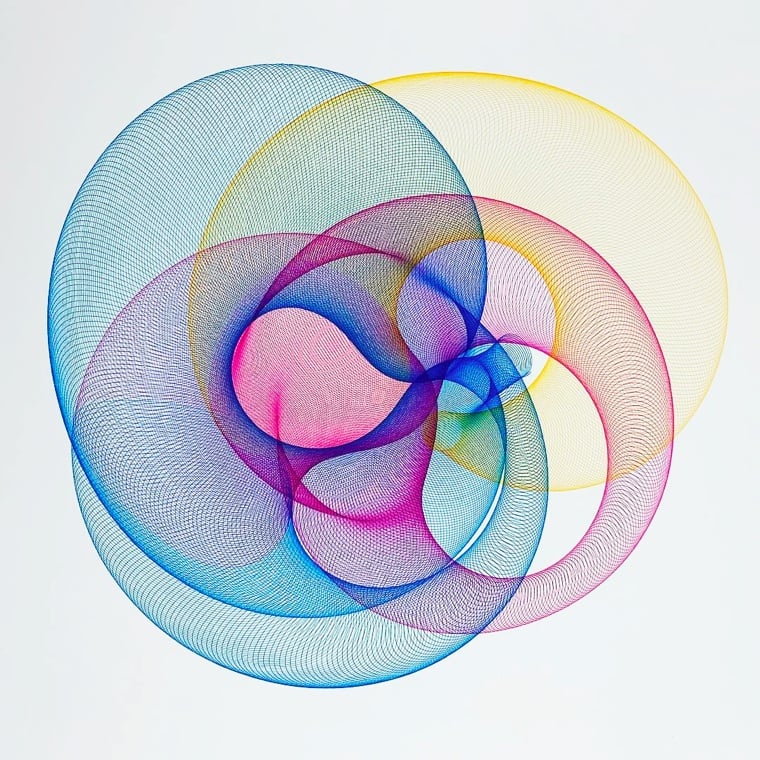

You can see more on James Nolan Gandy’s site.
An intriguing new habitat project “inspired” by NASA

The AI SpaceFactory team won half a million dollars from NASA for its Mars habitat prototype, MARSHA. They are now taking the research, learnings, and technologies they developed for their winning proposal and building an earth habitat (house) using the same concepts.
TERA interjects into the building industry’s massive waste of materials and creates a proof-of-concept for a new type of building - one that is durable and twice as strong as concrete, yet recyclable and compostable.

Considering how polluting the manufacturing of concrete is, their material certainly sounds interesting:
Biopolymer basalt composite -a material developed from crops like corn and sugar cane - tested and validated by NASA to be (at minimum) 50% stronger and more durable than concrete. This material has the potential to be leaps and bounds more sustainable than traditional concrete and steel, leading to a future in which we can eliminate the building industry’s massive waste of unrecyclable materials. It could transform the way we build on Earth - and save our planet.
In many countries, the production of ethanol with corn is creating problems with the provenance and availability of that grain to feed livestock and humans. I would love to know more about how the use here differs.
Since this is a prototype which they will make available for leasing by the night, they will also be using it as a lab to evolve the concept:
TERA is a living laboratory where feedback and operational data will be used to improve future designs for our future Earth and Space habitats. Each TERA will build on the last until we achieve highly autonomous structurally performing human-rated habitats.

The link at top is to the firm’s project page but they are also running an Indiegogo and that page has lots more details and pictures.
—
If you are intrigued by the impact of concrete and cement, and why we don’t yet have widely commercially available real alternatives, Rose Eveleth did a fantastic episode of her Flash Forward podcast on that topic: EARTH: The Cement Ban.
Socials & More